Gold Hallmarks and Stamps Decoded: What 375, 585, 750, 916, HGE and GF Really Mean
Every number and letter you will find on gold, from Victorian 15 .625 to Indian 22K916 and American 18K HGE, with real photographs of real marks and the eight checks that tell a hallmark from a stamp.
The number on gold is its purity in parts per thousand. The ones you will meet most:
- 375 = 9ct, 585 = 14ct, 750 = 18ct, 916 = 22ct, 999 = 24ct.
- Old British marks: 9 .375, 12 .5, 15 .625, 14 .585, and a crown with 18 or 22.
- Not solid gold: HGE, GEP, GP, GF, RGP and 1/20 after the number.
- A UK hallmark = sponsor's mark + fineness number + assay office mark.
- A number alone is the maker's claim, not a test.
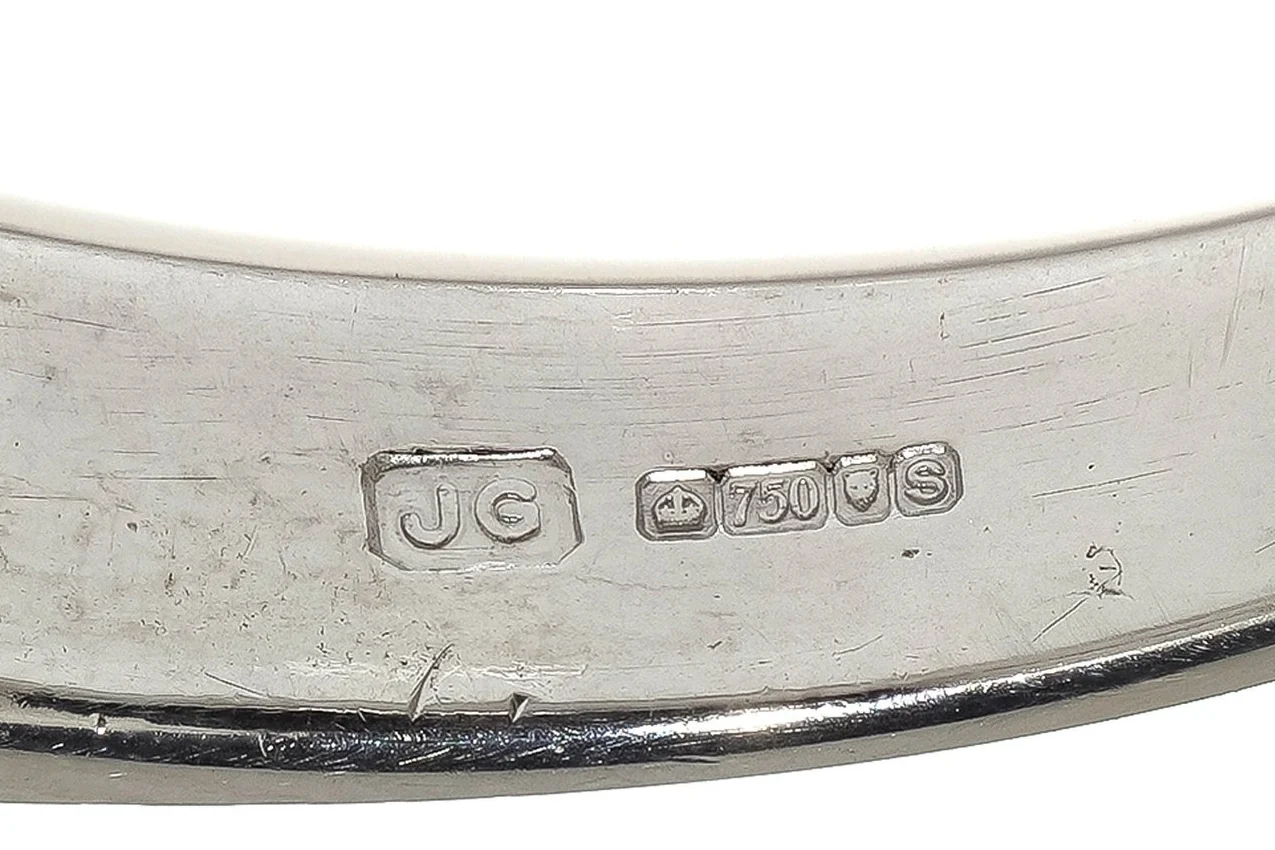
In this article
- What the number on your gold means
- The gold stamp decoder: every mark, what it means, and whether it is solid gold
- How to read a British gold hallmark, mark by mark
- Old British gold marks: before the numbers
- Foreign marks you will meet in Britain
- Plated, filled and rolled: the stamps that mean “not solid gold”
- A stamp is not a hallmark: 8 checks before you trust a number
- Found marks you cannot read? What to do next
- Questions
What the number on your gold means
Every number on gold is a share in parts per thousand. 375 means 375 parts of gold in every 1,000 parts of metal, which is 9 carat. 750 means 750 parts, which is 18 carat. The rest is silver, copper, zinc or palladium, which give the colour and the strength.
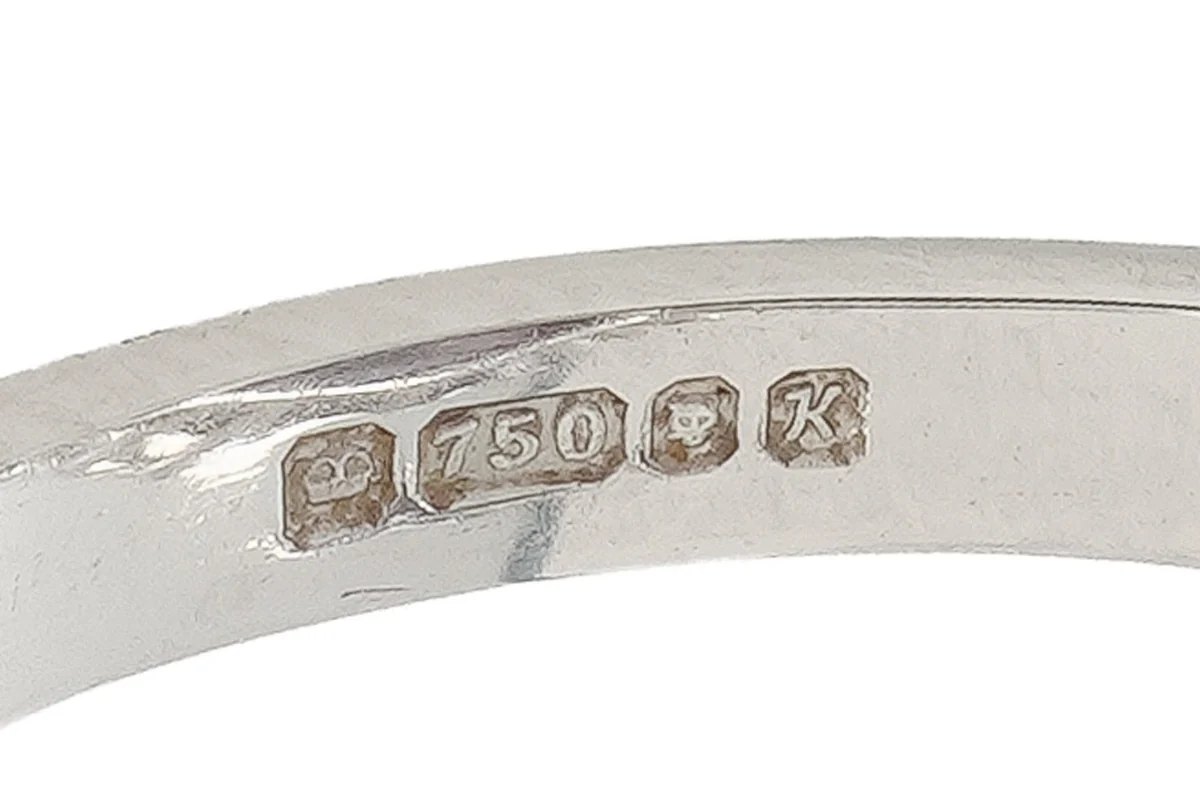
White and rose gold carry the same numbers
White gold is still gold: an 18ct white gold ring is stamped 750, exactly like a yellow one. Our guide to white, yellow and rose gold explains the alloys, and is my ring platinum or white gold? separates the two.
The shape of the shield around the number tells you the metal, so a 950 in a platinum shield is not the same as 950 on gold.
| Carat | Number stamped | Gold content | UK hallmark today? |
|---|---|---|---|
| 9ct | 375 | 37.5% | Yes, the lowest UK gold standard |
| 12ct | 500 (old mark “12 .5”) | 50% | No, cancelled in 1932 |
| 14ct | 585 (also 583) | 58.5% | Yes, since 1932 |
| 15ct | 625 (old mark “15 .625”) | 62.5% | No, cancelled in 1932 |
| 18ct | 750 | 75% | Yes, since 1798 |
| 22ct | 916 (916.6) | 91.6% | Yes |
| 23.8ct | 990 | 99% | Yes |
| 24ct | 999 | 99.9% | Yes |
The gold stamp decoder: every mark, what it means, and whether it is solid gold
Find the mark on your piece in the first column. “Check the rest” means that mark alone does not settle it: read it together with the other marks beside it.
| Mark | What it means | Solid gold? | Where you see it | Source |
|---|---|---|---|---|
| 375 / 9ct / 9K | 9 carat: 375 parts gold in 1,000 | Solid gold | Britain and Ireland above all; the lowest UK gold standard | Gov.uk |
| 9 .375 | The pre-1975 British way of marking 9ct, used from 1854 | Solid gold | Victorian to 1970s British gold | Assay Office London; Hallmarking Act |
| 12 .5 or 500 | 12 carat, a British standard from 1854 to 1932 | Solid gold | Victorian and Edwardian jewellery | Assay Office London; Parkin & Gerrish |
| 15 .625 or 625 | 15 carat, a British standard from 1854 to 1932 | Solid gold | Victorian and Edwardian jewellery | Assay Office London; Parkin & Gerrish |
| 417 / 10K | 10 carat. Not a UK hallmarking standard | Check the rest | Imported pieces; the UK can only call 10K bonded gold “9 carat” | Gov.uk |
| 585 / 583 / 14ct / 14K | 14 carat. 583 and 585 mean the same | Solid gold | Worldwide; a UK standard since 1932 | Jewelers Mutual; Birmingham Assay Office |
| 14 .585 | The pre-1975 British way of marking 14ct | Solid gold | British gold, 1932 to 1975 | Hallmarking Act |
| 750 / 18ct / 18K | 18 carat: three quarters gold | Solid gold | Worldwide; the standard for fine jewellery and watches | Gov.uk |
| Crown and 18 | The British 18ct mark from 1798 until the numbers arrived in 1975 | Solid gold | Georgian to 1970s | Assay Office London; Parkin & Gerrish |
| Crown and 22 | The British 22ct mark from 1844 | Solid gold | Wedding rings, Victorian bracelets | Assay Office London |
| 916 / 22ct / 22K / 22K916 | 22 carat, about 91.6% gold | Solid gold | British wedding rings; Indian and Gulf jewellery | Gov.uk; BIS |
| 990 | 99% gold, a UK and Convention standard | Solid gold | Modern high-carat pieces | Gov.uk |
| 999 / 24ct / 24K | Fine gold | Solid gold | Bars, coins and some Asian jewellery | Gov.uk |
| Au750 / Au 585 | Au is the chemical symbol for gold; the number is the fineness | Check the rest | Often beside a Convention mark, which needs a metal symbol | Gov.uk |
| Scales in two circles, with a number | The Common Control Mark of the Hallmarking Convention | Check the rest | Pieces sold between member countries; the UK signed in 1972 | Gov.uk; Wikipedia |
| Leopard's head / anchor / rose / castle | Assay office: London, Birmingham, Sheffield, Edinburgh | Check the rest | Every UK hallmark | Gov.uk |
| Two or more letters in a shape | The sponsor's mark: the maker or the firm that sent it for testing | Check the rest | Every UK hallmark; a maker's mark alone is not a hallmark | Gov.uk |
| A single letter in a shield | The date letter, compulsory until 1999 and optional since | Check the rest | UK hallmarks; it changes every 1 January | Gov.uk |
| Star, number and two letters | Italian maker's mark: the number is the maker, the letters the province (AR Arezzo, VI Vicenza) | Check the rest | Italian chains and jewellery | ASCAS |
| BIS triangle, 22K916, six-character code | Indian hallmark: BIS logo, purity grade and a unique HUID | Solid gold | Indian jewellery; HUID since July 2021 | BIS; GJEPC |
| GF / Gold Filled / 1/20 12K GF | A gold layer bonded to base metal, at least 1/20 of the total metal weight | Not solid gold | American jewellery, watch cases and pens | 16 CFR 23.3 |
| RGP / Rolled Gold Plate / 1/40 12K RGP | The same construction with a thinner layer; the fraction gives its share | Not solid gold | Watch cases, chains, cufflinks | 16 CFR 23.3 |
| GEP / Gold Electroplate | An electroplated layer of at least 0.175 microns | Not solid gold | Costume jewellery, watches | 16 CFR 23.3 |
| HGE / Heavy Gold Electroplate | An electroplated layer of at least 2.5 microns. 18K HGE is not 18ct gold | Not solid gold | Costume rings, often set with paste or opals | 16 CFR 23.3 |
| GP / 18K GP | Gold plated; the karat describes the plating only | Not solid gold | Costume jewellery | 16 CFR 23.3 |
| 925 on a gold-coloured piece | Sterling silver with a gold layer: vermeil or silver gilt | Not solid gold | Modern and antique silver gilt | Gov.uk; 16 CFR 23.4 |
| PT950 / 950 in a shaped shield | Platinum, not gold | Not solid gold | Engagement rings, Art Deco jewellery | Gov.uk |
| 18, 18ct or 750 on its own | A maker's claim, not a hallmark | Check the rest | Antique rings and imports; see the checks below | Gov.uk |
How to read a British gold hallmark, mark by mark
A UK hallmark is not a stamp the maker chooses. It is struck by an independent assay office after the metal has been tested. Three marks are compulsory and two more are optional.
The sponsor's mark
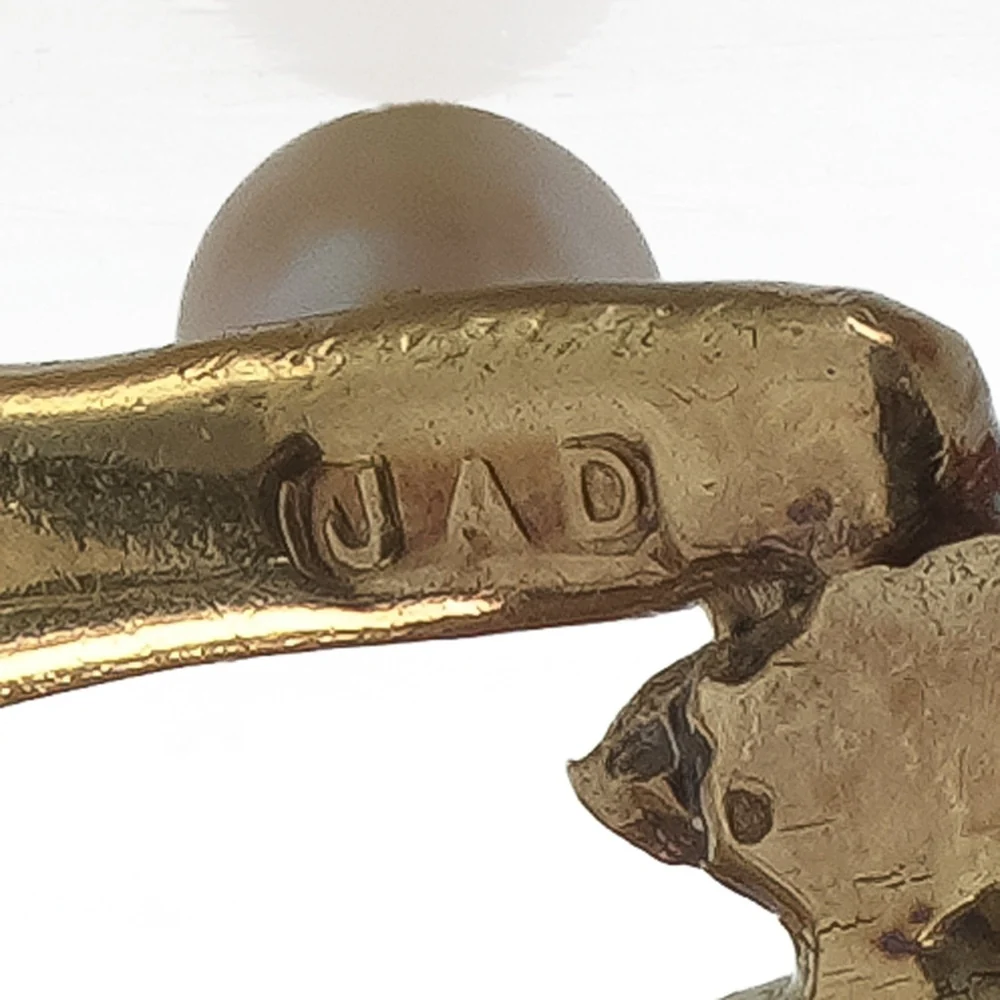
At least two letters inside a shaped surround, registered to the maker or the firm that sent the piece for testing. No two are the same at one assay office. Our guide to hallmarks and makers' marks shows how to trace one.
The fineness mark
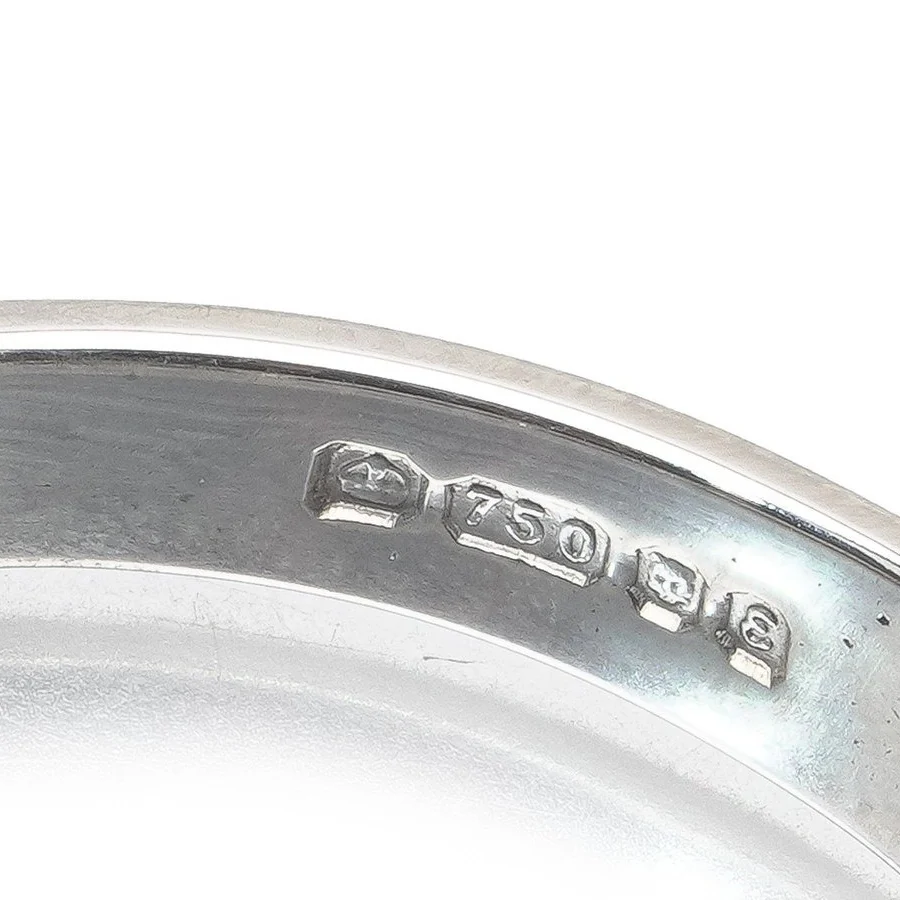
The number in parts per thousand, inside a shield whose shape shows the metal. It guarantees the metal is not less than the figure shown.
The assay office mark
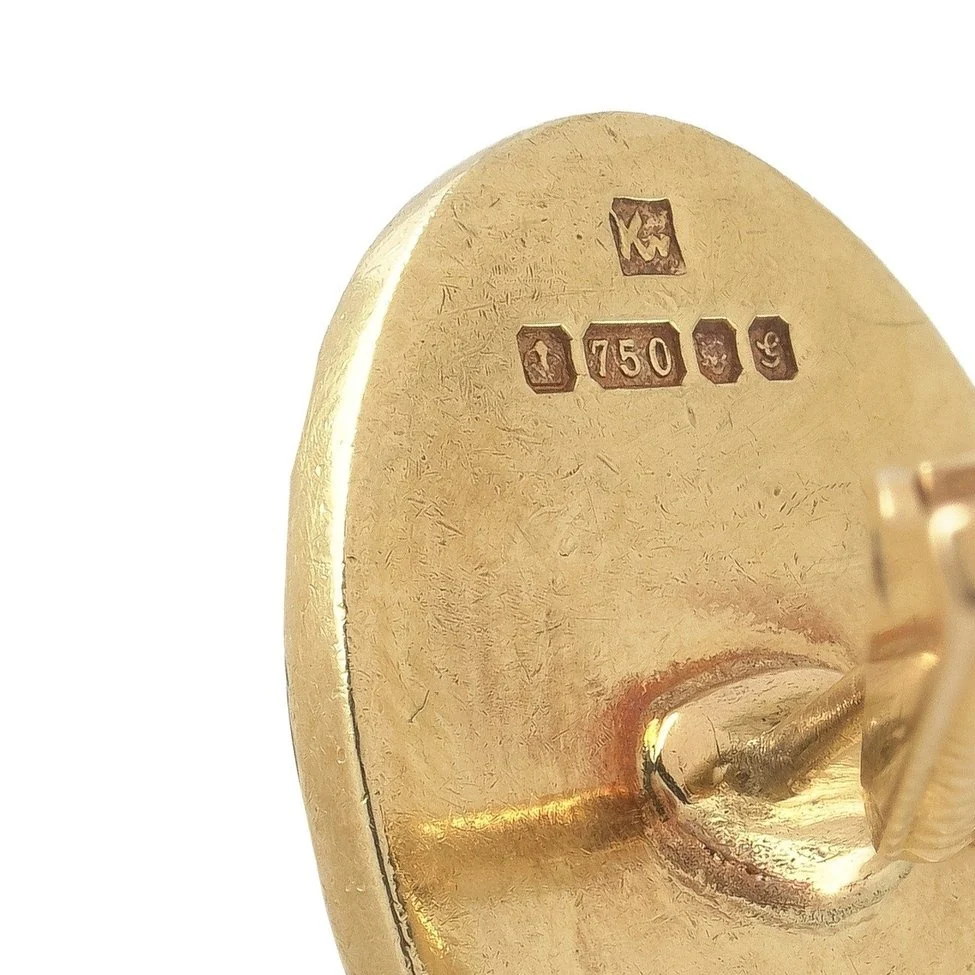
The leopard's head of London, the anchor of Birmingham, the rose of Sheffield or the castle of Edinburgh. Older pieces may carry the marks of closed offices such as Chester: see our assay offices guide.
The optional marks: crown and date letter
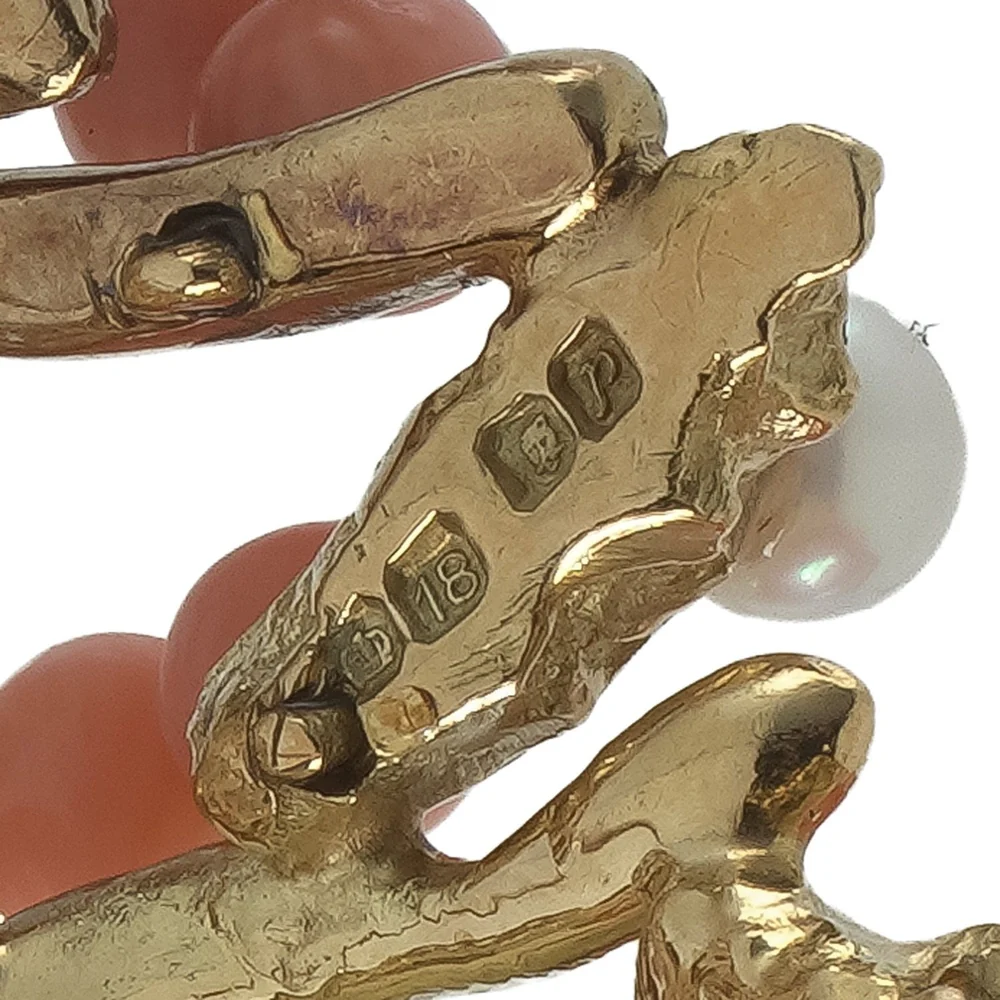
The crown is the traditional symbol for gold. The date letter changes on 1 January each year; it was compulsory until 1999 and is now optional. Date-letter tables are in our pocket watch hallmarks guide and silver hallmarks guide.
Old British gold marks: before the numbers
Antique and vintage British gold is marked differently from today's, and the old marks help to date it.
- 1798: 18 carat returns, marked with a crown and the figure 18.
- 1844: 22 carat is recognised, with a crown and 22.
- 1854: 15, 12 and 9 carat arrive, marked with their actual fineness: 15 .625, 12 .5 and 9 .375.
- 1932: 15 and 12 carat are cancelled and 14 carat (14 .585) replaces them.
- 1975: the Hallmarking Act 1973 takes effect and the millesimal numbers (375, 585, 750, 916) become standard.
- 1999: the date letter becomes optional.
Before 1975, rings (other than wedding rings), lockets, watch chains, filigree work and jewellers' settings were exempt from hallmarking. That is why so many Victorian and Edwardian gold rings carry only “18ct” or no mark at all. If they are of minimum fineness and proved to be pre-1975, they may still be sold as gold. More broadly, any piece proved to be made before 1950 may be sold as gold without a hallmark.
A 15ct or 12ct mark therefore points to a piece made before 1932, and a crown with 18 to one made before 1975. For watch cases, read how to date a vintage gold watch. We buy and sell antique gold jewellery every week.
Foreign marks you will meet in Britain
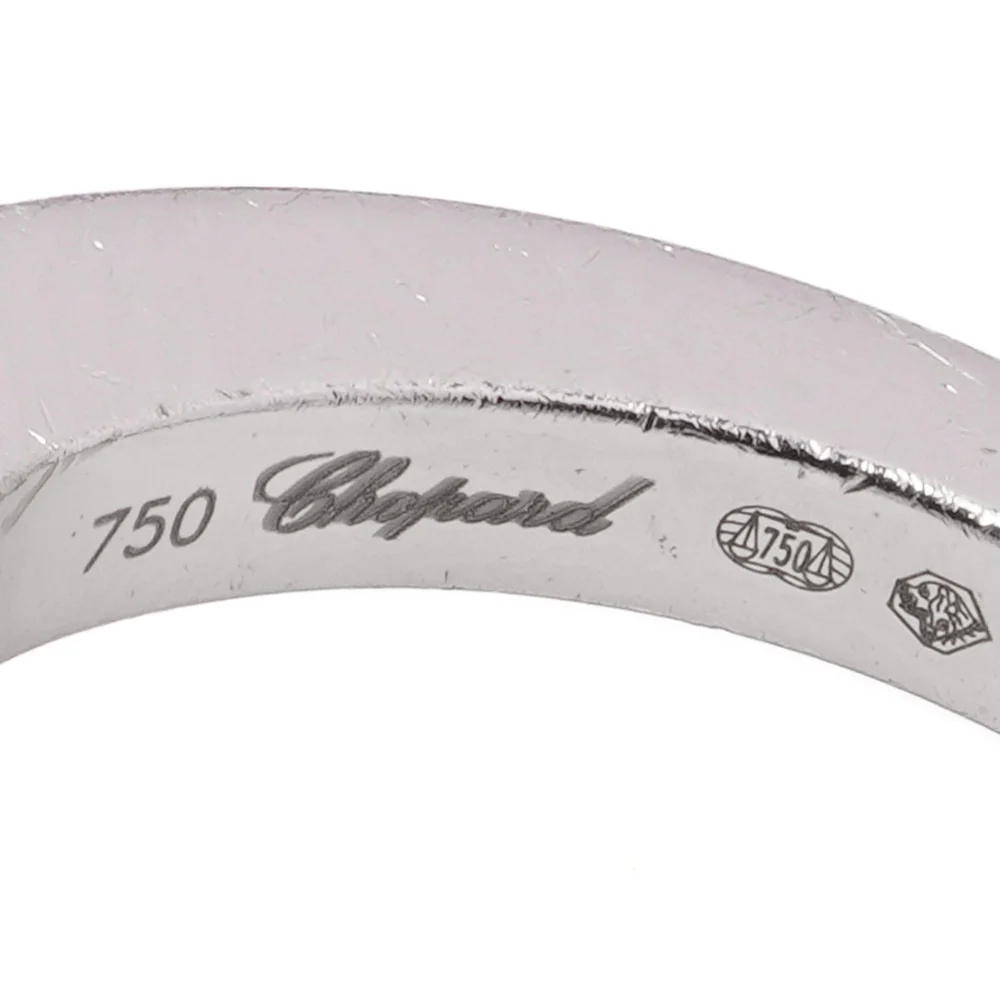
The Convention mark
The Common Control Mark shows a pair of balance scales; for gold they sit on two intersecting circles. It is struck by assay offices of the member countries and is legally recognised in the UK, so such a piece need not be hallmarked again here.
A full Convention hallmark has four marks: sponsor's mark, Common Control Mark, fineness number and assay office mark.
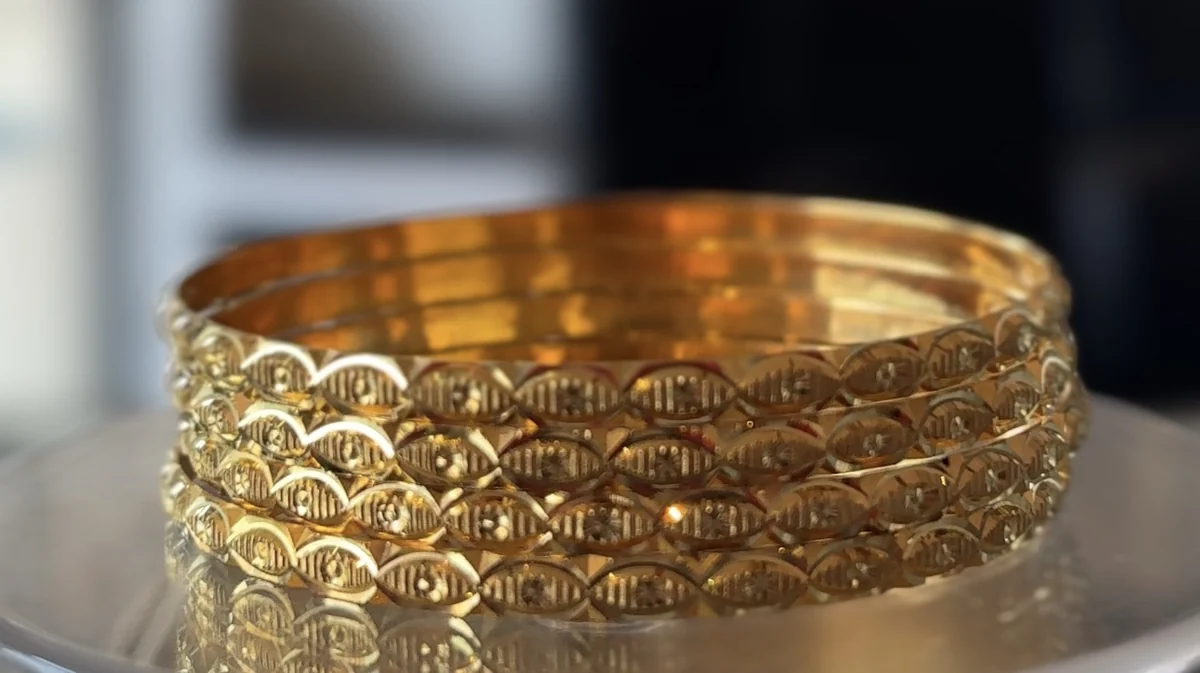

Indian 22 carat: 916 and the HUID
Indian hallmarks now have three marks: the BIS triangle logo, the purity grade such as 22K916 or 18K750, and a six-character code called the HUID, unique to that piece. Only HUID-marked jewellery may be sold in India from 1 April 2023; older hallmarked pieces stay valid.
Diwali falls on 8 November 2026, with Dhanteras on 6 November. Selling family gold? See selling 22ct Asian gold in the UK.
Italian gold often carries 750 or 585 with a star, a number and two letters. The number identifies the maker and the letters the province: AR for Arezzo, VI for Vicenza.
Plated, filled and rolled: the stamps that mean “not solid gold”
.jpg)
The karat is only the skin
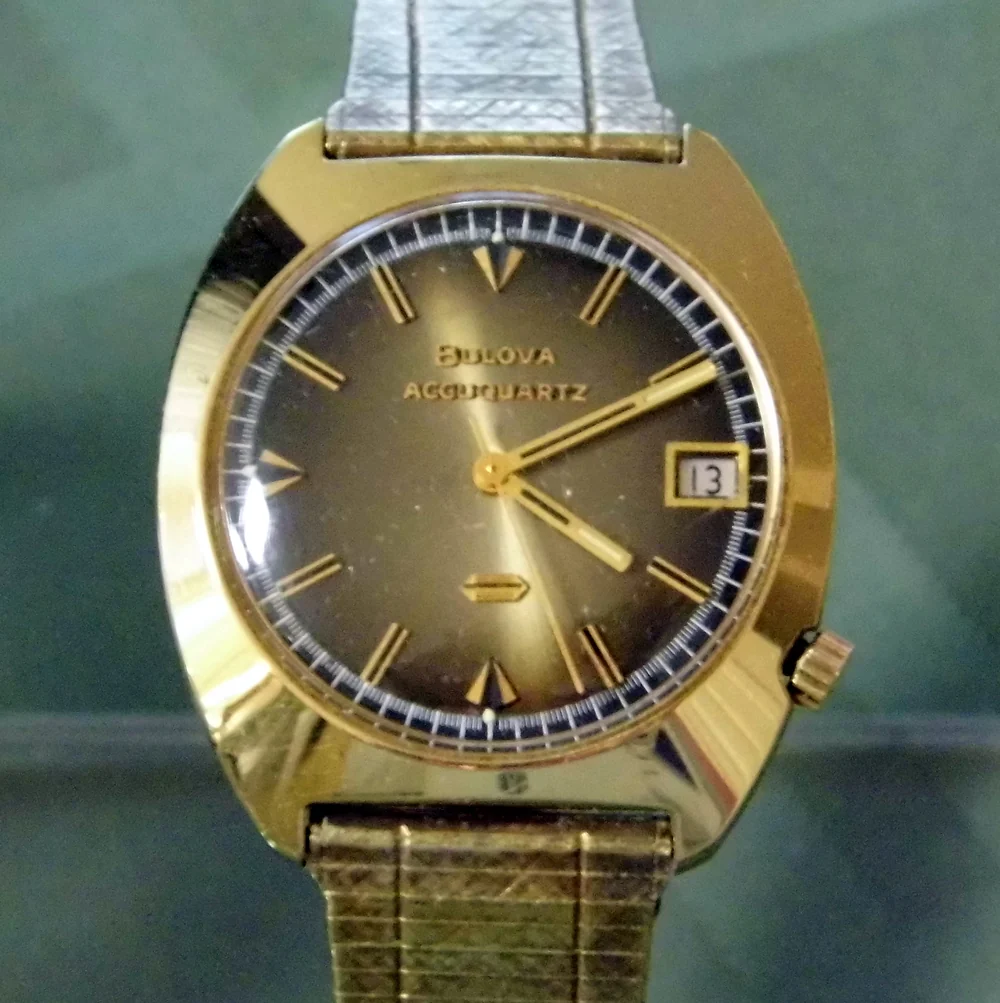
On plated and filled gold the karat describes the outer layer, not the piece. 18K HGE means a layer of 18 carat gold at least 2.5 microns thick over a base metal. 1/20 12K GF means a 12 carat layer making up at least one twentieth of the metal's weight.
- GF, Gold Filled: layer at least 1/20 of the metal weight.
- RGP, Rolled Gold Plate: the same idea, with a thinner layer stated as a fraction such as 1/40.
- GEP, Gold Electroplate: at least 0.175 microns. HGE: at least 2.5 microns.
- GP: gold plated, with the karat of the plating in front.
- Vermeil or silver gilt: silver under the gold, hallmarked as silver, often 925.
These rules come from the US Federal Trade Commission, which is why the terms appear on American jewellery and watch cases. In the UK, “rolled gold” and “gold plated” may describe plated base metal, and gold-plated silver must be sold as silver. Wondering about a whole box of it? Read is my costume jewellery real? and our silver gilt and vermeil guide.
A stamp is not a hallmark: 8 checks before you trust a number
Anyone can buy a punch
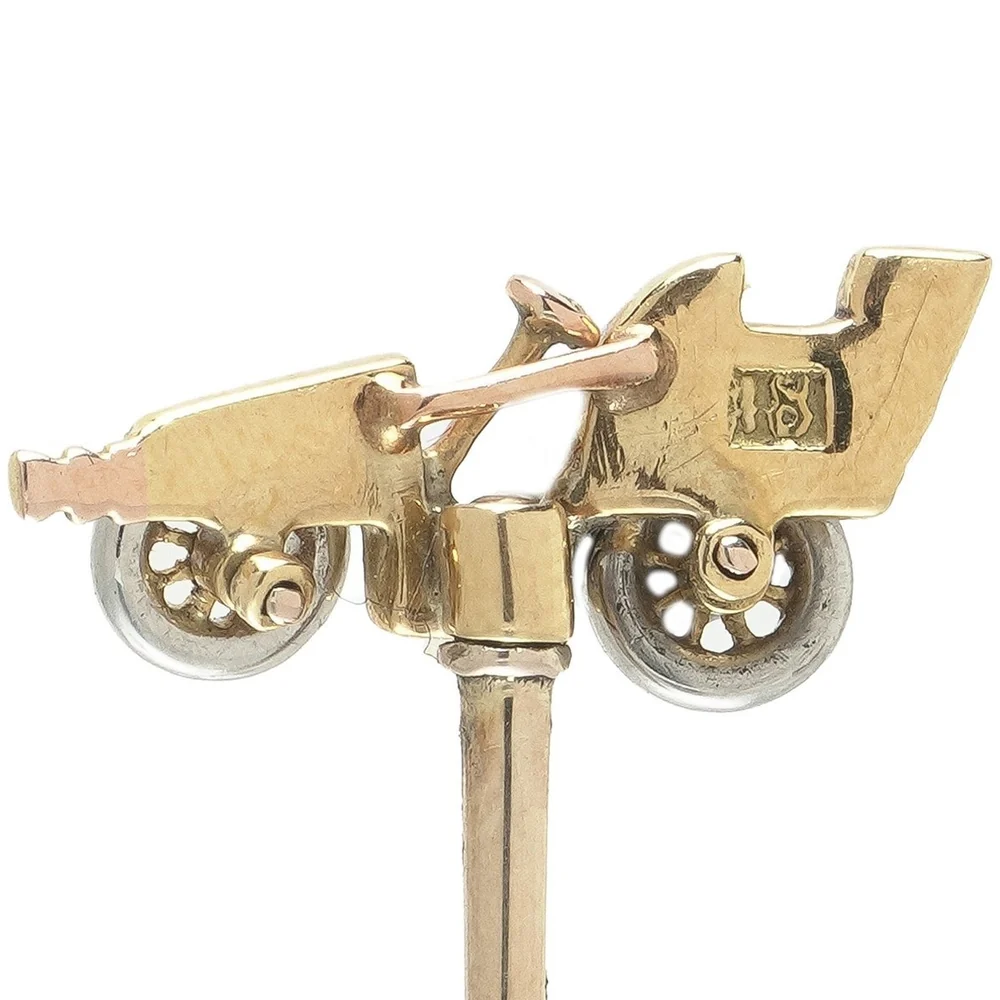
A number on its own is the maker's claim. In UK law a fineness stamp counts as a description, so an unhallmarked piece over 1 gram may not be sold as gold in the course of business unless an exemption applies. A stamp alone is never proof.
- Look for the assay office mark
A leopard's head, anchor, rose or castle, or a Convention mark, means the metal was tested by an independent office.
- Find the sponsor's mark
A UK hallmark always has one. A number with no maker's mark beside it proves nothing.
- Check the shield shape
The surround shows the metal. Gold, silver, platinum and palladium each have their own shape.
- Read every letter
HGE, GF, RGP, GP or EP after the number turn “18K” into plating.
- Match the date to the marks
A crown and 18 should be on a piece made before 1975; 750 on a piece described as Victorian needs a second look.
- Look at the wear
Plating wears through at the edges and the back of a shank, showing a different colour underneath.
- Check the colour against the number
A deep yellow piece stamped 9ct, or a pale one stamped 22ct, does not add up.
- Do not test it yourself
Acid and scratch tests mark the piece. Send photos first.
Our guides to fake gold jewellery, how to tell if gold is real and solid gold watch cases go further.
Send us a photo of the marks: free identification and valuation
Found marks you cannot read? What to do next
Most of the gold that reaches us arrives in a jewellery box nobody has opened for years. The marks are often worn, tiny and inside a ring shank.
- Photograph the marks
Use your phone's zoom, hold a torch low beside the piece so the marks throw shadows, and take several shots.
- Photograph the whole piece
Front, back and side, plus any clasp, box or receipt.
- Do not polish or test
Polishing softens the marks, and acid leaves stains.
- Keep things together
Boxes, papers and family stories help to identify a piece.
- Send them to us
Use the form below, call 01376 334482 or WhatsApp us. Visit 47 Maddox Street, Mayfair (by appointment) or Braintree, Essex. Contact us.
Every piece is different. Send us a few photos and we will tell you what yours is and what it is worth, free and with no obligation. If you decide to sell, we buy directly: see sell your gold, sell your gold jewellery, broken and scrap gold and selling inherited gold. Inherited a whole box? Start with inherited jewellery: what to do. Buying? Browse our yellow gold and white gold jewellery.
Request a free valuation
- 375, 585, 750, 916 and 999 are 9, 14, 18, 22 and 24 carat gold.
- A UK hallmark has a sponsor's mark, a fineness number and an assay office mark.
- 15 .625 and 12 .5 mean pre-1932 gold; a crown with 18 means pre-1975.
- HGE, GF, RGP, GEP and GP mean plated or filled, not solid gold.
- We identify and value gold free from photos of the marks.
Questions we are asked
What does 375 mean on gold?
375 is 9 carat gold: 375 parts of pure gold in every 1,000. It is the lowest gold standard hallmarked in the UK.
What does 585 mean on gold?
585 is 14 carat gold, 58.5% pure. 583 means the same. Britain adopted 14 carat in 1932.
What does 750 mean on jewellery?
750 is 18 carat gold, three quarters pure. On its own it is the maker's claim; with a sponsor's mark and an assay office mark it is a tested hallmark.
What does 916 mean on gold?
916 is 22 carat gold, about 91.6% pure. You will see it on British wedding rings and on Indian jewellery as 22K916.
Is 18K HGE real gold?
No. HGE means heavy gold electroplate: a layer of 18 carat gold at least 2.5 microns thick over another metal.
What does 1/20 12K GF mean?
Gold filled: a 12 carat gold layer that makes up at least one twentieth of the metal's weight, bonded to base metal. It is not solid gold.
Why does my old gold ring have no hallmark?
Before 1975 most rings other than wedding rings were exempt from hallmarking in the UK. Many antique rings carry only 18ct or nothing; testing confirms the metal.
Can a gold stamp be fake?
Yes. A number is the maker's claim and punches are easy to buy. A full UK or Convention hallmark is struck only after independent testing.
Can you tell me what my gold is worth?
Yes. Send photos of the piece and its marks for a free, no-obligation valuation, or visit us in Mayfair or Braintree.
Identify, value or sell your gold
Send photos of the piece and its marks for a free valuation, or bring it to Mayfair or Braintree. Call 01376 334482.
- We buy directly
- Free valuation from photos
- Appointments in Mayfair and Braintree
- Insured postage or collection
New pieces reach our list first: join the Mozeris list.