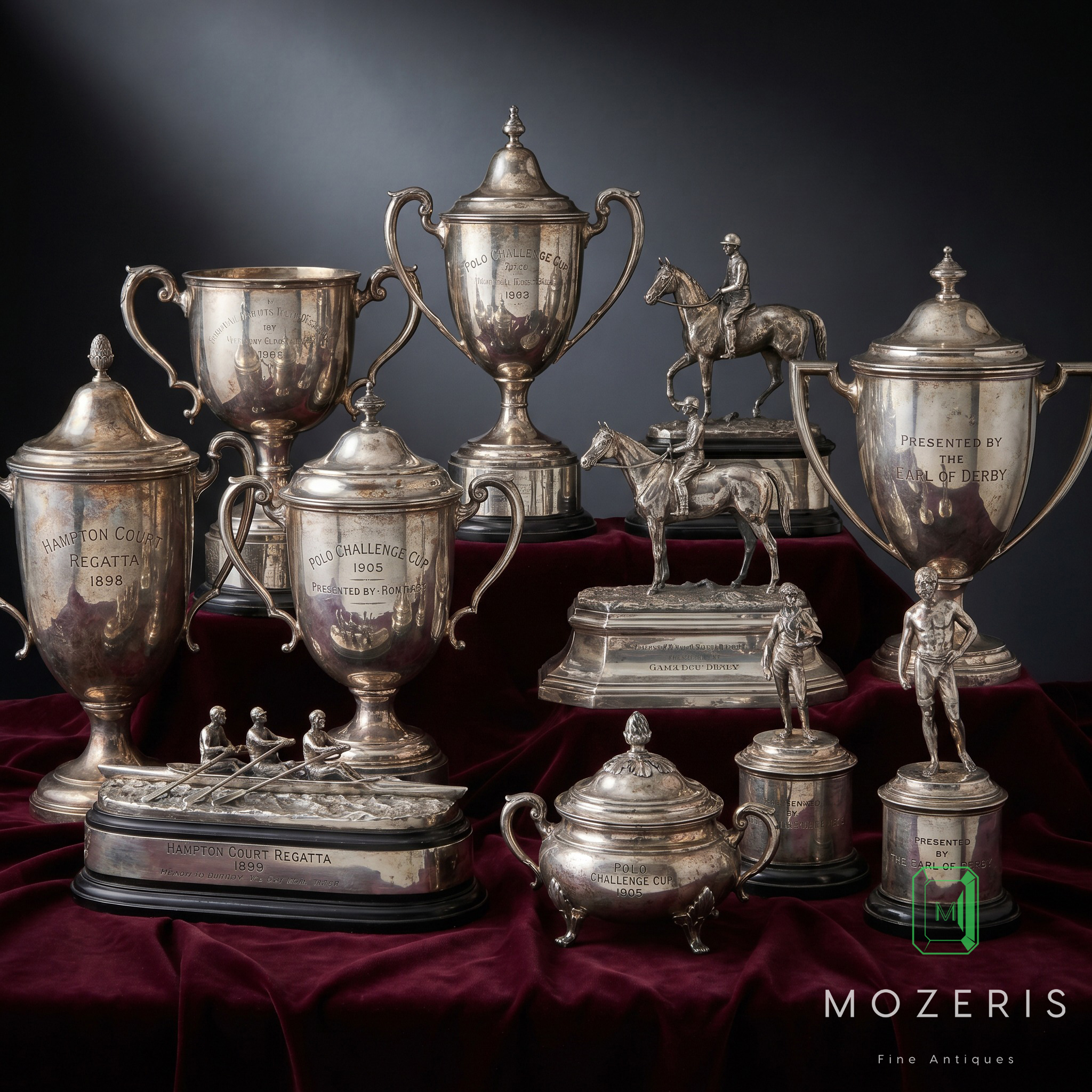
Sell Your Silver Trophy
or Presentation Cup
Victorian and Edwardian silver trophies, presentation cups and sporting urns bought at genuine collector prices. We look at the maker, the period and the inscription — not just the scrap value of the silver.
Request Your Free Valuation
Send us photos of your trophy or presentation cup — including the hallmarks and the full inscription — and we'll give you an honest, no-obligation assessment.
⚠️ Strictly by appointment only — no walk-ins at either showroom.
Why Silver Trophies Are Worth More Than Their Weight
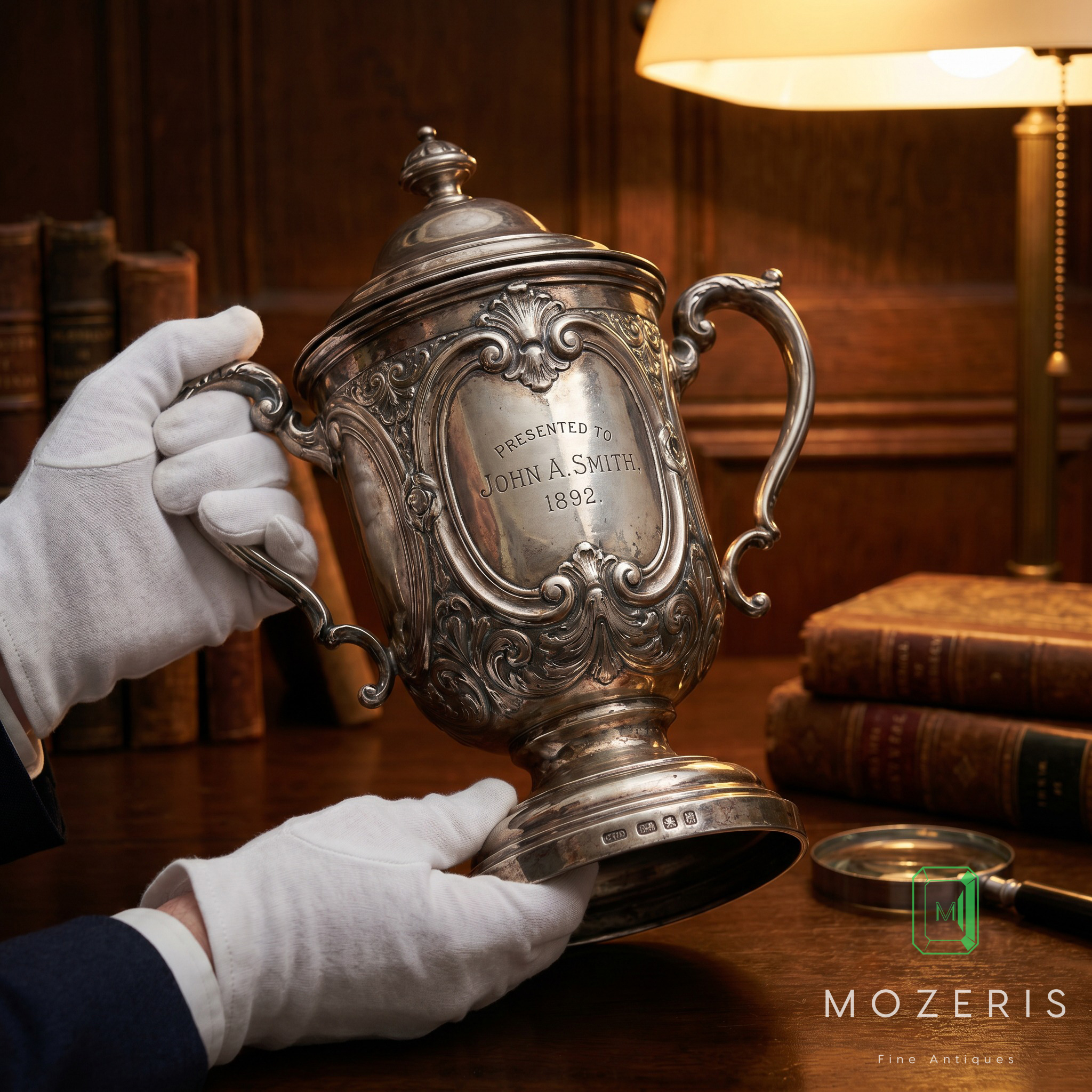
Most antique silver trophies are offered to scrap dealers and melt for what is, in practical terms, a fraction of their real worth. A Victorian two-handled silver cup by a major London or Birmingham maker — engraved with a sporting club's prize inscription, hallmarked and complete with its original base — is not scrap. It is a collectible object with a market value that can be many times the metal price.
The trophy market is more active than many sellers realise. Racing trophies, military prize cups, golf club challenge cups, cricket presentation pieces — all attract dedicated collectors. Even smaller, less obviously grand pieces can have strong value if the maker is right and the hallmarks are clear.
We assess every trophy on its individual merits: period, weight, maker, quality of chasing or engraving, and the story the inscription tells. If your piece has genuine collector appeal, our offer will reflect that.
Types of Silver Trophy We Buy
From small prize cups to monumental presentation urns — we buy silver trophies and awards from all periods and all sporting and social contexts.
Victorian Presentation Cups
Two-handled cups on spreading circular bases, typically heavily chased with foliate and floral decoration, with engraved presentation inscriptions. Made in vast numbers by the great Birmingham and London makers — Elkington, Martin & Hall, Hunt & Roskell — these are the most common and most actively collected Victorian trophies.
Sporting Prize Cups
Racing, cricket, golf, shooting, sailing, athletics and rowing clubs all commissioned silver prize cups from the mid-Victorian era onwards. Club challenge cups — particularly early examples — carry strong institutional and social history interest. Golf trophies from the 1880s–1920s are especially sought after.
Military & Regimental Trophies
Mess silver — presentation cups, challenge cups and inkstands awarded for skill at arms, riding or sport within the officer corps — represents a distinct and dedicated collecting field. Pieces with clear regimental inscriptions and Royal Warrant maker's marks command significant premiums.
Edwardian & George V Cups
Later presentation cups from the Edwardian period and 1910s–1930s are often larger, heavier and with more elaborate chasing than their Victorian predecessors. Art Nouveau-influenced examples are particularly desirable. The rise of mechanisation meant higher weights for lower prices — which means excellent metal content alongside collector appeal.
Urns & Vase Trophies
Larger presentation urns — two-handled vase forms on square or circular bases, sometimes with covers — were reserved for the most prestigious presentations. Race meeting winners' trophies, civic presentation pieces and national competition prizes were frequently made in urn form by the leading London silversmiths of the day.
Named Maker Pieces
A silver trophy bearing the marks of Paul Storr, Elkington & Co., Robert Garrard or Mappin & Webb carries a maker premium over an equivalent anonymous piece. We actively seek trophies by leading Victorian silversmiths and Sheffield plate trophy makers, and our valuations reflect the additional collector interest a recognised mark commands.
How to Sell Your Silver Trophy
A clear, straightforward process from first contact to payment — with no obligation at any stage.
Photograph the Trophy
Take photographs of the full trophy from multiple angles — front, back and side. Include a close-up of the hallmarks on the base or body, and a legible photograph of the full engraved inscription. Include a ruler or coin for scale.
Send Your Photos
Submit photos via our enquiry form above or by email to info@mozerisfineantiques.com. There is no charge for this and no obligation to proceed. We aim to respond to all enquiries within one working day.
Receive Our Assessment
We'll provide an honest valuation based on the current collector market for comparable pieces. We research recent auction results and private sales — not just silver spot price — to ensure our offer reflects genuine market value.
Agree & Receive Payment
If you accept our offer, we arrange collection or receive the piece at one of our showrooms by appointment. Payment is made immediately on agreement — no waiting, no staged payments. You are under no obligation at any point in this process.
What Determines the Value of a Silver Trophy
Six factors that our specialists assess before making any offer on a Victorian or Edwardian silver trophy.
The Maker's Mark
A trophy bearing the punch of a major Victorian silversmith — Elkington, Hunt & Roskell, Robert Garrard, Mappin & Webb — will always attract more collector interest than an equivalent anonymous piece. We identify makers even from partial or worn marks.
Period & Date Letter
Earlier pieces are generally more valuable. A Victoria-era trophy from the 1840s–1870s commands a premium over a comparable 1920s piece. The assay office date letter tells us exactly which year the piece was hallmarked — we read all standard British assay marks.
Weight of Silver
The troy weight of the piece establishes the floor value — no collector piece sells for below melt. Heavy, substantial trophies with good silver content have strong value even if maker and period are unremarkable. We always weigh on our precision scales before making an offer.
The Inscription
Contrary to popular belief, a good engraved inscription adds value rather than removing it. A trophy presented to a named winner at a known racing fixture, or by a distinguished regiment to a celebrated officer, has historical significance that collectors will pay for. We research inscriptions fully before valuing.
Chasing & Decoration Quality
A trophy with finely executed repoussé chasing — hunting scenes, foliate scrolls, classical figures — is more desirable than a plain equivalent of the same weight. Hand-chased decoration by a skilled Victorian craftsman adds measurable collector value above the metal content.
Original Fittings & Case
A silver trophy accompanied by its original fitted wooden or velvet case, or retaining its original finial, handles and base fittings in good order, is worth considerably more than the same piece incomplete. We assess condition carefully and adjust our offer to reflect what is present.
The Inscription: Why It Adds Rather Than Reduces Value
Many sellers assume that engraving reduces the value of a silver trophy — that a buyer will want to re-engrave or remove the inscription before selling on. This is a misconception that costs sellers money.
A well-documented inscription ties the piece to a moment in history. A silver cup awarded at the Goodwood Races in 1887, or presented to the champion of a Victorian rifle shooting competition, or given by a Guards regiment to a celebrated officer on his retirement — these are objects with a story, and collectors pay for that story.
We research every inscription we encounter. If yours has a story worth telling, we will find it — and our offer will reflect it.
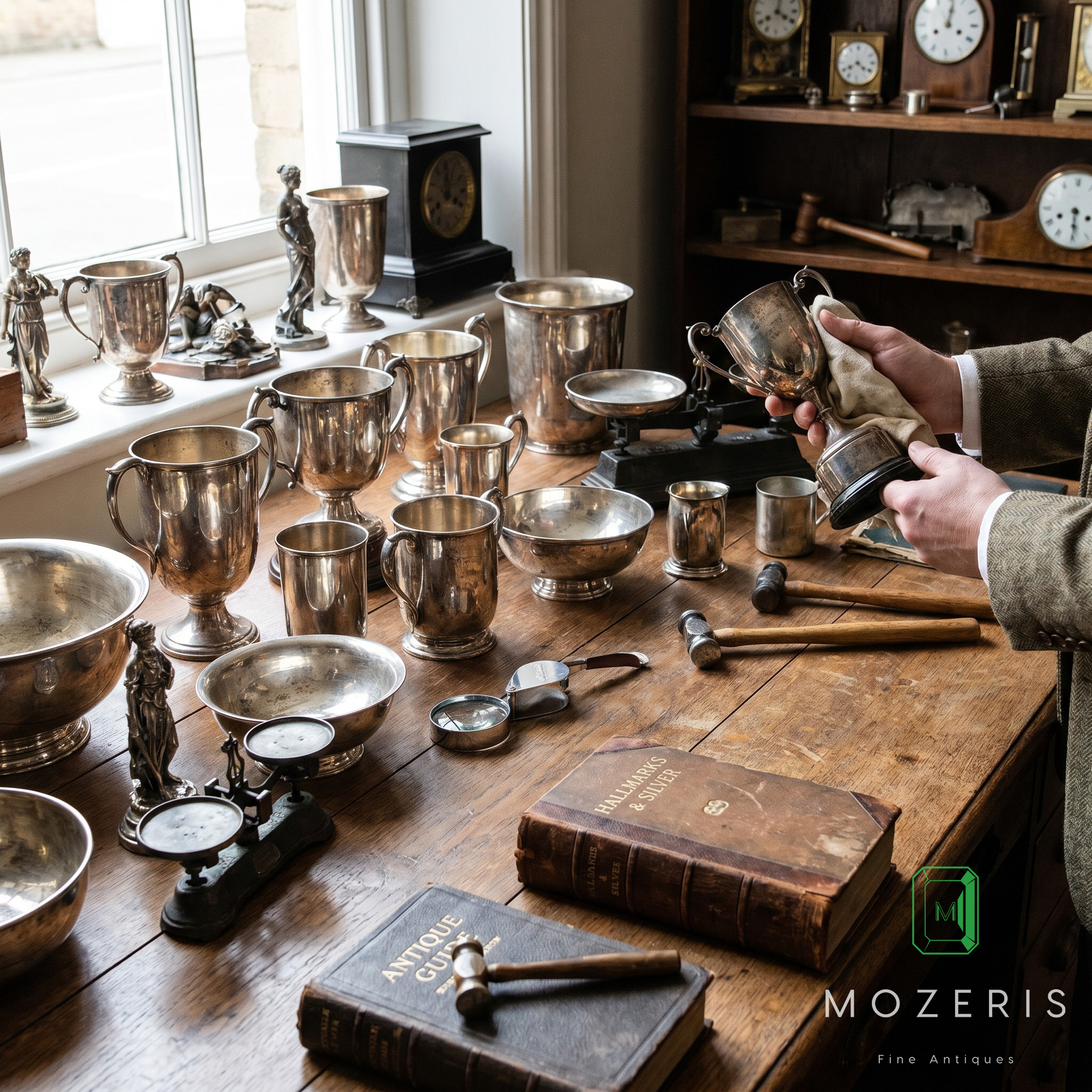
Silver Trophy Valuation: What We Look for at First Inspection

The hallmarks found on a Victorian silver cup: maker's punch (left), sterling lion (centre), assay office mark and date letter (right)
Reading the Marks on a Silver Trophy
British silver trophies made after 1544 carry a standard set of assay office marks. The key marks to identify are: the maker's punch (the silversmith's initials in a cartouche), the sterling standard mark (a lion passant), the assay office mark (indicating Birmingham, London, Sheffield or another city), and the date letter (a letter in a shaped shield that tells us the year of hallmarking).
On trophies from the major Victorian silversmithing centres — particularly Birmingham and Sheffield — you may also find a duty mark (a monarch's head, used 1784–1890). This confirms the piece predates 1890, which is useful for dating a piece where the date letter is worn or unclear.
If you are unsure what the marks on your trophy say, email us photographs — we read Victorian hallmarks every day and can identify them quickly, including worn or partial marks. There is no charge for this service.
Frequently Asked Questions
Common questions from people looking to sell a silver trophy or presentation cup.
Does the engraved inscription reduce the value of my silver trophy?
In most cases, no — and for the best pieces, an inscription adds value. A trophy with a documented sporting, military or civic history is more interesting to collectors than an equivalent blank piece. The exceptions are trophies with very modern (post-1960s) inscriptions or corporate awards with no historical significance, where the collector market is much thinner.
Is my silver trophy solid silver or silver-plated?
If it has British hallmarks — a lion passant, a date letter and an assay office mark — it is sterling silver (92.5% pure silver). Silver-plated trophies usually carry no hallmarks, or bear marks reading "EPNS" (electroplated nickel silver) or "A1" on the base. We buy both, though solid hallmarked silver commands significantly higher prices. If you are unsure, photograph the base and we will identify the marks for you.
My trophy has a dent and some damage — will you still buy it?
Yes. We buy damaged pieces and factor condition into our offer. A dented trophy by a major maker in a good period is still worth considerably more to a specialist buyer than an immaculate piece with no collector appeal. Some restoration damage — particularly amateur polishing that has blurred the hallmarks — affects value more than structural damage. We assess each piece honestly and explain our reasoning.
How do I know if my silver trophy is by a notable maker?
The maker's mark is stamped into the base or the body of the trophy — usually a cartouche containing the maker's initials. The most sought-after Victorian maker's marks include "E&Co" (Elkington & Co., Birmingham), "R&G" (Robert Garrard), "H&R" (Hunt & Roskell) and "M&W" (Mappin & Webb). Email us a clear photograph of the base marks and we will identify them for you at no charge.
What is the difference between a trophy and a presentation cup?
The terms are often used interchangeably. In the antiques trade, a "trophy" usually refers to a cup or urn awarded for competition, while a "presentation piece" refers to a cup, inkstand or other silver object given to mark a retirement, promotion or other personal event. Both are actively collected, and the distinction has little bearing on value — the maker, period and quality are what matter.
Can you collect my silver trophy from my home?
For significant pieces we are happy to discuss arrangements. For most enquiries, we ask you to bring the piece to one of our showrooms — 47 Maddox Street, Mayfair or our Braintree, Essex showroom — by appointment. Please call 01376 334 482 to arrange a viewing. We do not accept walk-ins at either location.
Send Us Your Trophy Details
Use the form below — attach photos of the front, back and hallmarks. We'll respond within one working day.