UK Hallmark Authority · Rose Since 1975 · Crown 1773 to 1974
The Sheffield Assay Office: Complete Guide
The Sheffield Assay Office, founded in 1773, marked silver with a crown until 1974 and a Tudor rose from 1975. A full Sheffield hallmark shows the maker's mark, the lion passant, the crown or rose, a date letter and, from 1784 to 1890, a duty mark. Old Sheffield plate is a different thing.
Reviewed by Faustas Svencionis, Mozeris Fine Antiques, since 2015 · Updated October 2026
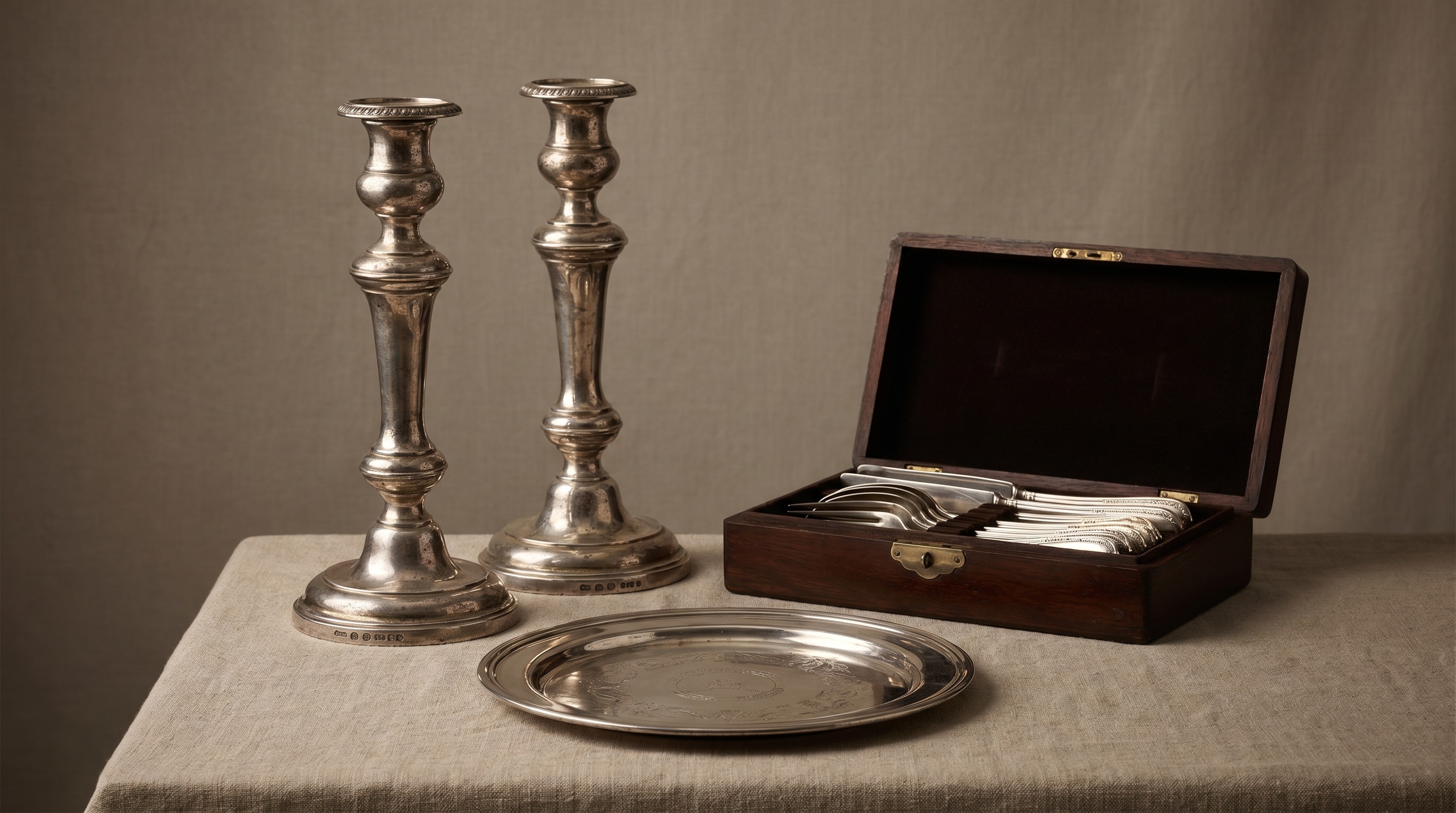
A specialist's guide to the Sheffield Assay Office: the crown that became a rose, Old Sheffield Plate vs sterling, the canteen-of-cutlery capital, and reading a full Sheffield hallmark.
Got Sheffield-Marked Silver? We'll Identify and Value It Free
Send photos of your hallmarks and we'll tell you the year, maker and, crucially, whether it's solid sterling silver or Old Sheffield Plate. Reply within one working day.
The Sheffield Assay Office was created by the same 1773 Act of Parliament that gave Birmingham its anchor, the legendary Crown & Anchor Tavern legend has Sheffield drawing the crown. The office served the manufacturing capital of British silver flatware, cutlery and hollow-ware. It also assayed (separately, with maker's marks but no town mark) the city's other great trade: Old Sheffield Plate, the silver-fused-on-copper sheet invented locally in the 1740s. Reading a Sheffield hallmark correctly means knowing the difference between the two.
A Brief History: Crown to Rose
The Sheffield Assay Office was founded in 1773 and changed its town mark from a crown to a rose in 1975.
For just over 200 years, Sheffield's town mark was a crown. That is why most antique Sheffield silver still carries the crown punch, and is why even today many people still call Sheffield silver "crown" marked.
In 1975, as part of the modernisation under the 1973 Hallmarking Act, the crown was replaced with a Tudor rose (Yorkshire's emblem). For gold the crown moved to indicate fineness; for silver, the rose took over as town mark. Both marks are recognisable, but the cycle change matters when dating a piece.
How to Read a Full Sheffield Hallmark
Read a Sheffield hallmark as the maker's mark, the lion passant, the crown or rose, the date letter and, between 1784 and 1890, the duty mark.
| Mark | What it tells you |
|---|---|
| Maker's mark | The silversmith's or firm's initials. |
| Lion passant | Sterling (.925); Britannia from 1903. |
| Crown or rose | A crown 1773 to 1974; a Tudor rose from 1975. |
| Date letter | The year of assay; early cycles skip letters. |
| Duty mark | A sovereign's head, 1784 to 1890 only. |
From left to right:
- Maker's (sponsor's) mark: the silversmith or firm's initials.
- Standard mark: a lion passant (sterling, .925). Sheffield assayed Britannia too from 1903 onward.
- Town mark: a crown (1773 to 1974) or Tudor rose (1975 onward).
- Date letter: a single letter in a shaped shield. Sheffield used an idiosyncratic letter sequence (it skipped certain letters and didn't follow alphabetical order in early cycles).
- Duty mark (1784 to 1890 only): a sovereign's head.
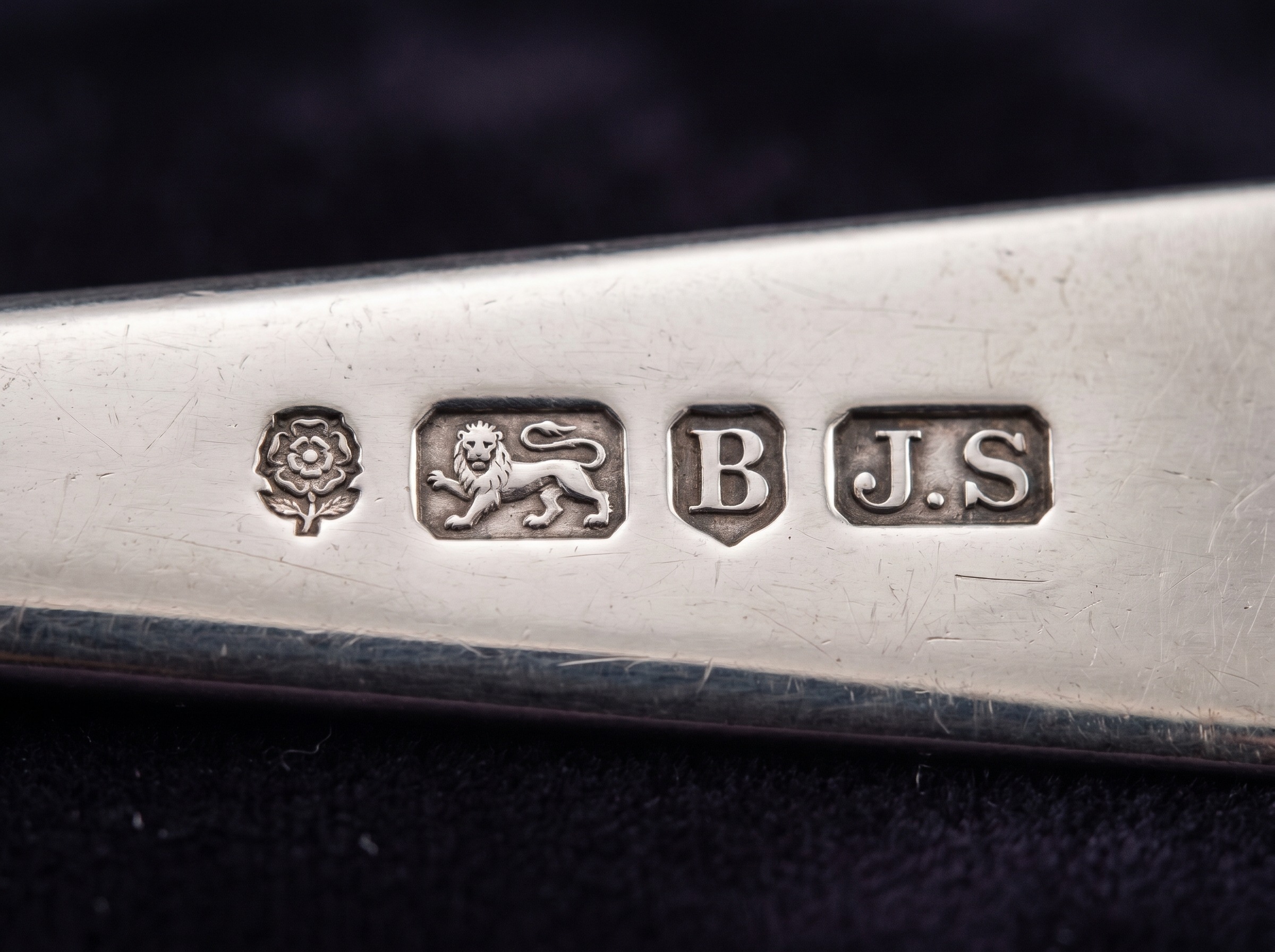
"Crown to 1974, rose from 1975. The mark itself dates the era: before you even look at the date letter."
The Rose Up Close
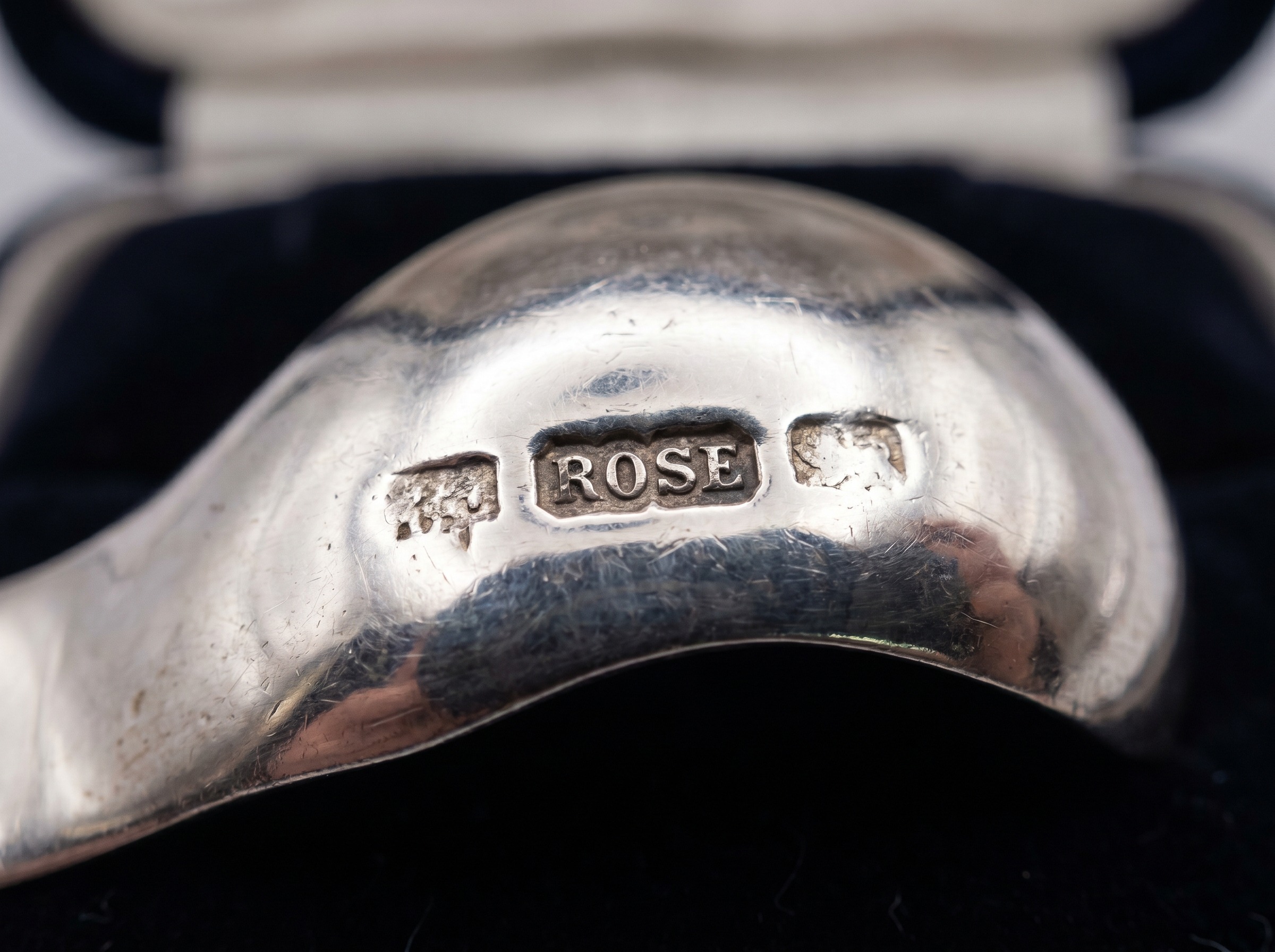
The post-1975 Sheffield rose is a full-faced Tudor rose; the earlier crown sits in a tall arched shield.
The post-1975 Sheffield rose is a full-faced Tudor rose with five outer petals: instantly recognisable. The pre-1975 crown sits in a tall arched shield. On worn pieces the crown's pearls can flatten before its outline; the rose's central whorl usually survives well because of punch depth.
Old Sheffield Plate: Not the Same Thing
Old Sheffield plate is silver fused onto copper, not hallmarked sterling.
This is where most confusion arises. "Old Sheffield Plate" (1742-c.1850) is not solid silver and was never given a Sheffield hallmark. It was a fused sheet of silver bonded to a copper core, invented by Thomas Boulsover. Pieces are marked with maker's punches only (Bradbury, Tudor & Leader, Roberts & Cadman, etc.): there is no rose, no crown, no lion passant. If your "Sheffield" piece has no lion passant, it is not sterling.
Later electroplate (EPNS, from c.1840 onward) replaced Old Sheffield Plate but is similarly never hallmarked. Old Sheffield Plate has antique value in its own right; modern EPNS does not. We can identify both.
Sheffield's Speciality: Flatware, Cutlery and Hollowware
What Sheffield made by the ton: canteens of cutlery, individual flatware, table silver, candlesticks and candelabra, salvers, tea services, large hollowware. London specialised in fine domestic and presentation silver; Birmingham specialised in small silver and jewellery; Sheffield specialised in the dining table. If you have a canteen of cutlery or a pair of large candlesticks, the chances are they carry a Sheffield crown or rose.
Major Sheffield firms include Walker & Hall, James Dixon & Sons, Mappin & Webb, Roberts & Belk, Atkin Brothers, Hawksworth Eyre, John Round, and Cooper Brothers. Walker & Hall and Mappin & Webb in particular were huge producers of canteens: much of the Victorian and Edwardian flatware in British homes is theirs.
Date Letters: Quirks to Watch For
Early Sheffield date letter cycles skipped letters and did not follow alphabetical order, so read them against a Sheffield table.
Sheffield's early date-letter cycles were not strictly alphabetical and skipped letters in ways that London and Birmingham did not. Always match the date letter to its specific shield outline and font for the correct year. From 1975 the office moved to standard annual letters in line with the unified UK system.
Duty Marks
The sovereign's head duty mark shows that duty was paid on silver assayed between 1784 and 1890.
Sheffield used the same 1784 to 1890 duty-mark sequence as the other UK offices: George III (1784 to 1820), George IV, William IV, Victoria young head. Post-1890 Sheffield pieces show four marks; pre-1890, five.
Pitfalls
- "Old Sheffield Plate" misread as sterling: no lion passant means no sterling. Look for the standard mark first.
- EPNS / A1 / "Sheffield Plated" on modern pieces: these are electroplate, not solid silver. They have a copper or nickel base.
- Re-let-in hallmarks: a real Sheffield crown cut from a damaged piece and soldered into a plated body. Look for a faint solder ring around the marks.
- Mappin & Webb double identity: M&W made both Sheffield-marked and London-marked silver; the firm-stamped marks on the back of cutlery are not hallmarks, only retailer's marks.
What We Look For When Sheffield-Marked Silver Arrives
When Sheffield-marked silver arrives we read the full row of marks, check whether the town mark is the crown or the rose, and date the piece against the Sheffield letter table.
Then we confirm the piece is hallmarked sterling rather than Old Sheffield plate or EPNS, and look at the maker and condition.
Got Sheffield-Hallmarked Silver to Sell?
We buy Sheffield sterling silver of every period: Georgian candlesticks, Victorian canteens, Edwardian tea services and modern Mappin & Webb, Walker & Hall and James Dixon pieces. By appointment in Mayfair or by free FedEx collection. Same-day payment.
- Send photosUse the form on this page, or email them to us.
- A specialist reviews itMaker, marks, age and condition.
- Free estimate by emailWithin one working day.
- You decidePaid once agreed. No obligation.
Four ways to sell: Mayfair (by appointment), Braintree (by appointment), Royal Mail Special Delivery, free FedEx collection.
Free valuation
Request a free valuation
Send us a few photos of your Sheffield silver. A specialist looks at every request personally and replies by email with an estimate within one working day. There is no obligation to sell.
What to photograph
- The whole piece. The whole piece, from the front and the side.
- The underside. The base or reverse, where the marks usually are.
- The hallmarks, close up. Every mark in the group, in focus, including the maker's mark.
Prefer email? Send photos to info@mozerisfineantiques.com or call 01376 334 482.
Ways to sell
- Mayfair (by appointment)
- Braintree (by appointment)
- Royal Mail Special Delivery
- Free FedEx collection
We buy directly, with payment once you accept our offer, and we can also sell for you by consignment or in our own auctions.
Related Reading
Frequently Asked Questions
Why is the Sheffield mark sometimes a crown and sometimes a rose?
Is Old Sheffield Plate the same as Sheffield silver?
Is EPNS Sheffield silver?
Are Mappin & Webb pieces Sheffield silver?
Will you tell me what my Sheffield silver is worth?
Selling Sheffield-Hallmarked Silver?
Free FedEx collection. Same-day payment.
Strictly by appointment only: no walk-ins at either location.
Items we buy
Antique Silver We Specialise In
Click any category for our specialist buying guide, then send photos for a free valuation. We also have a full Sell Your Silver overview.