UK Hallmark Authority · Leopard's Head Since 1300
The London Assay Office: Complete Guide
The London Assay Office at Goldsmiths' Hall marks silver with the leopard's head, crowned until 1821. A full London hallmark shows the maker's mark, the lion passant or Britannia, the leopard's head, a date letter and, from 1784 to 1890, the sovereign's head duty mark.
Reviewed by Faustas Svencionis, Mozeris Fine Antiques, since 2015 · Updated October 2026
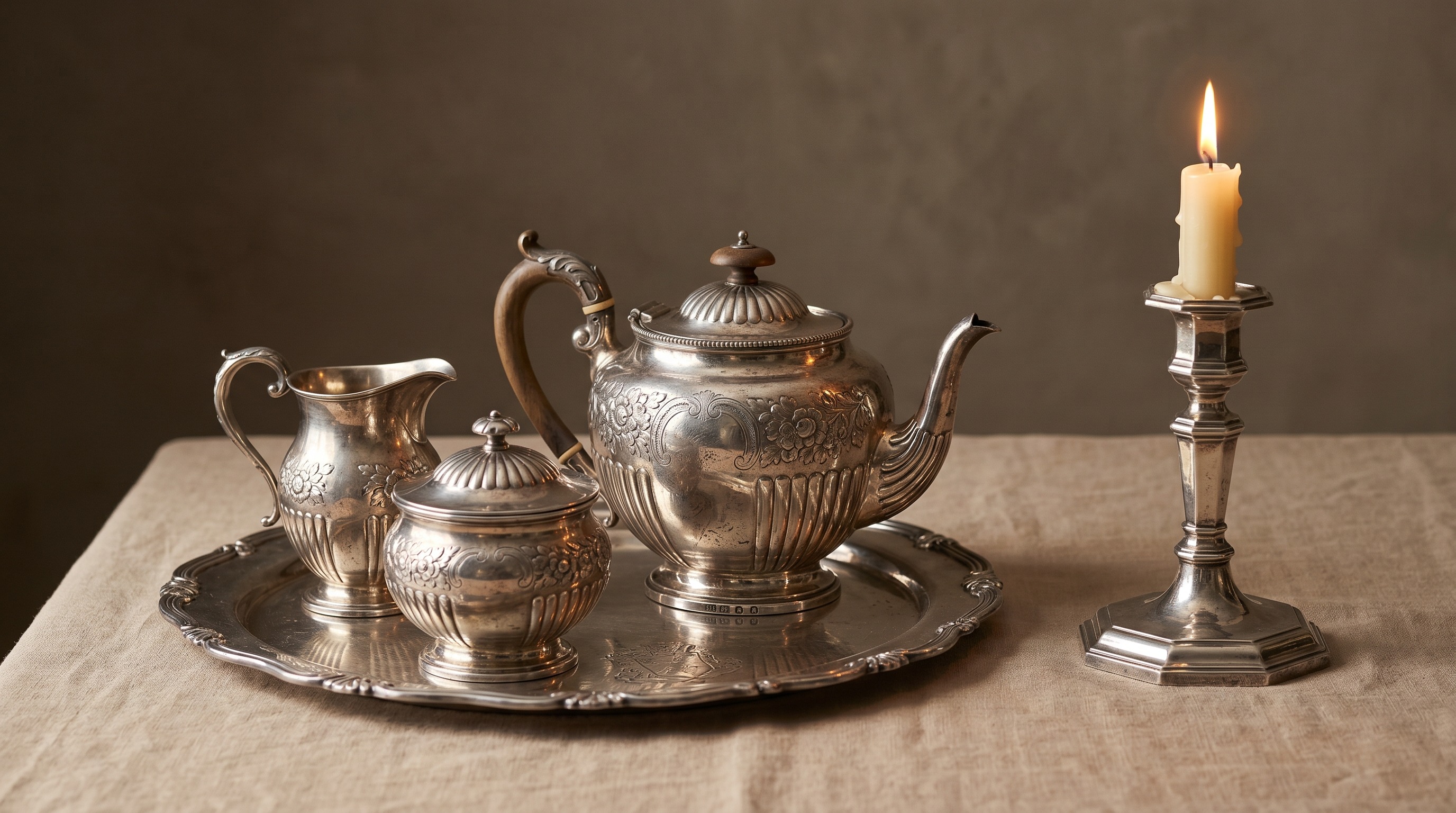
A specialist's guide to the world's oldest assay office, the famous leopard's head town mark, the full London hallmark sequence, and how to read sterling, Britannia and duty marks on antique English silver.
Got London-Marked Silver? We'll Identify and Value It Free
Send photos of your hallmarks and we'll tell you the year, maker and standard, and what your silver is worth on today's market. Reply within one working day.
The Worshipful Company of Goldsmiths has been assaying silver in London since 1300, making it the oldest continuously operating assay office in the world. Its leopard's head mark is the most widely recognised English silver hallmark, struck on Royal plate, Georgian tea services, Regency salvers and twentieth-century presentation pieces alike. Understanding the London hallmark is the single most useful skill for anyone valuing British silver.
This guide explains exactly what the London Assay Office is, what each of its punches means, how the date-letter system works, how to read the standard, duty and convention marks, and the most common pitfalls when attributing London silver. Throughout, we link to the relevant pages on our site so you can value or sell what you have.
A Brief History: Goldsmiths' Hall and the Leopard's Head
The London Assay Office at Goldsmiths' Hall is the oldest in Britain, and its leopard's head is the London town mark.
The 1300 statute of Edward I required every silver article offered for sale in England to be struck with the King's mark, a leopard's head, at Goldsmiths' Hall in London. Until 1478 this was the only assay mark required. The Goldsmiths' Company was granted its Royal Charter in 1327, which formalised its assay function.
From 1363 silversmiths were obliged to add their own maker's mark beside the leopard, and from 1478 a date-letter was added, establishing the four-mark sequence (town, maker, standard, date) that has defined English silver ever since.
The leopard wore a crown from 1478 until 1821, when the crown was removed. Outside the City the office is still referred to by the trade simply as "London" or "the Hall", and the leopard's head, crowned or uncrowned, is the single mark that confirms a piece was assayed there.
How to Read a Full London Hallmark
Read a London hallmark from left to right: maker's mark, standard mark, the leopard's head, the date letter and, between 1784 and 1890, the duty mark.
| Mark | What it tells you |
|---|---|
| Maker's mark | The silversmith's or retailer's initials in a shaped shield. |
| Lion passant | Sterling (.925); a Britannia figure for .958. |
| Leopard's head | London: crowned until 1821, uncrowned after. |
| Date letter | The year of assay. |
| Duty mark | A sovereign's head, 1784 to 1890 only. |
A complete London hallmark is a row of small punches struck on a discreet area of the piece, under the base of a teapot, on the rim of a salver, on the bezel of a snuff box. From left to right, the standard sequence is:
- Maker's (sponsor's) mark: the silversmith or retailer's initials in a shaped shield.
- Standard mark: a lion passant (sterling, .925) or Britannia figure (Britannia, .958).
- Town mark: the leopard's head (crowned to 1821, uncrowned thereafter) confirming London assay.
- Date letter: a single letter in a shaped shield indicating the year of assay.
- Duty mark (1784 to 1890 only): a sovereign's head, struck to show duty had been paid.
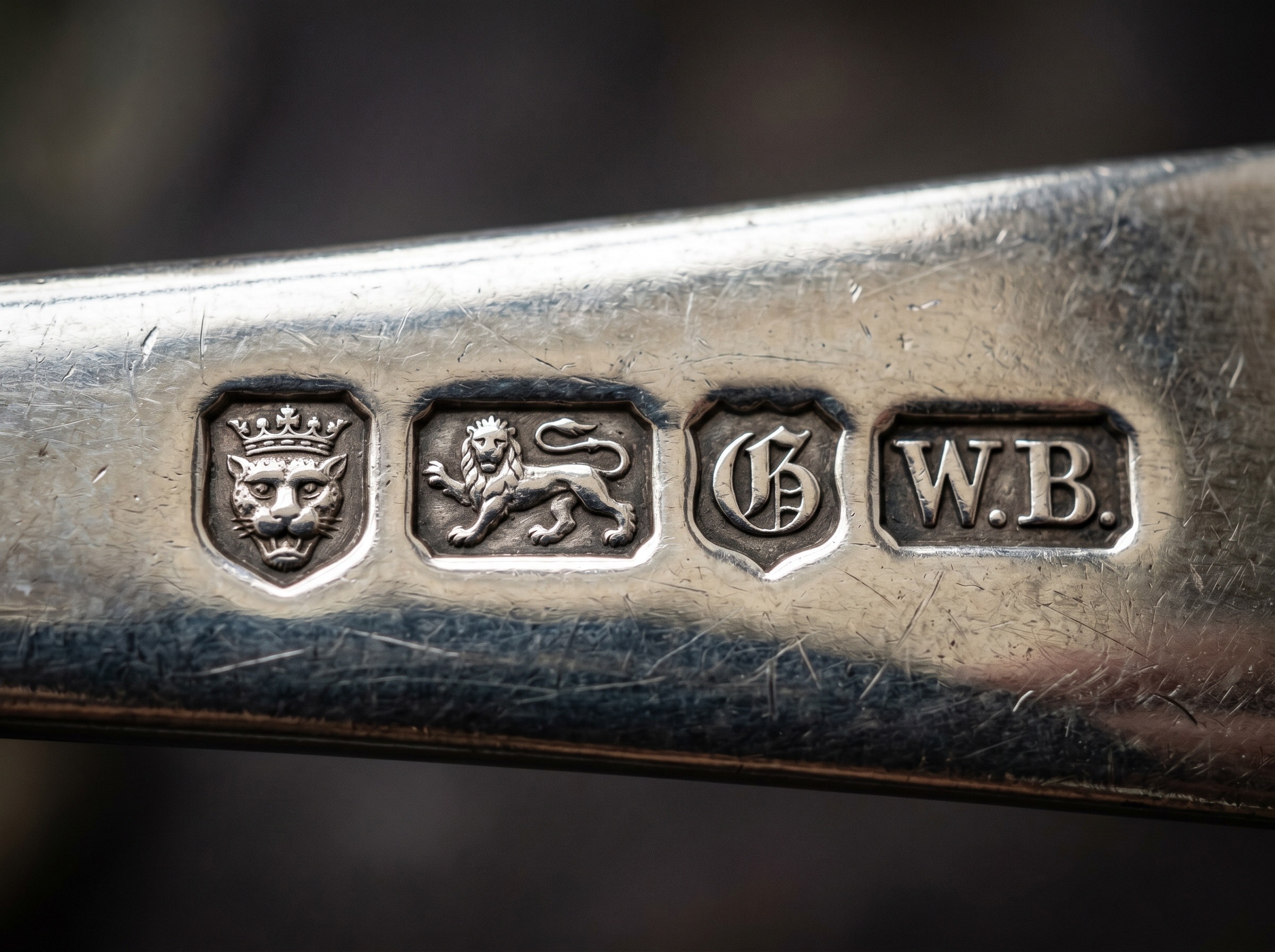
"Four marks tell you four things: who made it, what standard it is, where it was assayed and when. London silver, decoded."
The Leopard's Head, Up Close
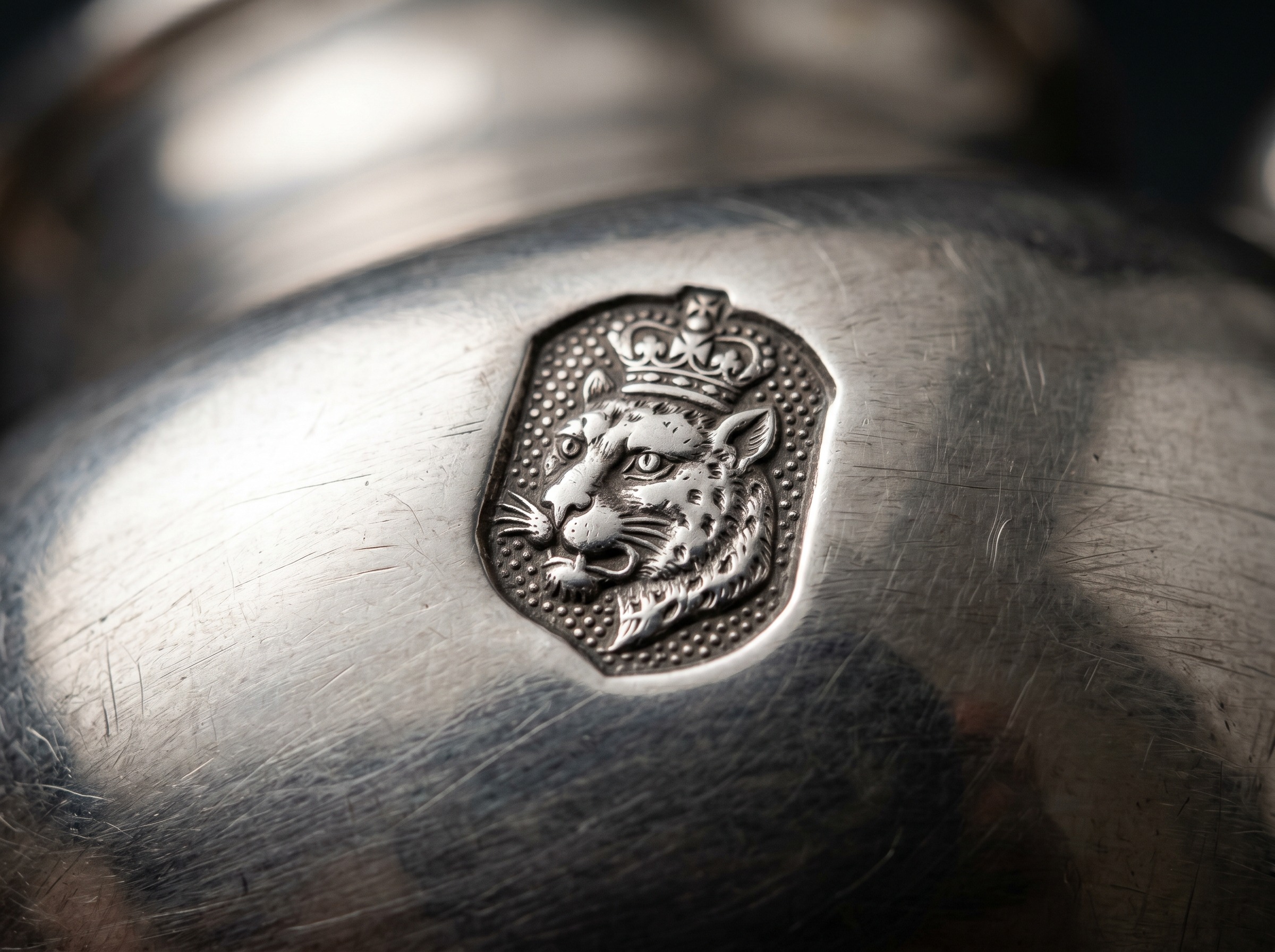
The leopard's head was crowned until 1821 and uncrowned after, which helps to date London silver.
The leopard's head is the giveaway. On Georgian and earlier pieces it appears crowned, often within a slightly squared shield; on Victorian and later silver it sits uncrowned within an oval or shaped surround.
The detail of the face, the mane and the punch outline are the easiest features to read on worn pieces, even when the date letter has rubbed flat, the leopard usually survives because of how its die was struck. Counterfeit pieces are routinely betrayed by an over-uniform, "printed" leopard with no relief.
The Date Letter System
London changes its date letter each year, with a new letter style and shield for each cycle.
London changed its date letter every May (St Dunstan's Day, 19 May, was the trade's traditional turn-over). Each cycle runs through 20 letters of the alphabet (J is skipped), then the shield shape, letter style and case all change for the next cycle. That triple combination (letter, shape, font) is what dates a London piece exactly. Some well-known cycles:
| Cycle | Years | Style |
|---|---|---|
| Roman capitals | 1716 to 1735 (A-U) | Early Georgian: Paul de Lamerie era |
| Court hand | 1736 to 1755 | Rococo period |
| Old English caps | 1756 to 1775 | Hester Bateman's early career |
| Roman lower-case | 1776 to 1795 | Neoclassical / Adam style |
| Roman capitals | 1796 to 1815 | Late Georgian / Regency |
| Roman lower-case | 1816 to 1835 | Regency & William IV |
| Black letter / Gothic | 1836 to 1855 | Early Victorian |
| Roman capitals | 1856 to 1875 | Mid-Victorian |
| Roman lower-case | 1876 to 1895 | Late Victorian / Aesthetic |
| Black letter caps | 1896 to 1915 | Edwardian |
A letter in isolation is rarely enough. You must match it to the shield shape and font cycle to date a London piece correctly: the same "A" appears every 20 years. Send us photographs of the marks and we'll date them for you.
Sterling and Britannia Standards
London silver is sterling, marked with the lion passant, or Britannia standard, marked with Britannia and a lion's head erased.
England has two recognised silver standards, both still assayed in London:
- Sterling: .925 (92.5% silver), marked with a lion passant. The dominant standard from 1300 onward.
- Britannia: .958 (95.84% silver), marked with a seated figure of Britannia. Compulsory in England from 1697 to 1720 to prevent silversmiths melting coinage; optional thereafter and still in use for high-quality presentation pieces. Britannia London silver also replaces the leopard's head with a lion's head erased.
Britannia-period (1697 to 1720) London silver is highly collectable; both for the higher fineness and the period craftsmanship of names such as Pierre Platel and the young Paul de Lamerie.
Duty Marks: The Sovereign's Head
The sovereign's head duty mark shows that duty was paid on silver assayed between 1784 and 1890.
Between 6 December 1784 and 30 April 1890, the British government levied a duty on hallmarked silver. The Assay Office added a fifth mark, a small profile of the reigning sovereign, to confirm the duty had been paid. Spotting which monarch on a London piece will pin its period instantly:
- George III: incuse and small to 1786, larger from 1786 to 1820.
- George IV: 1820 to 1830.
- William IV: 1830 to 1837.
- Victoria (young head): 1837 to early 1890.
From May 1890 the duty mark vanishes. Post-1890 London silver therefore shows four marks, not five.
The Modern London Hallmark
The 1973 Hallmarking Act unified UK procedure, and from January 1999 the date letter became optional (most makers still use it). The 1999 Convention introduced an additional common control mark (a balance with scales) on silver intended for international trade. Since 2007 the millennium "M" mark has appeared on commemorative items. The London leopard's head remains the constant.
Notable London Silversmiths: A Specialist's Short List
The London Assay Office served the country's finest silversmiths. A few whose marks add significant value:
- Paul de Lamerie (1712 to 1751): the finest rococo silversmith working in England. Anything by Lamerie is exceptional.
- Pierre Platel (Britannia period: Lamerie's master).
- Hester Bateman (1761 to 1790) and the wider Bateman dynasty: graceful, beautifully judged Georgian flatware and hollowware.
- Paul Storr (1793 to 1838): the great Regency silversmith. Storr silver is consistently the top of the London auction market.
- Robert Hennell dynasty (later 18th to mid-19th century): fine domestic silver.
- Garrard & Co: the Crown Jeweller; presentation pieces.
- Omar Ramsden (early 20th century): Arts & Crafts hand-raised silver.
If your London piece carries any of these maker's marks, do not melt it; the maker's name usually matters far more than the weight of silver.
Pitfalls and Forgeries
- Cast hallmarks: a real London hallmark is struck with a steel punch and shows displaced metal at the edges. Cast or transferred marks look soft and recessed without surrounding metal flow.
- Re-let-in marks: a tiny disc bearing a genuine hallmark, soldered into a new (often plated) piece. Look for a faint solder line in a circle around the mark.
- Wrong cycle / letter mismatch: a leopard's head with a maker's mark that did not register until decades later is a clear giveaway.
- EPNS, silver plate, "EP", "A1": these are not London marks at all. They are electroplate and contain no solid silver.
- Worn marks: wear is normal on antique pieces but the leopard usually survives because of the depth of the punch. If only one mark is legible, it is almost always the leopard.
What We Look For When London-Marked Silver Arrives
When London-marked silver arrives we read the full row of marks, check whether the leopard's head is crowned, and date the piece from the letter, the shield and any duty mark.
Then we look at the maker's mark, since London served the country's finest silversmiths, and at condition.
Got London-Hallmarked Silver to Sell? We Buy It Daily
Our Mayfair showroom sit a few streets from Goldsmiths' Hall itself. We buy London-assayed sterling and Britannia silver of every period (Georgian, Regency, Victorian, Edwardian and twentieth-century) by appointment in Mayfair or by free FedEx collection. Same-day payment.
- Send photosUse the form on this page, or email them to us.
- A specialist reviews itMaker, marks, age and condition.
- Free estimate by emailWithin one working day.
- You decidePaid once agreed. No obligation.
Four ways to sell: Mayfair (by appointment), Braintree (by appointment), Royal Mail Special Delivery, free FedEx collection.
Free valuation
Request a free valuation
Send us a few photos of your London silver. A specialist looks at every request personally and replies by email with an estimate within one working day. There is no obligation to sell.
What to photograph
- The whole piece. The whole piece, from the front and the side.
- The underside. The base or reverse, where the marks usually are.
- The hallmarks, close up. Every mark in the group, in focus, including the maker's mark.
Prefer email? Send photos to info@mozerisfineantiques.com or call 01376 334 482.
Ways to sell
- Mayfair (by appointment)
- Braintree (by appointment)
- Royal Mail Special Delivery
- Free FedEx collection
We buy directly, with payment once you accept our offer, and we can also sell for you by consignment or in our own auctions.
Related Reading
Explore other UK assay offices and item-specific guides to read your silver correctly:
Frequently Asked Questions
Reading London hallmarks: common questions.
What is the London Assay Office hallmark?
How do I date a London-marked piece?
What is the difference between sterling and Britannia silver?
What is the small monarch's head on my London silver?
Why does my piece only show a leopard's head?
Will you tell me what my London silver is worth?
Selling London-Hallmarked Silver?
Mayfair showroom a few streets from Goldsmiths' Hall. Free FedEx collection. Same-day payment.
Strictly by appointment only: no walk-ins at either location.
Items we buy
Antique Silver We Specialise In
Click any category for our specialist buying guide, then send photos for a free valuation. We also have a full Sell Your Silver overview.