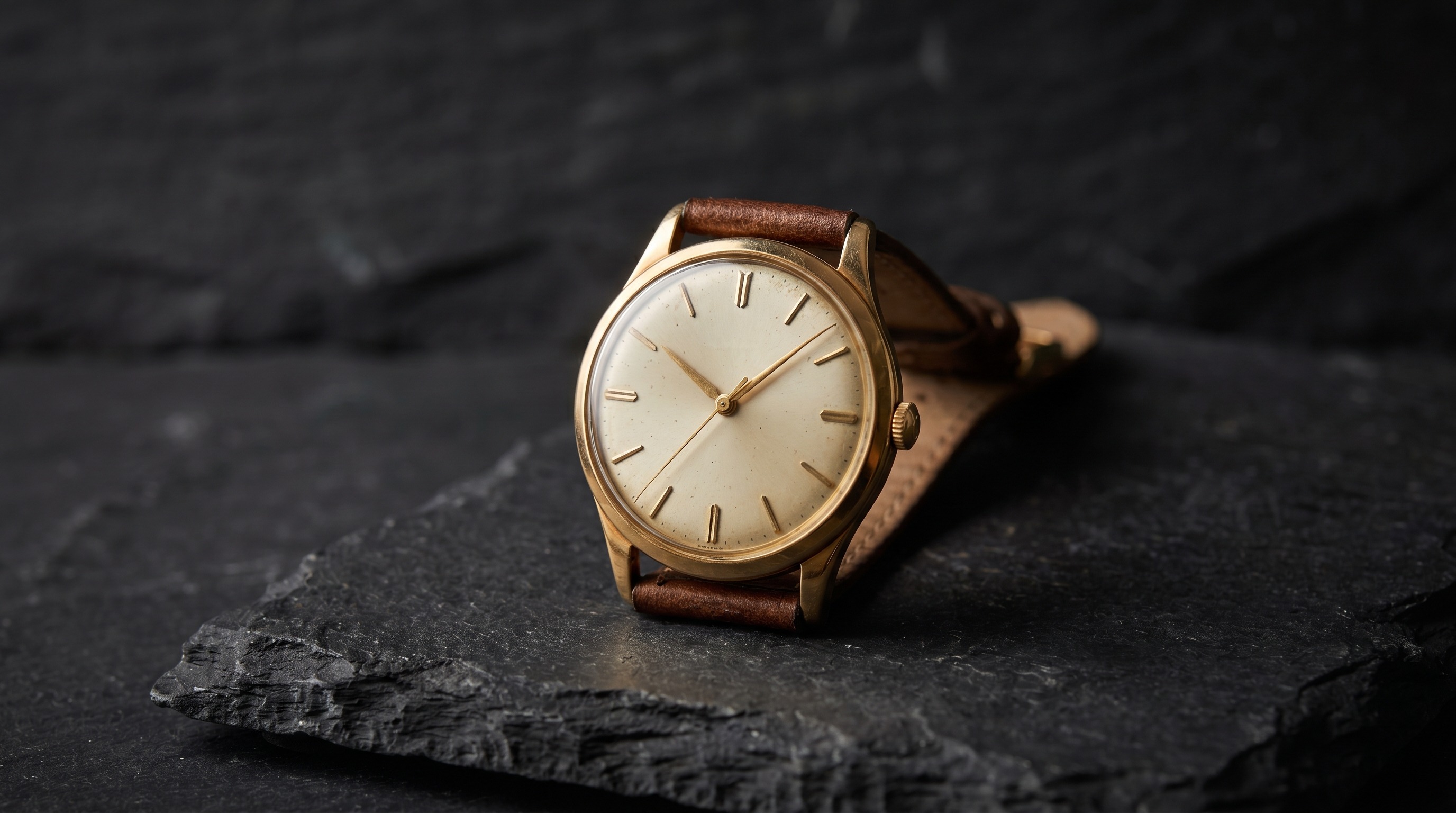
Solid Gold or Gold-Plated? How to Tell with a Vintage Watch
A gold-coloured case can mean anything from solid 18ct gold to a few microns of plating over base metal — and the difference can be a hundredfold in value. Here is how specialists read a vintage watch in seconds.
Not Sure What Your Watch Is Worth?
Send us a photo for a free, no-obligation valuation — or simply ask for honest advice. Our specialists reply within one working day.
Few questions matter more to the value of an old watch than this one — and few are more often answered wrongly. A drawer-find that "looks like gold" might be a solid 18ct dress watch worth a meaningful sum, or a 1960s gold-plated case worth little beyond its movement. The good news: the watch itself almost always tells you, if you know where to look.
At Mozeris Fine Antiques we handle gold watches every week — from slim mid-century dress pieces to heavy antique pocket watches — and the first thing we do with any of them is establish exactly what the case is made of. This guide walks you through the same checks, in the same order, that a specialist uses. None of them require anything more than good light and, ideally, a cheap jeweller's loupe.
First, the language: solid, filled, rolled and plated
"Gold" on a watch case is not one thing. There are four broad categories, and they sit on a steep ladder of value:
Solid Gold
The case is a gold alloy throughout — 9ct, 14ct or 18ct. This is the only category with significant intrinsic metal value, and the only one that carries proper hallmarks. Worth the most, by a wide margin.
Gold-Filled / Rolled Gold
A thick layer of gold mechanically bonded to a base-metal core (marked GF, RGP or "rolled gold"). More durable than plating, but the gold content is tiny. Modest value.
Gold-Plated
A microscopically thin electroplated layer (marked GP, KGP, HEG or a micron figure such as "20 microns"). Decorative only — negligible metal value.
Gilt / Wash
The faintest flash of gold over brass or steel, common on cheaper cases. Wears through quickly to show the base metal underneath.
The entire skill of identification comes down to working out which of these four you are holding. Here is how.
The fastest test: read the case-back marks
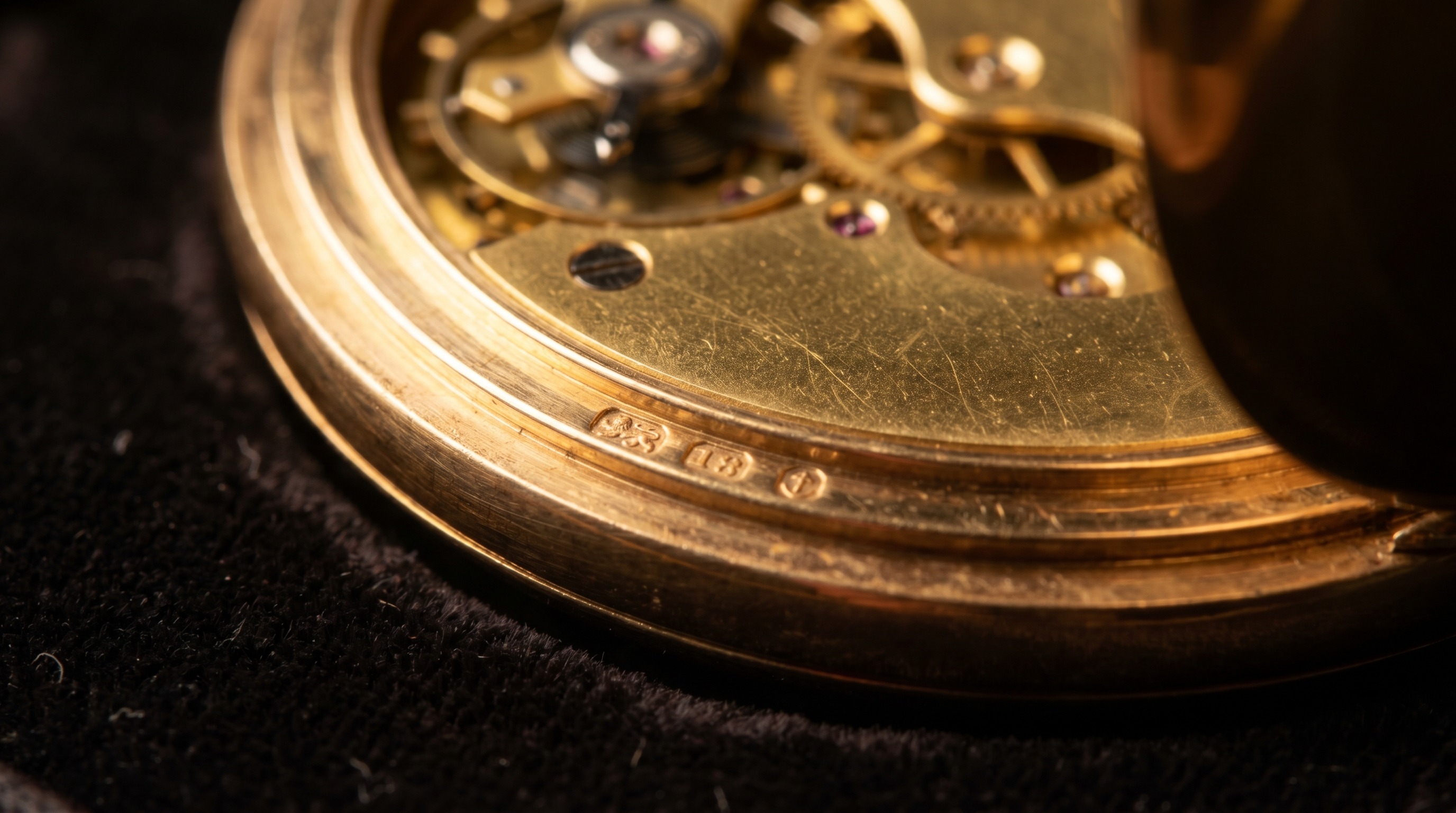
On a solid gold watch, the metal is regulated, and in Britain that means it must be hallmarked. The case-back — inside and out — is where the evidence lives. Open it (or have a jeweller open it) and look for a row of tiny punched stamps.
That rule is worth memorising. Gold-filled and plated cases were frequently stamped with a durability guarantee — "Warranted 10 Years", "Guaranteed 25 Years", "Warranted U.S.A." — because the maker was promising how long the thin gold layer would last. Solid gold needs no such promise. If you see a year guarantee, you are almost certainly looking at a filled or plated case.
What the Marks Mean
The numbers and symbols stamped into a case tell you the metal at a glance. The marks that matter most:
- 375 / 9ct — Solid 9 carat gold (37.5% pure). The most common British gold watch standard.
- 585 / 14ct / 0.585 — Solid 14 carat (58.5%). Common on American and Continental cases.
- 750 / 18ct / 0.750 — Solid 18 carat (75%). The standard for fine dress watches.
- 916 / 22ct — Solid 22 carat (91.6%). Rare in watches; usually pocket-watch cases.
- GF · RGP · "rolled gold" — Gold-filled / rolled gold plate. Not solid.
- GP · KGP · HEG · "20 microns" — Electroplated. Not solid.
- "Warranted __ Years" — A durability guarantee = filled or plated, never solid.
A British solid gold case will also carry an assay office mark and a date letter alongside the fineness number. No hallmark on a British case usually means it is not solid gold.
Four Confirming Checks
When the marks are worn or absent, these physical tells help a specialist decide. None is conclusive alone — together they build a clear picture.
Look at the wear points
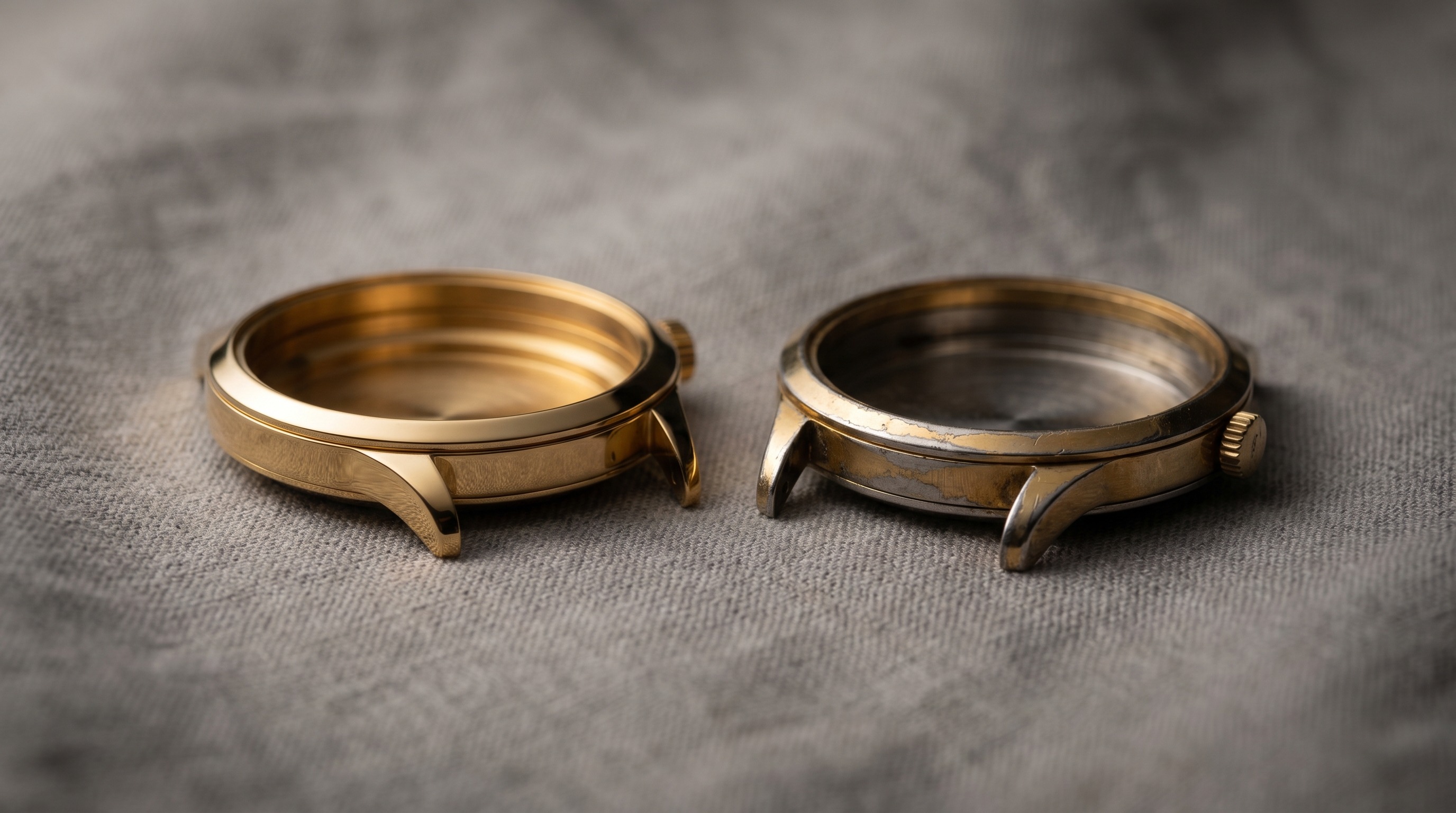
Examine the lugs, the case edges and the crown — the spots a sleeve rubs daily. Plating wears through to a silvery or yellow base metal there first. Solid gold wears evenly and stays the same colour all the way through.
Check the colour consistency
Solid gold has a soft, consistent warmth inside and out. Plated cases often look slightly too bright or brassy on the surface and quite different inside the case-back.
Feel the weight
Gold is dense. A solid 18ct case has a reassuring heft for its size; a plated brass or steel case feels comparatively light. Experience calibrates this quickly.
Mind the movement
Fine makers rarely fitted their best movements in plated cases. A high-grade signed movement is a strong hint the case is solid — though it should still be confirmed by the marks.
Why "not solid gold" doesn't mean "not valuable"
Here is the part many sellers get wrong in the other direction. A vintage watch is not simply a lump of gold — and the most valuable watches in the world are frequently not the heaviest. Brand, model, movement, condition and originality routinely outweigh metal content many times over.
A gold-plated 1960s chronograph from a respected maker can be worth far more than an anonymous solid 9ct dress watch, because collectors are buying the watch, not the gram weight. The reverse is also true: a plain solid gold case with a tired, unsigned movement may be worth little more than its scrap value. The metal is the floor, not the ceiling.
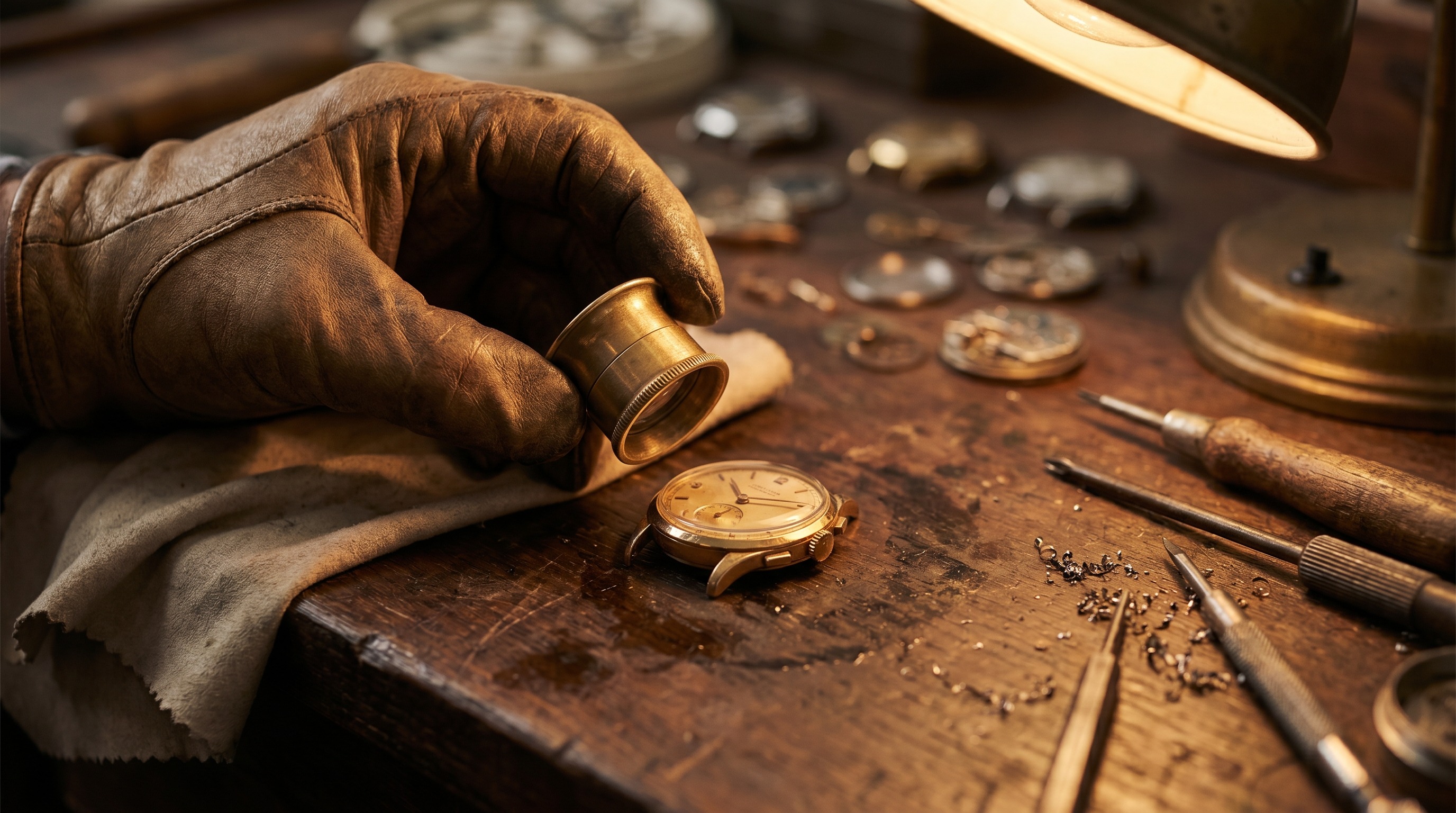
This is precisely why a specialist valuation matters. We assess both sides: the intrinsic gold value and the collector value, and we tell you which one drives the price for your particular watch. If you would like to understand the metal first, our guides to reading gold hallmarks and telling whether gold is real go deeper, and our live gold price page shows today's spot value.
Not Sure What You Have? Send Us a Photo
Photograph the watch and — crucially — the marks on the case-back, and we'll tell you honestly whether it's solid gold, what it is, and what it's worth. Free, with no obligation.
⚠️ Strictly by appointment only — no walk-ins at either showroom.
Frequently Asked Questions
The questions we're asked most often about gold-cased vintage watches.
My watch has no hallmark at all — does that mean it isn't gold?
On a British-made case, the absence of a hallmark strongly suggests it is not solid gold, because solid gold had to be assayed and marked by law. On some imported, very early, or worn cases marks can be missing or illegible, so it is not absolute — but it shifts the odds heavily towards gold-filled or plated. Send us a photograph and we'll confirm.
What does "750" inside my watch mean?
750 is the millesimal mark for 18 carat gold — 75% pure. It is the same as a "18ct" stamp, just expressed as parts per thousand, and is common on Continental and European cases. 585 means 14ct, and 375 means 9ct. These numbers indicate solid gold.
Is a gold-plated vintage watch worth anything?
Often yes — but for the watch, not the gold. Plated watches from desirable makers and models can carry strong collector value, while the plating itself is worth almost nothing. We value both the metal and the timepiece and tell you which matters for your watch.
Should I polish the case before selling?
Please don't. Over-polishing removes metal, softens crisp edges and can erase hallmarks — all of which reduce value to a collector. Leave the watch exactly as it is and let a specialist assess it untouched.
Can you tell from photos, or do you need the watch in hand?
Clear photographs of the watch and the case-back marks are usually enough for an honest initial assessment. For a firm offer we confirm in person at one of our showrooms by appointment.
Send Us Your Watch Photographs
Attach photos of the watch and the case-back marks. We'll respond within one working day.