
Sell Your Antique Silver Jewellery
To Specialist Buyers
Victorian silver brooches, Georgian paste pieces, Art Nouveau pendants, Edwardian silver lockets — we buy antique silver jewellery of all periods at genuine collector prices. Free valuation, no obligation.
Request Your Free Valuation
Send us photos of your silver jewellery — including any hallmarks — and we'll give you an honest, no-obligation assessment. Collections of any size considered.
⚠️ Strictly by appointment only — no walk-ins at either showroom.
Why Antique Silver Jewellery Is Worth More Than You Might Think
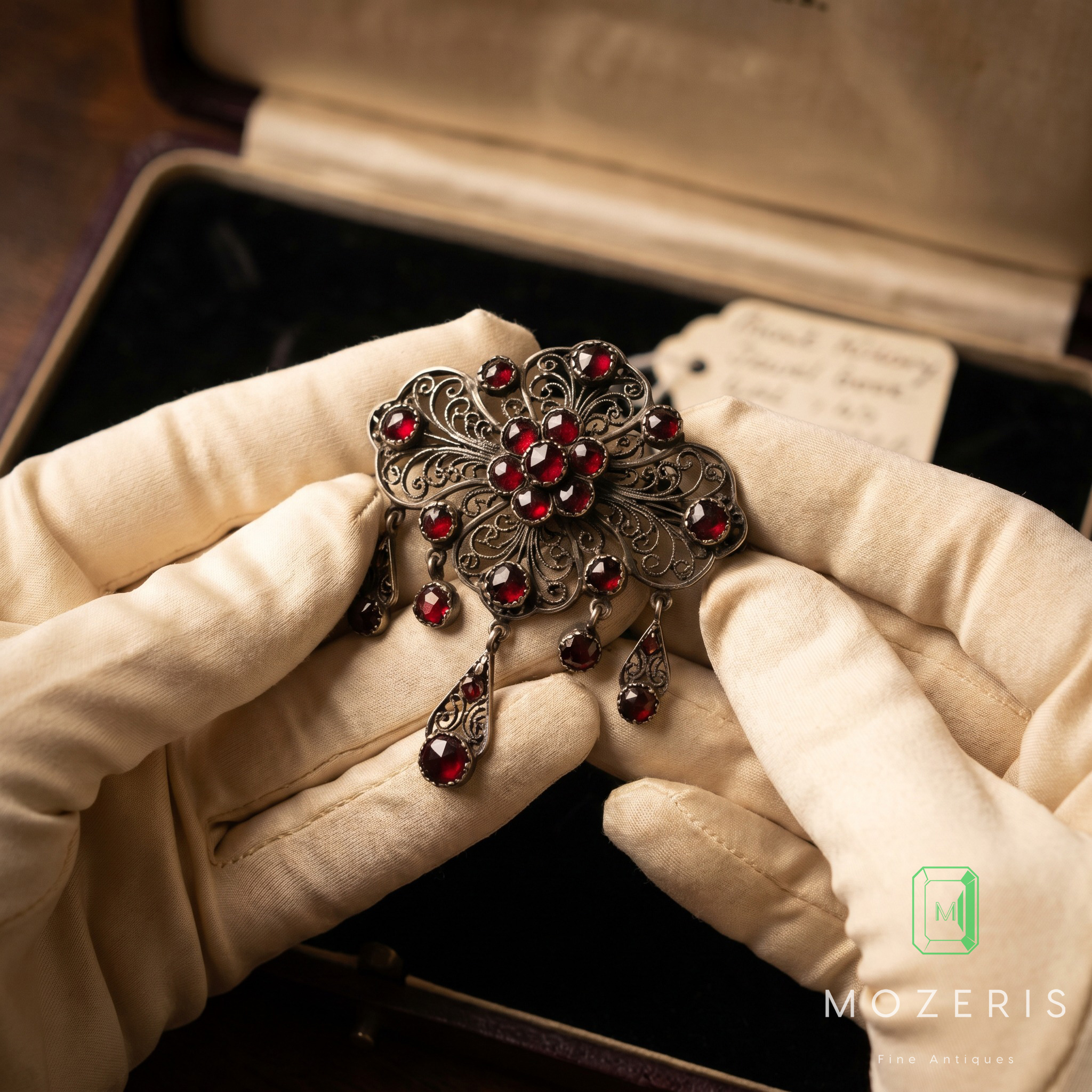
Antique silver jewellery is consistently undervalued by people who don't know what to look for. A plain silver brooch from the 1870s may look unremarkable — but if it carries a Chester hallmark, a quality maker's mark and original condition, it has genuine collector value that far exceeds its silver content.
We specialise in the kind of piece that a high-street jeweller would dismiss as "just silver" — Victorian mourning brooches, Georgian paste set pieces, Art Nouveau enamel pendants, Edwardian pearl and silver necklaces — and we know what collectors actually pay for them.
We buy single pieces and entire collections. If you have a jewellery box full of inherited silver pieces you've never properly assessed, bring it all — we'll go through everything and value every item individually.
Types of Silver Jewellery We Buy
From Georgian paste brooches to Art Deco silver and marcasite — we buy antique silver jewellery from every period.
Victorian Silver Brooches
The Victorian era produced an extraordinary variety of silver brooches — from simple name bar pins to elaborate floral, insect and sporting brooches set with garnets, amethysts and turquoise. Scottish pebble brooches and Luckenbooth brooches are particularly collected.
Georgian Silver & Paste Jewellery
Pre-1830 silver jewellery — often set with foil-backed paste stones, garnets or seed pearls — is among the most desirable antique jewellery we buy. Georgian pieces are rarely marked but can be identified by construction technique, stone cutting and style.
Art Nouveau Silver & Enamel
Silver jewellery from the 1890–1910 period featuring naturalistic motifs — flowing female figures, dragonflies, water lilies — often combined with plique-à-jour or painted enamel. Liberty & Co., Charles Horner and W.H. Haseler pieces are particularly sought after.
Edwardian Silver Necklaces & Pendants
Fine silver and paste or seed pearl necklaces, lavalières and pendants from the 1900–1914 period. Delicate openwork designs in the Edwardian style have a devoted following. Many were produced in Birmingham by specialist jewellery manufacturers.
Victorian Mourning Jewellery
Silver mourning brooches, lockets and pendants — particularly those containing hair or with memorial inscriptions — are actively collected by specialist buyers. The symbolism, condition and original contents all affect value significantly.
Art Deco Silver & Marcasite
1920s and 1930s silver jewellery set with marcasite (iron pyrite), onyx, paste or semi-precious stones. Geometric Art Deco designs in sterling silver have a strong following, particularly from Continental European makers such as Theodor Fahrner.
How to Sell Your Silver Jewellery
A simple, straightforward process with no obligation at any stage.
Photograph Your Pieces
Lay your jewellery on a plain white surface and photograph each piece from above. Include close-ups of any marks on the reverse. For brooches, photograph the clasp and reverse. Don't clean anything — original condition matters.
Send Us Your Photos
Use the form on this page or email directly. If you have a large collection, send an overview shot and then individual close-ups of the most interesting pieces. We'll identify everything and come back to you honestly.
Receive an Honest Assessment
We'll identify the periods, makers and likely values based on current market comparables — not just silver weight. If any pieces are likely to disappoint, we'll tell you that too.
Visit & Receive Payment
Book an appointment at our London or Essex showroom. We'll examine every piece in person and make a firm offer. Accept it and we pay immediately by bank transfer.

What Affects the Value of Antique Silver Jewellery?
Silver jewellery value is determined by far more than weight. Here's what our specialists look at — and what makes the biggest difference.
| Factor | Why it matters | Impact on value |
|---|---|---|
| Period & date | Georgian pieces (pre-1830) are the rarest and most collected. Art Nouveau and Victorian mourning pieces have passionate followings. | Very high — period can multiply value 5× |
| Maker's mark | A piece by Liberty, Charles Horner or a named goldsmith is worth considerably more than an unmarked equivalent. | High — named makers command premiums |
| Stones & settings | Original stones in original settings are essential. Replaced or missing stones reduce value significantly. Unusual stones (moss agate, bloodstone, Cairngorm) add interest. | Significant — original = full value |
| Condition | All mechanisms should function. Clasps, hinges and catches should be original and working. Breaks, repairs and replaced components all reduce value. | Moderate to high depending on period |
| Subject matter | Unusual subject matter — insects, animals, portraits, mourning hair — commands higher prices than generic floral or plain designs. | Moderate — rarity adds collector premium |
| Original box or case | Original fitted case or maker's box adds provenance and completeness. Not essential, but a positive indicator of careful preservation. | Low to moderate — adds 10–20% |

How We Identify & Date Your Silver Jewellery
British silver jewellery was required to be hallmarked from the 17th century onwards — though small items under a certain weight were sometimes exempt. The hallmarks tell us the silver standard, the year of manufacture and the maker.
On antique jewellery, marks are often tiny and can be difficult to read without magnification. We use a combination of hallmarks, construction techniques, clasp styles and stone cuts to date pieces accurately — even when marks are worn or absent.
Georgian jewellery in particular is frequently unmarked (small items were often exempt from hallmarking) but can be reliably dated by the cut of the stones, the type of setting and the construction of the reverse. Experience matters enormously here — and this is where a specialist makes the difference.
Send us close-up photographs of both the front and reverse of each piece. We'll identify what you have before you make any decisions about selling.
Frequently Asked Questions
Common questions about selling antique silver jewellery.
My silver jewellery has no hallmarks — is it still worth selling?
Yes, absolutely. Many pieces — particularly Georgian and pre-Victorian jewellery — are unmarked because small items were legally exempt from hallmarking. We can identify period, style and quality through construction, stone cuts and design. Unmarked Georgian jewellery is often very desirable to collectors.
I have a large box of inherited silver jewellery — do you buy collections?
We actively welcome collections. Bring everything — even pieces that appear damaged or incomplete. Occasionally the most overlooked piece in a collection proves to be the most valuable. We'll assess every item and give you individual and collective offers.
Some of my pieces have stones missing. Will you still buy them?
Missing stones do reduce value, but rarely eliminate it entirely. A Georgian brooch with one replaced paste stone is still a Georgian brooch. We assess each piece on its merits — what it is, what period it's from and what the market currently wants. Send us photos first.
How is antique silver jewellery different from modern sterling silver?
The silver content is the same (92.5%), but antique pieces carry collector value based on their age, period, maker, condition and rarity. A Victorian silver brooch is not valued as a weight of silver — it's valued as a historical object with provenance and collector appeal. The difference in price can be enormous.
Can I send my silver jewellery by post?
For individual pieces of moderate value, registered post can work. For collections or high-value pieces, we recommend an in-person appointment. We can also arrange FedEx home collection — contact us to discuss the best approach for your situation.
Do you buy Art Nouveau and Arts & Crafts silver jewellery?
Yes — we actively seek quality Art Nouveau and Arts & Crafts silver pieces. Liberty & Co., Charles Horner, Murrle Bennett, Theodor Fahrner and Guild of Handicraft pieces are particularly desirable. If you believe you may have something from these makers, please do get in touch.
Send Us Your Photos
Front, reverse and any visible hallmarks — that's all we need to give you an initial valuation. Collections of any size welcome.