UK Hallmark Authority · Wheatsheaves & Sword
The Chester Assay Office: Complete Guide
The Chester Assay Office marked silver for north-west England and north Wales until it closed on 24 August 1962. Its town mark from 1701 is three wheatsheaves around a sword. A full Chester hallmark shows the maker's mark, the lion passant, the wheatsheaves, a date letter and, from 1784 to 1890, a duty mark.
Reviewed by Faustas Svencionis, Mozeris Fine Antiques, since 2015 · Updated October 2026
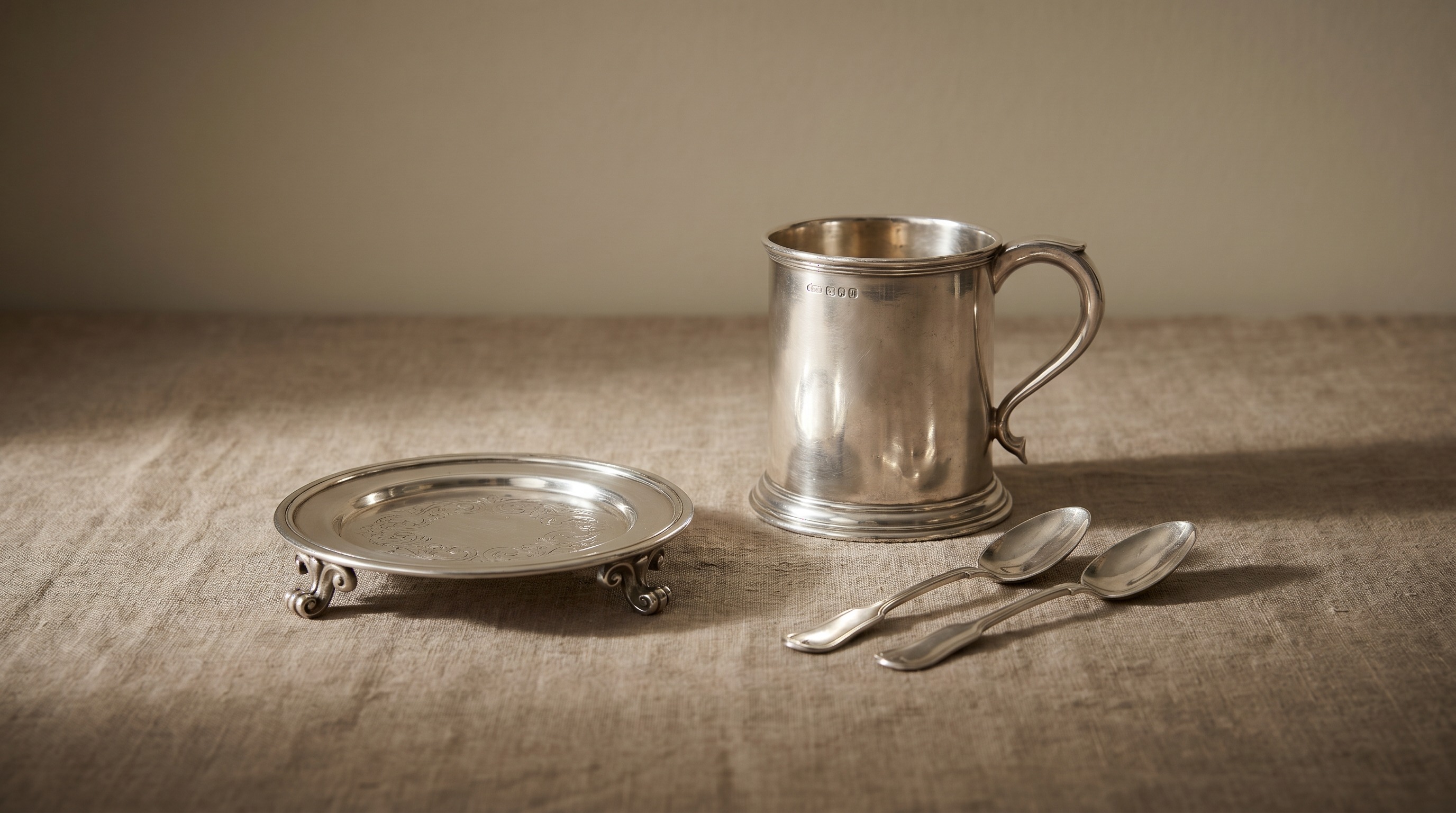
A specialist's guide to the closed Chester Assay Office, the three wheatsheaves and sword town mark, its 1962 closure, why collectors now seek it, notable Chester silversmiths and reading a full Chester hallmark.
Got Chester-Marked Silver? We'll Identify and Value It Free
Collectors actively seek Chester silver. Send photos and we'll identify the date, maker and value, with no obligation.
The Chester Assay Office was, for over four centuries, the principal hallmarking authority for north-west England and north Wales. Its closure in 1962 means no new silver has carried the Chester mark for more than sixty years: a finite, dated body of work that collectors actively seek. Chester's town mark, three wheatsheaves grouped around a sword, comes directly from the city's coat of arms. Identifying a Chester piece accurately means understanding which standard mark accompanies it, which date letter cycle it falls into, and which Liverpool, Birmingham and north-west makers sent their work here for assay.
A Brief History
The Chester Assay Office served north-west England and north Wales for over four centuries before closing in 1962.
Chester's hallmarking authority predates the formal assay office. From the late Middle Ages, the city's goldsmiths controlled their own assays under royal charter. The office was formally constituted alongside the 1701 Act of Parliament which gave Chester equal status with London, Birmingham, Sheffield and the others. From that date Chester silver carries a dated, sequenced hallmark in the same format as the rest of England.
Chester served the silversmiths of Liverpool (which never had its own assay office), the Wirral, Lancashire, Cheshire and north Wales. Many Liverpool and Birmingham pieces were sent to Chester for assay, especially in the 18th and 19th centuries. The office declined in the 20th century, Birmingham could assay faster and cheaper, and the workload finally collapsed in the 1950s. The Chester Assay Office struck its last hallmark on 24 August 1962 and closed.
How to Read a Full Chester Hallmark
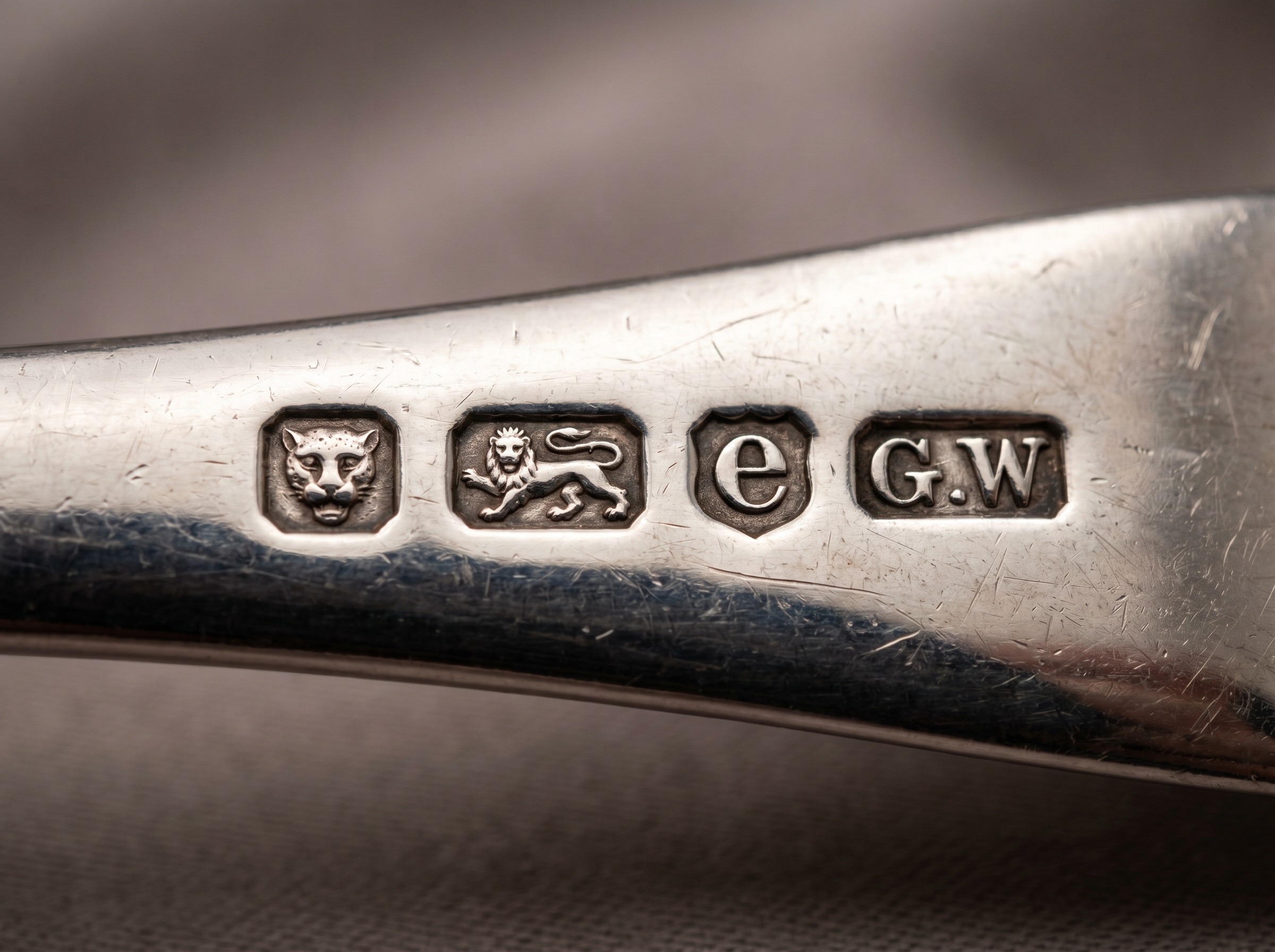
Read a Chester hallmark from left to right: maker's mark, lion passant, the wheatsheaves and sword, the date letter and, between 1784 and 1890, the duty mark.
| Mark | What it tells you |
|---|---|
| Maker's mark | The silversmith's or sponsor's registered initials. |
| Lion passant | Sterling (.925); until 1839 sometimes Britannia. |
| Wheatsheaves and sword | The Chester town mark, 1701 to 1962. |
| Date letter | The year of assay. |
| Duty mark | A sovereign's head, 1784 to 1890. |
The Chester sequence follows the standard English four-mark system. From left to right:
- Maker's mark: the silversmith's or sponsor's registered initials.
- Standard mark: a lion passant (sterling, .925) or, until 1839, sometimes the Britannia figure with .958 silver.
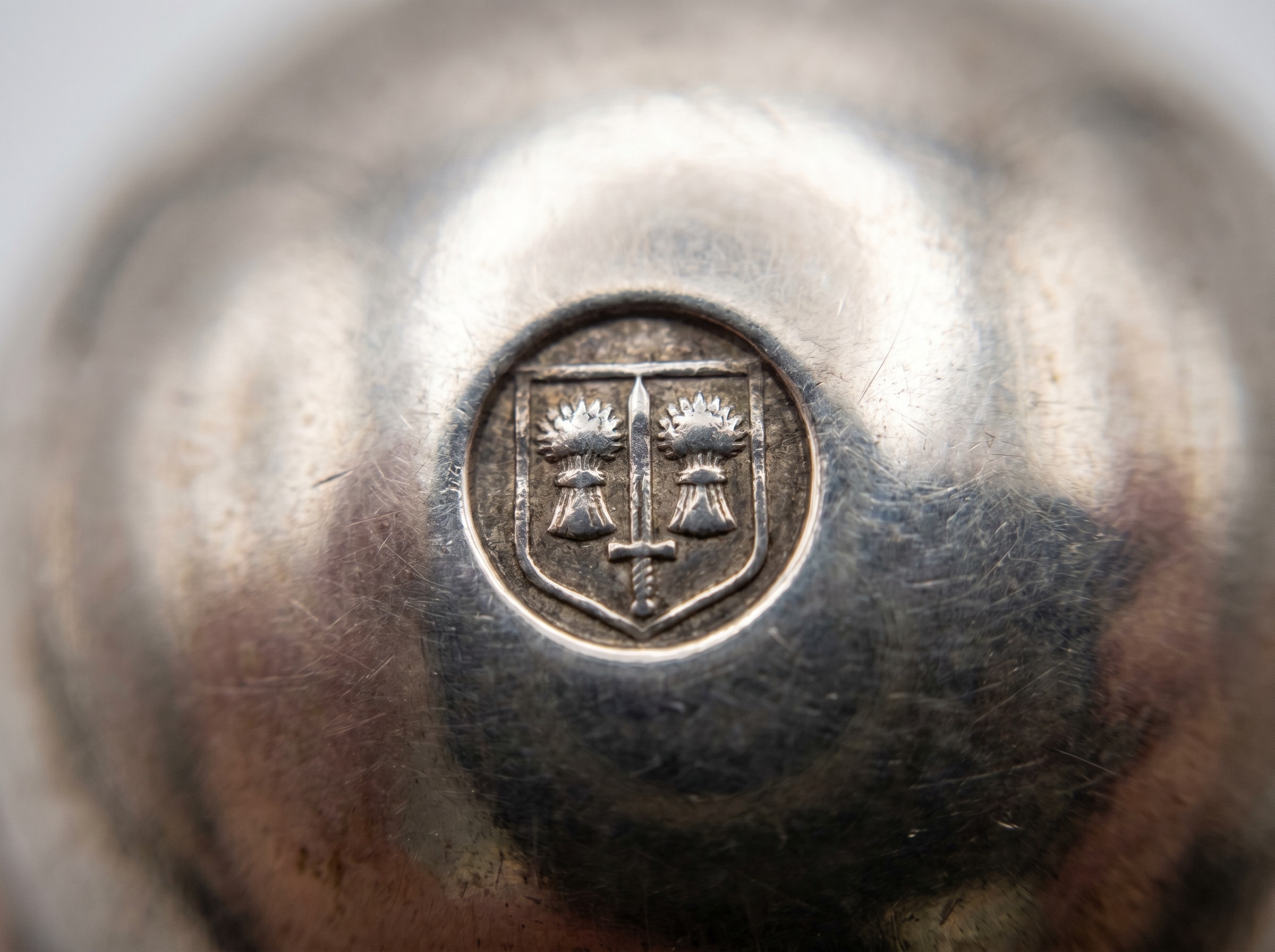
- Town mark: three wheatsheaves grouped around a sword in a shield (from 1701 to 1962). Earlier 17th-century Chester pieces carry a different town mark, three demi-lions and demi-wheatsheaves, used until c.1700.
- Date letter: a single letter in a shaped shield, marking the year of assay.
- Duty mark (1784 to 1890): a sovereign's head.
"Closed in 1962. No new Chester silver: only what already exists. That scarcity is what collectors seek."
The Three Wheatsheaves and Sword Town Mark
Three wheatsheaves grouped around a sword, from the city's arms, is the Chester town mark from 1701 to 1962.
The mark is unmistakable once you know what you are looking at. Three sheaves of corn (wheatsheaves, or in heraldic terms "garbs") arranged around an upright sword, struck into a shaped shield. The shield outline changes with each date-letter cycle, which helps narrow the period. The mark is taken from the arms of the City of Chester, granted by Henry VII.
Earlier Chester silver (pre-1701, occasionally encountered) carries a different town mark altogether: a shield combining demi-lions and demi-wheatsheaves. Genuine pre-1701 Chester pieces are scarce and valuable; if you suspect you have one, professional identification is essential.
Date Letters
Chester used a cyclical date letter system from 1701, with the final cycle running from 1951 to 1962.
Chester used the standard cyclical date letter system from 1701. A new letter each year, a new cycle (usually 20 to 26 letters depending on font) every twenty-odd years, and the shield shape changes between cycles. Reading a Chester date letter is identical to reading a London or Birmingham date letter; you match the letter, font and shield to a standard reference chart.
Final cycle: 1951 to 1962 used letters A through M before the office closed. A Chester hallmark with a 1960, 1961 or 1962 date letter (K, L or M) represents the very last Chester-assayed silver ever made, and is correspondingly collectable.
Why the 1962 Closure Matters: Collector Premium
Because Chester closed in 1962, no new silver can carry the Chester mark, which is why collectors seek it.
Chester is one of only three English assay offices to have closed (Chester 1962, Exeter 1883, Newcastle 1884, York 1858, Glasgow 1964 in Scotland). Closure creates a hard-bounded set of pieces. No new Chester silver can ever exist. For collectors of regional English silver, that finite supply is the entire appeal.
In practical terms, the Chester mark adds collector interest rather than transforming a piece. Pieces by recognised Chester silversmiths and particularly desirable forms (late Victorian and Edwardian Chester silver above all) are the most sought after. Liverpool-made silver in particular benefits, because the city never had its own office.
Notable Chester-Assayed Silversmiths
- Richard Richardson (active mid-18th century): leading Chester maker of his generation.
- Lowe & Son: long-running Chester firm, founded 1770, still trading as Lowe & Sons on Bridge Street.
- Boult & Son, Walker & Hall (some pieces sent to Chester for assay) and James Dixon.
- George Lowe, John Sutter, Pugh & Bayley: recognised Liverpool makers whose silver carries Chester marks.
- Stokes & Ireland, Barker Brothers Silver: Birmingham firms who used Chester assay.
What Chester Silver Looks Like
Chester assayed every category of British silver. Particularly common forms include:
- Christening mugs and small presentation cups: Liverpool and Manchester churches and shipping firms ordered these in volume from local Chester-assayed makers.
- Late Victorian and Edwardian flatware: Chester was a popular alternative to Sheffield and Birmingham for medium-volume cutlery production.
- Photograph frames, dressing-table silver, vesta cases: Edwardian Chester silver is widely encountered.
- Welsh ceremonial silver: Chester served north Wales and assayed civic and chapel pieces from Wrexham, Bangor and Caernarfon.
- Shipping company silver: Liverpool's Cunard, White Star and other shipping lines commissioned Chester-assayed presentation silver.
Pitfalls
The common Chester pitfalls are worn wheatsheaves misread as castles, confusion of pre- and post-1701 marks and forgotten duty marks.
- Misreading the wheatsheaves as something else: worn Chester marks can be confused with Newcastle's three castles or even Edinburgh's three-towered castle. The sword in the centre is the giveaway.
- Mixing up pre- and post-1701 Chester marks: the demi-lions/demi-wheatsheaves mark used before 1701 is genuinely rare and specialist territory.
- Forgetting the duty mark: a Chester piece without a duty mark either predates 1784 or postdates 1890. Combined with the date letter, this brackets the period instantly.
- Late Chester (1950 to 62) forgeries: uncommon but encountered. The closing years are well-documented and any unusual maker's punch should be checked against reference.
What We Look For When Chester-Marked Silver Arrives
When Chester-marked silver arrives we read the full row of marks, check the wheatsheaves and sword against the right period, and use the date letter and duty mark to date it.
Then we look at the maker, often a Chester or Liverpool silversmith, and at condition.
Got Chester-Hallmarked Silver to Sell?
Active buyer of Chester-marked silver: Christening mugs, presentation cups, flatware, Welsh ceremonial pieces, Liverpool shipping silver. By appointment in Mayfair or by free FedEx collection. Same-day payment.
- Send photosUse the form on this page, or email them to us.
- A specialist reviews itMaker, marks, age and condition.
- Free estimate by emailWithin one working day.
- You decidePaid once agreed. No obligation.
Four ways to sell: Mayfair (by appointment), Braintree (by appointment), Royal Mail Special Delivery, free FedEx collection.
Free valuation
Request a free valuation
Send us a few photos of your Chester silver. A specialist looks at every request personally and replies by email with an estimate within one working day. There is no obligation to sell.
What to photograph
- The whole piece. The whole piece, from the front and the side.
- The underside. The base or reverse, where the marks usually are.
- The hallmarks, close up. Every mark in the group, in focus, including the maker's mark.
Prefer email? Send photos to info@mozerisfineantiques.com or call 01376 334 482.
Ways to sell
- Mayfair (by appointment)
- Braintree (by appointment)
- Royal Mail Special Delivery
- Free FedEx collection
We buy directly, with payment once you accept our offer, and we can also sell for you by consignment or in our own auctions.
Related Reading
Frequently Asked Questions
What is the Chester Assay Office hallmark?
When did the Chester Assay Office close?
Is Chester silver worth more than London or Birmingham silver?
Why did Liverpool silver carry Chester marks?
How do I tell Chester from Newcastle marks?
Will you tell me what my Chester silver is worth?
Selling Chester-Hallmarked Silver?
Active buyer of Chester silver. Mayfair showroom by appointment or free FedEx collection. Same-day payment.
Strictly by appointment only: no walk-ins at either location.
Items we buy
Antique Silver We Specialise In
Click any category for our specialist buying guide, then send photos for a free valuation. We also have a full Sell Your Silver overview.