
Sell Your
Georg Jensen
Silver
Specialist buyers of Georg Jensen sterling silver — flatware in Acorn, Blossom and Lily of the Valley, hollowware, and jewellery. We price against the collector market, not the melt.
Looking for Georg Jensen Silver?
Explore our curated collection of Georg Jensen flatware, hollowware, and jewellery available for purchase.
Browse Our Silver →Have Georg Jensen to Sell?
Free specialist valuation. We identify your pattern, assess production era, and offer collector-market prices.
Get a Free Valuation →Get a Quick Valuation
Not sure what your Georg Jensen pieces are worth? Send us photos — we identify the pattern, date the production era, and come back with a realistic collector-market estimate. No obligation.
Why Georg Jensen Commands a Collector Premium
Georg Jensen (1866–1935)
Georg Jensen founded his Copenhagen silversmith workshop in 1904, having trained as both a goldsmith and a sculptor. His work stood apart from the prevailing Victorian and Edwardian silver for its organic, hand-modelled forms — naturalistic motifs drawn from nature rather than imposed geometric patterns — and for a distinctive matte, hammered finish that rejected the polished formality of mainstream silverware.
Jensen's flatware patterns, developed from 1906 onwards, became some of the most collected silverware in the world. Patterns such as Acorn (1915), Blossom (1919), and Lily of the Valley (1900) remain in continuous production over a century later. Vintage pieces from the first half of the 20th century command a substantial premium over later production on the secondary market.
The firm attracted major designers across the 20th century — Johan Rohde, Harald Nielsen, Sigvard Bernadotte, Henning Koppel, Vivianna Torun Bülow-Hübe — each adding a chapter to the brand's design legacy and creating individual collector markets within the Georg Jensen world.
What We Look For First
- Pattern — Acorn, Blossom, Lily of the Valley, Cactus, Pyramid, Beaded
- Production era — pre-1940 Danish-hallmarked pieces command the highest premiums
- Completeness — a full service with matching serving pieces is worth considerably more than the sum of parts
- Condition — light use marks are expected and acceptable; deep scratches or polishing damage reduce value
- Original case or box — adds modest value but is not required
Georg Jensen Flatware Patterns & Their Collector Value
Not all Georg Jensen patterns are equal on the secondary market. Vintage pre-war production in desirable patterns can be worth many multiples of later pieces in lesser-collected designs.
Acorn (No. 62)
The most collected Georg Jensen flatware pattern worldwide. Characterised by the acorn finial and leaf collar, with extraordinary modelling. Pre-1940 pieces command the highest premiums.
Highest Collector DemandBlossom (No. 104)
The distinctive floral terminal makes Blossom among the most recognisable Jensen flatware. Earlier Danish-hallmarked production is valued above post-war sterling-marked pieces.
High Collector DemandLily of the Valley (No. 5)
The earliest and most organic of Jensen's flatware designs. Its delicate bell-flower motif reflects Jensen's sculptural training. Pre-war production in this pattern is rare and sought-after.
Rare · Strong PremiumCactus (No. 30)
Nielsen's Cactus pattern has a following of its own — slightly stiffened, Art Deco-inflected forms. Collected both as flatware and as an aesthetic object in its own right.
Good Collector InterestBeaded (No. 7)
The Beaded pattern is among Jensen's simplest and most versatile designs — a string of beads bordering the handle. Wide collecting base; condition and set completeness are key.
Steady Collector DemandPyramid (No. 15)
A Modernist departure for Jensen — rectilinear, geometric, stripped of organic motifs. Collected by those drawn to Scandinavian mid-century modernism.
Modernist AppealGeorg Jensen Items We Purchase
Flatware & Cutlery
- Individual pieces in all patterns
- Part sets and complete canteens
- Service sets with original cases
- Rare patterns and early production
- Serving pieces: ladles, cake slices, fish servers
Hollowware & Objects
- Pitchers and jugs (Koppel and others)
- Bowls, dishes, and centrepieces
- Coffee and tea services
- Candlesticks and candelabras
- Decorative objects and vases
Jewellery
- Brooches — floral, figural, abstract
- Necklaces and pendants
- Cuff links and tie clips
- Koppel and Torun designs
- Early pre-war sterling pieces
Estate & Collection Items
- Inherited Jensen sets and pieces
- Collections being dispersed
- Items without original boxes
- Unidentified pattern pieces — we identify them
- Mixed condition pieces — honest assessment
Indicative Values for Georg Jensen Pieces
Georg Jensen silver is sold on collector premium, not scrap value. The table below gives indicative secondary market ranges based on current dealer and auction data.
| Item / Pattern | Indicative Range | Key Value Factor |
|---|---|---|
| Acorn dinner fork (pre-1940) | £80 – £200 | Early hallmarks, condition |
| Acorn table service (12 settings, complete) | £3,500 – £12,000+ | Completeness, vintage production |
| Blossom dinner fork | £60 – £160 | Date of production, condition |
| Lily of the Valley piece (vintage) | £100 – £300+ | Rarity, pattern originality |
| Koppel pitcher / jug | £800 – £4,000+ | Model, condition, date |
| Sterling brooch (vintage) | £120 – £800 | Designer, motif, condition |
| Coffee or tea service | £2,000 – £15,000+ | Pattern, completeness, date |
| Candlesticks (pair) | £600 – £4,000 | Model, hallmarks, condition |
Values are indicative and depend on current market conditions. Learn more about silver hallmarks →
Early vs Later Georg Jensen — Why Era Matters
Vintage Georg Jensen produced before the 1950s typically commands a significant premium over post-war and modern production — even in identical patterns. Understanding these differences helps you know what you have.
Early Period
- Hand-finished with visible tool marks and slight irregularities
- Danish crown hallmark with GJ in oval and assay marks
- Heavier gauge silver, often slightly thicker feel
- Pattern numbers stamped in older typeface
- Warmer, slightly greyer silver tone from period alloy
Later & Current Period
- More uniform finish from mechanised production methods
- STERLING or 925S mark; no crown; later GJ oval style
- Pattern and quality remain high — still genuine Jensen
- Pattern numbers in modern typeface
- Brighter, more consistent silver appearance

Identifying Genuine Georg Jensen Hallmarks
What to Look For
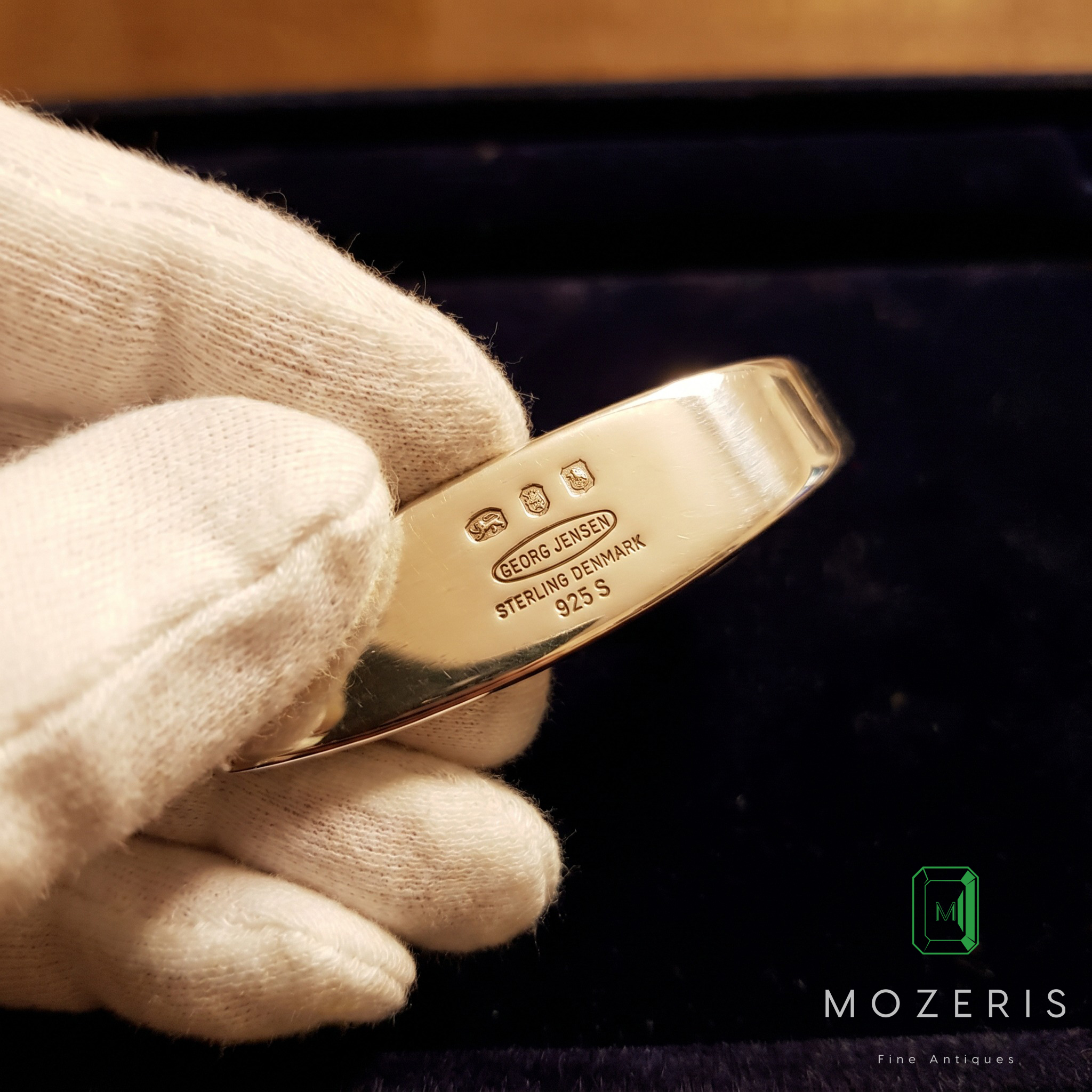
Genuine Georg Jensen sterling silver carries a distinctive set of marks. Early Danish production (pre-1945) is typically marked with the GJ logo within an oval or cartouche, the word STERLING, and sometimes a date letter or assay mark. UK-imported Jensen pieces may carry additional British hallmarks.
The pattern number is often stamped on the reverse of flatware handles — "62" for Acorn, "104" for Blossom, "30" for Cactus. This is one of the most reliable identification tools. Send us photos of the marks and we will identify the piece definitively at no charge.
GJ Oval Mark
The Georg Jensen maker's mark — an oval cartouche with "GJ" or "GEORG JENSEN". Present on all genuine pieces.
STERLING / 925
Confirms sterling silver (92.5% pure). Most Jensen pieces marked STERLING or 925S explicitly.
Pattern Number
Usually on the reverse. Cross-reference with known pattern lists to confirm design and era of production.

How to Photograph Your Marks
Good photos of the marks on your Georg Jensen pieces allow us to identify the pattern, date the production era, and give a realistic valuation — all before you send anything to us.
- Place piece flat on a neutral background in natural daylight — no flash
- Photograph the reverse of the handle, showing all stamped marks
- Take a separate photo of any pattern number on the back
- Include a full-length shot of the piece for pattern identification
- Email photos to info@mozerisfineantiques.com with a brief description
How to Sell Your Georg Jensen Silver
Send Photos
Email photos of the marks, pattern reverse, and overall piece. We identify pattern and production era.
Receive Estimate
We reply with a realistic collector-market indicative value — based on secondary market data, not scrap.
Post or Visit
Use our free insured postal service or book an appointment at our Mayfair or Braintree location.
Same-Day Payment
Formal offer confirmed on inspection. Accept and receive bank transfer the same day — no delays.
What Sellers Say
I had a partial Acorn service from my grandmother's estate. The team identified each piece, dated the production era, and gave a proper collector valuation — far above what a jeweller had suggested as scrap silver.
Sold a Koppel jug I'd inherited. I had no idea it was significant. They identified the model, explained the market, and made a fair offer well above my expectations. Completely transparent throughout.
Used the postal service for a collection of Jensen brooches. They identified each piece by designer, described the collector market for each, and paid promptly. Professional and specialist.
Questions About Selling Georg Jensen Silver
Guides for Silver Sellers
Antique Silver Hallmarks Guide
How to read British and continental silver hallmarks — assay offices, date letters, maker's marks, and purity marks explained.
Selling Silver Cutlery
A guide to selling antique and vintage silver cutlery — hallmarks, patterns, and what to expect.
Selling Mappin & Webb Silver
Royal Warrant holders since the 19th century — how Mappin & Webb sterling is valued and what we pay.
Selling Antique Silver Tea Sets
What makes a silver tea service valuable — maker, pattern, completeness and condition explained.
Get a Georg Jensen Valuation
Send photos of your pieces — marks, pattern reverse, overall condition. We identify the pattern, assess the date, and respond with a realistic collector-market estimate. No obligation, no cost.
Or fill in the form and we'll respond promptly: