UK Hallmark Authority · Anchor Since 1773
The Birmingham Assay Office: Complete Guide
The Birmingham Assay Office, founded in 1773 with the support of Matthew Boulton, is Britain's busiest assay office. Its town mark is an anchor. A full Birmingham hallmark shows the maker's mark, the lion passant or Britannia, the anchor, a date letter and, from 1784 to 1890, a duty mark.
Reviewed by Faustas Svencionis, Mozeris Fine Antiques, since 2015 · Updated October 2026
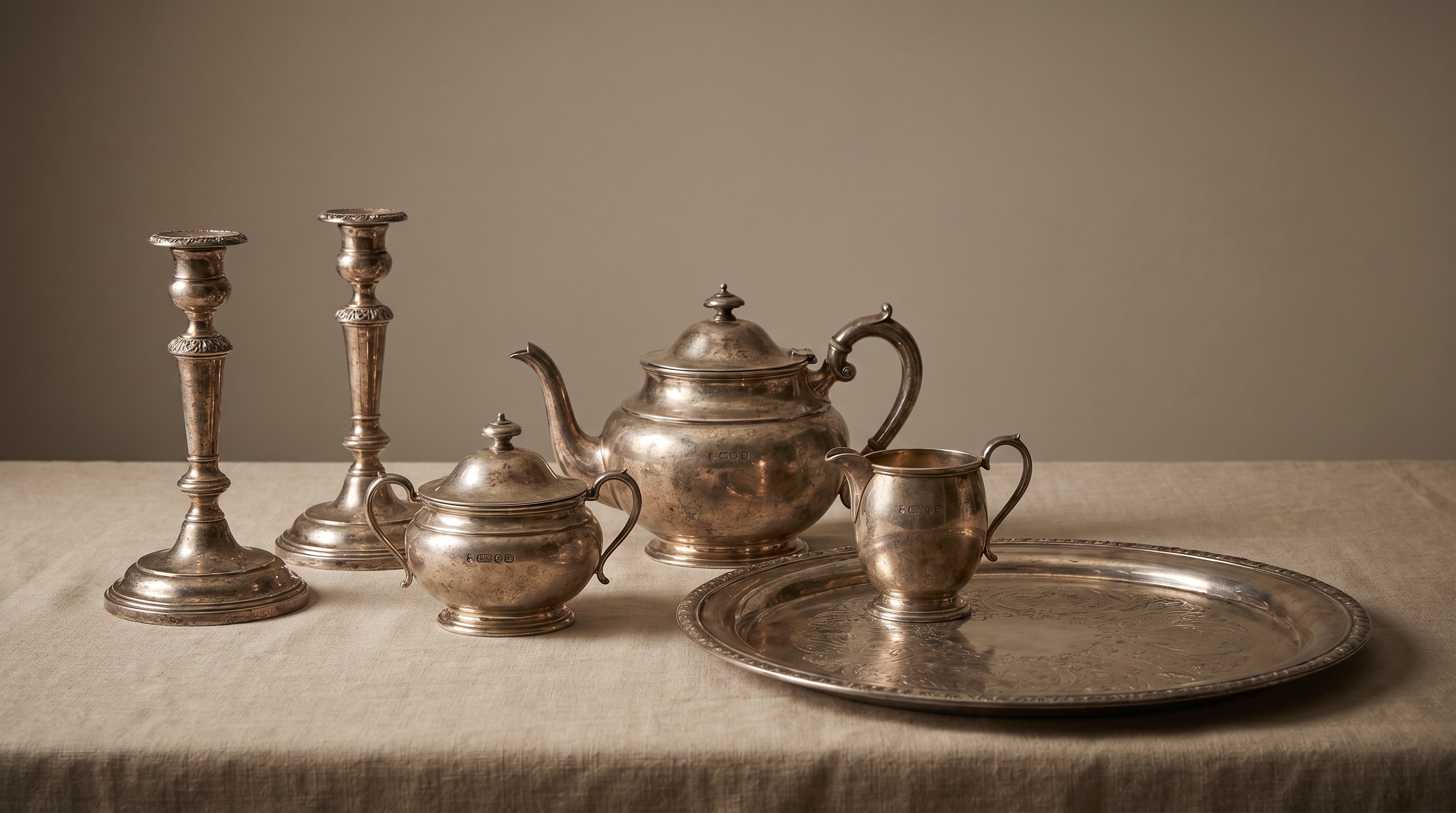
A specialist's guide to Britain's busiest assay office, the famous anchor town mark, the Jewellery Quarter's silversmiths, and how to read sterling, Britannia and duty marks on Birmingham-hallmarked silver.
Got Birmingham-Marked Silver? We'll Identify and Value It Free
Send photos of your hallmarks and we'll tell you the year, maker and standard, and what your silver is worth on today's market. Reply within one working day.
The Birmingham Assay Office is the world's busiest silver and precious-metal assay office, and its anchor town mark sits on a vast share of British silver, jewellery and giftware made since 1773. The office was founded by Act of Parliament, won for the city by the industrialist Matthew Boulton, to spare Birmingham silversmiths the journey to Chester or London, and within decades the city's Jewellery Quarter became the centre of the British silver trade. Understanding the Birmingham hallmark is essential for valuing British silver from the late Georgian period onward.
This guide explains the office's history, the anchor itself, the full Birmingham hallmark sequence, the date-letter system, sterling and Britannia standards, duty marks and the most common pitfalls when attributing Birmingham silver and jewellery.
A Brief History: Matthew Boulton and the Anchor
The Birmingham Assay Office was founded by Act of Parliament in 1773, won for the city by Matthew Boulton.
Until 1773 silver made in Birmingham had to be sent to Chester for assay: a 70-mile round trip that, according to local lore, lost as much silver to highway robbery as to the assay shavings. Matthew Boulton, of the famous Soho Manufactory, led a successful Parliamentary campaign and the Birmingham (and Sheffield) Assay Offices were established by Act in 1773.
The legend that the Birmingham and Sheffield town marks (an anchor for Birmingham and a crown for Sheffield) were chosen by the toss of a coin at the Crown & Anchor Tavern on the Strand in London is endlessly repeated. It is probably apocryphal, but the marks have remained unchanged since. The anchor is therefore the single defining mark of Birmingham-assayed silver, recognised globally and used on everything from canteens of cutlery and tea services to wedding rings.
How to Read a Full Birmingham Hallmark
Read a Birmingham hallmark from left to right: maker's mark, standard mark, the anchor, the date letter and, between 1784 and 1890, the duty mark.
| Mark | What it tells you |
|---|---|
| Maker's mark | The silversmith's or retailer's initials in a shaped shield. |
| Lion passant | Sterling (.925); a Britannia figure for .958. |
| Anchor | The Birmingham town mark. |
| Date letter | The year of assay. |
| Duty mark | A sovereign's head, 1784 to 1890 only. |
A complete Birmingham hallmark is a row of small punches struck on a discreet part of the piece, the underside of a base, the bezel of a small box, the inside of a ring shank. From left to right, the standard sequence is:
- Maker's (sponsor's) mark: the silversmith or retailer's initials in a shaped shield.
- Standard mark: a lion passant (sterling, .925) or Britannia figure (Britannia, .958).
- Town mark: an anchor, confirming Birmingham assay.
- Date letter: a single letter in a shaped shield indicating the year of assay.
- Duty mark (1784 to 1890 only): a sovereign's head, struck to show duty had been paid.
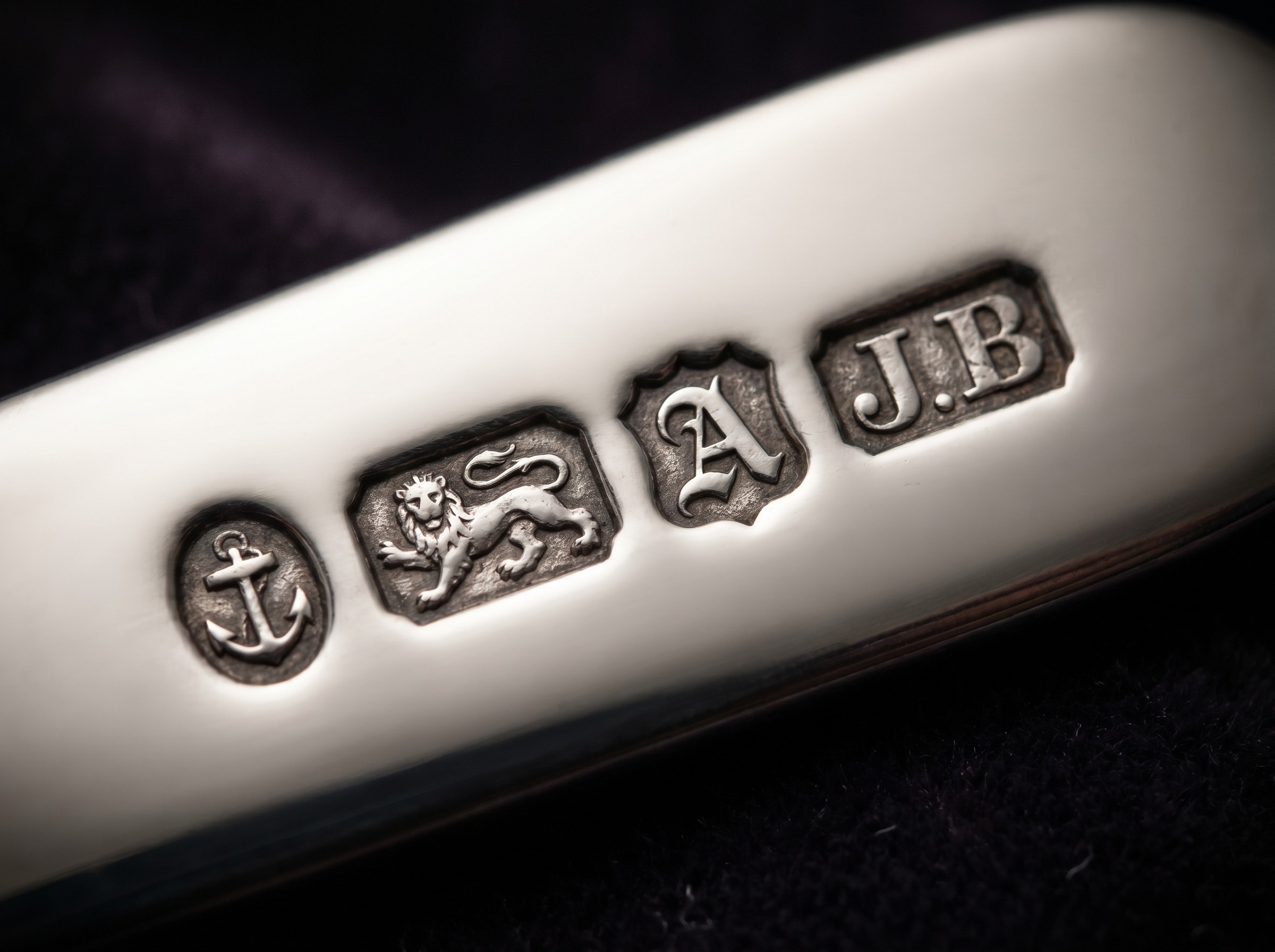
"Five marks, one anchor. The Birmingham row tells you who made it, what standard, where assayed, when, and whether duty was paid."
The Anchor, Up Close
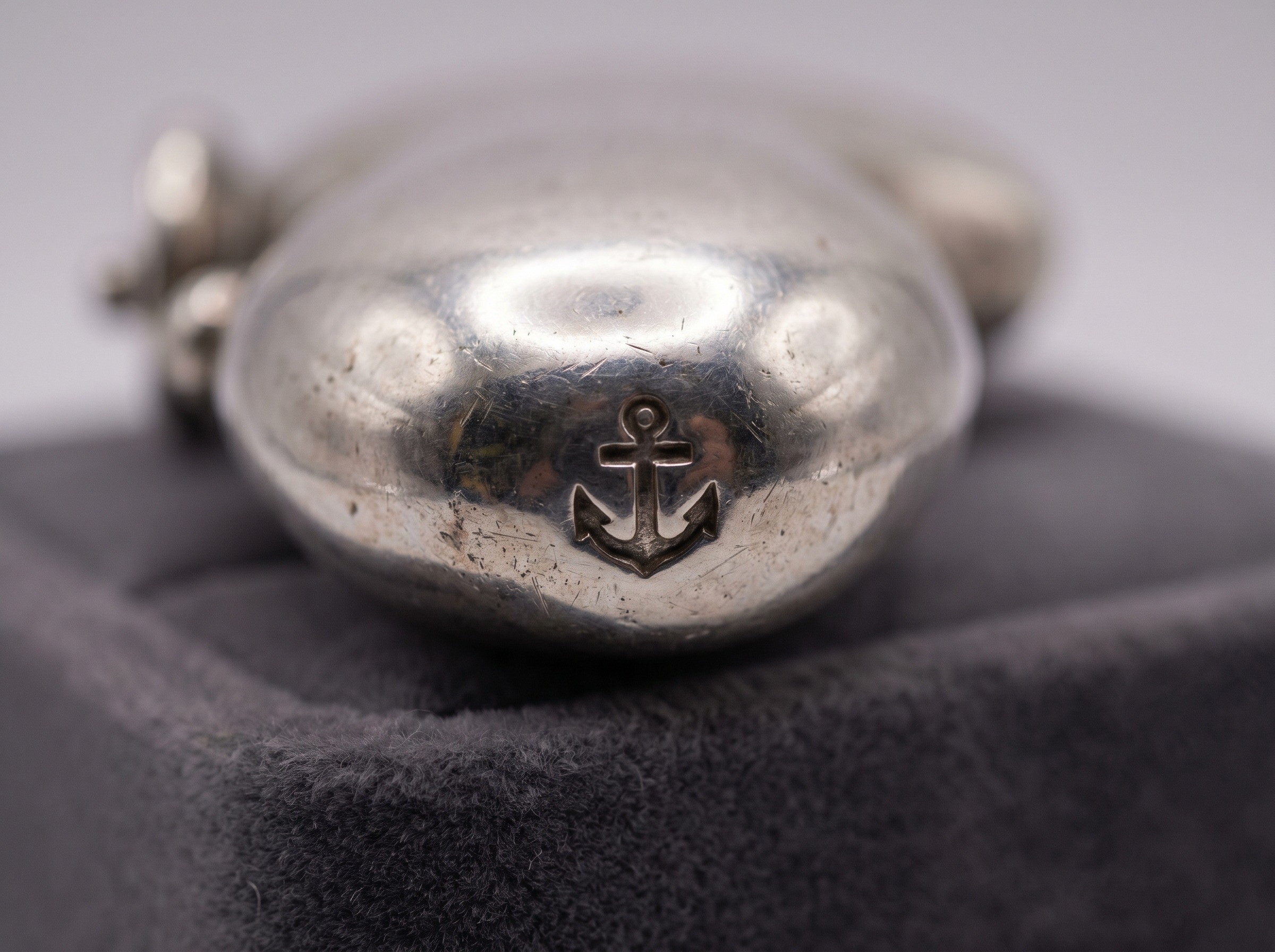
The anchor is the Birmingham town mark, struck upright on silver.
The Birmingham anchor is unmistakable: a vertical-shanked anchor with cross-stock, struck within a shaped shield. Over the centuries the shield outline has shifted (rectangular and rounded variants), but the anchor itself has not changed. On worn pieces, the anchor often survives best because of how deeply the punch is struck. Counterfeit Birmingham silver is usually given away by a flat or "printed" anchor without surrounding displaced metal at the punch edge.
The Date Letter System
The Birmingham date letter changes each year, and the letter style and shield shape change with each cycle.
Birmingham changed its date letter every July (1 July, originally; the practice has evolved). Each cycle runs through letters of the alphabet, with the shield shape, letter style and case all changing at the start of the next cycle. As with London, that combination of letter, shield and font is what dates a Birmingham piece exactly. The same letter recurs every 25 years (Birmingham used a 25-letter cycle for much of its history) so the shield style is critical.
| Cycle | Years | Style |
|---|---|---|
| Roman capitals | 1773 to 1798 | Founding cycle: Matthew Boulton era |
| Roman lower-case | 1798 to 1823 | Regency period |
| Roman capitals | 1824 to 1849 | William IV & early Victorian |
| Roman lower-case | 1850 to 1874 | Mid-Victorian |
| Black letter caps | 1875 to 1899 | Late Victorian / Aesthetic |
| Roman capitals | 1900 to 1924 | Edwardian / early 20th century |
| Roman lower-case | 1925 to 1949 | Art Deco & mid-century |
| Roman capitals | 1950 to 1974 | Post-war |
| 1975 onward | A from 1975, annual | Modernised cycle under 1973 Hallmarking Act |
A letter alone is rarely enough: match it to the shield shape and font cycle. Send us photographs of the marks and we will date them for you.
Sterling and Britannia Standards
Birmingham assays both standards:
- Sterling: .925 (92.5% silver), marked with a lion passant. The default standard.
- Britannia: .958 (95.84% silver), marked with a seated Britannia figure. Birmingham only began offering Britannia assay relatively recently compared with London, but high-end modern pieces are sometimes Britannia-marked.
For most antique Birmingham silver (the great mass of Georgian, Victorian and Edwardian production) you will see the lion passant: sterling at .925.
Duty Marks: The Sovereign's Head
The sovereign's head duty mark shows that duty was paid on silver assayed between 1784 and 1890.
Between 6 December 1784 and 30 April 1890, the British government levied a duty on hallmarked silver and the Assay Office added a fifth mark: a small profile of the reigning sovereign. Birmingham used the same duty-mark sequence as London:
- George III: 1784 to 1820 (incuse, small, then larger).
- George IV: 1820 to 1830.
- William IV: 1830 to 1837.
- Victoria (young head): 1837 to early 1890.
From May 1890 the duty mark vanishes. Post-1890 Birmingham silver therefore shows four marks; pre-1890 pieces show five.
The Jewellery Quarter and Birmingham's Speciality
The Birmingham Assay Office's huge output reflects what the Jewellery Quarter actually made. London specialised in fine domestic and presentation silver; Birmingham specialised in small silver, jewellery, novelty and giftware: vesta cases, snuff boxes, card cases, pencils, scent bottles, cigarette cases, mounted jugs and condiments, silver-mounted writing equipment, christening sets, wedding rings, brooches and chains. If you have a small silver object, the chances are it carries an anchor.
That specialisation also explains why Birmingham assays more articles by volume than the other UK offices combined: the Jewellery Quarter remains the production centre for UK silver jewellery today.
The Modern Birmingham Hallmark
The 1973 Hallmarking Act unified UK assay procedure. From January 1999 the date letter became optional (most makers still include it). The 1999 Convention introduced an additional common control mark for international trade. Since 2007 a millennium "M" mark appears on commemorative items. The Birmingham anchor remains constant. The Assay Office is now based in Newhall Street and processes millions of articles a year.
Notable Birmingham Silversmiths
A selection of Birmingham-marked names worth identifying:
- Matthew Boulton & the Soho Manufactory: the office's founding figure; Boulton-marked silver is highly collectable.
- Nathaniel Mills (1825 to 1856): the king of "castle-top" silver vinaigrettes, card cases and snuff boxes with relief-cast views of famous buildings.
- Hilliard & Thomason: fine vinaigrettes and small silver.
- Joseph Willmore, Edward Smith, Yapp & Woodward: all important Birmingham small-silver makers.
- Elkington & Co: pioneers of electroplate (most "EPNS" marks are theirs), but they also produced significant sterling silver under Birmingham marks.
- Liberty & Co Cymric range (Archibald Knox designs): early 20th century Arts & Crafts pieces with the anchor.
Nathaniel Mills castle-top pieces in particular are valued as antiques, not by weight; never sell a "Mills" vinaigrette as scrap.
Pitfalls and Forgeries
The common Birmingham pitfalls are misread date letters, plate sold as sterling and transposed marks.
- EPNS, A1, EP, "Silver on Copper": these are not Birmingham hallmarks. They are electroplate marks (often Elkington's) and contain no solid silver. Birmingham did not assay plated wares.
- Re-let-in marks: a genuine anchor cut from a damaged piece and soldered into a new (often plated) base. Look for a faint solder ring around the marks.
- Cast hallmarks: real marks are struck and show metal displacement at punch edges. Cast or transferred marks are recessed without that flow.
- Date letter / maker mismatch: a maker's mark used outside their dates is a clear giveaway.
- Worn marks: the anchor usually survives best because of punch depth. Even on rubbed pieces, the anchor and lion are normally still readable.
What We Look For When Birmingham-Marked Silver Arrives
When Birmingham-marked silver arrives we read the full row of marks, the maker's mark, the standard mark, the anchor and the date letter, and check for a duty mark on pieces from 1784 to 1890.
Then we look for the makers whose work is valued as antiques rather than by weight, such as Nathaniel Mills, and check condition before anything else.
Got Birmingham-Hallmarked Silver to Sell? We Buy It Daily
We buy Birmingham-assayed sterling and Britannia silver of every period, Georgian, Regency, Victorian, Edwardian and twentieth-century. By appointment in Mayfair or by free FedEx collection. Same-day payment.
- Send photosUse the form on this page, or email them to us.
- A specialist reviews itMaker, marks, age and condition.
- Free estimate by emailWithin one working day.
- You decidePaid once agreed. No obligation.
Four ways to sell: Mayfair (by appointment), Braintree (by appointment), Royal Mail Special Delivery, free FedEx collection.
Free valuation
Request a free valuation
Send us a few photos of your Birmingham silver. A specialist looks at every request personally and replies by email with an estimate within one working day. There is no obligation to sell.
What to photograph
- The whole piece. The whole piece, from the front and the side.
- The underside. The base or reverse, where the marks usually are.
- The hallmarks, close up. Every mark in the group, in focus, including the maker's mark.
Prefer email? Send photos to info@mozerisfineantiques.com or call 01376 334 482.
Ways to sell
- Mayfair (by appointment)
- Braintree (by appointment)
- Royal Mail Special Delivery
- Free FedEx collection
We buy directly, with payment once you accept our offer, and we can also sell for you by consignment or in our own auctions.
Related Reading
Explore other UK assay offices and item-specific guides to read your silver correctly:
Frequently Asked Questions
Reading Birmingham hallmarks: common questions.
What does the anchor hallmark mean?
How do I date a Birmingham-marked piece?
Is Birmingham silver less valuable than London silver?
Why does my Birmingham piece have an extra small monarch's head?
Is "EPNS" Birmingham silver?
Will you tell me what my Birmingham silver is worth?
Selling Birmingham-Hallmarked Silver?
Free FedEx collection. Same-day payment.
Strictly by appointment only: no walk-ins at either location.