
Sell Your Silver Tea Set
To Expert Buyers
Georgian, Victorian and Edwardian silver tea services bought at prices that reflect their true collector value — not just the melt weight. Free valuation, no obligation, payment on agreement.
Request Your Free Valuation
Describe your tea set and we'll get back to you with an honest assessment. Strictly by appointment — no walk-ins at either showroom.
⚠️ Strictly by appointment only — no walk-ins at either showroom.
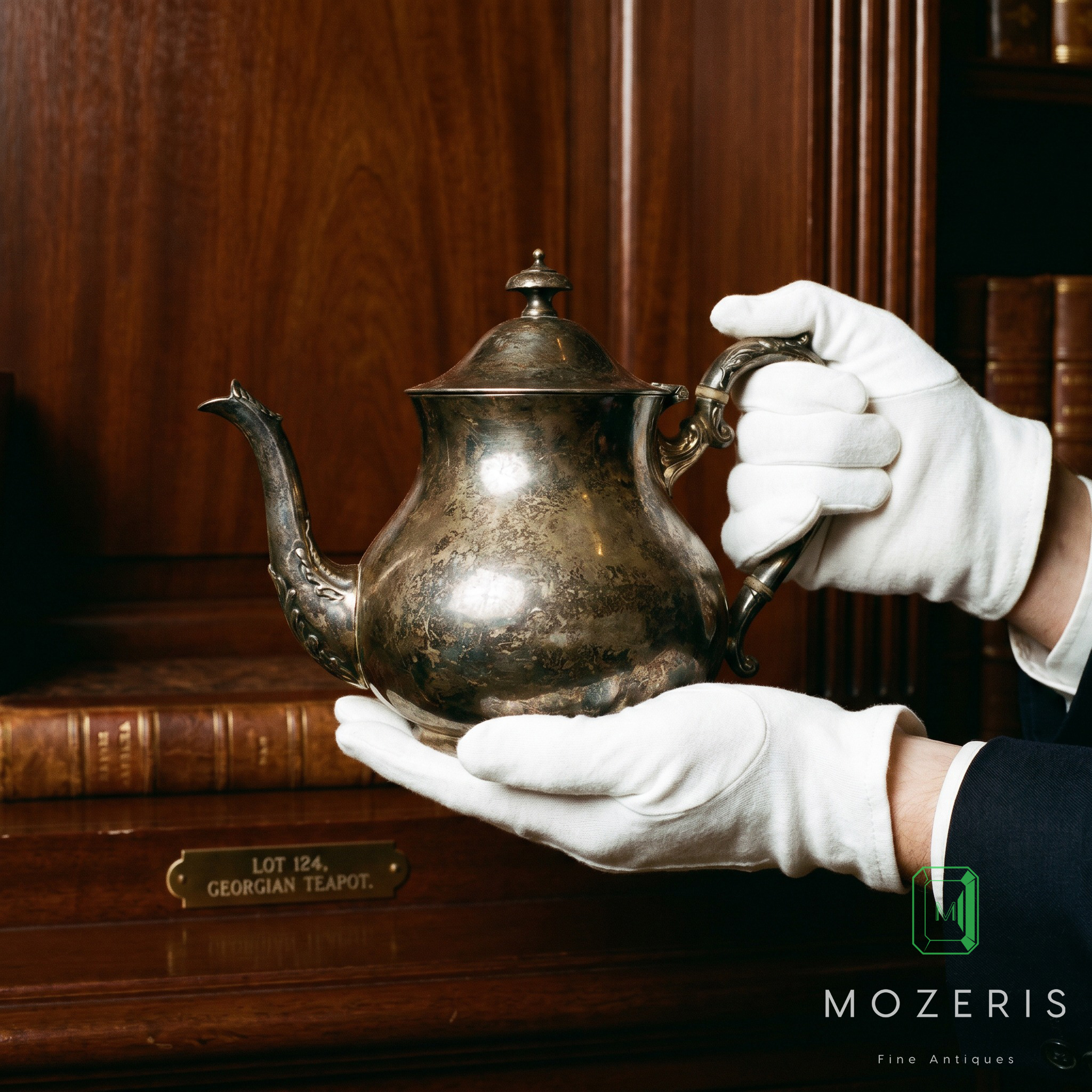
What We Look For in a Silver Tea Service
A silver tea set is rarely just a collection of silver. To a specialist buyer, each piece tells a story — the maker, the period, the hallmarks, the quality of the chasing and the condition all combine to determine what a serious collector or dealer would actually pay.
A high-street jeweller or scrap dealer will assess your tea service on its silver weight alone. We look at everything: the date letters, the maker's mark, the style of decoration, the completeness of the set and the current market for comparable services. The difference in offer can be substantial.
We buy tea sets of all sizes — from a simple three-piece (teapot, cream jug, sugar bowl) to grand six- and seven-piece services with matching tea urn and tray.
Types of Silver Tea Set We Buy
We buy silver tea services from all periods and makers — from simple Victorian sets to grand Georgian services by the finest London silversmiths.
Georgian Silver Tea Services
Pre-1830 silver tea services in the classical, neoclassical or rococo styles. Often by named London makers such as Paul Storr, Hester Bateman or Robert Garrard. Highly collectible and among the most valuable sets we buy.
Victorian Silver Tea Sets
The most commonly encountered antique tea services. Quality ranges widely — from simple plain sets by Sheffield makers to elaborate melon-fluted and repousse services by Mappin & Webb, Walker & Hall and other leading retailers.
Edwardian & Art Nouveau Sets
Tea services from the 1900–1915 period, often with elegant lobed or reeded forms. Art Nouveau examples with naturalistic ornament are particularly sought after. Many by Goldsmiths & Silversmiths Company or Liberty.
Named Silversmith Services
Sets bearing the marks of celebrated silversmiths command significant premiums. Paul Storr, Hester Bateman, Paul de Lamerie, John Emes and Robert Garrard are among the makers whose work we actively seek.
Complete Services with Tray
A complete silver tea service including the matching tray is considerably more valuable than the component pieces sold separately. If you have a matching tray, salver or waiter, always include it in your enquiry.
Partial & Unmatched Sets
We buy individual pieces — a single Georgian teapot, a Victorian cream jug — as well as later-assembled sets. If you're not sure whether pieces belong together, bring them all. We'll assess the whole collection.
How the Valuation Process Works
Four straightforward steps from first enquiry to payment in your account.
Send Us Photos
Use the form above or email photos of your tea service including the hallmarks on each piece. Clear images of the base of the teapot and underside of the tray are especially helpful.
Receive Your Estimate
We'll review your photos and come back to you with an honest range. We take the time to research comparable sales rather than giving you a reflexive low offer.
Book an Appointment
If the estimate looks promising, bring the set to our London or Essex showroom. We'll examine it in full, confirm the hallmarks and make you a formal offer on the day.
Payment on Agreement
If you accept our offer, we pay immediately by bank transfer. No waiting, no processing delays. If you decide not to proceed, there is no charge for the valuation.

What Determines the Value of Your Silver Tea Set?
Six factors our specialists examine when assessing every silver tea service.
The Maker's Mark
Named London or provincial silversmiths command the highest premiums. A set by Paul Storr can be worth ten times more than an anonymous set of the same weight and period.
Date & Period
Georgian silver (pre-1830) consistently achieves the strongest prices. Early Victorian sets in classical forms are also highly sought. Later Victorian and Edwardian sets vary widely by maker and quality.
Weight & Silver Content
Sterling silver (92.5% pure) is always valued against the live spot price. However, for quality antique services, the collector premium typically far exceeds the melt value.
Completeness of the Set
A complete matched service — teapot, hot water jug, cream jug, sugar bowl, waste bowl and tray — is worth significantly more than the same pieces sold individually or as a partial set.
Condition
Light surface wear and natural patina are expected and acceptable. Heavy dents, repaired cracks or later inscriptions reduce value. Unpolished original surfaces are often preferable to over-polished pieces.
Decoration & Style
Elaborate repousse floral decoration, armorial engraving and bright-cut ornament all add value when well-executed. Plain, undecorated surfaces in good condition are equally desirable in the right period.

Reading the Hallmarks on Your Tea Service
British sterling silver is among the most thoroughly hallmarked metalwork in the world. Every piece struck in England from the 14th century onwards was required by law to carry a series of marks confirming the metal standard, the assay office, the year of manufacture and the maker.
Understanding the hallmarks on your tea set helps establish exactly when and where it was made — and by whom. This is one of the first things we check when assessing a service.
| Mark | What it tells us |
|---|---|
| Lion Passant | Sterling standard — 92.5% silver. Present on all English sterling from 1544 |
| Date Letter | Precise year of hallmarking — changes annually, different per assay office |
| Assay Office Mark | Leopard's head (London), anchor (Birmingham), crown (Sheffield) |
| Maker's Mark | Initials of the silversmith or manufacturing firm who registered the piece |
| Sovereign's Head | Duty mark, used 1784–1890 — confirms duty was paid to the Crown |
Frequently Asked Questions
Common questions from clients looking to sell their silver tea services.
How do I know if my tea set is solid silver or silver plate?
Solid sterling silver will be hallmarked with a lion passant and a date letter. Silver-plated items carry marks such as EPNS (electroplated nickel silver), EP, or EPBM — and no lion passant. Sheffield Plate, made from 1740–1840, has its own distinct marks. If you're unsure, send us photos of the base of each piece and we'll identify them for you.
Does it matter if the set is incomplete?
Completeness significantly affects value, but we buy both complete and partial sets. A single Georgian teapot by a named maker can still be worth a considerable sum. Send us what you have — we'll value every piece individually and as a group.
My tea set has a family crest or inscription. Does that reduce the value?
Not necessarily. A fine heraldic engraving or original family crest can actually enhance the historical interest and value of a piece — particularly on Georgian silver. Later-added or amateur inscriptions can reduce value slightly, but rarely dramatically. We'll assess each case individually.
Can I send my tea set by post?
For something as valuable as a silver tea service, we strongly recommend an in-person appointment rather than postal submission. We can arrange a FedEx home collection service for clients who cannot travel to either showroom — contact us to discuss.
What if I decide not to sell after the valuation?
There is absolutely no obligation to sell. Our valuations are free, and if you choose not to proceed, your property is returned to you immediately. Many clients simply want to understand what they have — that is completely fine.
Do you buy silver-plated tea sets?
Occasionally, for exceptional or unusual pieces — particularly Victorian Old Sheffield Plate or very fine quality 19th-century electroplate. However, the market for plated ware is considerably smaller than for solid silver. Contact us with photos and we'll give you an honest assessment.
Send Us Your Photos
Include images of each piece and close-ups of the hallmarks — we'll come back to you with an honest assessment.