In this guide (10)
- Genuine Meissen carries crossed swords painted by hand in cobalt blue under the glaze: smooth to the touch and slightly irregular.
- The form dates it: a dot between the hilts about 1763 to 1774, a star beneath 1774 to 1815, a dot between the tips 1924 to 1934.
- Crossed swords alone are not proof: English factories, Samson of Paris and Dresden studios used look-alikes.
- Lines cut through the swords mark a factory second: genuine, but worth less.
What a genuine Meissen mark looks like
Meissen has marked its porcelain with the crossed swords from the arms of the Electorate of Saxony since 1722, and registered them as its trademark in 1875. They are still painted by hand on every piece, in the factory's own cobalt blue, according to Meissen. Because they are painted before the glaze is fired, they sit under the glaze. That gives you the checks that matter most:
| Check | Genuine Meissen | Warning sign |
|---|---|---|
| The swords | Painted by hand: slightly irregular, with the brush visible where the strokes cross | Printed or transferred, or perfectly even |
| Position | Under the glaze, so the surface is smooth over the mark | On top of the glaze, where a fingernail can catch the edge |
| Colour | Cobalt blue, sometimes softened slightly into the glaze | Black, gold, green or another colour over the glaze |
| Model number | Scratched into the base of figures and groups before firing | No incised number where the form should carry one |
| Modelling | Crisp, deeply undercut detail: fingers, lace and flowers fully formed | Soft, blurred or simplified detail, typical of copies cast from an original |
Worth knowing
The crossed swords confirm the factory, not the date and not the value. Meissen has used them for three centuries, and others copied them from the start. Read the whole base, then the whole piece.
Meissen marks by date
The swords changed shape over time, and small additions mark some periods. These are the forms the Meissen Porcelain Museum describes, drawn to show the feature to look for:
| Years | What to look for |
|---|---|
| 1723 to 1725 | The letters KPM, for Royal Porcelain Manufactory, with the swords |
| About 1763 to 1774 | A dot between the hilts |
| 1774 to 1815 | A small star beneath the swords, ordered by the director, Count Marcolini |
| 1815 to 1924 | Swords drawn as steep curves, crossing high, with more pronounced pommels |
| 1924 to 1934 | Inward-curving swords with no pommels and a dot between the tips |
| From 1934 | Swords with no additions, crossing roughly in the middle |
| 1945 to 1947 | A small arc between the hilts, not touching them |
Rare early marks
Before the swords became standard, Meissen used a caduceus (the staff of Mercury), from about 1721 to the early 1730s, and letter marks such as KPM and MPM. Pieces made for the court of Augustus the Strong and his son carried the AR monogram, for Augustus Rex. All of these are rare, which is why they were copied: an AR mark on a brightly painted vase is far more likely to be a later Dresden decoration, below.
Sell to a specialist
Free valuation from your photographs. Paid the same day after inspection.
- Free insured FedEx collection
- Insured to £10,000
- No obligation
The other numbers on the base
The Meissen model number database explains the three kinds of number you are likely to find beside the swords.
| Number | How it was made | What it tells you |
|---|---|---|
| Model number | Incised: scratched into the clay before firing | The design. Letters and numbers from 1764; five-digit numbers from 50001 for models after 1973 |
| Repairer's number | Impressed: a stamped numeral of up to three figures, made while the clay was leather-hard | Which repairer assembled the piece, for production control |
| Painter's number | Painted in colour, up to four digits | Which painter decorated it |
| Model number format | Used for models from |
|---|---|
| Letter and number up to 99, such as F 76 | 1764 |
| Letter and number from 100 to 300 | 1851 |
| Five digits, from 50001 | After 1973 |
A model number dates the design, not the piece. Meissen has recast its most popular 18th-century models ever since, so a figure modelled in the 1750s may have been made in 1900 or 1990. The form of the swords and the style of the painting tell you which.
Not sure what you have? Send photos of the piece and its base. We will tell you what it is and what it is worth.
How to spot fake and look-alike Meissen marks
Crossed swords were copied almost from the day they appeared. Most of what you will meet is not a forgery made to deceive, but the honest mark of another maker that looks like Meissen at a glance.
| What you see | What it usually is |
|---|---|
| Crossed swords on 18th-century English porcelain | An English factory: Bristol, Caughley, Chelsea, Derby, Lowestoft and Worcester all used versions of the swords, Roseberys notes |
| A Meissen-style piece in hard paste with a slightly different sword mark | Samson of Paris, which copied Meissen and other factories in the 19th century and marked its copies with its own versions of their marks |
| AR in blue on a vase or covered jar painted with flowers and figures | Helena Wolfsohn's Dresden studio, which decorated porcelain from 1843 and used the AR mark until Meissen's legal action stopped it in the 1880s |
| A crown, the word Dresden, or crossed lines | One of the Dresden decorating studios, not the Meissen factory |
| Swords over the glaze, or a mark you can feel | Added after firing, by a decorator or a faker: look very closely at the rest of the piece |
| Genuine swords with one or more lines cut through them | Real Meissen that the factory graded below first quality and sold as a second |
Two quick tests
Hold the piece to a strong light. Hard-paste porcelain like Meissen's lets light through where it is thin, and the glaze and body fuse together. Compare the modelling with a known example: copies cast from an original are slightly smaller and softer in detail.
Confirmed your mark is genuine? Sell your Meissen porcelain to us for a free valuation.
Meissen without a mark
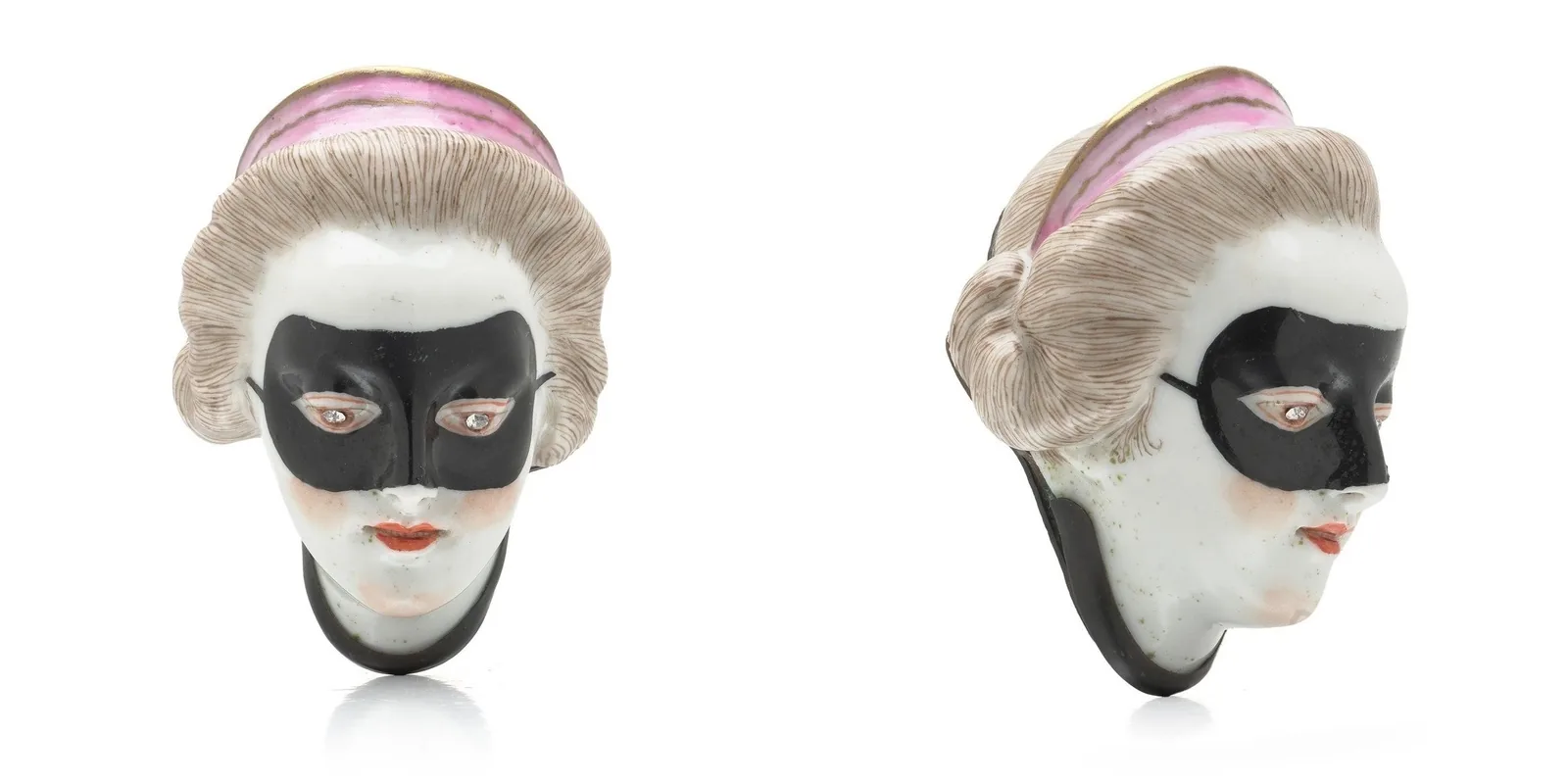
Not every piece of Meissen shows its swords. Snuff boxes, bonbonnieres and patch boxes were often set in metal mounts that cover the base. The masked lady bonbonniere below has its base closed by a gilt metal mount, so no factory mark is visible, and it is identified by its modelling, paste and painting instead.
- The base, closed by the gilt metal mount
- Opened on its hinge, with the mirror in the lid
- A Meissen patch box, about 1750, with a copper mount
- Its white hard-paste porcelain inside the mount
The bonbonniere is in our collection; the patch box has been sold. See more in decorative objects and antique boxes.
Meissen or Dresden?
The two names are often confused, partly because Meissen is close to Dresden and English collectors long called its porcelain Dresden. Today the difference matters. Meissen is the factory, and its mark is the crossed swords. Dresden porcelain usually means pieces painted in one of the many decorating studios in the city in the 19th and early 20th centuries, often on blanks from other factories, and marked with the studio's own mark, frequently with a crown or the word Dresden.
Is Meissen valuable?
Some Meissen is worth a great deal and a lot is worth modest sums. The factory has worked for more than 300 years and made enormous quantities, so the mark alone does not make a piece valuable. These decide it:
- Period
18th-century pieces are the most sought after; later recasts of the same models are far more common.
- Model and modeller
Complex figure groups and the models of the great 18th-century modellers, above all Johann Joachim Kändler, lead the market.
- Painting
Fine, detailed painting and gilding raise the value; simple or later decoration lowers it.
- Condition
Fingers, lace, instruments and applied flowers break first. Good restoration can be invisible in a photograph, so pieces are checked under a light.
- Quality grade
Lines cut through the swords mark a factory second, which is worth less than a first-quality piece.
- Completeness
Pairs, sets and services are worth more together than as single pieces.
Selling Meissen
- Photograph it The whole piece from each side, the base with the mark and numbers in focus, and any chips, cracks or repairs.
- Send the photos Use our free valuation form. We reply with a figure or with the questions we need answered, without obligation.
- Send or bring it Fully insured postage or collection, or an appointment at our Mayfair or Braintree office.
- Get paid Payment by bank transfer once the piece is checked and the price agreed.
Before you sell
Do not clean a piece with anything stronger than a soft brush, and do not try to repair it. Glue and fillers are harder to reverse than the damage.
The bottom line
- Genuine Meissen swords are hand-painted in cobalt blue under the glaze.
- Dots, stars, curves and arcs date the mark to a period.
- Look-alike swords come from English factories, Samson and Dresden studios.
- Value depends on period, model, painting and condition, not the mark alone.
Have Meissen to sell?
Send photos of the piece and of the mark on the base. We buy antique porcelain and decorative objects directly, and the valuation is free.
- We buy directly
- Free valuation from photos
- Appointments in Mayfair and Braintree
- Insured postage or collection
New pieces reach our list first: join the Mozeris list.