Chinese Export Silver: A Complete Collector's Guide
How to recognise Chinese export silver, read its marks, name its makers and understand what a piece is worth today, from a dealer who handles it.
Chinese export silver was made in China for Western buyers, from about 1785 to 1940.
- It was made mainly in Canton, Hong Kong and Shanghai, in Western forms with Chinese decoration: dragons, prunus, bamboo.
- Early pieces, to about the 1840s, often carry imitation English hallmarks. Later pieces carry the retailer's initials, a Chinese character mark and often 90.
- Names to look for: Wang Hing (WH), Luen Wo (LW), Hung Chong (HC), Tuck Chang (TC), Khecheong (KHC).
- Most is about 90% silver, worth … a gram as metal today. Maker and chasing add far more.
In this article
What Chinese export silver is
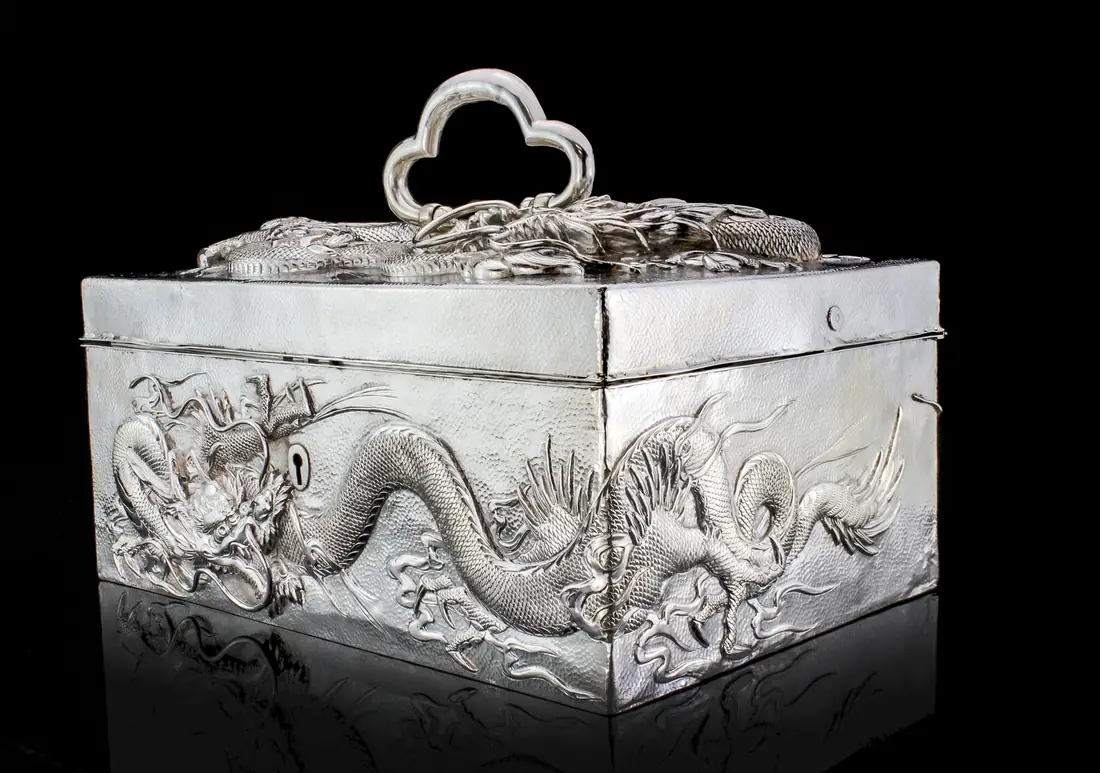
Chinese export silver is silver made in China for Western buyers: merchants, diplomats, officials and travellers who passed through the treaty ports. The main period runs from about 1785 to 1940. The trade grew with the ports opened after the First Opium War in 1842, above all Canton (Guangzhou), Shanghai and Hong Kong.
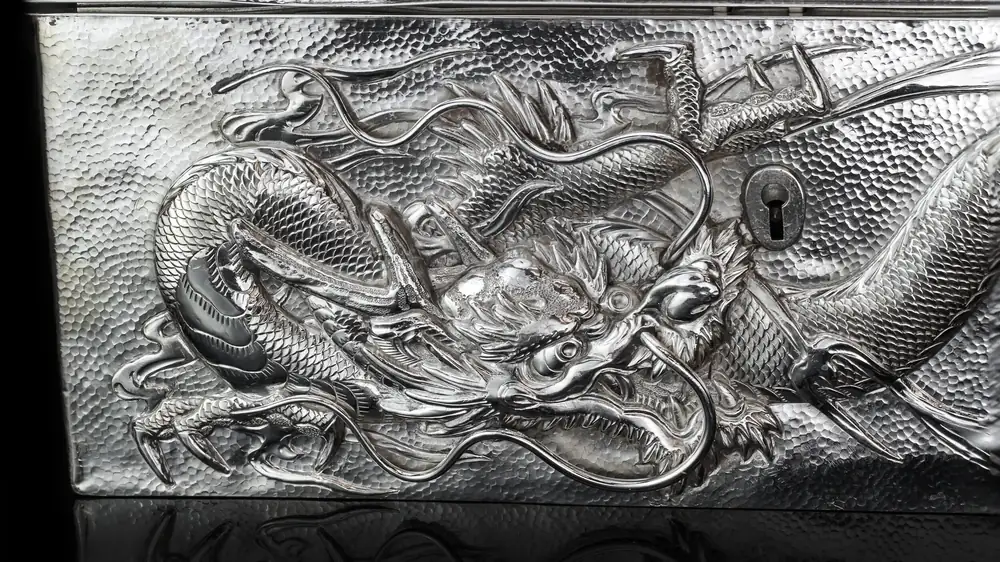
The result is neither wholly Chinese nor wholly Western. The forms are Western: tea services, card cases, cigarette boxes, cruets, photograph frames, flatware. The decoration is Chinese in its imagery and often extraordinary in its depth, with dragons, prunus, bamboo and landscapes chased over almost every surface.
The makers and retailers to know
Most marks you will find are retailers' marks: the shop that sold the piece, often with a Chinese character mark for the workshop that made it. A few names account for a large share of what survives.
| Name | Mark | Where and when |
|---|---|---|
| Cutshing | Imitation English marks with maker's initials | Canton, early 19th century |
| Sunshing | SS with an imitation lion and leopard's head | Canton, early 19th century |
| Khecheong | KHC | Canton, 1830s to 1870s |
| Wang Hing | WH, often with 90 and a character mark | Founded in Canton in 1854; Queen's Road, Hong Kong, 1880s to 1930s. The most prolific of all |
| Luen Wo | LW with a character mark | Nanking Road, Shanghai, about 1880 to 1940 |
| Hung Chong | HC with a character mark | Late 19th to early 20th century; retail shop opened 1892 |
| Tuck Chang | TC | Shanghai, early 20th century |
| Sing Fatt | Initials with 90 | Canton, after the Opium Wars |
Named makers matter to value. A tea service by Wang Hing or Luen Wo will sell better than an equivalent piece with an unfamiliar or illegible mark, and collectors follow particular firms.
How to read Chinese export silver marks
The marks changed over the period, and the change is the quickest way to date a piece.
Usual markingLess common
- Imitation English marks, to about the 1840s
Early Canton silversmiths copied British hallmarks because their customers expected them: a lion passant, a crowned leopard's head, a monarch's head and the maker's initials. Look closely and the animals are crude, the letters are odd and the marks follow no date letter system.
- Retailer's initials and a character mark, from the mid 19th century
Later pieces carry the shop's initials in Western letters (WH, LW, KHC) and a mark in Chinese characters for the silversmith who made the piece.
- A fineness number, usually 90
From the later 19th century many pieces are stamped 90 for 900 parts per thousand. It was a mark of quality: tested pieces by the best firms are often finer than 90%.
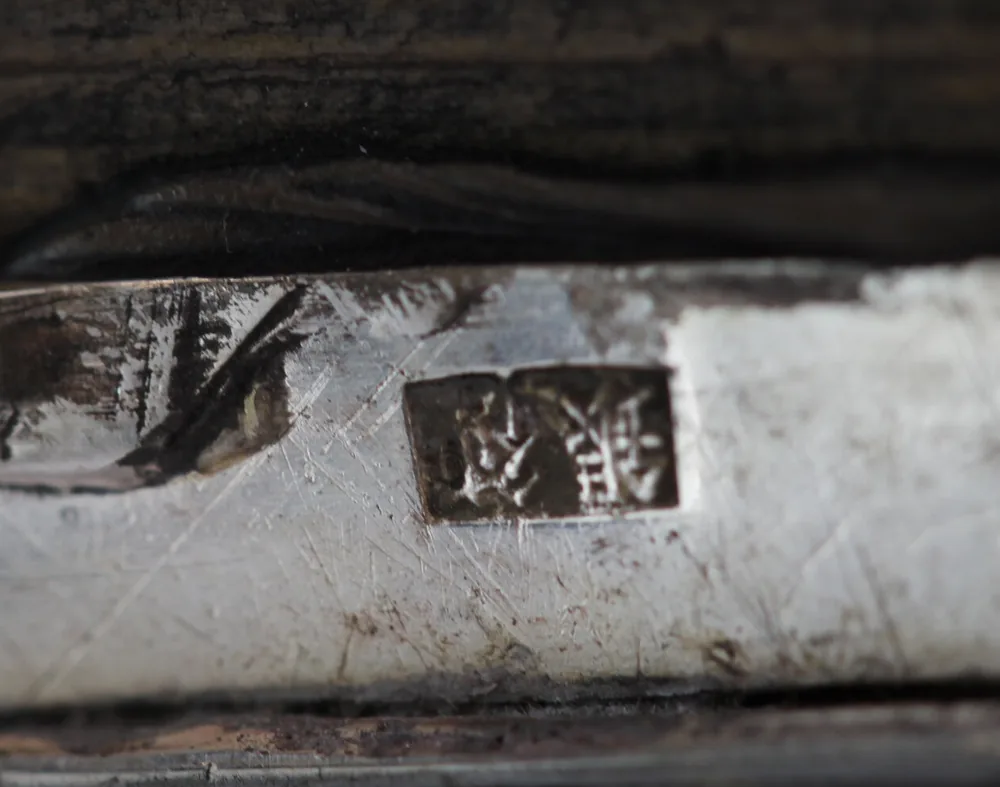
A crude lion passant does not make a piece British. If the lion looks clumsy and the decoration is dense Chinese chasing, you may be looking at early export silver with imitation marks, which is collectable in its own right.
To compare with the real thing, see our guide to reading British silver hallmarks. For marks that mean plate, see EPNS vs sterling.
How pure is Chinese export silver?
Most Chinese export silver is around 900 parts per thousand, 90% silver, and some is finer. That is close to sterling at 92.5% but not the same, which matters only when a piece is valued for its metal.
Silver at 90% today:…per gramloading the live price…
So a 1.5 kg tea service at 90% contains … of silver at today's price, before any value for the maker or the chasing. For decorative pieces the craftsmanship is worth far more than the metal.
Dragons and other motifs
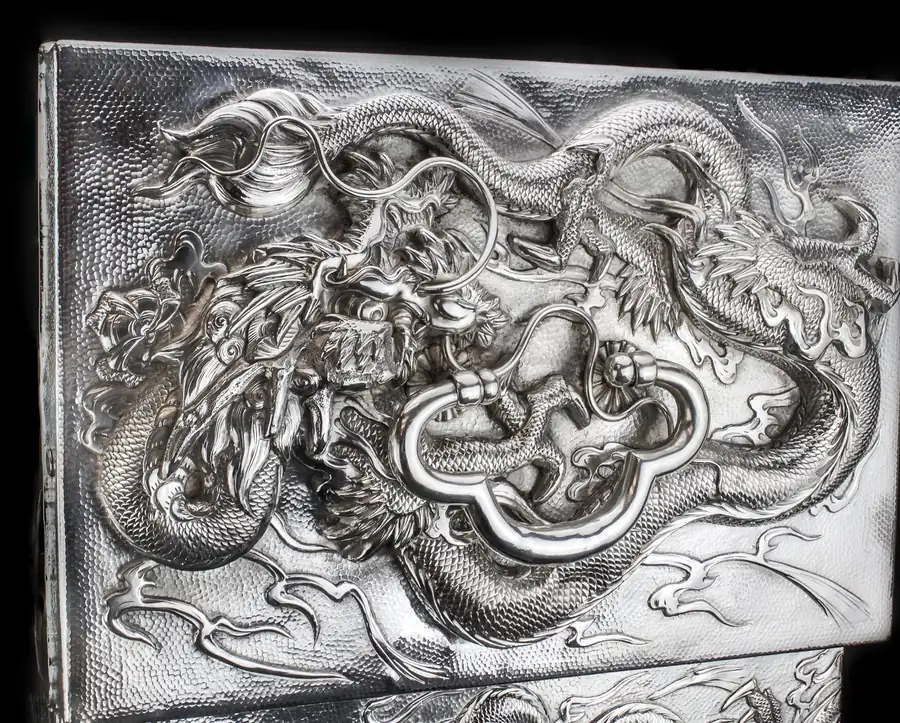
Where Victorian British silver used ornament sparingly, Chinese export silversmiths covered almost every surface with deeply chased or repoussé work. Some motifs appear so often that they have become shorthand for the genre:
The most common motif of all, coiling around bodies and chasing across lids. The best show individual scales, expressive heads and real movement.
The flowering plum, a symbol of perseverance, usually a gnarled branch in flower.
Chased as decoration, or used for the whole form, with handles like canes and finials like shoots.
Floral borders or central panels. Chrysanthemums are a Luen Wo favourite.
Panels of pagodas, mountains, figures and boats, framed in cartouches.
Symbols of long life, in flight or among lotus.
Common forms
Almost everything was adapted from Western domestic silver:
- Tea and coffee services, sometimes with a matching tray
- Card cases and cigarette cases
- Boxes, including dressing and betel boxes
- Photograph frames
- Cruets, salts, mustards and napkin rings
- Flatware and serving pieces
Tea services are among the most sought after, because they offer the largest surface for decoration and complete sets in good condition are now scarce.
What Chinese export silver is worth
There is an active, international market, with buyers in Britain, Europe, North America and China. Values are often misunderstood in both directions: not every piece is valuable, and good pieces are worth far more than their weight.
| What adds value | What takes it away |
|---|---|
| A named maker: Wang Hing, Luen Wo, Hung Chong, Khecheong | Illegible or unfamiliar marks |
| Deep, crisp chasing with fine detail | Chasing polished flat or worn on the high points |
| Complete services and sets | Missing pieces, replaced lids or finials |
| Sought-after forms: tea services, boxes, card cases | Dents in repoussé work, which are very hard to repair |
| Original condition and age-appropriate wear | Heavy repairs or removed monograms |
As a guide to the level of the market, a mid-20th-century Chinese export silver tea and coffee service sold at Bonhams in 2025 for $5,632. The metal gives a floor under every genuine piece; the maker, the chasing and the condition decide how far above it a piece sells.
Fakes and later copies
The market has attracted later copies. Many pieces made in the mid to late 20th century imitate the style but lack the construction and the wear of genuine antiques:
- Genuine pieces show wear on the high points of the chasing, on the base and around hinges and catches.
- Period construction is hand-raised and hand-chased; later copies are often cast or machined.
- Chasing on copies can look soft and repetitive, without the depth of the originals.
- If a piece looks too perfect, or too cheap for what it claims to be, get a second opinion.
Selling Chinese export silver
This is a specialist field, so it pays to deal with someone who knows the market rather than a generalist who will price it by weight. We buy quality Chinese export silver, particularly tea services, boxes, card cases and significant single pieces by named makers, and give a realistic figure rather than an inflated one.
Start with clear photographs of the whole piece, the decoration and every mark. See also our guides to silver prices and valuation and inherited silver.
Get a free quote
- Chinese export silver: made in China for the West, about 1785 to 1940.
- Imitation English marks mean an early piece; initials, a character mark and 90 mean a later one.
- Named makers and crisp, undamaged chasing decide value; the metal is only the floor.
- Never polish or repair chased decoration before a valuation.
Questions we are asked
Does Chinese export silver have hallmarks?
Not official ones. Early pieces, to about the 1840s, often carry imitation English hallmarks, including a crude lion passant, that were never struck by an assay office. Later pieces carry the retailer's initials, a Chinese character mark and often the number 90.
Who are the main Chinese export silver makers?
The names to know are Wang Hing (WH), the most prolific, Luen Wo (LW) and Tuck Chang (TC) in Shanghai, Hung Chong (HC), Khecheong (KHC) in Canton, and the early makers Cutshing and Sunshing, who used imitation English marks.
What does 90 mean on Chinese silver?
It means 900 parts per thousand, 90% silver. It was used by retailers such as Wang Hing from the later 19th century as a mark of quality, and tested pieces are often finer than 90%.
How pure is Chinese export silver?
Most is around 90% silver, and some is finer, close to but slightly below sterling at 92.5%. For decorative pieces the value lies in the maker and the chasing rather than the metal.
What is Chinese export silver worth?
Every genuine piece is worth at least its silver at the live price, and good pieces by named makers with fine, undamaged chasing sell well above it. Complete tea services, boxes and card cases are the most sought after.
How do I spot a fake or later copy?
Genuine pieces show wear on the high points of the chasing, on the base and around hinges, and were raised and chased by hand. Later copies are often cast, look too crisp, or have soft, repetitive decoration.
Have Chinese export silver to value?
Send photographs of the whole piece, the decoration and the marks. We buy Chinese export silver directly and give a free, realistic valuation.
- We buy directly
- Free valuation from photos
- Appointments in Mayfair and Braintree
- Insured postage or collection
New pieces reach our list first: join the Mozeris list.