In this guide (8)
Here is how to read the marks, tell sterling from plate, recognise the designs collectors want, and sell yours.
Quick answer. A silver napkin ring is a small band that holds a folded table napkin. British sterling examples carry a hallmark, usually on the outside or along the edge, and most date from the 1880s to the 1960s, many made in Birmingham. Designer pieces, enamelled rings and boxed sets in their original case are worth the most.
- Look for a lion passant, town mark and date letter; EPNS means plated.
- Most British silver napkin rings were made in Birmingham or Sheffield.
- Liberty, Georg Jensen, enamelled and figural rings attract collectors.
- Boxed sets and christening sets in their original cases add value.
What is a silver napkin ring?
A napkin ring is a band, usually round or oval, that holds a rolled or folded table napkin. Napkin rings came into general use in Britain in the Victorian period, when a family reused its napkins between washes and each person's ring was engraved with initials so everyone kept their own. They became a standard christening present, often engraved with the child's name and date and boxed with a spoon.
How to identify solid silver and read the hallmarks
A British sterling napkin ring has a full hallmark: the lion passant, a town mark, a date letter and the maker's mark. On a ring the marks are small and sit on the outer surface, beside the engraving panel or along one edge. Most were made in Birmingham, the centre of the British small silverware trade, with many from Sheffield, Chester and London.
- Birmingham: an anchor.
- Sheffield: a crown before 1975, a rose after.
- Chester: three wheatsheaves and a sword.
- London: a leopard's head.
Rings stamped EPNS or EP are silver plate. Continental rings are often stamped 800 or 835, and American rings STERLING. Our silver hallmark identifier reads the date letter for you.
Sell to a specialist
Free valuation from your photographs. Paid the same day after inspection.
- Free insured FedEx collection
- Insured to £10,000
- No obligation
Designs and makers collectors look for
- Arts and Crafts and Art Nouveau: Liberty and Co Cymric designs, some by Archibald Knox, with Celtic knots and enamel.
- Scandinavian: Georg Jensen rings, marked with the Jensen stamp and design number.
- Enamelled and guilloche rings in coloured enamel over engine-turned silver.
- Figural rings with animals or characters, popular as children's gifts.
- Russian niello and Scottish Celtic designs.
Plain engine-turned and bright-cut rings from the 1920s to the 1950s are the most common and are bought mainly for their silver.
Sets, cases and condition
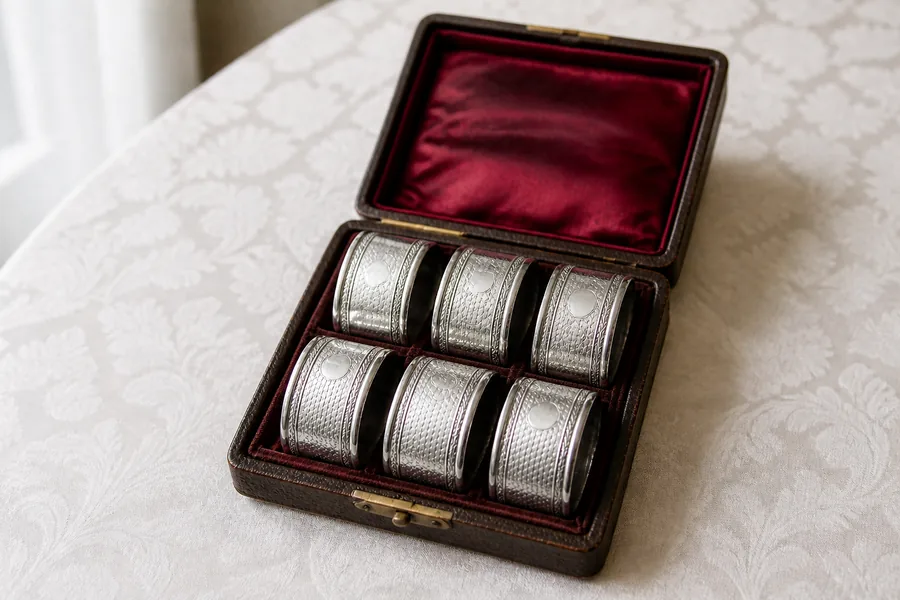
Boxed sets of two, four, six or twelve rings, sometimes numbered, are worth more together in their fitted case than as single rings. A christening set with the original box and spoon is more attractive than a lone ring. Most rings are rolled from sheet with a soldered seam, so check for splits along the seam, dents and wear to the engraving. A name or initials engraved at the time is normal and rarely a problem.
What drives the value of a silver napkin ring?
- Solid silver rather than plate.
- Maker or designer, such as Liberty or Georg Jensen.
- Enamel, figural or unusual designs.
- Complete sets in original cases.
- Condition: no splits, dents or worn enamel.
- Age: Victorian rings with fine engraving.
Single plain rings are usually valued for their silver. Send photos of every ring and its marks and we will tell you what each is worth.
How to sell silver napkin rings to us
Selling to us starts with photographs. Send clear pictures of the whole piece, the hallmarks close up and any damage through the photo form on this page, and we reply with a free valuation, subject to inspection. If you accept, post the piece by Royal Mail Special Delivery or book our free insured FedEx collection, insured to £10,000. We inspect it on arrival, confirm the offer, and pay the same day by bank transfer once you agree. Viewings are also available by appointment in Mayfair and Braintree.