In this guide (8)
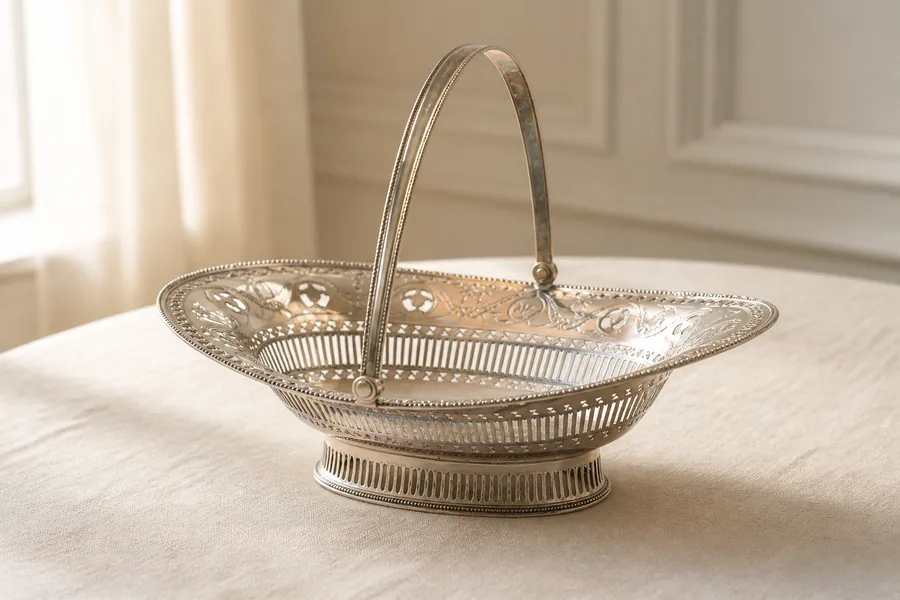
Quick answer. An antique silver cake basket is an oval or round dish, usually pierced, with a swing handle, made in England from the early 18th century for serving cake, bread or fruit. Look for a full hallmark under the base and a second set of marks on the handle. Maker, date, the quality of the piercing and condition decide its value.
- The classic Georgian form is oval, pierced and swing-handled, from about the 1730s.
- Solid silver baskets carry hallmarks on the body and separately on the handle.
- Splits in the piercing, repairs and removed engraving reduce value.
- Electroplated and Sheffield plate baskets are worth far less than sterling.
What is a silver cake basket?
A cake basket is a shallow serving dish for cake, bread or fruit, made to look like woven basketwork. In England silversmiths made them from the early 18th century, and the oval basket with a swing handle, often called a bail handle, became the standard Georgian form from around the 1730s. The same shape was also sold as a bread basket or fruit basket; the name changes, the object does not.
Huguenot silversmiths working in London, among them Paul de Lamerie and Peter Archambo, made heavy cast and chased baskets in the rococo style. Later in the century lighter, pierced and bright-cut baskets became fashionable, and Hester Bateman and the Hennell family made many. Regency baskets by makers such as Paul Storr returned to heavier gauge and bold cast borders.
Cake stands, tazzas and comports
Victorian and Edwardian households added the silver cake stand: a dish raised on a stem and foot, also called a tazza or comport, and tiered stands for afternoon tea. Single stands and tazzas were made in sterling silver, often in sets or pairs. Most tiered cake stands were electroplated, so check the marks before assuming a stand is solid silver.
Sell to a specialist
Free valuation from your photographs. Paid the same day after inspection.
- Free insured FedEx collection
- Insured to £10,000
- No obligation
How to identify and date one: the marks
A British solid silver basket carries a full hallmark: the lion passant for sterling, a town mark, a date letter and the maker's mark. On Georgian baskets the marks are usually under the base or on the foot rim. Because the swing handle was made separately, it should carry its own marks, normally the lion passant and the maker's mark near the hinge. A handle with no marks, or marks from a different maker or date, may be a replacement.
- Sterling: lion passant, town mark, date letter, maker's mark.
- Sheffield plate (about 1750 to 1840): no hallmark; copper may show through at worn edges.
- Electroplate (from the 1840s): EPNS, EP or A1, often with a maker's name.
Our silver hallmark identifier and UK hallmarks guide help you read the date letter.
Piercing, decoration and condition
Early piercing was cut by hand with a saw, which leaves slightly irregular openings. From the later 18th century a fly press punched repeating patterns quickly, which made lighter baskets cheaper to produce. Pierced silver is fragile: check for splits between the openings, old solder repairs, dents to the rim and wear to bright-cut engraving. A coat of arms engraved at the time adds interest, while a thin spot in the centre can mean engraving was polished out.
What drives the value of a silver cake basket?
- Maker: work by known London makers such as Paul de Lamerie, Paul Storr or Hester Bateman attracts collectors.
- Date and style: Georgian baskets, especially rococo and fine neoclassical examples, are the most collected; Victorian copies of Georgian styles are common.
- Quality and gauge: heavy cast borders and crisp chasing count for more than thin, machine-pierced sheet.
- Condition: unrepaired piercing, an original marked handle and no removed engraving.
- Provenance and arms: contemporary armorials or a documented history add interest.
Every basket is valued individually. Send photos and we will tell you what yours is worth.
How to sell a silver cake basket to us
Selling to us starts with photographs. Send clear pictures of the whole piece, the hallmarks close up and any damage through the photo form on this page, and we reply with a free valuation, subject to inspection. If you accept, post the piece by Royal Mail Special Delivery or book our free insured FedEx collection, insured to £10,000. We inspect it on arrival, confirm the offer, and pay the same day by bank transfer once you agree. Viewings are also available by appointment in Mayfair and Braintree.