UK / Irish Hallmark Authority · Hibernia & Crowned Harp
The Dublin Assay Office: Complete Guide
The Dublin Assay Office has marked Irish silver since 1638. A Dublin hallmark shows the maker's mark, the crowned harp for sterling, the seated figure of Hibernia, a date letter and, from 1807 to 1890, the sovereign's head duty mark. Distinctly Irish forms include dish rings and freedom boxes.
Reviewed by Faustas Svencionis, Mozeris Fine Antiques, since 2015 · Updated October 2026
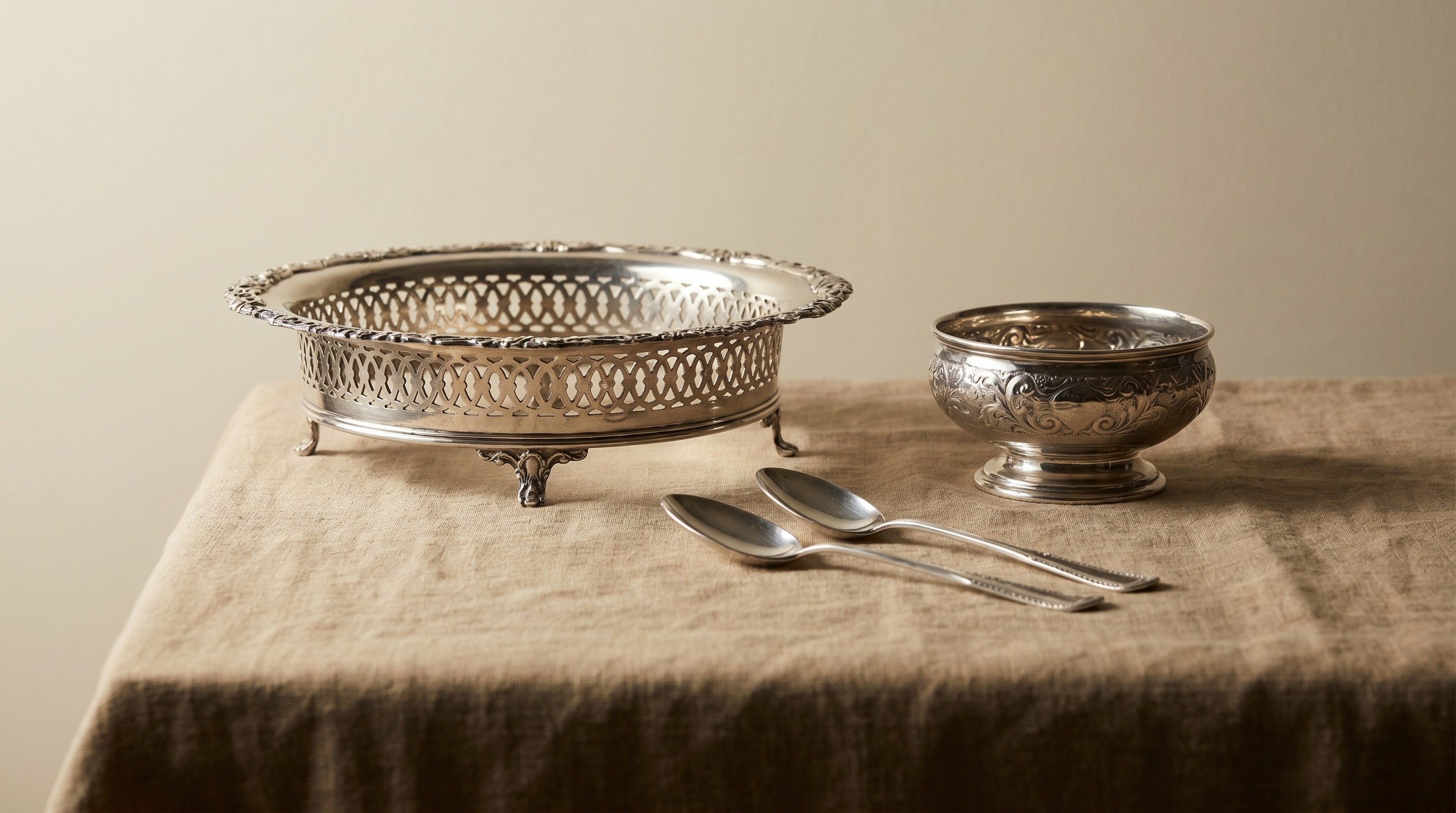
A specialist's guide to Ireland's oldest assay office: the crowned harp town mark, the Hibernia figure, key date letters, notable Dublin and provincial Irish silversmiths and reading a full Irish hallmark.
Got Irish Silver? We'll Identify and Value It Free
Irish silver is its own market: distinct forms and a small, focused collector base. Send photos and we'll identify the date, maker and value, with no obligation.
The Dublin Assay Office is Ireland's oldest and only assay office, with a formal hallmarking tradition dating from 1637. It is older than Birmingham, older than Sheffield, and still active today. Dublin's hallmark system uses two of the most distinctive marks in the British Isles: the crowned harp as the sterling standard mark, and the seated figure of Hibernia as the duty mark (from 1730). Irish silver runs to its own forms (dish rings, freedom boxes, bright-cut Georgian flatware, neoclassical Dublin tea services) and an Irish hallmark is unmistakable once you know what you are looking at.
A Brief History
The Dublin Assay Office has hallmarked Irish silver since the 17th century and is Ireland's assay office today.
The Company of Goldsmiths of Dublin received its founding charter from Charles I in 1637. From that date, silver assayed in Dublin was struck with a crowned harp (the sterling standard) and the maker's mark, with date letters added from 1638. This makes Dublin's date letter system one of the oldest in the British Isles; only London is older.
From 1730, the seated figure of Hibernia was added as a duty mark, confirming that the Crown's duty on wrought silver had been paid. Unlike the English sovereign's head duty mark (which was discontinued in 1890 when duty was abolished), Hibernia has remained on Dublin hallmarks ever since, evolving from a duty mark into an honorific national mark.
Today the Dublin Assay Office operates from Dublin Castle, hallmarking under the Hallmarking Act 1981 (Ireland). The office remains active and tests silver, gold, platinum and palladium.
How to Read a Full Dublin Hallmark
Read a Dublin hallmark as the maker's mark, the crowned harp, Hibernia, the date letter and, between 1807 and 1890, the sovereign's head.
| Mark | What it tells you |
|---|---|
| Maker's mark | The silversmith's registered initials or device. |
| Crowned harp | The sterling standard mark, from 1637. |
| Hibernia | A seated figure of Ireland: a duty mark from 1730, now the Dublin mark. |
| Date letter | The year of assay, used since 1638. |
| Sovereign's head | The British duty mark, 1807 to 1890. |
The Dublin sequence is distinctive and has its own logic. From left to right (broadly):
- Maker's mark: the silversmith's registered initials or device.
- Crowned harp: sterling standard (.925), used from 1637 to today.
- Hibernia: the seated female figure of Ireland personified, added from 1730. Originally a duty mark, now Dublin's town/national mark.
- Date letter: a single letter in a shaped shield, used since 1638.
- Sovereign's head (1807 to 1890): the British duty mark for the period of the Union.
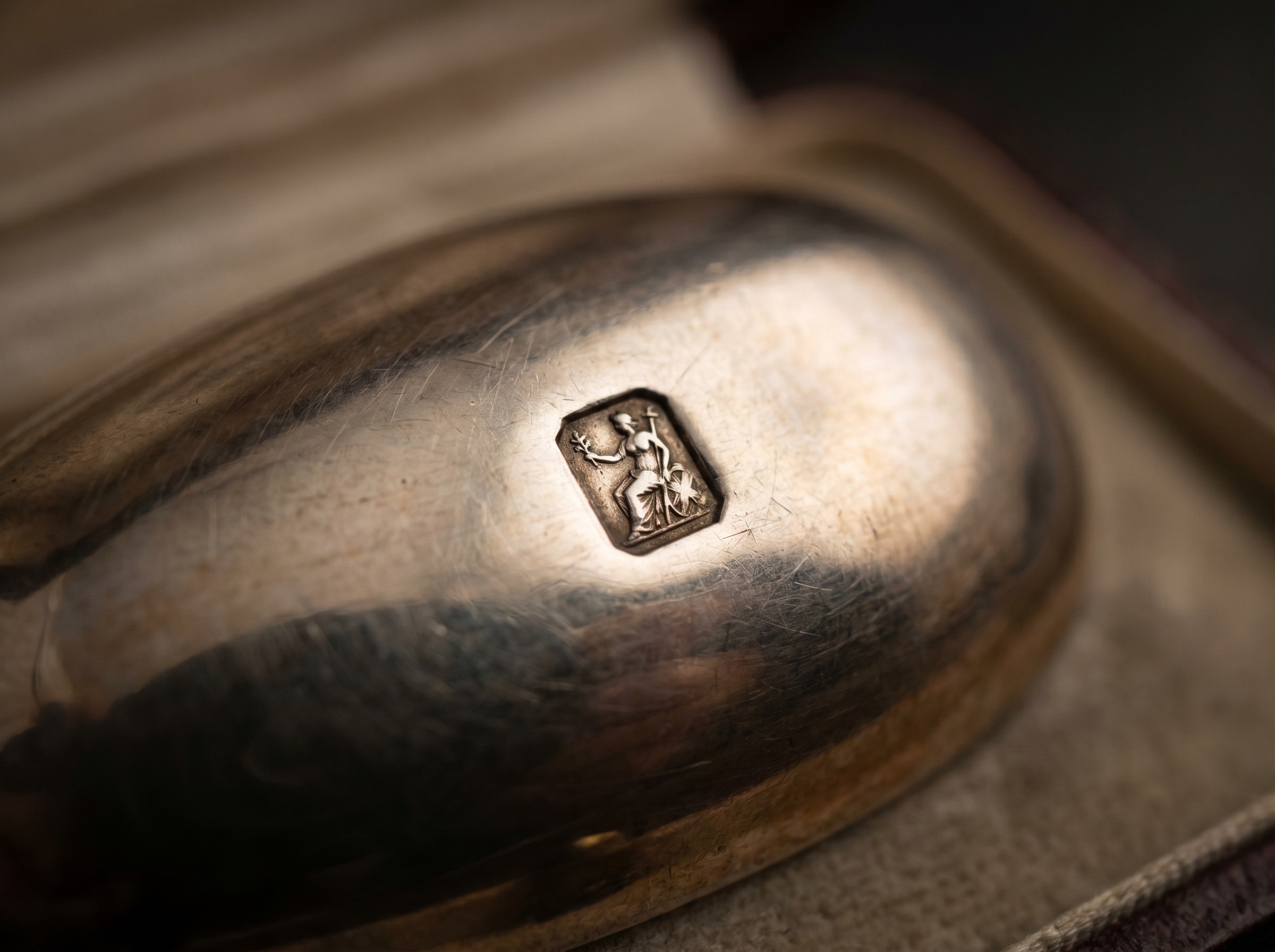
"Crowned harp for sterling. Seated Hibernia for Dublin. Together: Ireland's silver."
The Crowned Harp: Ireland's Sterling Mark
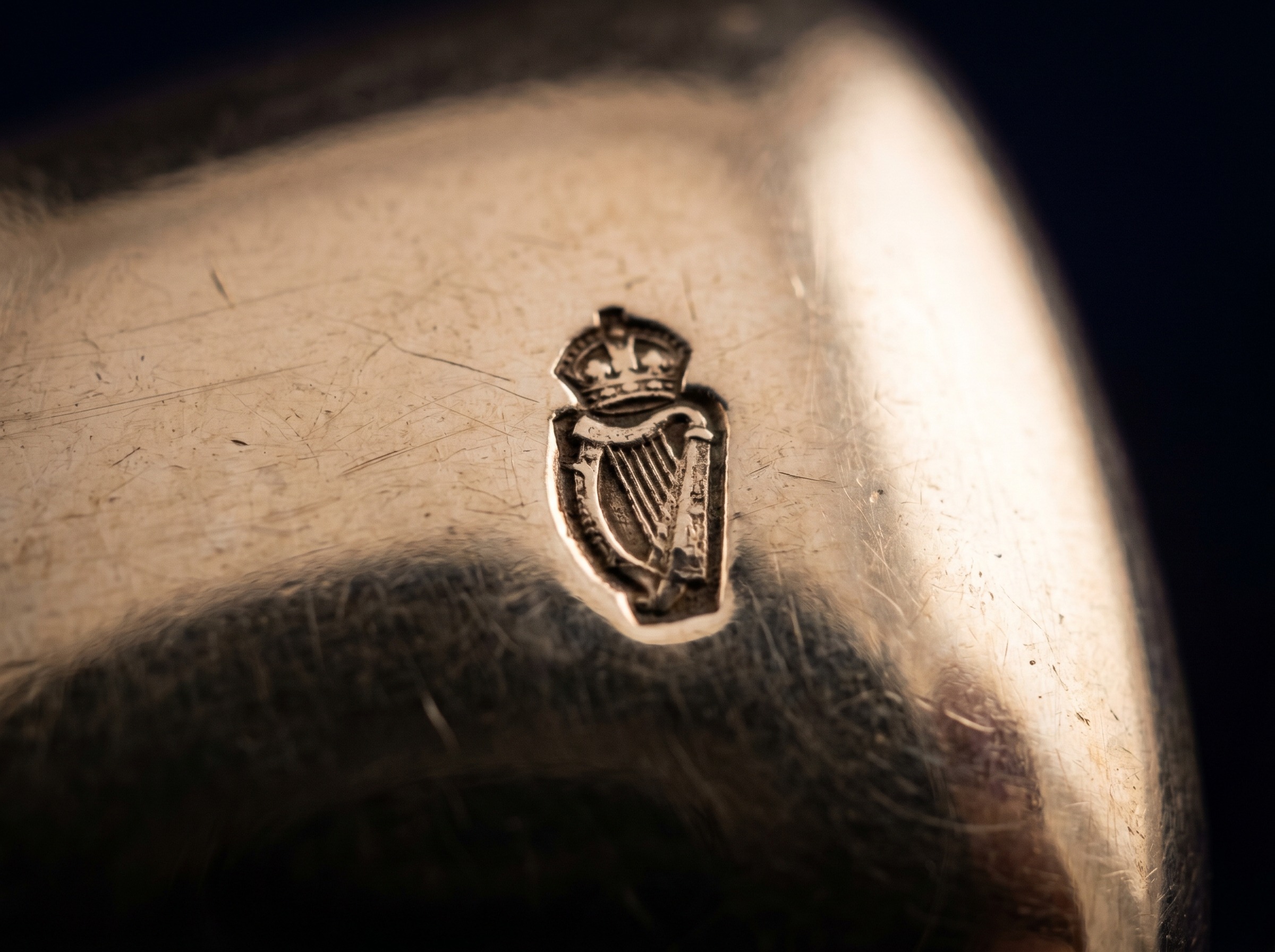
The crowned harp is the Irish sterling standard mark, used from 1637 to today.
Ireland's equivalent of England's lion passant and Scotland's lion rampant is the crowned harp: a Celtic harp surmounted by a royal crown, struck into a shaped shield. The mark has been continuously used since 1637: the longest unbroken use of a national standard mark in the British Isles after London's leopard's head. The crown above the harp confirms sterling standard (.925); without the crown, no piece of Irish silver would be considered sterling.
Hibernia: The Most Distinctive Hallmark in Europe
Hibernia, the seated figure of Ireland, was added in 1730 as a duty mark and is now the Dublin mark.
The Hibernia mark (a seated female figure holding a harp, originally added in 1730 as a Crown duty mark) is one of the most distinctive hallmarks anywhere in Europe.
The figure's exact pose and detail evolves through the decades (worth checking carefully when dating worn pieces), but the overall image is unmistakable: a classical female personification of Ireland, seated, holding a harp or shield. The Hibernia mark has remained in continuous use for nearly 300 years, longer than any other duty mark in the British Isles.
Date Letters
Dublin has used date letters since 1638, each cycle with its own letter style and shield.
Dublin's date letter system, established in 1638, runs in 24-letter cycles (J skipped) with the shield shape and font changing at each new cycle. Combined with the crowned harp, Hibernia and (where present) sovereign's head, a Dublin hallmark can be dated to the year with confidence.
Distinctly Irish Forms
The distinctly Irish silver forms are dish rings, freedom boxes, bright-cut Georgian flatware and neoclassical tea services.
Dublin assayed every category of Irish silver, but the marks particularly belong to a few recognisably Irish forms, the items Irish collectors look for:
- Dish rings: circular pierced rings designed to support a wooden bowl above a hot dish, a uniquely Irish 18th century form. No close English equivalent. Dublin-assayed dish rings are keenly collected.
- Freedom boxes: small boxes (often oval) presented to dignitaries with the Freedom of an Irish city. Dublin and Cork made these in significant numbers in the late 18th century.
- Bright-cut Georgian flatware: Irish silversmiths excelled at bright-cut engraving. Dublin-marked bright-cut spoons and forks are highly collectable.
- Neoclassical tea services: late 18th and early 19th century Dublin tea services share form vocabulary with English work but tend toward more pronounced pierced galleries and lighter gauge.
- Potato rings: sometimes confused with dish rings; same form, period name varies.
- Irish provincial silver: Cork, Limerick, Galway and Kinsale silversmiths sometimes sent work to Dublin for assay, sometimes used their own marks (see pitfalls).
Notable Dublin Silversmiths
- Thomas Bolton (active 1690s to 1730s): leading early Dublin maker.
- Robert Calderwood (mid-18th century): fine Georgian Dublin silver.
- Matthew West: late 18th century, prolific.
- William Hughes, James Le Bas, Edward Power: recognised 18th and early 19th century Dublin makers.
- West & Son: long-running Dublin retailer/maker, late Victorian and Edwardian.
- Weir & Sons: major Dublin silver retailer, still trading on Grafton Street.
Irish Provincial Silver: A Separate Category
Cork (anchor and ship mark), Limerick, Galway, Kinsale and Youghal all had silversmiths working independently of Dublin. Cork in particular has its own important body of 18th century work. Provincial Irish silver sometimes carries only a maker's mark and a "sterling" or "STER" mark (no assay office stamp). Provincial Irish silver is more specialist territory than Dublin work, and good Cork or Limerick pieces are keenly collected.
Pitfalls
- Worn Hibernia mark, often the highest point on a piece and the most worn. Soft, blurred Hibernia images can be confused with seated Britannia (English mark), but Britannia holds a trident, Hibernia holds a harp or shield.
- "Irish-style" silver without Dublin marks: bright-cut engraving and dish ring forms have been copied in England and the US. Always check the actual hallmark row.
- Post-1922 marks vs Republic-era marks: Dublin's hallmarking continued after Irish independence in 1922, and the Hallmarking Acts of the Republic preserved the historic marks. A 1925 Dublin hallmark looks much like an 1825 one.
- Provincial Irish without Dublin assay: Cork and Limerick silver often carry only maker's marks and a "sterling" word punch. These need specialist identification.
- Confusing the crowned harp with the Birmingham anchor: both can sit in similar shield shapes on worn pieces. The harp shape is the giveaway.
What We Look For When Irish Silver Arrives
When Irish silver arrives we read the crowned harp, Hibernia and the date letter, and check whether a provincial piece from Cork, Limerick or Galway carries only a maker's mark and a sterling mark.
Then we look at the form, a dish ring or a freedom box for example, and at condition.
Got Dublin-Hallmarked Silver to Sell?
Active buyer of Irish silver: Dublin and provincial dish rings, freedom boxes, bright-cut Georgian flatware, neoclassical tea services, presentation pieces and all Irish hallmarked work. By appointment in Mayfair or by free FedEx collection. Same-day payment.
- Send photosUse the form on this page, or email them to us.
- A specialist reviews itMaker, marks, age and condition.
- Free estimate by emailWithin one working day.
- You decidePaid once agreed. No obligation.
Four ways to sell: Mayfair (by appointment), Braintree (by appointment), Royal Mail Special Delivery, free FedEx collection.
Free valuation
Request a free valuation
Send us a few photos of your Irish silver. A specialist looks at every request personally and replies by email with an estimate within one working day. There is no obligation to sell.
What to photograph
- The whole piece. The whole piece, from the front and the side.
- The underside. The base or reverse, where the marks usually are.
- The hallmarks, close up. Every mark in the group, in focus, including the maker's mark.
Prefer email? Send photos to info@mozerisfineantiques.com or call 01376 334 482.
Ways to sell
- Mayfair (by appointment)
- Braintree (by appointment)
- Royal Mail Special Delivery
- Free FedEx collection
We buy directly, with payment once you accept our offer, and we can also sell for you by consignment or in our own auctions.
Related Reading
Frequently Asked Questions
What is the Dublin Assay Office hallmark?
What does the Hibernia mark mean?
Is Dublin Assay Office still active?
Is Irish silver worth more than English silver?
What is an Irish dish ring?
Will you tell me what my Irish silver is worth?
Selling Dublin or Irish Silver?
Active buyer of Irish silver: Dublin and provincial. Mayfair showroom by appointment or free FedEx collection. Same-day payment.
Strictly by appointment only: no walk-ins at either location.
Items we buy
Antique Silver We Specialise In
Click any category for our specialist buying guide, then send photos for a free valuation. We also have a full Sell Your Silver overview.