Antique Silver Coffee Pots — Complete Guide
A specialist's guide to antique English silver coffee pots — from Queen Anne tapered cylinders through to neoclassical urn-shaped pots. Identify the period, the maker and the value of one of the most collectable categories of Georgian silver.
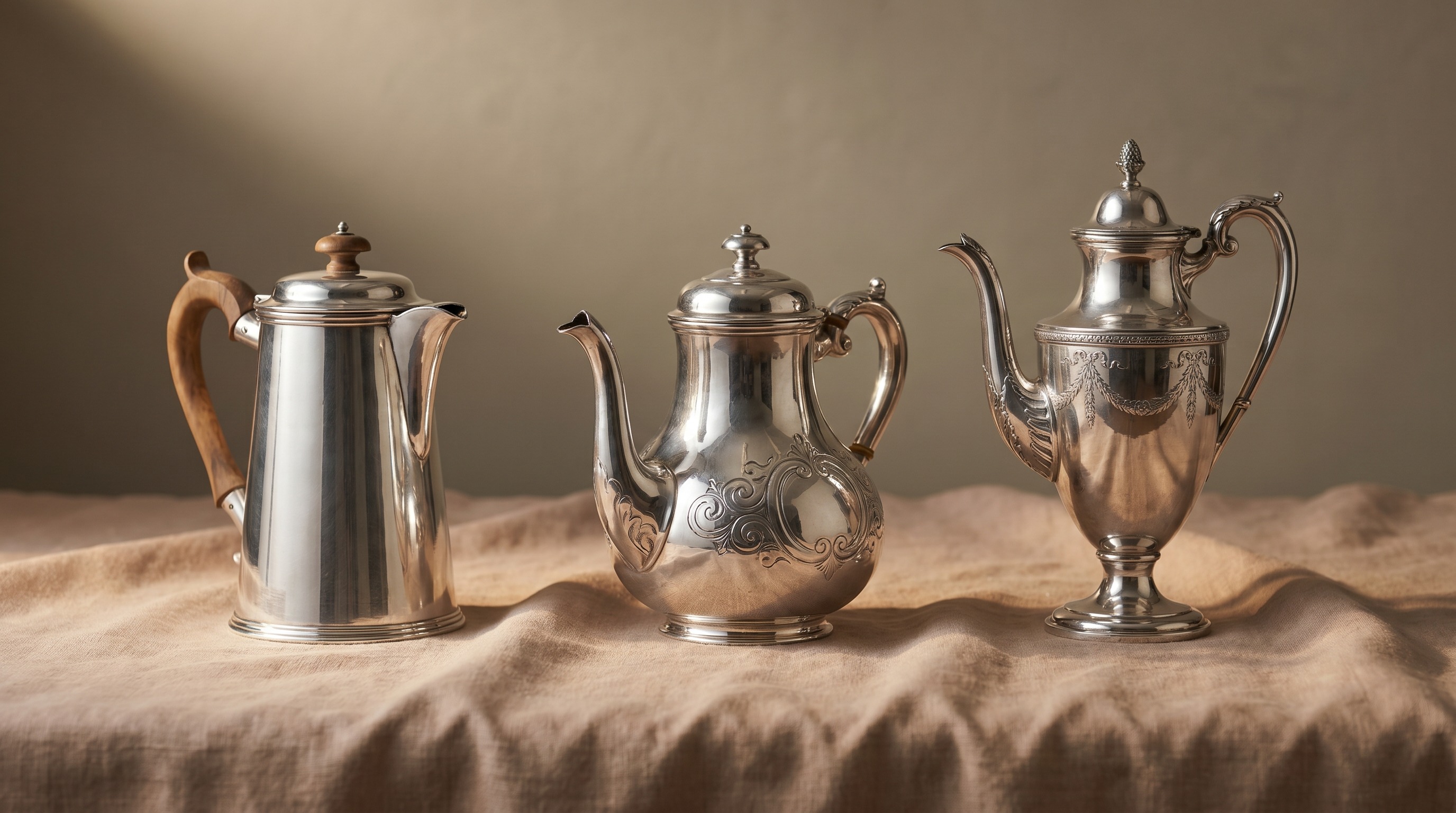 ☕ Typically £600–£8,000+
Got an Antique Silver Coffee Pot? We'll Identify and Value It Free
Send photos of the marks on the base, the engraved cartouche if any, and the side profile of the pot. We will tell you the period, maker and current market value.
Coffee arrived in England in the mid-17th century and London's first coffeehouse opened in 1652. By the 1680s coffee was being drunk in fashionable households, and silver coffee pots — distinct from teapots, taller, with a long curving handle set at right angles to the spout — became one of the most prestigious purchases a household could make. The history of the antique silver coffee pot reads like a tour of British silver style: Queen Anne plainness, Rococo extravagance, Adam neoclassical restraint, Regency weight, Victorian elaboration. Each period left a recognisable form, and each is collectable today.
This guide walks you through the principal coffee pot shapes period by period, explains how to identify makers and date them, and provides realistic market values.
Coffee Pot vs Teapot — Easy Confusion
Antique coffee pots and teapots are not the same. The differences:
- Height & capacity — coffee pots are taller and hold more (typically 1.5–2 pints); teapots are squatter, holding less.
- Handle orientation — coffee pot handles sit at right angles to the spout (so you turn the pot 90° to pour). Teapot handles sit opposite the spout.
- Body form — coffee pots are typically tapered cylindrical or pyriform; teapots are usually round, oval or rectangular.
- Spout — coffee pot spouts are longer and more curved.
A small pot with the handle opposite the spout is almost certainly a teapot, regardless of how "coffee pot shaped" it looks.
Period by Period
Queen Anne (1702–1714) and George I (1714–1727) — Tapered Cylinder
Plain tapered cylindrical body, octagonal or domed lid with a baluster finial, long straight or slightly swan-necked spout, wooden right-angled handle (often original fruit-wood). Engraved cartouche on the body. Britannia standard until 1720. The most sought-after early form.
Typical value: £4,000–£15,000+ depending on weight, maker and condition. Important Britannia-period examples by Pierre Platel, Anthony Nelme or Paul de Lamerie reach £20,000–£60,000+.
Early Georgian (1727–1750) — Tapered Cylinder Continued
The cylindrical form continued but with subtle refinements: domed and stepped lids, cast spouts with shells and leaves at the body junction, applied moulded foot-rim.
Typical value: £2,500–£8,000.
Rococo (1750–1770) — Pyriform Baluster
The rococo period transformed the coffee pot. Bodies became pear-shaped (pyriform / baluster) on a domed foot. Decoration moved to high-relief cast and chased shells, scrolls and naturalistic flowers, applied to a plain body. Spouts became sculptural — sometimes ending in a beast's head. This is the Lamerie / Crespin / Wickes period.
Typical value: £3,000–£12,000 standard; £20,000–£100,000+ for important named makers.
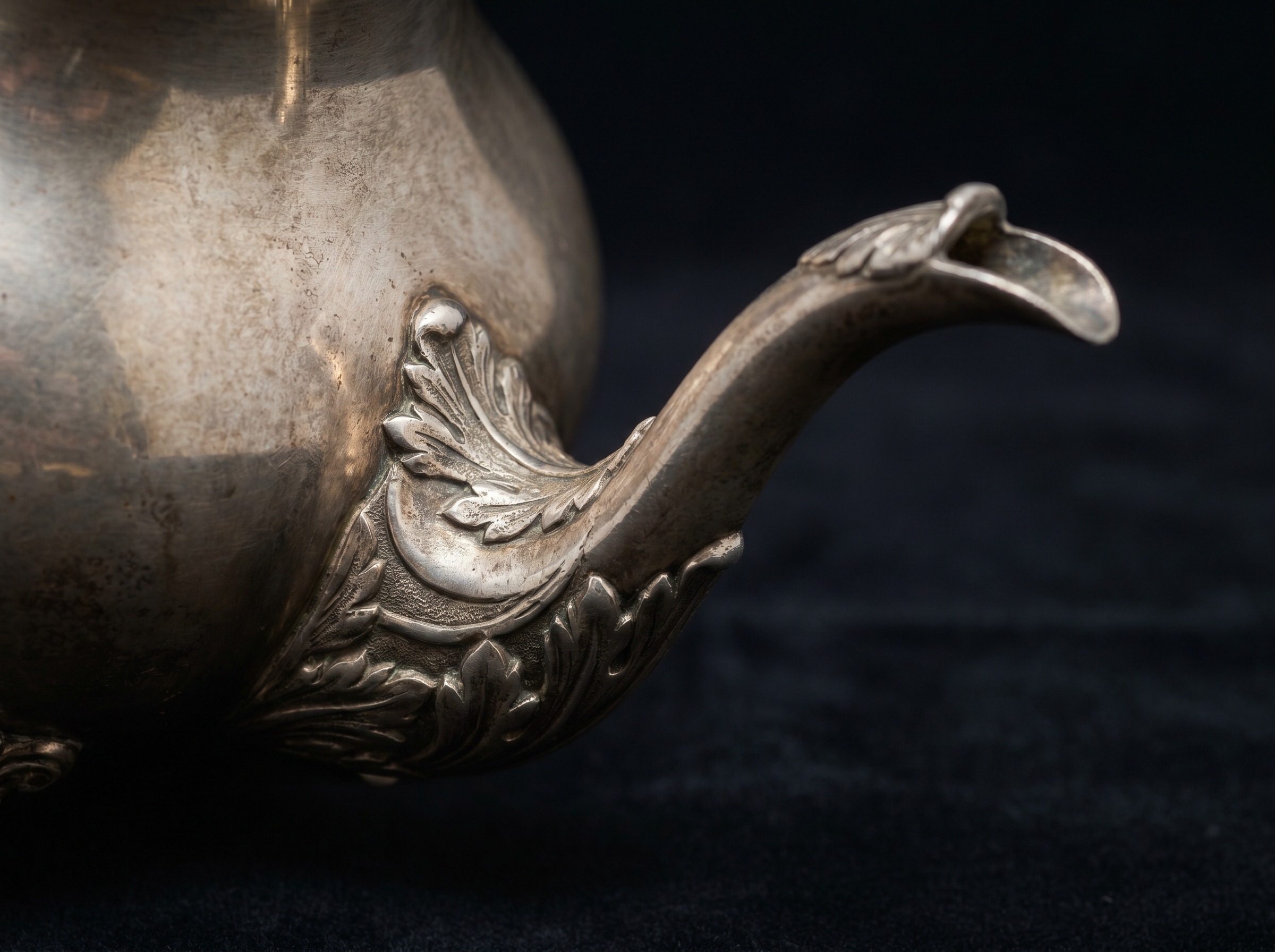
Cast and chased spout with applied leaf ornament at the body — a Rococo and later Georgian feature.
Neoclassical / Adam (1770–1800) — Urn and Vase Forms
Robert Adam's neoclassicism brought a new shape — the coffee pot as a classical urn. Pieces are tall, vase-shaped on a square pedestal or stepped foot, with bead borders, fluted decoration and bright-cut engraving. Hester Bateman, John Carter and Andrew Fogelberg are typical names of the period.
Typical value: £1,800–£7,000. Hester Bateman urn-form coffee pots: £2,500–£8,000.
Regency (1800–1830) — Heavy Gauge, Foliate Cast
The neoclassical form persisted but became heavier and more decorated. Paul Storr, Benjamin Smith, Robert Hennell. Cast foliate borders, gadrooning, applied ornaments. The Regency coffee pot is substantial — often 2.5 kg or more — and gives presence on the table.
Typical value: £2,500–£10,000. Paul Storr Regency coffee pots: £8,000–£40,000+.
William IV and Victorian (1830–1900) — Revival Styles
Victorian taste cycled through revivals — rococo revival (heavy cast and chased), neoclassical revival (lighter, urn shapes), naturalistic chasing (grapes, vines, ivy). Mappin & Webb, Hunt & Roskell, Elkington production. Often part of complete tea-and-coffee services rather than standalone pots.
Typical value: £600–£3,000 standalone; £2,000–£10,000 as part of a complete tea and coffee service.
Edwardian to Modern (1900–1970) — Adam Revival
Mostly Adam-revival urn shapes, lighter gauge, often loaded handles. Sheffield production by Walker & Hall, James Dixon, Atkin Brothers.
Typical value: £400–£1,500 standalone.
How to Read the Marks
Marks on an antique coffee pot are usually struck on the base, the underside of the handle hinge or the inside of the rim. From left to right: maker's mark, lion passant (sterling) or Britannia figure (Britannia standard, before 1720), town mark (leopard's head for London, anchor for Birmingham, rose/crown for Sheffield, castle for Edinburgh, etc.), date letter, and duty mark (1784–1890).
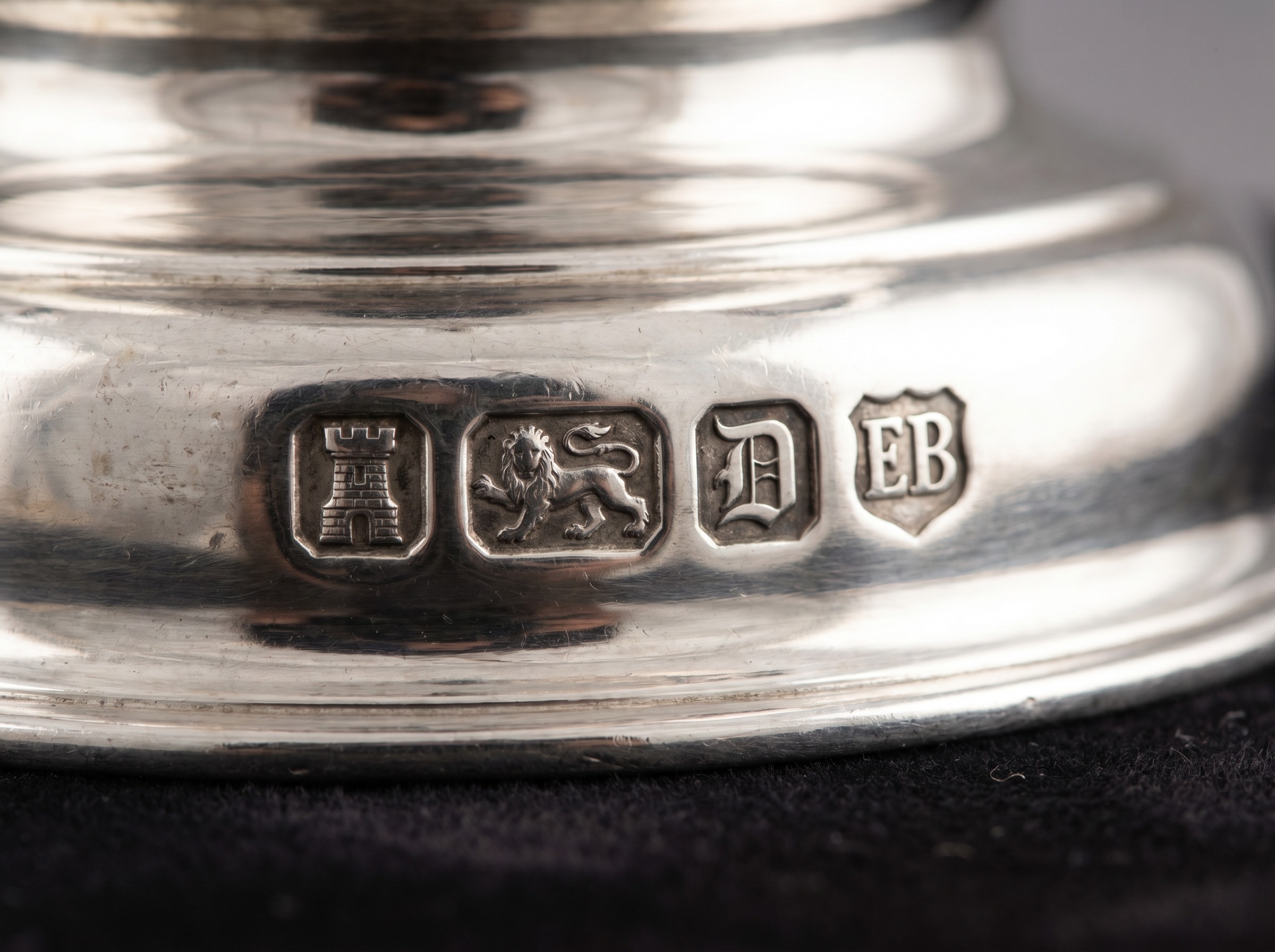
Hallmarks struck on the base — town mark, lion passant, date letter and maker's mark.
What Increases Value
- Named maker — Paul de Lamerie, Paul Storr, Hester Bateman, Garrard, Hennell all add substantial premium.
- Britannia standard (1697–1720) — early; higher fineness; usually finer craftsmanship.
- Original engraved armorial — un-erased, contemporary with the piece. An erased cartouche reduces value 15–30%.
- Heavy gauge — substantial weight indicates quality (and silver content).
- Original wooden handle — replacements reduce value 20–40%.
- Original lid finial and hinge in working order.
- Britannia-period silver-gilt interior for chocolate-pot variant.
Pitfalls
- Replaced handles — very common; fruit-wood handles break and get replaced. Check the rivets.
- Re-spouted pots — the spout has been replaced. Look for a join under the body where the original spout used to meet.
- "Coffee-pot shape" Victorian hot-water jugs — narrower, taller, slimmer; not coffee pots. Check capacity and handle orientation.
- EPNS / "Sheffield Plate" coffee pots — common in 19th century. No lion passant means not sterling.
Got an Antique Silver Coffee Pot to Sell?
Active buyer of all antique English silver coffee pots — Queen Anne tapered cylinders through to Edwardian Adam-revival pots. Mayfair showroom by appointment or free insured nationwide courier. Same-day payment, fair offers plus full maker premium for Lamerie, Storr, Bateman, Garrard, Hennell and other named pieces.
- Send photos of your coffee pot and its hallmarks via our online valuation form — include base hallmarks and a side profile photo.
- We email an instant indicative price (usually within one working day).
- Visit our Mayfair showroom by appointment, or we book a free insured collection.
- Your coffee pot is independently verified at our office.
- You're paid by same-day bank transfer once you accept our offer.
All courier collections insured up to £25,000 per parcel. Higher-value coffee pots collected by specialist secure courier at no cost.
Related Reading
Frequently Asked Questions
How do I tell a coffee pot from a teapot?
Coffee pots are taller, with the handle at a right angle to the spout. Teapots are squatter, with the handle opposite the spout. Capacity is also larger on coffee pots.
What is the most valuable type of antique silver coffee pot?
Important Rococo and Britannia-period pots by named makers (Lamerie, Platel, Crespin, Nelme) — £20,000 to over £100,000 at auction. Plain Queen Anne tapered cylinders also command serious prices.
My pot has a wooden handle that looks newer — does it matter?
Yes. Original fruit-wood handles are part of the value. A competently replaced handle still beats a broken stub, but a 20th-century handle on a Georgian pot reduces value 20–40%.
How much is an Edwardian coffee pot worth?
£400–£1,500 typically. Sheffield Adam-revival production. Part of a complete tea-and-coffee service: more.
Is a Britannia-marked coffee pot worth more?
Generally yes — Britannia coffee pots are 1697–1720, are higher fineness (.958), and tend to be early/important examples. Sterling-period pots can be equally or more valuable depending on maker and quality.
Will you tell me what my coffee pot is worth?
Yes — free, no obligation. Email info@mozerisfineantiques.com with photos of the marks and a side profile.
⚠️ Strictly by appointment only — no walk-ins at either location.
Antique Silver We Specialise In
Click any category for our specialist buying guide — then send photos for a free valuation. We also have a full Sell Your Silver overview.