
In this guide (13)
- Got Antique Silver Candelabra? We'll Identify and Value Them Free
- Candelabrum vs Candelabra vs Candlestick
- Loaded or Cast: How to Tell
- Style Periods
- How they were decorated
- The "Married" Candelabra Problem
- Caring for silver candelabra
- Major Makers to Look For
- What Decides the Value of Silver Candelabra
- Got Silver Candelabra to Sell?
- Frequently Asked Questions
- Antique Silver We Specialise In
- Questions
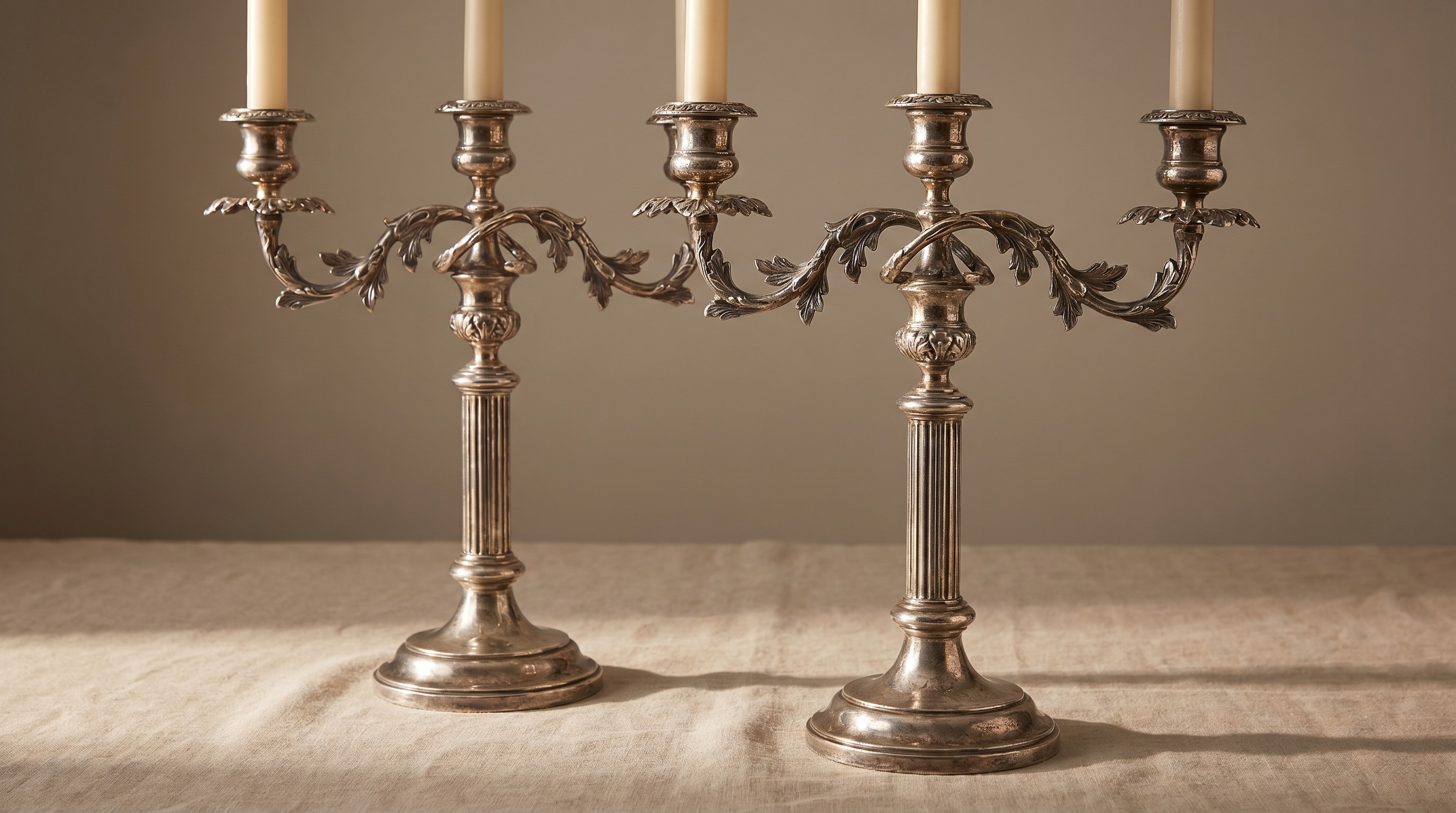
Got Antique Silver Candelabra? We'll Identify and Value Them Free
Send photos of the marks and the candelabra (please include a photo of the base hallmarks and the underside of the sconces). We'll tell you the period, maker and current market value.
Silver candelabra are the showpieces of the antique dining table. They are also the easiest piece of household silver to misread: branches, columns and bases are often not the same period, and loaded and cast pieces look alike at a glance. This guide shows you how to tell them apart.
It covers the types, construction (loaded or cast), how to read the marks, what Georgian, Regency, Victorian and modern examples look like, and what decides their value.
Candelabrum vs Candelabra vs Candlestick
The distinction is important. A candlestick holds one candle. A candelabrum (singular) is a candlestick with detachable branches turning it into a multi-light fitting: typically two-light (one branch and one central), three-light or five-light. Candelabra is the plural. Antique candelabra are almost always sold and used in pairs, occasionally in sets of four or six for very large dining tables.
Selling Antique Silver Candelabra?
Free valuation from your photographs. Paid the same day after inspection.
- Free insured FedEx collection
- Insured to £10,000
- No obligation
Loaded or Cast: How to Tell
Candelabra were made in two main ways, and it helps to know which you have:
- Cast. Silver poured into a mould and finished by hand, solid throughout with no filler inside. This is how most Georgian and Regency candelabra were made.
- Loaded. Stamped or raised sheet-silver columns filled with pitch, plaster or, later, resin to keep them steady. Loaded candelabra are the standard 19th and 20th century construction, and they are genuine sterling silver.
Loaded candelabra are usually marked "loaded" on the base, or have a felt-covered base. If a "Georgian" pair is stamped rather than cast, check the hallmarks closely: it is more likely a 20th-century reproduction in Georgian style than an 18th-century pair.
Style Periods
Early Georgian (1714–1750)
Plain cast columns, shaped square or octagonal bases, simple drip pans. Branches are scrolled and integral.
Mid-Georgian / Rococo (1750–1770)
Cast scrolling foliate stems, shell motifs, mask escutcheons. The Lamerie / Crespin / Sprimont generation.
Late Georgian / Neoclassical (1770–1800)
The Adam style: fluted columns, urn-shaped sockets, beaded edges, restrained classical decoration. Pairs by Hester Bateman, John Carter and the Sheffield makers belong here. Lighter and more restrained than rococo.
Regency (1800–1830)
Substantial cast construction, foliate branches, gadrooned bases, sometimes with applied vine and grape detail. Paul Storr is the leading name of the period.
Early to mid-Victorian (1837–1880)
Naturalistic cast branches with foliage, fruit, sometimes figural caryatid stems. Often more elaborate than Georgian. Major firms: Garrard, Hennell, Hunt & Roskell, Elkington.
Late Victorian / Edwardian (1880–1910)
Mostly loaded construction, reproducing earlier styles, "Adam revival" being common. Major Sheffield production by Walker & Hall and Mappin & Webb.
Modern / Reproduction (1950–2000)
Loaded construction in Georgian and Adam styles, with Sheffield and Birmingham hallmarks.
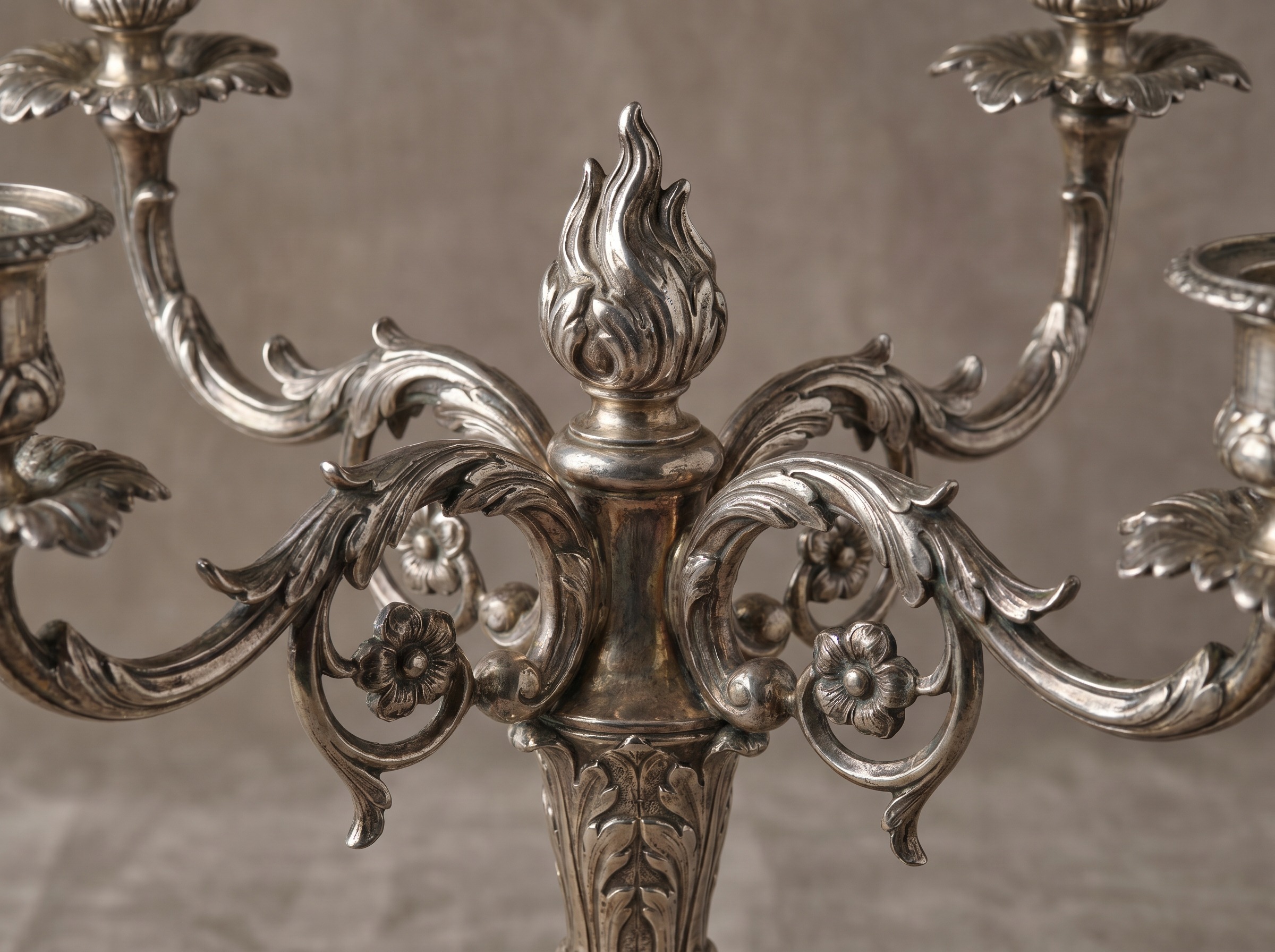
Cast scrolling foliate branches with central flame finial, a Regency feature.
How they were decorated
Three techniques account for most of the ornament on antique candelabra:
- Chasing. The surface is worked from the front with punches, pushing the silver into pattern without removing any.
- Repoussé. The silver is hammered out from behind to raise the design, then refined from the front by chasing.
- Engraving. A sharp tool cuts lines into the surface, used for crests, monograms and borders.
Crisp, undamaged decoration that matches the period of the piece adds to its appeal.
The "Married" Candelabra Problem
Detachable branches are exactly that, detachable. Over 250 years, branches get lost, broken, replaced, swapped between pairs, and "made up" from spares. A "Georgian pair" can in fact be: Georgian bases + Victorian branches + later sockets. Each component carries its own hallmarks. Always check that:
- The bases are a true pair (same maker, same date, same model).
- The branches match each other (left and right) and ideally match the bases by maker/date.
- The sockets and drip pans match the branches.
- The candlesticks under the branches are themselves a genuine pair (same model, mirror-image not duplicate).
Married candelabra still sell, but a true matched pair, with every part of the same date and maker, is what buyers look for.
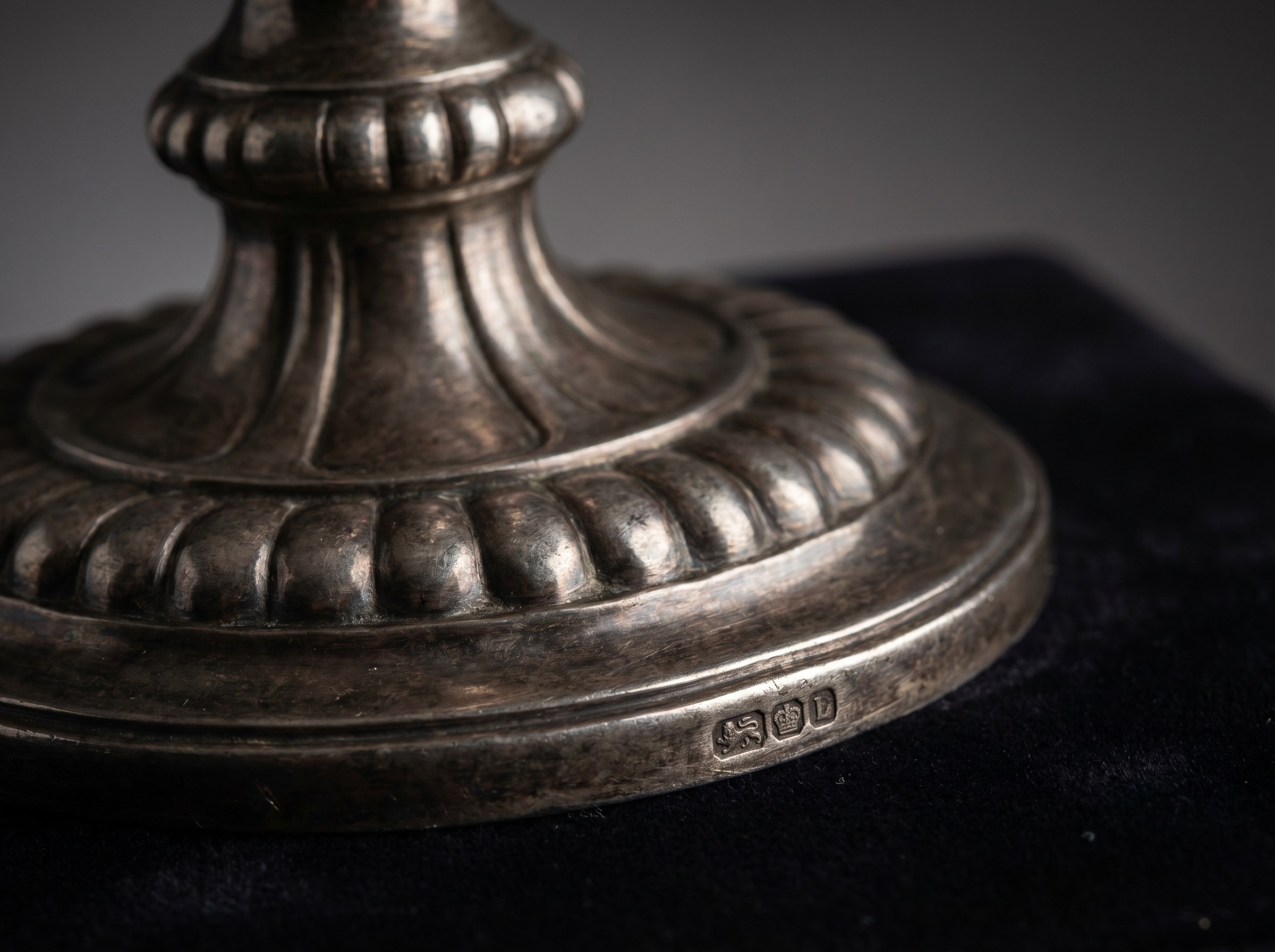
A gadrooned Regency base with full London hallmarks on the foot.
Caring for silver candelabra
Remove candle wax first: chill the piece briefly or soften the wax with warm water, then lift it away without scraping. Clean gently, as in our guide to cleaning antique silver, and do not force detachable branches or nozzles. Display away from direct sun, heat and damp, and store each part wrapped in acid-free tissue in a padded box.
Major Makers to Look For
- Paul Storr. The Regency master: foliate cast, naturalistic and finely finished.
- Garrard & Co: Crown Jeweller; high-quality presentation candelabra throughout 19th and 20th centuries.
- Robert Hennell dynasty, fine Georgian and Regency.
- John Carter, John Schofield, Henry Chawner, late Georgian neoclassical.
- Matthew Boulton: Birmingham Soho Manufactory pairs.
- Hester Bateman, slender neoclassical pairs.
- Hunt & Roskell, Elkington: Victorian.
- Walker & Hall, Mappin & Webb, James Dixon: Sheffield late Victorian / Edwardian production.
What Decides the Value of Silver Candelabra
No two pairs are the same, so we never publish figures. These are the six things we look at, and the ones a buyer looks at too:
- Maker. A named maker such as Paul Storr, Garrard or Hennell, with clear marks.
- Date. The period, confirmed by the hallmarks on every part.
- Quality. Crisp casting, fine chasing and good proportions.
- Condition. No splits or repairs, with the drip pans and sockets present.
- Originality. Branches, columns and bases of the same date and maker, and any original engraved armorial intact.
- Demand. How many buyers are looking for that style and period now, and whether you have a true pair or a set.
Send photographs of the marks on the base, the underside of the sconces and a side view for a free valuation, with a reply within one working day.
Got Silver Candelabra to Sell?
We buy antique English silver candelabra: Georgian, Regency, Victorian, Edwardian and quality modern pairs. By appointment in Mayfair or at our Braintree office, by post, or by free insured collection. Paid the same day after inspection by bank transfer, once you accept our offer.
- Send photos via our online valuation form: include the base hallmarks, the underside of the sconces and a side view of the full piece.
- We reply with a free estimate, subject to inspection, within one working day.
- Book an appointment in Mayfair or at our Braintree office, send by Royal Mail Special Delivery, or book a free FedEx collection.
- We inspect every piece, its marks and construction, before confirming the offer.
- You are paid the same day by bank transfer once you accept our offer.
Insured up to £10,000 per parcel when you send to us.
Frequently Asked Questions
What's the difference between a candelabrum and a candlestick?
A candlestick holds one candle; a candelabrum has detachable branches making it a multi-light fitting (typically three or five lights). Candelabra is the plural: they almost always come in pairs.
What does "loaded" mean?
A loaded candelabrum has a column of sheet silver filled with pitch, plaster or resin to keep it steady, rather than being cast solid. It is genuine sterling silver and is usually marked "loaded" on the base. Loaded construction is normal from the 19th century onwards. Send us a photograph of the base and we will confirm it.
Is a "Georgian" pair always Georgian?
Not necessarily. Branches detach and many candelabra have replaced parts. Always check hallmarks on all components.
Are silver candelabra worth more in pairs?
Yes. A genuine matching pair, with every part of the same date and maker, is what buyers look for, and it is worth more than two singles. Sets of four or six are rarer still. Check the hallmarks on every part, then send us photographs for a free valuation.
What decides the value of an Edwardian pair?
The maker, such as Walker & Hall or Mappin & Webb, the size, the quality of the design, the condition and whether every part is original. Loaded construction is normal for the period and does not count against a pair. Send photographs of the marks and the full pieces for a free valuation.
Will you tell me what mine are worth?
Yes, free and with no obligation. Send photographs of the marks on the base, the underside of the sconces and the full pieces through our valuation form, by email to info@mozerisfineantiques.com, or by WhatsApp, and you get a reply within one working day.
Antique Silver We Specialise In
Click any category for our specialist buying guide, then send photos for a free valuation. We also have a full Sell Your Silver overview.
Tea Services Claret Jugs Tankards & Mugs Soup Tureens Entrée Dishes Sauce & Gravy Boats Meat Domes Fish Servers Punch & Rose Bowls Epergnes Salts & Mustard Pots Cruet Sets Sugar Casters Caddy Spoons Nutmeg Graters Grape Scissors Marrow Scoops Wine Coasters Wine Funnels Wine Labels Chambersticks & Snuffers Toast Racks Card Cases Snuff Boxes Vinaigrettes Scent Bottles Vesta Cases Match Strikers Cigar Cases Photograph Frames Inkstands & Inkwells Desk Accessories Christening Sets Quaich Coffee Pots Silver-Gilt & Vermeil Flatware