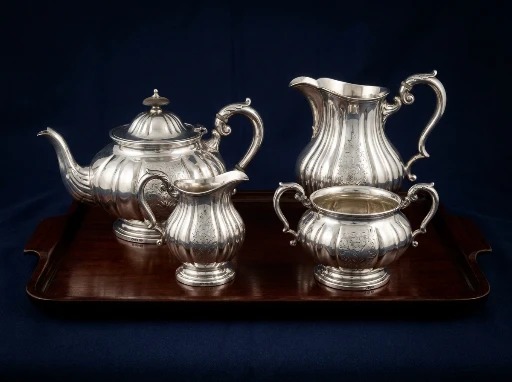
The Complete Guide to Antique Silver Tea Services
An honest walk through how to identify, date and value an antique silver tea service, from a plain Georgian three-piece to a full Art Deco set, with realistic 2026 figures and the damage that quietly knocks the price down.
First settle the question that decides everything: is the set sterling silver or electroplate? Look for a full British hallmark with the lion passant. A sterling three-piece service usually sells for roughly £300 to £800 at auction; the equivalent EPNS set often fetches £30 to £150. After that, value turns on maker, period, completeness and condition.
Antique silver tea services are among the most commonly inherited and most frequently misunderstood pieces we see at Mozeris Fine Antiques. People arrive full of hope: a family set polished and boxed for decades, handed down as something precious. The valuation conversation can then disappoint if nobody has explained how this part of the market actually works.
This guide gives you a straight, thorough grounding before you speak to a dealer. We cover what counts as a service, how to read the period from the style, how the hallmarks date it, and what these sets are realistically worth right now.
If you are selling, insuring, or simply want to understand what is sitting in the sideboard, the sections below will tell you what to check and what to expect.
Key takeaways
- The first test is always sterling versus electroplate. A lion passant and a full hallmark mean solid silver; "EPNS" or "EP" means plate. See our guide to reading silver hallmarks.
- Style dates the set quickly: plain Georgian, heavy Regency fluting, busy Victorian embossing, restrained Edwardian, geometric Art Deco.
- A genuinely matched set, same maker and same date letter on every piece, is worth far more than a group assembled to look similar.
- Maker matters. A Mappin & Webb set or a fine Georgian maker carries a premium; ordinary Victorian commercial output does not.
- Condition quietly governs price. Dents, split seams, replaced handles and over-polishing all reduce what a buyer will pay. Before selling, weigh up a free valuation at sell your silver tea set.
What a Tea Service Consists Of
The phrase "tea service" gets used loosely. It helps to know the correct terminology before you judge what you have.
- 3-piece service: teapot, cream jug and sugar basin. The most common configuration and the minimum for a usable set.
- 4-piece service: adds a hot water jug, sometimes called a hot milk jug. It is usually taller and narrower than the teapot and was used to dilute strong tea at the table.
- 5-piece service: adds a kettle on a stand, often with a spirit burner beneath to keep the water hot. These are impressive pieces and, when complete and matching, command higher prices than simpler sets.
- 6-piece full service: adds a further element, typically a slop basin (for cold tea dregs) or a second tray. Full matched six-piece sterling services are uncommon and can be very desirable when every piece shares the same maker, date letter and decoration.
A matching tray is often linked with a service but is technically separate. A large tray with matching decoration and hallmarks adds meaningful value, both visually and practically. A mismatched tray adds little. For trays in their own right, see our guide to silver salvers and trays.
Main Styles and Periods
The style of a service is one of the most reliable guides to its date. Knowing the major periods lets you place a set before a specialist ever sees it.
Georgian (circa 1714 to 1830)
Early Georgian tea services lean towards simplicity: clean lines, plain surfaces, or restrained decoration such as bright-cut engraving (a shallow, faceted form of engraving that catches the light) and beaded borders. Teapots of the period are often drum-shaped or oval. The weight and quality of construction are typically very high. Genuine Georgian sterling services are scarce and attract serious collector interest when the hallmarks are intact and the condition is good.
Regency (circa 1811 to 1830)
The Regency brought heavier, more architectural forms. Melon fluting, the vertical or curved ribs running the length of the body, is characteristic, as are heavy cast borders with shell, acanthus and gadrooned decoration. These tend to be substantial pieces with considerable silver weight.
Victorian (circa 1837 to 1901)
Victorian tea services are by far the most common category. The period spans an enormous stylistic range: heavily embossed naturalistic decoration of flowers, foliage and birds; Rococo Revival forms with elaborate scrollwork; and later the relative restraint of the Aesthetic Movement. The sheer volume produced means most Victorian sterling services are plentiful, and the collector market reflects that. A standard Victorian three-piece set in average condition is not highly valuable.
Edwardian and Arts & Crafts (circa 1901 to 1910)
Edwardian silver is often more restrained than late Victorian, with cleaner surfaces and lighter construction. Arts & Crafts silversmiths, working in the tradition of the Guild of Handicraft and similar workshops, produced distinctive hand-hammered pieces with deliberately rustic surfaces. These are specialist interest items with a dedicated following.
Art Deco (circa 1920 to 1940)
Art Deco tea services are among the most collectable of the twentieth century. Clean geometric forms, stepped covers, angular handles and minimal surface decoration define the style. A well-matched, complete Art Deco silver tea service in good condition draws strong interest from collectors and interior buyers alike.
How to Date a Tea Service
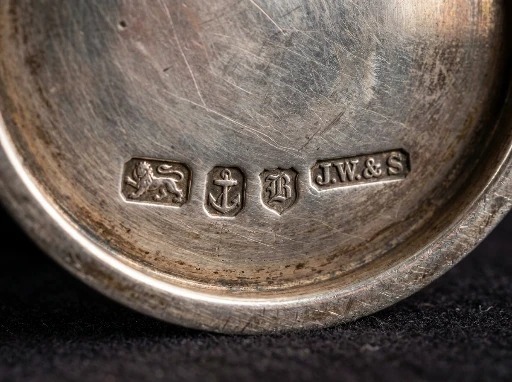
British silver hallmarks are one of the most reliable dating systems in the decorative arts. A full hallmark on sterling carries a standard mark (the lion passant for English silver), an assay office mark, a date letter and usually a maker's mark. Read together, they tell you where a piece was made, by whom, and in which year it was assayed.
Our detailed guide to reading silver hallmarks covers the full system. For tea services specifically, check these points:
- Whether every piece carries the same date letter, which confirms a genuine matched set rather than parts assembled from different years.
- Whether the maker's mark matches across all the pieces.
- The assay office mark: London (leopard's head), Birmingham (anchor), Sheffield (rose, with a crown until 1974), Edinburgh (castle). Each office ran its own date-letter cycle.
- The condition of the marks themselves. Rubbed or partly struck marks reduce value and can make accurate dating harder.
Birmingham and Sheffield were major centres of tea service production from the mid-Victorian period onwards. London-assayed pieces, especially Georgian ones, tend to carry a premium. Maker's marks from significant firms (Barnard Brothers, Elkington & Co, or Paul Storr for earlier work) add to value, though most Victorian output came from large manufacturers whose marks carry limited collector premium. Caddies follow the same logic; see our note on Georgian silver tea caddies.
Not sure if your set is sterling?
Send us clear photos of the marks and the full service. We read British hallmarks every day and will tell you what you have, free of charge.
EPNS Versus Sterling: The Most Important Question
Before anything else, establish whether your service is sterling silver or electroplate. The vast majority of Victorian tea services found in homes today are electroplated nickel silver (EPNS): a base-metal alloy given a thin coat of silver by electrolysis. EPNS looks much like sterling and was produced in enormous quantities from the 1840s onwards.
Our full guide to EPNS versus sterling silver explains how to tell them apart. In short, look for a complete set of British hallmarks including the lion passant. EPNS pieces carry marks such as "EPNS", "A1" or "EP", but never a lion passant or a proper date letter. The gap in value is large, as the table below shows.
| Type | Marks to expect | Typical value (3-piece) |
|---|---|---|
| Sterling silver | Lion passant, assay office, date letter, maker | £300 to £800 at auction |
| EPNS / electroplate | "EPNS", "EP", "A1"; no lion passant | £30 to £150 |
Understanding the Decoration
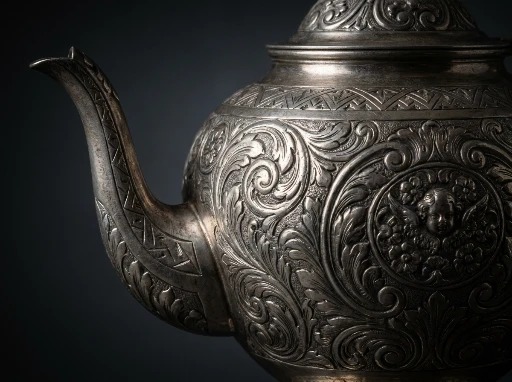
Decoration tells you about a service's period, its quality, and sometimes its original cost. Heavily embossed pieces took skilled labour and were expensive when new, but embossing also leaves thin, vulnerable surfaces that damage over time. A deeply embossed Victorian service with dents and split seams is not a desirable object.
Plain or lightly decorated sets are often structurally sounder and easier to assess. Bright-cut engraving, typical of the late Georgian period, is a mark of quality when it is crisp and unpolished. Over-polishing softens those delicate cuts and significantly reduces the appeal, and value, of bright-cut pieces.
Crests and Armorials
Many Victorian services were engraved with family crests or full armorial bearings. Modern buyers often find these less desirable than plain pieces, since they signal the item belonged to someone else. A well-documented armorial on a piece of real quality can add interest for specialist collectors, but on ordinary Victorian tableware a crest usually has a neutral effect on value at best.
What Affects Value: A Summary
- Sterling versus EPNS: the single most important distinction. Settle it before forming any view on value.
- Completeness and matching: a genuinely matched set (same maker, same date letter, same decoration) is worth considerably more than an assembled group of similar pieces.
- Period: Georgian and Regency sterling services outrank standard Victorian output. Art Deco is strong. Post-war is generally weak.
- Condition: dents, split solder seams, replaced handles (often in bone, ivory or later resin, all of which can crack or discolour), worn lids and hinges, and over-polished surfaces all reduce value.
- Silver weight: sterling sets are valued partly by weight, so heavier pieces have a higher floor price. A light, thin Victorian service has less bullion value underpinning it; for that floor, see our silver value guide.
- Maker: most Victorian silver was commercially produced. Pieces by celebrated makers such as Paul Storr or significant Regency silversmiths command strong premiums. Standard Victorian firm marks add little.
Realistic Values in 2026
We give honest assessments rather than encouraging hopes that the market will not meet. Based on current auction and private sale data:
| Service | Condition | Auction range |
|---|---|---|
| Victorian sterling 3-piece | Average | £300 to £800 |
| Victorian sterling 4-piece | Matched, no damage | £600 to £1,500 |
| Sterling 5-piece with kettle | Excellent, matching | £1,500 to £4,000+ |
| Georgian sterling | Maker dependent | Considerably more; valuation essential |
| Art Deco sterling | Excellent, well designed | £800 to £3,000+ |
| EPNS (any period) | Typical | £30 to £150 |
These are auction estimates. Private sale values can differ. Heavy or unusual EPNS pieces by Elkington or Walker & Hall may reach the upper end of the plate range, and condition or completeness can shift any set well within or outside these figures.
Damage to Look For Before You Sell
Before presenting a service for valuation, check carefully for the following, since each one affects the assessment:
- Dents or distortion to the body of any piece.
- Splits at solder seams, particularly around spouts and where handles attach.
- Worn or damaged lids, including bent or broken hinge mechanisms.
- Replaced or cracked handles and insulators.
- Deeply worn or rubbed hallmarks.
- Over-polishing that has removed surface detail or thinned embossed decoration.
- Green or black staining that may point to verdigris or sulphide damage on the base metal.
For looking after silver before a valuation, read our guide on caring for antique silver. As a rule, do not clean or polish a set aggressively before a valuation. You can reduce its value in the process.
Selling Your Tea Service
If you have identified a service and want to know what it is worth now, a specialist assessment gives a far more accurate figure than an online calculator or a general dealer. Value rests not only on weight and purity but on the maker, the period, the condition, rarity and any notable provenance.
At Mozeris Fine Antiques we offer free, no-obligation assessments on antique silver tea services of every period. We are active buyers and will give you a straight opinion of what you have and what it is worth. If it is a fine piece, we will say so. If it is a common EPNS set with modest value, we will tell you that too, because honest dealing is the foundation of a good reputation. Start at sell your silver tea set, or see the wider sell your silver hub. We pay competitive prices with same-day payment at our Mayfair and Braintree showrooms.
Frequently Asked Questions

Faustas has over ten years' experience in antique silver and jewellery, specialising in Georgian, Victorian and Regency pieces. He works with private clients and estates from the Mozeris showrooms in Mayfair and Braintree, Essex.
Have a Tea Service You'd Like Valued?
Send us a few photographs, including the hallmarks and the full set, and our specialists will give you an honest, no-obligation assessment. Free valuation, same-day payment, showrooms in Mayfair and Braintree.
Thinking of Selling Antique Silver?
Mozeris Fine Antiques are specialist buyers of antique and sterling silver. Send us photographs — including the hallmarks — for a free, no-obligation valuation. Payment on agreement.
📍 47 Maddox Street, Mayfair · Braintree, Essex · 📞 01376 334 482 · Strictly by appointment