Antique Silver Claret Jugs: A Complete Collector's Guide
From cut-crystal bodies with silver mounts to rare all-silver examples, learn how to tell the two types apart, read the marks, judge condition, and understand what claret jugs really sell for.
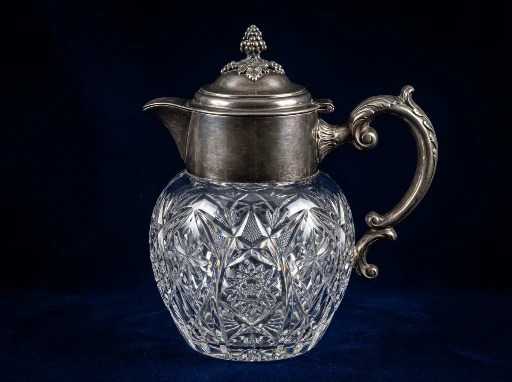
There are two kinds of antique claret jug: a cut-crystal body with hallmarked silver mounts (common), and a jug made entirely of silver (rarer, usually worth more). On crystal examples the silver carries the marks, so date them by the silver. Condition rules everything: a chipped or cracked glass body can halve the value or worse. Most fall between £150 and £1,200, with fine all-silver and novelty jugs going higher.
Few pieces of Victorian silverware mix practical use with decorative ambition quite like the claret jug. Designed for serving claret, the red Bordeaux wine that became fashionable on English tables from the mid-nineteenth century, these jugs were a fixture of the well-dressed Victorian and Edwardian dining room.
They remain one of the more approachable areas of antique silver to collect. Quality and condition vary enormously, though, and value is far more nuanced than most sellers expect. At Mozeris Fine Antiques we buy, sell and value claret jugs regularly for private clients and estates.
This guide sets out what you need to know: how to identify what you have, what the silver tells you, and what realistic market values look like today.
Key takeaways
- The first job is to decide which type you own: a crystal body with silver mounts, or an all-silver jug. They differ in rarity and value.
- On crystal-bodied jugs the silver mounts carry the marks. Date them using the date letter; see how to read silver hallmarks.
- Crystal condition is decisive. A single chip to the rim or lip can cut value by 50% or more, and a crack is effectively fatal.
- Maker matters most on all-silver and novelty jugs. Familiar names and finer chasing push prices well beyond melt; see our silver valuation guide.
- Care matters too: keep jugs out of direct sunlight and never immerse the whole piece. Our guide to caring for antique silver explains how.
Two Distinct Types of Claret Jug
The first thing to establish is which of the two main types you are looking at. They share a function but differ considerably in construction, rarity and value.
Crystal-bodied jugs with silver mounts
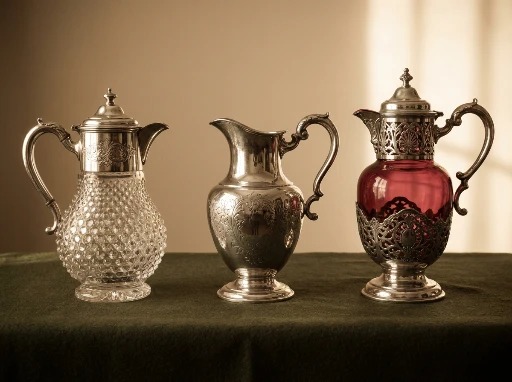
By far the most common type. These jugs have a glass or cut-crystal body fitted with silver mounts: a hinged or removable lid, a neck collar and a handle, all in hallmarked silver. The body does the decorative work while the silver provides the structural and functional parts.
The quality of the crystal matters a great deal. The most desirable examples show deeply cut, high-quality crystal in recognisable patterns: hobnail cut (a grid of raised diamond points), broad-flute cut, panel cut, or the particularly sought-after cranberry glass, a rich ruby red achieved by adding gold during manufacture. Plain, mould-blown bodies are the least valuable. Under a good light, fine cut crystal shows crisp, well-defined cuts with brilliant clarity, whereas moulded glass has softer edges and a slightly flat look.
Common body shapes include plain cylindrical forms, tapering forms with a wider base, and bulbous "club" shapes. The cutting tends to reflect the decade: hobnail cut was popular from the 1870s through the 1900s, while panel cut and faceted designs span the whole Victorian period.
All-silver claret jugs
Rarer and generally more valuable, all-silver claret jugs are made entirely of silver, with no glass body. They are often heavily embossed or chased with naturalistic ornament: trailing vines and grape clusters, putti, hunting scenes or foliate scrollwork. They tend to have a more substantial, sculptural presence than their crystal-mounted cousins.
Because the silver is doing all the decorative work, the quality of the chasing and the prestige of the maker count for much more. These jugs are usually later Victorian and were clearly luxury commissions from the outset.
Understanding the Silver Mounts
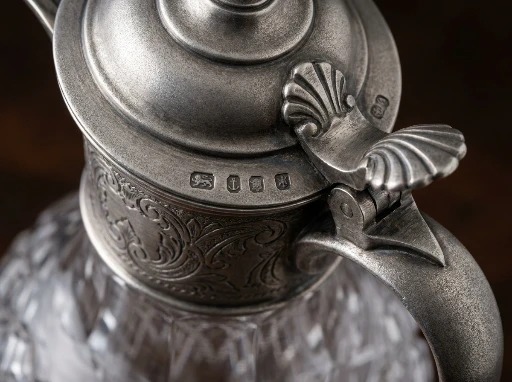
On a crystal-bodied jug it is the silver mounts that carry the hallmarks, so they are what allow accurate dating and attribution. The marks are typically struck on the collar at the neck, on the underside of the lid, or occasionally at the base of the handle where it meets the body.
Most surviving examples date from the 1860s through to about 1910, the peak Victorian and Edwardian period for the form. The assay offices most commonly seen are London (the lion passant, the leopard's head and a date letter in their London cartouches) and Birmingham (the anchor mark). Sheffield examples exist but are less common for this particular form.
For a full explanation of how to read British silver marks, the maker's mark, the assay office mark, the standard mark and the date letter, see our detailed guide to how to read silver hallmarks. On claret jugs the date letter is your most reliable indicator of age; the maker's mark may need cross-referencing against a reference such as Culme's Directory of Gold and Silversmiths.
Major Makers to Know
Several Birmingham and London makers dominated claret jug production during the Victorian period. Recognising their marks can make a meaningful difference to value.
- Heath & Middleton (Birmingham): prolific makers of high-quality crystal-mounted jugs; their mounts are well finished and often finely detailed.
- Hukin & Heath (Birmingham): known for more avant-garde designs, including pieces designed by Christopher Dresser. Dresser-attributed pieces command significant premiums.
- William Hutton & Sons (Sheffield and London): large manufacturers producing a wide range of quality levels.
- E.H. Stockwell (London): noted for novelty and figural designs, including the famous owl and other animal-form jugs. These are among the most collected claret jug forms today.
For most crystal-mounted examples by standard Victorian manufacturers, the maker's mark adds only modest value unless it is one of the names above or can be tied to a known designer.
Not sure what you have?
Send us a clear photo of the jug and its hallmarks. We value claret jugs every week and will tell you honestly what it is, and what it is worth.
What Drives and Destroys Value
This is where sellers are most often surprised. The claret jug market is highly condition-sensitive, and the faults that reduce value are common.
Crystal condition is everything
On a crystal-bodied jug the glass is the primary decorative element, so any damage to it is serious. Even a small chip to the rim or pouring lip, the kind you might only spot under close inspection, will reduce the value of an otherwise good jug by 50% or more. A crack through the body is effectively fatal to value. Scratches to the cut surfaces are less catastrophic, but they dull the visual impact and reduce desirability.
Replaced or non-matching crystal bodies are another thing to watch for. If the glass is not original to the mounts, perhaps swapped after damage at some point in the jug's history, the piece is effectively being sold as a mount only, and the value drops accordingly. A mismatched body may give itself away by a slightly loose fit in the collar, or by cutting that does not match the date of the silver.
Silver mount condition
On the silver itself, look for resoldered or re-attached handles (a common repair, usually visible as a slightly rough join or a patch of discolouration), replaced lids, and splits or dents to the collar. Lids that no longer close properly or hinges that are broken are also deductions. Fine engraving or chasing to the mounts, particularly if well executed, adds value.
Realistic Market Values
We are often asked what a claret jug is worth, and the honest answer is usually less than you hope, unless it is genuinely exceptional. The market for Victorian decorative silver has softened over the past two decades, and claret jugs are not immune. The table below gives broad guidance for pieces in sound condition.
| Type and condition | Typical retail range |
|---|---|
| Plain crystal body, simple mounts, average condition | £150 to £400 |
| Good cut crystal, well-finished mounts, good condition | £400 to £900 |
| Cranberry glass body, fine mounts, excellent condition | £600 to £1,200 |
| All-silver body, good chasing, identified maker | £800 to £2,000+ |
| Novelty or figural designs (Stockwell etc.), exceptional condition | Can exceed the above significantly, but genuinely uncommon |
Any crystal damage moves these figures sharply downwards. A jug that might otherwise fetch £600 with a chipped lip is realistically a £200 to £250 piece. We say this not to put you off seeking a valuation, but because you deserve an honest assessment before you decide what to do with it. For more on how period and maker affect price, see our silver price and valuation guide.
Caring for Your Claret Jug
If you are storing or displaying a claret jug, a few simple precautions protect both the silver and the crystal. Keep it out of direct sunlight, which can encourage tarnish and, in the case of cranberry glass, some fading over time.
When cleaning the silver mounts, use a soft cloth and a reputable silver polish. Avoid polishing compounds near the glass, as they can leave residue in the cut surfaces and, if abrasive, dull the crystal. Never immerse the whole jug in water; the adhesive or friction fit that secures the body to the collar can loosen over time. For fuller guidance, see our articles on how to care for antique silver and cleaning antique silver.
Thinking of Selling?
If you have a claret jug, inherited, bought or otherwise, and would like to know what it is worth, we are glad to give an honest, no-obligation assessment. We buy Victorian and Edwardian silver and silver-mounted glass regularly, and we will give you a straightforward view of condition, dating and realistic market value through our sell your silver service.
You may also find our guides to antique silver tea services and Art Deco silver useful if you are dealing with a broader collection.
You can reach us at our London showroom at 47 Maddox Street, Mayfair, W1S 2PG, or at our Essex base in Braintree, CM7 3RU. Call us on 01376 334 482, email info@mozerisfineantiques.com, or use our contact form to send photographs and a brief description. We aim to respond to all enquiries promptly.
Frequently Asked Questions

Faustas has over ten years' experience in antique silver and jewellery, specialising in Georgian, Victorian and Regency pieces. He works with private clients and estates from the Mozeris showrooms in Mayfair and Braintree, Essex.
Have a Claret Jug You'd Like Valued?
Send us a few photographs, including the hallmarks and any damage, and our specialists will give you an honest, no-obligation assessment. Free valuation, same-day payment, showrooms in Mayfair and Braintree.
Thinking of Selling Antique Silver?
Mozeris Fine Antiques are specialist buyers of antique and sterling silver. Send us photographs — including the hallmarks — for a free, no-obligation valuation. Payment on agreement.
📍 47 Maddox Street, Mayfair · Braintree, Essex · 📞 01376 334 482 · Strictly by appointment