Famous Silversmith Series · The Greatest English Rococo Silversmith
Paul de Lamerie: Complete Silversmith Guide
Paul de Lamerie (1688 to 1751) was a Huguenot silversmith regarded as the finest ever to work in England, active in London from 1713. His work spans Britannia-standard silver and later Rococo masterpieces; a confirmed Lamerie maker's mark with a correct London hallmark is essential.
Reviewed by Faustas Svencionis, Mozeris Fine Antiques, since 2015 · Updated October 2026
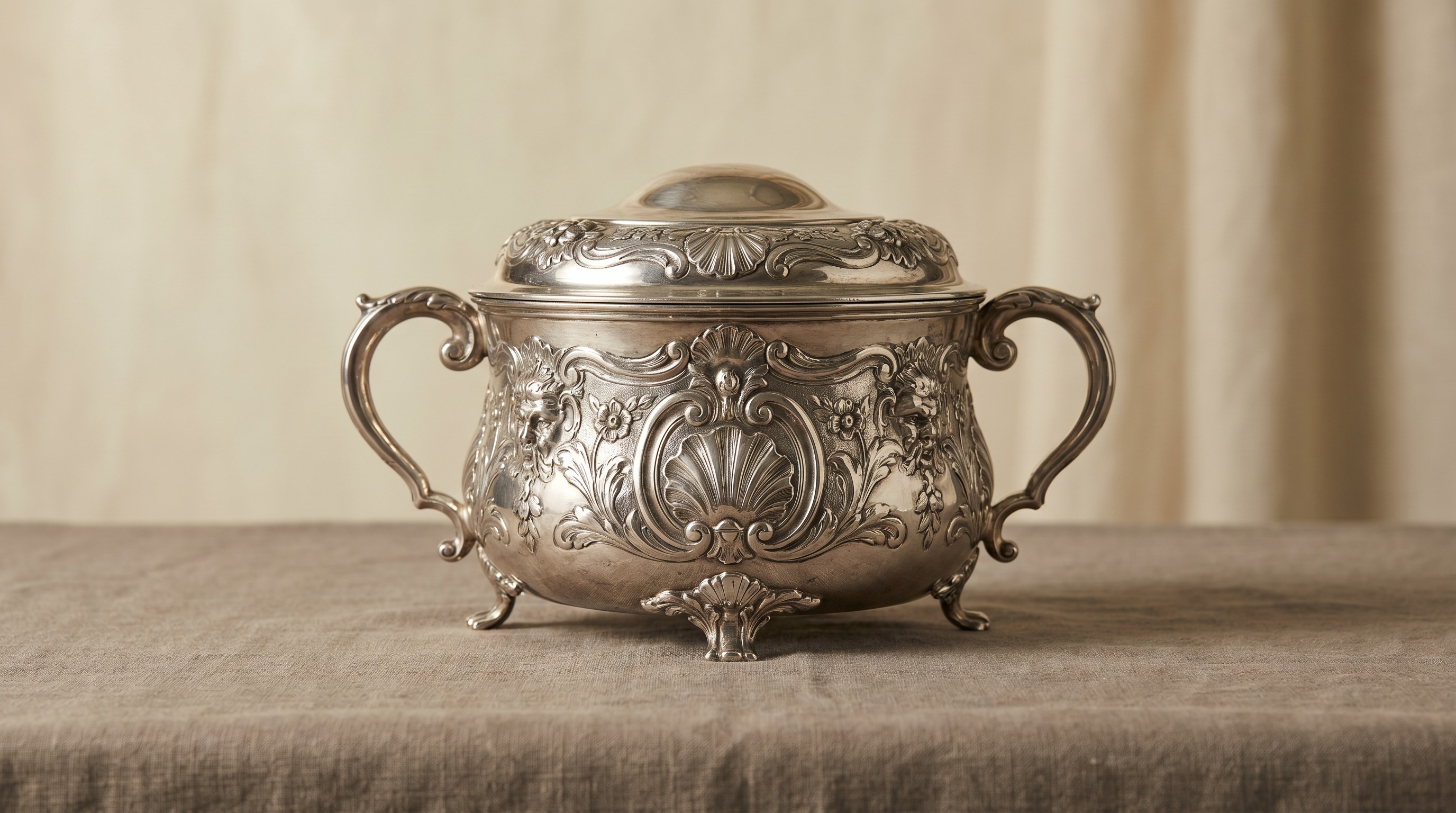
A specialist's guide to Paul de Lamerie (1688 to 1751), the Huguenot master regarded as the finest silversmith ever to work in England. Identify his marks, recognise his rococo style, and understand why genuine Lamerie pieces are among the most valuable items in the entire British silver market.
Got Paul de Lamerie Silver? We'll Identify and Value It Free
Send photos of the marks and your piece. Genuine Lamerie pieces are among the highest-value items in British silver; we will handle yours with the discretion the maker deserves.
Paul de Lamerie is, simply, the greatest silversmith ever to work in England. From his workshop in Windmill Street, off Haymarket, and later Gerrard Street in Soho, he produced, between 1713 and his death in 1751, a body of work without equal in technical ambition, sculptural invention or sheer rococo brilliance. The Royal Collection, the V&A, the Met, the Hermitage and the Getty all hold major Lamerie pieces. A confirmed Lamerie mark transforms a piece of silver from a precious metal into a museum object.
This guide explains who he was, the structure of his marks across the Britannia and sterling periods, what to look for stylistically, and the very real pitfalls of "Lamerie style" later silver and outright forgeries.
Who Was Paul de Lamerie?
Paul de Lamerie was a Huguenot-born London silversmith who worked from Windmill Street and later Gerrard Street, Soho, from 1713 until his death in 1751.
Paul Jacques de Lamerie was born in April 1688 in 's-Hertogenbosch in the Netherlands, the son of Huguenot refugees who had fled French Catholic persecution. The family came to London in 1689 and settled in Soho's growing Huguenot community. In 1703 the young Paul was apprenticed to the leading London Huguenot silversmith Pierre Platel, in whose workshop he served seven years.
He registered his first mark, for Britannia standard silver, at Goldsmiths' Hall on 5 February 1713, having become a Free silversmith earlier that year. He was twenty-four. By 1717 he was already supplying silver to George I (he was appointed "Goldsmith to the King") and within a decade he was the most sought-after silversmith in London. He died on 1 August 1751 at the height of his powers.
Crucially, Lamerie inherited the Huguenot tradition of cast and chased decoration: the French exiles brought with them a level of sculptural ambition and finish that English silversmiths could not match in the early 18th century. This is the technical foundation of his work.
Paul de Lamerie's Maker's Marks
Paul de Lamerie used different maker's marks for Britannia-standard and later sterling silver, always with a London hallmark.
| Mark | What it tells you |
|---|---|
| Maker's mark | PL for Paul de Lamerie (Britannia period marks differ from his later sterling marks). |
| Lion passant | Sterling silver, assayed in England. |
| Leopard's head | The London town mark (crowned until 1821). |
| Date letter | The year of assay; London changed its letter each May. |
Lamerie's marks divide into two clear periods reflecting the change of England's compulsory silver standard. Knowing which mark belongs to which period is essential.
| Mark | Standard / Period | Dates |
|---|---|---|
| LA with a star above and fleur-de-lys below, in a shaped shield | Britannia standard .958: Huguenot first letters of surname (LA-merie) | 1713 to 1732 |
| PL in italic capitals with a crown above and fleur-de-lys below | Sterling standard .925: after the 1720 Act allowed return to sterling | 1732 to 1751 |
| PL in script, with crown above, in oval punch (later second mark) | Sterling standard: used concurrently in later years | 1739 to 1751 |
Important notes:
- From 1697 to 1720 the higher Britannia standard (.958) was compulsory in England. Lamerie's earliest 18 years of work are Britannia. The town mark on Britannia pieces is a lion's head erased, not the leopard's head, and the standard mark is a seated Britannia, not the lion passant. If your "Lamerie" piece shows a lion passant and leopard's head, it cannot be earlier than 1732.
- The "LA" mark uses the first two letters of Lamerie's surname: a Huguenot convention (initials of the surname rather than initials of forename + surname).
- The shift to "PL" in 1732 reflects the new English convention of using forename + surname initials, not a change of person.
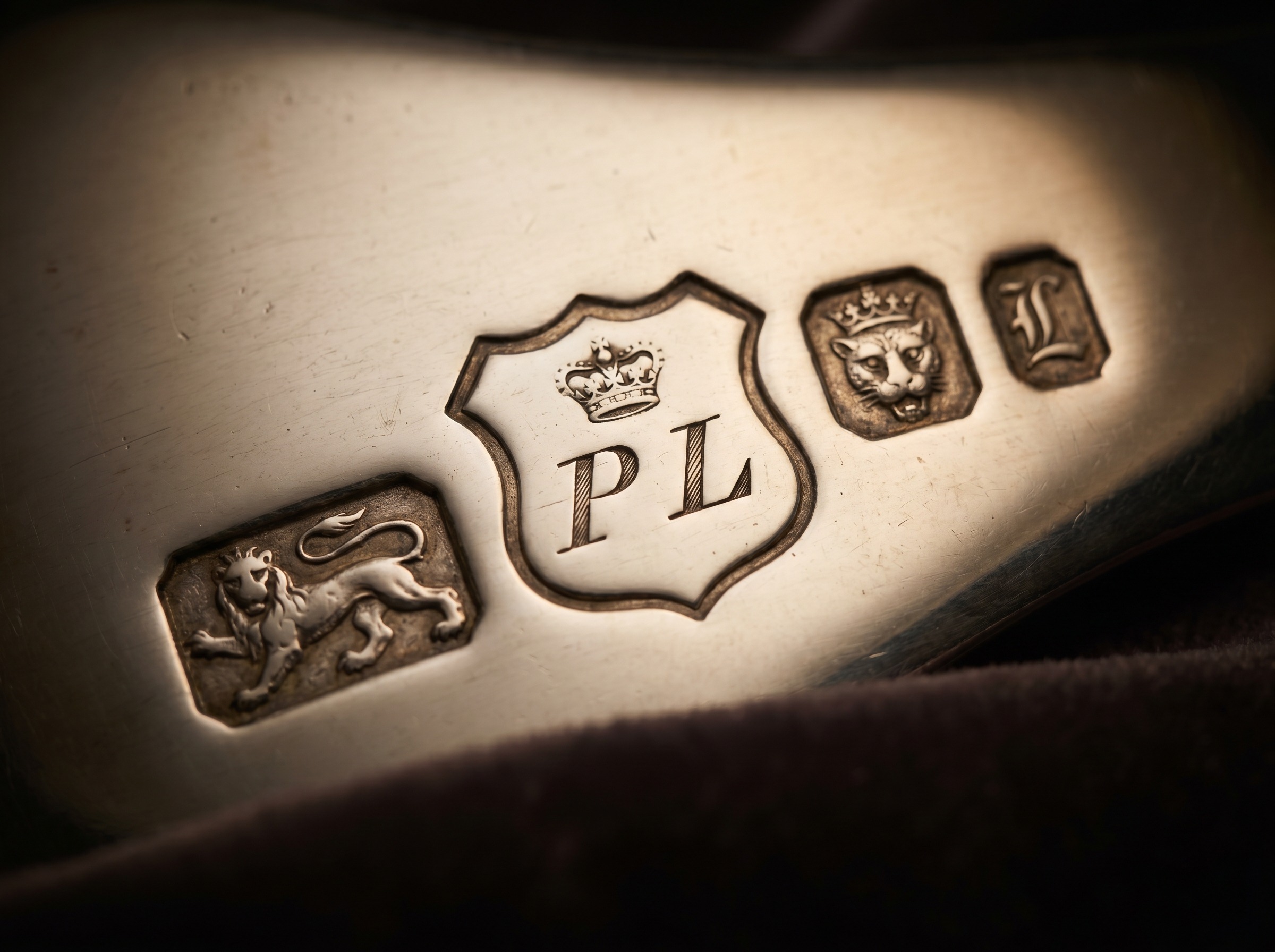
"Lamerie's marks bracket the Britannia / sterling change. Get the standard wrong and the mark is wrong too: a giveaway on forgeries."
The Lamerie Style: What to Look For
Lamerie silver is recognised by sculptural Rococo ornament, crisp casting and chasing, and exceptional finish.
Lamerie's career spans three stylistic phases:
1. Early Britannia period (1713 to 1727): Restrained Baroque
His earliest work is heavy, sculptural and relatively restrained. Cut-card work (silver applied in flat decorative shapes), gadrooned borders, escutcheons with cast handles, sometimes with applied strapwork. Coffee pots, tankards, casters and salvers from this period are firmly Huguenot baroque rather than rococo.
2. Middle period (1727 to 1735): Transitional
The decoration becomes richer. Cast applied decoration grows more elaborate. The first hints of asymmetry and naturalism appear. This is the bridge into mature rococo.
3. Mature rococo (1735 to 1751): Lamerie at his peak
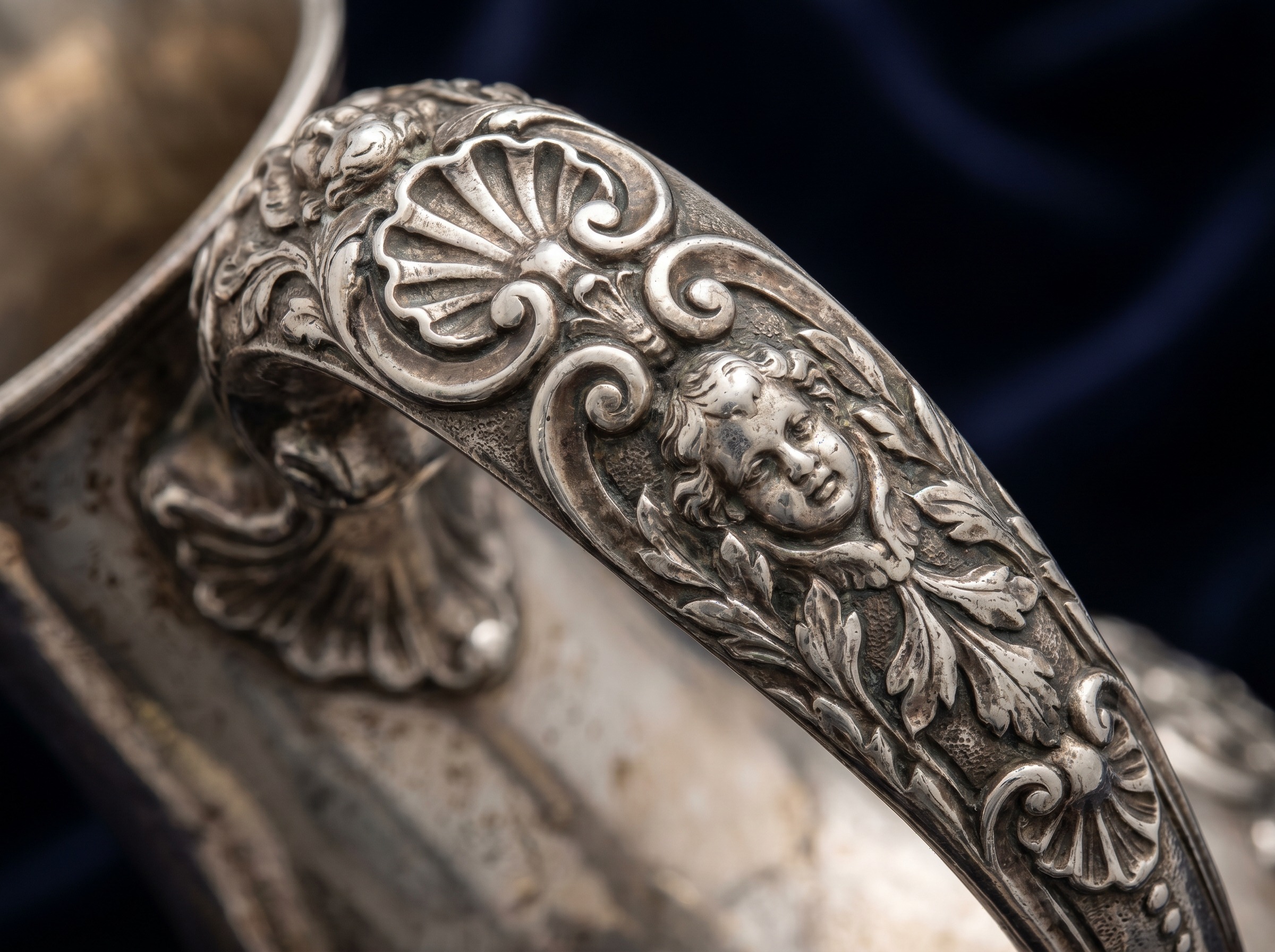
This is the body of work for which Lamerie is famous: highly sculptural, asymmetrical, riotously decorated cast and chased silver featuring shells, masks, putti, satyrs, naturalistic flowers, scrolls and S-curves. Borders are not engraved: they are cast in high relief and applied. Spouts on coffee pots become beasts. Handles become snakes. Feet become shells with putti riding them. The technical challenge is enormous; this is silver made by sculptors as much as silversmiths.
What Paul de Lamerie Made
Lamerie made domestic plate such as salvers, casters, coffee pots and kettles, and sculptural commissions such as wine cisterns, monteiths and ewers.
- Wine cisterns, monteiths and ewers: sculptural showpiece commissions for aristocratic dining.
- Salvers: large, on cast scroll feet, with applied cast borders and engraved armorials.
- Coffee pots and chocolate pots: with cast spouts, applied scrollwork and finely engraved arms.
- Tea kettles on stands: major presentation pieces.
- Soup tureens and entrée dishes: entire dinner services for noble houses.
- Candelabra and candlesticks: cast in heavy gauge with figural elements.
- Centrepieces / epergnes: extravagant cast sculptural objects.
- Royal commissions: for George I, George II and the Russian court (a major Lamerie group remains in St Petersburg).
- Flatware: Hanoverian and shell-back pattern table silver, often armorial.
Almost all of his major work is heavy, large and commissioned. Light "everyday" Lamerie objects (tablespoons, cream jugs, plain salvers) do exist but are far less common than the showpieces.
What Lamerie Silver Is Worth
The value of Lamerie silver depends on a confirmed mark, the period, the form and importance, provenance, engraving and condition.
Genuine confirmed Lamerie sits in a different market from ordinary Georgian silver. A piece by Lamerie should never be sold on weight or melt. These are the things we look at:
What drives value
- A confirmed markA Lamerie maker's mark with the full London hallmark, checked against the right period.
- PeriodBritannia-standard work, or his later Rococo pieces.
- Form and importanceSculptural commissions such as wine coolers, centrepieces and monteiths, against flatware and small pieces.
- Provenance and engravingThe importance of the commission, original engraving, and whether the cartouche has been erased.
- ConditionNo repairs, later decoration or replaced parts.
Every piece is different. Send us a few photos and we will tell you what your Lamerie silver is worth, free and with no obligation. Get a free valuation
What We Look For When a Lamerie Piece Arrives
When a possible Lamerie piece arrives we check the maker's mark against his registered punches for the right period, and read the London hallmark and date letter.
Then we look for later decoration, repairs and replaced parts, check whether the cartouche has been erased, and consider whether the piece is Lamerie's own work or in the Lamerie style.
The "Lamerie Style" Problem and Forgeries
Because Lamerie is so famous and so valuable, the market is full of misattributions and outright fakes. The most common issues:
- "Lamerie style" Victorian and later replicas: large, technically competent rococo silver made in the 19th century with later hallmarks (and frequently spurious "PL" punches added). Always check the full hallmark, not just the maker's punch.
- Re-let-in marks: a genuine Lamerie "PL" cut from a damaged 18th-century piece and soldered into a later silver object. Look for a circular solder ring around the marks and any inconsistency between the marks and the article's date.
- Cast forged marks: a real Lamerie hallmark is sharp, with metal displacement at the punch edges. Cast marks look soft, recessed and even.
- Wrong standard: Britannia "LA" marks on sterling-period style, or "PL" marks on Britannia-standard pieces. Lamerie did not work that way.
- Period replicas by his contemporaries: Edward Wakelin, Frederick Kandler, Paul Crespin all worked in a similar idiom and are sometimes misattributed. These are still extremely valuable in their own right, just not Lamerie prices.
The rule: if a Lamerie piece looks too good to be true, it usually is. Always verify with a specialist before buying or selling.
Got a Paul de Lamerie Piece? We Handle Discreetly
Confirmed Lamerie silver is handled at the very top of the market; most pieces are sold privately to museums and important collectors rather than at general auction. We provide free, no-obligation private valuations and, where you wish to sell, can offer a direct firm price or place your piece with a specialist auction house under our guidance. Discretion guaranteed.
- Send photosUse the form on this page, or email them to us.
- A specialist reviews itMaker, marks, age and condition.
- Free estimate by emailWithin one working day.
- You decidePaid once agreed. No obligation.
Four ways to sell: Mayfair (by appointment), Braintree (by appointment), Royal Mail Special Delivery, free FedEx collection.
Free valuation
Request a free valuation
Send us a few photos of your Lamerie silver. A specialist looks at every request personally and replies by email with an estimate within one working day. There is no obligation to sell.
What to photograph
- The whole piece. The whole piece, from the front and the side.
- The underside. The base or reverse, where the marks usually are.
- The hallmarks, close up. Every mark in the group, in focus, including the maker's mark.
Prefer email? Send photos to info@mozerisfineantiques.com or call 01376 334 482.
Ways to sell
- Mayfair (by appointment)
- Braintree (by appointment)
- Royal Mail Special Delivery
- Free FedEx collection
We buy directly, with payment once you accept our offer, and we can also sell for you by consignment or in our own auctions.
Related Reading
Frequently Asked Questions
Identifying Paul de Lamerie silver: common questions.
How do I tell if my silver is by Paul de Lamerie?
What's the most a Lamerie piece has sold for?
Is "Lamerie style" the same as Lamerie?
Where did Lamerie work?
Should I sell to a dealer or at auction?
Will you tell me what my Lamerie is worth?
Have a Paul de Lamerie Piece?
Private, discreet specialist valuation. Direct offers or auction placement. Mayfair viewing by appointment. Free, no obligation.
Strictly by appointment only: no walk-ins at either location.
Items we buy
Antique Silver We Specialise In
Click any category for our specialist buying guide, then send photos for a free valuation. We also have a full Sell Your Silver overview.