Famous Silversmiths · Bateman Dynasty · London 1790 to 1800
Peter & Ann Bateman: Complete Guide
Peter and Ann Bateman were Hester Bateman's son and daughter-in-law, who ran the family workshop from 1791. Their silver carries the paired PB AB mark with a London hallmark and, from 1784, a duty mark; it continues Hester's neoclassical style with fine bright-cut engraving.
Reviewed by Faustas Svencionis, Mozeris Fine Antiques, since 2015 · Updated October 2026
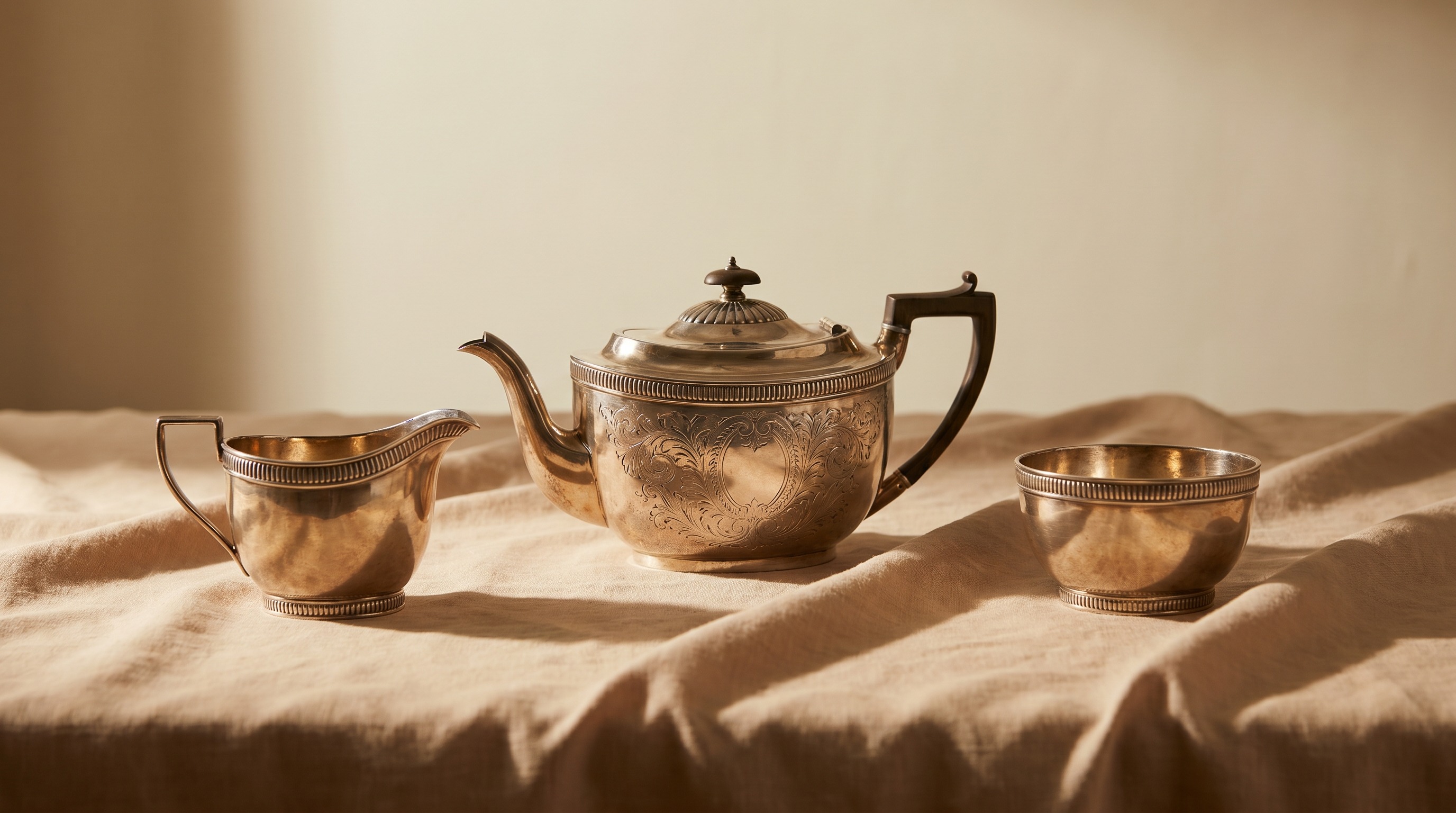
A specialist's guide to Peter & Ann Bateman: Hester Bateman's son and daughter-in-law, makers of the finest late neoclassical Bateman silver, with their distinctive joint PA mark and a brief but productive ten-year partnership at the heart of the Bateman family dynasty.
Think You Have Peter & Ann Bateman Silver? We'll Tell You: Free
Bateman family silver is one of the most actively collected categories in Georgian silver. PA-marked pieces in particular are keenly collected. Send photos and we'll identify it free.
Peter Bateman (1740 to 1825) and his wife Ann (née Dowle, dates uncertain) worked as partners in the family silver business from 1791 to 1800, following Peter's mother Hester Bateman's retirement. Their joint maker's mark, PA conjoined in a rectangular punch, is one of the most recognised in Georgian silver collecting. Their work continues the Bateman family's defining characteristics: fine bright-cut engraving, elegant neoclassical oval and urn forms, reeded borders and high-quality finish at accessible price points. In 1800, Ann was joined by her son William, beginning the next Bateman partnership.
The Bateman Family Dynasty
The Bateman workshop passed from Hester Bateman to her son Peter and his wife Ann in 1791, and later to William Bateman.
The Bateman silversmithing dynasty is one of the great family businesses in the history of English silver. The sequence:
- Hester Bateman (1709 to 1794): the founding figure, registered her own mark in 1761 after her husband's death, active 1761 to 1790. The most famous name in the dynasty.
- Peter & Ann Bateman (1791 to 1800): Peter inherits the business with his wife Ann as co-registrant.
- Ann & William Bateman (1800 to 1805): Ann continues with her son William after Peter's retirement from the mark.
- William Bateman (solo, 1805 onward): third generation, continues into the Regency period.
The PA mark therefore places a piece precisely in the decade 1791 to 1800: a useful dating tool in its own right.
The PA Maker's Mark
Peter and Ann Bateman silver carries the paired PB AB punch, used from 1791 to 1800, with a London hallmark and a duty mark.
| Mark | What it tells you |
|---|---|
| Maker's mark | PB above AB in a paired punch: Peter and Ann Bateman, 1791 to 1800. |
| Lion passant | Sterling silver, assayed in England. |
| Leopard's head | The London town mark (crowned until 1821). |
| Date letter | The year of assay; London changed its letter each May. |
The joint PA mark: Peter and Ann: consists of the two initials conjoined or placed side by side in a rectangular or oval punch. It was registered at Goldsmiths' Hall in 1791 when Peter took over the business from his mother. The mark appears alongside the standard London hallmarks:
- Leopard's head: London town mark
- Lion passant: sterling standard
- Date letter: 1791 to 1800 cycles
- Sovereign's head: duty mark (present throughout this period)
The combination of PA mark + sovereign's head + date letter places a piece precisely in the 1791 to 1800 window.
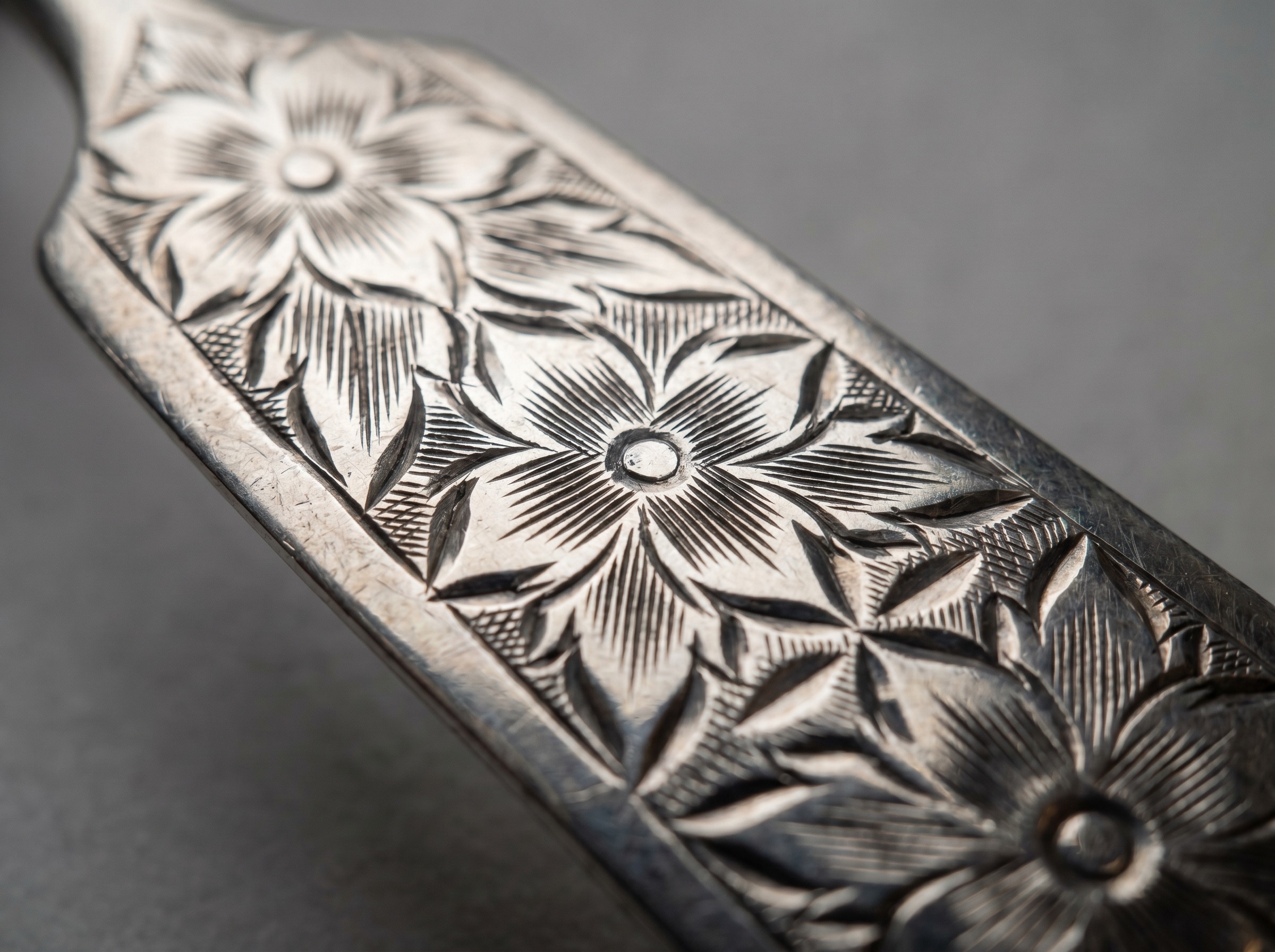
"PA mark + sovereign's head = 1791 to 1800. A decade of production, instantly identified. That precision is part of the appeal."
Style: The Bateman Neoclassical Vocabulary
Peter and Ann Bateman silver uses the Bateman neoclassical vocabulary: oval forms, bright-cut engraving, beading and reeding.
Peter & Ann Bateman continued precisely the style established by Hester Bateman in the 1770s to 1780s, the finest expression of the neoclassical in everyday domestic English silver:
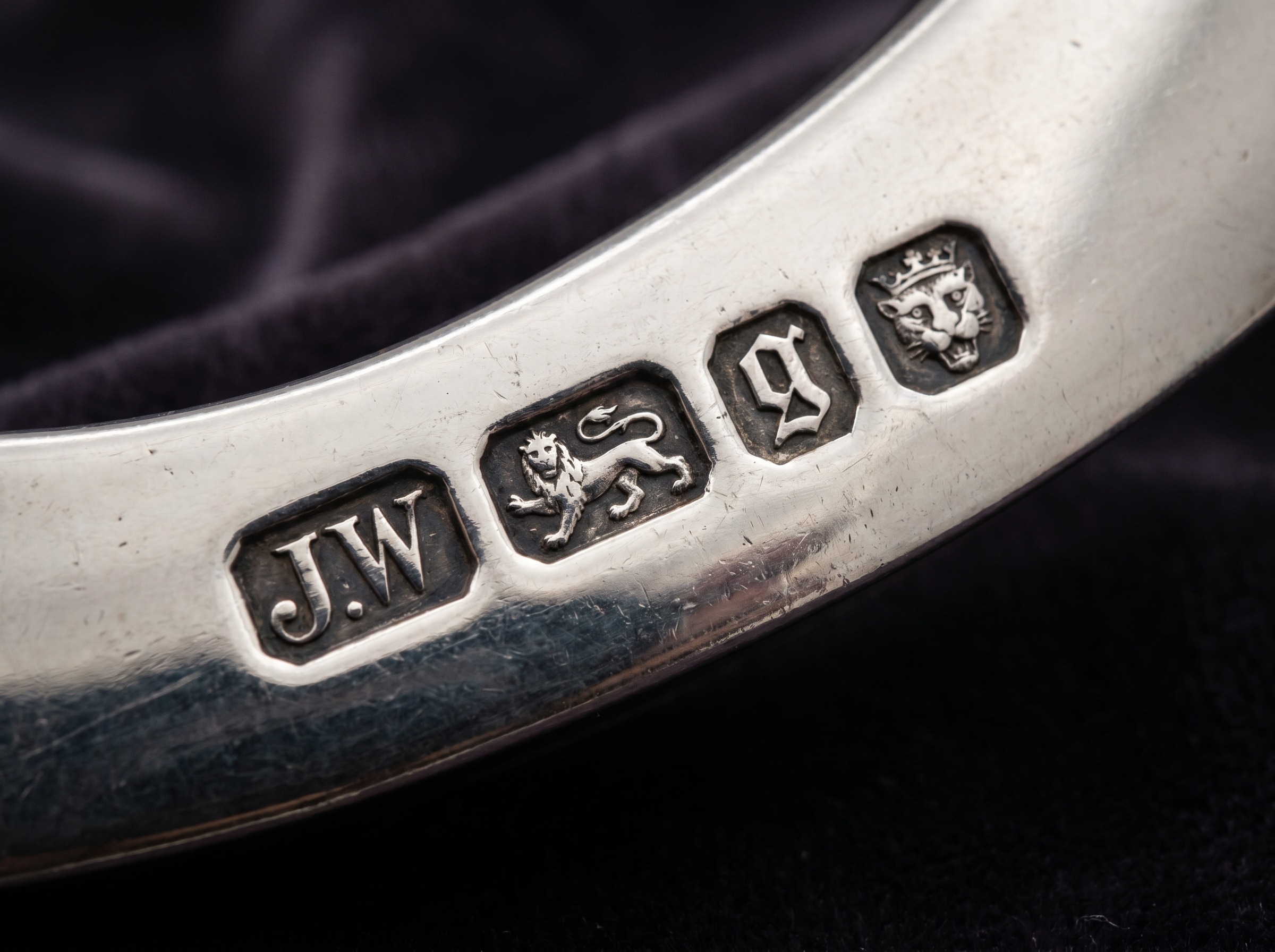
- Bright-cut engraving: the Bateman signature. A technique using a curved graver to cut faceted patterns into the silver surface, creating a sparkling light-catching effect. Swags, foliage, cartouches and geometric borders are the typical motifs.
- Oval forms: teapots, cream jugs and sugar bowls in elegant oval plan, often with flat lids and straight spouts.
- Reeded borders: fine parallel reeding around rims, feet and handles.
- Beaded edges: a row of small applied beads as a border treatment, used on flatware handles, cream jug rims and teapot covers.
- Pierced gallery work: sugar baskets, cream baskets and epergne dishes with pierced geometric galleries.
Key Piece Types
Peter and Ann Bateman made cream jugs, sugar bowls and baskets, teapots, tea services and flatware.
- Tea services: oval or drum teapots, cream jugs, sugar bowls and sometimes a hot water urn, in matched sets. PA tea services are highly collected.
- Sugar baskets and cream baskets: pierced oval baskets with swing handles and blue glass liners.
- Flatware: Old English pattern and bright-cut handled dessert and table silver.
- Sauce boats and ladles: neoclassical oval forms with reeded handles.
- Candlesticks: column-shaft neoclassical candlesticks with beaded and reeded detailing.
- Entrée dishes and covers: less common in Bateman output, but good examples are known.
Peter & Ann vs Hester: Differences
Peter and Ann Bateman silver is of equivalent quality to Hester's; it differs in the mark, the date and a slightly more refined style.
Collectors often ask how Peter & Ann pieces compare to Hester Bateman. In practice:
- Quality: largely equivalent. The workshop continued under the same craftsmen; Peter had worked alongside Hester for years before taking over.
- Name: Hester Bateman's own pieces are generally valued a little above PA pieces of equivalent form, on name recognition alone. PA pieces are not "lesser" Bateman silver.
- Dating: a PA piece is always 1791 to 1800 by definition. A Hester piece is 1761 to 1790. The decade is immediately identifiable.
- Style evolution: PA pieces tend toward slightly more elongated oval forms and finer, more delicate bright-cut patterns than early Hester work; the style had refined over three decades.
How We Value Peter & Ann Bateman Silver
We value Peter and Ann Bateman silver on the mark, the form, whether a service is matched, the engraving and condition.
Bateman silver is one of the most actively collected categories in Georgian silver. Every piece is valued on its own merits; these are the things we look at:
What drives value
- The markThe paired PB AB punch, used 1791 to 1800, with the London hallmark and a duty mark.
- FormTeapots, matched tea services and sugar baskets with blue glass liners, against single spoons.
- CompletenessMatched tea services with every piece by the same makers and date.
- Bright-cut engravingFine, crisp bright-cut work that has not been polished away.
- ConditionNo splits, repairs, replaced handles or erased cartouches.
Every piece is different. Send us a few photos and we will tell you what your Bateman silver is worth, free and with no obligation. Get a free valuation
What We Look For When Peter and Ann Bateman Silver Arrives
When Peter and Ann Bateman silver arrives we read the paired PB AB mark and the date letter, which places it between 1791 and 1800, and check for the duty mark.
Then we look at the bright-cut engraving for polishing wear, check seams and handles for repairs, and see whether a service is truly matched.
Pitfalls
- PA vs other PA marks: several contemporaries had PA initials. The cartouche shape and consistent London date letters 1791 to 1800 are the distinguishing factors.
- Bright-cut additions: occasionally encountered: plain pieces with bright-cut added later to make them look "more Bateman". The engraving depth and tool marks should be consistent with the metal gauge and date.
- Misidentifying Ann & William (AW/WB) as Peter & Ann: the partnership marks are different. Check the exact initials.
Selling Peter & Ann Bateman Silver?
Active buyer of all Bateman family silver (Hester, Peter & Ann, Ann & William, William) as well as all Georgian neoclassical London silver. Bateman pieces are consistently liquid and are keenly collected. By appointment in Mayfair or free FedEx collection. Same-day payment.
- Send photosUse the form on this page, or email them to us.
- A specialist reviews itMaker, marks, age and condition.
- Free estimate by emailWithin one working day.
- You decidePaid once agreed. No obligation.
Four ways to sell: Mayfair (by appointment), Braintree (by appointment), Royal Mail Special Delivery, free FedEx collection.
Free valuation
Request a free valuation
Send us a few photos of your Bateman silver. A specialist looks at every request personally and replies by email with an estimate within one working day. There is no obligation to sell.
What to photograph
- The whole piece. The whole piece, from the front and the side.
- The underside. The base or reverse, where the marks usually are.
- The hallmarks, close up. Every mark in the group, in focus, including the maker's mark.
Prefer email? Send photos to info@mozerisfineantiques.com or call 01376 334 482.
Ways to sell
- Mayfair (by appointment)
- Braintree (by appointment)
- Royal Mail Special Delivery
- Free FedEx collection
We buy directly, with payment once you accept our offer, and we can also sell for you by consignment or in our own auctions.
Related Reading
Frequently Asked Questions
Who were Peter and Ann Bateman?
What is the Peter & Ann Bateman maker's mark?
Is Peter & Ann Bateman silver worth less than Hester Bateman?
What is bright-cut engraving?
How much is Peter & Ann Bateman silver worth?
Will you value my Peter & Ann Bateman silver?
Selling Bateman Family Silver?
Active buyer of all Bateman silver and Georgian neoclassical London pieces. Mayfair showroom by appointment or free FedEx collection. Same-day payment.
Strictly by appointment only: no walk-ins at either location.
Items we buy
Antique Silver We Specialise In
Click any category for our specialist buying guide, then send photos for a free valuation. We also have a full Sell Your Silver overview.