Famous Silversmiths · Bateman Dynasty · London 1800 to 1843
William Bateman
Complete Guide to the Silversmith
William Bateman was Hester Bateman's grandson, who carried the family workshop into the Regency period. His silver carries the WB mark with a London hallmark, in plainer Regency forms with reeded or gadrooned borders and heavier construction than Hester's work.
Reviewed by Faustas Svencionis, Mozeris Fine Antiques, since 2015 · Updated October 2026
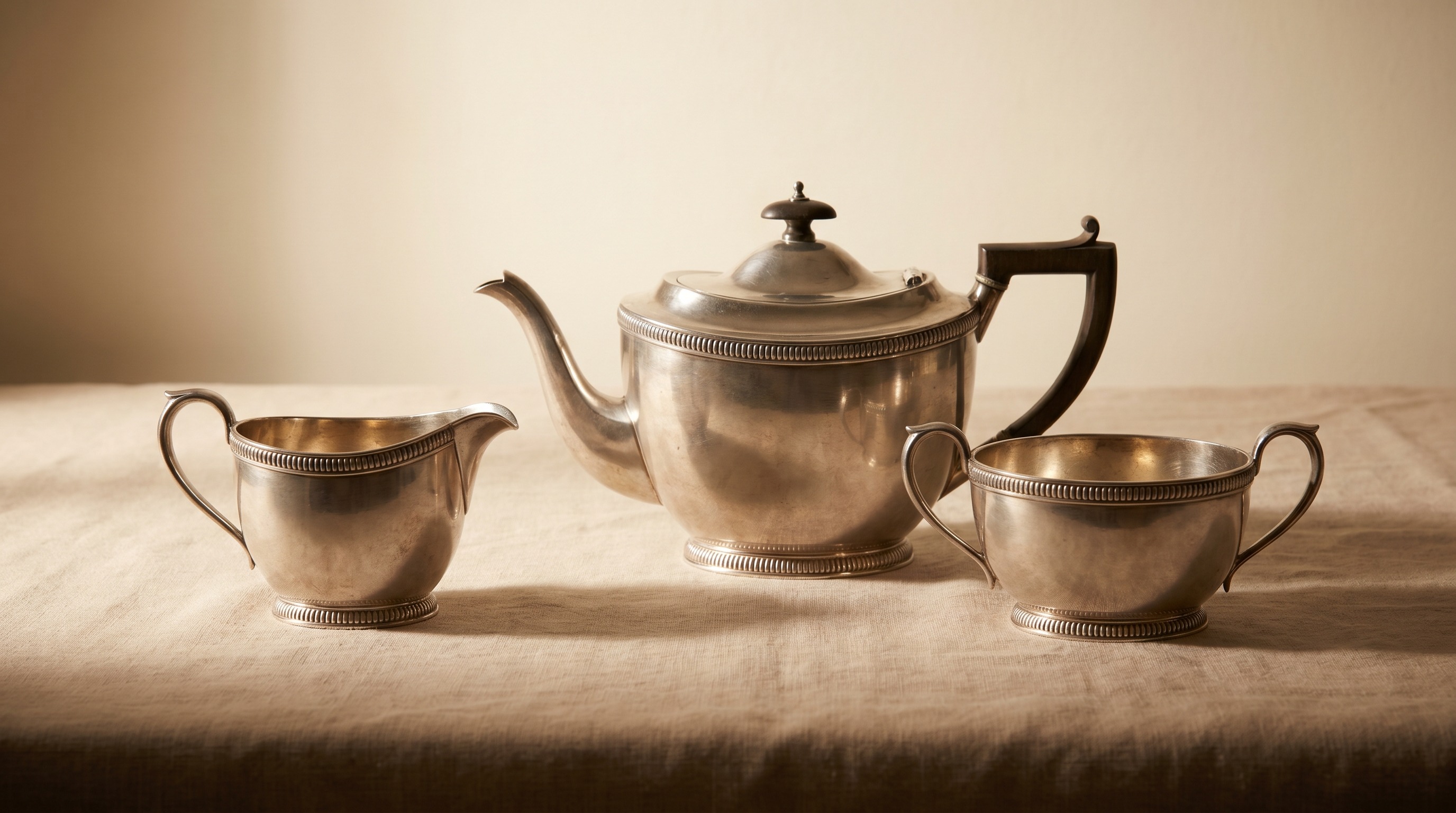
Son of Peter Bateman and grandson of the legendary Hester, William Bateman was the final chapter of Britain's most celebrated silversmithing dynasty, producing refined Regency flatware, tea wares and domestic silver of enduring quality.
Own a Piece of Bateman Silver?
William Bateman pieces are actively sought by collectors of Regency silver. We buy outright: no auction commission, no delay. Get a free valuation today.
William Bateman (baptised 1774, active c.1800 to 1843) was the third generation of Britain's most celebrated silversmithing family to register a maker's mark at Goldsmiths' Hall. Where his grandmother Hester had built the dynasty and his father Peter had consolidated it, William's task was to carry the Bateman name into the Regency and early Victorian era: a period of rapid stylistic change and fierce commercial competition. He succeeded with quiet distinction, producing silver that, while less flamboyant than some contemporaries, has aged into one of the most consistently valued categories in the antique silver market.
The Bateman Dynasty: Context for William's Place
William Bateman carried the Bateman family workshop forward after Hester and after Peter and Ann into the Regency period.
The Bateman story begins with Hester Bateman (1709 to 1794), a widow who took over her late husband's wire-drawing business and transformed it into one of the most prolific silver workshops in Georgian London.
Her son Peter Bateman (c.1740 to 1825) joined the firm in later years, working alongside his wife Ann Bateman and, after Ann's retirement in 1800, with his son William. When Peter retired around 1815, William continued under his own mark, closing one of the most remarkable family chapters in British craft history.
This family lineage means Bateman silver must always be attributed carefully. Pieces marked with "WB" date from William's independent period (c.1800 to 1843), while earlier pieces may carry "PB" (Peter alone), "PB & AB" (Peter and Ann jointly), or "HB" (Hester, the earliest and most valuable). Understanding which mark is present is the first step in any accurate valuation.
William Bateman's Maker's Mark
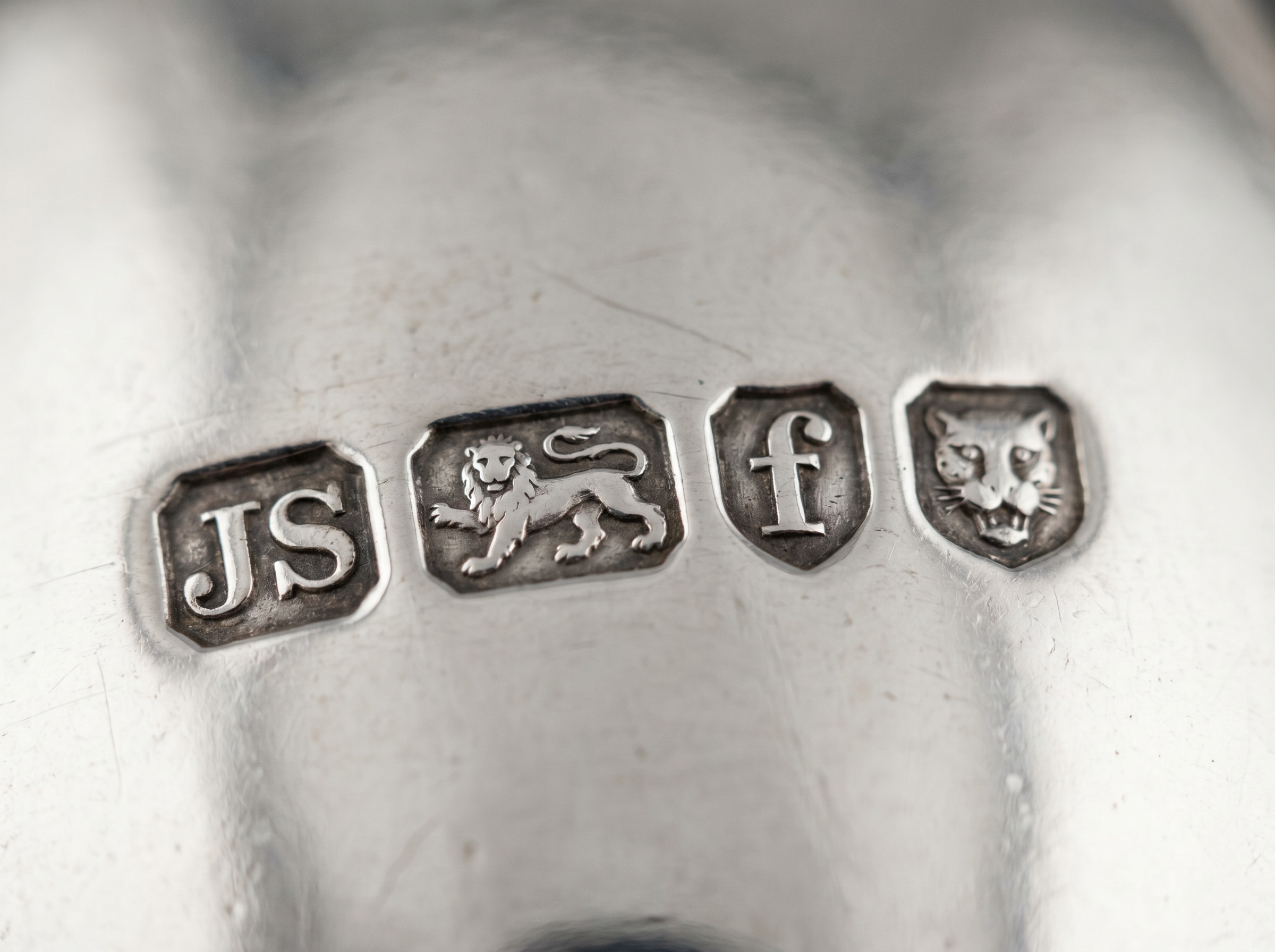
William Bateman silver carries the WB maker's mark with a London hallmark.
| Mark | What it tells you |
|---|---|
| Maker's mark | WB for William Bateman I (1815 to 1840). |
| Lion passant | Sterling silver, assayed in England. |
| Leopard's head | The London town mark (crowned until 1821). |
| Date letter | The year of assay; London changed its letter each May. |
William Bateman's primary maker's mark is the initials WB in an oblong punch, entered at Goldsmiths' Hall in London. He registered his first independent mark around 1800 when working alongside his father Peter, and continued registering marks through the 1810s and 1820s as the business evolved.
Like all London-assayed silver, his pieces carry the full hallmark set: the maker's mark (WB), the lion passant (sterling standard), the London leopard's head (assay office), and the date letter (which cycles through the alphabet in various fonts across different cycles).
A piece marked WB with a London leopard's head and a date letter from the "k" cycle, for instance, would date to a specific year in the 1820s to 1830s that can be pinpointed using Jackson's or standard hallmark tables.
Beware of confusion with other silversmiths sharing the "WB" initials. William Bateman's mark has a specific punch shape and was registered in London; provincial silversmiths with the same initials used different assay offices (Birmingham anchor, Sheffield crown). Always read the full hallmark set, not just the maker's mark in isolation.
Style and Technique
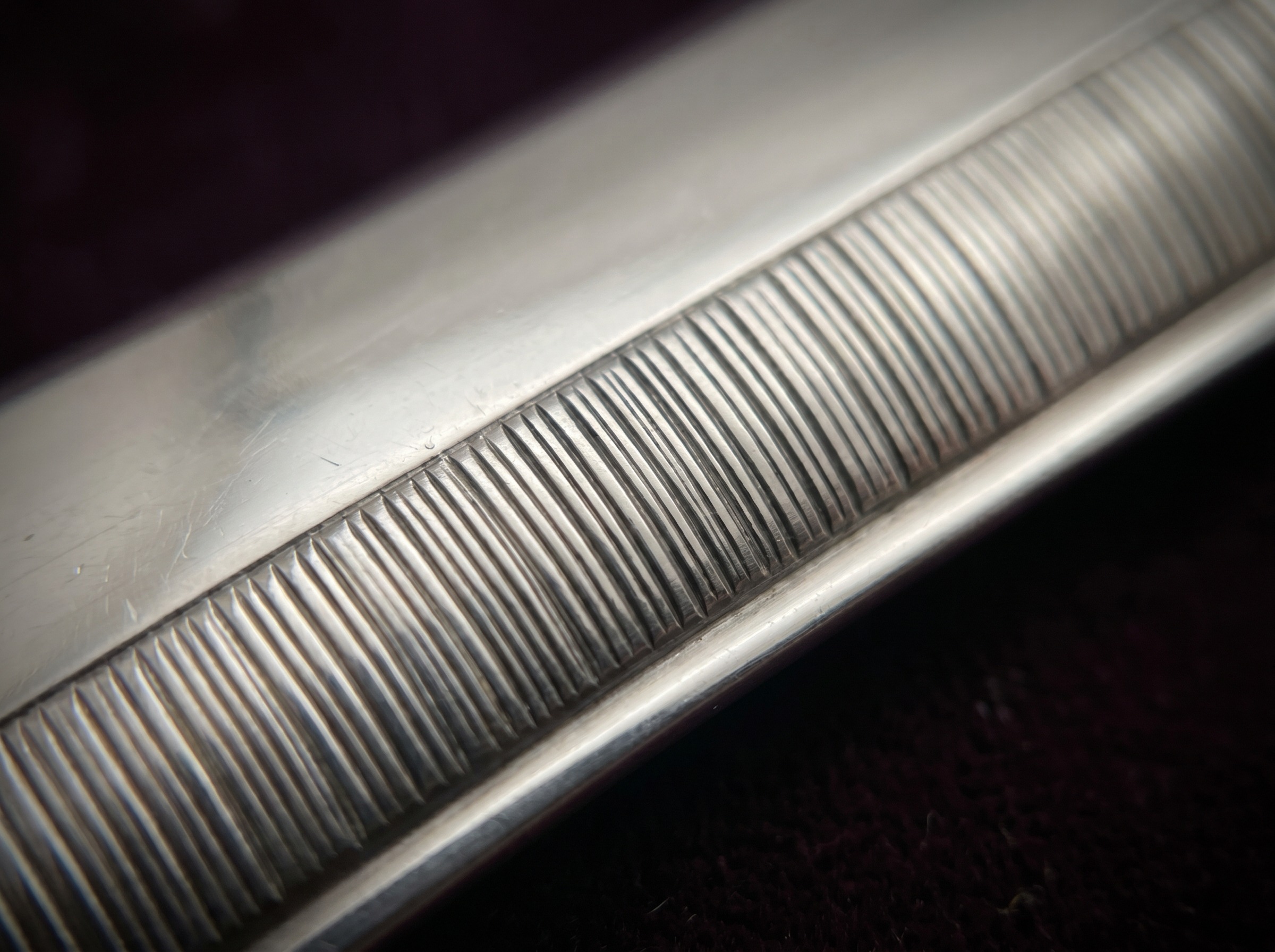
William Bateman silver is recognised by plainer Regency bodies, reeded or gadrooned borders, engraved armorials and heavier construction.
William Bateman's output reflects the transition from late Georgian to Regency taste. His early work, made alongside Peter, retains the clean neoclassical lines associated with the family: bright-cut engraving on flat surfaces, delicate beaded borders, oval forms for tea caddies and cream jugs. These pieces stand at the refined end of late-Georgian production and are highly collectable.
As William worked more independently through the 1810s and 1820s, his work began to incorporate the heavier Regency aesthetic: gadrooned and reeded borders replacing fine beading, slightly more robust forms for teapots and cream jugs, and the shift towards the plainer "Old Sheffield" style that dominated the period before Victorian elaboration took hold.
What marks all Bateman family silver, including William's, is consistent technical quality. The family operated a large workshop at Bunhill Row, Finsbury, and employed skilled craftsmen to produce high-quality domestic silverware at price points accessible to the growing Georgian and Regency middle class. The result is silver that is beautifully made but not ostentatious: pieces designed to be used, appreciated and passed down.
"William Bateman's silver represents the Regency ideal: restraint, quality and daily utility. These are pieces made not for aristocratic show but for the well-furnished English home."
Key Piece Types Made by William Bateman
William Bateman made tea and coffee services, flatware, candlesticks and salvers.
William Bateman's workshop produced the full range of domestic silverware in demand during the Regency and early Victorian periods. The most commonly encountered pieces today include:
- Tea services: Three-piece and four-piece sets comprising a teapot, cream jug, sugar bowl and sometimes a matching coffee pot. Reeded borders, plain bodies and engraved armorials are typical. Complete sets with all matching date letters and maker's marks are the most keenly collected.
- Flatware: William's workshop produced substantial quantities of silver flatware: fiddle pattern, hourglass pattern and Old English pattern spoons, forks and serving pieces. Bateman flatware is among the most sought in its category; matched sets are rare.
- Candlesticks: Column-form candlesticks with square bases, either with loaded stems for stability or plain cast versions. Pairs or sets of four are the market standard.
- Cream jugs and sugar basins: Small pieces often survive where complete sets do not. Reeded or gadrooned borders, plain bodies. Always check the match between maker's mark and date letter; sets assembled post-originally often contain mixed-maker pieces.
- Sauce boats and ladles: Oval boats with double-scroll handles, often on three hoof feet. Simple, practical, well-finished.
- Salvers and waiters: Circular or shaped salvers on three or four bracket feet. Often engraved with armorials in the centre.
- Inkstands: Oblong stands with pen channels, glass ink wells and a pounce pot. Practical desk items in plain silver with minimal decoration.
William Bateman and the Regency Market
The Regency period (c.1811 to 1820, though its stylistic influence extended well beyond) was a demanding time for silversmiths. On one hand, demand for silver was strong among a newly prosperous middle class. On the other, competition was intense; Paul Storr was producing spectacular pieces for Rundell, Bridge & Rundell; Benjamin Smith was creating grand ceremonial plate; Matthew Boulton's Birmingham manufactory was challenging London workshops on price.
William Bateman's response was consistent quality at competitive prices: not trying to compete with the grand silversmiths of the day, but serving a loyal market that valued the Bateman name and the consistent standard of their domestic wares.
This positioning proved durable. William continued working into the 1840s, when the Victorian era was already in full swing and decorative taste was becoming more elaborate. His later pieces occasionally show the beginning of this transition (slightly heavier casting, hints of foliate decoration) but the essential Bateman restraint remained.
The William Bateman Workshop and Hallmarking at Goldsmiths' Hall
London silversmithing in the Regency era was governed by the Goldsmiths' Company, which had enforced hallmarking standards at its assay office since the fourteenth century. Every piece of sterling silver made in William Bateman's workshop had to be submitted to the assay office at Foster Lane (now Goldsmiths' Hall on Foster Lane, EC2) before sale. The assay office would test the silver purity, confirming it met the sterling standard of 925 parts per thousand, and then strike the hallmarks.
The London assay office mark is the leopard's head (crowned in earlier periods, uncrowned after 1821). Alongside it, the date letter changes annually in August each year and cycles through the alphabet in a specific font and shield shape.
The date letter cycle relevant to most William Bateman pieces includes the "i" cycle (1801 to 1822) in large Roman font and the "j" cycle (1822 to 1841) in Roman script: consult Jackson's English Goldsmiths and Their Marks for precise year matching.
How We Value William Bateman Silver
We value William Bateman silver on the mark, whether a set is truly matched, the form, the engraving and condition.
William Bateman silver holds a respected position in the antique market. Every piece is valued on its own merits; these are the things we look at:
What drives value
- The markWB for William Bateman, confirmed against the London hallmark and date letter.
- Matched setsTea services and flatware with every piece by the same maker and date, not assembled sets.
- FormTea and coffee services, candlesticks and salvers, against single spoons.
- EngravingOriginal armorials and crisp reeded or gadrooned borders.
- ConditionNo split seams, replaced spouts or handles, dents or silver thinned by polishing.
Every piece is different. Send us a few photos and we will tell you what your Bateman silver is worth, free and with no obligation. Get a free valuation
What We Look For When William Bateman Silver Arrives
When William Bateman silver arrives we read the WB mark and the date letter, and check that every piece of a service or flatware set shares the same maker and date.
Then we look for split seams, replaced spouts or handles, dents and silver thinned by polishing.
How to Identify William Bateman Silver
Identify William Bateman silver by the WB mark and London date letter, and by its Regency style.
A systematic approach to reading the hallmarks is the most reliable method of attribution:
- Locate the hallmark cluster. On flatware, marks are usually struck on the back of the handle near the shoulder. On hollowware (teapots, jugs), marks appear on the underside near the rim or on the body. Lids typically carry a repeat mark.
- Identify the maker's mark. Look for "WB" in a shaped punch. The exact shield or cartouche shape varied slightly across different registrations: Jackson's lists these. If the mark reads "PB & AB" the piece is from Peter & Ann Bateman; "HB" is Hester's mark.
- Confirm the assay office. The leopard's head (a facing heraldic leopard) confirms London assay. If you see an anchor, the piece was assayed in Birmingham; a crown denotes Sheffield: these would not be William Bateman pieces.
- Read the date letter. Cross-reference against Jackson's or the Goldsmiths' Company date letter tables to confirm the year of assay.
- Check the lion passant. The walking lion facing left confirms sterling standard (925/1000). Britannia standard pieces (used 1697 to 1720 and optionally thereafter) carry a different mark; Bateman silver is almost always sterling standard.
Pitfalls and What to Watch For
Several issues can affect both attribution and value when buying or selling William Bateman silver:
Mixed-maker sets: A common issue with flatware and tea services is that pieces from different makers or dates have been assembled into a "matching" set. The handles may look uniform but the maker's marks or date letters differ. This significantly reduces value compared to a genuinely matched set.
Confusing William with Peter or Hester: The three main Bateman maker's marks (HB, PB/AB, WB) look superficially similar. Hester Bateman pieces are typically earlier (pre-1790) and often more finely bright-cut; they are keenly collected. Misattribution in either direction is a common valuation error.
Later additions and alterations: Some pieces have had later armorials or crests engraved, cartouches added, or spouts replaced. These interventions reduce value. Look for "tool marks" around engraved areas that are inconsistent with the rest of the surface patina.
Silver plate: EPNS (electroplated nickel silver) pieces from the Victorian era were sometimes made in styles very similar to Regency silverware. Always confirm the presence of all four hallmarks; EPNS pieces are not hallmarked in the same way and carry no sterling marks.
The Bateman Legacy and Its Influence
The Bateman family's contribution to British silversmithing goes beyond any individual piece. Hester's achievement in building a major London workshop as a woman in the eighteenth century was exceptional; Peter and Ann consolidated the business; William carried it forward into a new century. Taken together, they produced tens of thousands of pieces of sterling silver that furnished middle-class homes across Britain and the Empire.
William Bateman silver is now firmly embedded in the collector market. It appears regularly at the major London auction houses (Bonhams, Christie's, Sotheby's) as well as at specialist silver dealers and regional auction houses. Prices have held steady against the general trend in antique silver, partly because the Bateman name carries strong recognition, and partly because the quality and weight of the silver itself is consistently good.
For anyone inheriting or acquiring a piece of Bateman silver, whether it bears William's mark or an earlier family mark, a professional assessment is always the right first step. The difference between a single flatware spoon and a matched twelve-place service in terms of value can be substantial, and only a specialist can advise accurately.
How to Sell Your William Bateman Silver
- Send photosUse the form on this page, or email them to us.
- A specialist reviews itMaker, marks, age and condition.
- Free estimate by emailWithin one working day.
- You decidePaid once agreed. No obligation.
Free valuation
Request a free valuation
Send us a few photos of your Bateman silver. A specialist looks at every request personally and replies by email with an estimate within one working day. There is no obligation to sell.
What to photograph
- The whole piece. The whole piece, from the front and the side.
- The underside. The base or reverse, where the marks usually are.
- The hallmarks, close up. Every mark in the group, in focus, including the maker's mark.
Prefer email? Send photos to info@mozerisfineantiques.com or call 01376 334 482.
Ways to sell
- Mayfair (by appointment)
- Braintree (by appointment)
- Royal Mail Special Delivery
- Free FedEx collection
We buy directly, with payment once you accept our offer, and we can also sell for you by consignment or in our own auctions.
Related Reading
William Bateman Silver: Frequently Asked Questions
What is William Bateman's maker's mark?
How do I tell the difference between William and Hester Bateman silver?
When was William Bateman working?
Is William Bateman silver valuable?
Where can I sell William Bateman silver?
Does William Bateman silver need to be in perfect condition to sell?
Visit Us or Send Your Silver by Post
Our Mayfair showroom operates by appointment. Please call ahead before visiting.
Ready to Value Your Bateman Silver?
Items we buy
Antique Silver We Specialise In
Click any category for our specialist buying guide, then send photos for a free valuation. We also have a full Sell Your Silver overview.