Famous Silversmiths · Goldsmith to George III · London c.1747 to 1784
Edward Wakelin: Complete Guide to the Silversmith
Edward Wakelin was a mid-Georgian London silversmith whose firm, later Wakelin and Tayler, became Garrard, the Crown Jewellers. Wakelin silver carries his maker's mark with a London hallmark, and the firm's Gentlemen's Ledgers, now at the V&A, can trace many commissions to the original client.
Reviewed by Faustas Svencionis, Mozeris Fine Antiques, since 2015 · Updated October 2026
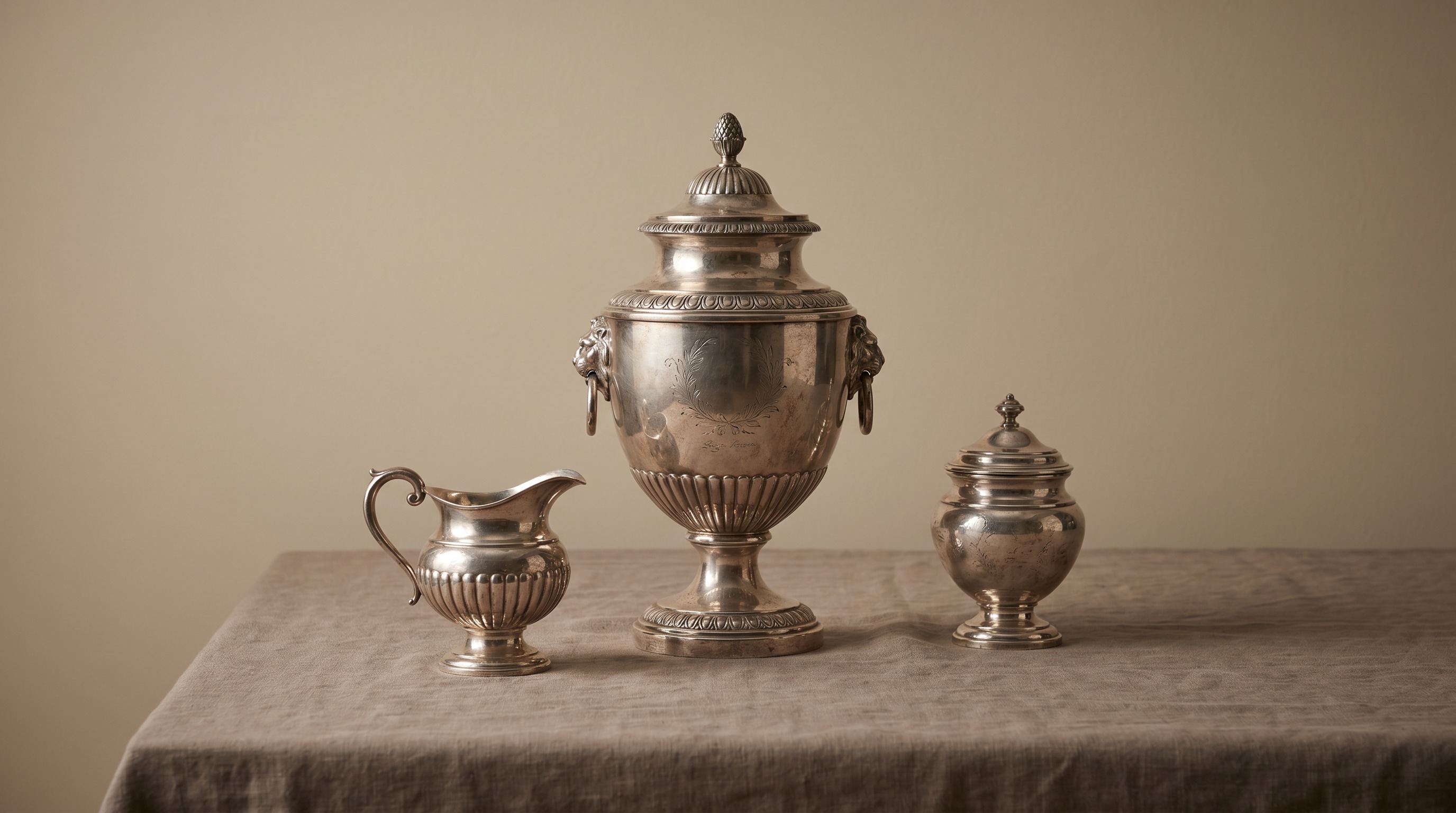
A specialist's guide to Edward Wakelin; one of the most important Georgian London silversmiths, partner in Wakelin & Tayler (predecessor firm to Garrard), goldsmith to George III, and a central figure in the Rococo-to-neoclassical transition in English silver.
Think You Have Wakelin Silver? We'll Tell You: Free
Wakelin pieces are serious Georgian silver: royal patronage, high quality, strong collector demand. Send photos of the piece and its marks and we'll give a professional opinion with no obligation.
Edward Wakelin (c.1730 to 1784) occupies a pivotal position in the history of English silversmithing. His workshop (first as Wakelin alone, then as Wakelin & Tayler) was the direct predecessor firm to Garrard & Co, the Crown Jewellers, making it one of the most consequential businesses in the history of British silver. Wakelin held the appointment of Goldsmith to George III. His work spans the mature Rococo of the 1750s and the elegant neoclassical transition of the 1760s to 1770s, and his shop accounts (preserved in the Victoria & Albert Museum) provide one of the most detailed records of aristocratic silver patronage in Georgian England.
Biography and the Garrard Dynasty Connection
Edward Wakelin succeeded George Wickes in the Panton Street business, which passed through Wakelin and Tayler to become Garrard.
Edward Wakelin registered his first maker's mark at Goldsmiths' Hall in 1747, having trained under George Wickes: the leading London court silversmith of the generation before him. When Wickes retired in 1759, Wakelin took over the business and the prestigious client list that came with it.
In 1776 Wakelin took John Tayler into partnership, forming Wakelin & Tayler. On Wakelin's death in 1784, Tayler continued with Robert Garrard; the firm eventually became R & S Garrard and ultimately Garrard & Co: Crown Jewellers for nearly two centuries. The lineage runs unbroken: Wickes → Wakelin → Wakelin & Tayler → Garrard. Understanding Wakelin means understanding the roots of the most famous name in British court silversmithing.
The Gentlemen's Ledgers
The Gentlemen's Ledgers are the Wakelin firm's shop records, now at the Victoria and Albert Museum, listing commissions for aristocratic and royal clients.
The Wakelin firm kept detailed shop ledgers, the "Gentlemen's Ledgers", recording every significant commission from aristocratic and royal clients. These ledgers, now held at the Victoria & Albert Museum, list pieces made for some of the great families of Georgian England: the Dukes of Newcastle, Northumberland and Portland; the Earl of Shelburne; and the royal household itself.
They are an extraordinary resource for attribution, and mean that many Wakelin pieces can be traced to a specific client and date even when the original commission record is lost.
Maker's Marks
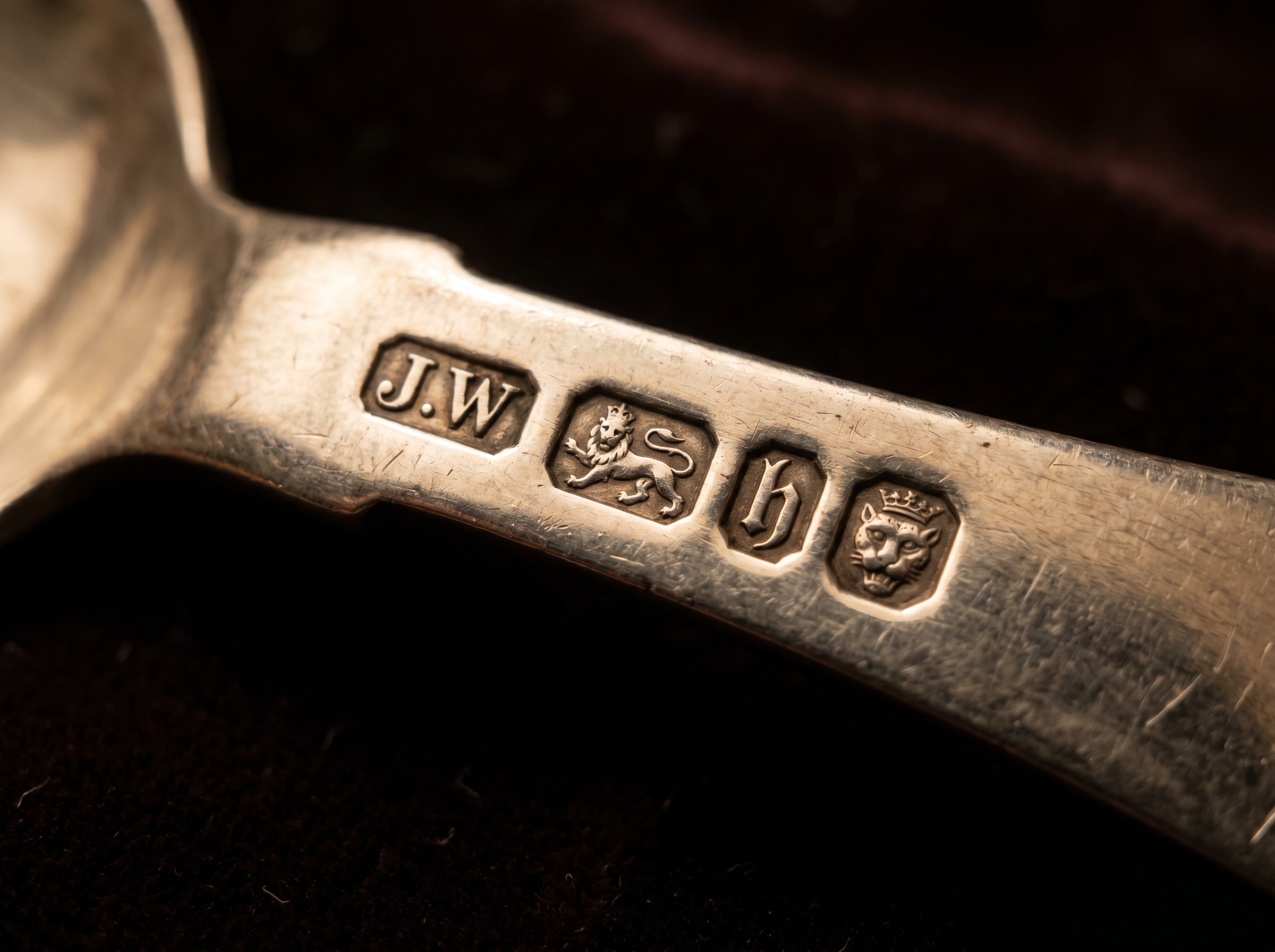
Wakelin silver carries the EW mark, or the Wakelin and Tayler partnership mark, with a full London hallmark.
| Mark | What it tells you |
|---|---|
| Maker's mark | EW for Edward Wakelin, or the Wakelin & Tayler partnership mark. |
| Lion passant | Sterling silver, assayed in England. |
| Leopard's head | The London town mark (crowned until 1821). |
| Date letter | The year of assay; London changed its letter each May. |
Wakelin registered several marks during his career:
- EW in a shaped cartouche (registered 1747): earliest solo mark.
- EW in a rectangular punch with pellet: used through the 1750s and 1760s.
- W&T in a rectangular punch (Wakelin & Tayler, registered 1776): partnership mark used 1776 to 1784.
All genuine pieces carry full London hallmarks alongside the maker's mark: leopard's head, lion passant, date letter, and from 1784 a sovereign's head, though Wakelin's active years end exactly at the duty mark's introduction, so genuine Wakelin solo pieces pre-date the sovereign's head.
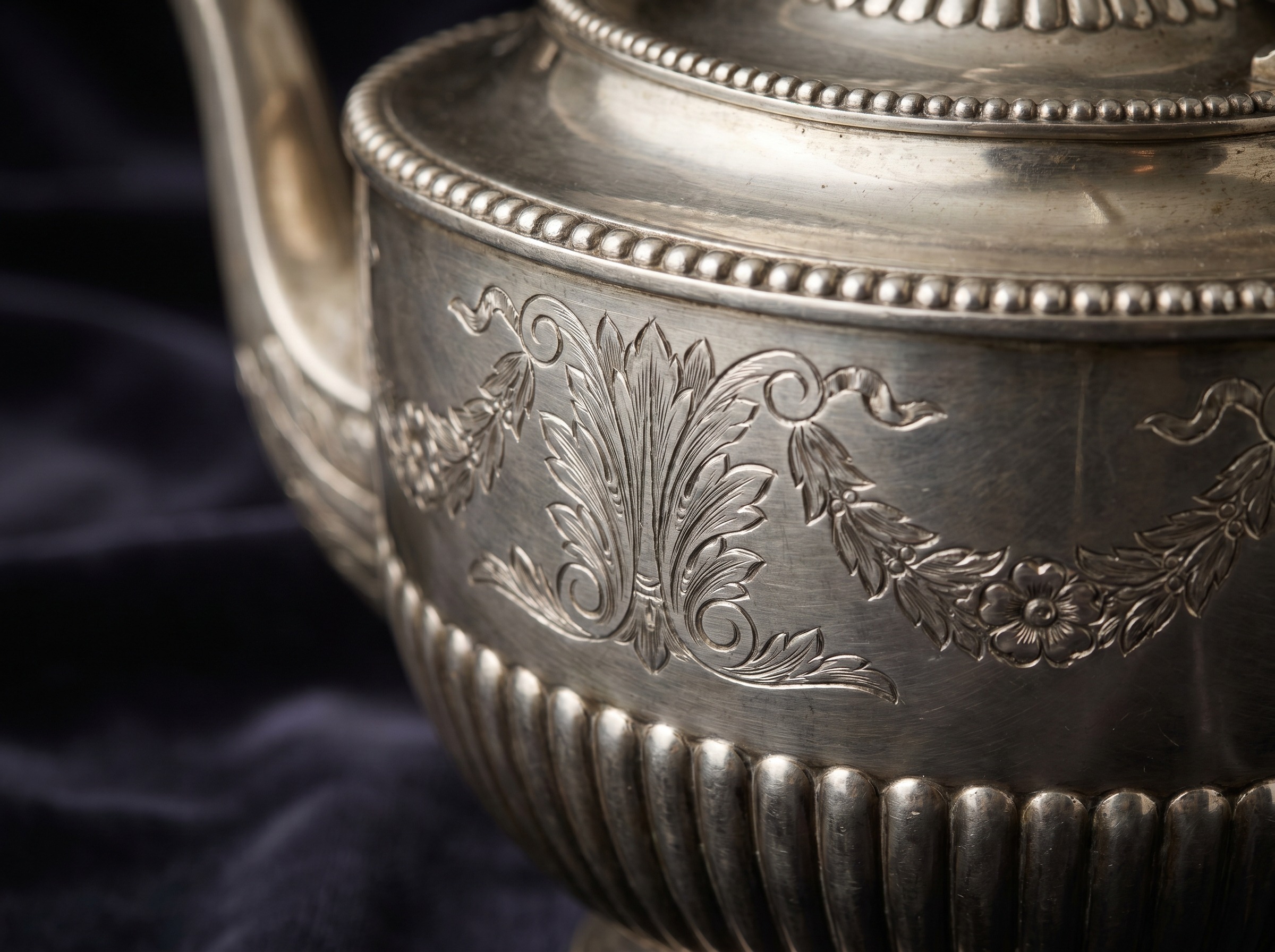
"Trained under Wickes. Preceded Garrard. Goldsmith to the King. Wakelin is the spine of Georgian court silver."
Style and Period
Wakelin's work divides cleanly into two stylistic phases:
- Rococo (1747-c.1762): heavy cast ornament, asymmetric composition, shells and scrolls. This is the vocabulary inherited from Wickes and contemporary with Crespin and de Lamerie. Wakelin Rococo is high-quality but slightly less exuberant than the top Crespin or de Lamerie pieces.
- Neoclassical transition (c.1762 to 1784): fluted bodies, bright-cut engraving, beaded borders, oval and urn forms. This is where Wakelin's output is most distinctive; he was one of the first London silversmiths to fully commit to the neoclassical vocabulary, partly under the influence of Robert Adam's architectural designs circulating in London from the early 1760s.
Key Piece Types
- Tea urns: Wakelin made some of the finest neoclassical tea urns in English silver, with lion mask ring handles, tapering bodies and high-footed stands.
- Tea and coffee services: oval teapots, cream jugs, sugar vases and hot water jugs in matched neoclassical sets.
- Sauce boats and tureens: in both Rococo and neoclassical styles depending on date.
- Candelabra and candlesticks: columnar neoclassical shafts, detachable branches.
- Flatware services: Old English pattern and fiddle pattern, often in large matched sets for aristocratic households.
- Presentation and race cups: important commissions for aristocratic clients.
How We Value Wakelin Silver
We value Wakelin silver on the mark, provenance, the form and scale, the ornament and armorials, and condition.
Wakelin silver is underpinned by the royal connection and the documented Garrard lineage. Every piece is valued on its own merits; these are the things we look at:
What drives value
- The markWakelin alone, or the Wakelin & Tayler partnership, confirmed against the full London hallmark.
- ProvenanceA commission traceable in the Gentlemen's Ledgers, or royal and aristocratic ownership.
- Form and scaleTea urns, tureens, candelabra and services, against smaller pieces such as cream jugs and ladles.
- Ornament and armorialsThe quality of the casting and chasing, and original armorials.
- ConditionNo erased armorials, splits, repairs or replaced parts.
Every piece is different. Send us a few photos and we will tell you what your Wakelin silver is worth, free and with no obligation. Get a free valuation
What We Look For When Wakelin Silver Arrives
When silver that may be by Wakelin arrives we read the maker's mark and London date letter, then look at the armorials, which can sometimes be matched to a ledger entry.
Then we check for erased armorials, repairs and replaced parts, and judge the quality of the casting and chasing.
How to Identify Wakelin Silver
Identify Wakelin silver by its maker's mark and London hallmark, its mid-Georgian style and, where possible, an entry in the ledgers.
- Check maker's mark: EW in cartouche (solo) or W&T (partnership). Compare exact punch form against Grimwade's London Goldsmiths 1697 to 1837.
- Confirm London hallmarks: leopard's head, lion passant, date letter consistent with 1747 to 1784.
- Style cross-check: Rococo ornament for pre-1762 dates; neoclassical (fluted, bright-cut, beaded) for post-1762.
- Check V&A Gentlemen's Ledger transcripts if piece has armorial engraving; the client family may be identifiable.
Pitfalls
- Confusing EW (Wakelin) with other EW punches: the exact cartouche shape matters. Several contemporaries had EW initials.
- Wakelin & Tayler mark confusion: W&T pieces sometimes attributed to later Tayler-only or Garrard pieces. Dates should resolve this.
- Later additions: armorial engraving sometimes added in the 19th century to plain pieces. Style of engraving should be consistent with the hallmark date.
Selling Edward Wakelin Silver?
Active buyer of Georgian court silver: Wakelin, Wakelin & Tayler, George Wickes, Paul Crespin and all leading 18th century London makers. We deal directly with serious collectors and pay competitive prices without auction commission. By appointment in Mayfair or free FedEx collection. Same-day payment.
- Send photosUse the form on this page, or email them to us.
- A specialist reviews itMaker, marks, age and condition.
- Free estimate by emailWithin one working day.
- You decidePaid once agreed. No obligation.
Four ways to sell: Mayfair (by appointment), Braintree (by appointment), Royal Mail Special Delivery, free FedEx collection.
Free valuation
Request a free valuation
Send us a few photos of your Wakelin silver. A specialist looks at every request personally and replies by email with an estimate within one working day. There is no obligation to sell.
What to photograph
- The whole piece. The whole piece, from the front and the side.
- The underside. The base or reverse, where the marks usually are.
- The hallmarks, close up. Every mark in the group, in focus, including the maker's mark.
Prefer email? Send photos to info@mozerisfineantiques.com or call 01376 334 482.
Ways to sell
- Mayfair (by appointment)
- Braintree (by appointment)
- Royal Mail Special Delivery
- Free FedEx collection
We buy directly, with payment once you accept our offer, and we can also sell for you by consignment or in our own auctions.
Related Reading
Frequently Asked Questions
Who was Edward Wakelin?
What is Wakelin's maker's mark?
How does Wakelin connect to Garrard?
What are the Gentlemen's Ledgers?
How much is Wakelin silver worth?
Will you value my Wakelin silver?
Selling Wakelin or Georgian Court Silver?
Active buyer of 18th century London silver. Mayfair showroom by appointment or free FedEx collection. Same-day payment, no auction commission.
Strictly by appointment only: no walk-ins at either location.
Items we buy
Antique Silver We Specialise In
Click any category for our specialist buying guide, then send photos for a free valuation. We also have a full Sell Your Silver overview.