Edward Cornelius Farrell — Complete Silversmith Guide
A specialist's guide to Edward Cornelius Farrell (c.1779–1850) — the Regency silversmith behind the most flamboyant antiquarian-revival silver of the 1810s and 1820s. Identify his marks, recognise his figural chasing, and value Farrell silver accurately.
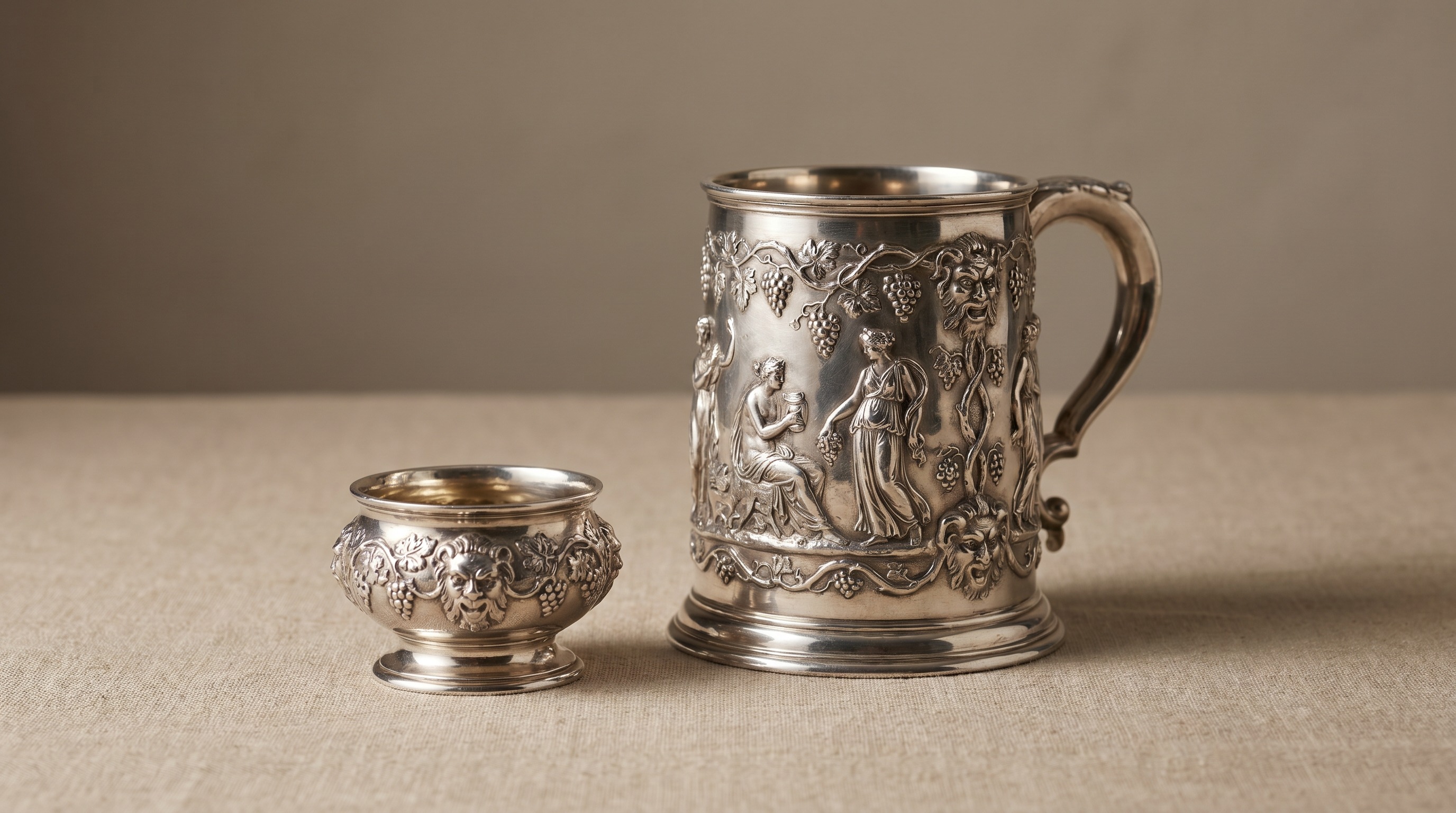 EF · Active c.1813–1840, London
Got Edward Cornelius Farrell Silver? We'll Identify and Value It Free
Send photos of the marks and the chased decoration — Farrell's figural pieces carry a strong premium over weight alone. Reply within one working day.
Edward Cornelius Farrell was the great showman of Regency silver. While Paul Storr refined the neoclassical and Rundell, Bridge & Rundell supplied the Crown, Farrell built a reputation on something more theatrical: dense, high-relief antiquarian silver that revived 17th-century Dutch genre scenes, Renaissance grotesques and Rubensian figures. Much of his most extravagant work was made for the dealer Kensington Lewis, whose principal client was the Duke of York. Farrell's figural pieces are some of the most sought-after — and most valuable — of the entire Regency period.
Who Was Edward Cornelius Farrell?
Farrell was born around 1779–1780 and worked as a London silversmith from the early 19th century. He entered his first recorded maker's mark at Goldsmiths' Hall in 1813 and operated from premises in Clerkenwell and later Cockspur Street. He was a highly skilled chaser and modeller as well as a manufacturer, and his workshop specialised in lavish, sculptural, historically-inspired silver at a time when the prevailing taste was moving away from plain neoclassicism toward eclectic revivalism.
His career is inseparable from the dealer Kensington Lewis, a flamboyant retailer who positioned himself as a rival to the royal goldsmiths Rundell, Bridge & Rundell. Lewis commissioned Farrell to produce extraordinarily elaborate plate — much of it for Frederick, Duke of York, the most extravagant royal collector of his day. Farrell freely adapted earlier sources: paintings by David Teniers the Younger, designs after Rubens, German Renaissance silver and 17th-century Dutch ornament. The result was silver that looked centuries older than it was — antiquarian revival at its most ambitious.
Farrell's Maker's Marks
| Mark | Period | Dates |
|---|---|---|
| E·F in shaped rectangular or oval punch | Edward Cornelius Farrell | from 1813 |
| E·C·F variants | later registered marks | 1815 onward |
| London hallmark (leopard's head, lion passant, date letter, duty mark) | struck alongside maker's mark | throughout |
Farrell's silver always carries full London hallmarks alongside his maker's initials. Because his pieces deliberately imitate earlier styles, the hallmark is the decisive proof of date and maker — never judge a Farrell piece by its appearance alone. The Regency duty mark (the sovereign's head) is an important confirmation that you are looking at a genuine period piece rather than a later copy.
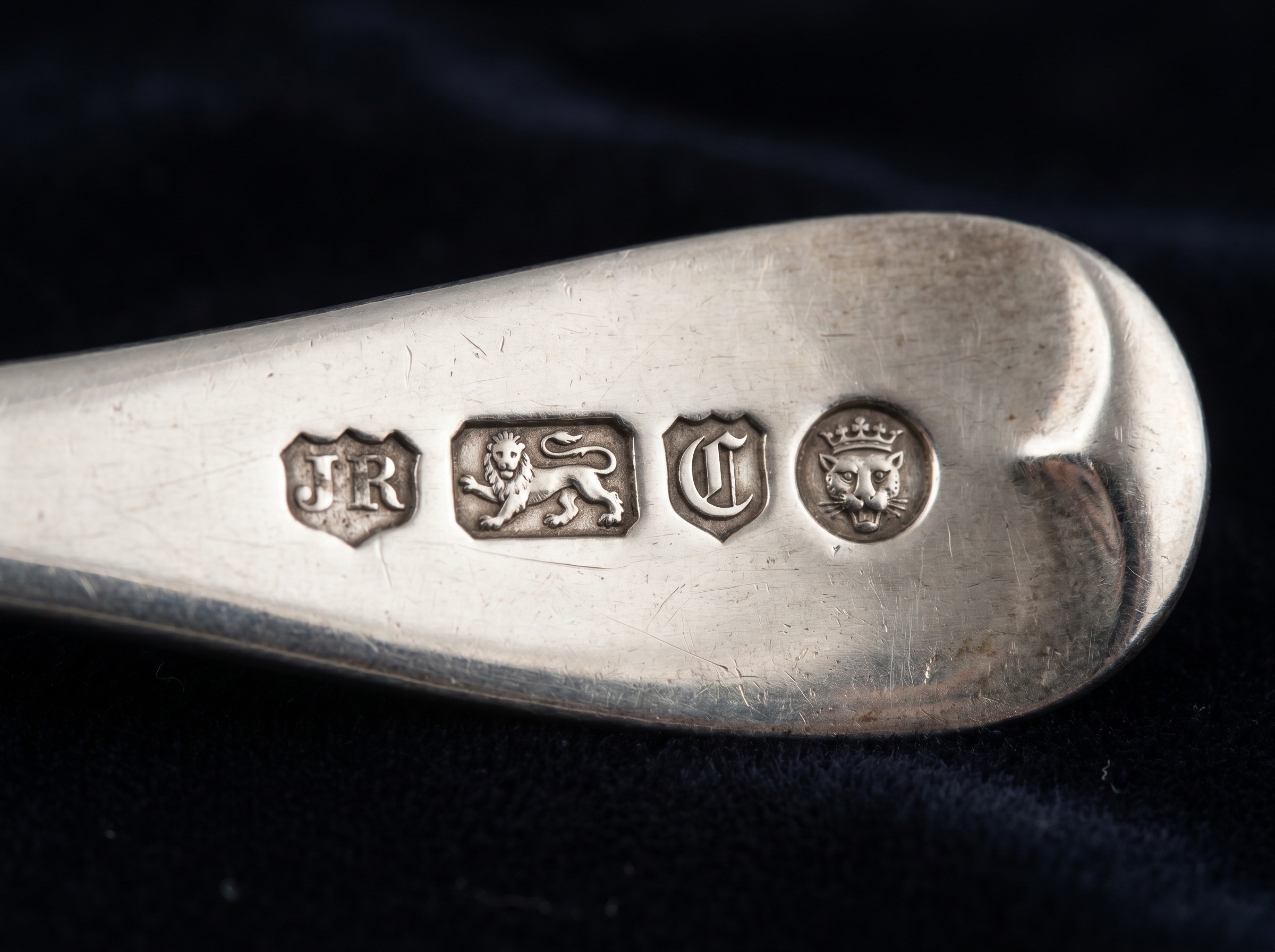
Farrell's E·F maker's mark — struck alongside the full London hallmark and Regency duty mark.
The Farrell Style
Farrell's silver is unmistakable once you know the vocabulary:
- High-relief figural chasing — peasant scenes after Teniers, drinking and tavern subjects, putti, classical and Renaissance figures worked in deep, three-dimensional relief. This is the single most diagnostic Farrell feature.
- Antiquarian and Renaissance revival forms — tankards, cups, ewers and vases imitating German and Dutch 16th- and 17th-century plate.
- Grotesque masks and caryatids — applied cast masks, satyrs, lion masks and figural handles.
- Fruiting vines and dense foliage — scrolling grapevines, acanthus and naturalistic ornament covering the whole surface.
- Heavy gauge, sculptural cast elements — Farrell silver is substantial, with separately cast and applied figures, finials and handles.
- "Teniers ware" — a class of cups and tankards densely chased with copies of David Teniers's peasant paintings, closely associated with Farrell.
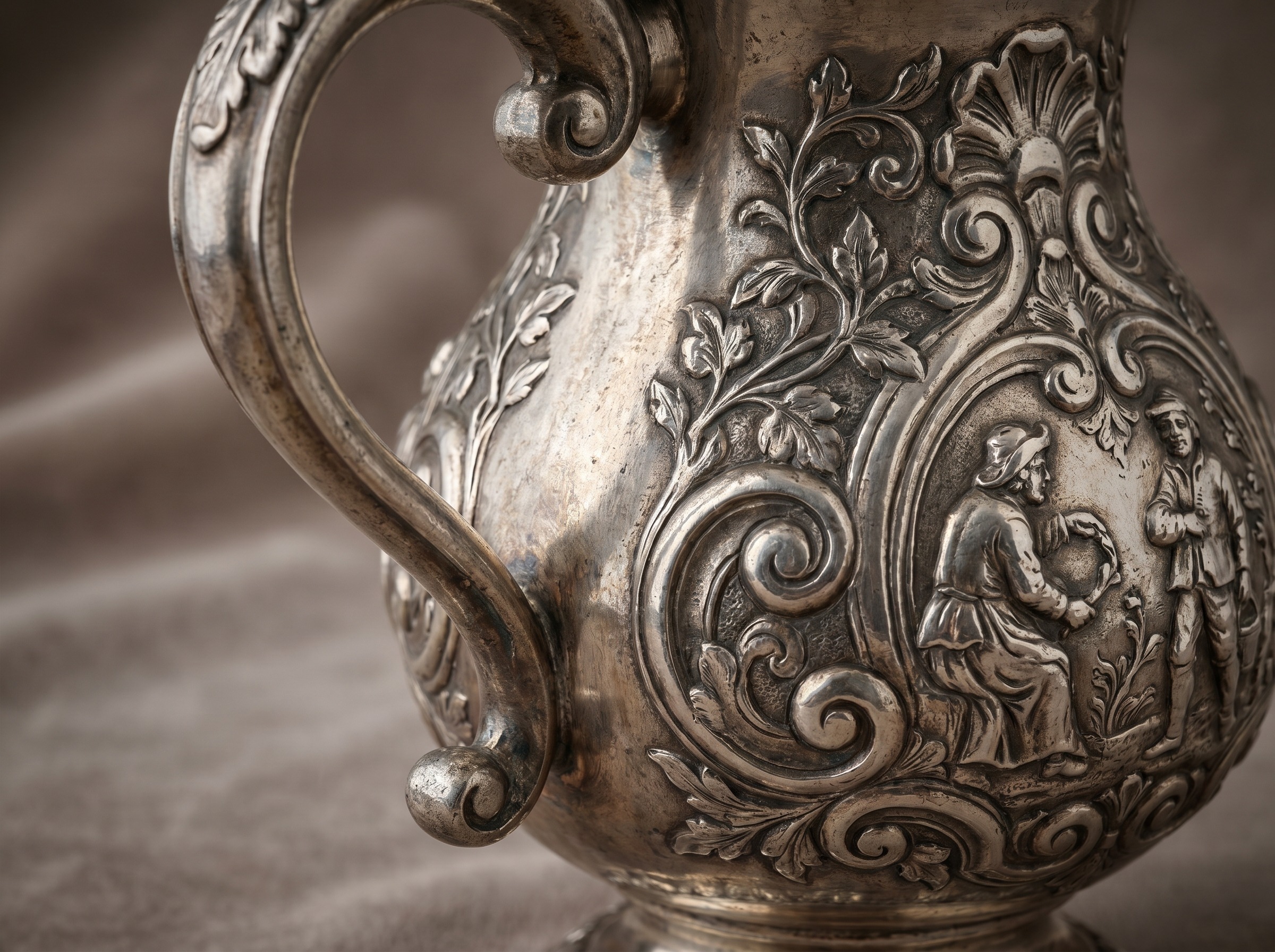
The Farrell signature — dense, deep figural chasing in the 17th-century Dutch revival manner.
What Farrell Made
- Teniers tankards and cups — chased with copied peasant scenes; the pieces most strongly associated with his name.
- Presentation and exhibition plate — elaborate ewers, vases and centrepieces for Kensington Lewis.
- Tea and coffee services — densely chased with figures, vines and grotesques.
- Inkstands and standishes — sculptural, figural, often with cast animal or classical mounts.
- Salt cellars, casters and condiment pieces — figural and Renaissance-revival forms.
- Cast figural candlesticks and candelabra — with caryatid or grotesque stems.
What Farrell Silver Is Worth
- Small condiment or caster, chased: £400–£1,200.
- Chased mug or beaker: £600–£1,800.
- Teniers-style tankard: £2,000–£8,000 depending on quality and weight.
- Tea or coffee pot, figural chasing: £1,500–£5,000.
- Inkstand, figural: £3,000–£10,000.
- Important presentation cup, ewer or centrepiece: £8,000–£30,000+.
- Documented Kensington Lewis / royal-provenance pieces: £20,000–£80,000+.
Farrell's value rests on the figural quality and weight rather than on melt value. The best Teniers tankards and any piece with a Kensington Lewis or Duke of York association sit at the top of the market. Plainer Farrell pieces are valued more conventionally but still carry a maker premium.
Pitfalls
- Later antiquarian copies — Victorian and Continental makers produced similar densely-chased revival silver. Only the London hallmark and E·F mark confirm a genuine Farrell.
- Re-chased plain silver — plain Georgian silver was sometimes "improved" with later chasing. Genuine Farrell chasing is integral to the original manufacture, not added to an earlier blank.
- Mark confusion — several Regency makers used EF initials. Cross-check the punch shape and the date letter against documented Farrell examples.
- Condition — high-relief chasing is vulnerable to wear and over-polishing, which softens the figures and reduces value. Crisp, sharp relief is worth far more.
Got Edward Cornelius Farrell Silver to Sell?
Active buyer of all Edward Cornelius Farrell silver — Teniers tankards, figural cups, chased tea services, inkstands and Kensington Lewis commissions. By appointment in Mayfair or by free insured nationwide courier. Same-day payment, fair offers well above melt for genuine Farrell pieces.
- Send photos of your silver and its hallmarks via our online valuation form. Include close-ups of the chased decoration.
- We email an instant indicative price (usually within one working day).
- Visit our Mayfair showroom by appointment, or we book a free insured collection.
- Your silver is independently verified at our office.
- You're paid by same-day bank transfer once you accept our offer.
All courier collections insured up to £25,000 per parcel. Higher-value pieces collected by specialist secure courier at no cost.
Related Reading
Frequently Asked Questions
How do I tell if my silver is by Edward Cornelius Farrell?
Look for the E·F (or E·C·F) maker's mark struck alongside a full London hallmark and the Regency duty mark. Farrell pieces are typically heavy and densely chased with figural scenes in high relief.
What is "Teniers ware"?
A class of tankards and cups chased with copies of peasant scenes after the painter David Teniers the Younger. These figural pieces are closely associated with Farrell and are among his most collectable work.
Who was Kensington Lewis?
A Regency silver dealer who commissioned much of Farrell's most extravagant plate, principally for Frederick, Duke of York. A documented Kensington Lewis association significantly increases value.
Is Farrell silver valued by weight?
No — the best figural pieces sell far above melt value on the strength of their chasing, quality and provenance. Crisp, unworn relief is worth a substantial premium.
Will you tell me what my Farrell silver is worth?
Yes — free, no obligation. Email info@mozerisfineantiques.com with photos of the marks and the piece.
⚠️ Strictly by appointment only — no walk-ins at either location.
Antique Silver We Specialise In
Click any category for our specialist buying guide — then send photos for a free valuation. We also have a full Sell Your Silver overview.