Famous Silversmiths · Regency Grand Plate · London 1802 to 1850
Benjamin Smith
Complete Guide to the Regency Silversmith
Benjamin Smith (about 1764 to 1823) was a leading Regency silversmith who supplied grand plate to Rundell, Bridge and Rundell, the Crown Jewellers. His silver carries BS, or DS and BS for the partnership with Digby Scott, with a London hallmark; his son Benjamin Smith II worked on after 1823.
Reviewed by Faustas Svencionis, Mozeris Fine Antiques, since 2015 · Updated October 2026
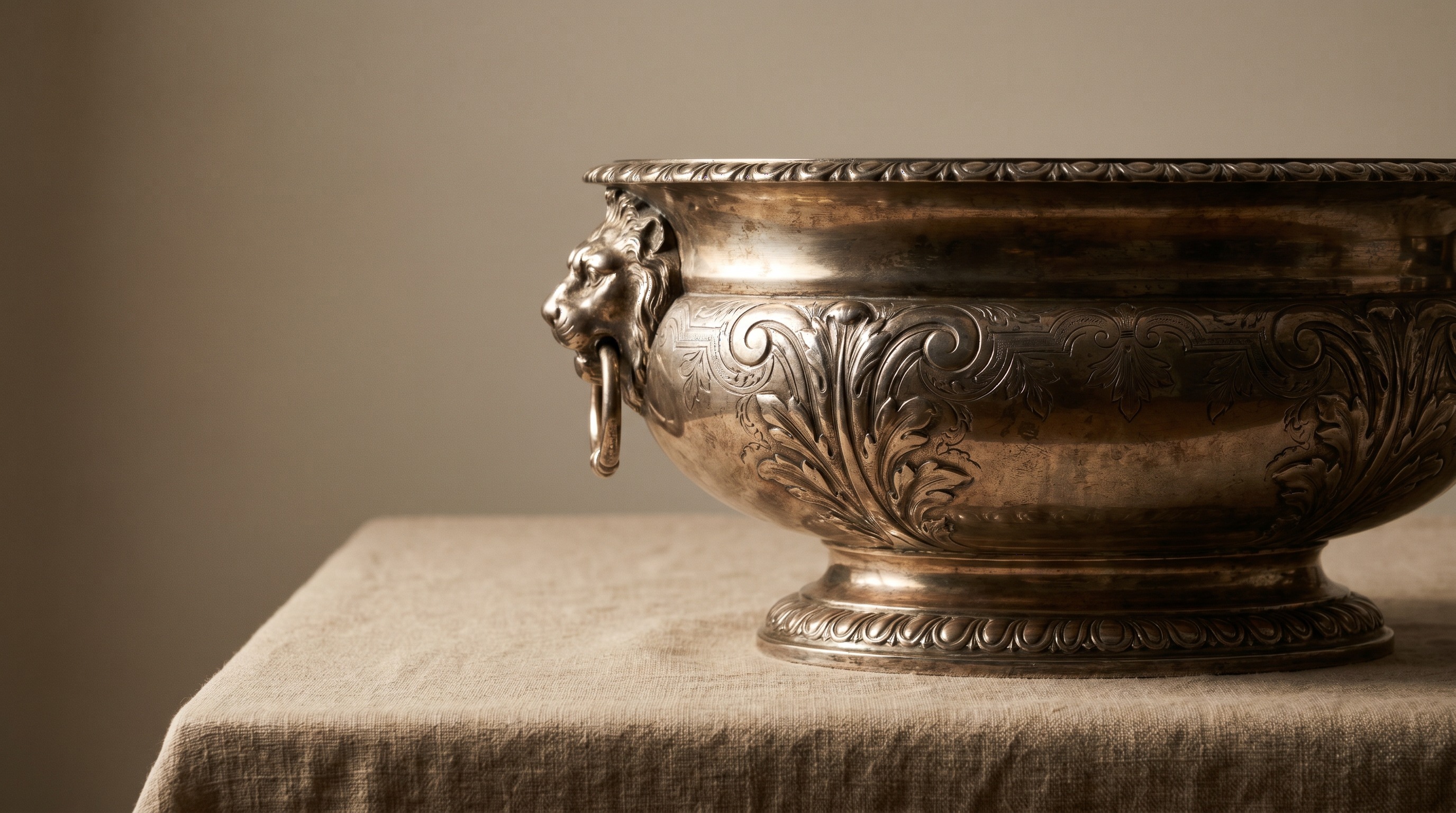
Benjamin Smith was one of the defining silversmiths of the Regency era: a master of spectacular large-scale plate who supplied wine coolers, candelabra and ceremonial silver to the Crown jewellers Rundell, Bridge & Rundell, and whose pieces remain among the grandest examples of the period at auction.
Own a Piece of Benjamin Smith Silver?
Benjamin Smith pieces are among the most impressive examples of Regency silver on the market. We buy outright at specialist prices: no auction delay, no commission. Get a free expert valuation today.
Benjamin Smith (c.1764 to 1823) occupies a distinctive and commanding position in the history of British silversmithing. Working at the height of the Regency period, he was one of the principal craftsmen supplying plate to Rundell, Bridge & Rundell: the Crown Jewellers and the most prestigious retail silversmith in Georgian London. His work is characterised by grand ambition, exceptional execution and the full vocabulary of Regency decorative taste: lion masks, paw feet, acanthus leaves, reeded columns and the monumental proportions that defined the era's idea of luxury.
Biography and Background
Benjamin Smith trained in Birmingham before moving to London, where his Greenwich workshop made grand Regency plate.
Benjamin Smith was born around 1764 and trained as a silversmith in the Midlands tradition. His early career brought him into contact with Digby Scott, with whom he entered a working partnership in London from approximately 1802. The Scott and Smith partnership (marked "DS & BS") produced important plate during the early Napoleonic era before dissolving around 1807.
Before his London years, Smith had connections to the Matthew Boulton manufactory in Birmingham: one of the most technologically advanced silver and ormolu workshops of the late eighteenth century. This background in large-scale, highly organised manufacture gave Smith a capacity for producing ambitious pieces on a timeline that hand-craft workshops could not match.
From around 1807, Smith worked independently from a workshop in Greenwich, producing plate principally for Rundell, Bridge & Rundell at their Ludgate Hill shop. This relationship, between the craftsman in Greenwich and the prestigious West End retailer, was the dominant commercial model of the period, with Rundell's receiving the public credit and the retail profit while Smith and other craftsmen like Paul Storr provided the manufacturing expertise.
Benjamin Smith died around 1823, and the business continued under his son Benjamin Smith II (c.1793 to 1850), who continued to work in a similar idiom and registered his own maker's mark. Benjamin Smith II's career extended well into the Victorian era.
Benjamin Smith's Maker's Mark
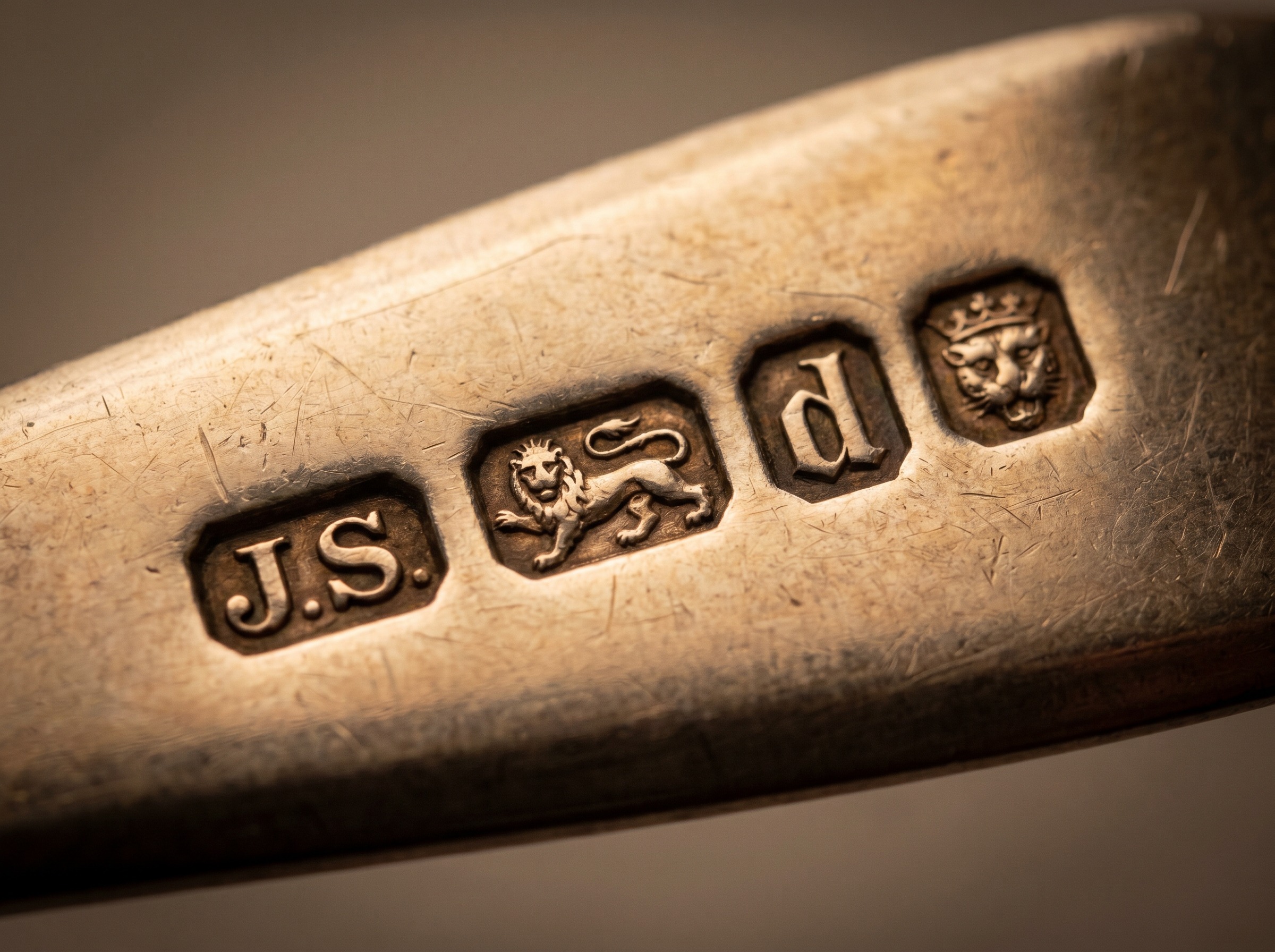
Benjamin Smith's silver carries BS alone, or DS and BS for the partnership with Digby Scott before 1807, with a London hallmark.
| Mark | What it tells you |
|---|---|
| Maker's mark | BS alone, or DS & BS for the partnership with Digby Scott (before 1807). |
| Lion passant | Sterling silver, assayed in England. |
| Leopard's head | The London town mark (crowned until 1821). |
| Date letter | The year of assay; London changed its letter each May. |
Benjamin Smith registered several maker's marks across his career, corresponding to his different working arrangements:
- "DS & BS": Digby Scott and Benjamin Smith partnership, approximately 1802 to 1807. Some of the grandest and most collectable pieces carry this combined mark.
- "BS" alone: Benjamin Smith working independently from c.1807 onwards. The punch shape varied slightly across different registrations at Goldsmiths' Hall.
- "BS" (Benjamin Smith II): The son's mark, from approximately 1815 to 1850. Distinguishing between father and son requires careful reading of the date letter and the specific punch form.
As with all London silver, every Benjamin Smith piece carries the full London hallmark set: maker's mark, London leopard's head (assay office), lion passant (sterling standard) and annual date letter. The date letters for prime Benjamin Smith I pieces fall within the "h" and early "i" cycles (approximately 1795 to 1820); Benjamin Smith II's work continues through the "j" cycle into the 1830s and 1840s.
It is also important to note that many pieces sold through Rundell, Bridge & Rundell carry only the Rundell maker's mark or the mark of their retail partner; some Benjamin Smith workshop pieces may be marked "RP" (Rundell's registering mark) rather than Smith's own initials. This practice of the retailer entering plate under their own mark was common and should not be confused with forgery or alteration.
Style, Technique and the Regency Aesthetic
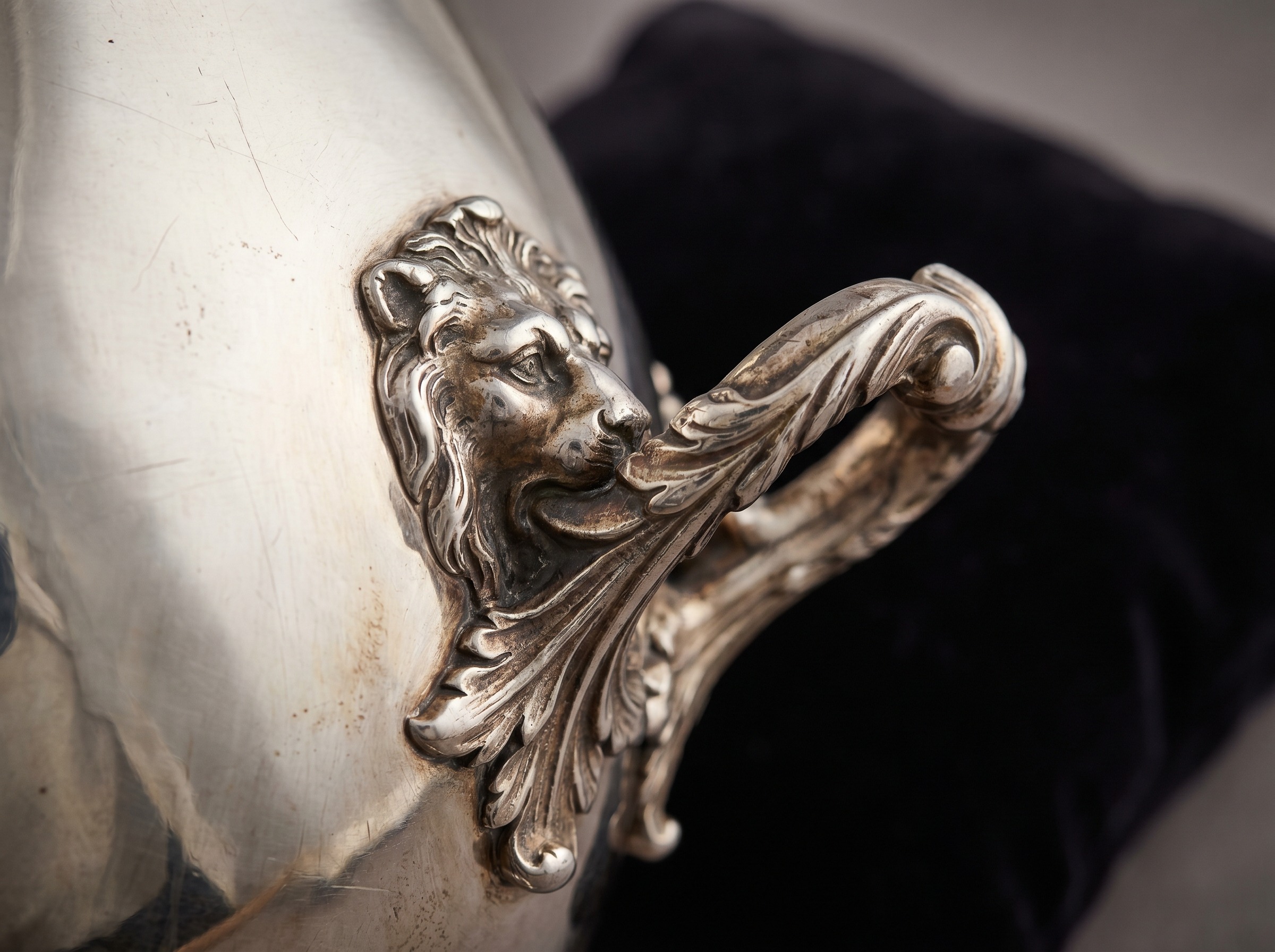
Benjamin Smith's silver is among the most overtly theatrical of the Regency period. Unlike the restrained neoclassicism of Paul Storr's earlier work, or the domestic elegance of the Bateman family, Smith's pieces are conceived for display and spectacle. His wine coolers, tureens and candelabra were designed to impress at the grandest dining tables in England, pieces made not for daily use but for the orchestrated theatre of Regency hospitality.
The decorative vocabulary Smith deployed was drawn from the full Regency repertoire:
- Lion masks: Cast lion head handles, frequently appearing on wine coolers, tureens and ewers. The quality of Smith's casting is exceptional; the lions are highly modelled and retain sharp detail.
- Paw feet: Heavy cast paw feet, often of lion or bear form, supporting the body of tureens, wine coolers and sauce boats. These are among the most technically demanding elements of Regency silversmithing.
- Acanthus leaves: Applied and chased acanthus leaf decoration on bodies, handles and bases. Typically combined with gadrooned borders.
- Reeded columns and handles: The neoclassical reeded column form appears on handles, borders and candelabra stems.
- Armorial engraving: Grand pieces were typically engraved with the armorials of aristocratic or royal patrons: a significant proportion of Rundell & Bridge clients were from the highest levels of British and European aristocracy.
- Shell and dolphin motifs: Frequently deployed on sauce boats, ladles and maritime-themed pieces.
The technical quality of Benjamin Smith's work is consistently exceptional. Large hollow bodies, complex cast elements and the assembly of multi-part pieces like candelabra and épergnes required a workshop with significant skill and equipment. Smith's Greenwich operation was capable of producing pieces at a scale and level of finish that very few contemporary workshops could match.
"Benjamin Smith's wine coolers and tureens are not merely functional objects; they are the material expression of Regency England's confidence in its own grandeur. Few silversmiths have ever matched his capacity for monumental display."
Key Piece Types and the Rundell Connection
Benjamin Smith's most important pieces are grand Regency commissions made for Rundell, Bridge and Rundell: wine coolers, tureens, candelabra and ewers.
Benjamin Smith's most important pieces were made for Rundell, Bridge & Rundell and are associated with the grandest commissions of the Regency era. The most significant categories include:
- Wine coolers: The most spectacular of Smith's pieces: large, heavily cast vessels designed to hold ice and chill bottles of wine at table. Typically made in pairs or sets of four, with lion mask handles, gadrooned borders and armorial engraving. A fine pair of Benjamin Smith wine coolers is a seven-figure proposition at major auction.
- Soup tureens: Grand oval or circular tureens with matching stands and ladles, heavily decorated with applied cast work. Often made as part of complete dinner services.
- Candelabra: Multi-branch candelabra in the full Regency monumental style, column stems, cast figural bases, detachable branches. Sets of four or six are the auction standard.
- Sauce tureens and boats: Smaller versions of the tureen form, paired or in sets of four, with matching stands and ladles.
- Ewers and pitchers: Heavily decorated jugs in the classical ewer form, sometimes en suite with matching wine coolers.
- Tea and coffee services: Less common in Smith's output than the grand pieces, but where they exist they carry the same quality of casting and construction.
- Flatware: Smith also produced flatware, typically in the Kings pattern or Fiddle and Thread pattern, often as part of complete dinner services for aristocratic clients.
Rundell, Bridge & Rundell: The Most Important Relationship
Understanding Benjamin Smith requires understanding Rundell, Bridge & Rundell: the partnership that dominated the top end of the London silver market from the 1780s to the 1840s.
Philip Rundell and John Bridge established themselves as goldsmiths and jewellers at Ludgate Hill and built a retail operation that supplied the Crown, the aristocracy and the wealthiest merchants in England. They did not manufacture silver themselves; they commissioned it from specialist craftsmen, of whom Paul Storr and Benjamin Smith were the two most important.
The relationship was commercially productive but not always comfortable. Smith supplied magnificent plate to Rundell's who sold it to clients like the Prince Regent, the Duke of Wellington and European royal houses. The craftsmanship was Smith's; the profit and credit largely Rundell's. This structure was common in the period and does not diminish Smith's achievement, but it does mean that some of his greatest works are better known under the Rundell name than his own.
When Rundell's eventually dissolved in the 1840s, their stock and records were dispersed; some pieces re-entered the market without clear attribution, and others were retained in aristocratic collections where they remain today.
Benjamin Smith II: Continuing the Legacy
Benjamin Smith's son, Benjamin Smith II (c.1793 to 1850), continued the family workshop after his father's death in 1823. He registered his own maker's mark and continued producing silver in the Regency style through the 1820s and 1830s, though the taste of the period was already beginning to shift towards the more elaborate mid-Victorian aesthetic.
Benjamin Smith II's pieces are often listed simply as "Benjamin Smith" in auction catalogues, which can cause confusion. The date letter is again the primary tool for distinguishing father from son; pieces from after 1823 must necessarily be Benjamin II's work.
The son's output is generally slightly more conservative than the father's grandest commissions, but the quality of execution remains high. His flatware and smaller domestic pieces have been particularly well received in recent auction cycles.
How We Value Benjamin Smith Silver
We value Benjamin Smith silver on the maker, Smith I or Smith II, Rundell provenance, the form and scale, completeness and condition.
Benjamin Smith silver, particularly the grand Regency pieces made for Rundell's, is among the most important Regency work in the antique silver market. Every piece is valued on its own merits; these are the things we look at:
What drives value
- Smith I or Smith IIThe punch form and the date letter tell father from son; pieces after 1823 cannot be by Smith I.
- Rundell provenanceA Rundell, Bridge & Rundell retail mark, or armorials traceable to a major patron.
- Form and scaleWine coolers, tureens, candelabra and ewers are the grand commissions; domestic pieces are a different market.
- CompletenessWhether a piece is part of a service that survives together.
- ConditionOriginal cast handles, feet and ornament, without re-soldering, filled cracks or replacements.
Every piece is different. Send us a few photos and we will tell you what your Benjamin Smith silver is worth, free and with no obligation. Get a free valuation
What We Look For When Benjamin Smith Silver Arrives
When Regency silver arrives that may be by Benjamin Smith, we read the maker's mark and date letter first to tell Smith I from Smith II, and look for a separate Rundell retail mark.
Then we check the cast handles, feet and ornament for re-soldering, filled cracks or replacements, and note any armorials that could trace the original patron.
How to Identify Benjamin Smith Silver
Identify Benjamin Smith silver by locating the hallmarks, reading the maker's mark and the London assay mark, and dating it from the letter cycle.
- Locate the hallmarks. On large hollow wares, marks typically appear on the underside of the body, on the base rim, or on the interior of a base plate. On flatware, marks are on the back near the shoulder. Lids should carry a repeat mark.
- Read the maker's mark. "DS & BS" (partnership with Scott, pre-1807), "BS" (Smith alone), or "BS" in a different punch form (Smith II, post-1823). Compare against Jackson's for exact punch shapes by period.
- Check the assay office. The London leopard's head confirms London assay. Pieces assayed at Birmingham or Sheffield cannot be attributed to Benjamin Smith's London workshop.
- Date via the letter cycle. Benjamin Smith I: primarily "h" and early "i" cycles (c.1795 to 1820). Benjamin Smith II: late "i" through "j" cycles (c.1815 to 1845).
- Look for Rundell association. Some pieces will carry a separate Rundell retail mark alongside or instead of the Smith maker's mark. The presence of both marks is highly significant for provenance and value.
Pitfalls and What to Watch For
Confusing father and son: Benjamin Smith I and Benjamin Smith II have very similar maker's marks. The date letter is the definitive guide: pieces from after 1823 cannot be by Smith I. Smith II's work is generally valued below his father's grandest pieces.
Dispersed service components: Grand dinner services are frequently broken up and sold in parts. A soup tureen from a complete service has different value depending on whether the matching tureens, sauce boats and candelabra are available. Single pieces are valued on their own merits; complete services are far rarer.
Retailer marks versus maker's marks: Some pieces from Rundell's carry the retail house mark rather than Smith's initials. These are not less authentic, this was standard practice, but attribution requires knowledge of the Rundell house marks and their associated craftsmen.
Condition of cast elements: The elaborate applied cast handles, feet and decorative elements on Smith's pieces are vulnerable to damage and repair. Any areas of re-soldering, filled cracks or replaced elements should be disclosed and will affect value. Examine all joining points carefully.
Benjamin Smith's Legacy in British Silversmithing
Benjamin Smith's place in the history of British silversmithing is secure, if less celebrated than it deserves. His name is often overshadowed by Paul Storr, with whom he is a near-contemporary and who served the same great patron in Rundell, Bridge & Rundell. But Smith's grandest pieces (the wine coolers, the candelabra, the monumental tureens) are arguably equal to Storr's best work in ambition and execution.
The Regency period in which he worked was the last great era of English grand silver making before the Victorian industrialisation of the trade. Smith was one of the craftsmen who defined what that era looked and felt like in silver, heavy, confident, imperial and technically spectacular. His pieces survive in the great country houses of England, in museum collections, and periodically at auction where they attract the most serious specialist bidding.
For anyone who inherits or discovers a piece bearing the "BS" mark alongside a full London hallmark set from the Regency period, specialist valuation is essential before any decision is made. The value range is wide, and accurate attribution to father or son, to the partnership period or the independent period, can make a substantial difference to the price realised.
How to Sell Your Benjamin Smith Silver
- Send photosUse the form on this page, or email them to us.
- A specialist reviews itMaker, marks, age and condition.
- Free estimate by emailWithin one working day.
- You decidePaid once agreed. No obligation.
Free valuation
Request a free valuation
Send us a few photos of your Benjamin Smith silver. A specialist looks at every request personally and replies by email with an estimate within one working day. There is no obligation to sell.
What to photograph
- The whole piece. The whole piece, from the front and the sides.
- The underside. The underside, the base rim or the base plate.
- The hallmarks, close up. Every mark in the group, plus any Rundell retail mark or armorial.
Prefer email? Send photos to info@mozerisfineantiques.com or call 01376 334 482.
Ways to sell
- Mayfair (by appointment)
- Braintree (by appointment)
- Royal Mail Special Delivery
- Free FedEx collection
We buy directly, with payment once you accept our offer, and we can also sell for you by consignment or in our own auctions.
Related Reading
Benjamin Smith Silver: Frequently Asked Questions
Who was Benjamin Smith the silversmith?
What is Benjamin Smith's maker's mark?
How much is Benjamin Smith silver worth?
What is the connection between Benjamin Smith and Rundell, Bridge & Rundell?
How do I tell Benjamin Smith I from Benjamin Smith II?
Where can I sell Benjamin Smith silver?
Visit Us or Send Your Silver by Post
Our Mayfair showroom operates by appointment. Please call ahead before visiting.
Expert Valuation on Regency Silver
Items we buy
Antique Silver We Specialise In
Click any category for our specialist buying guide, then send photos for a free valuation. We also have a full Sell Your Silver overview.