Antique Rings for Women: A Guide by Era
What women's rings looked like in each period from the Georgians to the 1970s, how to date one, what collectors look for and what to check before you buy, with rings from our own collection.
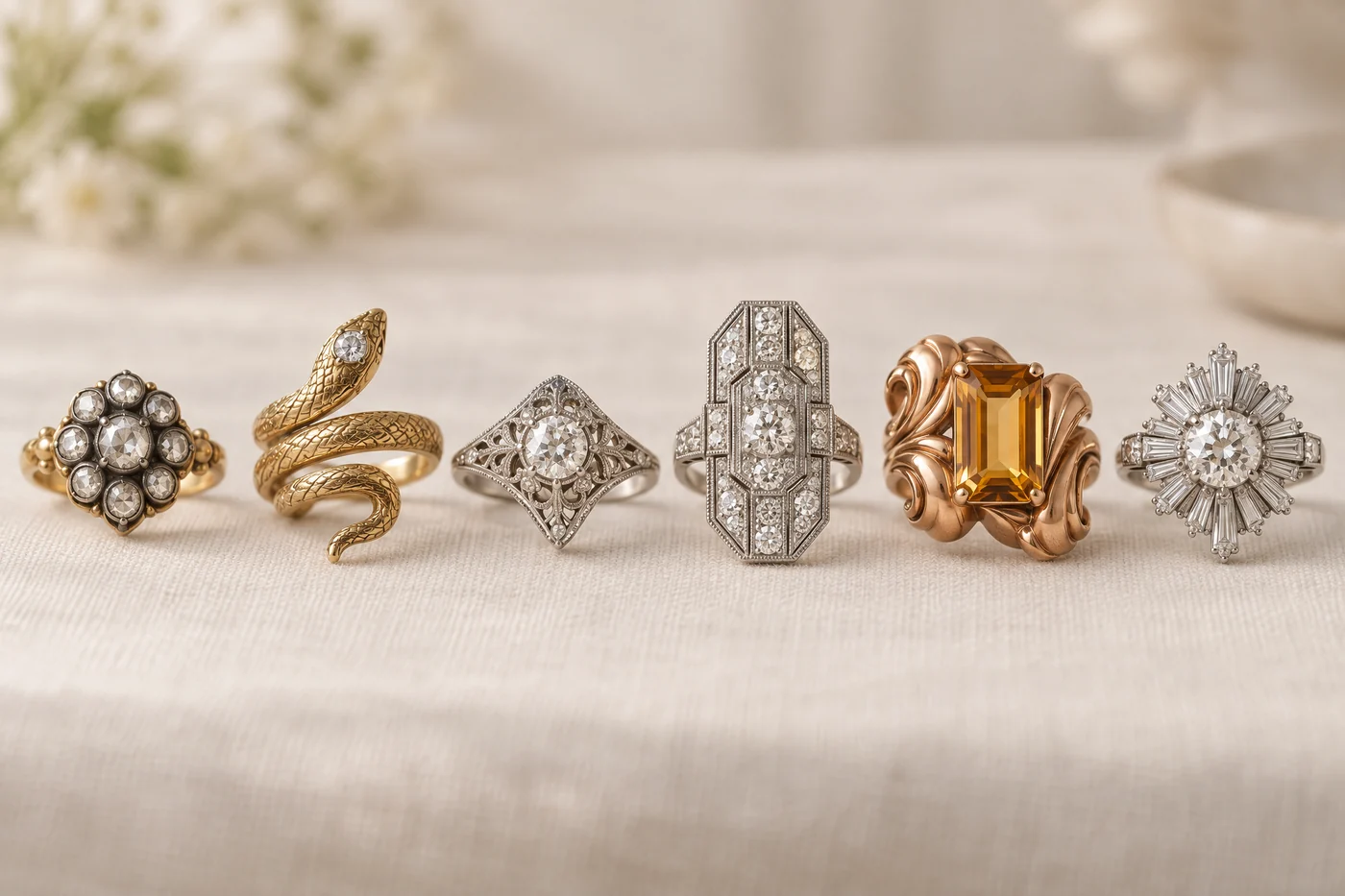
Antique rings for women fall into clear periods, each with its own look:
- Georgian (1714 to 1837): hand-made gold, rose and old mine cut diamonds in closed-back silver settings.
- Victorian (1837 to 1901): snakes, half hoops, gypsy rings and clusters in 18ct, 15ct or 9ct gold.
- Edwardian (1901 to about 1915): lacy platinum, millegrain, natural pearls and old European cuts.
- Art Deco (1920s and 1930s): geometric platinum plaques and targets with step-cut and calibre-cut stones.
- Retro and mid-century (about 1939 to the 1970s): bold gold, big coloured stones, baguette starbursts and cocktail rings.
In this article
The eras at a glance
An antique ring is at least 100 years old, so today that means made before about 1926: Georgian, Victorian, Edwardian and early Art Deco. Rings from the late 1920s to the 1970s are vintage.
Each period had its own metals, diamond cuts and favourite shapes, which is how a ring can be dated without paperwork.
PeriodStyle runs on
| Era | Metal | Stones and cuts | Signature rings |
|---|---|---|---|
| Georgian, 1714 to 1837 | Gold; diamonds set in silver | Rose and old mine cuts, closed backs, often foiled | Clusters, mourning and posy rings |
| Victorian, 1837 to 1901 | 18ct, 15ct and 9ct gold; silver-topped | Old mine and rose cuts, cabochons, natural pearls | Snakes, half hoops, gypsy rings, clusters, cameos |
| Edwardian, 1901 to about 1915 | Platinum, or platinum on gold | Old European cuts, natural pearls | Lacy clusters, millegrain, three stones |
| Art Deco, 1920s and 1930s | Platinum | Old European, step and calibre cuts, emeralds and sapphires | Plaque rings, target clusters, geometric shapes |
| Retro, about 1939 to 1950 | Yellow and rose gold, white gold | Round brilliants, large coloured stones | Three stone rings, bold scrolls |
| Mid-century, 1950s to 1970s | Platinum, white and textured gold | Brilliants with baguettes, big coloured stones | Starburst clusters, cocktail rings |
One of the most upvoted posts on Reddit's r/jewelry this autumn showed rings inherited from the women of one family (4,690 upvotes). If you have a ring like that, the list below will usually tell you its era.
Seven eras of rings, Georgian to the 1970s
Each era below is shown by a ring from our own collection where we have a true example, and by an illustration of the style where we do not.
Georgian rings, 1714 to 1837
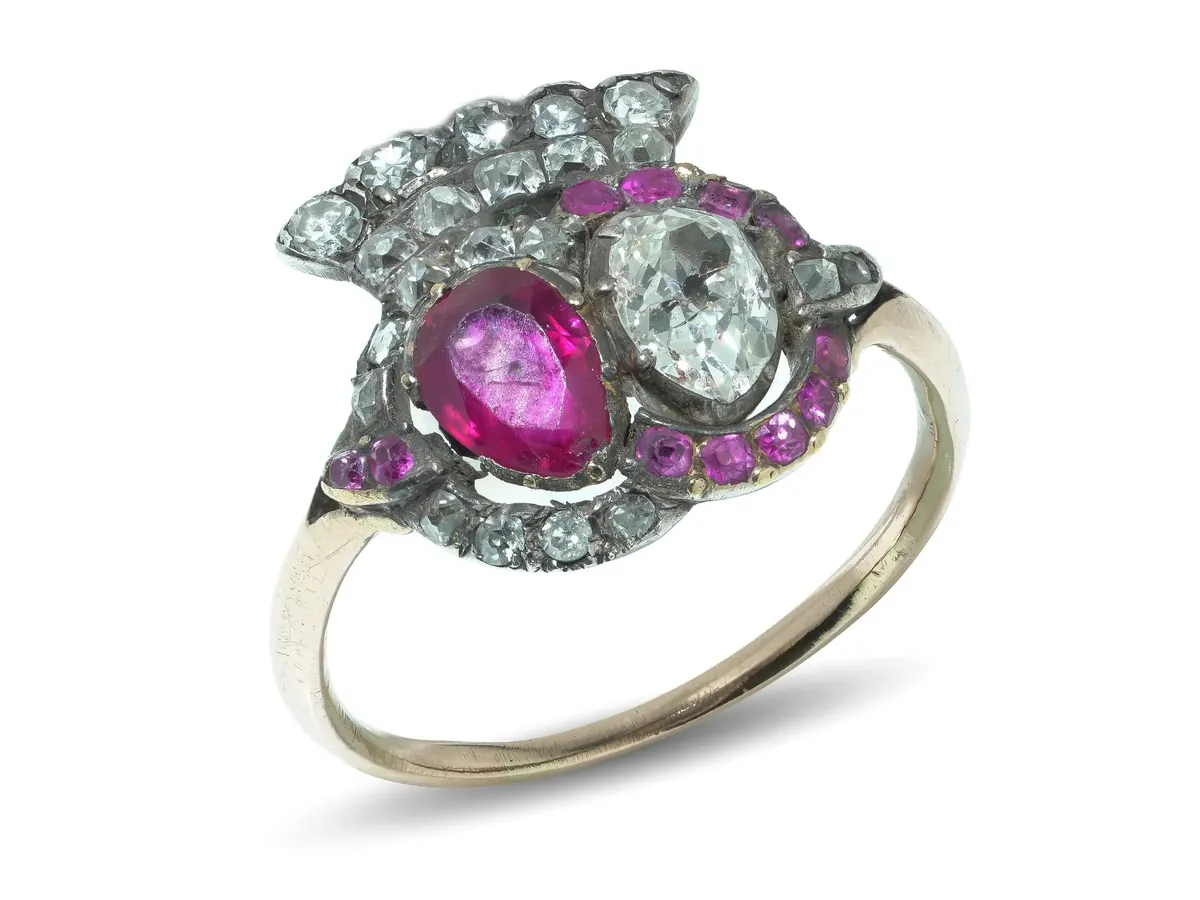
Georgian rings were made by hand, one at a time, and lit by candlelight. Diamonds were rose cut (flat beneath, a dome of triangular facets above) or old mine cut, set in silver so they looked whiter, with gold below.
Stones sat in closed-back collets, often over a coloured or silvered foil to lift them. Few survive intact: gold was melted and stones were reset as fashions changed. Look out for posy rings with an inscription inside, and mourning rings in black enamel.
Pictured: our Georgian ruby and diamond cluster. Also in our collection: a Victorian gold ring with an 18th-century intaglio.
Victorian rings, 1837 to 1901
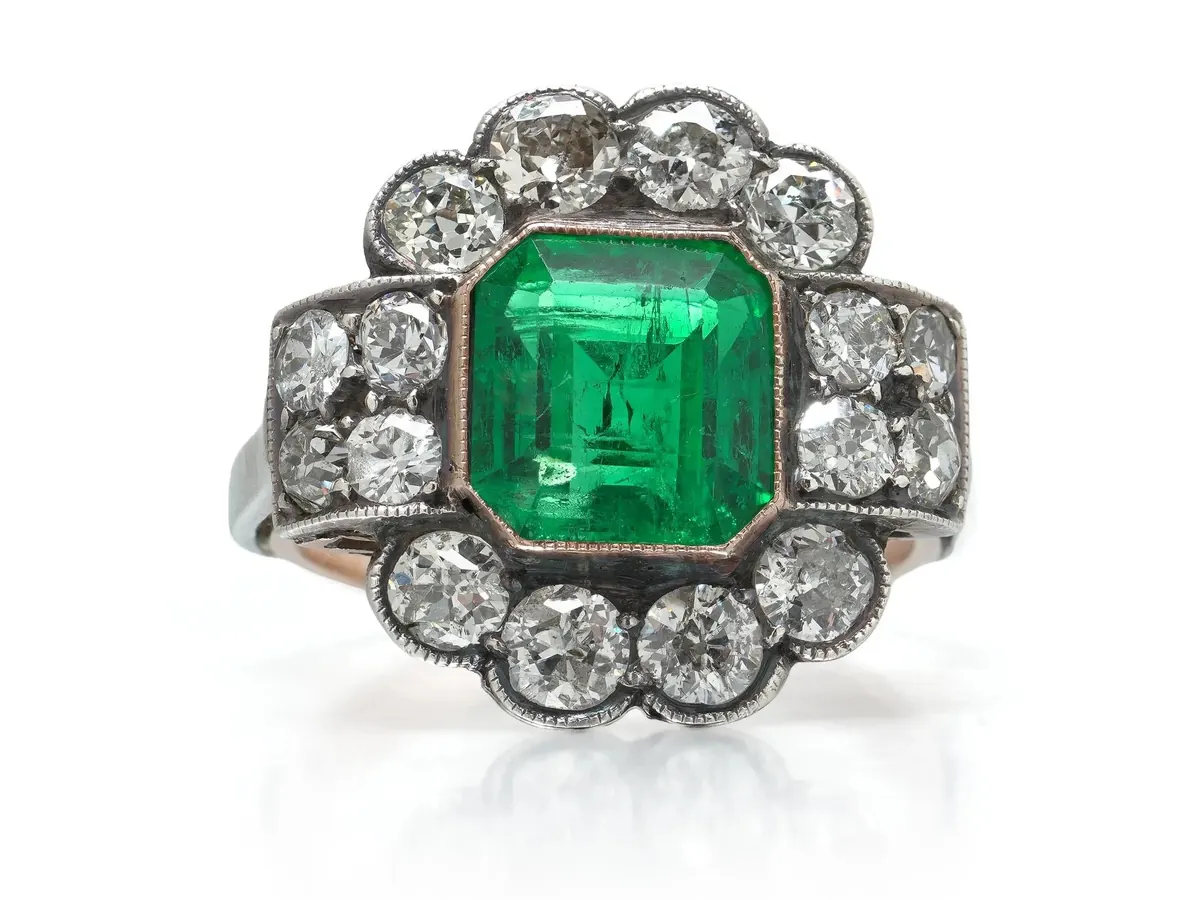
The widest choice of antique rings comes from Victoria's reign, and it changed a great deal over 64 years (see the three periods of Victorian jewellery).
- Clusters. A centre stone or natural pearl inside a ring of diamonds, set in silver on a gold shank, often with an open gallery behind. See old mine cut.
- Half hoops and gypsy rings. Five graduated stones across the finger, or stones sunk flush into a heavy gold band in a gypsy setting.
- Sentiment. Prince Albert gave Victoria an engagement ring in 1839 in the form of a snake set with an emerald, and snake rings stayed popular all century. Regard rings spelled a word in stones: Ruby, Emerald, Garnet, Amethyst, Ruby, Diamond.
- Carved stones. Cameos and intaglios set in gold, many of them earlier stones in Victorian mounts.
- New gold standards. 15ct, 12ct and 9ct gold became legal in 1854, alongside 18ct and 22ct.
Pictured: our Victorian Colombian emerald cluster, on 9ct gold and silver. Also in our collection: a five stone ruby half hoop with a carved gallery, a double snake ring in 18ct gold with old cut diamonds, a natural pearl and old cut diamond cluster and a Ceylon sapphire and rose cut diamond three stone ring.
Edwardian rings, 1901 to about 1915
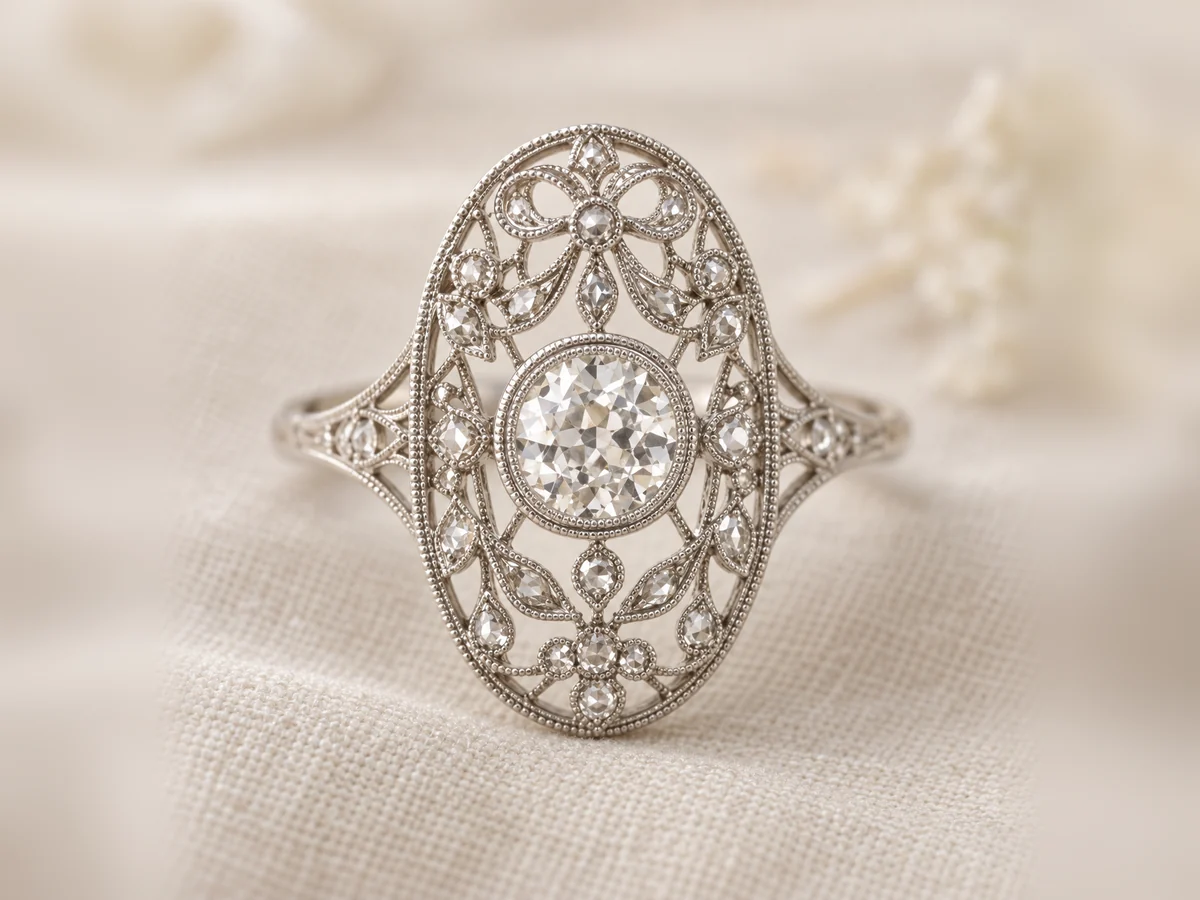
Platinum changed ring design. It is strong enough to be pierced and beaded into fine lace, so Edwardian rings look white, light and open, edged with millegrain (tiny beads of metal along every edge). Diamonds are usually old European cuts, round with a small table and a visible culet.
Natural pearls were prized. Many rings are platinum on top and gold below, and yellow gold rings in the Victorian manner carried on beside them, like our natural pearl cluster of about 1910 and our snake ring hallmarked in Birmingham in 1915. Also in our collection: a ruby and old European cut diamond ring and a five stone ruby ring.
Art Deco rings, 1920s and 1930s
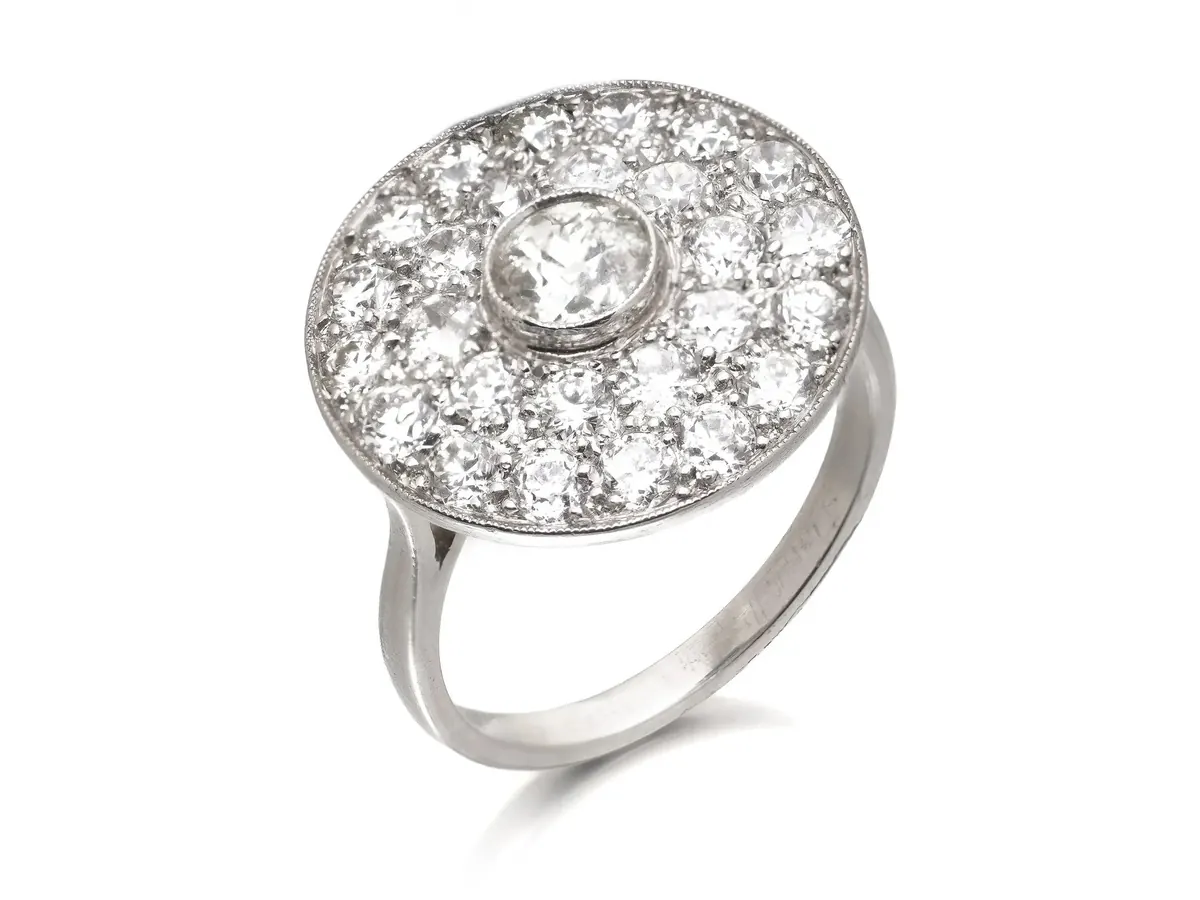
Deco rings are geometry in platinum: plaques set on the diagonal, target clusters, octagons and long rectangles running up the finger. Coloured stones were cut to fit the design (calibre cuts), and step cuts, emerald cuts and baguettes arrived alongside old European and transitional cuts.
Marcel Tolkowsky published the proportions of the modern round brilliant in 1919, but old cuts were still set throughout the period. More in our Art Deco jewellery buying guide.
Pictured: our target cluster, 2.32 carats of old European cut diamonds. Also in our collection: a marquise diamond plaque ring, an emerald and diamond plaque ring, a cabochon sapphire and diamond cluster and a jade and diamond navette in platinum.
Retro rings, about 1939 to 1950
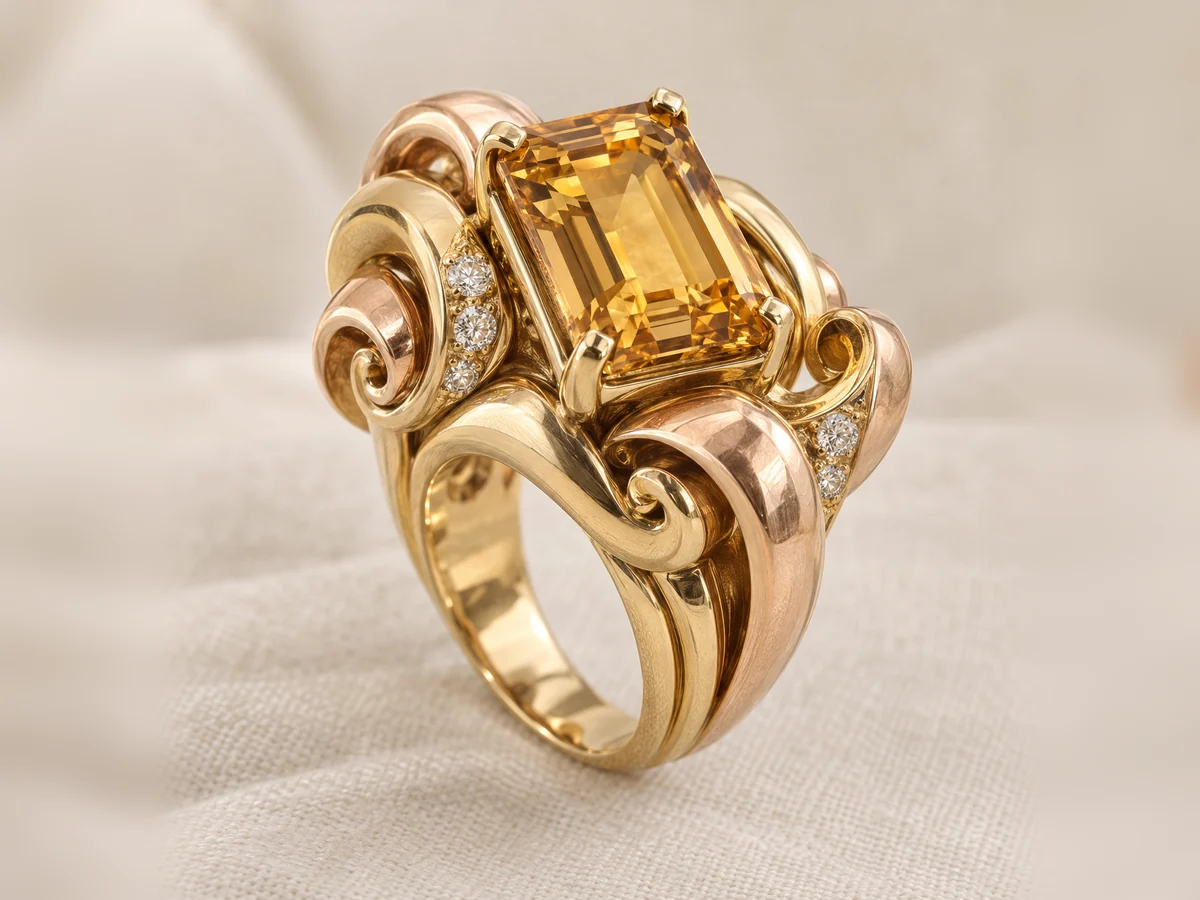
In 1942 the United States declared platinum a strategic war metal, and jewellers turned to gold. Retro rings are rose and yellow gold in big, sculptural shapes, often with large coloured stones.
More in our guide to recognising retro jewellery. From the same decade in our collection: a three stone diamond ring dated 1947.
The 1950s: flowers and starbursts
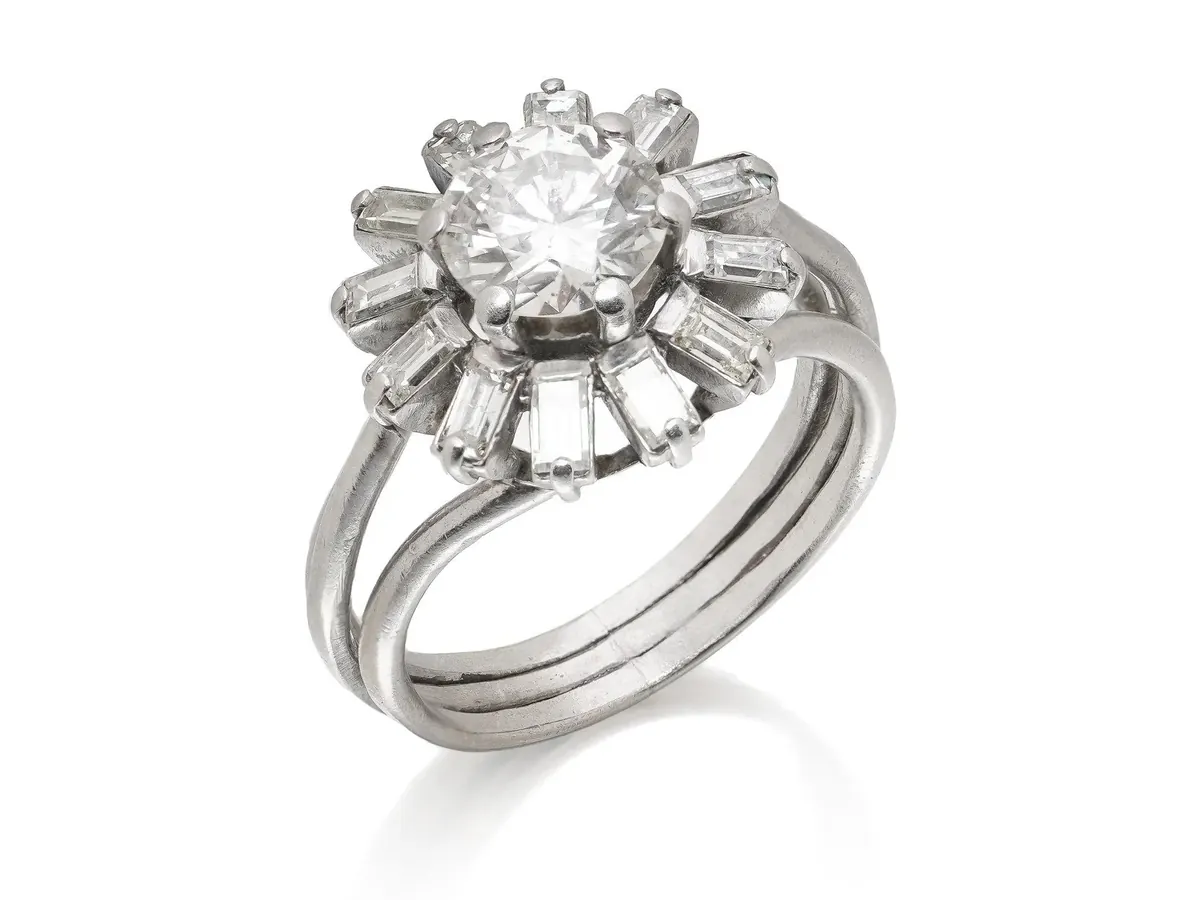
After the war, the geometry of the 1930s softened into flowers and starbursts, with baguettes radiating round a brilliant.
Pictured: our 1950s platinum cluster, a 1.33 carat diamond inside a ring of baguettes. Also in our collection: a cabochon emerald in fluted gold and a blue zircon and diamond ring.
The 1960s and 1970s: cocktail rings
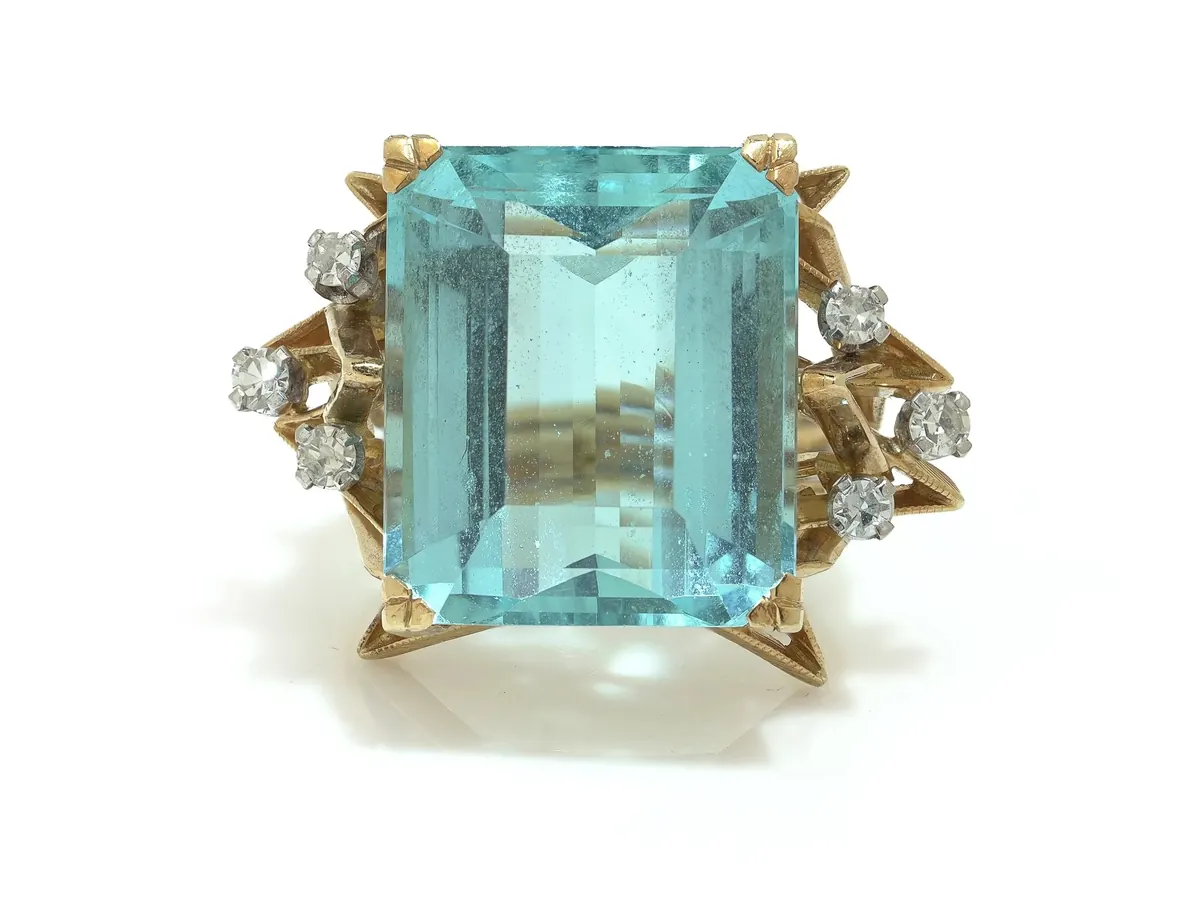
The 1960s and 1970s brought textured gold and big cocktail rings: one large stone, held high.
Pictured: our 1970s aquamarine and diamond ring in 18ct gold. Also in our collection: a Cartier gold and pearl ring, a tiger's eye ring in 18ct gold and an angel skin coral and diamond bombe ring.
How to date an antique ring
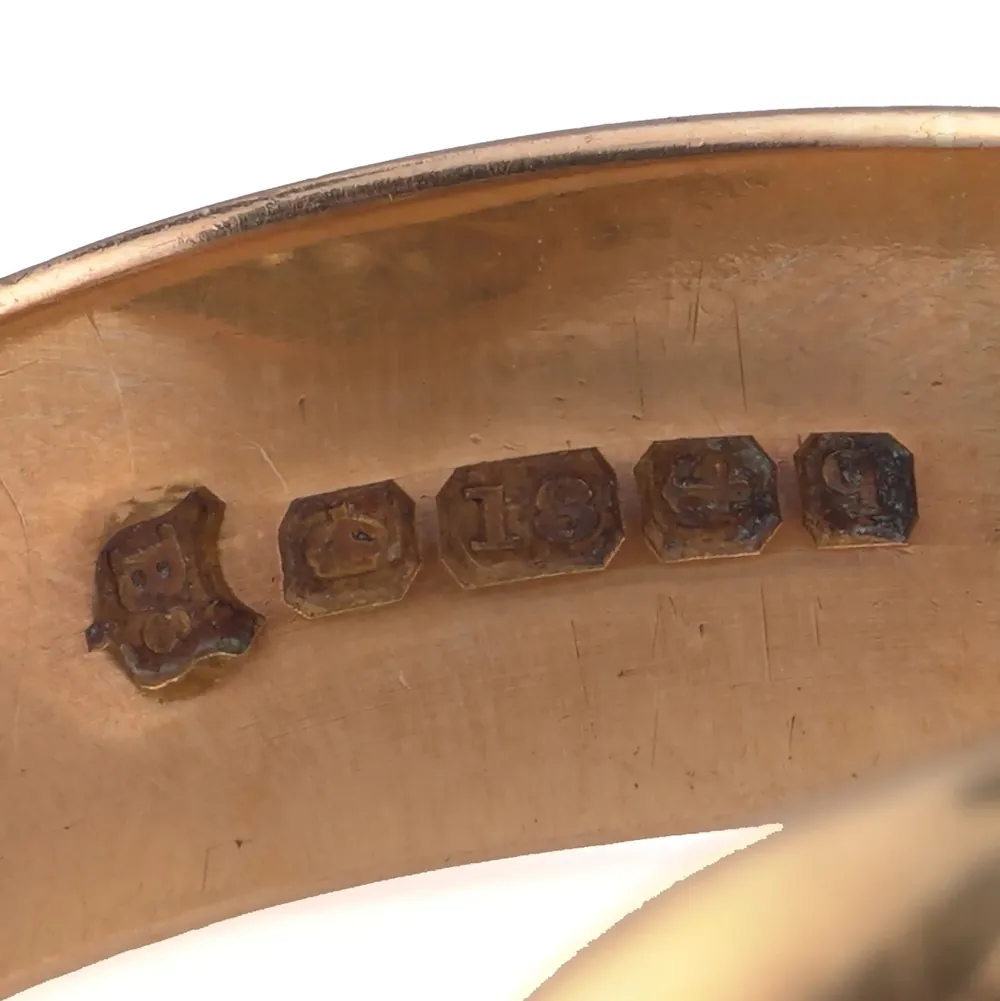
Read the marks
A British hallmark gives the gold standard, the assay office and a date letter, like these Birmingham marks for 1915 (see the Birmingham assay office guide). Many antique gem-set rings were never hallmarked, so a missing mark is not a warning sign on its own.
15ct or 12ct places British gold between 1854 and 1932; 14ct replaced 15ct in 1932. Britain only hallmarked platinum from 1975, so earlier platinum is often stamped PLAT or PT, or not marked at all (platinum hallmarks).
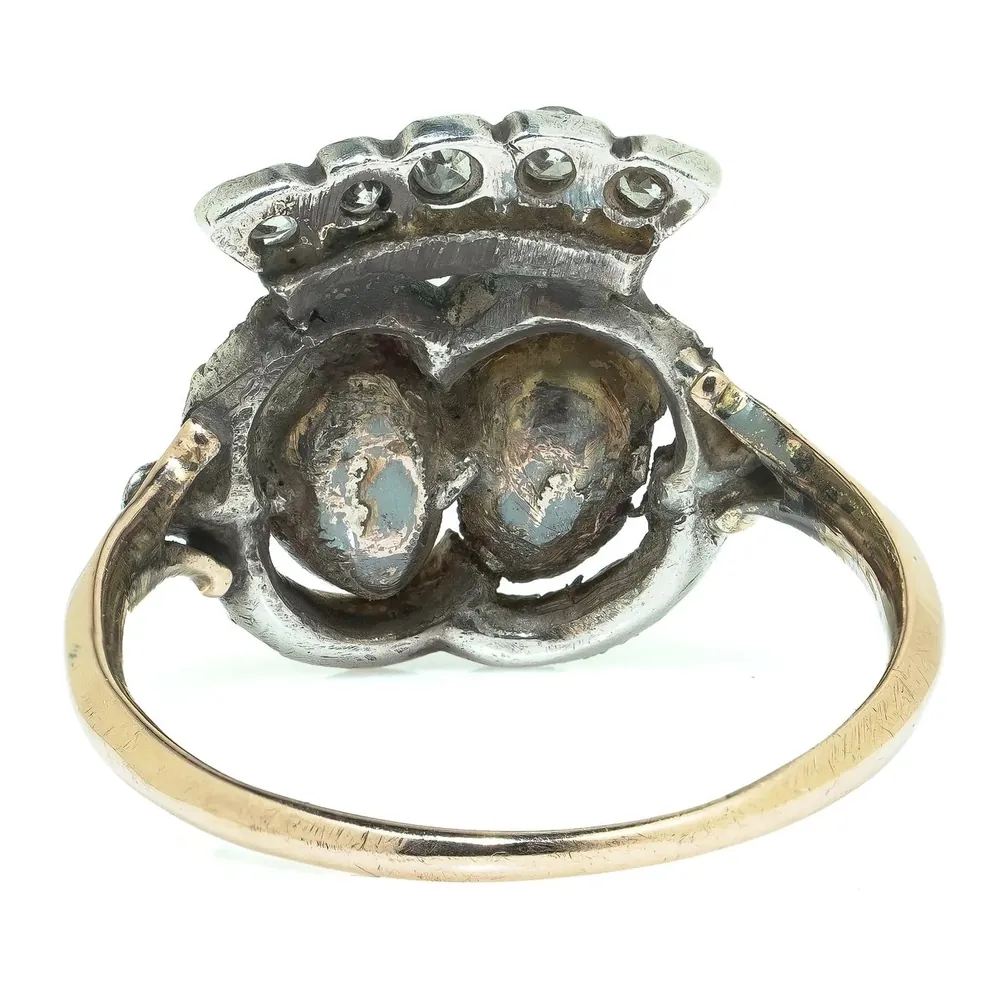
Turn it over, then look at the cut
Closed backs suggest the Georgian period, as here; open galleries the 19th century onwards; millegrain and piercing the Edwardian and Deco years.
Then look at the cut. Rose and old mine cuts are the oldest; old European cuts run from about 1890 to 1930; transitional cuts bridge to the modern brilliant.
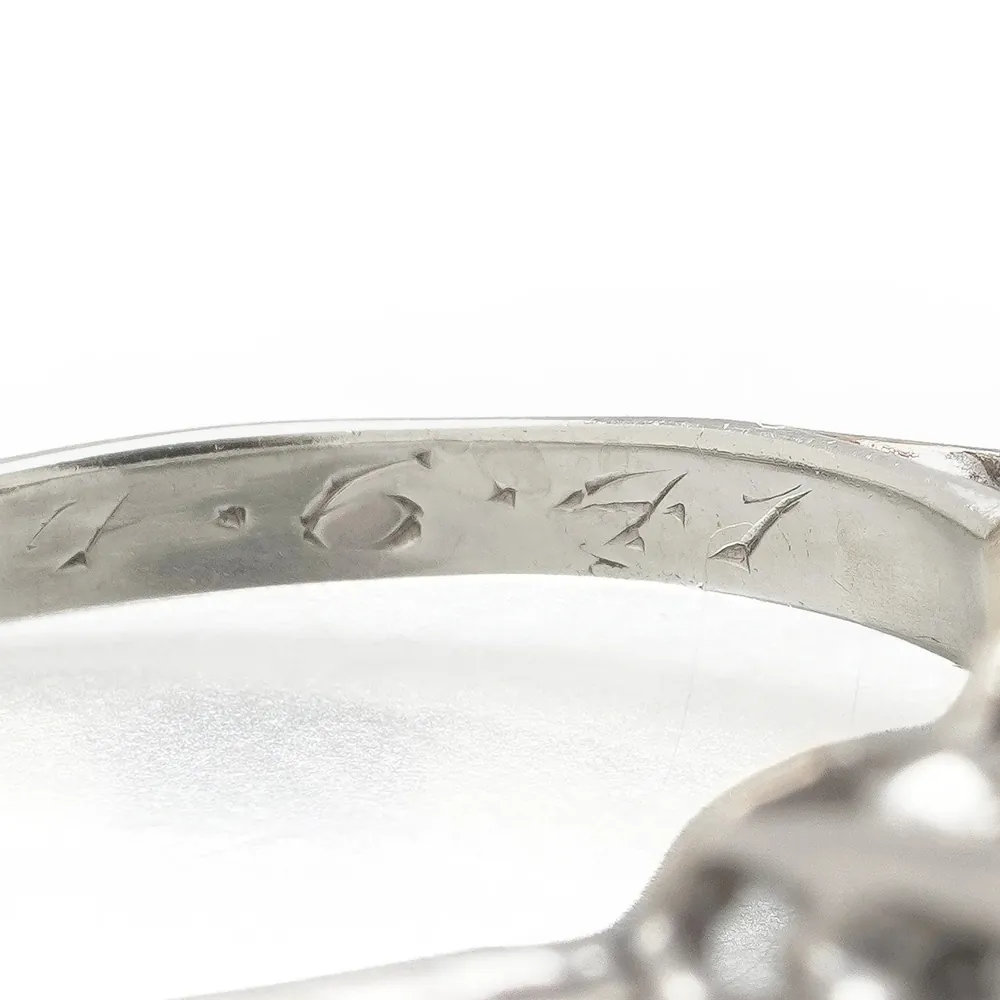
Look inside the band
Dates, initials and retailers' marks. One of our rings is engraved 4.6.47, the day it was given.
Signed rings carry the maker's name inside too, like the Cartier signature on a 1970s gold ring of ours.
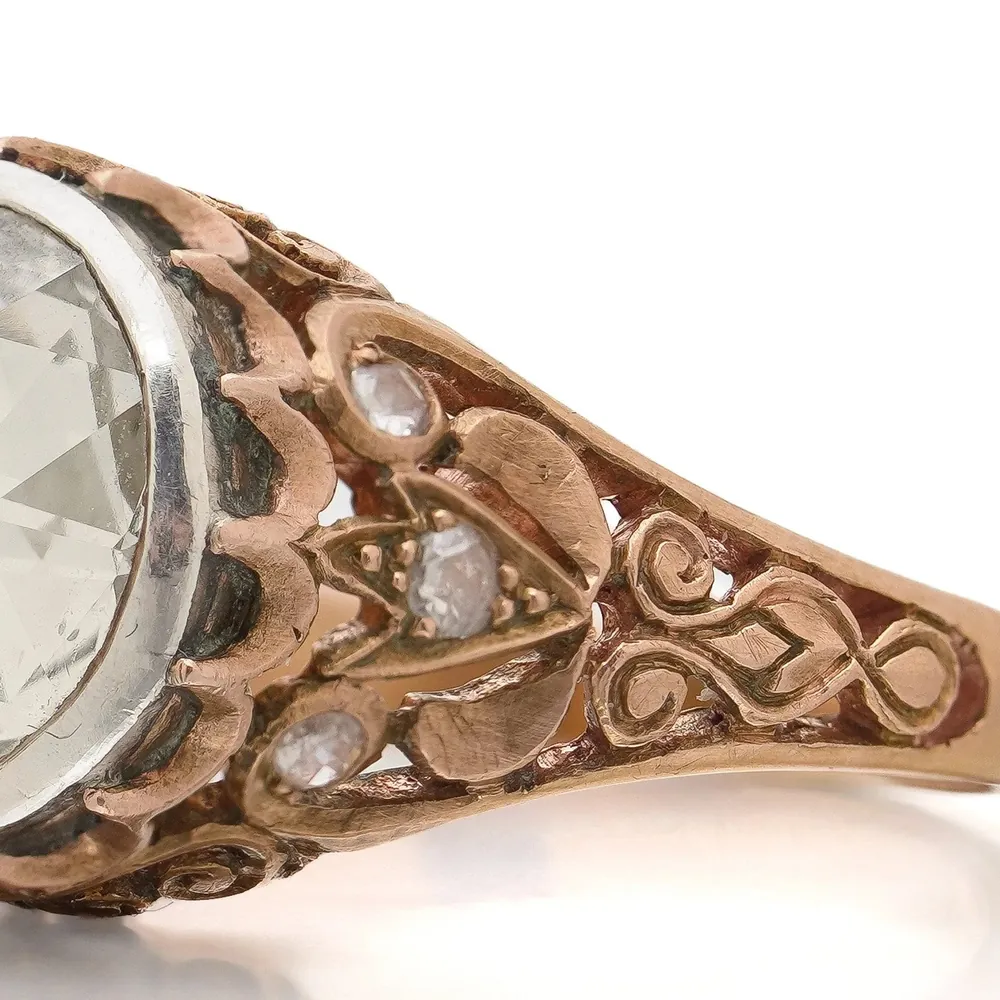
One ring, two eras
Old stones were often moved into newer mounts, so one ring can hold two eras. This rose cut diamond of about 4.40 carats keeps its closed-back silver collet, the Georgian practice.
The pierced, scrolled shank is Victorian 15ct gold, a standard legal in Britain only from 1854 to 1932. A dealer should tell you which parts are which, as the listing for this ring does.
Inherited a ring? Send photos and we will date it
Buying an antique ring: what to look for
Original closed-back settings and foils, untouched by later repairs.
Snakes, regard and dearest rings, mourning rings with legible inscriptions.
Proved by a laboratory report, not by eye. See natural vs cultured pearls.
Rose, old mine and old European cuts in their first setting.
Colombian emeralds and Ceylon and Burma sapphires and rubies of good colour.
Crisp millegrain, all stones present, no cracks in the piercing.
Cartier, Boucheron, Van Cleef & Arpels and other great houses, with clear marks.
More on natural vs cultured pearls and old cut diamonds.
Condition, resizing and re-shanking
| Check | What to look for |
|---|---|
| Shank | Thin, cracked or out of round at the back, where a century of wear lands |
| Re-shanking | A new lower band joined to the old head. Normal and sensible on old rings, as long as it is described |
| Claws and collets | Worn tips and loose stones; tap gently near your ear for a rattle |
| Stones | Chips on rose cut edges, cracks in emeralds, replaced stones that do not match |
| Pearls | Whether natural or cultured, which only a laboratory can confirm |
| Size | Many rings can be resized, but full eternity rings, gypsy rings and stone-set shoulders are harder |
Sizes on our listings are given as UK, US and EU, for example UK N / US 6¾ / EU 54. Not sure of yours? See our ring sizing guide.
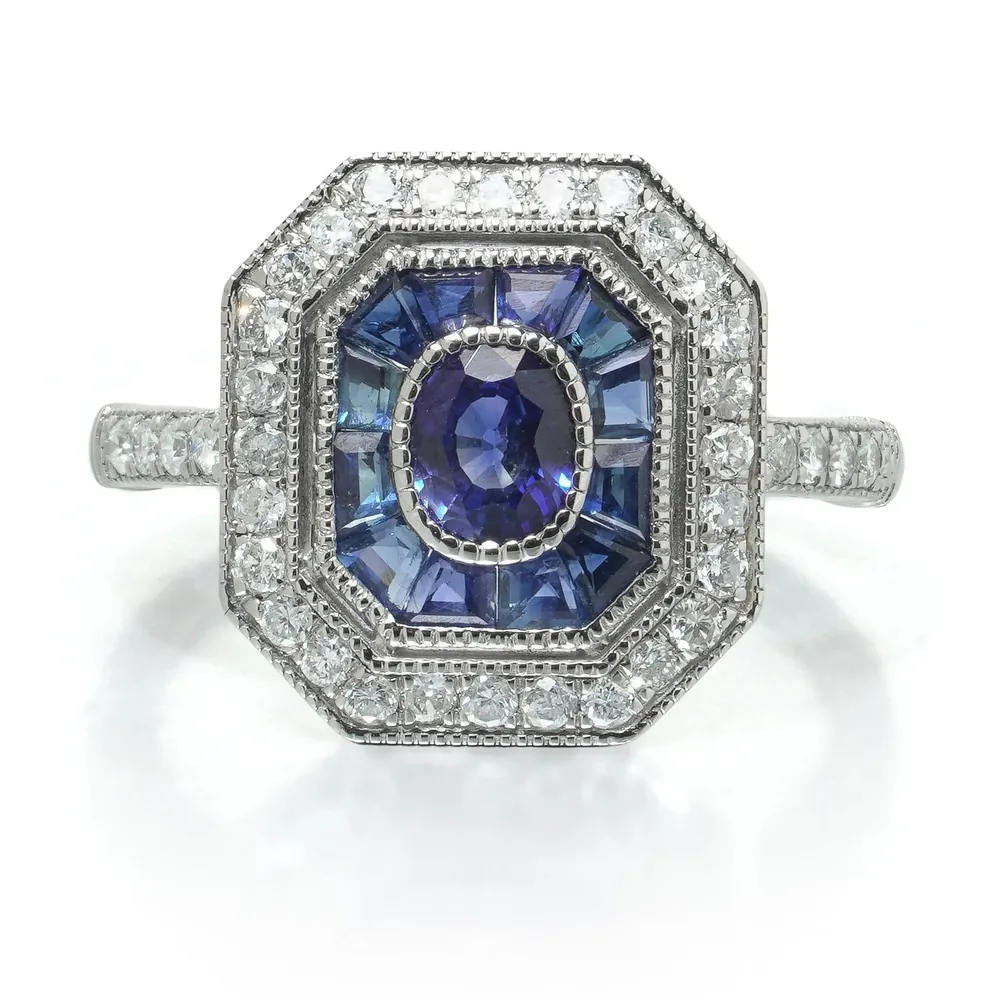
Period or style?
"Art Deco style" means made recently in the Deco manner, like this sapphire ring. Period rings are listed by era.
Style rings are a fine alternative but are priced as modern jewellery. Ask if it is not clear.
Buying for an engagement? Read the antique engagement rings buying guide, and for bands, the antique wedding bands stacking guide. How we check every ring before it is listed: how we authenticate antique jewellery.
How we can help
Every ring on this page is in our ring collection, with free worldwide delivery, and can be seen by appointment in Mayfair or Braintree. Browse by period: Georgian, Victorian, Edwardian, Art Deco and vintage, or see antique rings and signet rings.
We also buy antique rings, from a single inherited ring to a whole collection. Send photos of the front, the back and any marks inside the band and we will tell you its era and what we would pay, free and with no obligation.
Call 01376 334482 or message us on WhatsApp.
Selling a ring? Get a free quote
Selling guides: Georgian, Victorian, Edwardian and Art Deco jewellery, and selling vintage jewellery.
- Georgian: hand-made, closed backs, rose and old mine cuts. Victorian: gold, snakes, half hoops, clusters.
- Edwardian: platinum lace and natural pearls. Art Deco: geometry in platinum.
- Date a ring by its marks, carat, cut, setting and any inscription.
- Check the shank, claws and stones, and ask about re-shanking and resizing.
Questions we are asked
What counts as an antique ring?
A ring at least 100 years old: today that means made before about 1926, so Georgian, Victorian, Edwardian and early Art Deco. Rings from the late 1920s to the 1970s are usually called vintage.
How can I tell what era my ring is from?
Look at the hallmarks and carat marks, the diamond cut, the metal and the back of the setting. 15ct gold dates a British ring to 1854 to 1932, closed backs suggest the Georgian period, and platinum with millegrain points to the Edwardian and Art Deco years.
What did Victorian rings look like?
Yellow gold, often with diamonds set in silver on top. Typical forms are snake rings, five stone half hoops, gypsy rings with stones sunk into the band, clusters around a pearl or coloured stone, and cameo rings.
What is the difference between Edwardian and Art Deco rings?
Edwardian rings are lacy and garland-like, in platinum with millegrain and old European cut diamonds. Art Deco rings are geometric: plaques, targets and step-cut or calibre-cut coloured stones.
Why are some antique rings not hallmarked?
Many antique gem-set rings were never hallmarked, and platinum was only hallmarked in Britain from 1975. A missing mark is common on genuine antique rings; the construction and stones date them instead.
Can antique rings be resized?
Most can, by a jeweller used to antique work. Full eternity rings, gypsy rings and rings with stones down the shoulders are harder. Many of our listings say when a ring can be resized on request.
What does re-shanked mean?
The worn lower part of the band has been replaced with new metal joined to the original head. It is common on rings that have been worn for a century and is fine when it is described.
Is an "Art Deco style" ring antique?
No. "Style" means made recently in the Deco manner. A period Art Deco ring was made in the 1920s or 1930s.
Looking for an antique ring, or selling one?
Browse our rings by era, or send photos of yours for a free valuation. Call 01376 334482 or WhatsApp us.
- We buy directly
- Free valuation from photos
- Appointments in Mayfair and Braintree
- Insured postage or collection
New pieces reach our list first: join the Mozeris list.