How to Tell if a Gold Bracelet Is Real: Antique Gold Bracelets and Bangles
A dealer's guide to gold bracelets and bangles: reading hallmarks and carat stamps, dating a piece by its carat, spotting rolled gold, plating and pinchbeck, and the antique styles worth knowing.
How can you tell if a gold bracelet is real?
- Look for a hallmark or carat stamp on the clasp, the tongue or inside a hinged bangle.
- GF, RGP, HGE and HGP mean a gold layer over base metal, not solid gold.
- 15 and 12 carat gold dates a British piece to 1854 to 1932.
- Unmarked antique gold is common; a jeweller can test it.
In this article
How to tell if a gold bracelet or bangle is real
Start with the marks, then look at the wear. Most real gold bracelets made in Britain since the 19th century carry a hallmark or a carat stamp; most imitations show their base metal where they rub.
- Find the marks
Look on the clasp, the box clasp tongue, the safety chain ring and inside a hinged bangle. A British hallmark has a sponsor's mark, a fineness mark and an assay office mark (Wikipedia); a date letter was compulsory until 1999.
- Read the fineness
375 is 9 carat, 585 is 14, 750 is 18 and 916 is 22. Older pieces may show 9, 12, 15, 18 or 22 with the letters C or CT.
- Check for plating marks
1/20 12K GF, RGP, HGE or HGP mean gold filled, rolled gold plate or electroplate: a gold layer over base metal, not solid gold (Wikipedia).
- Look at the wear points
Edges, the inside of links and the clasp take the most wear. Pink, grey or brassy metal showing through means plating.
- Have it tested
Unmarked antique gold is common. A jeweller can test it with acid or an XRF analyser without damage you can see.
| Mark or sign | What it means |
|---|---|
| 375, 585, 750, 916 in a hallmark | Solid gold, 9, 14, 18 or 22 carat, tested by an assay office |
| 15 or 12 carat marks | Solid gold made between 1854 and 1932, when those standards existed |
| 9C, 15CT, 18CT stamped alone | A maker's claim, common on antique pieces; not an assay office hallmark |
| 1/20 12K GF, R.G.P. | Gold filled or rolled gold plate over base metal |
| HGE, HGP | Gold electroplate; these letters have no legal meaning |
| A woman's head in a headdress with 56 | Imperial Russian 14 carat, 1899 to 1917 |
| An eagle's head | French 18 carat gold |
Sources: Assay Office London; Wikipedia, Hallmark; Wikipedia, Gold-filled jewelry.
The magnet test only catches steel or iron. Gold, brass, copper and silver are all non-magnetic, so a bracelet that ignores a magnet can still be plated brass.
Foreign marks
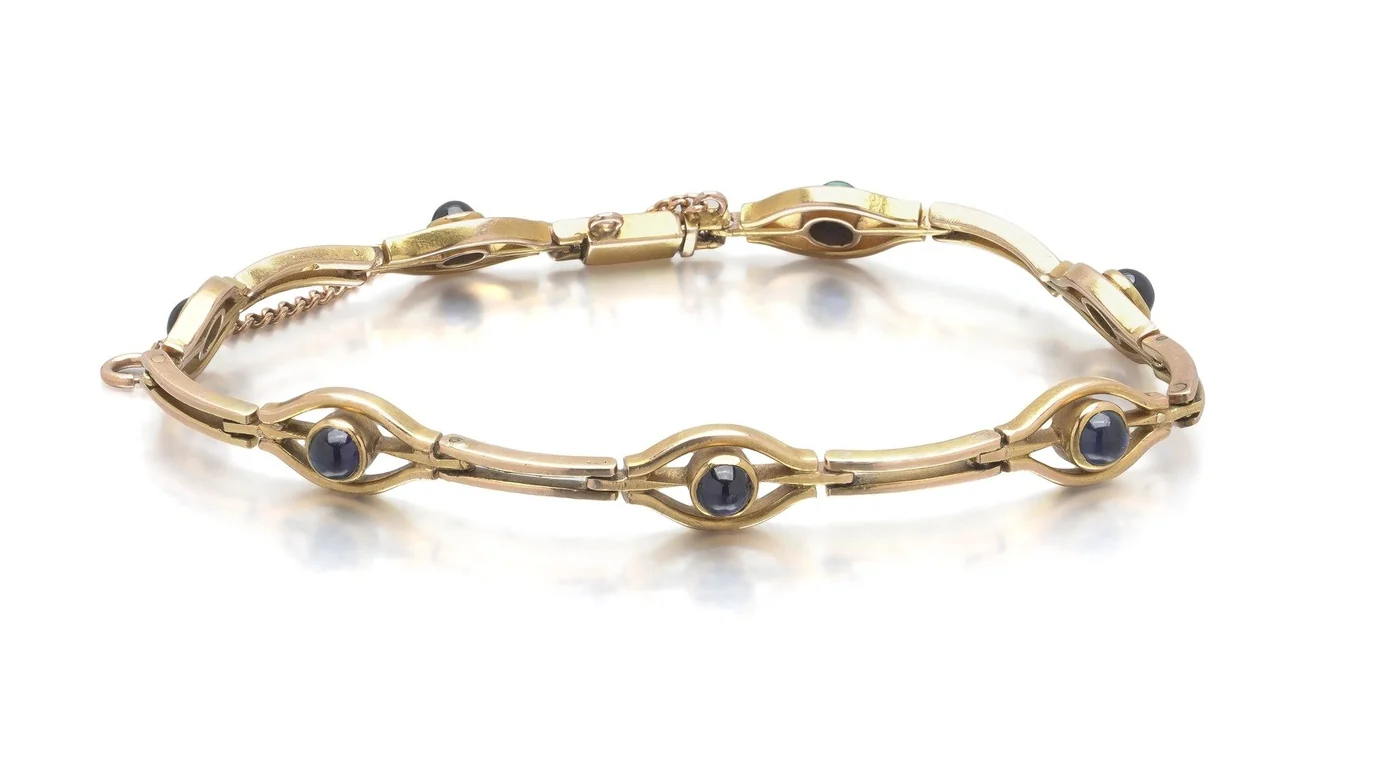
Gold made abroad carries its own country's marks. Russia used the kokoshnik, a woman's head in a traditional headdress, from 1899 to 1917, with 56 zolotniks equal to 14 carat.
Our Imperial Russian sapphire bracelet is struck with both. For British marks, see gold hallmarks and stamps decoded.
What the carat tells you about the date
British gold standards changed over time, so the carat can narrow down when a bracelet was made.
| Standard | In use | What it suggests |
|---|---|---|
| 22 carat | Marked with a crown and 22 from 1844 | High-carat work of any period |
| 18 carat | Throughout | Fine jewellery of every period |
| 15 carat | 1854 to 1932 only | Victorian, Edwardian or early 20th century |
| 12 carat | 1854 to 1932 only | Victorian, Edwardian or early 20th century |
| 9 carat | From 1854 | Victorian onwards |
| 14 carat | From 1932 in Britain | Later British work, or imported |
Source: Assay Office London, history of hallmarking. The Hallmarking Act 1973 took effect on 2 January 1975.
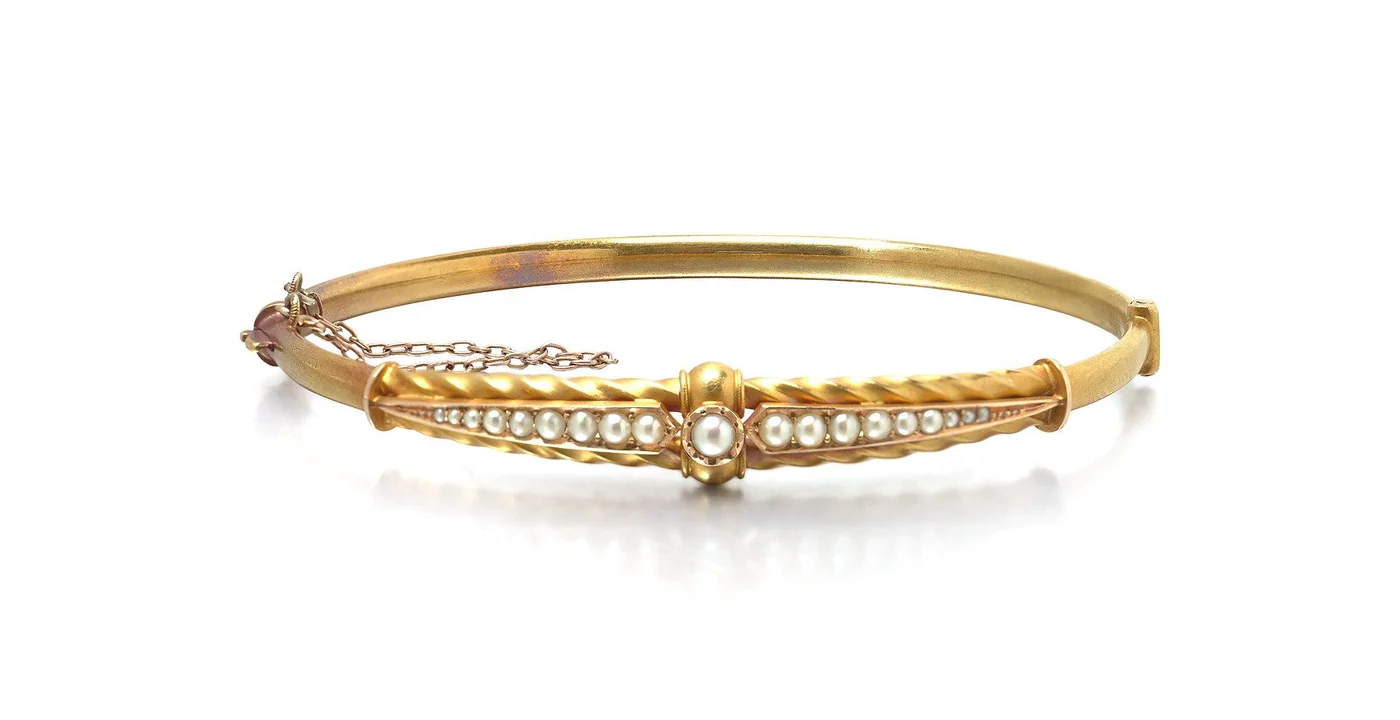
A 15 carat bangle
Because 15 carat was only a legal standard from 1854 to 1932, a 15KT bangle sits inside those dates before you look at anything else.
Our Victorian 15KT seed pearl bangle has the twisted rope panels, box clasp and safety chain typical of the period.
A full hallmark
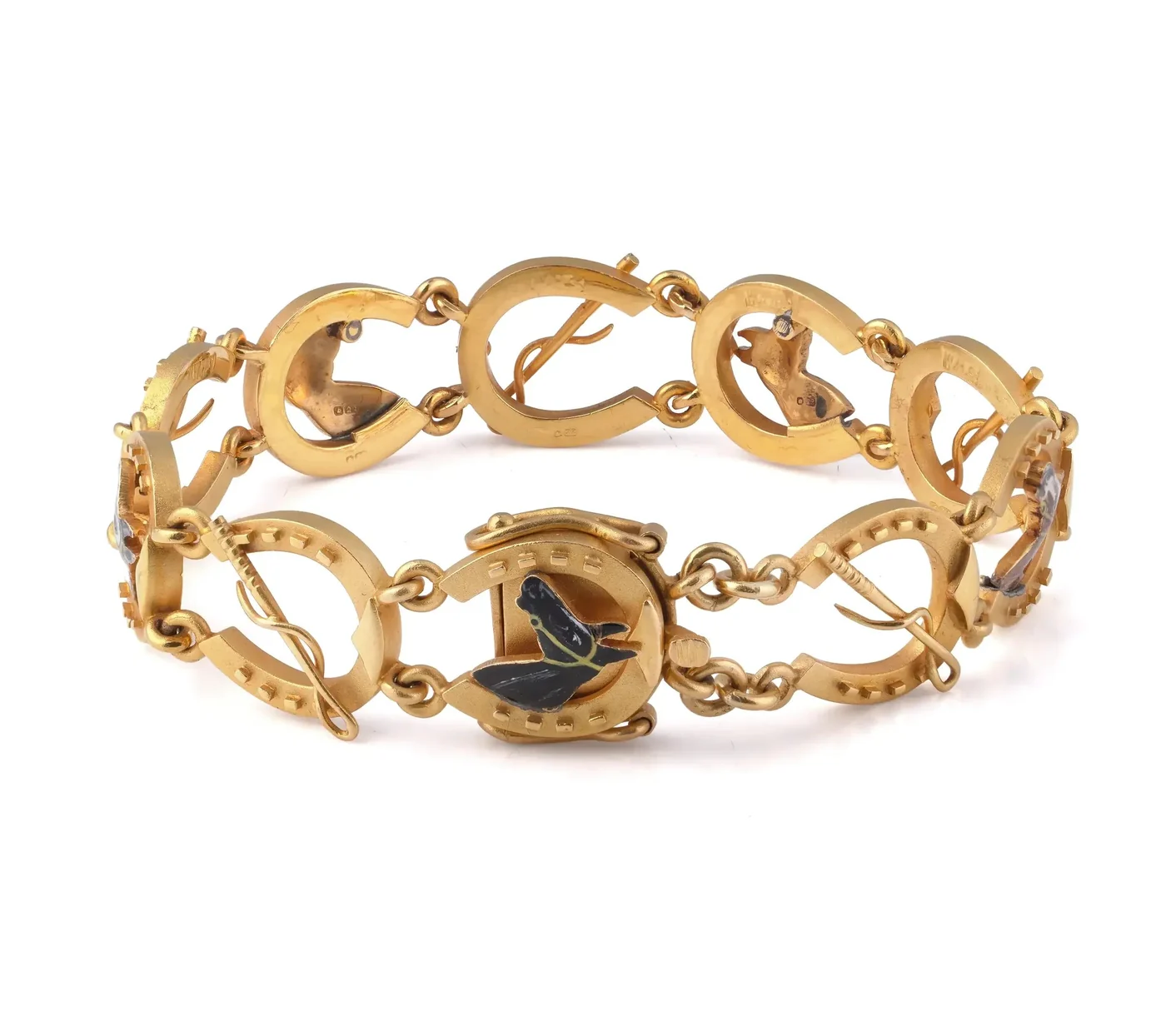
A full British hallmark gives the maker, the standard, the assay office and the year. Our 22KT horse motif bracelet, pictured at the top of this page, carries the maker's mark WH&S and the Birmingham mark for 1899. More on reading marks in gold hallmarks explained and what 9ct, 14ct, 18ct and 24ct mean.
Pinchbeck, rolled gold and plated gold
Three things are often mistaken for solid gold in old jewellery boxes.
| Material | What it is | How to spot it |
|---|---|---|
| Pinchbeck | A copper and zinc alloy that looks like gold, invented in the early 18th century by the London watchmaker Christopher Pinchbeck | No gold marks; warm brassy tone; dark tarnish in crevices |
| Rolled gold, gold filled | A layer of carat gold bonded to a base metal core, at least 1/20 of the weight | Marks such as 1/20 12K GF or R.G.P.; base metal shows at wear points |
| Gold plated | A very thin electroplated layer | HGE or HGP; wears through quickly at edges |
Pinchbeck let people wear gold-looking jewellery when gold was sold only at high carats, and it fell out of use after 1854, when lower carat gold became legal (Wikipedia). Good Georgian pinchbeck is collected in its own right, but it is not gold.
Antique gold bracelets and bangles, era by era
A bangle is rigid, either solid or hinged to open; a bracelet is flexible, made of links or mesh. Browse our gold bangles and gold bracelets to compare them.
Victorian hinged bangles with stones
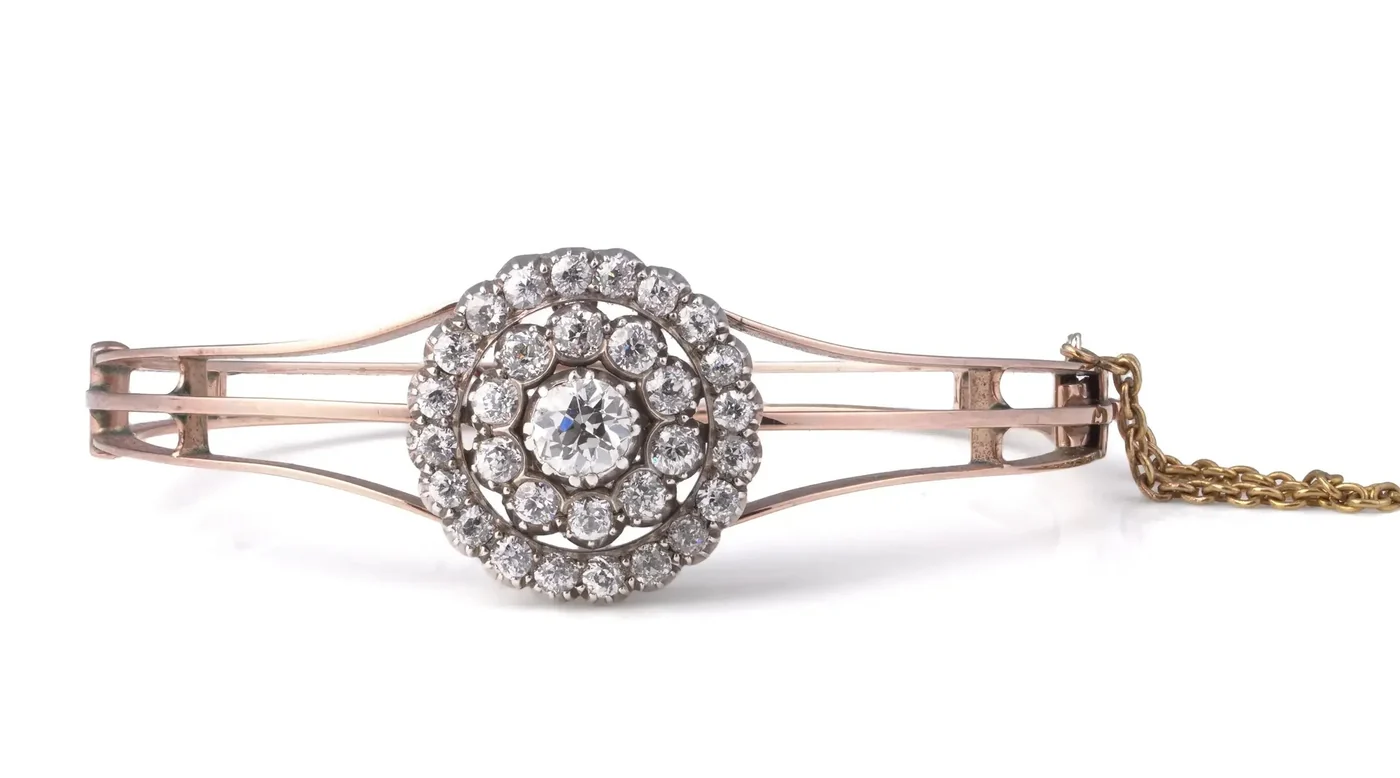
The Victorian bangle opens on a hinge, closes with a box clasp and carries a safety chain. The front is set with stones, from single clusters to graduated rows.
Our Victorian diamond bangle sets an old cut diamond target cluster on a pierced 9KT frame. See Victorian jewellery.
Snakes and sentiment
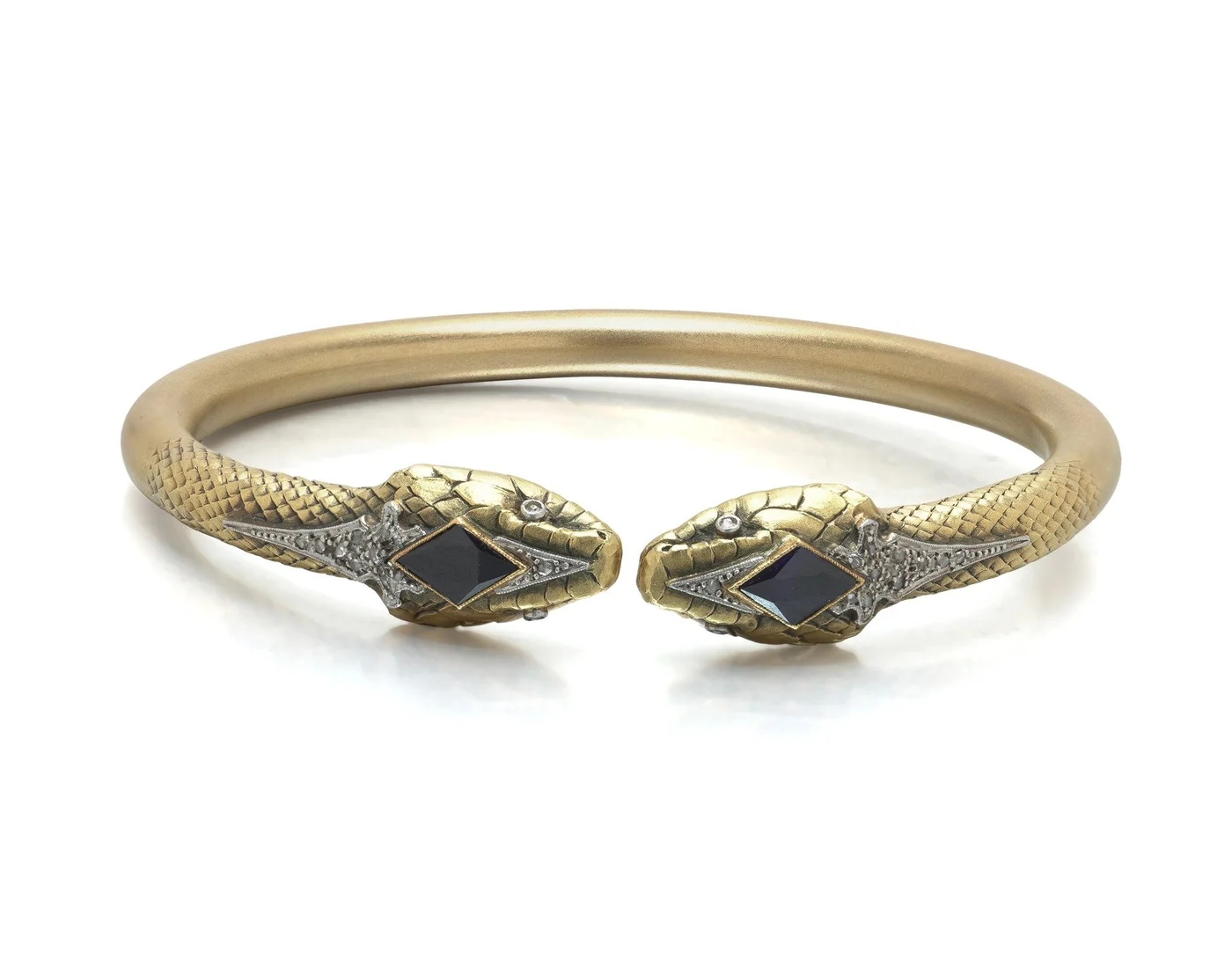
The serpent, a symbol of eternity, became a favourite after Prince Albert gave Queen Victoria a snake engagement ring in 1839.
Our double snake bangle has two chased serpents meeting head to head, each set with a sapphire and rose cut diamonds.
Lockets and enamel
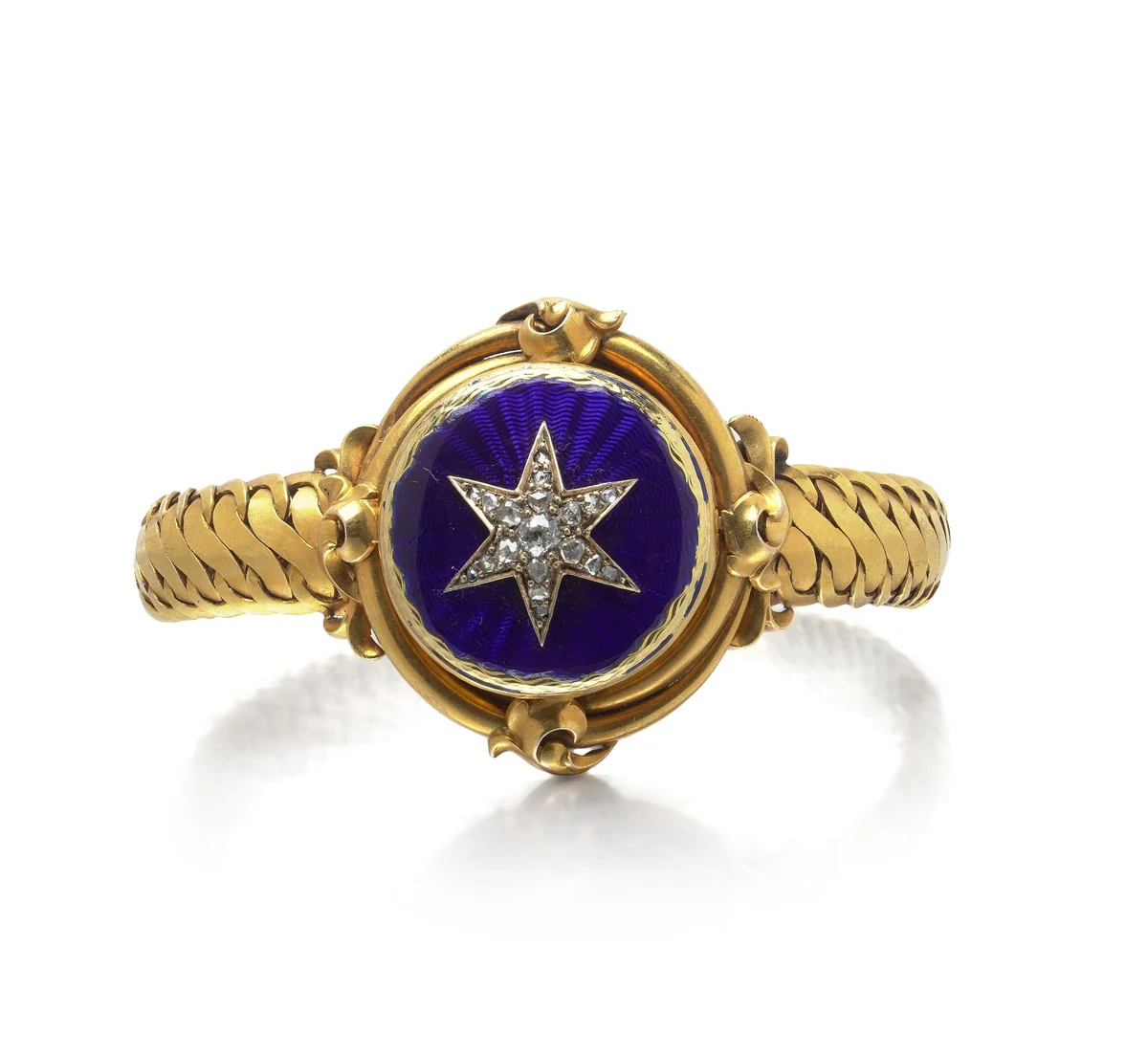
Many Victorian bracelets close on a locket, often fitted with a compartment for a lock of hair, a mourning or sentimental keepsake.
Our blue enamel locket bracelet of the 1880s has a diamond star on royal blue guilloché enamel.
Grand Tour souvenirs: micromosaic
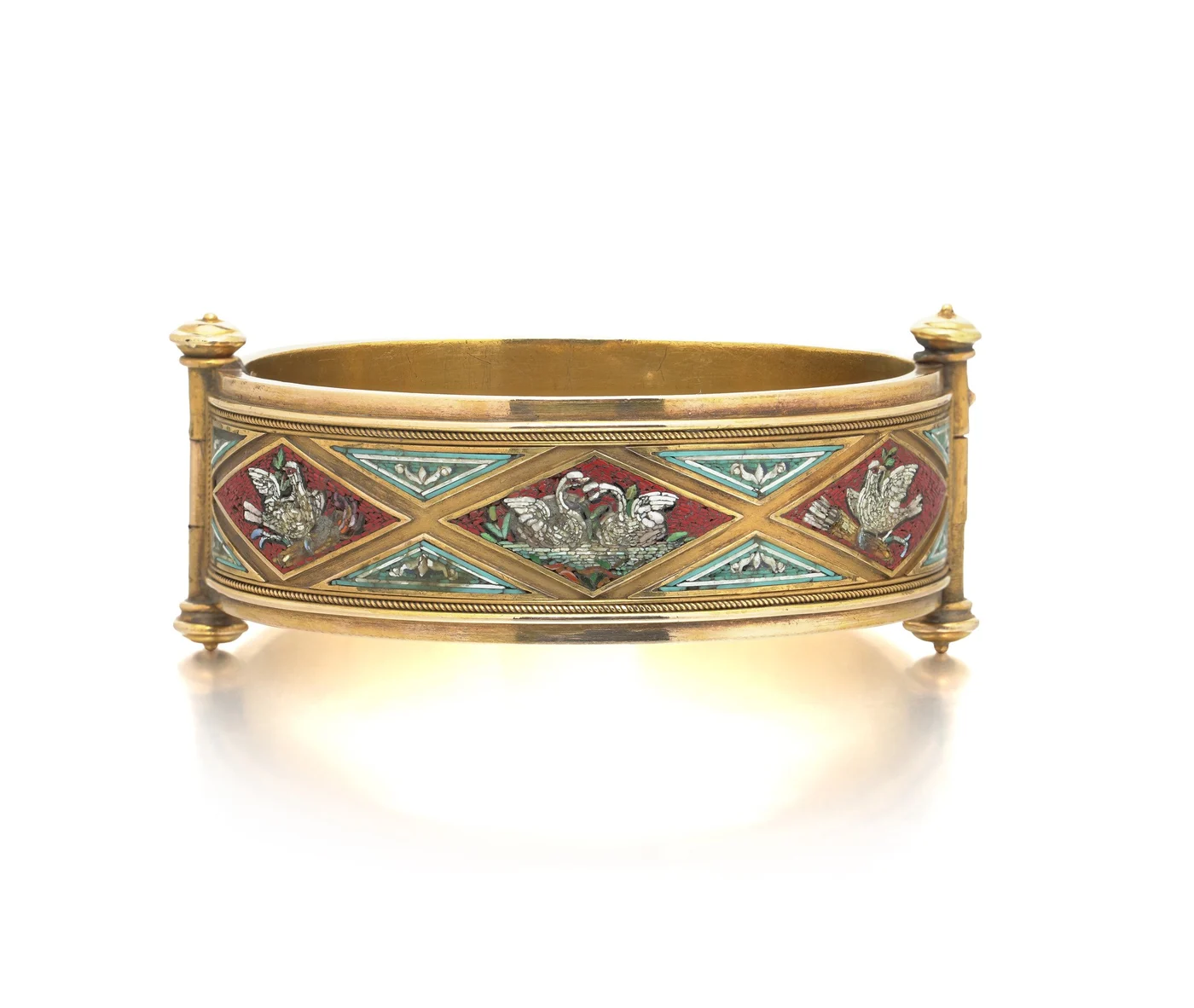
Rome's workshops set minute glass tesserae into gold for 19th century travellers, often with Etruscan Revival wirework.
Our micromosaic bangle shows swans and doves in a gold lattice between columnar hinges.
Chain bracelets: curb and rope
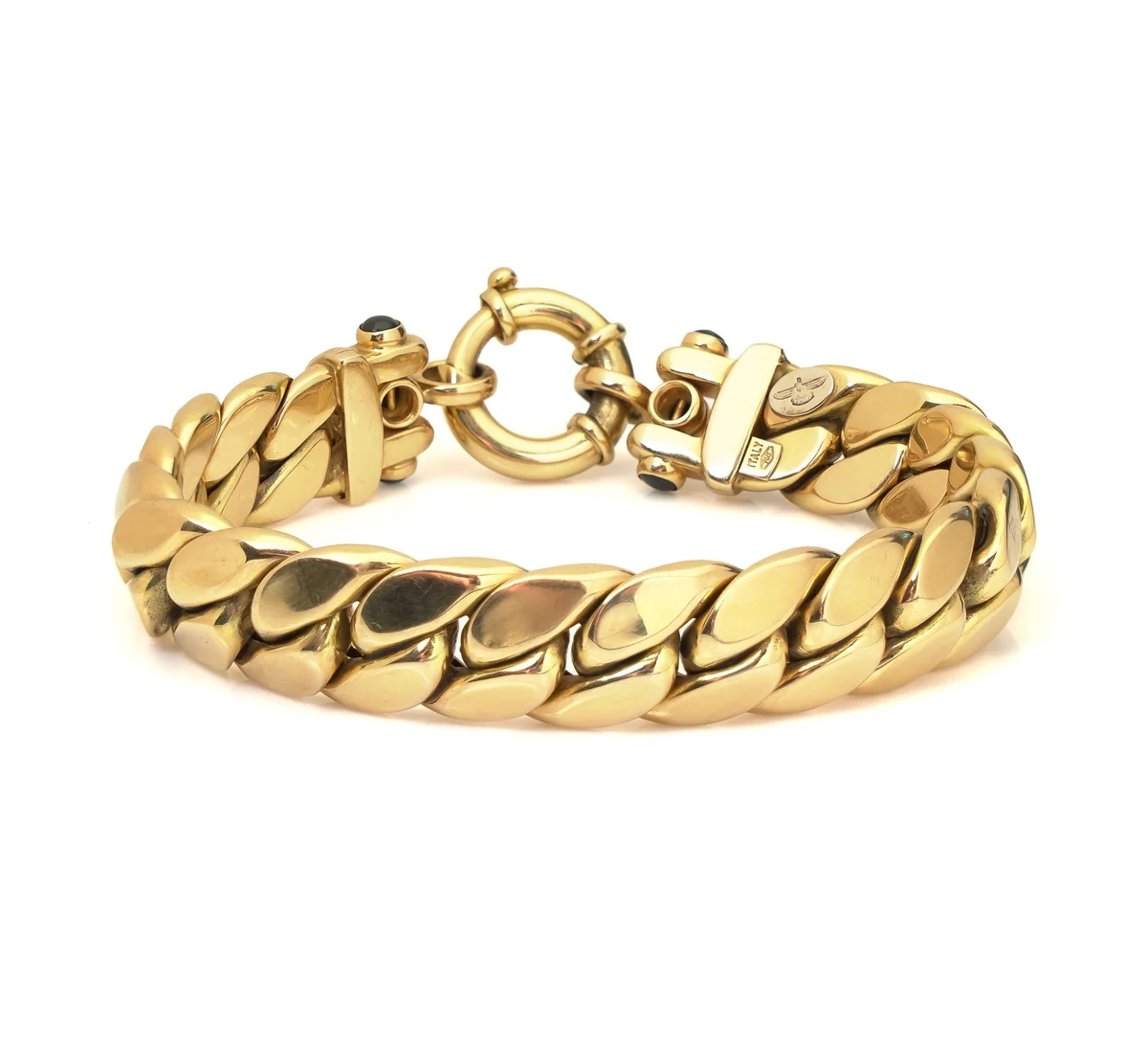
Heavy link bracelets in plain gold, curb, rope twist and belcher, are the other great family.
Our Italian 18KT curb bracelet has broad polished links.
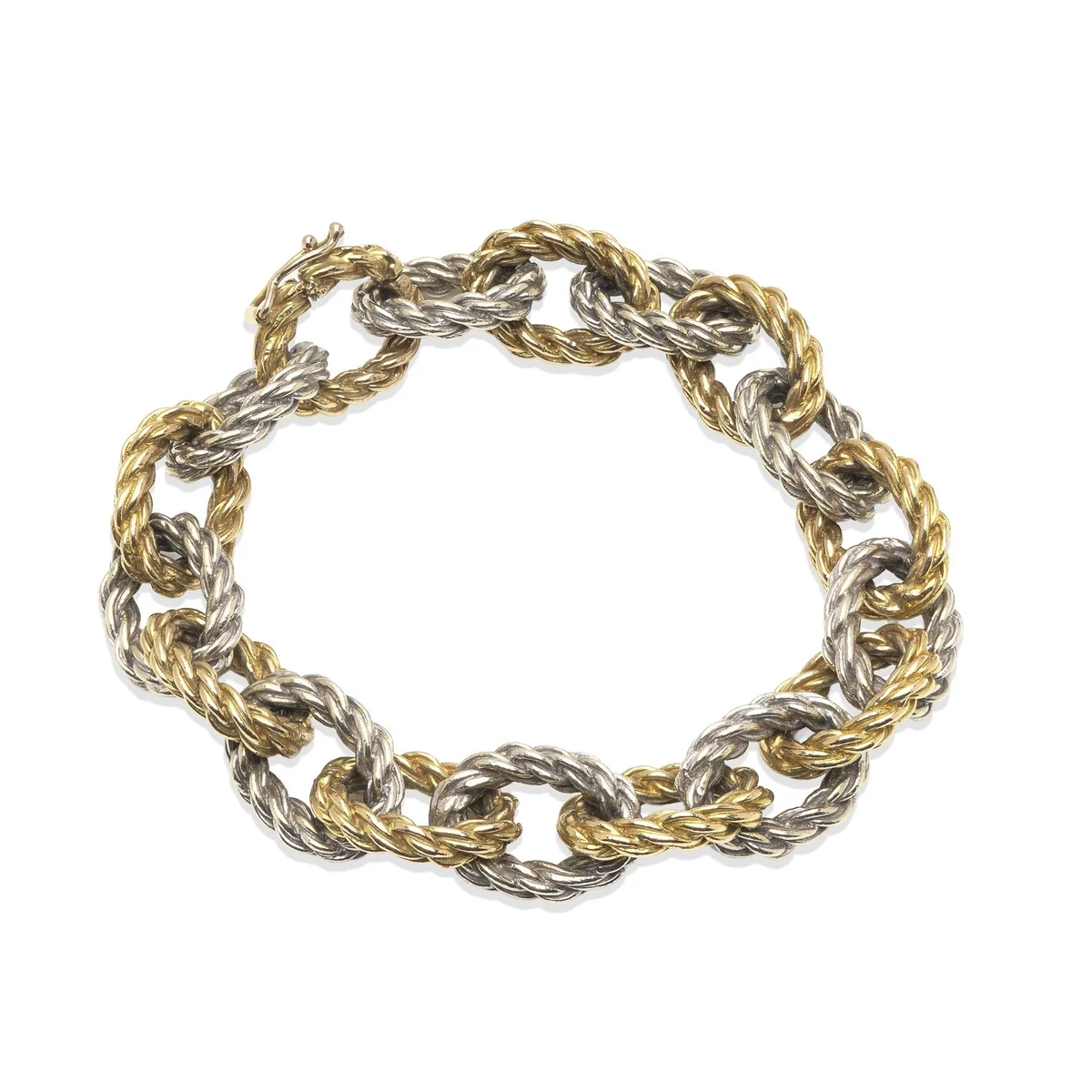
The 1970s favoured weight and texture over stones, often in 9KT yellow and white gold together, like our two-tone rope twist bracelet.
Designer bracelets have their own checks: see our Cartier Love bracelet guide and how to spot a fake Love bracelet.
Send us photos of your gold bracelet or bangle
Fit, care, buying and selling
- Fit: a slip-on bangle has to pass over the knuckles, so measure the widest part of the hand; a hinged bangle only has to fit the wrist.
- Safety chain: keep it fastened; it saves a bangle when a worn clasp opens.
- Clasp and hinge: check the box clasp tongue and the hinge pin once a year. A clasp that closes without a click needs a jeweller.
- Hollow gold: many Victorian bangles are hollow; dents are hard to remove, so do not knock them.
- Cleaning: warm soapy water and a soft brush for plain gold; no dips on enamel, pearls or foiled stones.
When buying, ask for the marks to be photographed, ask what has been repaired, and check the clasp and hinge in the photos. Our gold bracelets and gold bangles are listed with metal, marks, measurements and condition.
An antique bracelet is more than its gold: age, maker, stones and work all count. Send us a few photos of the piece and its marks and we will tell you what it is worth, free and with no obligation. Request a free valuation.
Do not take an antique bangle or bracelet to a scrap buyer before it has been seen: a gold-weight offer ignores everything that makes it antique.
- Sell antique jewellery and sell Victorian jewellery
- Dealer or auction? The trade-offs explained
Request a free valuation
- Marks first: a hallmark or carat stamp on the clasp, tongue or inside the bangle.
- GF, RGP, HGE and HGP are plating; pinchbeck contains no gold.
- The carat dates a British piece: 15 and 12 carat mean 1854 to 1932.
- Hinged Victorian bangles, snakes, lockets and micromosaic are the antique styles to know.
Questions we are asked
How can you tell if a gold bracelet is real?
Look for a hallmark or carat stamp on the clasp, the tongue or inside the bangle, check the wear points for base metal showing through, and watch for plating marks such as GF, RGP, HGE or HGP. A jeweller can test unmarked gold.
What do 375, 585 and 750 mean on a bracelet?
They are the gold content in parts per thousand: 375 is 9 carat, 585 is 14 carat and 750 is 18 carat. 916 is 22 carat.
Does real gold stick to a magnet?
No, but neither do brass, copper or silver, so a bracelet that ignores a magnet can still be plated. The magnet test only rules out steel or iron.
What is the difference between a bangle and a bracelet?
A bangle is rigid, solid or hinged; a bracelet is flexible, made of links or mesh.
What does 15ct gold tell you about a bangle?
That it was made between 1854 and 1932, the only years 15 carat was a British standard.
Is unmarked antique gold real?
Often, yes. Much Victorian and earlier jewellery was not hallmarked, or is marked only on the clasp. Have it tested rather than assume.
What is pinchbeck?
A copper and zinc alloy that imitates gold, invented in the early 18th century by Christopher Pinchbeck. It contains no gold.
What does R.G.P. or 1/20 12K mean?
Rolled gold plate or gold filled: a layer of carat gold bonded over a base metal core. It is not solid gold.
Want to know what your gold bracelet is worth?
Send photos of the piece and its marks. We buy antique and vintage jewellery directly, and the valuation is free.
- We buy directly
- Free valuation from photos
- Appointments in Mayfair and Braintree
- Insured postage or collection
New pieces reach our list first: join the Mozeris list.