How to Tell if a Ruby Is Real: Treatments, Origins and Antique Ruby Rings
A dealer's guide to ruby: the checks that separate ruby from garnet, spinel, glass and synthetics, what heating and glass filling mean, how Burmese, Mozambique and Thai stones differ, and how to date an antique ruby ring.
How can you tell if a ruby is real?
- Natural ruby shows inclusions under a 10x loupe, keeps sharp facet edges and usually glows red under UV.
- Gas bubbles, curved colour lines or a join at the girdle point to glass, a synthetic or a garnet-topped doublet.
- Most rubies are heated, which is accepted when disclosed; glass-filled rubies are a different, fragile product.
- Natural against synthetic, heated against unheated, and origin are settled by a laboratory report.
In this article
How to tell if a ruby is real
Ruby is red corundum, coloured by chromium, and at 9 on the Mohs scale it is harder than every natural gem except diamond (Wikipedia). Four things are sold as ruby, or mistaken for it: red garnet, red spinel, glass, and synthetic ruby. A fifth, the garnet-topped doublet, is common in antique rings. These checks sort most of them before a laboratory is needed.
- Look at the colour in daylight
Ruby is red to slightly purplish or pinkish red. Fine stones glow because ruby fluoresces red, even in daylight. Garnet tends to look darker and browner, and a dark stone that only shows red at the edges points to garnet or an iron-rich ruby.
- Turn it under a 10x loupe
Natural ruby almost always has inclusions: fine needles called silk, crystals, healed fractures. A large stone with no inclusions at all, or with round gas bubbles, needs testing.
- Check the edges of the facets
Glass is soft and its facet edges wear round and chipped. Ruby keeps sharp edges for centuries.
- Look at the stone side on
A garnet-topped doublet has a thin slice of garnet fused to a glass base. Side on you can see the join at the girdle, and the garnet crown is often a different colour from the pavilion (GIA).
- Try a UV torch
Most rubies glow red under longwave UV. Burmese stones glow strongly, iron-rich stones weakly. Garnet stays dark. A strong glow does not rule out a synthetic, which also fluoresces.
| What you see | What it points to |
|---|---|
| Round or flattened gas bubbles | Glass, a synthetic, or a glass-filled ruby |
| Curved lines of colour, like the grooves of a record | Verneuil synthetic ruby (Richard Hughes) |
| Straight, angular colour bands and fine needles | Natural corundum |
| A join line at the girdle, two colours top and bottom | Garnet-topped doublet |
| Blue and orange flashes in cracks as you tilt it | Lead glass filling (GIA) |
| Worn, rounded facet edges | Glass |
When to get a laboratory report
A loupe sorts glass and doublets. Separating natural from synthetic ruby, heated from unheated, and one origin from another needs a laboratory: GRS, GIA, SSEF, Gübelin and AGL all issue ruby reports that state treatment and, where it can be determined, origin.
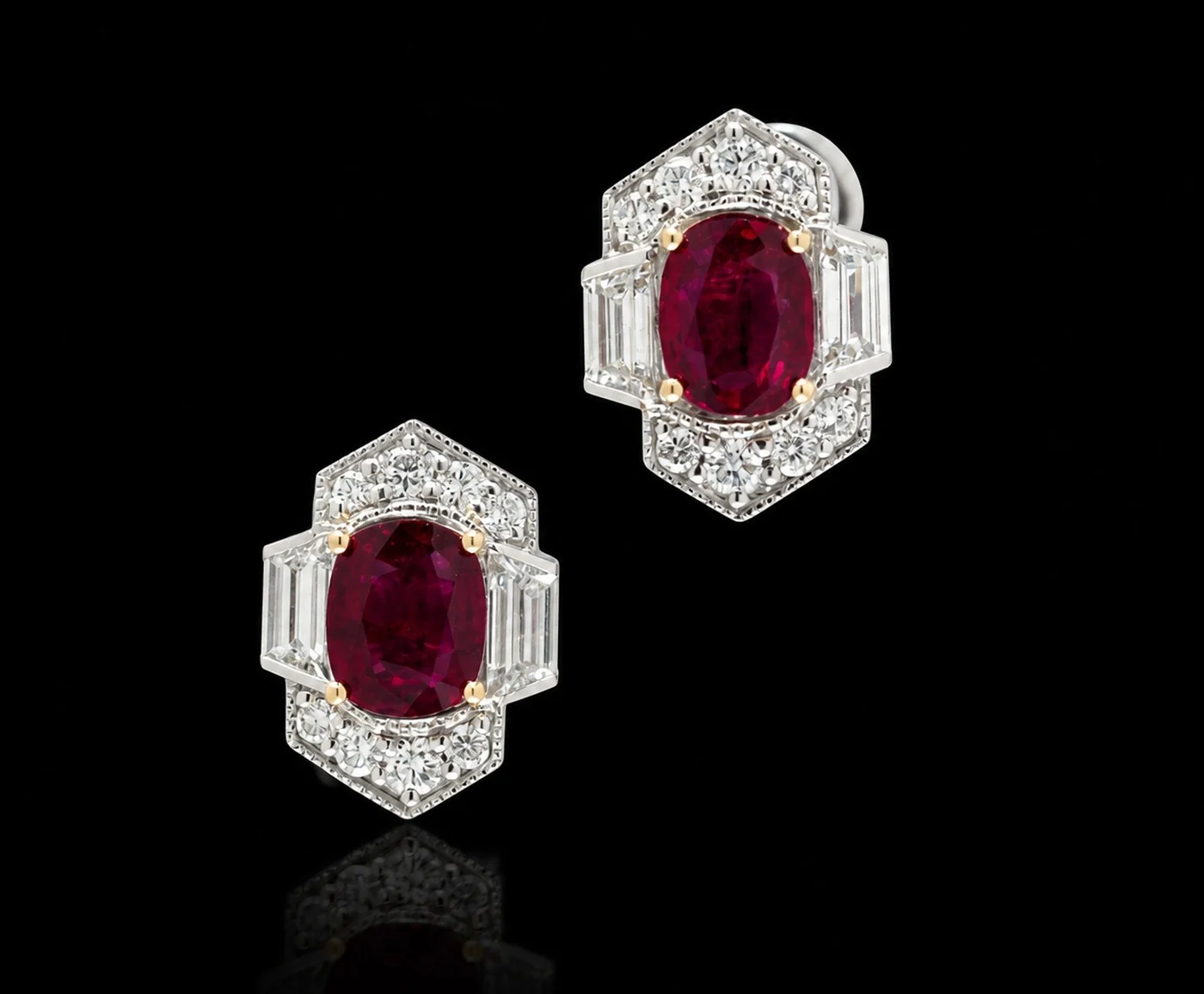
Our Burmese ruby earrings, pictured at the top of this page, come with two GRS reports, one for each stone, stating Burma origin, no heat and the colour grade Vivid Pigeon Blood.
Red spinel was sold as ruby for centuries. The Black Prince's Ruby in the Imperial State Crown is a spinel, and the old trade name for red spinel was balas ruby (Wikipedia). Spinel is a valuable gem in its own right: a stone that tests as spinel is not a fake.
Ruby or garnet?
Garnet is the stone most often taken for ruby in old jewellery. Ruby is harder (9 against about 7 to 7.5), and it is doubly refractive, so through a dichroscope it shows two shades of red, one more purplish and one more orange. Garnet shows one colour only. Garnet also tends to be darker, and it does not glow under UV.
Heated, unheated and glass-filled rubies
Most rubies on the market have been heated, and the trade treats heating as acceptable when it is disclosed. The International Gem Society advises buyers to assume a ruby is heated unless the seller states that it is not.
| Treatment | What it does | How it is detected | What it means |
|---|---|---|---|
| Heat | Improves colour and clarity by dissolving silk | Changed or melted inclusions under a microscope; clean stones need a laboratory | Accepted when disclosed |
| No heat | Nothing: the stone is as mined | Intact silk shows no high-temperature heating (GIA); a report confirms it | Rarer and more sought after |
| Lead glass filling | Fills cracks with high-lead glass so a poor stone looks transparent | Gas bubbles, low-relief cracks and blue or orange flashes at 10x (GIA) | Not accepted by the trade; a different product |
| Diffusion | Adds colour from outside the stone with heat and chemicals | Laboratory | Less accepted than plain heat |
Heated is still natural
A heated ruby is still a natural ruby, mined from the ground. Heating was used in the gem markets of Asia long before modern laboratories, and a disclosed heated ruby is the normal stone in fine jewellery.
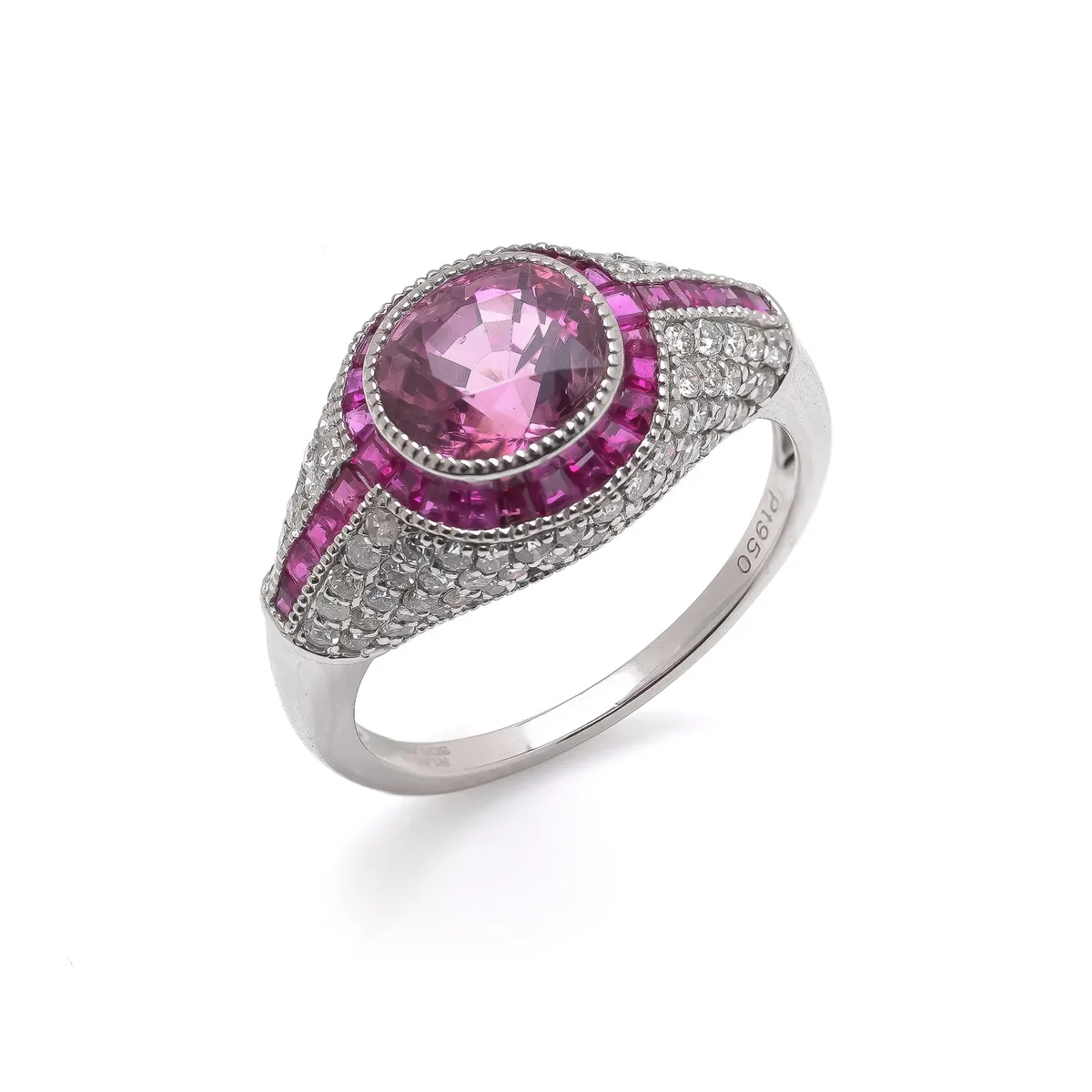
We state it on every listing, as on our Burma ruby cluster ring, whose centre stone is heated.
Glass-filled rubies
A lead glass filled ruby starts as heavily cracked corundum, and the glass is what holds the stone together. GIA found the filling easy to identify under a microscope: flattened gas bubbles in the cracks, cracks that almost disappear, and a blue and orange flash as the stone is tilted.
Glass filled rubies are fragile. JCK reported that their surfaces can turn white after contact with something as common as lemon juice, and a jeweller's torch damages the glass. Never clean one in acid or an ultrasonic, and tell any jeweller before a repair.
Burma vs Mozambique vs Thai rubies
Where a ruby was mined affects its colour, its fluorescence and how buyers see it. Origin is decided by a laboratory from the inclusions and trace elements; it cannot be read from colour alone.
| Burma (Myanmar) | Mozambique | Thailand and Cambodia | |
|---|---|---|---|
| Main source | Mogok, for centuries | Montepuez, found in 2009 | Border fields of Thailand and Cambodia |
| Colour | Red to slightly purplish red, red throughout the stone | From Burma-like to Thai-like | Darker, garnet-like red |
| Fluorescence | Strong red glow, even in daylight | Varies with iron content | Weak, held back by iron |
| Supply today | Small | The largest current source | Production now negligible |
| In antique jewellery | The main source for Victorian and Edwardian pieces | Only in jewellery set since 2009 | Found in later pieces |
Sources: International Gem Society; Wikipedia. Montepuez produced about 10 million carats in 2022.
Burmese ruby and pigeon blood
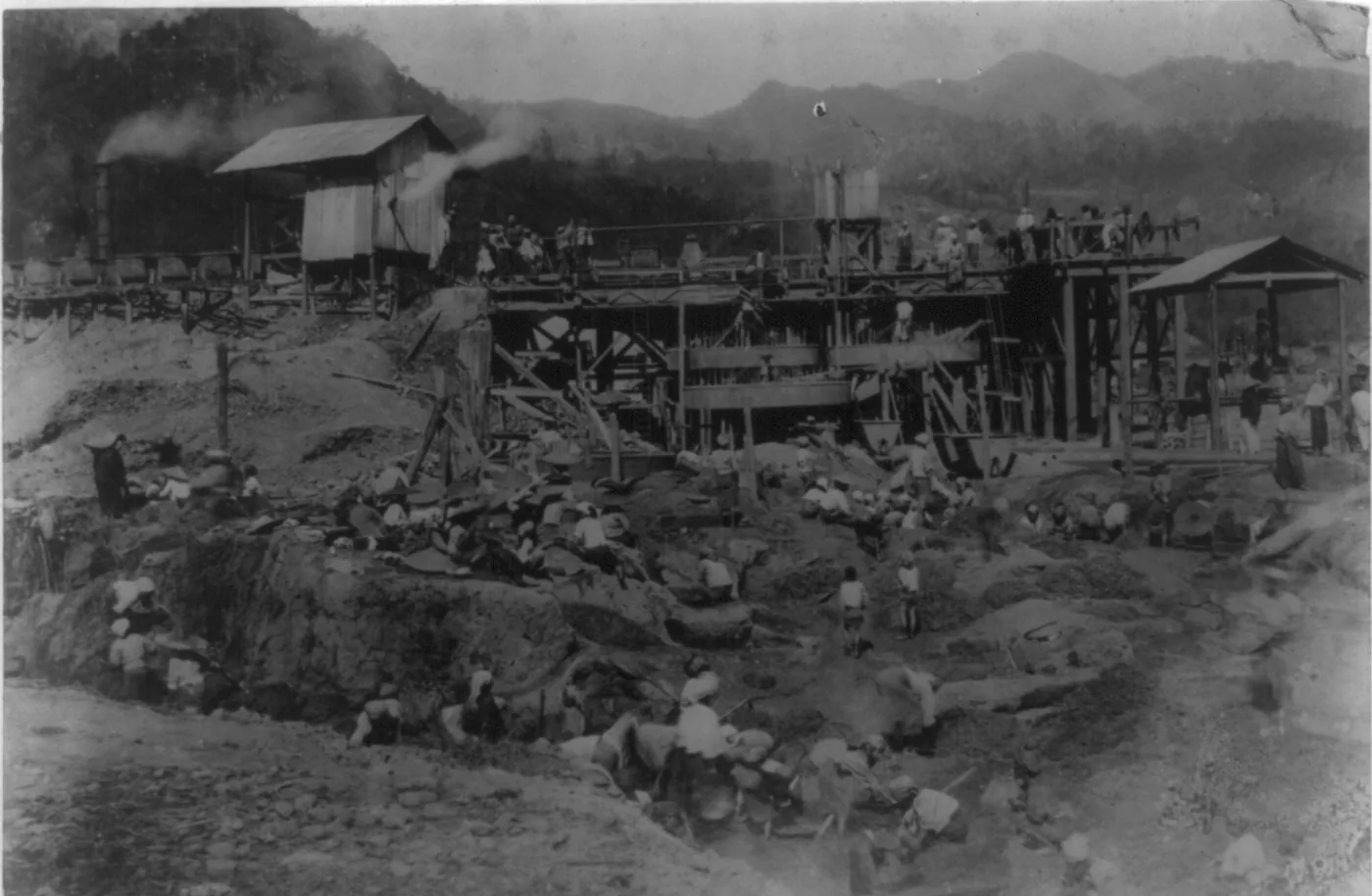
Mogok in upper Burma was the world's main ruby source for centuries, and Burmese stones are the ones most associated with the colour called pigeon blood.
GIA describes pigeon blood as the red to slightly purplish red of rubies with a soft, glowing red fluorescence. Today it is a colour grade on laboratory reports, GRS among them, and it describes colour, not where a stone was mined.
Mozambique ruby
Rubies were found near Montepuez in northern Mozambique in 2009, and the deposit is now the largest source of new rubies. The best match fine Burmese colour; others are darker and closer to Thai stones. They are sold both heated and unheated (IGS).
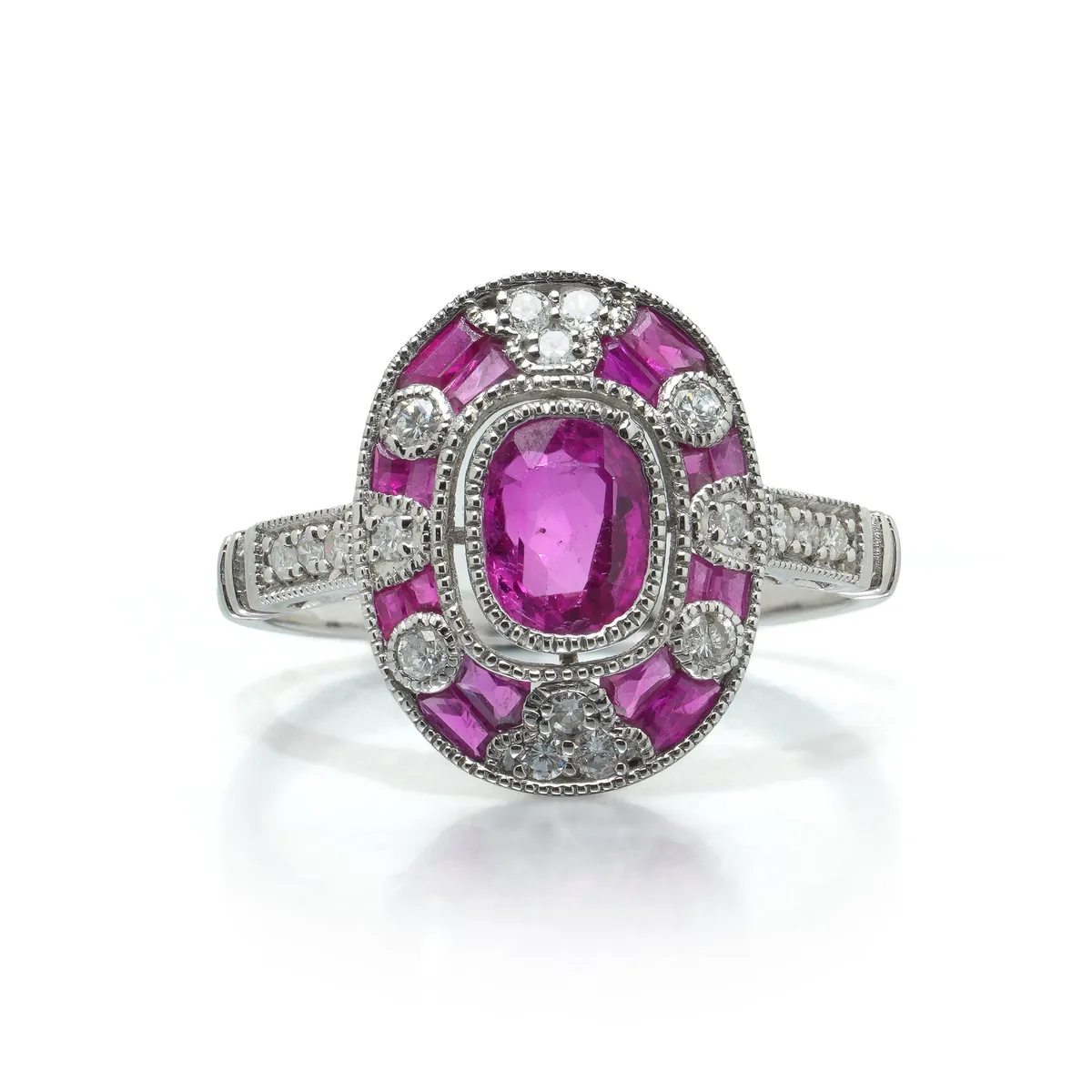
A Mozambique ruby in a ring that looks antique tells you the ring was made or reset after 2009, like our Art Deco style platinum ring, a modern ring in the 1920s manner.
Thai and Cambodian ruby
Rubies from the border fields of Thailand and Cambodia carry more iron. Iron dampens the red glow, so the stones look darker and more garnet-like, and only the facets that reflect light inside the stone show a rich red (IGS). Thailand is also a major centre for cutting and heating ruby, so a stone traded in Bangkok may have been mined elsewhere.
Send us photos of your ruby jewellery
Synthetic rubies, and why they turn up in antique rings
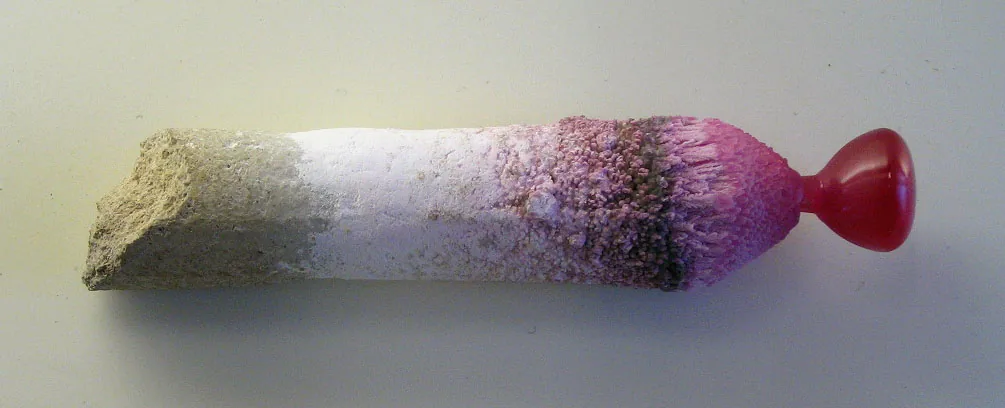

Made by the kilo since 1907
Auguste Verneuil's flame fusion process, made public in the early 1900s, grows ruby by melting powdered alumina with chromium and letting it build up drop by drop into a pear-shaped boule. By 1907 it was producing about 1,000 kg of synthetic ruby a year (Wikipedia).
Synthetic ruby has the same chemistry and hardness as natural ruby, so hardness, scratch and fluorescence tests do not separate them.
This is why an Edwardian or 1920s ring can hold a synthetic ruby set when it was new. Jewellers used them openly, and many such rings have been passed down as natural. Under a loupe, Verneuil stones often show curved growth lines and round gas bubbles (Richard Hughes). Later flux-grown and hydrothermal synthetics can imitate natural inclusions closely and need a laboratory.
Laboratory-grown ruby is also sold new, as lab-grown or lab-created ruby. It is real corundum, made in a factory, and is priced as a manufactured stone.
Antique ruby rings, era by era
The setting usually dates a ruby ring before the stone does. Browse our ruby rings and ruby cluster rings to see these styles together.
Georgian, 1714 to 1837: closed backs and foil
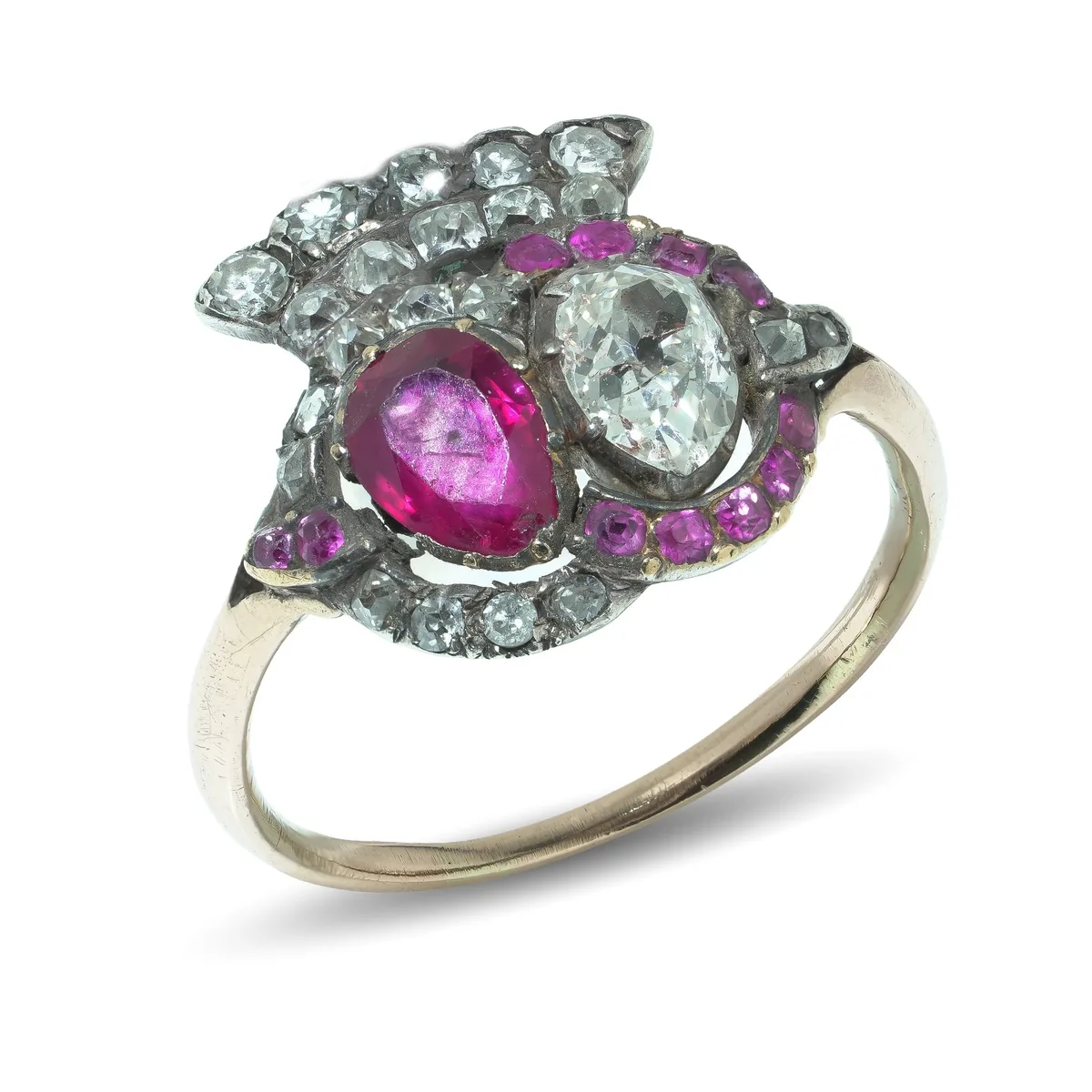
Stones in closed settings, often with a coloured foil behind to brighten them by candlelight (International Gem Society). Silver-topped gold for the diamonds, hand-cut old stones of slightly different sizes.
Our Georgian cluster ring of about the 1780s pairs an oval ruby with a pear-shaped old cut diamond in an asymmetric cluster of smaller rubies and diamonds. See Georgian jewellery.
Victorian, 1837 to 1901: half hoops and graduated rows
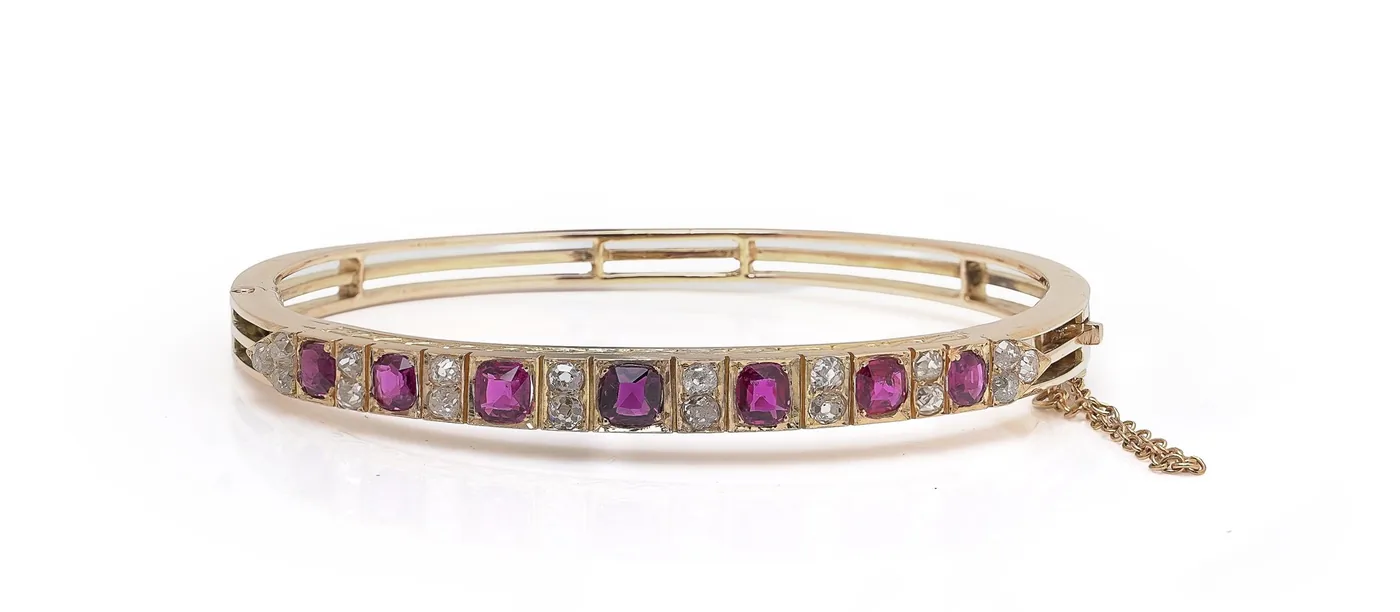
Rubies set in a row across the finger, graduating to a larger centre stone, often alternating with diamonds, on a carved gallery. Burma was the main source of the period, and the stones are cushion or oval cut by hand.
The same graduated row runs across our Victorian Burma ruby bangle of about 1880. More in Victorian ruby jewellery and Victorian jewellery.
Edwardian, 1901 to 1910: clusters and old European cuts
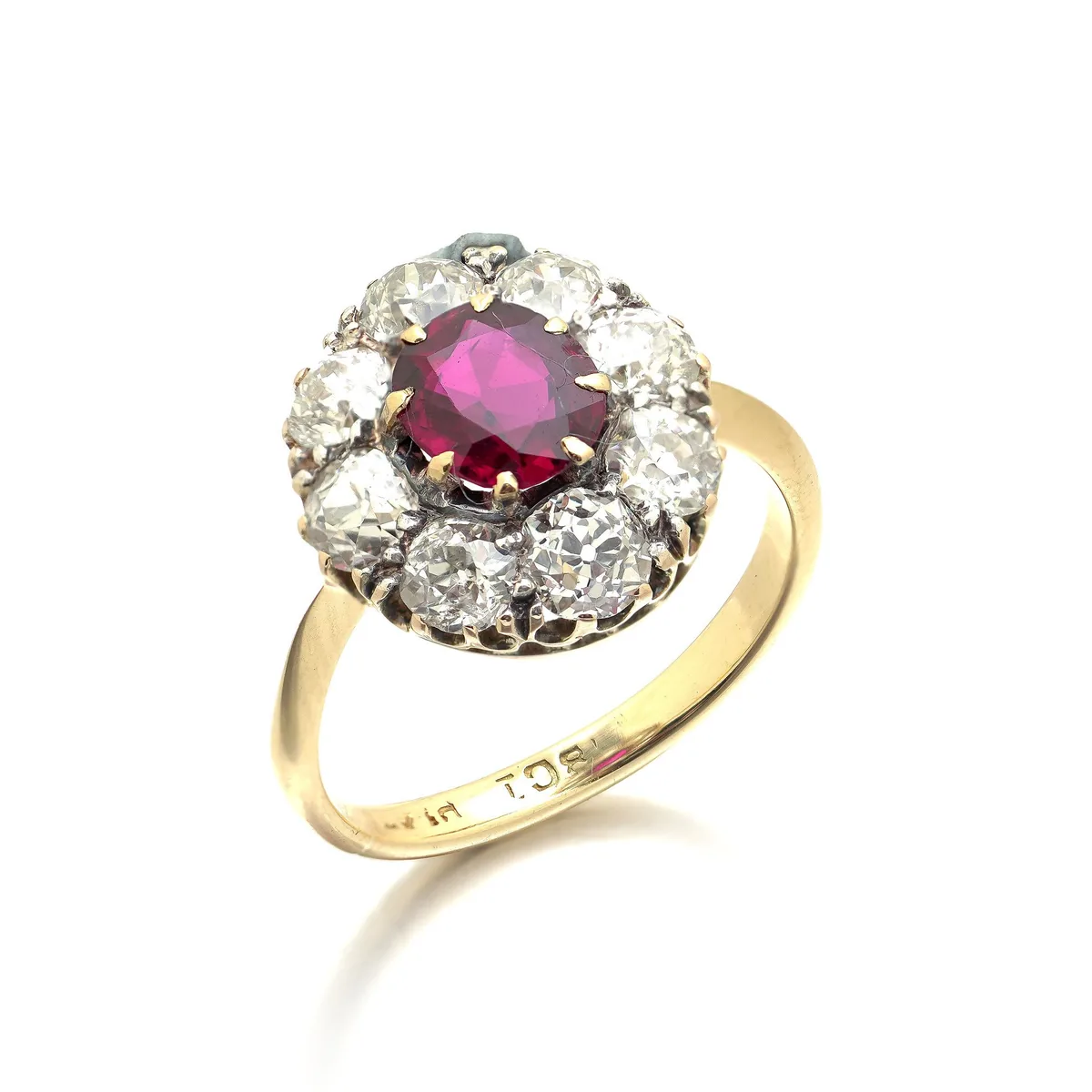
Lighter settings, the daisy or flower cluster, and old European cut diamonds with small tables and high crowns around a single ruby. Platinum begins to replace silver for the diamonds.
Our Edwardian cluster ring sets a 1.00 ct ruby inside eight old European cut diamonds. See Edwardian jewellery.
The carved half hoop: an English classic
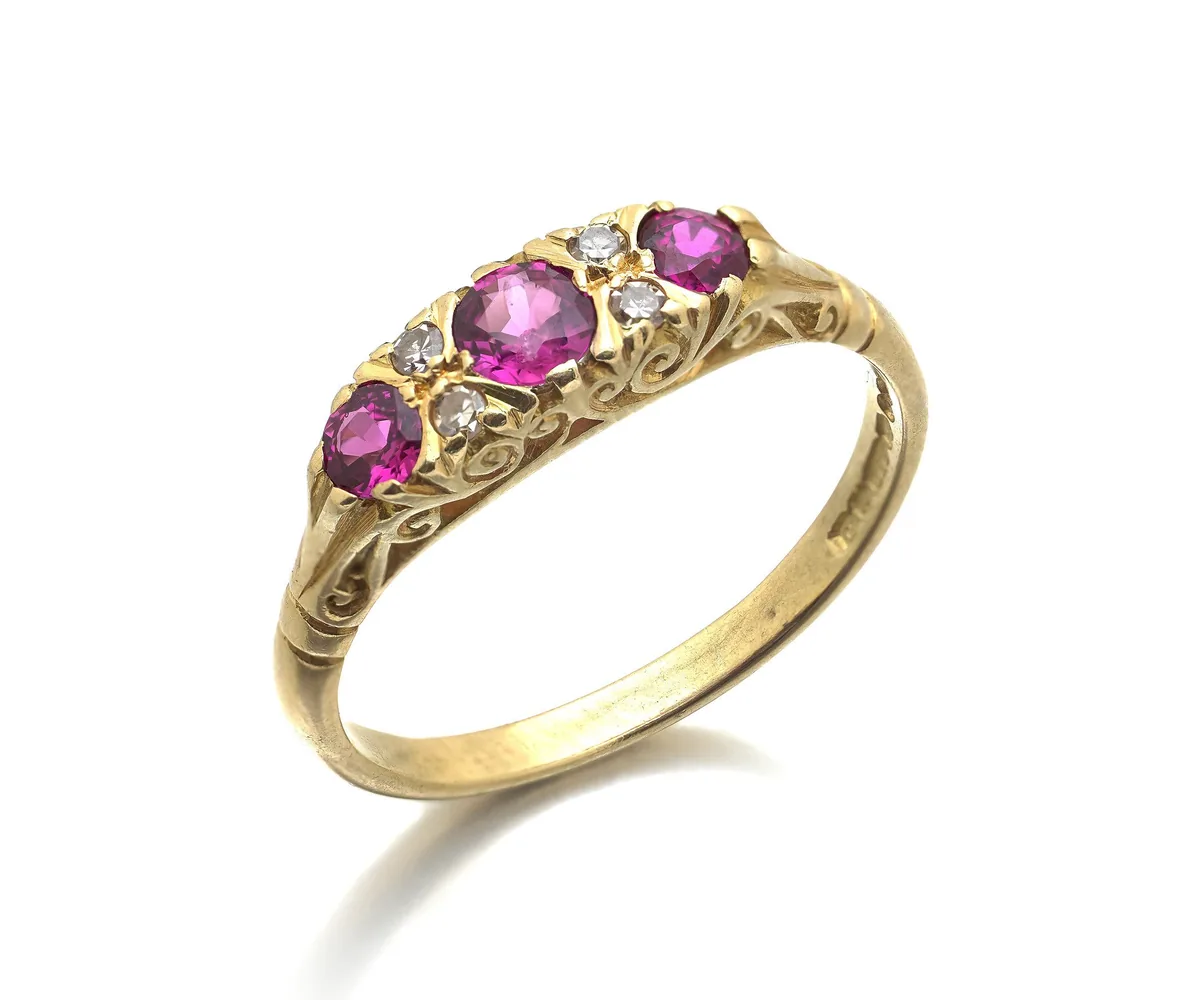
Three or five rubies with pairs of tiny diamonds between, raised on a gallery chased with scrolls. English jewellers made this ring from the late Victorian period well into the 20th century, so read the hallmark: it gives the year.
Our carved half hoop is hallmarked inside the shank. See hallmarks and makers' marks.
Star rubies
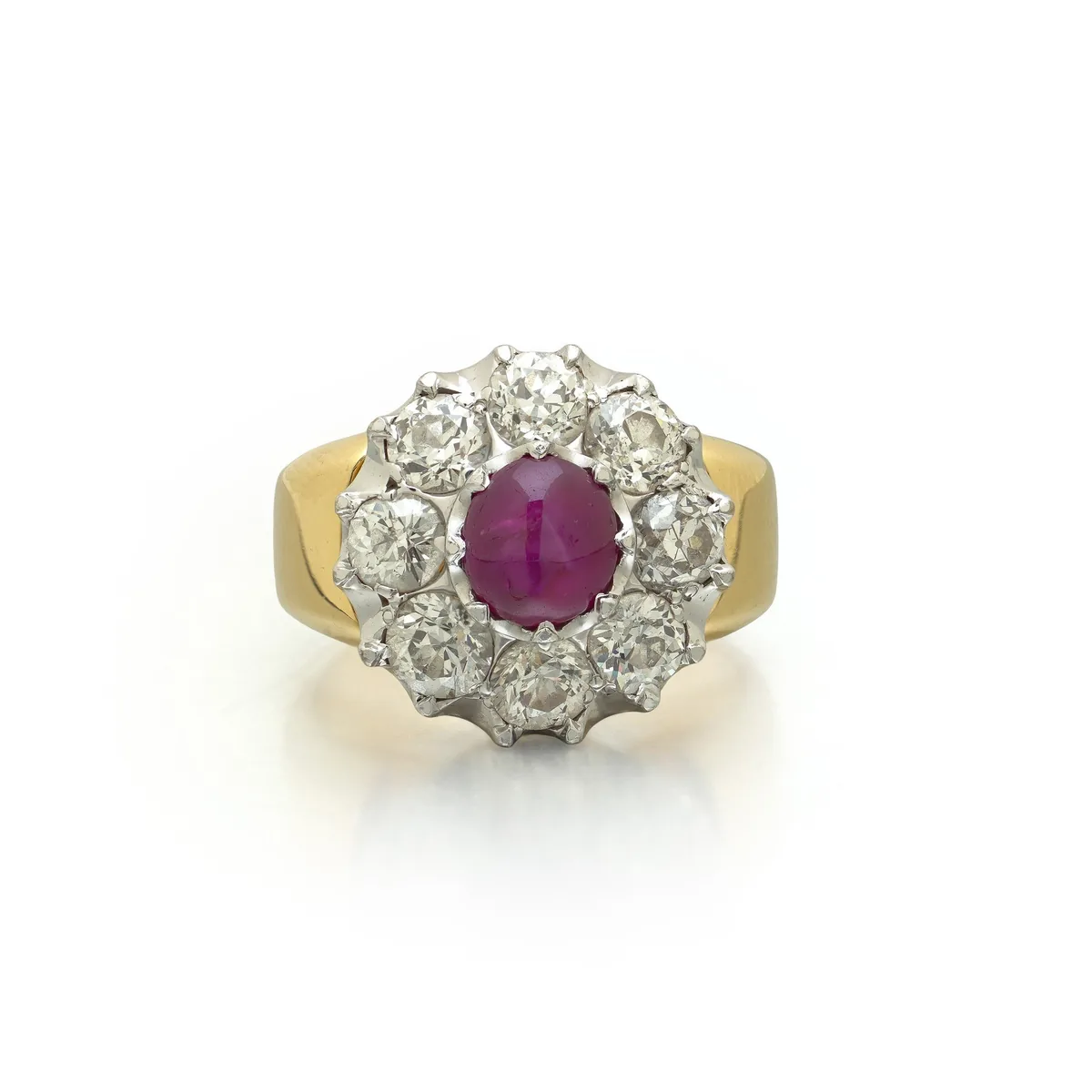
A star ruby is cut as a high cabochon so that fine needles of rutile inside gather the light into a six-rayed star that moves as the stone turns (Wikipedia). The silk that makes the star is the same silk that heating dissolves, so star rubies are often unheated.
Our star ruby cluster ring sets one inside eight diamonds.
Five checks on an antique ruby ring
- Read the marks: a hallmark dates the gold; many older rings carry none, which is normal.
- Check the cut: hand-cut cushions and ovals that differ slightly fit the period; perfectly matched calibrated stones are usually later.
- Look at the back: a closed back may hide foil or a doublet. Do not open it.
- Look for replacements: one stone brighter or a different red from the rest has often been replaced.
- Look for synthetics: a flawless, very bright ruby in a 1900 to 1930 ring is worth a laboratory test.
Care, buying and selling
- Cleaning: warm soapy water and a soft brush. Clean included or fractured stones by hand only (IGS), and never put a glass-filled ruby in acid or an ultrasonic.
- Foil backs: never wet a closed-back Georgian setting: water ruins the foil.
- Repairs: tell the jeweller whether the stone is heated, filled or unknown before any heat is used.
When buying, ask for the treatment in writing, and for a laboratory report on any important stone. Every ruby on our ruby jewellery pages is described with its period, metal, treatment where known, and condition.
Every ruby is different. Send us a few photos of the front, the side and the back and we will tell you what yours is worth, free and with no obligation. Request a free valuation.
Do not sell an antique ruby ring by gold weight: the stones, the age and the work count for more. Keep any laboratory report or box with it, and do not clean or polish it before it is seen.
- Sell antique jewellery and sell Victorian jewellery
- Sell Georgian jewellery and sell Edwardian jewellery
- Dealer or auction? The trade-offs explained
Request a free valuation
- Ruby is red corundum, hardness 9; garnet, spinel, glass, doublets and synthetics are the usual look-alikes.
- A loupe catches glass and doublets; a laboratory settles synthetic, heat and origin.
- Heated rubies are natural and accepted when disclosed; glass-filled rubies are not fine rubies.
- Burma is the classic source, Mozambique the main new one, Thai stones darker; the setting dates the ring.
Questions we are asked
How can you tell if a ruby is real?
Look for natural inclusions under a 10x loupe, sharp facet edges and a red glow under UV light. Round gas bubbles, curved colour lines or a join at the girdle point to glass, a synthetic or a doublet. Only a laboratory can separate natural from synthetic ruby with certainty.
What is the difference between a ruby and a garnet?
Ruby is corundum, hardness 9, doubly refractive and shows two shades of red through a dichroscope. Garnet is softer, shows one colour only, tends to be darker and browner, and does not glow under UV light.
Is a heated ruby real?
Yes. A heated ruby is a natural ruby whose colour and clarity were improved by heat. Most rubies on the market are heated, and the trade accepts it when it is disclosed. Unheated rubies are rarer.
What is a glass-filled ruby?
Heavily cracked ruby whose fractures are filled with lead glass so it looks transparent. It shows gas bubbles and blue or orange flashes under magnification, is damaged by acids and heat, and is not treated by the trade as a fine ruby.
What does pigeon blood ruby mean?
A colour grade for the finest rubies: a vivid red to slightly purplish red with a soft red glow from fluorescence. It is most associated with Burma, but it describes colour, not origin.
Are Burmese rubies better than Mozambique rubies?
Burma has the longest history and the strongest fluorescence. The finest Mozambique rubies, found since 2009, can match Burmese colour. Quality depends on the individual stone, and origin needs a laboratory report.
Can an antique ring have a synthetic ruby?
Yes. Flame fusion synthetic ruby was made in quantity from the early 1900s, and many Edwardian and 1920s rings were set with it when new. Curved growth lines and gas bubbles under a loupe are the usual signs.
What is a star ruby?
A ruby cut as a high cabochon so that fine rutile needles inside reflect a six-rayed star across the dome.
Want to know what your ruby jewellery is worth?
Send photos of the piece, its back and any report. We buy antique and vintage jewellery directly, and the valuation is free.
- We buy directly
- Free valuation from photos
- Appointments in Mayfair and Braintree
- Insured postage or collection
New pieces reach our list first: join the Mozeris list.