How to Tell if an Emerald Is Real: Oil, Origins and Antique Emerald Jewellery
A dealer's guide to emerald: the checks that separate it from glass, assembled stones and synthetics, what oiling means, how Colombian and Zambian stones differ, and how to date an antique emerald piece.
How can you tell if an emerald is real?
- Natural emerald is almost always included: the jardin is normal, round bubbles are not.
- Over 90% of emeralds are oiled; colourless oil is normal, coloured oil or epoxy must be disclosed.
- Colombia (Muzo, Coscuez, Chivor) and Zambia are the main sources; origin needs a report.
- Never clean emerald in an ultrasonic or steam cleaner.
In this article
How to tell if an emerald is real
Emerald is green beryl, coloured by chromium, vanadium or both; iron pushes the colour bluer (IGS). It is 7.5 to 8 on the Mohs scale, but almost every emerald is included, and those inclusions make it more fragile than its hardness suggests. That is the first clue to a real one.
- Expect a garden
Natural emerald nearly always shows inclusions: wispy veils, fractures, crystals, the pattern the trade calls the jardin, French for garden. A large, perfectly clean green stone needs testing.
- Look for bubbles
Round gas bubbles and swirls belong to glass. Emerald inclusions are angular, feathery or three-phase pockets, never perfect spheres.
- Check the edges
Glass wears round and chips at the facet edges. Emerald can chip too, because it is brittle, but its edges stay crisp where unworn.
- Look at it side on
An assembled stone, a doublet or triplet, is glued in layers. The join shows at the girdle as a line or a change in colour.
- Try a UV torch
Natural emerald is usually inert or weakly red under UV. Oiled stones can show a yellow-green glow from the filler (IGS). A clue, not a proof.
| Look-alike | How it gives itself away |
|---|---|
| Green glass (paste) | Gas bubbles, swirl lines, worn facet edges, too clean |
| Assembled stone (doublet or triplet) | A join line at the girdle; colour sits in a layer |
| Synthetic emerald (hydrothermal or flux) | Very clean, even colour; needs a laboratory |
| Green YAG, cubic zirconia, synthetic spinel | Too bright, too clean; different refractive index |
| "African emerald" and similar names | Often green fluorite or another stone sold under a misleading name (IGS) |
Synthetic emeralds, grown by the hydrothermal and flux methods, are made by companies such as Chatham and Gilson. They are real beryl made in a factory, and a laboratory report is the reliable way to separate them from mined stones.
Oiled emeralds: what treatment means
More than 90% of emeralds in the trade are treated (IGS). The standard treatment is oiling: the stone is soaked, often under vacuum, in a colourless oil or resin that fills the surface-reaching cracks so they show less. Cedar oil is the traditional filler; the cheapest stones may be filled with epoxy resins (Wikipedia).
| Treatment | What it is | What it means |
|---|---|---|
| None | No filler | Rare; confirmed only by a report |
| Minor oil | A little colourless oil in a few fissures | The normal state of a fine emerald |
| Moderate to significant | More filler, more fissures | Less durable; needs more care |
| Coloured oil or epoxy | Green-tinted filler or hard resin | Non-standard; must be disclosed |
Reading a report
A laboratory report names the treatment and grades how much filler is in the stone. In the United States the FTC requires the treatment to be disclosed (Wikipedia).
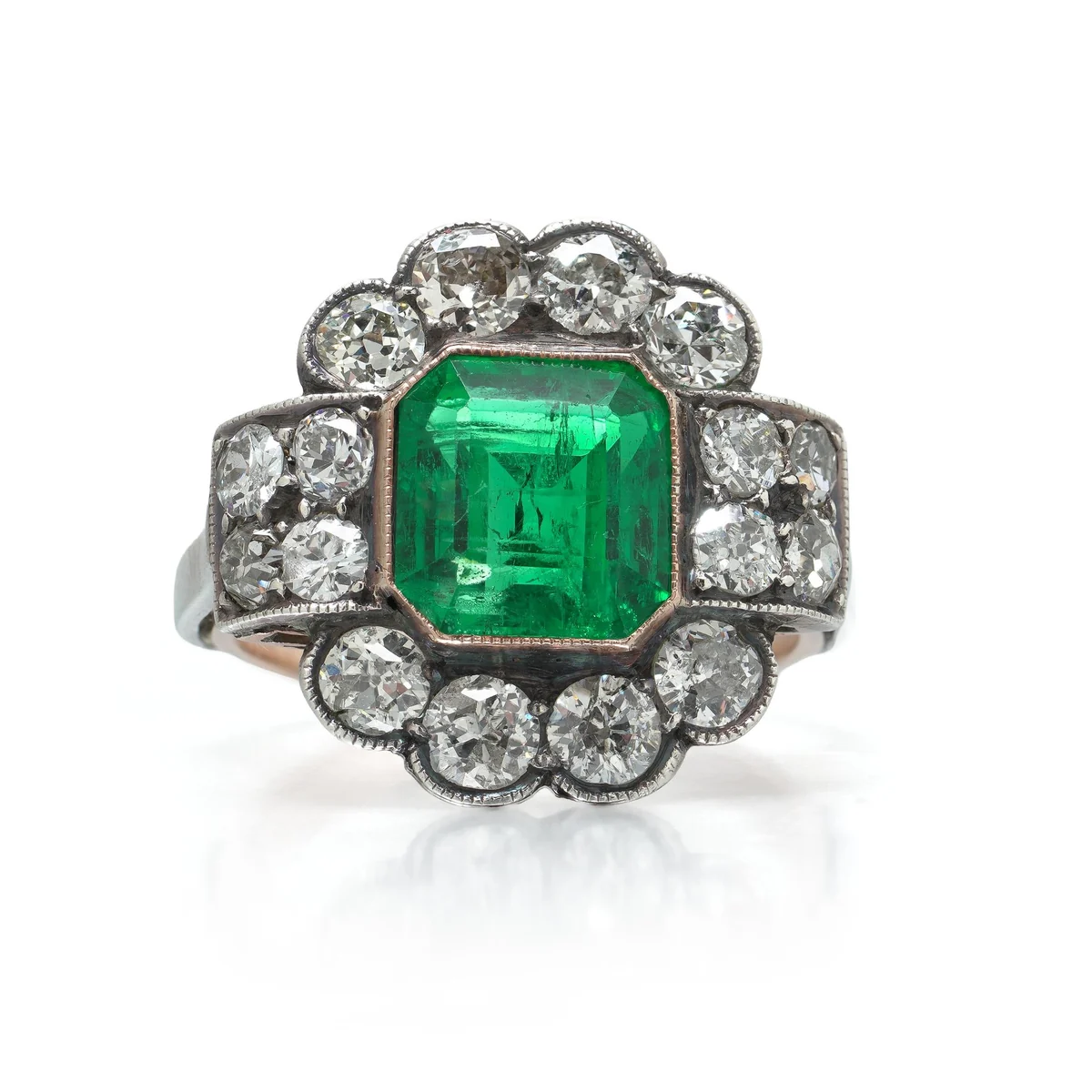
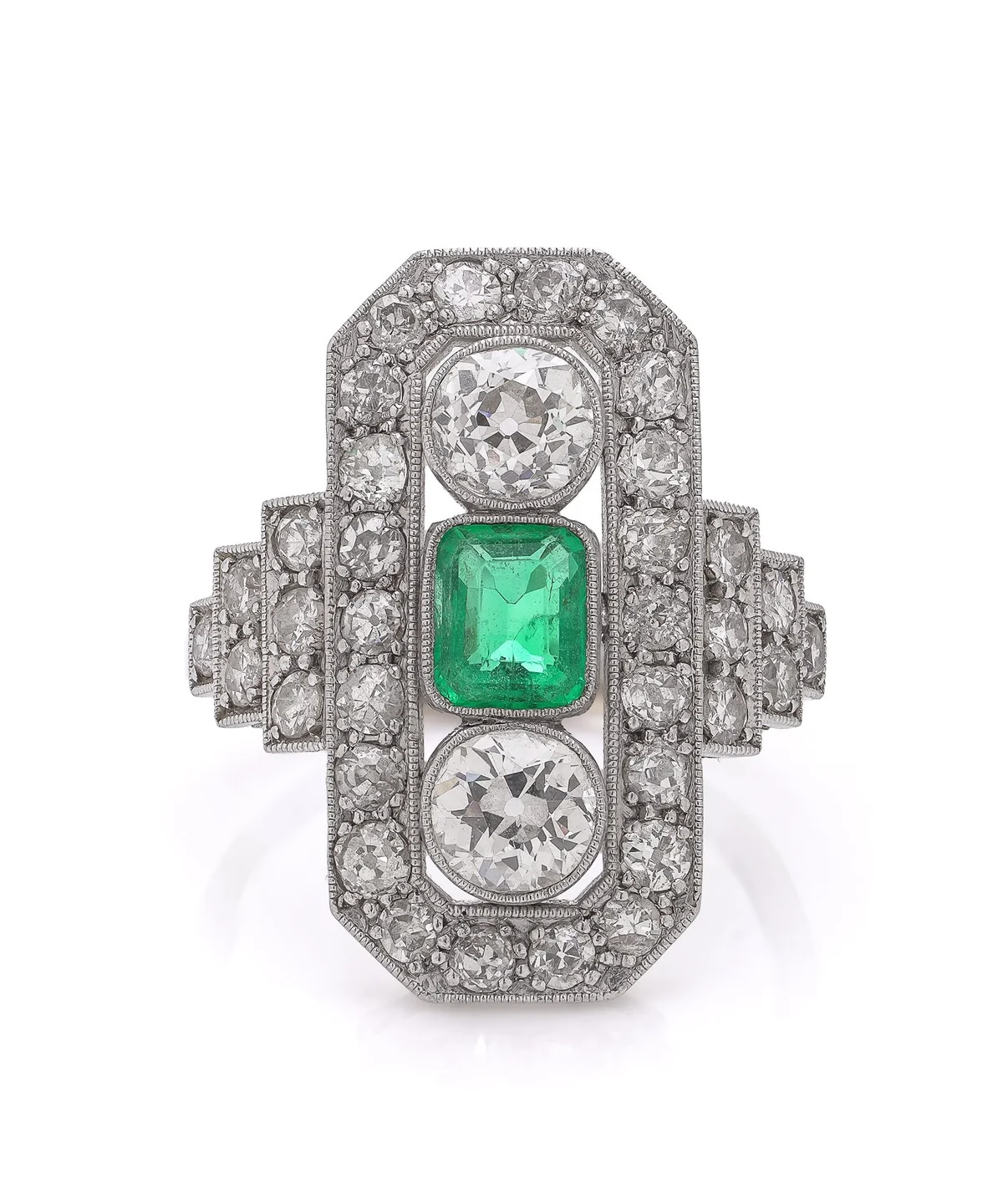
Our Art Deco emerald ring of about 1920 holds a Colombian emerald with minor oil, the usual condition of an antique stone.
Oil can dry out or wash out over the years, and the fissures show again. Never put an emerald in an ultrasonic or steam cleaner, or near boiling water: it can crack, or at least need re-oiling (IGS).
Colombian vs Zambian emeralds, and other sources
Colombia has long been the largest producer, with its main mines at Muzo, Coscuez and Chivor. Zambia is second, with the Kagem mines (Wikipedia). Origin is decided by a laboratory from the inclusions and chemistry.
| Origin | Typical look | Notes |
|---|---|---|
| Colombia, Muzo | Warm, slightly yellowish green | The classic source; rare trapiche crystals |
| Colombia, Chivor | Bluish green | One of Colombia's three main mines |
| Zambia | Bluish green, often darker | Iron-rich, strong colour zoning |
| Brazil | Varied | Recent finds rival fine Colombian stones |
| Ethiopia | Varied | Producing since 2016, some stones need no oil |
Sources: International Gem Society; Wikipedia.
Colombian emerald
Colombian stones are the benchmark for emerald colour. Trapiche emeralds, which show six dark spokes radiating from the centre like a wheel, come from Colombia and are rare (Wikipedia).
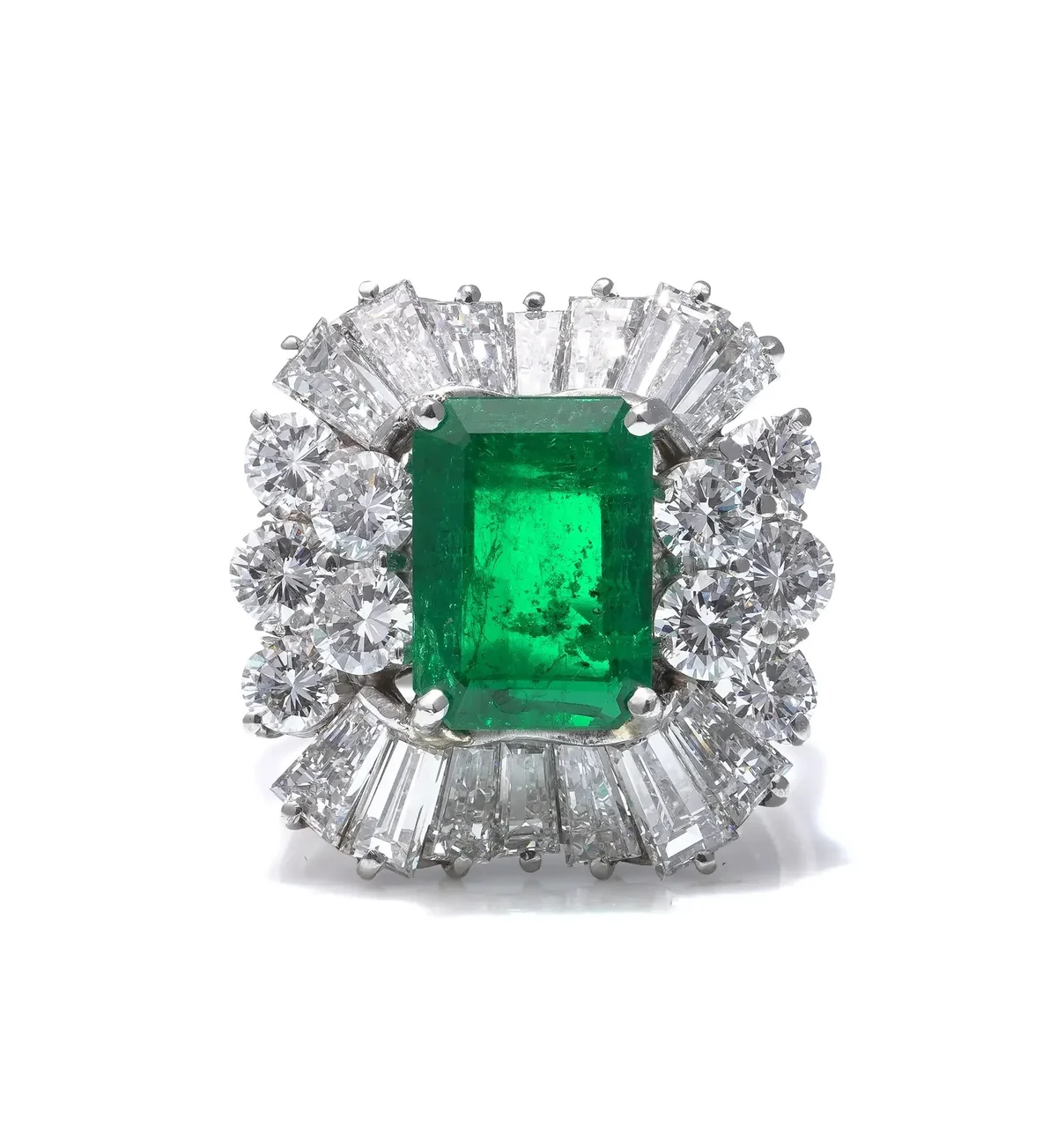
Our Colombian emerald cluster ring comes with an AGL report stating Colombian origin.
Two famous emeralds show the range: the Duke of Devonshire emerald, an uncut Colombian crystal of 1,383.93 ct in the Natural History Museum, London, and the carved Mogul Mughal emerald, 217.80 ct, in the Museum of Islamic Art, Doha (Wikipedia).
Send us photos of your emerald jewellery
Antique emerald jewellery, era by era
The setting usually dates an emerald piece before the stone does. Browse our emerald rings, emerald cluster rings and emerald jewellery to compare them.
Georgian, 1714 to 1837: festoons and closed settings
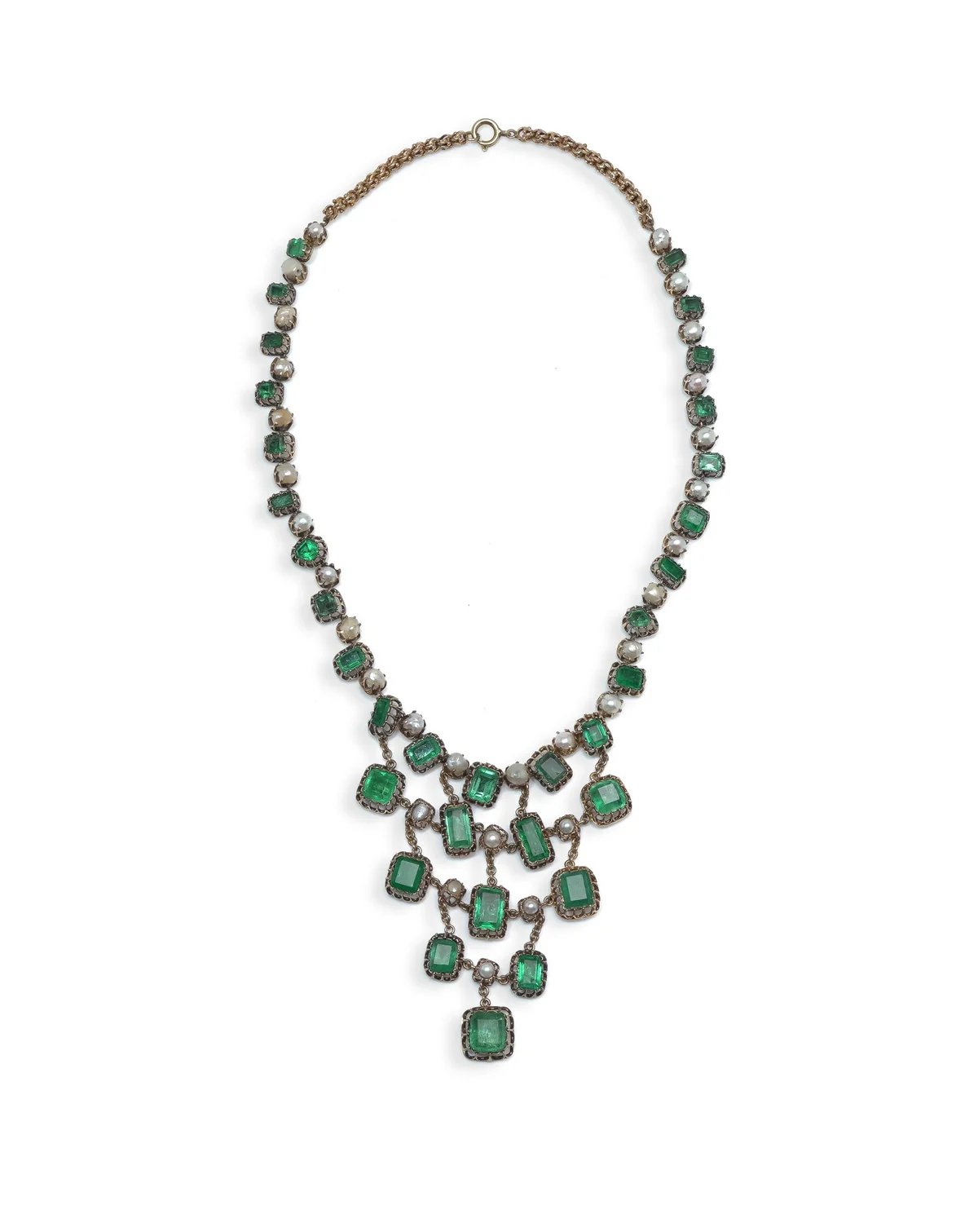
Emeralds in gold collets, often closed at the back, in necklaces that hang in festoons with drops and pearls. Gold content varies more than in later hallmarked pieces.
Our Georgian emerald and pearl necklace carries 33 natural emeralds in a graduated festoon. See Georgian jewellery.
Victorian, 1837 to 1901: silver-topped gold
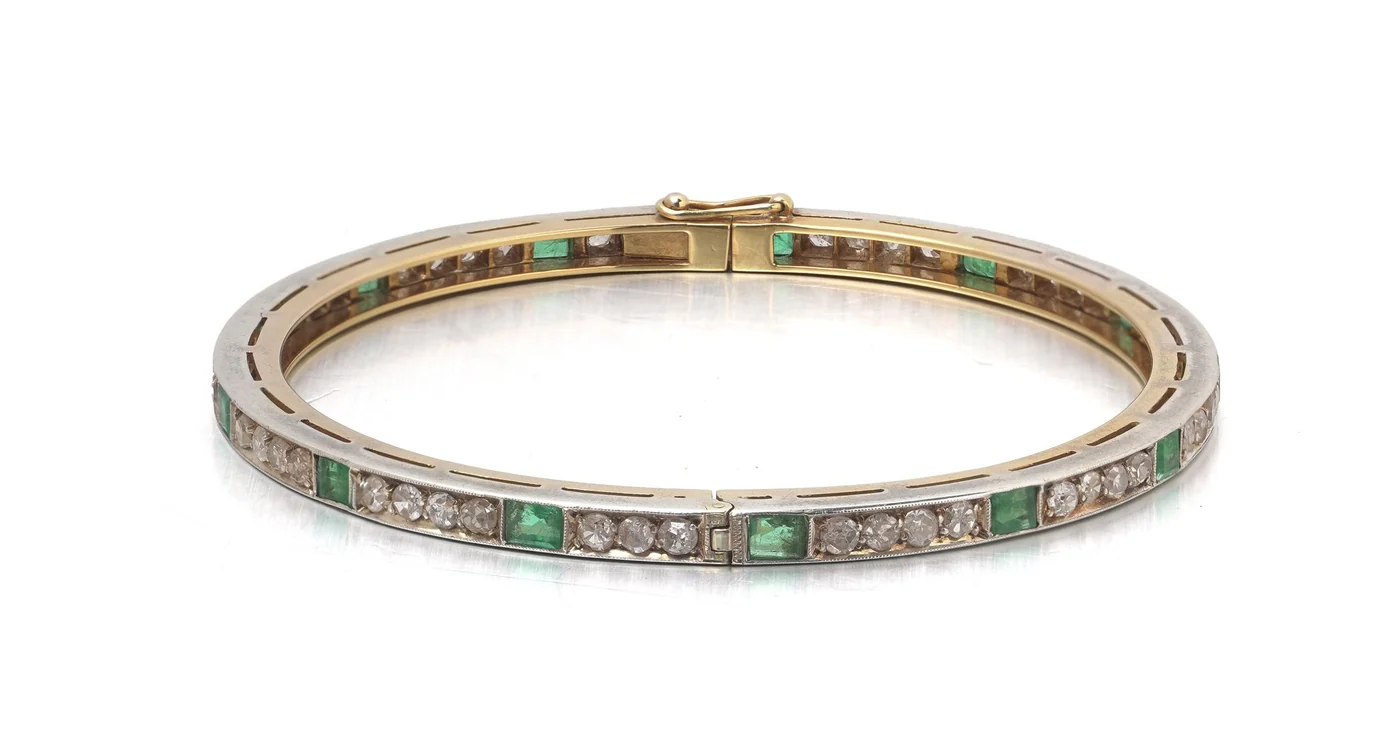
Diamonds set in silver on a gold body, so the diamonds look white and the gold stays against the skin. Emeralds alternate with rose cut diamonds on bangles, brooches and clusters.
Our Victorian emerald bangle alternates thirteen square cut emeralds with rose cut diamonds. See Victorian jewellery.
Sentimental rings and French work
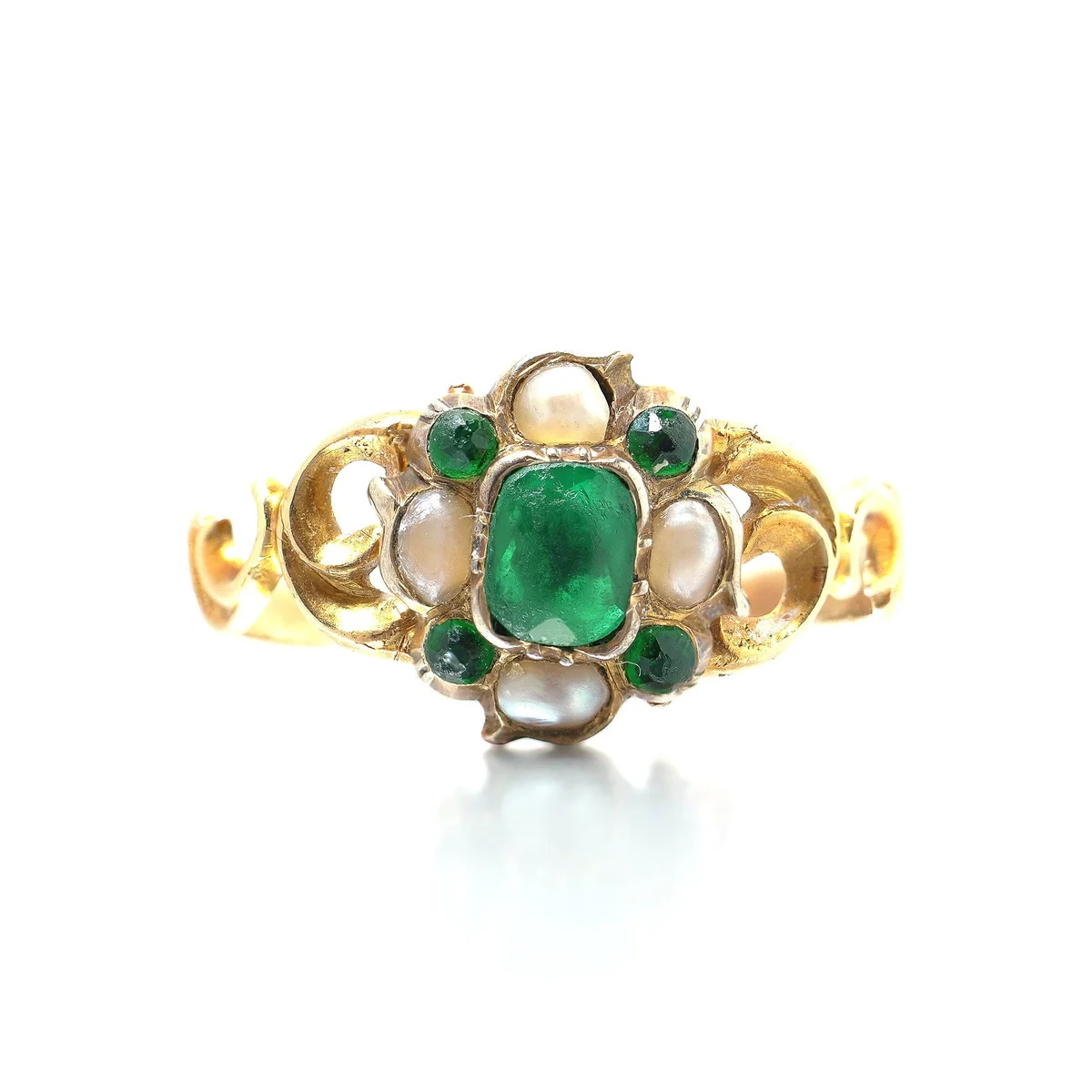
Small emeralds with pearls in cluster rings, sometimes with a glazed compartment at the back for hair, as on our Victorian emerald and pearl ring.
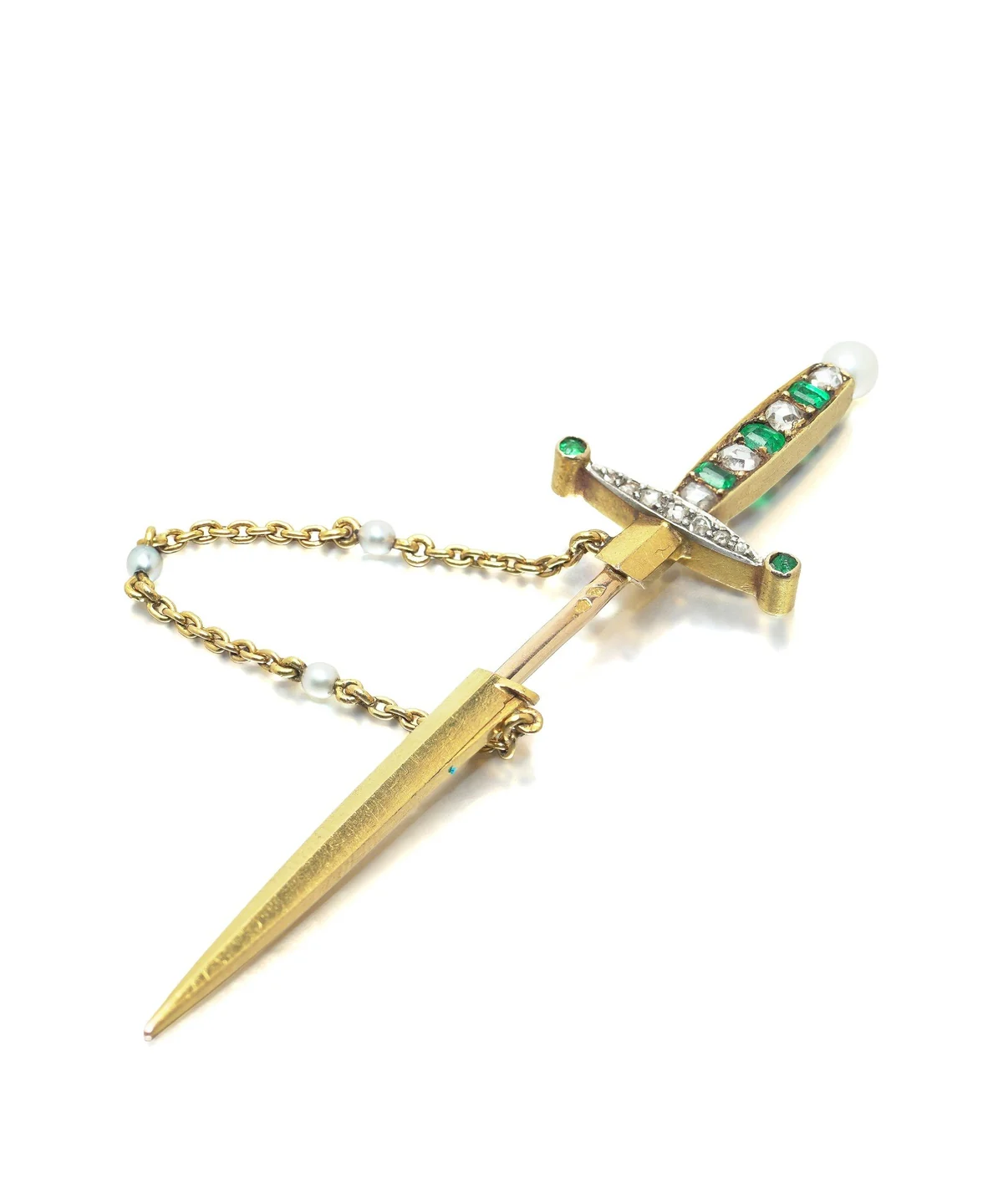
French pieces carry the eagle's head mark for 18 carat gold, like our sword jabot pin set with emeralds and rose cut diamonds.
Art Deco, 1920s and 30s: calibré emeralds in platinum
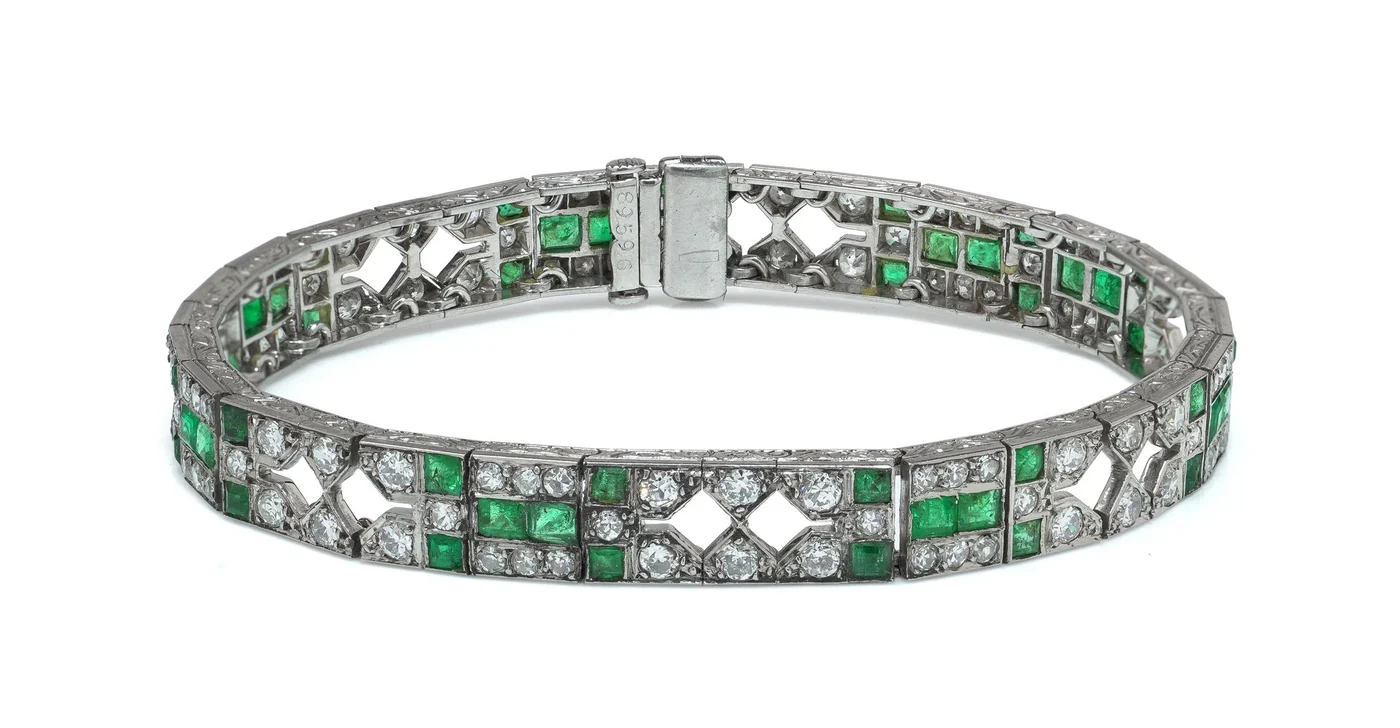
Emeralds cut to fit exact shapes, set in lines and blocks against diamonds in platinum. The emerald cut, a rectangle with stepped facets, suits the period; see the emerald cut.
Our signed Mauboussin bracelet of the 1920s is a Parisian example. More in Art Deco emerald jewellery.
Five checks on an antique emerald piece
- Colour in daylight: a lively mid to deep green beats a pale or very dark one.
- Clarity in context: inclusions are normal; fissures that reach the surface on a ring are a risk.
- Chips: look at the corners and girdle; emerald chips more easily than ruby or sapphire.
- Replacements: one stone of a different green has often been replaced, sometimes with glass.
- Closed backs: do not open them; they may hide foil or an assembled stone.
Care, buying and selling
- Cleaning: warm water, mild detergent and a soft brush only. No ultrasonic, steam or boiling (IGS).
- Wear: take emerald rings off for housework, gardening and the gym; a protective setting helps on a ring worn daily.
- Repairs: heat from a jeweller's torch can damage the filler; tell the jeweller the stone is emerald.
When buying, ask whether the emerald is oiled and how much, and ask for a laboratory report on any important stone. Choosing one for an engagement? Read our emerald engagement ring guide.
Every emerald is different. Send us a few photos of the front, the side and the back and we will tell you what yours is worth, free and with no obligation. Request a free valuation.
Do not sell antique emerald jewellery by gold weight: the stones, the age and the work count for more. Keep any report or box with it, and do not clean it before it is seen.
- Sell antique jewellery and sell Georgian jewellery
- Sell Victorian jewellery and sell Art Deco jewellery
- Dealer or auction? The trade-offs explained
Request a free valuation
- Emerald is green beryl; glass, assembled stones and synthetics are the usual look-alikes.
- Inclusions are normal; round bubbles and girdle joins are warning signs.
- Oiling is standard and accepted when disclosed; care means no ultrasonic, steam or heat.
- Festoons mean Georgian, silver-topped gold Victorian, calibré emeralds in platinum Art Deco.
Questions we are asked
How can you tell if an emerald is real?
Natural emerald nearly always has inclusions, the jardin, and no round gas bubbles. Glass shows bubbles and worn edges; an assembled stone shows a join at the girdle. A laboratory report separates natural from synthetic emerald.
Are all emeralds oiled?
Most are: over 90% of emeralds in the trade are treated, usually with colourless oil or resin in surface fissures. Unoiled emeralds exist but are rare and need a report to confirm them.
What is the difference between Colombian and Zambian emeralds?
Colombian emeralds, from Muzo, Coscuez and Chivor, range from warm yellowish green to bluish green. Zambian emeralds are iron-rich and tend to be bluer and darker. Origin needs a laboratory report.
What is a jardin in an emerald?
French for garden: the pattern of inclusions inside an emerald. It is normal, and it helps show a stone is natural.
Can you clean an emerald in an ultrasonic cleaner?
No. Ultrasonic, steam and boiling water can crack an emerald or wash out its oil. Use warm water, mild detergent and a soft brush.
What is a trapiche emerald?
A rare Colombian emerald with six dark spokes radiating from the centre like a wheel.
Are synthetic emeralds real emeralds?
They are beryl with the same colour cause, grown in a laboratory by the hydrothermal or flux method. They are sold as synthetic or lab-created and are not natural emeralds.
How do I date an antique emerald ring?
Look at the setting: closed backs and festoons suggest Georgian, silver-topped gold Victorian, calibré emeralds in platinum Art Deco. Hallmarks and maker's marks help where present.
Want to know what your emerald jewellery is worth?
Send photos of the piece, its back and any report. We buy antique and vintage jewellery directly, and the valuation is free.
- We buy directly
- Free valuation from photos
- Appointments in Mayfair and Braintree
- Insured postage or collection
New pieces reach our list first: join the Mozeris list.