How to Tell if a Sapphire Is Real: Heat, Origins and Antique Sapphire Jewellery
A dealer's guide to sapphire: the checks that separate it from glass, doublets and synthetics, what heating and diffusion mean, how Kashmir, Burmese and Ceylon stones differ, and how to date an antique sapphire piece.
How can you tell if a sapphire is real?
- Natural sapphire shows inclusions and straight colour bands under a 10x loupe, and keeps sharp facet edges.
- Gas bubbles or curved colour bands point to glass or a flame fusion synthetic, made since 1909.
- Most sapphires are heated, which is accepted when disclosed; diffusion is a different treatment.
- Kashmir, Burma and Ceylon each have a typical look, but origin needs a laboratory report.
In this article
How to tell if a sapphire is real
Sapphire is corundum, the same mineral as ruby: red corundum is ruby, and every other colour is sapphire. Blue comes from tiny amounts of iron and titanium (Wikipedia), and at 9 on the Mohs scale it is second only to diamond among natural gems (IGS). The usual impostors are glass, other blue gems, garnet-topped doublets and synthetic sapphire.
- Look for inclusions with a 10x loupe
Natural sapphire usually shows something: fine needles called silk, small crystals, healed fractures, or straight bands of lighter and darker blue. A large stone that is perfectly clean needs testing.
- Check for bubbles and curved lines
Round gas bubbles point to glass or a synthetic. Curved bands of colour, like the grooves on a record, are the mark of flame fusion synthetic sapphire (Richard Hughes).
- Look at the facet edges
Glass is soft and its edges wear round and chipped. Sapphire keeps crisp edges after a century of wear.
- Look at the stone side on
A doublet is a thin slice of garnet fused onto coloured glass. Seen from the side, the join shows at the girdle and the top and bottom differ in colour (GIA).
- Try a UV torch
Most natural blue sapphires stay dark under UV, while some glass and synthetics glow. It is a clue, not a proof.
| What you see | What it points to |
|---|---|
| Straight, angular bands of colour and fine silk | Natural sapphire |
| Curved colour bands | Flame fusion synthetic sapphire |
| Round gas bubbles, rounded facet edges | Glass |
| A join line at the girdle, red flash at the top | Garnet-topped doublet |
| Perfectly clean, very bright, in a 1910 to 1930 ring | Have it tested: synthetic sapphire was in use |
A laboratory report (GIA, GRS, SSEF, Gübelin, AGL) settles natural against synthetic, heated against unheated, and origin where it can be determined. For an important stone it is the only answer.
Synthetic sapphire in antique jewellery
Auguste Verneuil made blue synthetic sapphire by flame fusion in 1909 (Wikipedia), a few years after his synthetic ruby. Jewellers set it openly, so a ring of the 1910s or 1920s can hold a synthetic stone that has been called natural ever since. Under a loupe, curved banding and gas bubbles give it away.
Heated, unheated and treated sapphires
Heating is the normal treatment for sapphire and has a long history: Wikipedia notes evidence of heated sapphire from at least Roman times. Heat makes the blue purer and dissolves silk (Wikipedia), and the trade accepts it when it is disclosed (IGS).
| Treatment | What it does | How it is found | What it means |
|---|---|---|---|
| Heat | Improves colour and clarity | Altered silk and inclusions; a laboratory for clean stones | Normal when disclosed |
| No heat | Nothing: the stone as mined | Intact silk; confirmed by a report | Rarer, more sought after |
| Beryllium (lattice) diffusion | Heat with beryllium changes colour through the stone, often to orange | Advanced laboratory analysis | Appeared about 2000; must be disclosed |
| Surface diffusion | A thin layer of blue added to a pale stone | Colour concentrated at facet edges, seen in liquid | Lost if the stone is re-cut |
Sources: International Gem Society; Wikipedia. In Sri Lanka, milky white geuda stones are heated to blue, yellow or orange.
Cabochons and star sapphires
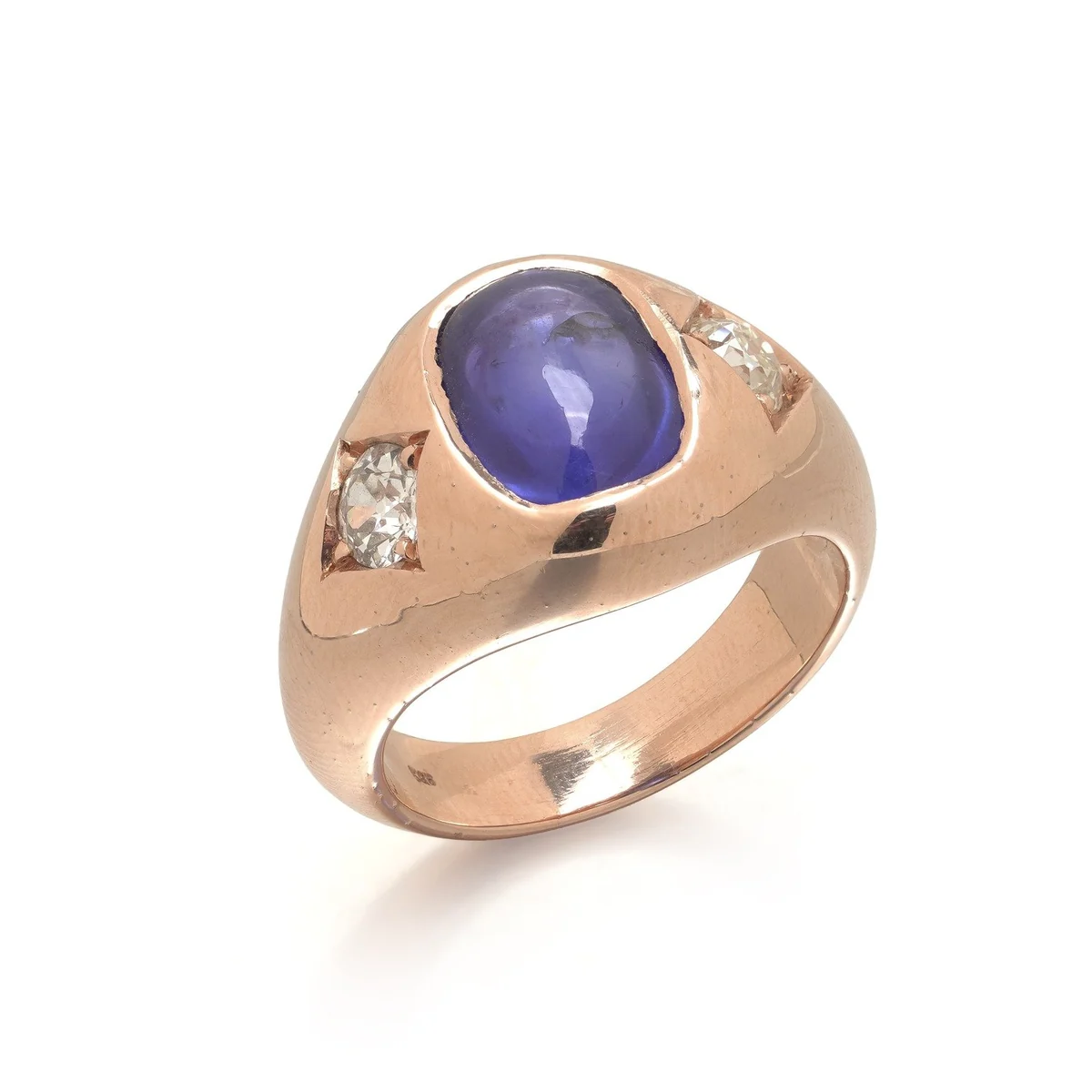
Sapphires full of silk are often cut as cabochons, smooth domes that show a soft, velvety blue. When the silk lines up in three directions, a high cabochon shows a six-rayed star (IGS).
Our antique cabochon sapphire ring sets one in heavy rose gold between two old European cut diamonds.
Kashmir, Burma and Ceylon sapphires
Origin changes how a sapphire looks and how buyers see it, but it is decided by a laboratory, never by colour alone.
| Origin | Typical look | Notes |
|---|---|---|
| Kashmir | Velvety, cornflower blue from very fine silk; strong colour zoning | Mined mainly in the late 19th and early 20th century; the source is exhausted |
| Burma (Myanmar) | Saturated, slightly violet blue | Highly regarded; supply is small |
| Ceylon (Sri Lanka) | Lighter, bright, greyish to violet blue | Supplies most blue sapphires on the market; also pink and padparadscha |
| Thailand and Australia | Dark, often inky blue | Can look almost black in dim light |
| Montana | Often steely blue | Yogo Gulch stones are the exception: bright cornflower blue |
Sources: IGS; Wikipedia (Kashmir deposits in the Paddar valley).
Ceylon sapphire
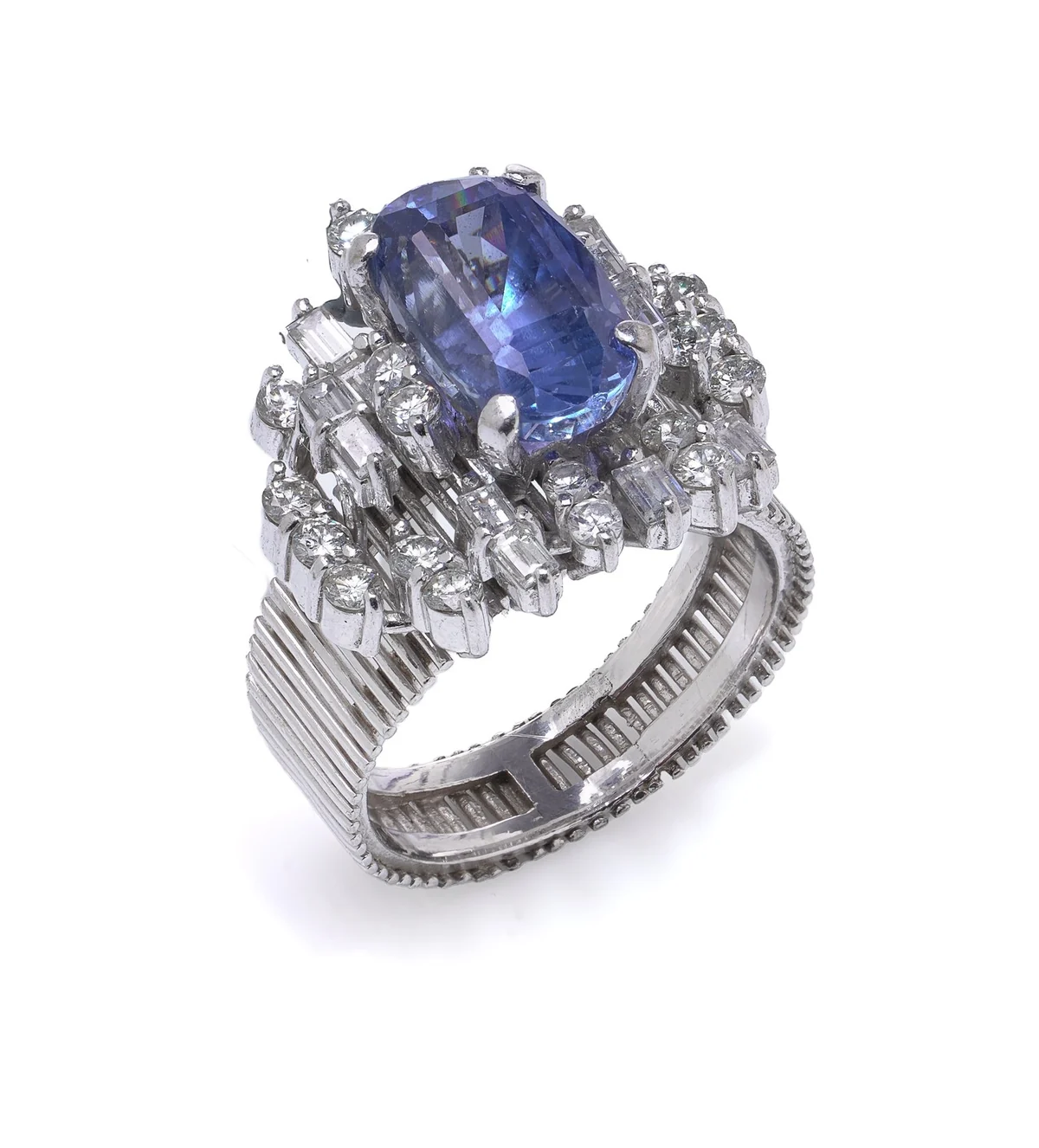
Sri Lanka has produced sapphires for centuries, and its stones are known for a lighter, livelier blue that stays bright in poor light. Two of the most famous sapphires came from there: the Star of India, 563.4 ct, in the American Museum of Natural History, and the Logan sapphire, about 423 ct, in the Smithsonian (Wikipedia).
Our Ceylon sapphire cluster ring shows the typical bright mid blue.
A Kashmir or Burmese attribution should always come with a laboratory report.
Fancy colours
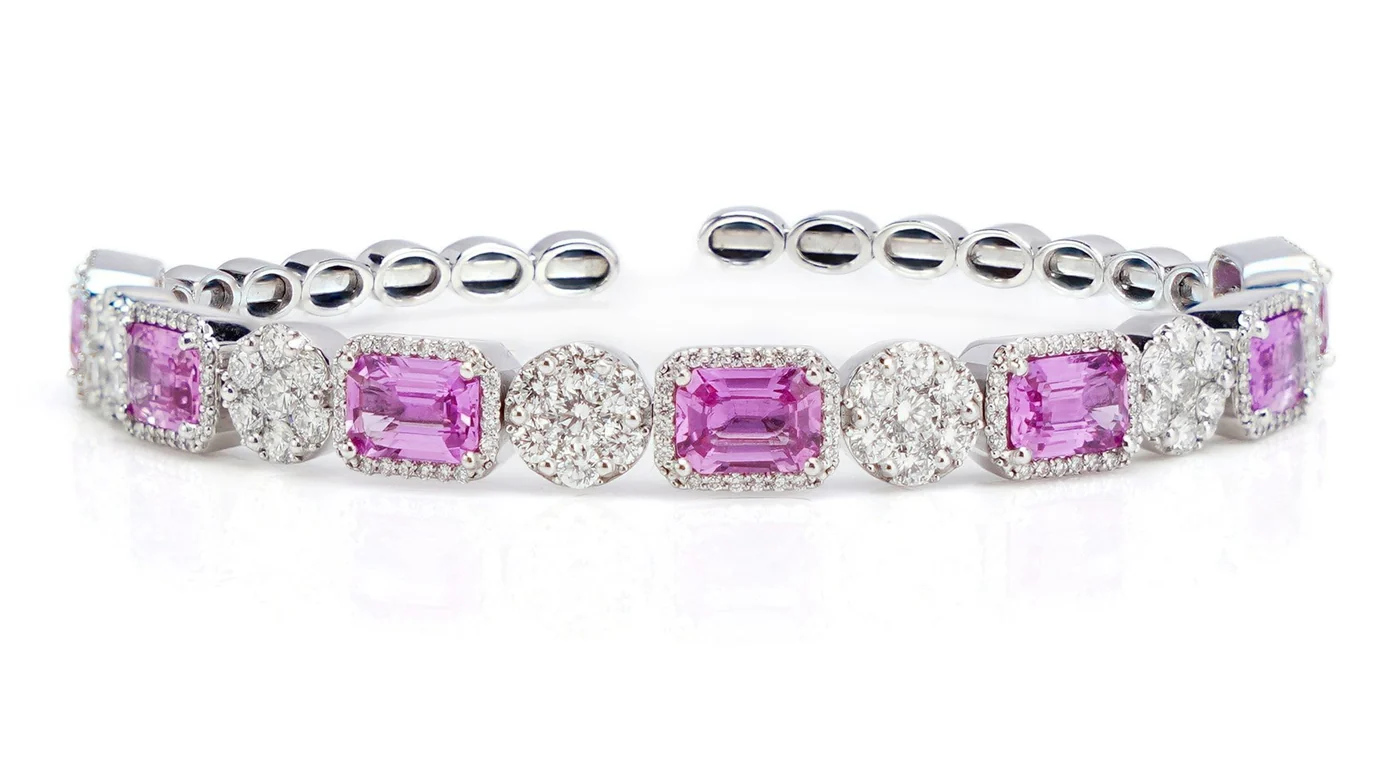
Sapphire also comes in pink, yellow, orange, purple, green and white. Pink sapphires, and the pinkish-orange padparadscha, are the most sought after after blue (IGS).
Our pink sapphire bangle sets seven step cut pink sapphires among diamonds.
Send us photos of your sapphire jewellery
Antique sapphire jewellery, era by era
The setting usually dates a sapphire piece before the stone does. See our sapphire rings and sapphire jewellery for these styles side by side.
Victorian, 1837 to 1901: graduated rows
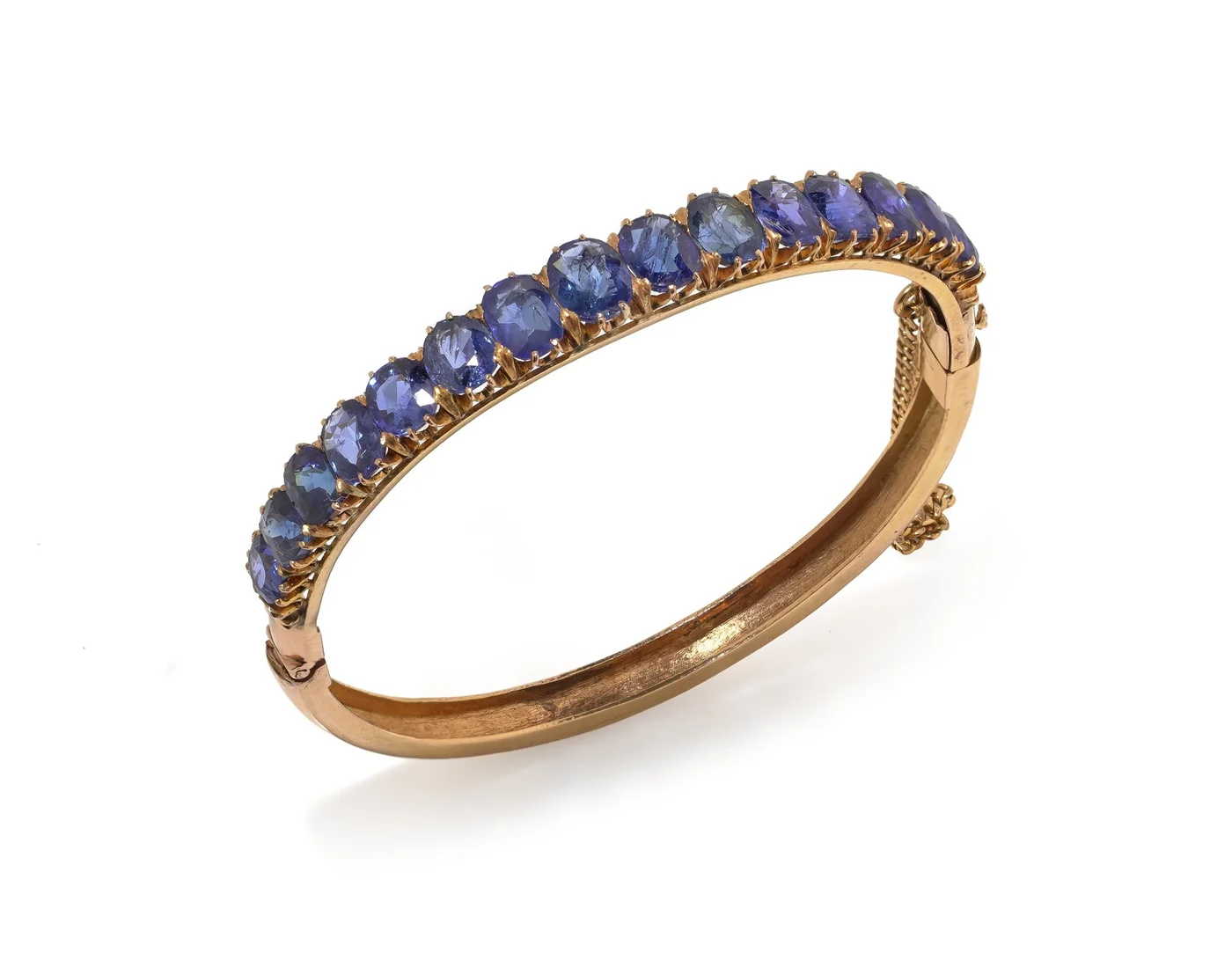
Sapphires set in a row that rises to a larger centre stone, on hinged bangles, half hoop rings and bar brooches, often in yellow gold and cut by hand into ovals and cushions.
Our Victorian sapphire bangle graduates fifteen oval sapphires across the front. See Victorian jewellery.
Edwardian, 1901 to 1910: platinum on gold
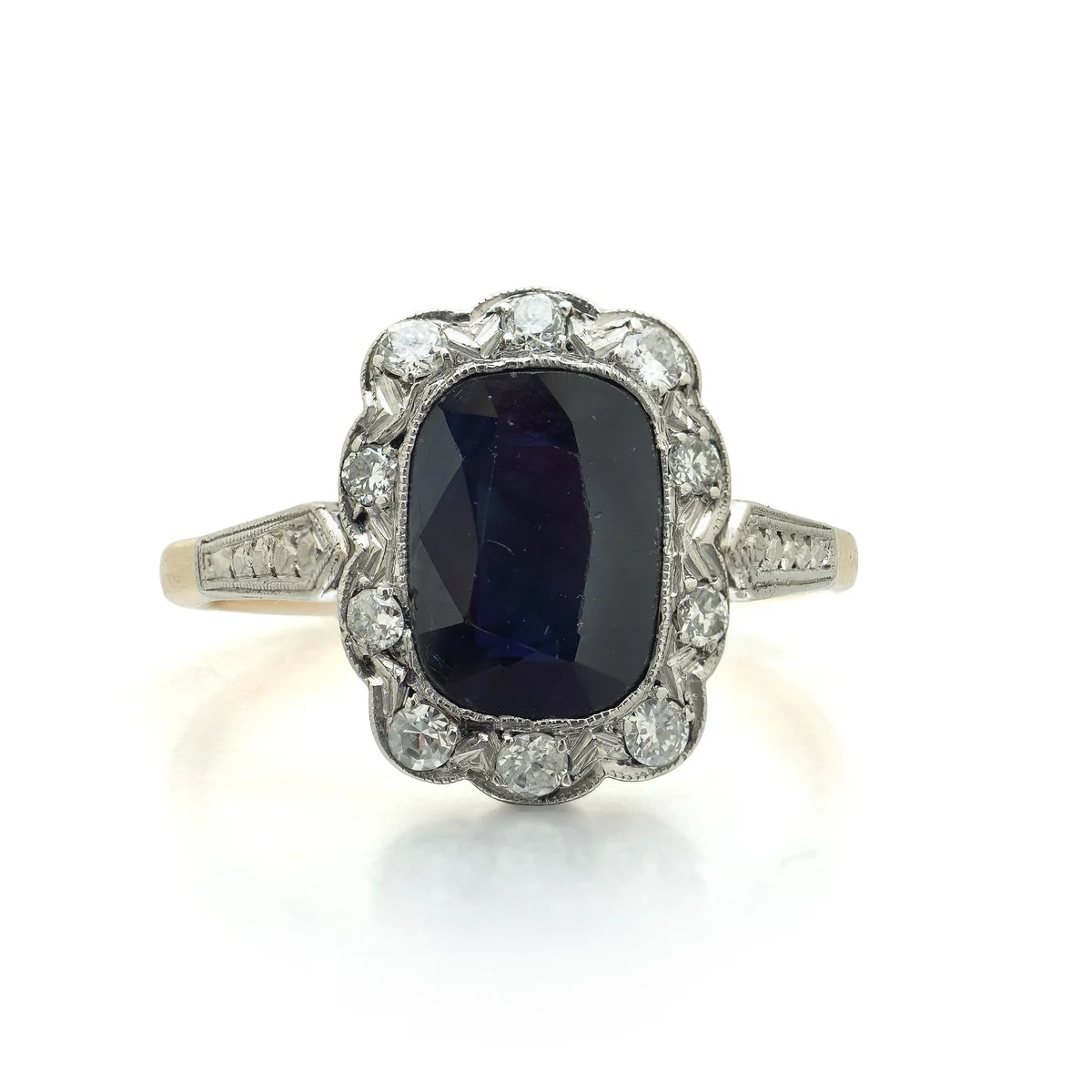
Platinum-topped gold let jewellers set diamonds in white metal around a sapphire while keeping a gold band against the finger. Millegrain edges and pierced galleries are typical.
Our antique sapphire cluster ring is marked 18CT and PLAT, with a deep blue cushion sapphire inside ten diamonds. See Edwardian jewellery.
Art Deco, 1920s and 30s: calibré cuts and geometry
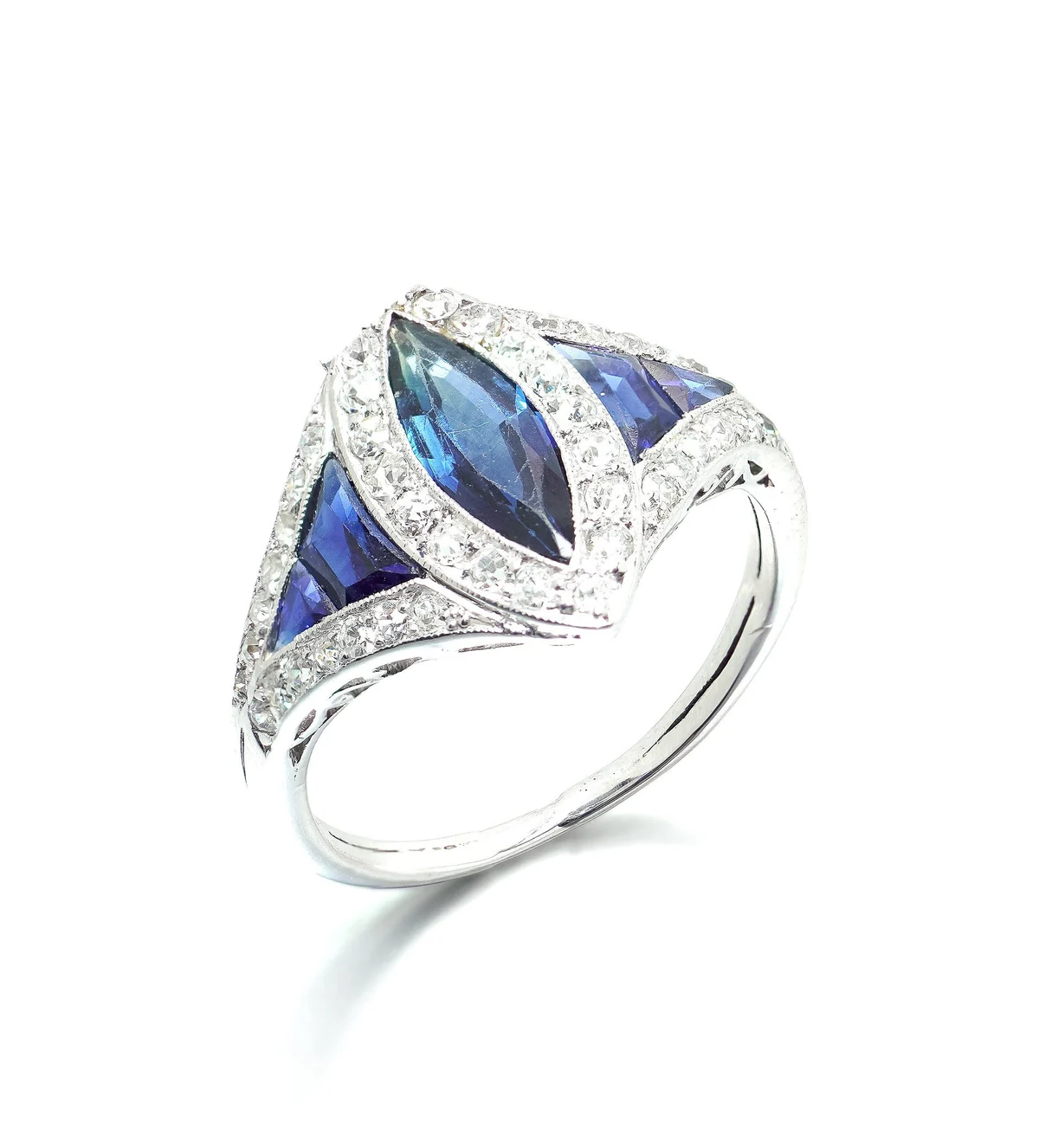
Sapphires cut to fit exact shapes, called calibré, set in platinum with diamonds in strict geometric patterns.
Our Art Deco marquise sapphire ring fits triangles and trapezes of calibré sapphire into wings either side of the centre stone. More in Art Deco sapphire jewellery.
The oval cluster
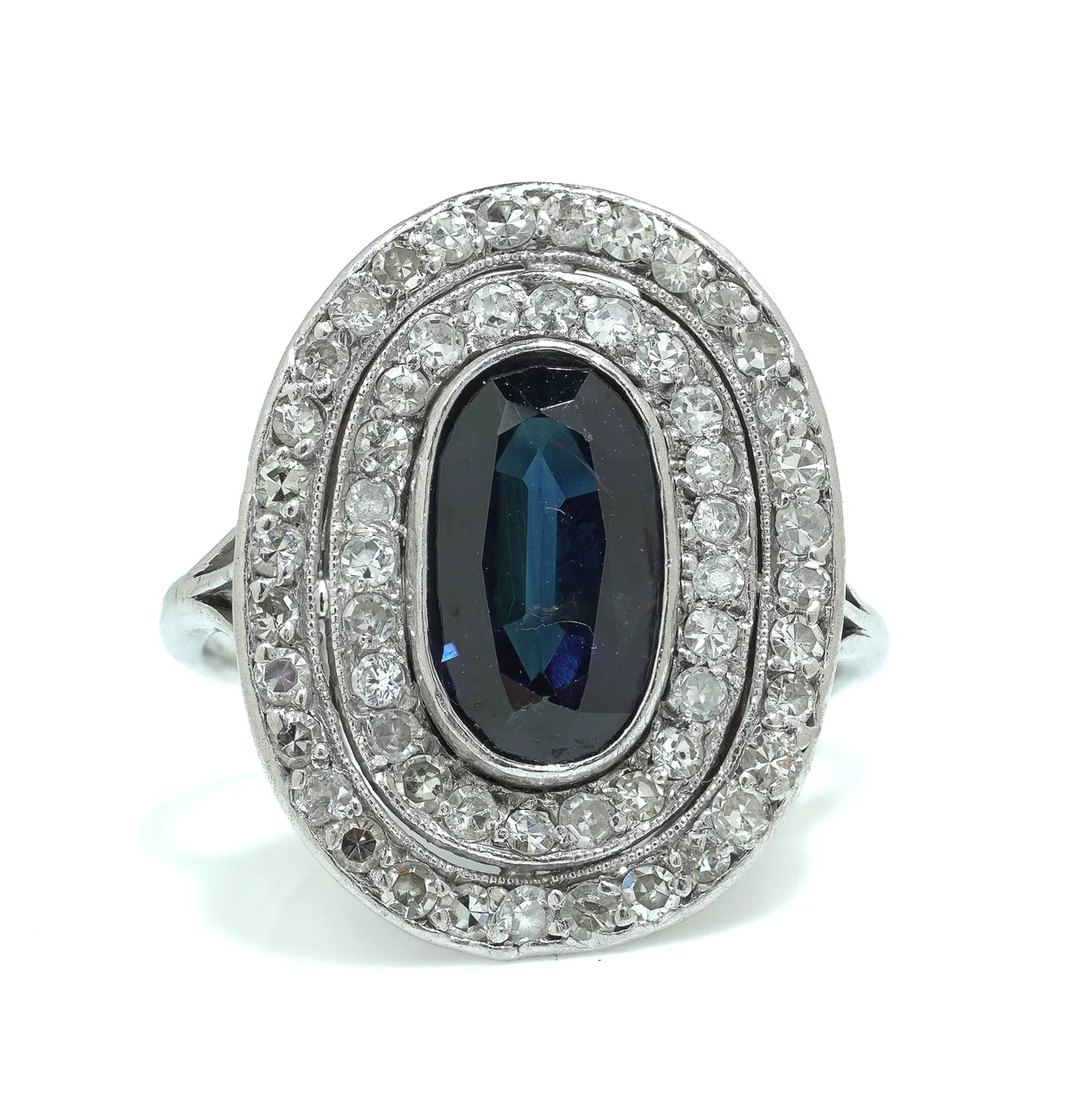
An oval sapphire inside one or two rows of diamonds, the shape most people picture as a sapphire ring, made from the Edwardian period through the Art Deco years and copied ever since. Our 1920s oval sapphire ring, pictured at the top of this page, sets a deep blue stone of about 2 ct inside 58 old cut diamonds. Choosing one for an engagement? Read our sapphire engagement ring guide.
Five checks on an antique sapphire piece
- Colour in daylight: saturation matters more than lightness or darkness; a stone that looks black indoors loses its appeal.
- The cut: hand-cut ovals and cushions that differ slightly suit the period; perfectly calibrated round stones are usually later.
- Replacements: one stone of a different blue in a row has often been replaced.
- Synthetics: a flawless stone in a 1910 to 1930 mount deserves a test.
- Marks: 18CT, PLAT or a hallmark helps date the mount; many older pieces carry none.
Care, buying and selling
- Cleaning: warm water, mild detergent and a soft brush. Avoid ultrasonic cleaners for fractured or treated stones (IGS).
- Wear: sapphire stands daily wear well, but check claws and collets once a year.
- Repairs: tell the jeweller if a stone is diffused or filled before any heat is used.
When buying, ask in writing whether the stone is heated or treated, and ask for a laboratory report on any important sapphire. Our sapphire jewellery listings state period, metal, treatment where known, and condition.
Every sapphire is different. Send us a few photos of the front, the side and the back and we will tell you what yours is worth, free and with no obligation. Request a free valuation.
Do not sell antique sapphire jewellery by gold weight: the stones, the age and the work count for more. Keep any report or box with it, and do not clean or polish it before it is seen.
Request a free valuation
- Sapphire is corundum, hardness 9; glass, doublets and synthetics are the usual look-alikes.
- A loupe catches glass and doublets; a laboratory settles synthetic, heat and origin.
- Heated sapphires are natural and accepted when disclosed; diffusion must be disclosed too.
- Graduated rows mean Victorian, platinum on gold Edwardian, calibré cuts Art Deco.
Questions we are asked
How can you tell if a sapphire is real?
Look for natural inclusions under a 10x loupe, sharp facet edges and straight colour bands. Round bubbles, curved colour lines or a join at the girdle point to glass, a synthetic or a doublet. A laboratory report confirms natural against synthetic.
Is a heated sapphire real?
Yes. A heated sapphire is natural sapphire whose colour and clarity were improved by heat. Heating is normal and accepted when disclosed; unheated sapphires are rarer.
What is a Ceylon sapphire?
A sapphire from Sri Lanka, usually a lighter, bright blue. Sri Lanka supplies most of the blue sapphires on the market and produced the Star of India and the Logan sapphire.
Why are Kashmir sapphires so famous?
They have a soft, velvety cornflower blue from very fine silk inclusions, they were mined mainly in the late 19th and early 20th century, and the source is exhausted.
What is a Burmese sapphire?
A sapphire from Myanmar, usually a saturated, slightly violet blue. As with every origin, it needs a laboratory report to confirm it.
Can an antique ring have a synthetic sapphire?
Yes. Blue synthetic sapphire was made by flame fusion from 1909, and rings of the 1910s and 1920s were often set with it. Curved colour bands and gas bubbles under a loupe are the usual signs.
What is a calibré cut sapphire?
A small sapphire cut to fit an exact shape in a design, typical of Art Deco jewellery, where rows and triangles of calibré stones line a platinum setting.
How do I clean a sapphire ring?
With warm water, mild detergent and a soft brush. Avoid ultrasonic cleaners if the stone is fractured or treated.
Want to know what your sapphire jewellery is worth?
Send photos of the piece, its back and any report. We buy antique and vintage jewellery directly, and the valuation is free.
- We buy directly
- Free valuation from photos
- Appointments in Mayfair and Braintree
- Insured postage or collection
New pieces reach our list first: join the Mozeris list.