Antique boxes guide
How to Date an Antique Jewellery Box: The Jeweller's Imprint Register
To date an antique jewellery box, read the printed lid. It names the retailer, not the maker, and its address, royal warrant wording and company style each set a date window: “By appointment to the King” means 1901 to 1952, and W.1 or E.C.4 means 1917 or later. Our register dates 33 jewellers' lids.
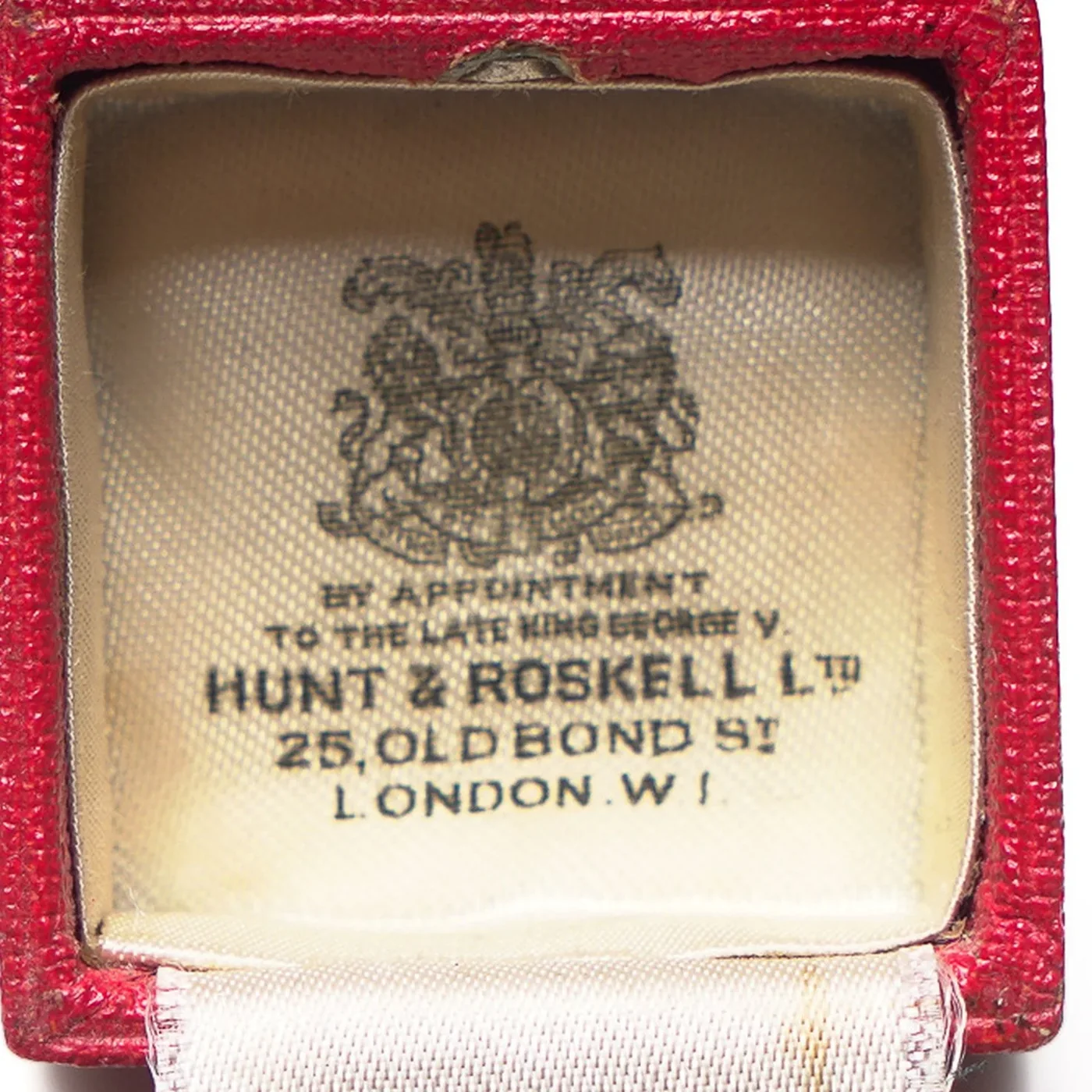
- The lid names the retailer, not the maker: read it word for word.
- By appointment to the King: 1901 to 1952 on a British lid.
- W.1, E.C.3, E.C.4: numbered London districts, so 1917 or later.
- 33 dated lids: every row in our register cites its source.
In this article
- The name on the lid is the retailer, not the maker
- Lid clues that date a box: the decoder
- The Jeweller's Imprint Register
- Royal warrant wording on boxes: Queen, King and the late King
- What the inside tells you: the fitting chart
- Coverings: leather, shagreen, velvet and ivory-coloured cases
- Designer house boxes: Cartier, Tiffany, Hancocks, Asprey and Garrard
- Does a box matter when you sell a jewel?
- Questions
The name on the lid is the retailer, not the maker
The gilt or printed name inside an antique jewellery box is the shop that sold the jewel. Specialist case makers made the boxes, and the retailer's name, address and warrants were blocked onto the silk or satin lid. The jewel itself may come from a workshop the retailer never named.
That makes the lid a dating tool. Firms moved, changed their names, became limited companies and gained or lost royal warrants, and each change shows on the boxes they ordered. Read the lid as printed, word for word, before anything else. For the marks on the jewel, see our guide to hallmarks and makers' marks and to dating antique jewellery.
Every lid in this guide was read at full resolution from a box we have handled. Our stock of antique and vintage boxes is on the antique boxes page.
Lid clues that date a box: the decoder
Five things on a lid set a date: the royal warrant wording, the company style, the address and postal district, a telephone number and anything else that existed only for a time. Each gives a window; put them together and the window narrows.
| On the lid | What it tells you | Example in the register |
|---|---|---|
| By appointment to the King | 1901 to 1952, when four Kings reigned in turn, or from 2022 | Goldsmiths & Silversmiths Co Ltd, 112 Regent Street |
| the late King George V | After 20 January 1936, when George V died | Hunt & Roskell Ltd, 25 Old Bond Street |
| By appointment to the Queen | Not a date on its own: Victoria reigned to 1901, three Queens consort were “the Queen” from 1901 to 1952, and Elizabeth II reigned 1952 to 2022. Read it with the address | Wartski, 14 Grafton Street (1974 to 2018, so Elizabeth II) |
| Ltd or Limited | The firm had become a limited company, which the Companies Act 1862 opened to most traders. Each firm's own date is narrower | Benson 1897, Goldsmiths & Silversmiths 1898, Tessiers 1920, Reid 1930 |
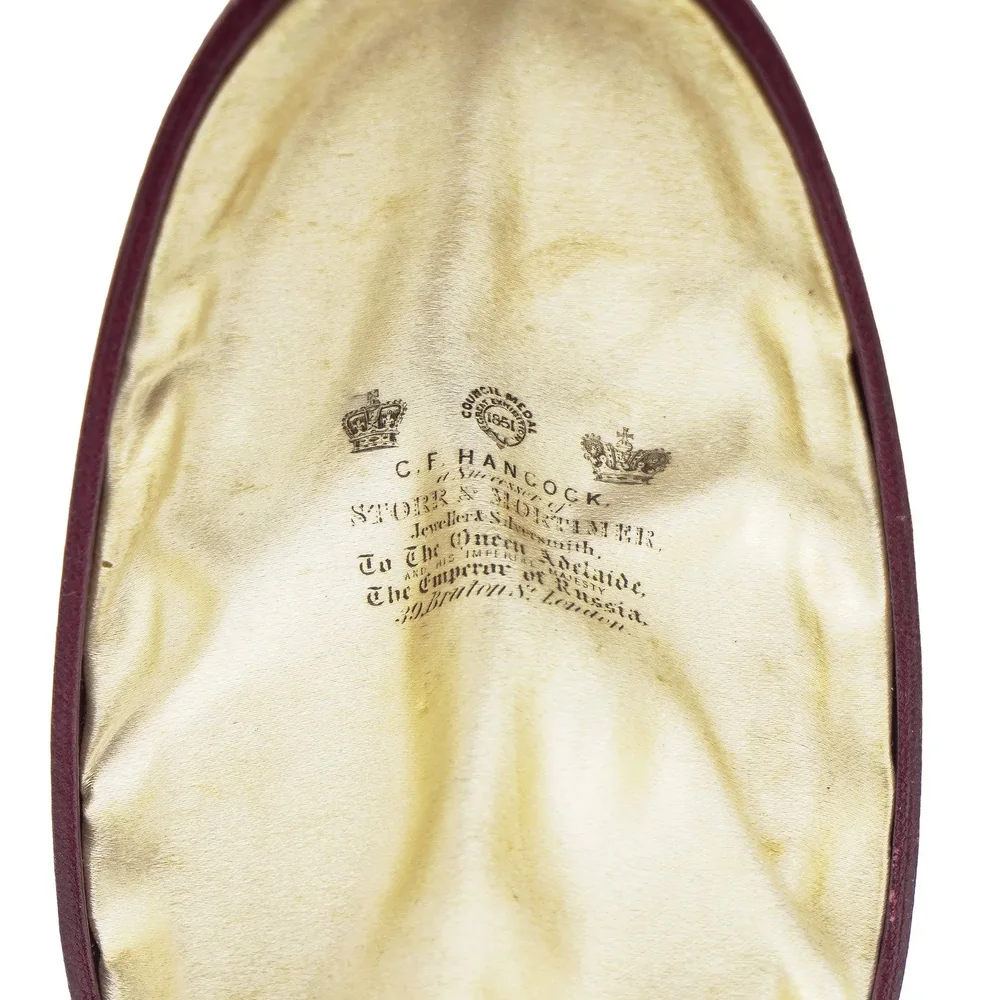
| Successor to, or late | Printed after one firm took over another | C.F. Hancock, Successor of Storr & Mortimer |
| E.C. or W. with no number | London postal districts of 1858 to 1917 | J.W. Benson Ltd, Royal Exchange, London E.C. |
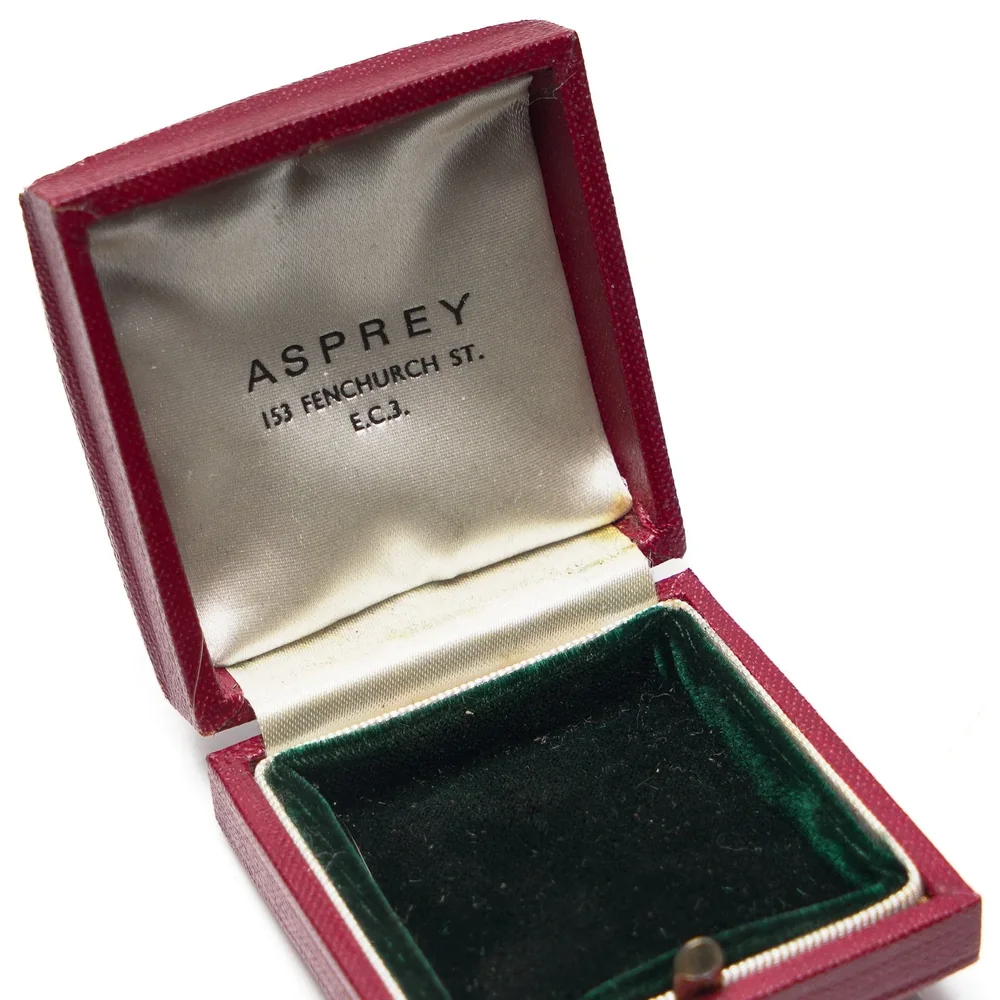
| W.1, E.C.3 or E.C.4 | Numbered London districts, from 1917 | Asprey, 153 Fenchurch St., E.C.3 |
| A full postcode, such as W1X 2HP | The national postcode, adopted in stages from 1959 to 1974 | Hancocks, 1 Burlington Gardens, London W1X 2HP |
| A telephone number with exchange letters | London used three-letter exchange names from 1927; all-figure numbers replaced them from 1966 | Collect any lid with a number, then check the exchange |
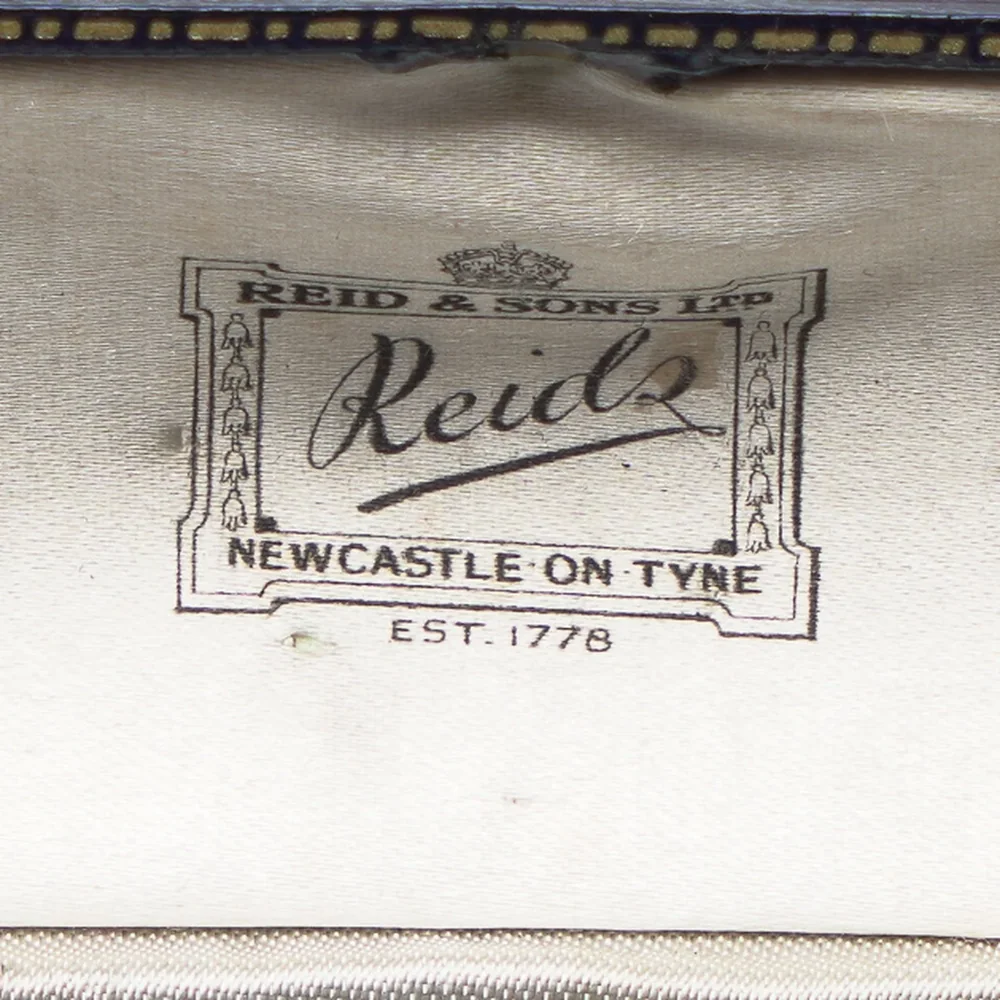
| Est. and a year | The founding date the firm claimed, not the date of the box | Reid & Sons Ltd, Est. 1778 |
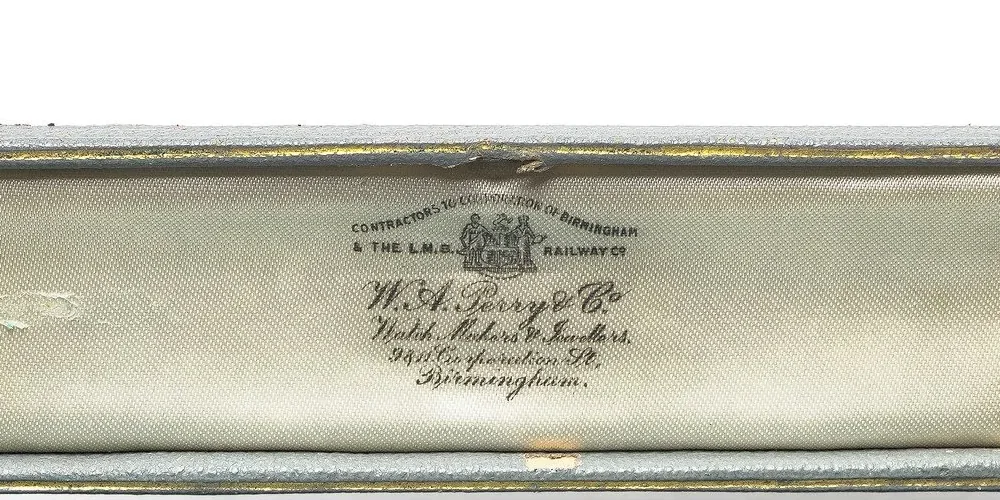
| A named customer, railway or monument | The date that body or building existed | W.A. Perry, L.M.S. Railway Co, 1923 to 1947 |
Postal districts and postcodes
London was divided into lettered postal districts such as E.C. and W. in 1857 and 1858. Numbers were added in 1917, so a lid reading W.1 or E.C.3 was printed in 1917 or later.
Full postcodes such as W1X 2HP came with the national scheme, adopted in stages between 1959 and 1974.
Successor to, and late
Charles Frederick Hancock left the partnership that had traded as Storr & Mortimer, by then Hunt & Roskell, in January 1849 and opened at 39 Bruton Street. His lids name him as their successor and carry the Council Medal won at the Great Exhibition of 1851.
Hancock left Bruton Street in 1917, which closes the window.
Ltd, and Est.
Limited liability was opened to most trading firms by the Acts of 1855 and 1856 and consolidated in the Companies Act 1862. A firm added Ltd when it incorporated, so Ltd on a lid means the box is no earlier than that firm's own date.
Reid & Sons of Newcastle became a limited company in 1930. Their lid also reads Est. 1778: a founding date the firm printed, not the date of the box.
Telephone numbers and renumbered streets. London telephone numbers used three-letter exchange names from 1927 until all-figure numbers began in 1966, so the form of a number on a lid places it in one era or the other. Street numbers can mislead: London's councils issued orders renaming and renumbering streets, so two numbers for one firm may be a renumbering rather than a move. Check a trade directory before you read it as a new address.
The Jeweller's Imprint Register
The register lists 33 jewellers' lids, each with the wording as printed, a date window and the source for that window. Every row is a box we have handled; most are in stock and link to the listing.
| Jeweller | As printed on the lid | Date window | How it is dated | Our box | Source |
|---|---|---|---|---|---|
| C.F. Hancock | C.F. Hancock, Successor of Storr & Mortimer, To the Queen Adelaide, 39 Bruton St, London; Council Medal 1851 | 1851 to 1917 | The Great Exhibition medal of 1851; the firm left Bruton Street in 1917 | MFA-B-233 | Hancocks London; Glasgow School of Art Archives |
| Howard & Co. | Howard & Co., Fifth Ave., N.Y. | 1866 to c.1922 | Founded in New York in 1866; the last record of the firm is from 1922 | MFA-B-289 | silvercollection.it |
| Hamilton & Inches | Hamilton & Inches, 90 Princes St, Edinburgh | 1866 to 1952 | Opened on Princes Street in 1866; moved to 87 George Street in 1952 | MFA-B-168 | Hamilton & Inches |
| J.H. Werner | J.H. Werner, Hof-Juwelier to the Kaiser and Kaiserin, 173 Friedrichstrasse and Unter den Linden, Berlin W. | 1871 to 1918 | Kaiser and Kaiserin are titles of the German Empire, 1871 to 1918 | MFA-B-245 | Auktionshaus Stahl |
| Hopkins & Hopkins | Hopkins & Hopkins, Goldsmiths, Opposite O'Connell Monument, Dublin | From 1882 | The O'Connell Monument was unveiled in 1882 | MFA-B-39 | Dublin Guide; National Museum of Ireland |
| J.C. Vickery | J.C. Vickery, Regent St. W. | c.1890 to 1930 | Vickery took over 183 Regent Street around 1890; the firm failed in 1930. W. without a number points to before 1917 | MFA-B-60, MFA-B-63 | silvercollection.it; GENUKI |
| Marcus & Co. | Marcus & Co., Jewelers, 5th Ave. Cor. 45th St., New York | 1892 to 1962 | Founded in 1892; merged with Black, Starr & Frost in 1962 | MFA-B-58, MFA-B-59 | Lang Antiques |
| J.W. Benson Ltd | J.W. Benson Ltd, 28 Royal Exchange, London E.C. | 1897 to 1917 | Ltd registered July 1897; plain E.C. before the numbered districts of 1917 | MFA-B-262 | South Wales Daily News, 12 Jul 1897; Grace's Guide; GENUKI |
| Goldsmiths & Silversmiths Co Ltd | Prize Medals, Manufacturing Goldsmiths & Silversmiths Company Ltd, 112 Regent St, London | 1898 to 1952 | Registered as a limited company in 1898; merged with Garrard in 1952 | MFA-B-37 | Grace's Guide |
| E.M. Gattle & Co. | E.M. Gattle & Co., 630 Fifth Ave., New York, Opposite Cathedral | 1900 to 1926 | Moved to Fifth Avenue in 1900 and to the St Regis Hotel in 1926 | MFA-B-279 | Hancocks London |
| Goldsmiths & Silversmiths Co Ltd | By Appointment to the King, The Goldsmiths & Silversmiths Company Ltd, 112 Regent St, London | 1901 to 1952 | A King reigned from 1901; the company merged with Garrard in 1952 | MFA-B-239, MFA-B-258, MFA-B-273 | Grace's Guide; The Royal Family |
| R. & S. Garrard & Co. | R. & S. Garrard & Co., To the King by Special Appointment, Haymarket, London | 1901 to 1909 | A King from 1901; the firm became Garrard & Co Ltd in 1909 | Sold | Grace's Guide |
| Stewart Dawson & Co Ltd | Stewart Dawson & Company Limited, Regent Street, London | 1907 to c.1935 | Became a limited company in 1907; sold in 1931 and traded until about 1935 | MFA-B-259, MFA-B-154 | Carters |
| Mallett | Mallett, The Octagon, Bath & 40 New Bond St, London | 1908 to 1991 | Mallett traded at 40 New Bond Street from 1908 to 1991 | MFA-B-243 | London Picture Archive |
| Garrard & Co Ltd | Garrard & Co. Ltd, to H.M. The King, Calcutta and London | 1909 to 1952 | Garrard & Co Ltd from 1909; a King on the throne until 1952 | MFA-B-223 | Grace's Guide; The Royal Family |
| Black, Starr & Frost | Black, Starr & Frost, Fifth Ave. cor. 48th St., New York | From 1912 | Moved to Fifth Avenue and 48th Street in 1912; traded as Black, Starr & Frost-Gorham from 1929 to 1962 | MFA-B-284 | Wikipedia |
| Cartier | Cartier, New York 653 5th Ave, Paris 13 Rue de la Paix, London 175 New Bond St | From 1917 | Cartier New York moved into 653 Fifth Avenue in 1917 | MFA-B-231 | Wikipedia |
| J.W. Benson Ltd | J.W. Benson Ltd, Watchmakers, Jewellers & Silversmiths, 62 & 64 Ludgate Hill, E.C.4 | From 1917 | The numbered district E.C.4 dates from 1917 | MFA-B-164, MFA-B-188 | Grace's Guide; GENUKI |
| Asprey | Asprey, 153 Fenchurch St., E.C.3 | From 1917 | The numbered district E.C.3 dates from 1917 | MFA-B-292 | GENUKI |
| Chas. Packer & Co Ltd | Chas. Packer & Co. Ltd, 76 & 78 Regent Street, London | 1917 to c.1932 | Charles Packer & Co until 1917, then Ltd to about 1932 | MFA-B-228 | Navette Jewellery |
| Tessiers Ltd | Tessiers Ltd, 26 New Bond St, London | 1920 to 1968 | Became Tessiers Ltd in 1920; traded at 26 New Bond Street until 1968 | MFA-B-276 | silvercollection.it |
| W.A. Perry & Co. | W.A. Perry & Co, Watch Makers & Jewellers, Corporation St, Birmingham; Contractors to the Corporation of Birmingham & the L.M.S. Railway Co | 1923 to 1947 | The London Midland & Scottish Railway existed from 1923 to 1947 | MFA-B-247 | Science Museum Group |
| Georg Jensen | Georg Jensen, New York, with the crowned GJ monogram | From 1924 | The New York branch opened in 1924 | MFA-B-235 | Wikipedia |
| B.A. Seaby Ltd | B.A. Seaby Ltd, Great Portland Street, London | From 1926 | Herbert Seaby founded B.A. Seaby Ltd in 1926 | MFA-B-184 | The E-Sylum |
| Reid & Sons Ltd | Reid & Sons Ltd, Reids, Newcastle on Tyne, Est. 1778 | From 1930 | Became Reid & Sons Ltd in 1930 | MFA-B-281 | Science Museum Group |
| Hunt & Roskell Ltd | By Appointment to the late King George V, Hunt & Roskell Ltd, 25 Old Bond St, London W.1 | 1936 to late 1960s | George V died in January 1936; the firm ceased trading in the late 1960s | MFA-B-297 | Hancocks London; South Wales Daily News, 12 Jul 1897 |
| Fred | Fred, 6 Rue Royale, Paris | From 1936 | Fred Samuel opened at 6 Rue Royale in 1936 | MFA-B-96 | Berganza |
| David Webb Inc. | David Webb Inc., New York | From 1948 | David Webb Inc. was established in 1948 | MFA-B-238 | Sotheby's |
| Garrard & Co Ltd | By appointment to H.M. The Queen, Goldsmiths & Crown Jewellers, Garrard & Co. Ltd, 112 Regent Street W.1 | 1952 to 1998 | Moved to 112 Regent Street in 1952; left for New Bond Street in 1998 | MFA-B-207, MFA-B-209 | Grace's Guide; Wikipedia |
| Boodle & Dunthorne | Boodle & Dunthorne, Jewellers, Liverpool and Chester | 1965 to 2005 | The Chester shop opened in 1965; the firm became Boodles in 2005 | MFA-B-68 | Wikipedia |
| Hancocks & Co. (Jewellers) Ltd | By Appointment to Queen Elizabeth The Queen Mother, Goldsmiths & Silversmiths, Hancocks & Co. (Jewellers) Ltd, 1 Burlington Gardens, London W1X 2HP | 1970 to 1998 | At Burlington Gardens from 1970 until the move to Burlington Arcade in 1998 | MFA-B-242, MFA-B-65, MFA-B-26 | Wikipedia |
| Must de Cartier | must de Cartier | From 1973 | Les Must de Cartier was created in 1973 | MFA-B-201, MFA-B-151 | Wikipedia |
| Wartski | By appointment to H.M. The Queen, Jewellers, Wartski, 14 Grafton St, London W1 | 1974 to 2018 | At 14 Grafton Street from 1974; moved to St James's Street in 2018 | MFA-B-214 | C20 Society; Antiques Trade Gazette |
How we built it: we read the lids of more than 300 boxes listed by Mozeris Fine Antiques in 2025 and 2026, then kept only the jewellers whose trading dates, addresses or company style we could confirm from a published source: firm histories, Grace's Guide, museum and archive records, newspapers and, where nothing better exists, Wikipedia. Lids we could not date are left out. A window is the period in which that exact wording could be printed; the box can be used later. Compiled by Mozeris Fine Antiques, October 2026. Corrections with a source are welcome at info@mozerisfineantiques.com.
Royal warrant wording on boxes: Queen, King and the late King
“By appointment to the King” dates a British lid to 1901 to 1952; “the Queen” needs the address to date it, because Queens consort were also styled the Queen. A warrant names the royal who granted it, so the wording follows the throne.
| Monarch | Reigned | Queen consort, also styled the Queen |
|---|---|---|
| Queen Victoria | 1837 to 1901 | None (Victoria was the Queen) |
| Edward VII | 1901 to 1910 | Queen Alexandra |
| George V | 1910 to 1936 | Queen Mary |
| Edward VIII | January to December 1936 | None |
| George VI | 1936 to 1952 | Queen Elizabeth, later the Queen Mother |
| Elizabeth II | 1952 to 2022 | None (Elizabeth II was the Queen) |
| Charles III | From 2022 | Queen Camilla |
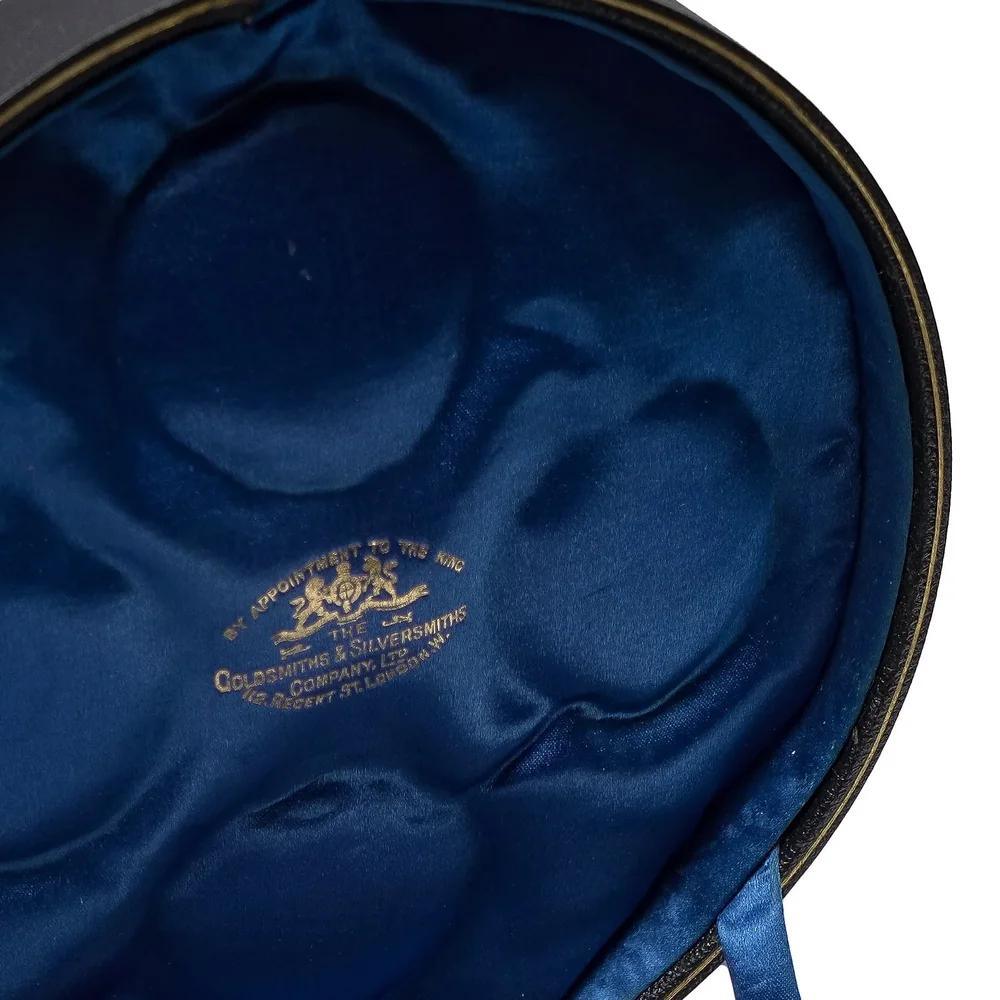
The King, 1901 to 1952
Four Kings reigned in turn from Edward VII's accession in 1901 to the death of George VI in 1952. The Goldsmiths & Silversmiths Company printed By Appointment to the King on its lids until it merged with Garrard in 1952.
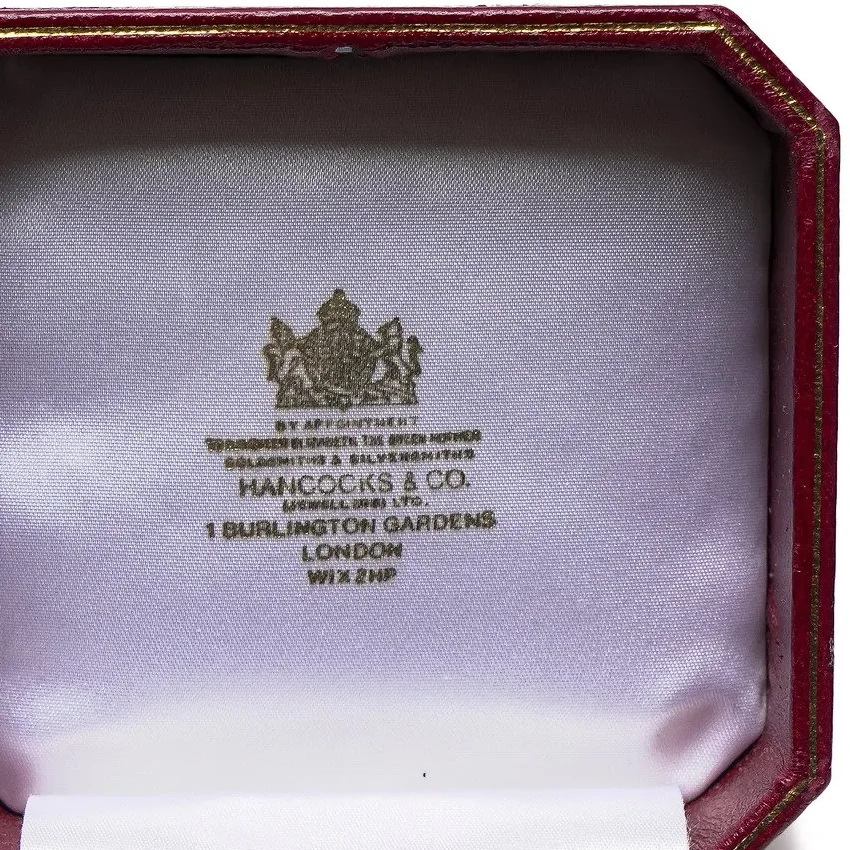
The late King, and the Queen Mother
When a grantor dies the warrant lapses, and the holder may go on using the arms for a limited time, today usually up to two years. That is why lids read By Appointment to the late King George V: Hunt & Roskell's box was printed after his death in January 1936.
Queen Elizabeth The Queen Mother granted her own warrants. Hancocks received one in 1962 and printed it on lids at 1 Burlington Gardens, where the firm traded from 1970 to 1998.
Foreign courts worked the same way. J.H. Werner of Berlin printed his appointment as court jeweller to the Kaiser and Kaiserin, titles that existed only from 1871 to 1918.
What the inside tells you: the fitting chart
The velvet fitting in the base shows what the box was made for: a slot for a ring, a well for a pendant or watch, a pad for a brooch, a tray for a suite and a long bed for a bracelet. The lid is lined in silk or satin, which takes the printed name; the base is velvet, which holds the jewel.
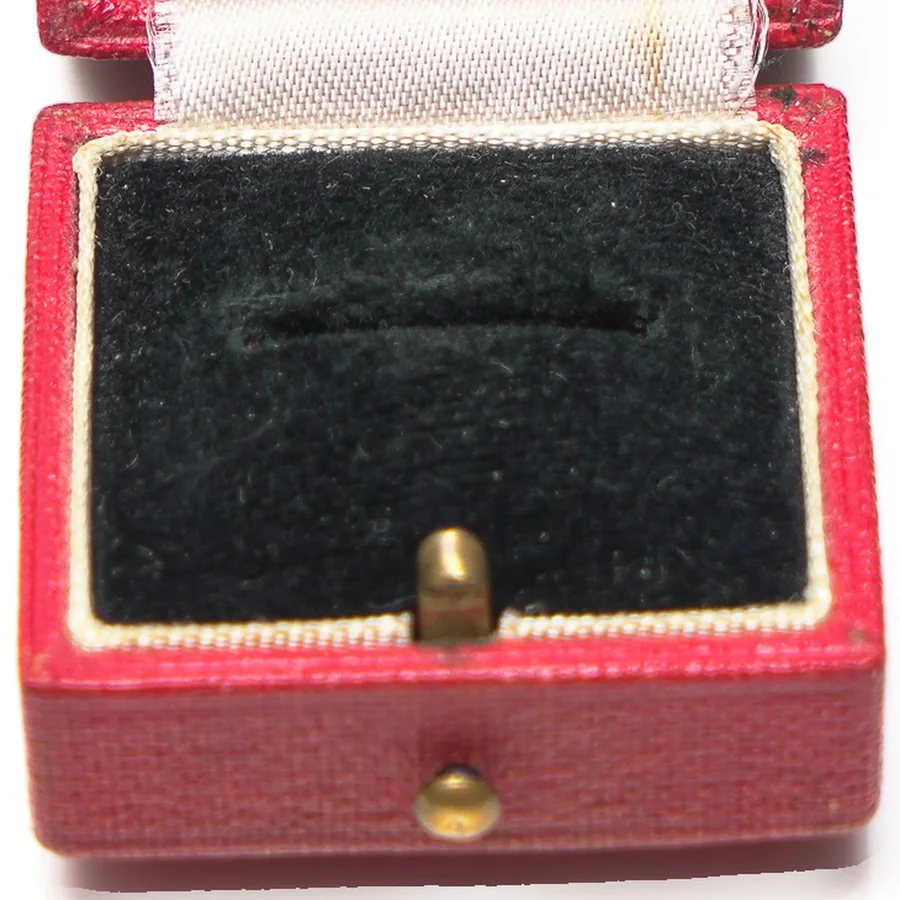
Ring slots and wells
A ring box has a velvet pad cut with a single slot; the shank drops in and the head sits upright. Twin slots take a pair of earrings or cufflinks. A round well takes a pendant, a coin or a watch.
Browse our ring boxes, brooch boxes and cufflink and dress set boxes.
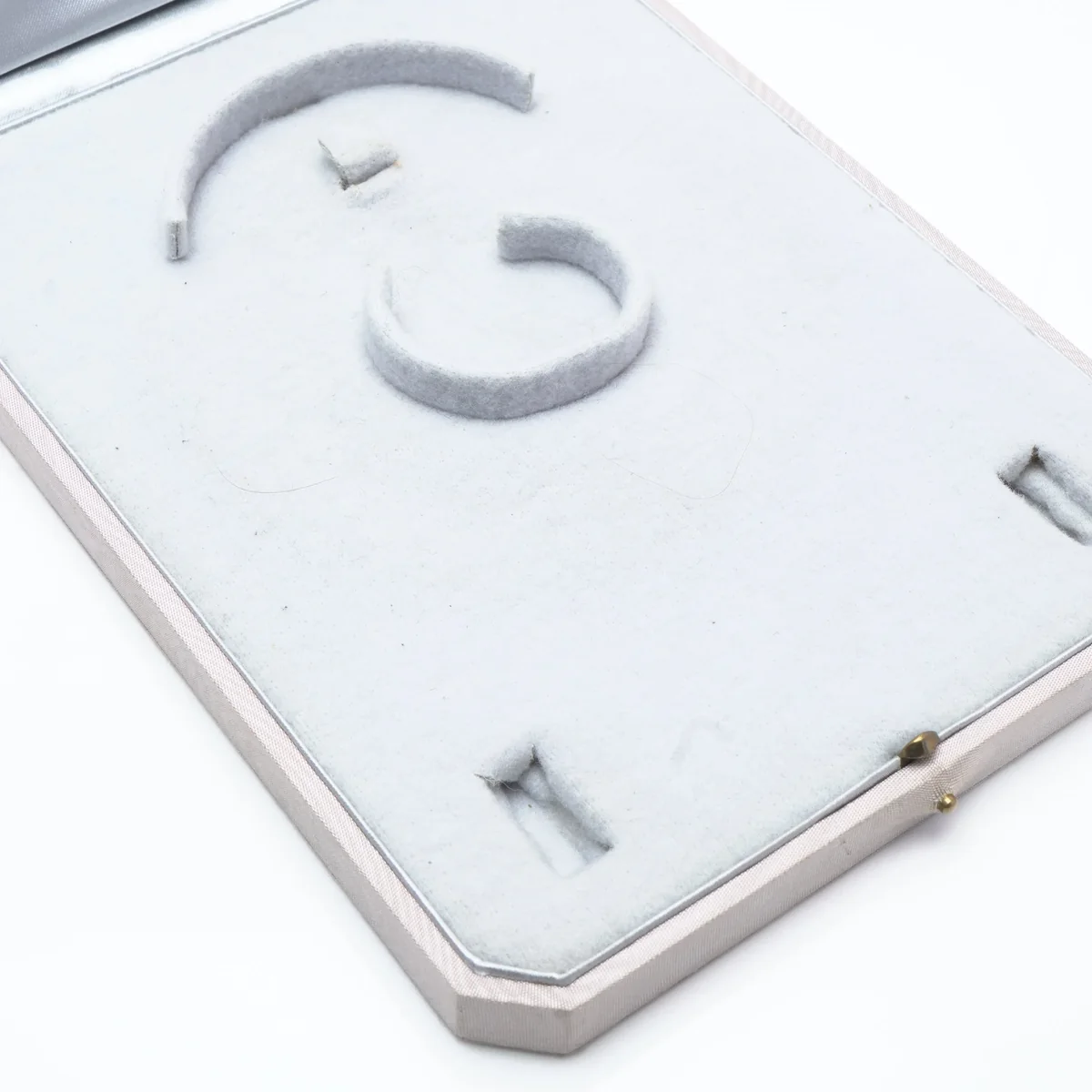
Suite trays
A suite or parure box is moulded for several jewels at once: a curved channel for a necklace, posts or slots for earrings and a pad for a brooch. The shapes tell you which pieces belonged together.
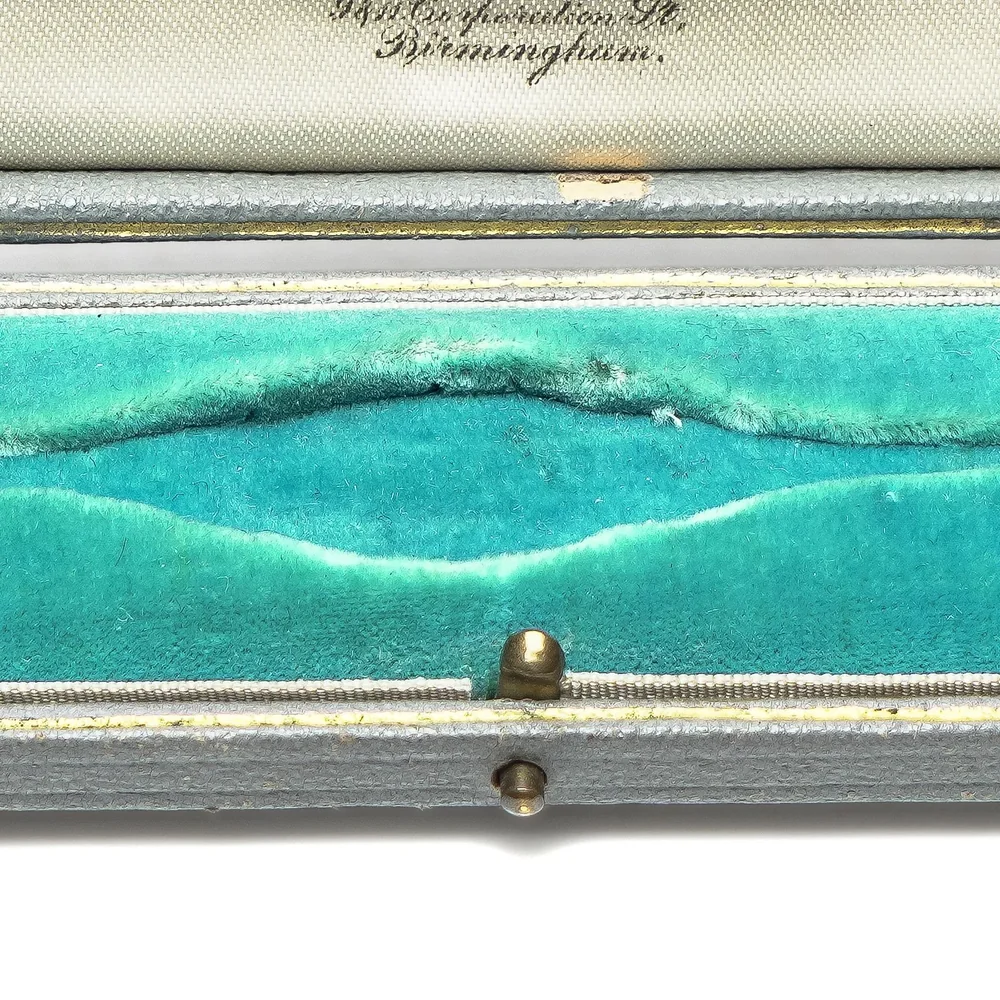
Long beds
A long box with a raised, curved bed holds a bracelet or a wristwatch open. Necklace boxes are wider and often flat. See our bracelet boxes, necklace boxes and watch boxes.
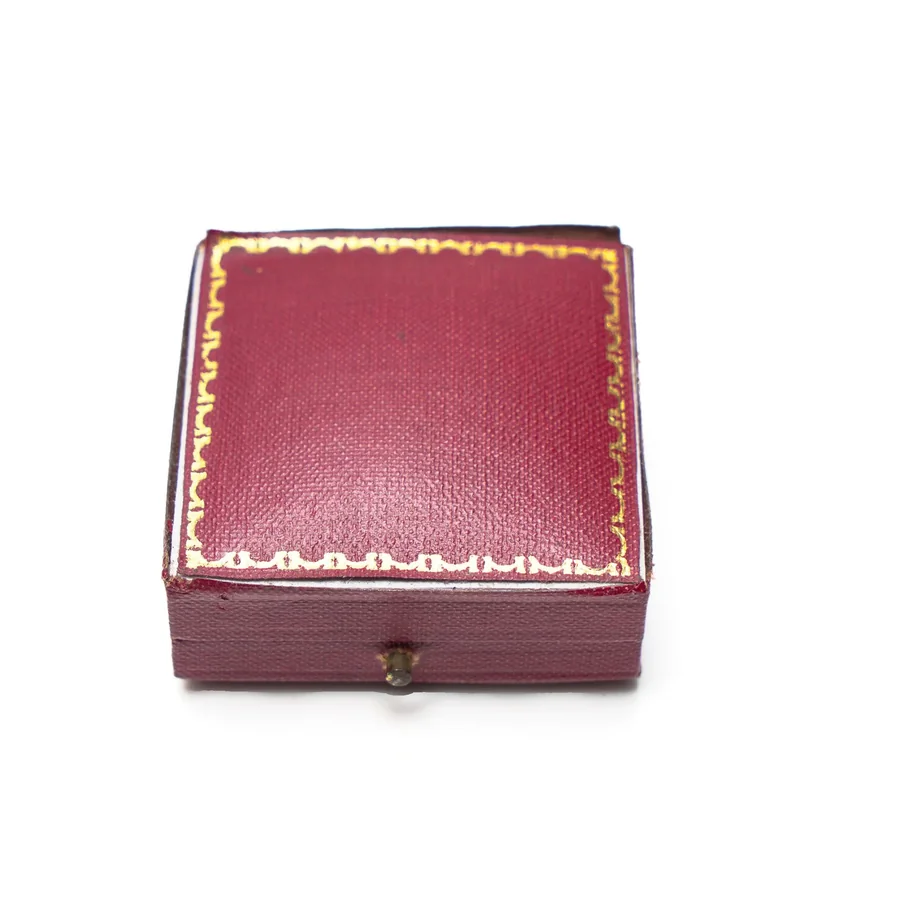
Catches
Most boxes close with a sprung push button at the front; others use a small hook and eye at the side. Check that the catch holds and the hinge is sound before a box goes back into use.
For the fastenings on the jewels themselves, see our guide to antique necklace clasps.
Free valuation
Request a free valuation
If you have a jewel in its original box, or a box from one of the jewellers in this register, send us a few photos. A specialist will reply by email with an estimate within one working day.
What to photograph
- The jewel and its box. Front on, in good daylight, the box open and closed.
- The marks and the lid. Hallmarks or signatures close up, and the printed name inside the lid.
- Any paperwork. Receipts, certificates or an old valuation.
Prefer email? Send photos to info@mozerisfineantiques.com or call 01376 334482. There is no obligation to sell.
Coverings: leather, shagreen, velvet and ivory-coloured cases
Most retailers' boxes are covered in grained leather or leather paper with a gilt tooled line border; others are velvet, suede, shagreen-pattern paper or a moulded ivory-coloured case. The covering helps match a box to a house, but it is the lid that dates it.
- Leather and leather paper. Red, green, navy and brown are the usual colours, often with a gilt border round the lid.
- Shagreen pattern. Paper or leather embossed to look like sharkskin, as on our J.W. Benson ring box MFA-B-188.
- Moulded ivory-coloured cases. Small rounded cubes with a cream push button, such as the Benson Royal Exchange box MFA-B-262.
- Velvet and suede. Crushed velvet on the Wartski box of the 1970s, suede on many later designer boxes.
Designer house boxes: Cartier, Tiffany, Hancocks, Asprey and Garrard
A great house's box is dated the same way: by the addresses and wording on the lid. These are the house histories behind the rows in the register.
- Cartier. A lid naming New York 653 Fifth Avenue, Paris 13 Rue de la Paix and London 175 New Bond Street dates from 1917 or later, when the New York branch moved into 653 Fifth Avenue. Must de Cartier boxes date from 1973 on. More in our Cartier history and Must de Cartier guide.
- Hancocks. C.F. Hancock opened at 39 Bruton Street on 1 January 1849, moved in 1917, traded at Burlington Gardens from 1970 and in Burlington Arcade from 1998.
- Asprey. The Fenchurch Street lid, with its E.C.3 district, is from 1917 or later. Read about the house in our Asprey jewellery guide.
- Garrard. R. & S. Garrard & Co. of the Haymarket became Garrard & Co Ltd in 1909, moved to Albemarle Street in 1911 and to 112 Regent Street after merging with the Goldsmiths & Silversmiths Company in 1952.
- Tiffany & Co. Tiffany boxes need the same reading of the lid; histories give different dates for the early London branch, so we leave them out of the register. See our Tiffany history.
Does a box matter when you sell a jewel?
An original fitted box that matches the jewel adds evidence: it names the retailer and dates the sale, and buyers of signed and designer pieces look for it. A box that fits the jewel exactly, with a legible lid and sound hinge and catch, is the best kind.
Value still rests on the jewel: its maker, metal, stones, condition and history. Keep the box with the piece, do not clean or repair the silk, and send photos of both. Our guides to signed jewellery and designer jewellery authentication explain what we check.
How selling works
- Send photosUse the form on this page, or email them to us.
- A specialist reviews itMaker, marks, age, condition and the box.
- Free estimate by emailWithin one working day.
- You decidePaid by bank transfer once agreed. No obligation.
Ways to sell
- Mayfair, 47 Maddox Street (by appointment)
- Braintree, Essex (by appointment)
- Royal Mail Special Delivery
- Free FedEx collection
We buy directly, with payment once you accept our offer, and we can also sell for you by consignment or at auction. Mozeris has traded since 2015 and is five-star rated: read our Google reviews.
More on selling: antique jewellery, Victorian jewellery, Edwardian jewellery, designer jewellery, Cartier and Tiffany & Co.. Inherited a jewel in its box? Our inherited jewellery guide explains what to do first.
- The printed lid of an antique jewellery box names the retailer and dates the box.
- Royal warrant wording, Ltd, the postal district and the address each set a window.
- The fitting inside shows what the box was made to hold.
- Keep an original box with its jewel, and send photos of both for a free valuation.
Questions we are asked
How can I tell how old an antique jewellery box is?
Read the printed lid. The jeweller's name, address, postal district, royal warrant wording and the word Ltd each fix a date window, and together they usually narrow it to a few decades.
Does the name inside the box mean that jeweller made the jewel?
No. The name is the retailer that sold the jewel. The box was made by a case maker and the jewel may come from another workshop.
What does By appointment to the King on a box mean?
The retailer held a royal warrant from the reigning King. On a British lid that means 1901 to 1952, or from 2022.
What does W.1 or E.C.4 on a box lid tell me?
Numbered London postal districts began in 1917, so a lid with W.1 or E.C.4 was printed in 1917 or later. A plain W. or E.C. points to 1858 to 1917.
Is a box marked Est. 1778 from 1778?
No. Est. gives the year the firm says it was founded. The rest of the lid dates the box.
What was a jewellery box with a long curved bed made for?
A bracelet or a wristwatch. The curved velvet bed holds it open, and a ring slot, circular well or suite tray shows a box made for other jewels.
Does an original box make antique jewellery more desirable?
An original fitted box that matches the jewel names the retailer and supports its history, and buyers of signed pieces look for it. The jewel itself still decides its value.
Can you value a jewel and its box?
Yes. Send photos of the jewel, its marks, the box open and closed and the printed lid, and we will reply with a free estimate within one working day, with no obligation to sell.
Value or sell antique jewellery and its box
Tell us about the jewel, and the box it came in, in the form below. We will reply by email with a free, no-obligation estimate within one working day.
Or call 01376 334482, WhatsApp us, or book an appointment in Mayfair or Braintree.