Antique jewellery guide
How to Date Antique Jewellery: The Earliest-Date Register
To date antique jewellery, find the newest feature on the piece, not the oldest-looking one. Every hallmark, metal, stone, cut and clasp has an earliest possible year: 15ct gold from 1854, 14ct from 1932, a 750 inside a British hallmark from 1975, cubic zirconia from 1976. The latest of those dates is the earliest the piece can be.
A register of 80 sourced dates for marks, metals, stones, cuts and fittings, and how to use them.
Reviewed by Faustas Svencionis, Mozeris Fine Antiques, Mayfair and Braintree, since 2015 · Updated October 2026
Key takeaways
- The newest feature sets the date. A Victorian-style ring with a 750 in its British hallmark was hallmarked in 1975 or later.
- Carat marks are dated by law. 15ct and 12ct ran from 1854 to 1932, 14ct began in 1932, and the crown with a three-figure number began in 1975.
- Stones and fittings have start dates too. Synthetic ruby from 1902, cultured pearls from 1893, cubic zirconia from 1976, screw-back earrings from 1894.
- Date each part. Stones are reset and clasps replaced, so a ring can carry a Georgian diamond on a later shank.
Date by the latest feature, not the oldest look
An antique piece can be no older than its newest original feature. Style can be copied at any time, but a mark, a material or a fitting cannot appear before it existed.
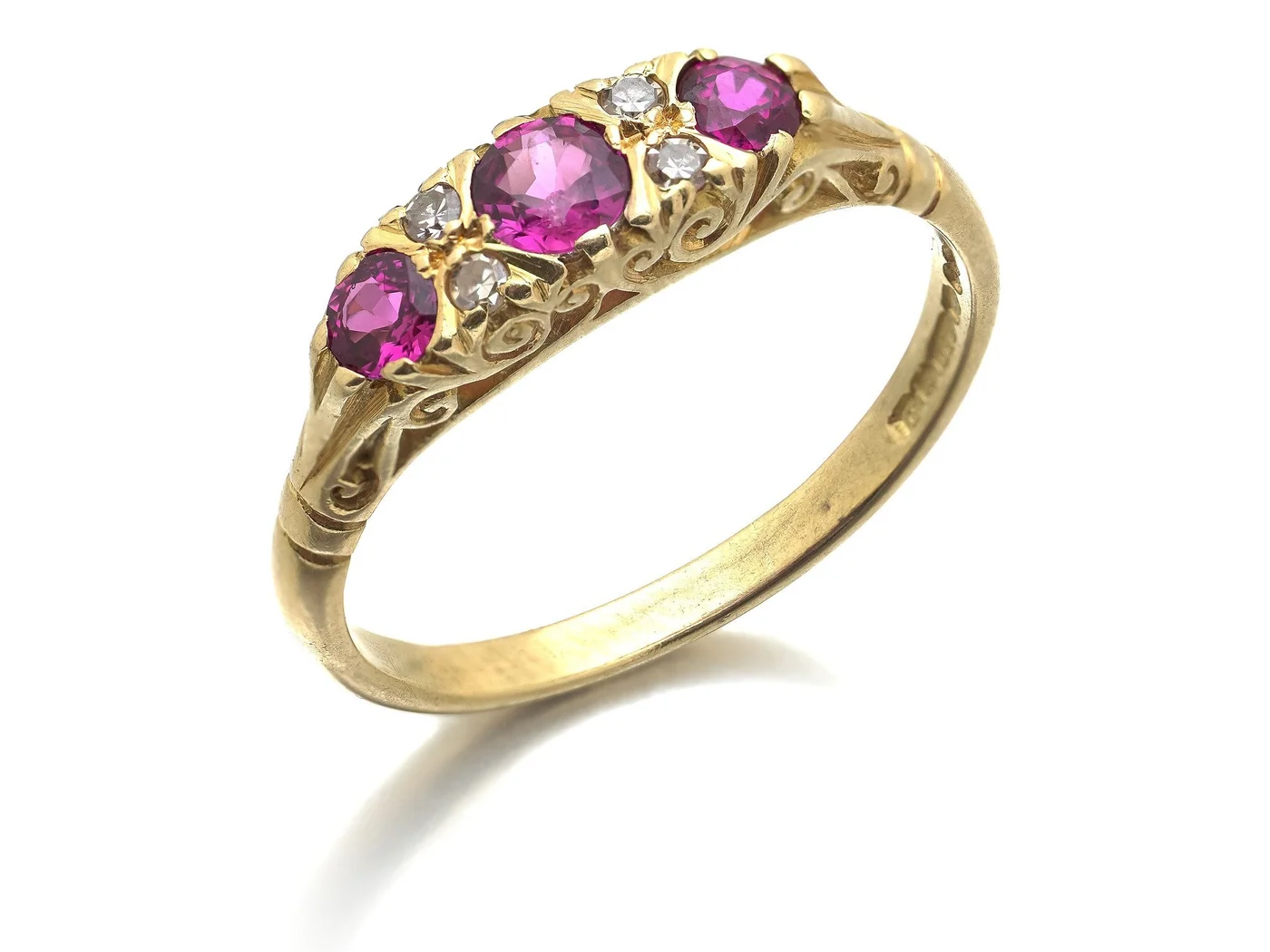
Our ruby and diamond half hoop ring, MFA-J26-135, shows why. It has every Victorian feature: three rubies divided by pairs of small diamonds, a carved scroll gallery and a slim tapering shank. Our Victorian jewellery guide shows the originals it follows.
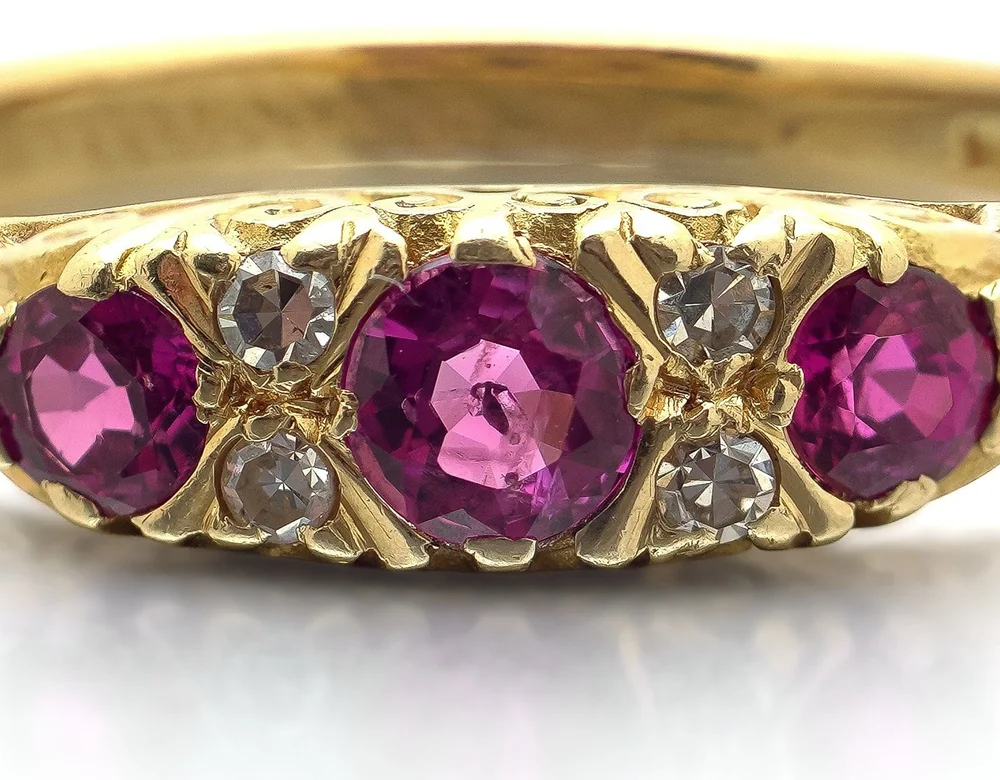
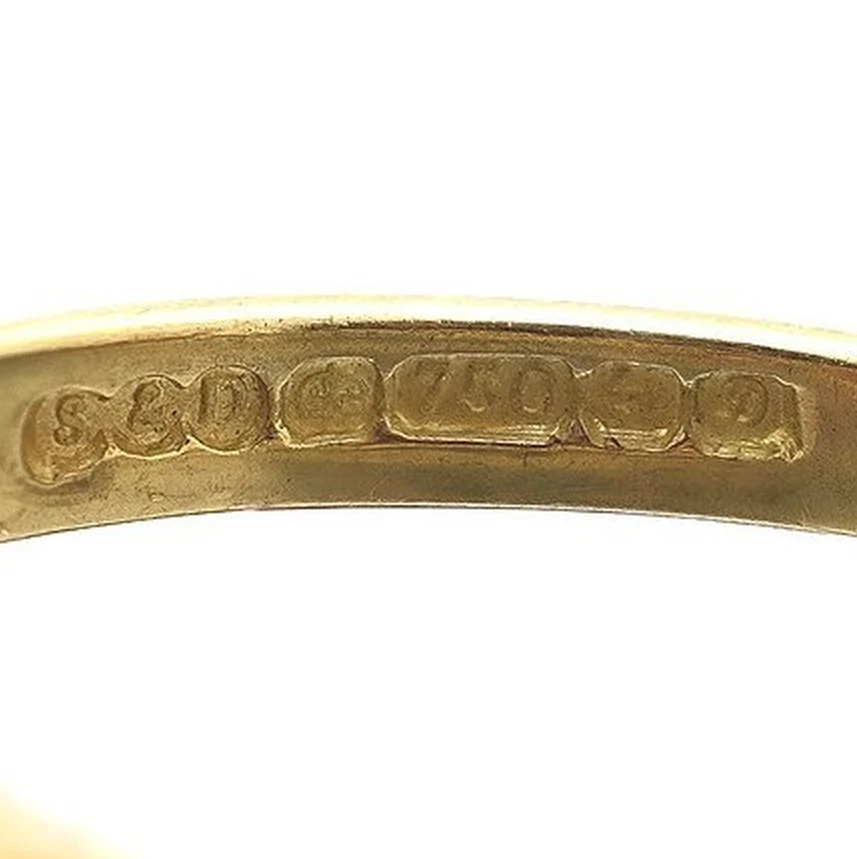
Inside the shank the hallmark reads S&D, a crown, 750, the Birmingham anchor and a date letter. The crown with 750 is the British gold standard mark set by the Hallmarking Act 1973, which came into force in 1975. Before 1975, 18 carat gold was marked with a crown and 18. So the ring was hallmarked in 1975 or later, whatever its style says.
It is a well made later ring in the Victorian manner, and our listing describes it as an 18KT gold half hoop, hallmarked, with no Victorian date. The same test works on any hallmarked British gold: our gold hallmarks guide decodes every mark.
What we look for when a piece arrives
- The hallmark or stamp. Standard mark, town mark, date letter and sponsor, read with a loupe.
- The stones. Cut, natural or synthetic, and whether they are original to the mount.
- The construction. Hand-made or cast, solder repairs, replaced shanks and later fittings.
- The fittings. Clasps, catches, hinges and earring backs, each with its own start date.
- The wear. Even, honest wear in the places that touch skin and clothing.
Sources: Hallmarking Act 1973, Schedule 2; Assay Office London.
The earliest-date register
The register lists 80 marks, materials, cuts and fittings with the earliest year each one can appear and, where it ended, the last. Find every feature on your piece, then take the latest start date: the piece cannot be older than that.
Each row links its own source: the assay offices, the Hallmarking Act 1973, The National Archives, GIA, patents and museum or specialist references. A start date is the earliest a feature can appear, not proof that a piece was made then.
| Mark, material or fitting | Dates | What it tells you | Source |
|---|---|---|---|
| British hallmarks: the standard marks | |||
| Lion passant (sterling silver) | From 1544 | The lion has marked sterling since 1544. From 1999 it is optional beside the compulsory 925. | Assay Office London; Assay Office London, UK hallmarks |
| Britannia and the lion's head erased | 1697 to 1720 (compulsory) | The higher Britannia silver standard replaced sterling for these years; afterwards it stayed as an option. | Assay Office London |
| Crown and 18 (18 carat gold) | 1798 to 1974 | 18 carat was reintroduced in 1798 and marked with a crown and 18. From 1975 it reads crown and 750. | Assay Office London; Hallmarking Act 1973, Schedule 2 |
| Crown and 22 (22 carat gold) | 1844 to 1974 | 22 carat gold received its own crown and 22 in 1844. From 1975 it reads crown and 916. | Assay Office London; Hallmarking Act 1973, Schedule 2 |
| 15 carat (15 and .625) | 1854 to 1932 | A legal British standard for these years only, so a hallmarked 15ct piece is Victorian, Edwardian or early 20th century. | Assay Office London; Birmingham Assay Office |
| 12 carat (12 and .5) | 1854 to 1932 | Introduced with 15 and 9 carat and abolished with 15 carat in 1932. | Assay Office London; Birmingham Assay Office |
| 9 carat (9 and .375) | 1854 to 1974 | No British 9 carat hallmark exists before 1854. From 1975 the mark reads crown and 375. | Assay Office London; Birmingham Assay Office; Hallmarking Act 1973, Schedule 2 |
| 14 carat (14 and .585) | 1932 to 1974 | 14 carat replaced 15 and 12 carat in 1932. A British 14ct hallmark cannot be Victorian. | Birmingham Assay Office; Assay Office London |
| Crown with 375, 585, 750 or 916 | From 1975 | The Hallmarking Act 1973 made the gold standard mark a crown and a three-figure number. Inside a British hallmark, 750 means 1975 or later. | Hallmarking Act 1973, Schedule 2; Assay Office London |
| Orb and cross (platinum, 950) | From 1975 | Platinum became hallmarkable in Britain under the 1973 Act. There is no British platinum hallmark before 1975. | Hallmarking Act 1973, Schedule 2; Assay Office London |
| 925 in a shield, lion optional | From 1999 | The number became compulsory and the traditional symbol optional. | Assay Office London, UK hallmarks; Birmingham Assay Office |
| Pallas Athene head (palladium) | From 2009 (compulsory 2010) | Palladium became hallmarkable in 2009 and compulsory to hallmark from 1 January 2010. | Birmingham Assay Office |
| British hallmarks: town, duty and date marks | |||
| Date letter (London) | From 1478 | A date letter needs its town mark and its shield shape to be read. | Assay Office London |
| Edinburgh thistle | 1759 to 1974 | The thistle replaced the assay master's mark in 1759. | Edinburgh hallmarks |
| Birmingham anchor on silver | From 1773 | Birmingham Assay Office opened in 1773. | Birmingham Assay Office |
| Birmingham anchor on gold | From 1824 | Birmingham could hallmark gold only from 1824. | Birmingham Assay Office |
| Duty mark: the sovereign's head | 1784 to 1890 | A tax mark. Its presence dates a piece between these years; its absence alone proves nothing. | Birmingham Assay Office; Assay Office London |
| Uncrowned leopard's head (London) | From 1822 | London's leopard lost its crown in 1822. | Assay Office London |
| Gold wedding rings hallmarked | From 1855 | The Gold Wedding Ring Act brought wedding rings under hallmarking. | Birmingham Assay Office; Assay Office London |
| Common date letter, changing 1 January | From 1975 | All British offices share one date letter from 1975, and it changes in January rather than mid-year. | Birmingham Assay Office |
| Edinburgh lion rampant | From 1975 | Edinburgh marks sterling with a lion rampant in place of the thistle. | Hallmarking Act 1973, Schedule 2; Edinburgh hallmarks |
| Date letter optional | From 1999 | A modern British hallmark may have no date letter at all. | Birmingham Assay Office; Assay Office London, UK hallmarks |
| York town mark | To about 1857 | The York office closed in the 1850s. | Wikipedia, Assay office |
| Exeter town mark | To 1883 | The Exeter office closed in 1883. | Wikipedia, Assay office |
| Newcastle town mark | To 1884 | The Newcastle office closed in 1884. | Wikipedia, Assay office |
| Chester town mark | To 1962 | The Chester office closed in 1962. | Wikipedia, Assay office |
| Glasgow town mark | To 1964 | The Glasgow office closed on 31 March 1964. | Wikipedia, Assay office |
| British hallmarks: import and commemorative marks | |||
| F in an oval (imported) | 1867 to 1904 | Imported gold and silver hallmarked in Britain. | Assay Office London; Hall-Marking of Foreign Plate Act 1904 |
| Separate import marks | 1904 to 1998 | The 1904 Act gave imported plate its own marks; the 1998 amendments abolished them. | Hall-Marking of Foreign Plate Act 1904; Birmingham Assay Office |
| King and queen heads (Silver Jubilee) | 1934 to 1935 | The first voluntary commemorative mark, for George V and Queen Mary. | Assay Office London; Birmingham Assay Office |
| Coronation mark | 1953 to 1954 | For the coronation of Elizabeth II. | Assay Office London |
| Silver Jubilee mark | 1977 | Elizabeth II's Silver Jubilee. | Assay Office London |
| Millennium mark | 1999 to 2000 | A voluntary mark for the millennium. | Assay Office London |
| Golden, Diamond and Platinum Jubilee marks | 2002, 2012, 2022 | Each one fixes its piece to that year. | Assay Office London |
| Marks from other countries | |||
| British registered design: diamond mark | 1842 to 1883 | The diamond encodes the date the design was registered: the piece was made then or later. | The National Archives |
| British registered design: Rd No | From 1884 | A registered number replaced the diamond. | The National Archives |
| French eagle's head (18ct gold) | From 1838 | The French guarantee mark for 18 carat gold. | Adin, eagle's head hallmark |
| Russian kokoshnik, facing left | 1899 to 1908 | The head faces right from 1908. | silvercollection.it, kokoshnik |
| US karat stamps under federal law | From 1906 | The National Gold and Silver Stamping Act set the tolerances for 10K, 14K and other stamps. | 15 U.S.C. chapter 8 (Act of 13 June 1906) |
| Metals and finishes | |||
| Electroplated gilding | From 1840 | Elkington patented electroplating in 1840. | Wikipedia, Elkington & Co. |
| Platinum as a jewellery metal | From about 1900 | Cartier adopted platinum from about 1899; it became the setting of Edwardian and Art Deco diamond jewellery. | Johnson Matthey Technology Review; The Cartiers, platinum |
| White gold | From 1913 | The gold, palladium and nickel alloy was invented in 1913 and patented in 1915 by Karl Richter of Pforzheim. | Navette Jewellery, white gold |
| Synthetic and imitation stones | |||
| Synthetic ruby (Verneuil flame fusion) | From 1902 | Verneuil announced jewellery-sized synthetic rubies in 1902. Curved growth lines under a loupe are the tell. | Lang Antiques, synthetic corundum |
| Synthetic blue sapphire | From 1911 | Verneuil and the Heller Company were granted US patents in 1911. | Lang Antiques, synthetic corundum |
| Synthetic spinel | From the 1920s | Flame-fusion spinel was sold as faceted gems from the 1920s, often in imitation of other stones. | International Gem Society, synthetic spinel |
| Synthetic emerald | From 1935 | Carroll Chatham grew a one carat emerald in 1935. | Wikipedia, Carroll Chatham |
| Synthetic star ruby and sapphire (Linde) | From 1947 | Reported in Gems & Gemology in 1947. | Lang Antiques, synthetic corundum |
| Synthetic rutile | From the late 1940s | An early diamond imitation, with a yellowish tint and strong fire. | GIA, simulants |
| Strontium titanate | From the 1950s | A diamond imitation with fire more than four times diamond's. | GIA, simulants |
| Laboratory-grown diamond | From 1954 (gem quality 1970) | General Electric grew the first reproducible synthetic diamonds; gem-quality crystals followed around 1970. | GIA, synthetic diamonds |
| YAG and GGG | From the 1960s | Synthetic garnets used to imitate diamond. | GIA, simulants |
| Gilson synthetic opal | From 1974 | Pierre Gilson began to market synthetic opal in 1974. | International Gem Society, opal synthetics |
| Cubic zirconia | From 1976 | Commercial production began in 1976. | Wikipedia, Cubic zirconia |
| Synthetic moissanite | From 1998 | Introduced to the jewellery market in 1998. | Wikipedia, Moissanite |
| Pearls and newly found stones | |||
| Cultured pearls (Mikimoto) | From 1893 | Hemispherical in 1893, round in 1905, used widely in jewellery from the 1920s. | GIA, Japanese cultured pearls; Navette Jewellery, cultured pearls |
| Demantoid garnet | From 1868 | Found in the Ural Mountains in 1868. | Wikipedia, Demantoid |
| Black opal (Lightning Ridge) | From 1903 | The first parcel of black opal was sold in 1903. | GIA, Lightning Ridge |
| Tanzanite | From 1967 | Found in Tanzania in 1967; launched by Tiffany in 1968. | GIA, tanzanite |
| Tsavorite garnet | From 1967 | Found in 1967; introduced by Tiffany in 1974. | GIA, Gems & Gemology, tsavorite |
| Paraiba tourmaline | From 1989 | Found in Paraiba, Brazil, in 1989. | International Gem Society, Paraiba |
| Treatments | |||
| Irradiated blue topaz | From 1957 | First used in 1957 and widespread from the late 1970s. | GIA, topaz |
| Laser-drilled diamonds | From the mid-1960s | Fine drill holes from the surface to a dark inclusion. | JCK, laser drilling |
| Fracture-filled diamonds | From the 1980s | GIA first examined Yehuda filled diamonds in 1987. | GIA, filled diamonds |
| Beryllium-diffused sapphire | From 2001 | Appeared in the Bangkok market in late 2001. | GIA, beryllium in corundum |
| Lead-glass filled ruby | From 2004 | First reported by a Japanese laboratory in early 2004. | GIA, Gems & Gemology, Spring 2006 |
| Cuts and settings | |||
| Round outline by bruting machine (old European cut) | From 1874 | Morse and Field's bruting machine made round diamonds practical. | Lang Antiques, brilliant cut |
| Asscher cut | From 1902 | Designed and patented by Joseph Asscher in 1902. | Wikipedia, Asscher cut |
| Modern round brilliant proportions | From 1919 | Marcel Tolkowsky published Diamond Design in 1919. | Wikipedia, Marcel Tolkowsky |
| Mystery Set (Van Cleef & Arpels) | From 1933 | Patented in France in December 1933. | Van Cleef & Arpels, the Mystery Set |
| Clasps, catches and fittings | |||
| Bolt ring clasp | From the 1840s | The forerunner of the spring ring. | Navette Jewellery, clasps |
| Safety pin fastening | From 1849 | Walter Hunt patented the safety pin in 1849. | Navette Jewellery, the safety pin |
| Trombone catch | From the mid-1850s | A sliding tube that locks the brooch pin. | Navette Jewellery, the safety pin |
| Patented brooch safety attachment | From 1891 | An early US patent for a safety on a brooch pin. | US patent 460,296 (1891) |
| Screw-back earring fitting | From 1894 (common from the 1910s) | Patented by Tilford and Bennett in 1894. | Navette Jewellery, earring patents |
| Spring ring with a bale | From about 1900 | The spring ring grew out of the bolt ring. | Navette Jewellery, clasps |
| Post and butterfly back | From the 1920s | The modern stud fitting. | Navette Jewellery, earring patents |
| Omega back | From the 1960s | A hinged loop over a post. | Navette Jewellery, earring patents |
| Plastics | |||
| Celluloid | From 1870 | The Hyatt brothers' patent; used for imitation ivory and tortoiseshell. | Science History Institute, celluloid |
| Bakelite | From 1907 | Developed by Leo Baekeland in 1907 and patented in 1909. | Wikipedia, Bakelite |
| Lucite (acrylic) | From 1937 | DuPont's acrylic, popular in costume jewellery of the 1940s and 1950s. | Collectors Weekly, Lucite |
The register as a timeline
- 1784The duty mark (sovereign's head) begins. It ends in 1890.
- 18549, 12 and 15 carat gold become legal British standards.
- 1902Verneuil announces jewellery-sized synthetic rubies.
- 1919Tolkowsky publishes the modern round brilliant proportions.
- 193215 and 12 carat end; 14 carat begins.
- 1975Crown with 375, 585, 750 or 916 on gold; platinum hallmarked; one date letter for all offices.
- 1976Cubic zirconia goes into commercial production.
- 1998Synthetic moissanite reaches the jewellery market.
- 1999925 compulsory on silver; the lion and the date letter become optional.
- 2010Palladium hallmarking compulsory.
Sources: each row links its own source. Compiled by Mozeris Fine Antiques, October 2026. Corrections are welcome through our contact page.
Free valuation
Not sure how old your jewellery is? Request a free valuation
Send us photos of the piece, its marks and its clasp, and we will tell you what it is, when it was made and what it is worth.
A specialist looks at every request personally and replies by email with an estimate within one working day. There is no obligation to sell.
What to photograph
- The whole piece. Front and back, in daylight.
- The marks. Hallmarks or stamps, as close as your camera allows.
- The fittings. Clasp, catch or earring backs.
Prefer email? Send photos to info@mozerisfineantiques.com, call 01376 334482 or WhatsApp us.
Marks that date a piece
British hallmarks are the most precise dating evidence on jewellery, because the law fixed each mark's dates. Read the standard mark first, then the town mark and the date letter.
- Carat in figures and decimals. 15 .625, 12 .5 and 9 .375 began in 1854. 15 and 12 ended in 1932, when 14 .585 began.
- Crown with a three-figure number. 375, 585, 750 or 916 beside a crown means 1975 or later. Before 1975 the crown sat beside 18 or 22, and the lower carats had no crown.
- Platinum and palladium. The orb hallmark starts in 1975 and the Pallas Athene head in 2009, compulsory from 2010. See our platinum hallmarks guide.
- The date letter. From 1975 every office shares one letter, changing on 1 January. From 1999 the date letter is optional.
- Town marks that stopped. York, Exeter, Newcastle, Chester and Glasgow closed, so their marks set a latest date. Our assay offices guide covers each office.
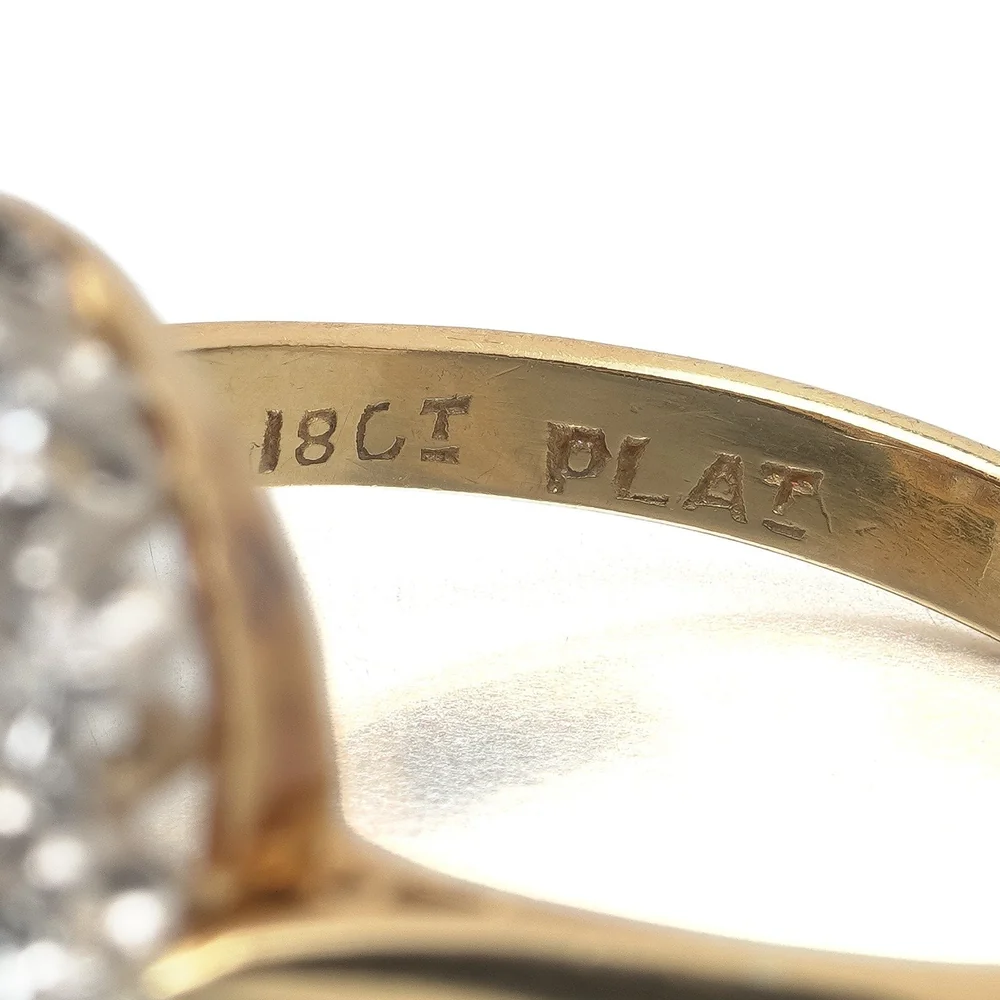
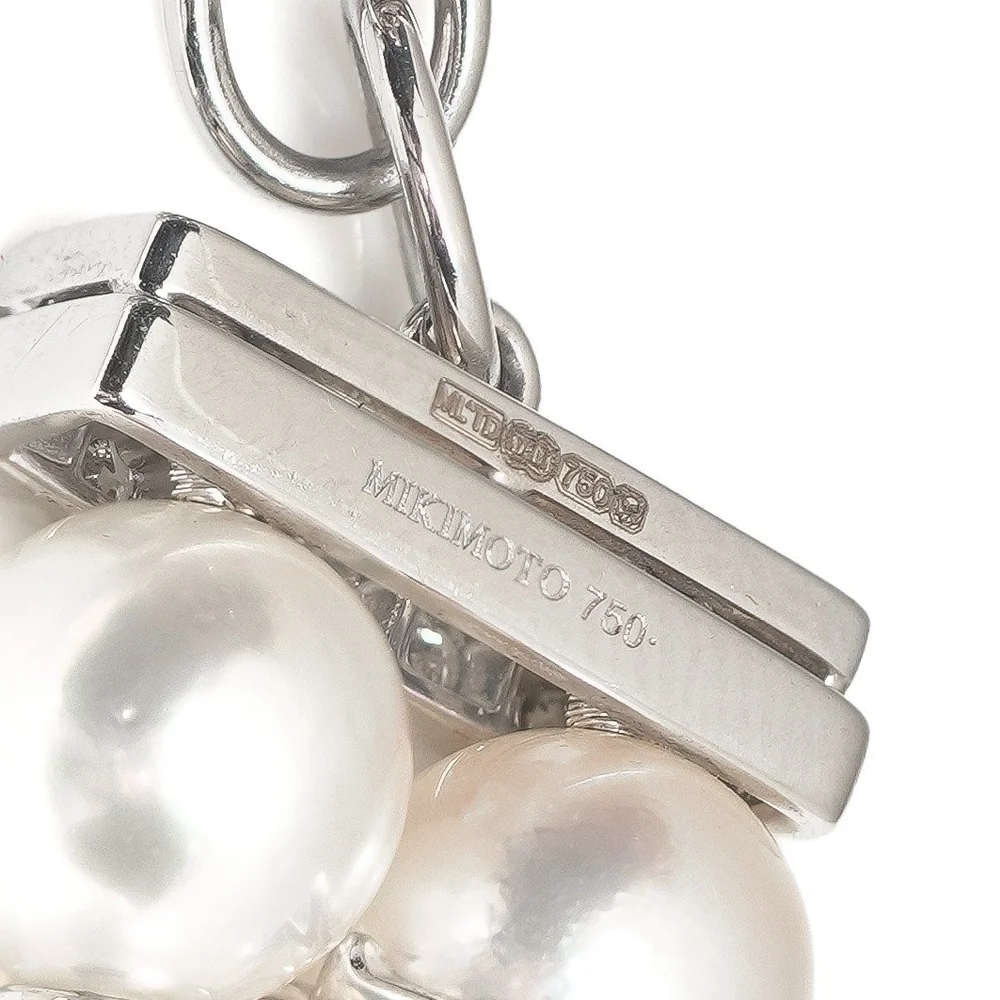
A stamp is not a hallmark. 18CT and PLAT stamped by a maker tell you the metals but give no town and no year. Our guide to hallmarks and maker's marks explains the difference, and how to identify fake gold jewellery covers stamps that lie.
Foreign marks have their own dates: the French eagle's head for 18 carat gold from 1838, the Russian kokoshnik from 1899, and US karat stamps under federal law from 1906.
Sources: Hallmarking Act 1973, Schedule 2; Assay Office London; Birmingham Assay Office; Assay Office London, UK hallmarks; Adin, eagle's head hallmark; silvercollection.it, kokoshnik; 15 U.S.C. chapter 8 (Act of 13 June 1906).
Materials and stones that date a piece
Synthetic stones, imitations and modern treatments each have a first year. One synthetic or treated stone in an original setting dates the whole piece to that year or later.
- Synthetic ruby and sapphire. Flame-fusion ruby from 1902 and blue sapphire from 1911. Under a loupe they show curved growth lines where natural stones show straight ones.
- Diamond imitations. Synthetic rutile from the late 1940s, strontium titanate from the 1950s, YAG and GGG from the 1960s, cubic zirconia from 1976 and moissanite from 1998.
- Cultured pearls. Mikimoto produced hemispherical cultured pearls in 1893 and round ones in 1905. Our natural and cultured pearls guide and Mikimoto guide explain how to tell them apart.
- White gold and platinum. Platinum jewellery from about 1900, white gold from 1913. Our guide is my ring platinum or white gold shows how to tell the two apart.
- New stones. Demantoid from 1868, black opal from 1903, tanzanite and tsavorite from 1967 and Paraiba tourmaline from 1989.
- Plastics. Celluloid from 1870, Bakelite from 1907 and Lucite from 1937.
A replaced stone dates only the repair. If one stone differs from the rest, the setting around it often shows the work.
Sources: Lang Antiques, synthetic corundum; GIA, simulants; Wikipedia, Cubic zirconia; Wikipedia, Moissanite; GIA, Japanese cultured pearls; Johnson Matthey Technology Review; Navette Jewellery, white gold; GIA, tanzanite; Wikipedia, Bakelite.
Clasps, catches and fittings
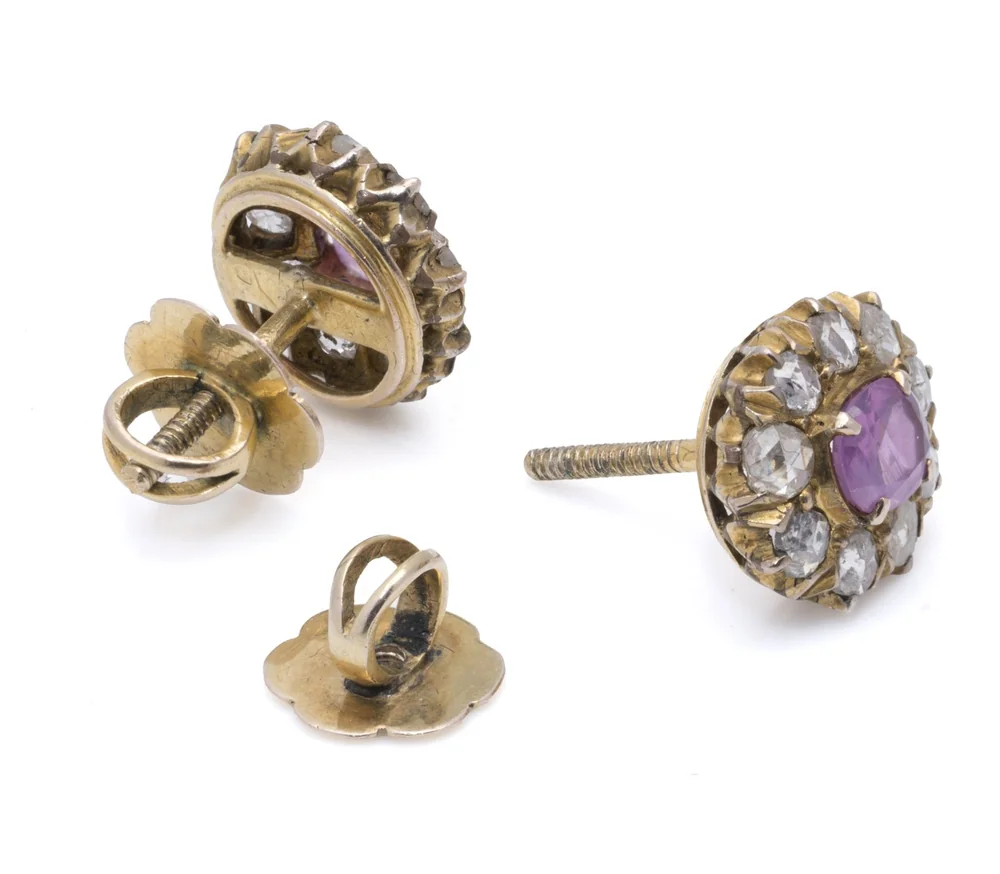
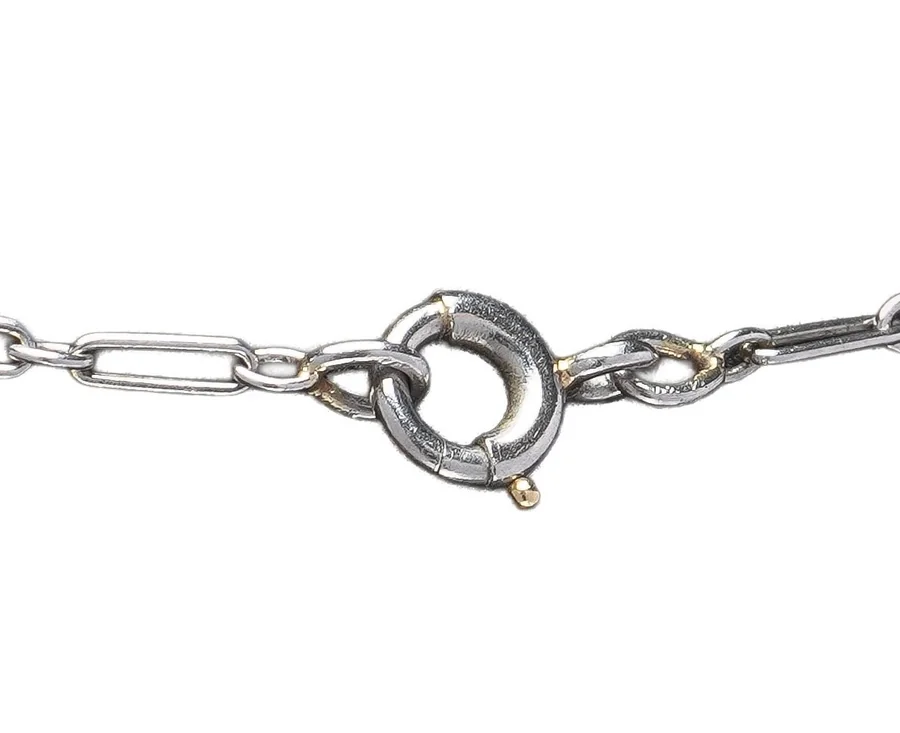
Fittings date a piece as well as marks do, as long as they are original. A clasp or earring back is the part most often replaced, so check that its metal, colour and wear match the rest. Screw fittings in particular were often added later to older earrings.
- Brooch pins. The trombone catch from the mid-1850s; patented safety attachments from 1891.
- Necklace clasps. The bolt ring from the 1840s, and the spring ring with a bale from about 1900.
- Earrings. Screw-back fittings were patented in 1894 and became common from the 1910s. The post and butterfly back belongs to the 1920s onwards and the omega back to the 1960s onwards.
Our guides to identifying antique and vintage necklace clasps and dating earrings by their fastenings show each type close up.
Sources: Navette Jewellery, the safety pin; US patent 460,296 (1891); Navette Jewellery, clasps; Navette Jewellery, earring patents.
Diamond cuts at a glance
The cut of a diamond places it in a period, but recutting and resetting are common, so the cut dates the stone rather than the mount.
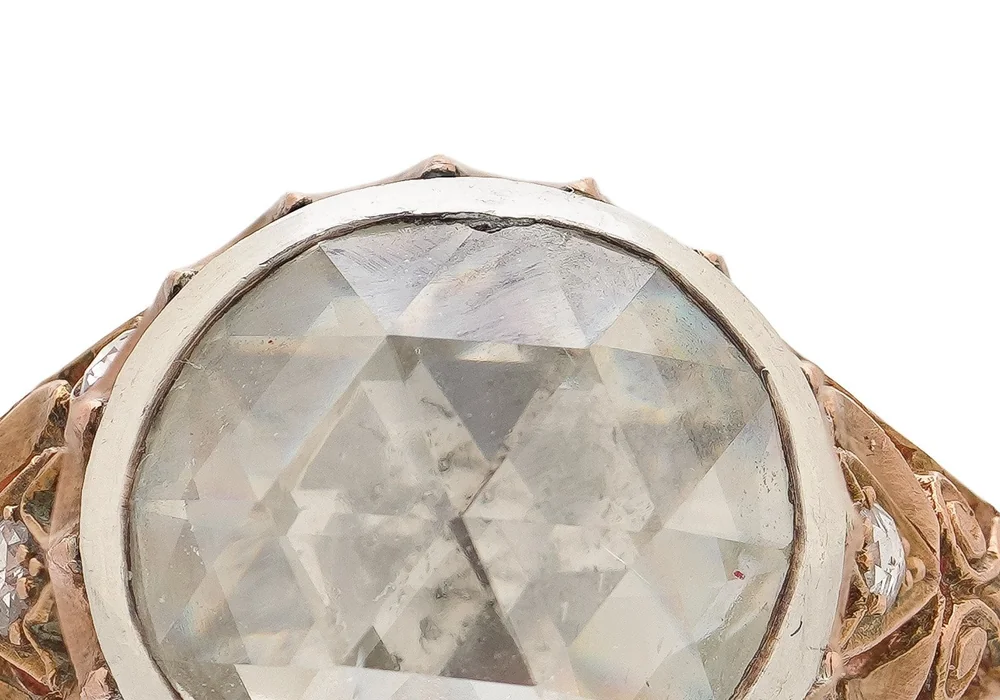
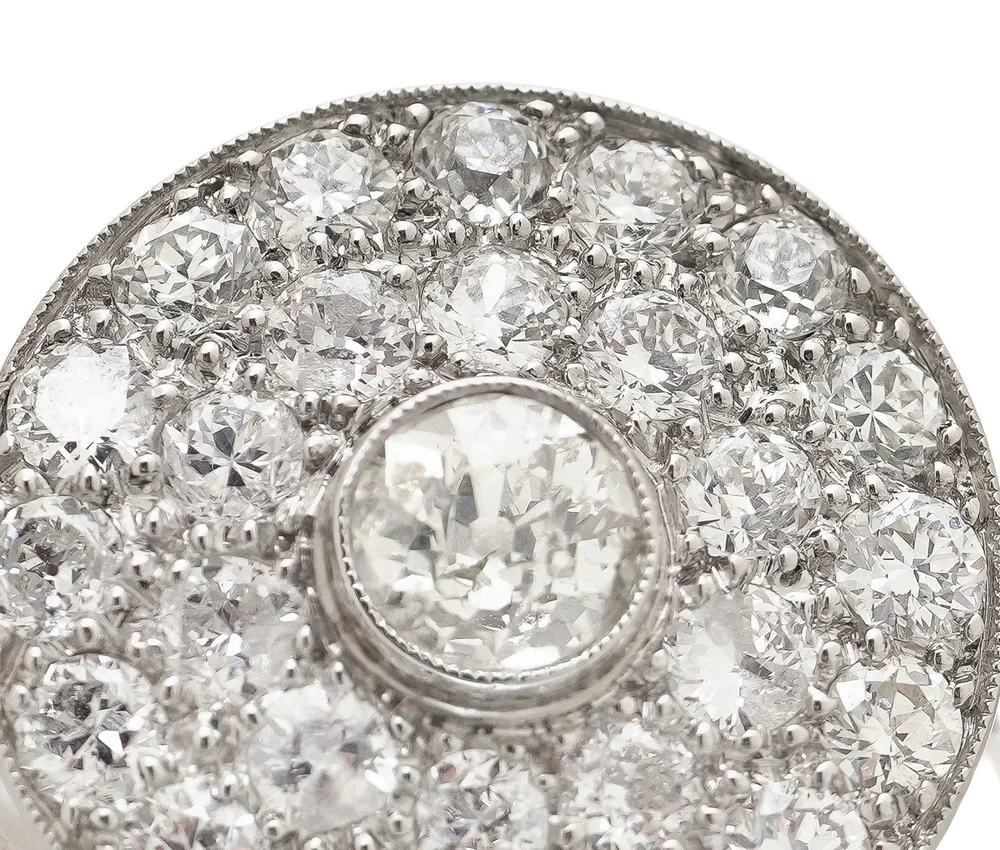
- Rose cut. A flat base and a dome of triangular facets. See rose cut diamond rings.
- Old mine cut. A cushion outline, high crown and open culet. See the old mine cut guide.
- Old European cut. A round outline, made practical by the bruting machine of 1874. See the old European cut guide.
- Modern round brilliant. Proportions published by Tolkowsky in 1919. A large table and a pointed culet point to the 20th century.
- Asscher cut. From 1902.
Our rose cut ring above shows why each part is dated separately: the Georgian diamond sits on a 15KT shank, and 15 carat gold was a British standard only from 1854 to 1932.
Sources: Lang Antiques, brilliant cut; Wikipedia, Marcel Tolkowsky; Wikipedia, Asscher cut; Assay Office London.
Victorian-style or Victorian? Seven tells of a reproduction
A reproduction is given away by one feature that did not exist in the period it copies. These seven are the ones we meet most often.
- A number inside a British gold hallmarkCrown with 375, 585 or 750 means 1975 or later, as on our ruby half hoop.
- 14 carat in a British hallmark14ct was not a British standard until 1932.
- A British platinum hallmarkThe orb starts in 1975.
- Cubic zirconia or moissaniteFrom 1976 and 1998.
- A synthetic ruby or sapphireFrom 1902 and 1911; look for curved growth lines.
- Modern brilliant proportionsA large table and a pointed culet follow Tolkowsky's 1919 proportions; old cuts have a small table and an open culet.
- A post and butterfly earring backFrom the 1920s, on earrings sold as Victorian.
One tell can be a later repair. Two or three together usually settle it. Reproductions are not fakes when they are sold as what they are: our note on Art Deco jewellery reproductions shows the same reasoning for the 1920s.
Sources: Hallmarking Act 1973, Schedule 2; Birmingham Assay Office; Wikipedia, Cubic zirconia; Wikipedia, Moissanite; Lang Antiques, synthetic corundum; Wikipedia, Marcel Tolkowsky; Navette Jewellery, earring patents.
When to get a second opinion
When the marks are worn, the stones are untested or the parts disagree, a specialist can date the piece in hand. Every piece is different, so we value each one individually.
- Period and originality. A piece that is all of one date, with its original stones and fittings.
- Metal and marks. Hallmarked gold and platinum, and a readable maker's mark.
- Stones. Natural stones and their cut.
- Maker. A known jeweller or a signed piece.
- Condition. Worn shanks, repairs and replaced parts.
- Provenance. Boxes, receipts and family history.
Send us a few photos and we will tell you what yours is worth, free and with no obligation.
How selling works
- Send photosUse the form on this page, or email them to us.
- A specialist reviews itMarks, metal, stones and fittings.
- Free estimate by emailWithin one working day.
- You decidePaid once agreed. No obligation.
Ways to sell
- Mayfair, 47 Maddox Street (by appointment)
- Braintree, Essex (by appointment)
- Royal Mail Special Delivery
- Free FedEx collection
We buy directly, with payment once you accept our offer, and we can also sell for you by consignment or at auction. Five-star rated: read our Google reviews.
We buy antique jewellery every week: see sell your antique jewellery, sell your Victorian jewellery and sell your gold jewellery. If the piece came to you with other jewellery, read inherited jewellery: what to do, and see how we authenticate antique jewellery.
Frequently asked questions
How do I date antique jewellery?
Find every mark, material, cut and fitting on the piece and look up the earliest year each could appear. The latest of those years is the earliest the piece can be, as long as the parts are original.
How can I tell the age of a gold ring from its hallmark?
Read the standard mark first. 15ct and 12ct mean 1854 to 1932, 14ct means 1932 or later, and a crown with 375, 585, 750 or 916 means 1975 or later. The town mark and date letter then give the year.
What does 750 mean on a ring?
750 means 18 carat gold, 750 parts per thousand. Inside a full British hallmark it means the ring was hallmarked in 1975 or later; on its own it is a maker's stamp and may be from any country.
When was 15ct gold used?
15 carat was a legal British gold standard from 1854 to 1932, so a hallmarked 15ct piece is Victorian, Edwardian or early 20th century.
Can a Victorian-looking piece be modern?
Yes. Victorian designs have been reproduced throughout the 20th century. A 750 in a British hallmark, 14ct marks, cubic zirconia or a post and butterfly back all show a later date.
Are screw-back earrings antique?
Screw-back fittings were patented in 1894 and became common from the 1910s, so they can be antique, but they are also often added later to older earrings.
When did cultured pearls appear?
Mikimoto produced hemispherical cultured pearls in 1893 and round ones in 1905. They were used widely in jewellery from the 1920s.
Can you date and value my jewellery?
Yes. Send us photos of the piece, its marks and its clasp, and we will reply by email with a free, no-obligation valuation. You can also visit us in Mayfair by appointment or in Braintree.
Free valuation
Date and value your jewellery
Ready to find out more about your piece? Send us a few photos using the form below.
A specialist looks at every request personally and replies by email with an estimate within one working day. There is no obligation to sell.
Prefer email? Send photos to info@mozerisfineantiques.com, call 01376 334482 or WhatsApp us.