Part of: Art Deco emerald jewellery
Emeralds have been mined for more than two thousand years. The earliest known mines were in the Eastern Desert of Egypt, worked in Ptolemaic and Roman times and later linked with Cleopatra. The great change came in the 1500s, when the Spanish reached the emerald mines of the Muisca people in Colombia; Colombian emeralds then travelled across the world, to the courts of Europe, the Ottoman Empire and Mughal India. Today Colombia, Zambia and Brazil are the main sources, and fine emeralds from the historic Colombian mines are known in the trade as "old mine" emeralds.
Have emerald jewellery to sell?
Free, no obligation, returned at our cost if you decline.

- Read our Google reviews (opens Google)
- Free, no obligation
- A reply within one working day
- Paid the same day after inspection
What is an emerald?
Emerald is the green variety of the mineral beryl, coloured by traces of chromium and vanadium. Most emeralds contain natural inclusions, which the French call "jardin" (garden). Emerald is hard but brittle, which is why the step-cut "emerald cut", with its cut corners, was developed to protect it.

Emerald history at a glance
- Ptolemaic and Roman Egypt
- What happened
- Emeralds mined in the Eastern Desert near the Red Sea, at sites such as Wadi Sikait
- Roman Empire
- What happened
- Emeralds worn as beads and in rings and earrings
- Before 1500
- What happened
- The Muisca people of Colombia mine and trade emeralds
- 1530s
- What happened
- Spanish conquistadors reach the Colombian emerald region; Chivor, then Muzo, come under Spanish control
- 1600s
- What happened
- Colombian emeralds shipped to Spain in the treasure fleets; the Atocha, wrecked in 1622, carried emeralds
- 1600s to 1700s
- What happened
- Colombian emeralds reach Mughal India, where large stones were carved and engraved
- 1900s
- What happened
- New deposits found in Africa, Brazil, Russia and elsewhere; Zambia becomes a major source


When were emeralds discovered?
Emeralds were known in the ancient world: the Egyptian mines in the Eastern Desert were worked in Ptolemaic and Roman times, and emerald appears in Roman jewellery. In South America the Muisca had mined emeralds in Colombia long before the Spanish arrived in the 1530s.
Colombian emeralds
Colombia’s mines, in the Boyacá region north of Bogotá, include Muzo, Chivor and Coscuez. Colombian emeralds are prized for a pure, intense green with a slightly bluish tone. Their arrival in Europe and Asia in the 1500s and 1600s made large emeralds available as never before, and many of the great historic emeralds in royal and Mughal collections are Colombian.
What is an old mine emerald?
"Old mine" is a trade term for emeralds from the historic Colombian mines, cut long ago and often found in antique jewellery. They are known for their deep, velvety green. The term describes the source and age of the stone, and a laboratory report can confirm Colombian origin.
The Bahia emerald
The Bahia emerald is a very large mass of emerald crystals in rock, found in Bahia, Brazil, in 2001. It is a mineral specimen rather than a gem, and it became famous for a long court battle over who owns it.
Emeralds in antique jewellery
- Georgian and Victorian. Emeralds set with diamonds in rings, brooches and en tremblant sprays like our Victorian brooch.
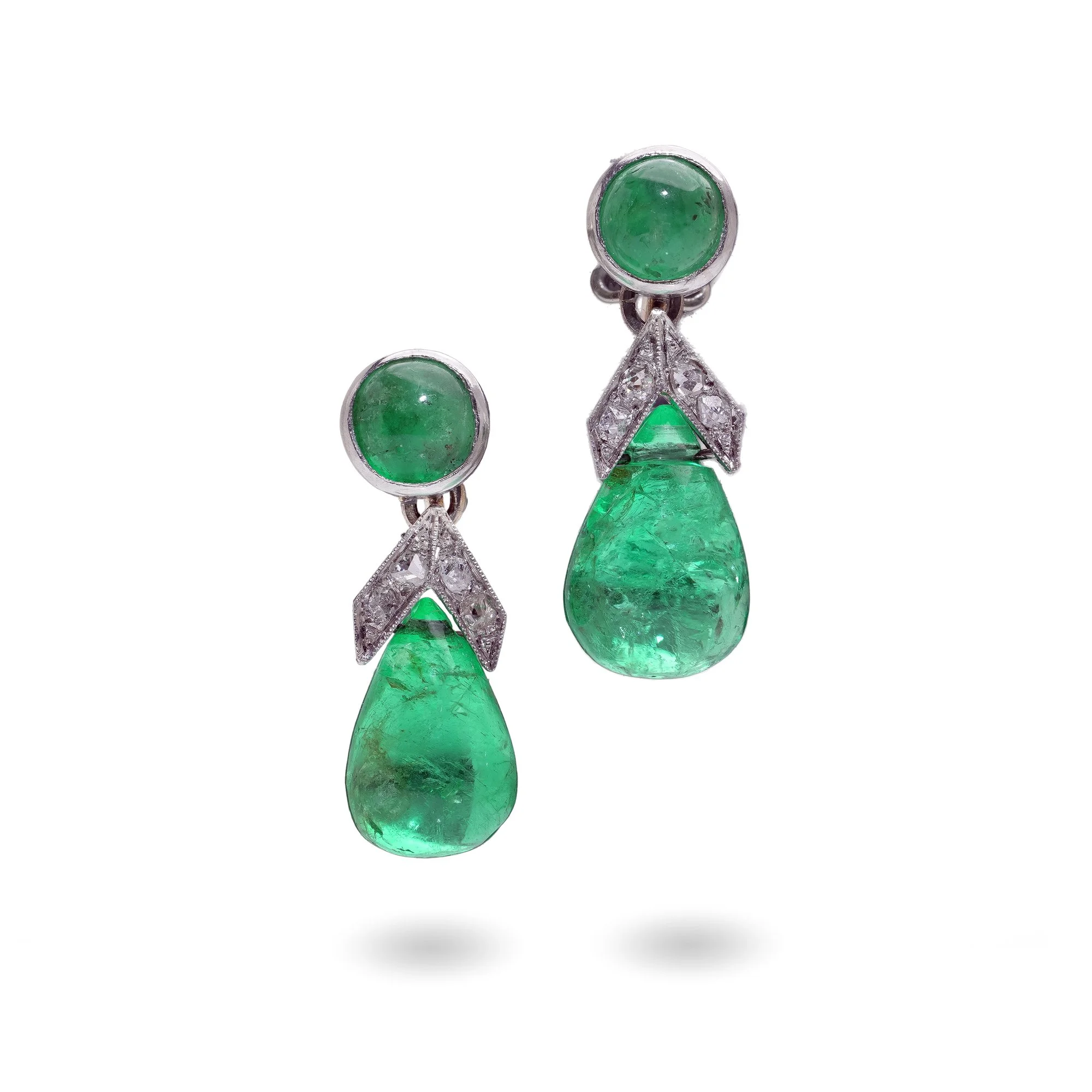
- Art Deco. Emeralds cut as cabochons, drops and step cuts, set in platinum with diamonds, as in our Art Deco earrings.
- Carved emeralds. Mughal-style carved and engraved emeralds appear in Cartier’s Tutti Frutti and Indian-inspired designs of the 1920s and 1930s.
Treatment and care
0 of 2 checked
1Most emeralds
Most emeralds are treated with oil or resin to fill surface-reaching fissures and improve clarity, a practice going back centuries.
2Avoid ultrasonic and steam cleaners
Avoid ultrasonic and steam cleaners, heat and harsh chemicals; clean emeralds with lukewarm soapy water and a soft brush.
Have emerald jewellery to sell? Send clear photographs of the piece and any certificate for a free, honest check.
Free, no obligation, returned at our cost if you decline.
What makes an emerald valuable?
The colour (a vivid, even green leads), the clarity and how visible the inclusions are, the size, the cut, the origin (Colombian and old mine stones are sought after), the degree of treatment and any laboratory report, then the maker and period of the jewel. We never publish figures; every piece is different.
Free, no obligation, and returned at our cost if you decline.
Read our Google reviews (opens Google)
- Colour
- Clarity
- Size
- Cut
- Origin
- Treatment
How selling works
- 1
Send photographs
of the piece and any certificate or box.
- 2
Free value inspection
We reply within one working day with an estimate, subject to inspection. If our offer differs, you can decline and we return it at our cost.
- 3
Paid the same day after inspection
by bank transfer or in cash, in Mayfair, at our Braintree office, by post or by free collection.
Questions people ask
When were emeralds first discovered?
Emeralds were mined in Egypt’s Eastern Desert in Ptolemaic and Roman times, and the Muisca were mining them in Colombia before the Spanish arrived in the 1530s.
Where do the best emeralds come from?
Colombia is the most famous source, from mines such as Muzo and Chivor; Zambia and Brazil are also major producers.
What is an old mine emerald?
A trade term for an emerald from the historic Colombian mines, often found in antique jewellery and known for its deep green.
What is the Bahia emerald?
A huge mass of emerald crystals in rock found in Bahia, Brazil, in 2001, known for a long legal fight over its ownership.
Why do emeralds have inclusions?
Emeralds grow with natural inclusions and fissures; a "jardin" of inclusions is normal and helps to tell a natural emerald from a synthetic.
Are emeralds treated?
Most are oiled or filled with resin to improve clarity. A laboratory report states the degree of treatment.
Related guides
Have an emerald piece to sell?
Send a few photographs and we will tell you what it is and what it is worth, free.
Free, no obligation, returned at our cost if you decline.