Moissanite vs Diamond: How to Tell the Difference
A dealer's guide to moissanite and diamond: what each is made of, the loupe checks that separate them, why a basic tester is fooled, how lab-grown diamond fits in, and what a moissanite in an old ring tells you.
Diamond is pure carbon, the hardest natural material at 10 on the Mohs scale, and singly refractive. Moissanite is silicon carbide, made in laboratories for jewellery since 1998, slightly softer at about 9.25, doubly refractive and more than twice as dispersive, so it throws stronger rainbow flashes than a diamond.
- Moissanite is silicon carbide; diamond is carbon. Both are hard, but only diamond reaches 10 on the Mohs scale.
- Moissanite is doubly refractive: through the side of the stone its facet edges look doubled.
- A thermal diamond tester reads moissanite as diamond; an electrical or multi tester separates them.
- Gem moissanite dates from 1998, so in an antique ring it is always a replacement stone.
In this article
Moissanite and diamond: the short answer
Diamond is crystallised carbon. Moissanite is silicon carbide, a different mineral that Henri Moissan found in 1893 in rock from Canyon Diablo, Arizona, and first took for diamond (Wikipedia). Natural moissanite is extremely rare, and every moissanite in jewellery is made in a laboratory. It came onto the jewellery market in 1998 as a diamond alternative.
| Diamond | Moissanite | |
|---|---|---|
| Material | Carbon, cubic crystal | Silicon carbide, hexagonal crystal |
| Hardness (Mohs) | 10 | About 9.25 |
| Refraction | Single | Double: facet edges look doubled |
| Refractive index | 2.42 | 2.65 to 2.69 |
| Dispersion (fire) | 0.044 | 0.104, more than twice diamond |
| Specific gravity | 3.52 | 3.22: slightly lighter for its size |
| Thermal tester | Reads diamond | Also reads diamond |
| Electrical tester | Most diamonds do not conduct | Conducts |
| In antique jewellery | Yes, in every period | Only as a replacement, since 1998 |
Sources: GIA, Gems & Gemology 1997; Wikipedia, Moissanite; Wikipedia, Diamond.
Why moissanite looks different
Moissanite bends light more than diamond and splits it into colours more than twice as strongly. In daylight that shows as bold rainbow flashes, especially in larger stones. A diamond shows more white brilliance and a finer mix of colour.
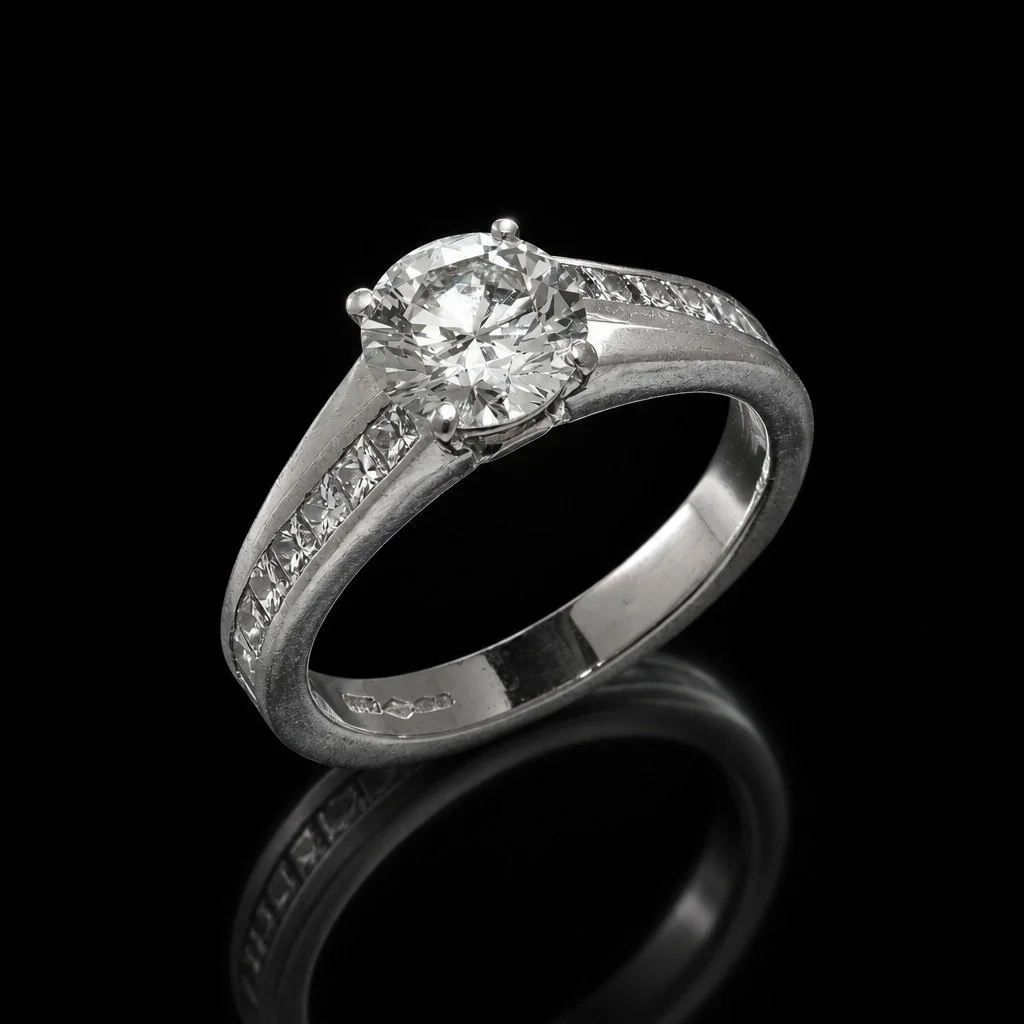
Our 1.60 ct platinum solitaire shows the balance of white light and fire that a well cut diamond gives.
How to tell moissanite from a diamond
Five checks sort most stones before any instrument is needed. None is proof on its own; together they point clearly one way.
- Look for doubling
Turn the stone and look through the side of the crown with a 10x loupe at the facet edges on the far side. In moissanite they look doubled, like a slightly blurred second line. In diamond they stay single and sharp. Looking straight down the table may hide the doubling, so tilt the stone (GIA).
- Watch the fire
Strong rainbow flashes across the whole stone, even indoors, point to moissanite. Diamond fire is real but finer.
- Look at the inclusions
Moissanite often shows fine parallel needles or stringers, and these too look doubled (GIA). Diamonds show crystals, feathers and clouds.
- Feel the weight
Moissanite is about 9% lighter than diamond, so a loose moissanite of the same size weighs less. In a mounted ring this is hard to judge.
- Use the right tester
A thermal tester alone reads moissanite as diamond. A combined tester that also checks electrical conductivity separates them.
A basic diamond pen tests heat only, and moissanite carries heat almost as well as diamond. When moissanite first appeared, GIA found standard thermal probes read it as diamond. Use a moissanite or multi tester, or ask a gemmologist.
For the other look-alikes, from cubic zirconia to white sapphire and glass, see how to tell if a diamond is real.
Moissanite, lab-grown diamond and natural diamond
Three things are often mixed up. A natural diamond is mined. A lab-grown diamond is diamond made in a factory: GIA describes it as having essentially the same chemical, physical and optical properties as natural diamond (GIA). Moissanite is neither: it is a different material.
| Natural diamond | Lab-grown diamond | Moissanite | |
|---|---|---|---|
| What it is | Carbon, mined | Carbon, made in a factory | Silicon carbide, made in a factory |
| Hardness | 10 | 10 | About 9.25 |
| Doubled facet edges | No | No | Yes |
| Separated by | A gem laboratory | A loupe or a moissanite tester | |
| Graded on the 4Cs | Yes | Yes | Not by GIA's diamond system |
When buying, ask what the stone is and get it in writing. Any important diamond should have a laboratory report from GIA or another recognised laboratory, which states whether it is natural or laboratory-grown.
Moissanite in old and antique-style rings
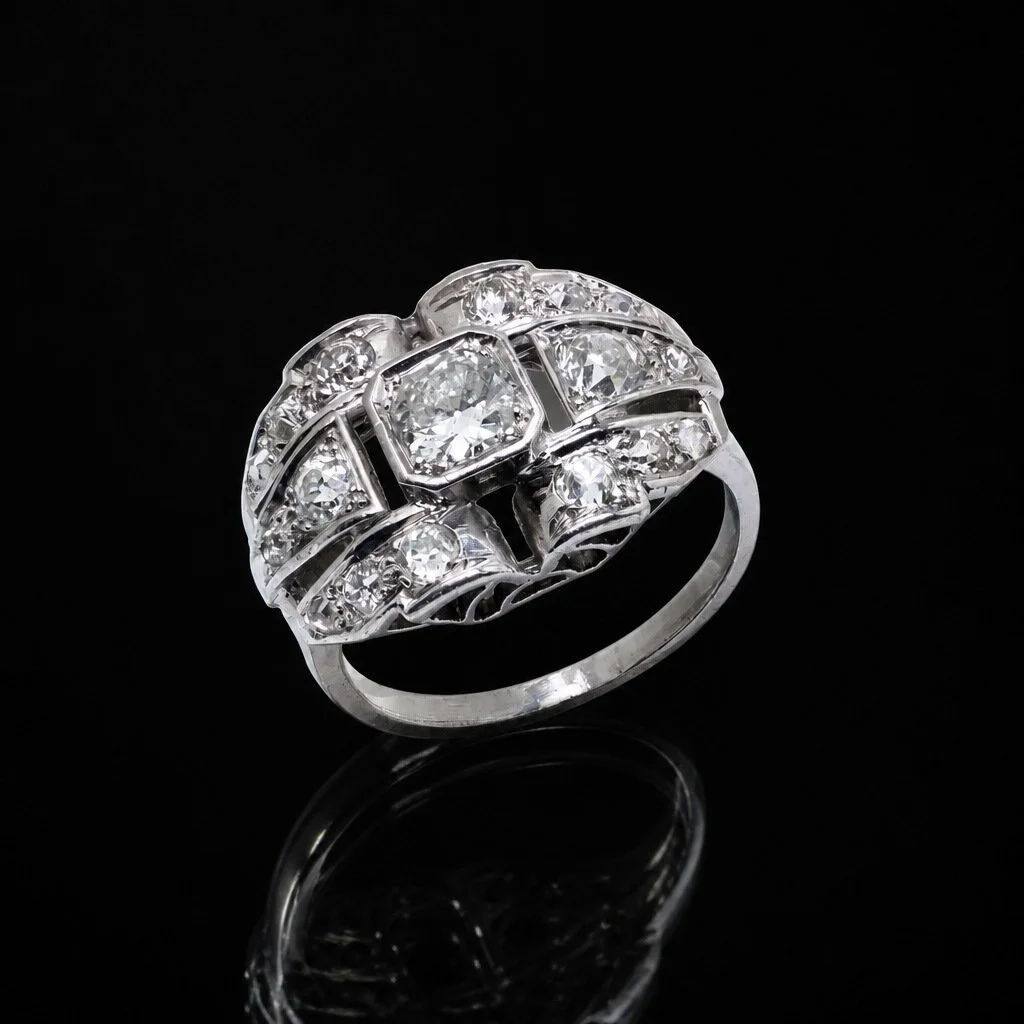
A stone made since 1998
Gem moissanite reached jewellers in 1998. A Victorian, Edwardian or Art Deco ring cannot have been set with it when new, so a moissanite in an old setting means a stone has been replaced.
Moissanite is now cut in old mine and old European styles too, so an old-looking cut is not proof of an old diamond. Our old cut diamonds guide explains how genuine old cuts differ: hand-cut, slightly uneven facets, a small table and often an open culet.
Checks on an old ring
- Compare the stones: one stone much brighter or more fiery than the rest has often been replaced.
- Look at the claws: fresh, sharp or retipped claws around one stone show it has been reset.
- Check the cut: perfectly even, machine-sharp facets in a 1910 ring point to a modern stone.
- Read the hallmark: it dates the mount, not the stone. See platinum or white gold for the marks.
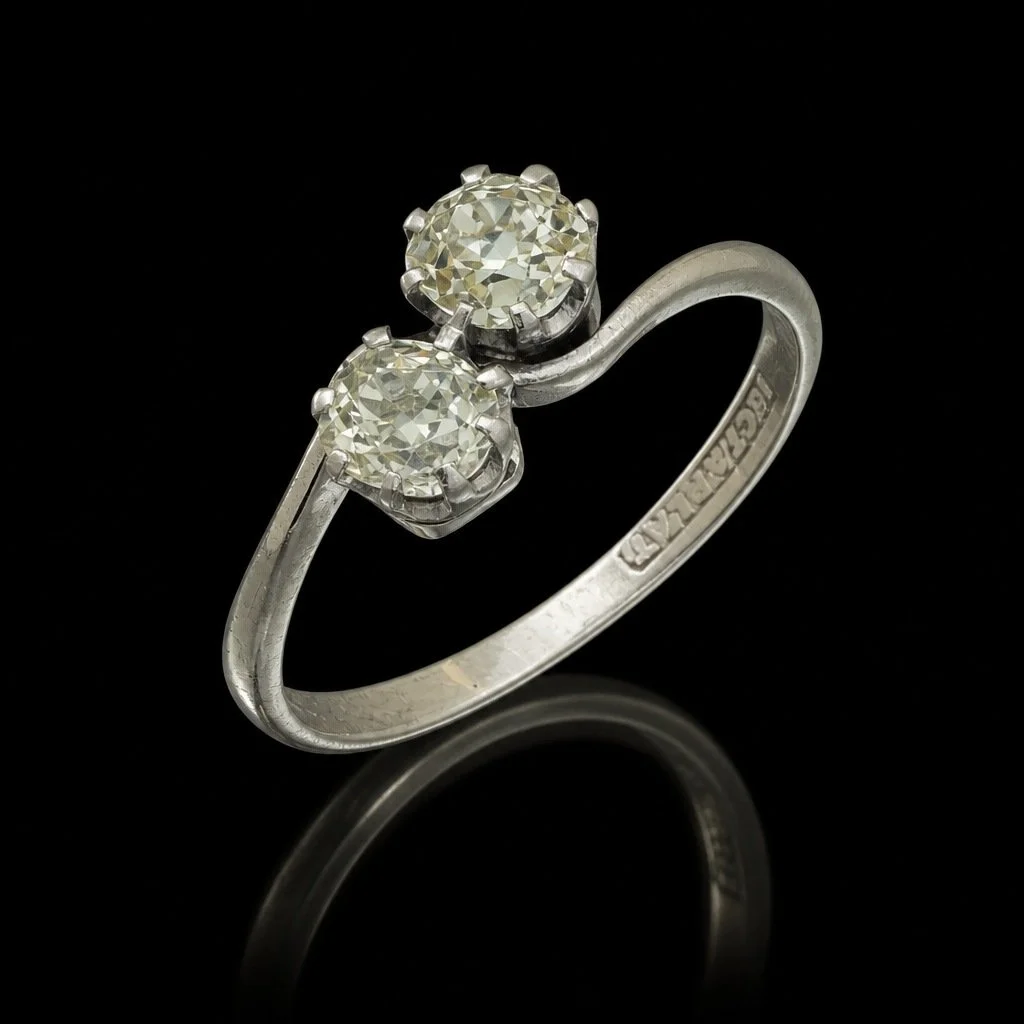
Every diamond we sell is described by cut, weight and period, as on our antique toi et moi ring with two old European cut diamonds. Browse old cut diamond jewellery and diamond engagement rings.
How diamonds are graded: the 4Cs in brief
Diamonds are graded on four factors that GIA set out as the 4Cs: cut, colour, clarity and carat weight (GIA). Moissanite is not graded on GIA's diamond scales.
| Factor | What it measures | Scale |
|---|---|---|
| Cut | How well the facets return light | Excellent to Poor (round brilliants) |
| Colour | How colourless the diamond is | D (colourless) to Z (light yellow or brown) |
| Clarity | Inclusions and blemishes at 10x | Flawless to Included (I1 to I3) |
| Carat | Weight | 1 ct is 0.2 g, divided into 100 points |
More in the four Cs explained and the diamond shapes guide. Old mine and old European cuts were cut by eye for candle and gas light, so modern cut grades do not fit them; they are judged on their own terms (old European cut, old mine cut).
Engagement and eternity rings
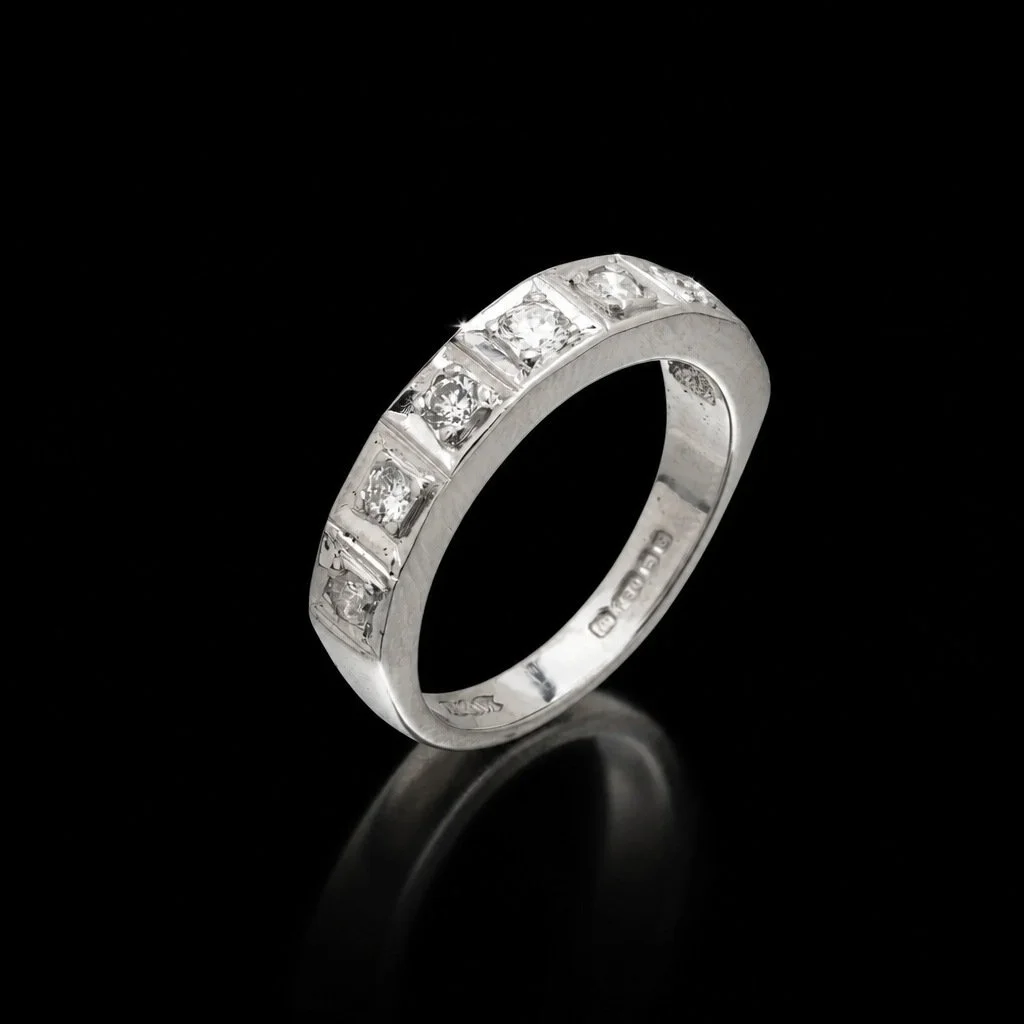
In an eternity ring every stone should match in colour and brilliance. A ring that mixes diamond and moissanite shows it: the moissanite flashes rainbow colours the others do not.
See our 1970s half eternity ring and the full eternity rings range, and how to choose an engagement ring.
Valuing and selling a diamond ring
Before any valuation we confirm the stone is diamond. After that a ring is valued on the diamond's cut, colour, clarity and carat, any certificate, the metal and setting, the maker and the period. Antique cuts and signed pieces can be worth more than the stones alone.
Every ring is different. Send us photos of the front, the side and the hallmark, with any certificate, and we will tell you what yours is worth, free and with no obligation. Request a free valuation.
- Sell a diamond ring: how we value and buy diamond rings
- Sell antique jewellery: Georgian to Art Deco
- Appointments are available at our Mayfair and Braintree offices.
Sources
- Nassau, McClure, Elen and Shigley, Synthetic Moissanite: A New Diamond Substitute, Gems & Gemology, Winter 1997
- GIA, Gem News International, Gems & Gemology, Summer 2016
- GIA, diamond quality factors (the 4Cs)
- GIA, laboratory-grown diamonds
- Wikipedia, Moissanite and Wikipedia, Diamond
- Moissanite is silicon carbide, about 9.25 on the Mohs scale; diamond is carbon, 10.
- Doubled facet edges and strong rainbow fire point to moissanite.
- Thermal testers are fooled; electrical testers and gemmologists are not.
- A moissanite in an antique ring is a replacement: gem moissanite dates from 1998.
Questions we are asked
What is the difference between moissanite and diamond?
Diamond is pure carbon, the hardest natural material at 10 on the Mohs scale, and singly refractive. Moissanite is silicon carbide, made in laboratories for jewellery since 1998, slightly softer at about 9.25, doubly refractive and more than twice as dispersive, so it throws stronger rainbow flashes than a diamond.
How can you tell moissanite from a diamond?
Look through the side of the stone with a 10x loupe: moissanite is doubly refractive, so the back facet edges look doubled, while a diamond's look single. Moissanite also shows stronger rainbow fire and is slightly lighter for its size. A moissanite tester or a gemmologist settles any doubt in seconds.
Will a diamond tester detect moissanite?
A basic thermal diamond tester will not. Moissanite carries heat almost as well as diamond, so a thermal probe reads it as diamond, which GIA reported when moissanite first appeared in 1997. A combined tester that also measures electrical conductivity separates the two, because moissanite conducts electricity and most diamonds do not.
Is moissanite a fake diamond?
Moissanite is a real gemstone in its own right, silicon carbide, but it is not diamond. Sold honestly as moissanite it is a diamond alternative; sold as diamond it is a misdescription. Natural moissanite is extremely rare, so the stones in jewellery are made in laboratories.
Is moissanite the same as a lab-grown diamond?
No. A lab-grown diamond is diamond: carbon with the same chemical, physical and optical properties as a mined diamond. Moissanite is a different material, silicon carbide, with its own hardness, brilliance and double refraction. A gemmologist can separate moissanite from any diamond; separating lab-grown from mined diamond needs a laboratory.
Can an antique ring have a moissanite stone?
Only if the stone has been replaced. Gem moissanite reached jewellers in 1998, so a Victorian, Edwardian or Art Deco ring set with moissanite has had a stone changed in recent years. Moissanite is now also cut in old mine and old European styles, so an old-looking cut does not prove an old diamond.
Does moissanite scratch or go cloudy?
Moissanite is very hard, about 9.25 on the Mohs scale, so it resists scratching in daily wear and does not go cloudy. Like a diamond, it can look dull when grease builds up on the back facets, and warm soapy water with a soft brush restores it. Only diamond is harder.
How is a diamond ring valued?
A diamond ring is valued on the diamond's cut, colour, clarity and carat weight, any laboratory certificate, the metal and setting, and the maker. Antique cuts and signed pieces can be worth more than the stones alone. We first confirm the stone is diamond, not moissanite or another simulant, then value it free from photographs.
Where is moissanite found, and can you buy natural moissanite?
Natural moissanite occurs only in tiny grains, first found in rock from the Canyon Diablo meteorite crater in Arizona and later in a few other rocks. The grains are far too small and rare to cut as gems, so every moissanite sold in jewellery is laboratory made, not natural.
Where can I buy a moissanite ring?
Moissanite rings are sold mainly by online jewellers and some high street shops. Whoever you buy from, check the listing names the stone as moissanite, states the metal and its hallmark, and gives the stone's size in millimetres. Mozeris sells antique and vintage diamond and gemstone rings rather than moissanite.
What should I look for when buying moissanite jewellery?
Check the colour, since older moissanite can look slightly green or yellow and newer stones are near colourless; the cut, which decides how much it sparkles; the metal and its hallmark; and whether the setting holds the stone securely. Ask for the stone's size in millimetres and the seller's returns terms.
What do VVS and GRA mean on moissanite?
VVS is a clarity term borrowed from diamond grading, meaning very very slightly included. On moissanite it is a seller's description, because GIA does not grade moissanite on its diamond scales. GRA reports come with many moissanite pieces sold online; they are not reports from the major gem laboratories.
Are there different grades and types of moissanite?
Yes. Moissanite varies in colour, from near colourless to faintly green, yellow or grey, and in clarity and cutting quality, which affect how it looks. Sellers grade these themselves, often using diamond terms. It is also made in coloured versions and cut in modern and old styles, including old European cuts.
Can you sell moissanite, and is it worth anything?
Moissanite is manufactured in any quantity, so on the second-hand market a moissanite ring is usually valued on its gold or platinum and any maker rather than the stone. We buy gold and platinum jewellery: send photographs and the hallmark for a free valuation within one working day.
Is a moissanite ring a good choice for an engagement ring?
Moissanite is hard, about 9.25 on the Mohs scale, so it wears well every day, and it is very brilliant. It is not diamond, and it shows stronger rainbow flashes than a diamond, which some people prefer and others do not. Buy it described clearly as moissanite, with a hallmarked gold or platinum mount.
Is moissanite shinier than diamond?
Moissanite has a higher refractive index than diamond and more than twice its dispersion, so it returns more light and throws stronger rainbow flashes, especially in sunlight and in larger stones. A well cut diamond shows more white brilliance and finer colour. Many people can tell the two apart by that fire alone.
Can I wear a moissanite ring every day, in the shower or in water?
Yes. Moissanite is hard and stable and is not harmed by water, so you can wear it every day. Soap and lotion leave a film on the back of the stone that dulls it, so take it off to wash, swim in chlorinated water or apply creams. The metal setting needs the same care as any ring.
How do you clean moissanite? Can you use vinegar?
Warm water, mild washing-up liquid and a soft toothbrush clean moissanite best: brush behind the stone, rinse and dry with a lint-free cloth. Mild solutions do not harm the stone itself, but acids such as vinegar can dull some metals and other gemstones in the same piece, so soapy water is safer.
Can moissanite have inclusions?
Yes. Laboratory-made moissanite often contains fine needle-like inclusions or stringers, and because the stone is doubly refractive these look doubled under a loupe, which helps tell moissanite from diamond. Better stones show few inclusions, and many look clean to the naked eye.
What is a Portuguese cut?
A Portuguese cut is a round cut with extra rows of facets on the crown and the pavilion, giving a dense, glittering pattern of small flashes rather than the larger flashes of a round brilliant. It is used for moissanite and for coloured gemstones, and it takes longer to cut than a standard brilliant.
Is moissanite sold in carats?
Moissanite can be weighed in carats like any gem, but it is lighter than diamond, so a moissanite the same size as a 1 ct diamond weighs less. Sellers therefore often describe moissanite by its size in millimetres or as a diamond-equivalent weight. Compare stones by millimetre size rather than carats.
Does moissanite float or sink in water?
Moissanite sinks, like diamond, because it is far denser than water, with a specific gravity of about 3.22 against diamond's 3.52. Floating tests do not separate gems. A loupe showing doubled facet edges, or a multi tester, is the reliable way to tell moissanite from diamond.
Shop diamond rings, or find out what yours is worth
Browse antique and vintage diamond rings, each described by cut, weight and period. Selling? The valuation is free, from photographs.
- We buy directly
- Free valuation from photos
- Appointments in Mayfair and Braintree
- Insured postage or collection
New pieces reach our list first: join the Mozeris list.