Grandfather Clock Value: What Is Your Longcase Clock Worth?
An honest UK guide to grandfather and longcase clock values: why many are worth less than families expect, which are valuable, and how to tell what you have.
What a grandfather clock is worth depends on a few things you can check yourself:
- Typical: many decorative longcase clocks are worth less than families expect.
- Valuable: named makers, 8-day movements and original cases; early London clocks reach six figures, such as a Tompion at £114,700 (Bonhams, 2023).
- Quick check: no winding holes means 30-hour, two means 8-day, three means chiming.
- Modern: Howard Miller, Ridgeway and "Tempus Fugit" clocks often resell for a fraction of their new price.
In this article
- Grandfather, longcase or grandmother clock?
- Why most grandfather clocks are worth less than you expect
- What makes a longcase clock valuable: six things to check
- 30-hour or 8-day? Count the winding holes
- Dating a grandfather clock by its dial
- The top of the market: early London clocks
- Tempus Fugit, Howard Miller and Ridgeway: modern grandfather clocks
- Moving a grandfather clock: the safe basics
- Free grandfather clock valuation from photos
- Questions
Grandfather, longcase or grandmother clock?
They are the same family of clock. A longcase clock is a weight-driven clock in a tall case, and the case is tall for a reason: most use a seconds pendulum about 1 metre long, so a standard longcase stands 1.8 to 2.4 metres high.
| Name | What it means |
|---|---|
| Longcase clock | The British trade and auction term for a weight-driven clock in a tall wooden case |
| Grandfather clock | The popular name, from Henry Clay Work's 1876 song My Grandfather's Clock |
| Tall-case, hall or floor clock | Other names for the same thing, more common in the US |
| Grandmother clock | A smaller version, nominally under 6 ft 3 in |
| Granddaughter clock | Smaller again, under 5 ft 2 in |
Longcase clocks were first made in London around 1660, at first only there, and spread to the provinces by the 1680s. The grandmother and granddaughter names come from the grandfather one, nothing more.
Why most grandfather clocks are worth less than you expect
Families are often surprised. The clock has stood in the hall for generations, so it must be valuable. Many are not, at least not in the way people hope.
- They were made in large numbers. Thirty-hour clocks were made all over Britain from about 1700 to 1840, each town with its own local features.
- Thirty-hour clocks sit lower. The same auctioneers find 8-day clocks "most popular and usually more desirable than thirty-hour examples".
- Size matters. A clock up to 2.4 metres tall needs a wall and a ceiling to suit.
- Alterations cost money. A later plinth or a hood that has lost its dome is noted in the auction catalogue, and buyers mark the clock down for it.
Every clock is different. Send us a few photos and we will tell you what yours is worth, free and with no obligation. Ask for a free valuation.
The other end of the market is very different. The rest of this guide shows how to tell which end your clock belongs to.
What makes a longcase clock valuable: six things to check
These six points decide most of the price. Work through them with the clock in front of you.
Who made it, and where
Look for the name on the dial. The longcase began in London, and the great London makers of the late 1600s are in a different league: Knibb, Fromanteel and Tompion "regularly fetch six figure sums", say Anderson and Garland.
Look any name up in a reference such as Brian Loomes' Watchmakers and Clockmakers of the World, which gives the town and working dates.
Eight-day or thirty-hour
An 8-day clock runs a week on two weights and is the more desirable. A 30-hour clock runs a day on one weight and is usually less valuable. How to tell them apart takes ten seconds.
Brass dial or painted dial
Brass dials came first; painted dials arrived just after 1770. A clean, original dial of either kind beats a repainted or re-silvered one. Dating by the dial is below.
The case: wood, decoration and proportions
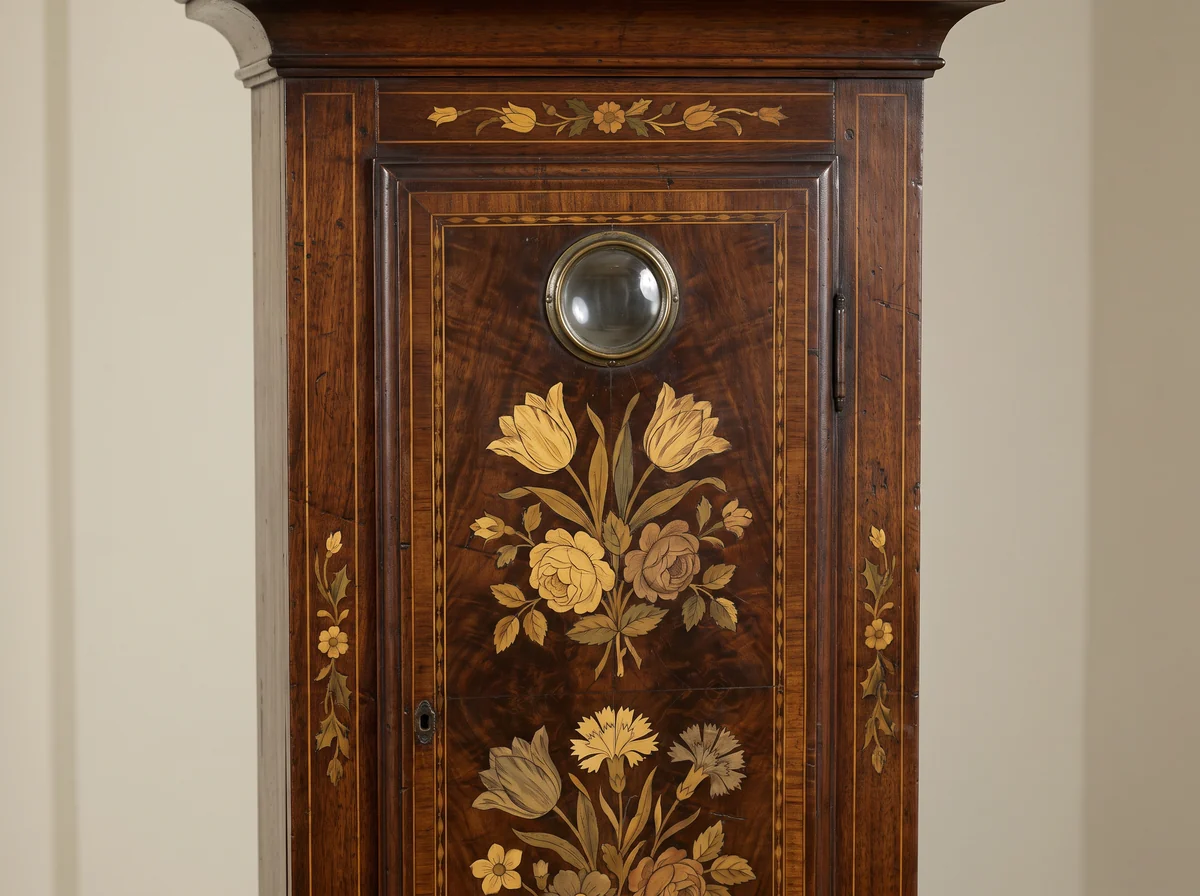
The case tells you much of the date and quality. London cases went from ebony in the 1660s to walnut in the 1670s, floral marquetry from just before 1680, with lacquer alongside it, and plain walnut again from about 1715.
Early cases are slim and tall in proportion. Good figured veneers, crisp mouldings and the original feet and finials all count. Late 17th century London walnut cases, such as those on clocks by Robert Seignior, are what collectors look for.
Originality: is it a marriage?
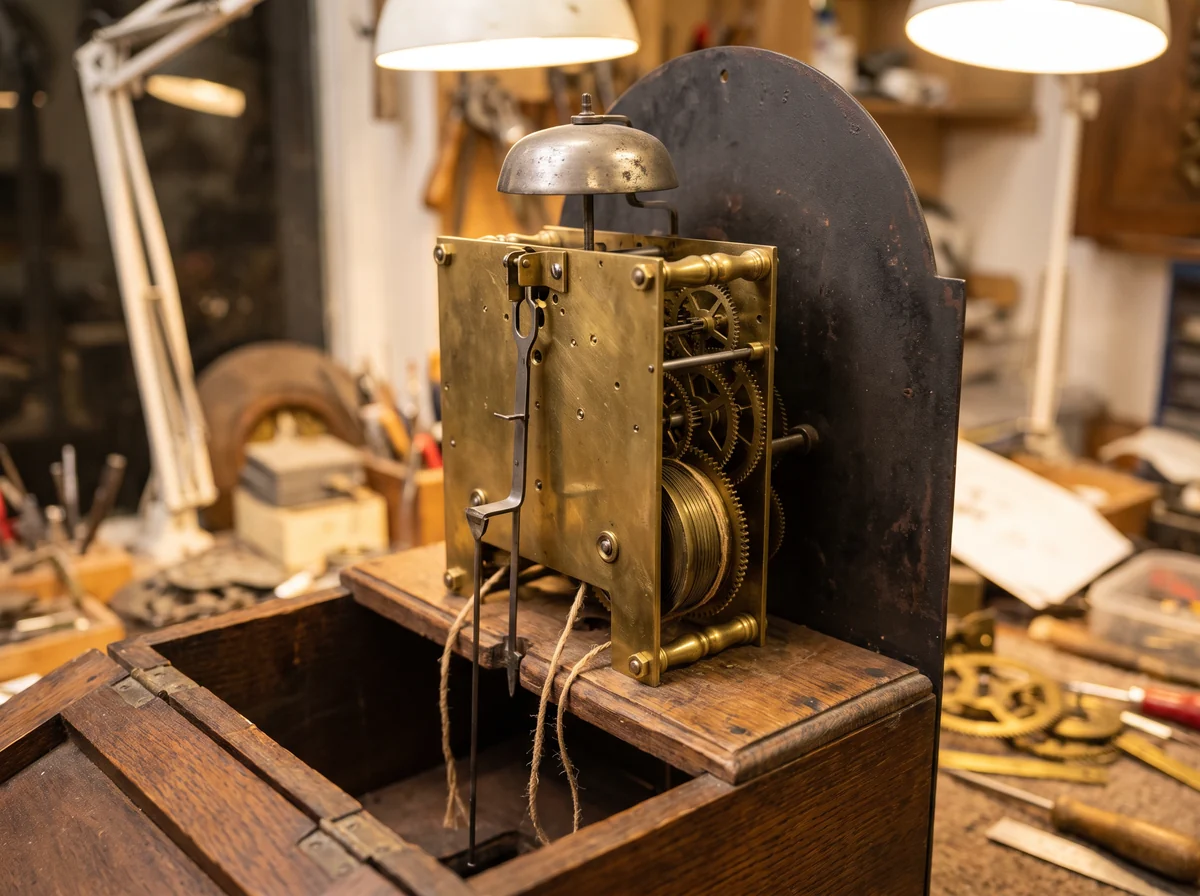
A "marriage" is a movement and dial put into a case made for another clock. Signs include a dial that leaves gaps in the hood opening, plugged winding holes with new ones drilled, extra screw holes and a replaced seatboard.
Even great names suffer. A Tompion movement and dial in an associated case made £43,750 at Bonhams in 2015; a Tompion longcase in its own case, with the receipts from its sale in 1942, made £114,700 in 2023.
Cut-down plinths, lost domes and replaced hoods
Clocks were often reduced in height to fit lower rooms. Bellmans' catalogue for a George II chinoiserie longcase sold in May 2022 noted that a domed top "is commonly removed to reduce the height" and that its stepped plinth was later.
Check that the base matches the trunk in wood, colour and mouldings, and that the hood sits naturally on the case. Anderson and Garland put it simply: a clock in totally original condition will fetch more than one with excessive restoration.
30-hour or 8-day? Count the winding holes
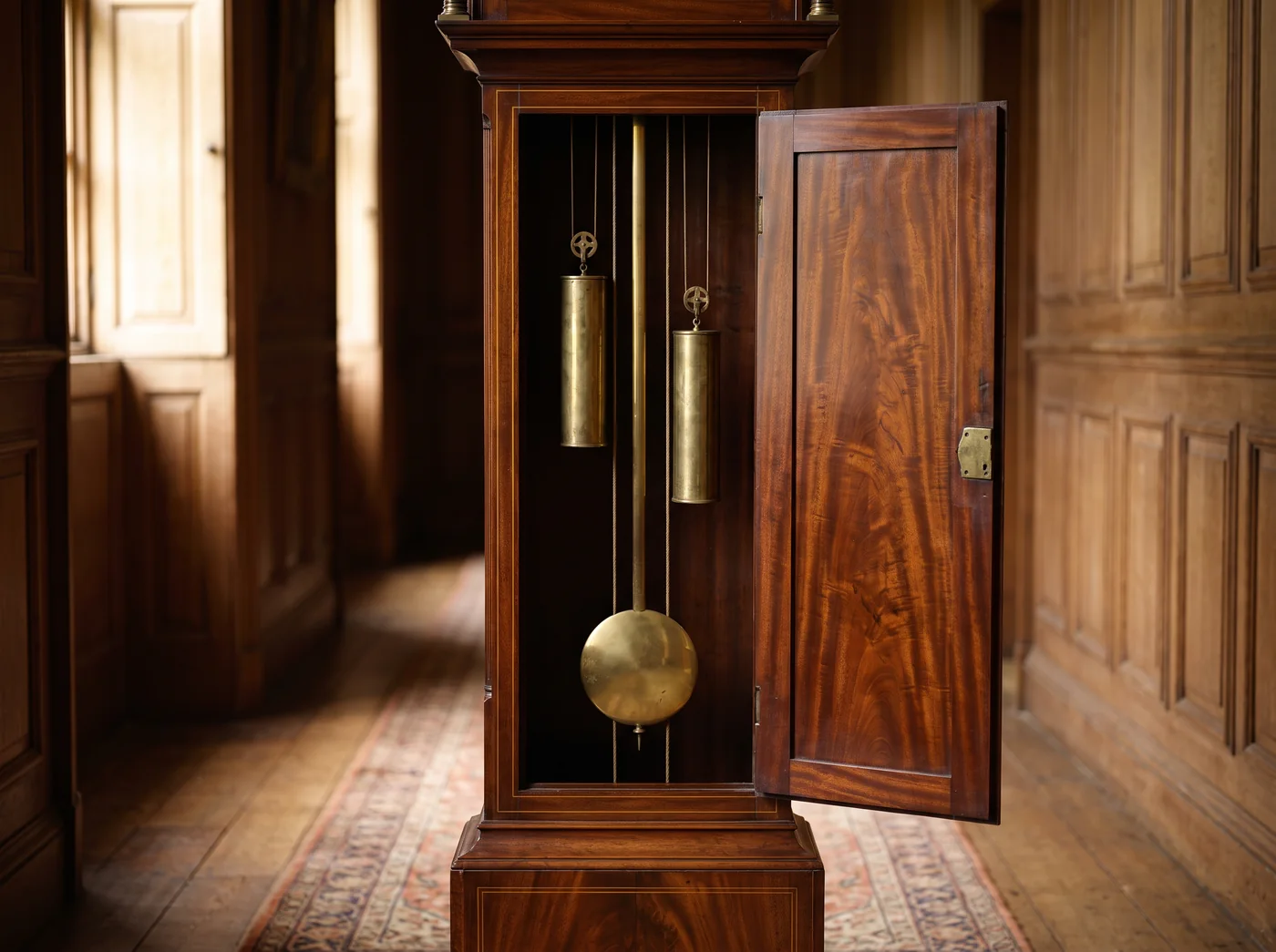
- No winding holes: a 30-hour clock. One weight hangs on an endless rope or chain and drives both the time and the strike. You wind it every day by pulling the rope or chain.
- Two winding holes: an 8-day clock. Two weights, one for the time and one for the strike, wound once a week with a crank key.
- Three winding holes: an 8-day clock that also chimes, with a third weight.
Open the trunk door to be sure. Some 30-hour dials carry dummy winding holes, ringed to look like an 8-day clock: the Antiquarian Horological Society describes one on a clock by Richard Midgley.
Dating a grandfather clock by its dial
The dial is the quickest guide to age. Brass dials came first. The one-piece brass dial arrived around 1760, and painted iron dials just after 1770.
Painted dials were first made in Birmingham by Osborne and Wilson, in partnership from 1772 to 1777, and their style changed in clear stages:
| Dial | Date | What to look for |
|---|---|---|
| Square brass dial | Late 1600s to mid 1700s | A separate silvered chapter ring and cast brass corner spandrels |
| One-piece brass dial | From about 1760 | A single engraved and silvered brass sheet, no applied ring |
| Painted dial, gold corners | About 1772 to 1775 | White ground, gold leaf decoration only |
| Painted dial, coloured corners | About 1775 to 1785 | Colour added to the corners and arch |
| Painted dial, scenes or birds | About 1785 to 1810 | Gold dropped; the finest detail is of about 1790 to 1800 |
| Painted dial, later | 1810 onwards | Larger dials, denser painting |
On a genuine antique, a painted dial of 13 inches or smaller usually means a date before about 1820.
A dial and its case should agree in date. A dial of the 1790s in a case of the 1840s points back to a marriage.
The top of the market: early London clocks
At the very top are the clocks of the first English makers. An architectural 8-day longcase by Joseph Knibb, made about 1665 to 1667 in an ebonised case, sold for £286,800 at Dreweatts in March 2014.
Clocks like that are rare. For most longcase clocks the six points above decide the value: the maker, the duration, the dial, the case, originality and whether the height has been altered.
Every clock is different. Send us a few photos and we will tell you what yours is worth, free and with no obligation. Ask for a free valuation.
Not sure where your clock sits? Get a free valuation
Tempus Fugit, Howard Miller and Ridgeway: modern grandfather clocks
"Tempus Fugit" is a motto, not a maker
Tempus fugit is Latin for "time flies", from a line in Virgil's Georgics. It is a common motto on sundials and clocks. A "Tempus Fugit grandfather clock" tells you nothing about who made it.
To find the maker, look for a name on the dial, a label inside the case, or a name and number stamped on the back plate of the movement.
The big modern names
- Howard Miller, Zeeland, Michigan: founded in 1926 by Howard C. Miller, son of Herman Miller, and making grandfather clocks from the early 1960s. In July 2025 it announced that manufacturing would end after the last quarter of 2025.
- Ridgeway: began as the Gravely Furniture Company in 1926 and made only grandfather clocks from 1960. Owned by Pulaski from 1985, it was bought by Howard Miller in November 2004; its movements came from Kieninger, part of the same group.
- Hermle, Gosheim, Germany: founded in 1922 by Franz Hermle and sons, it sells mechanical movements and finished clocks in more than 80 countries. A Hermle movement dates a clock to after 1922.
Do they hold their value?
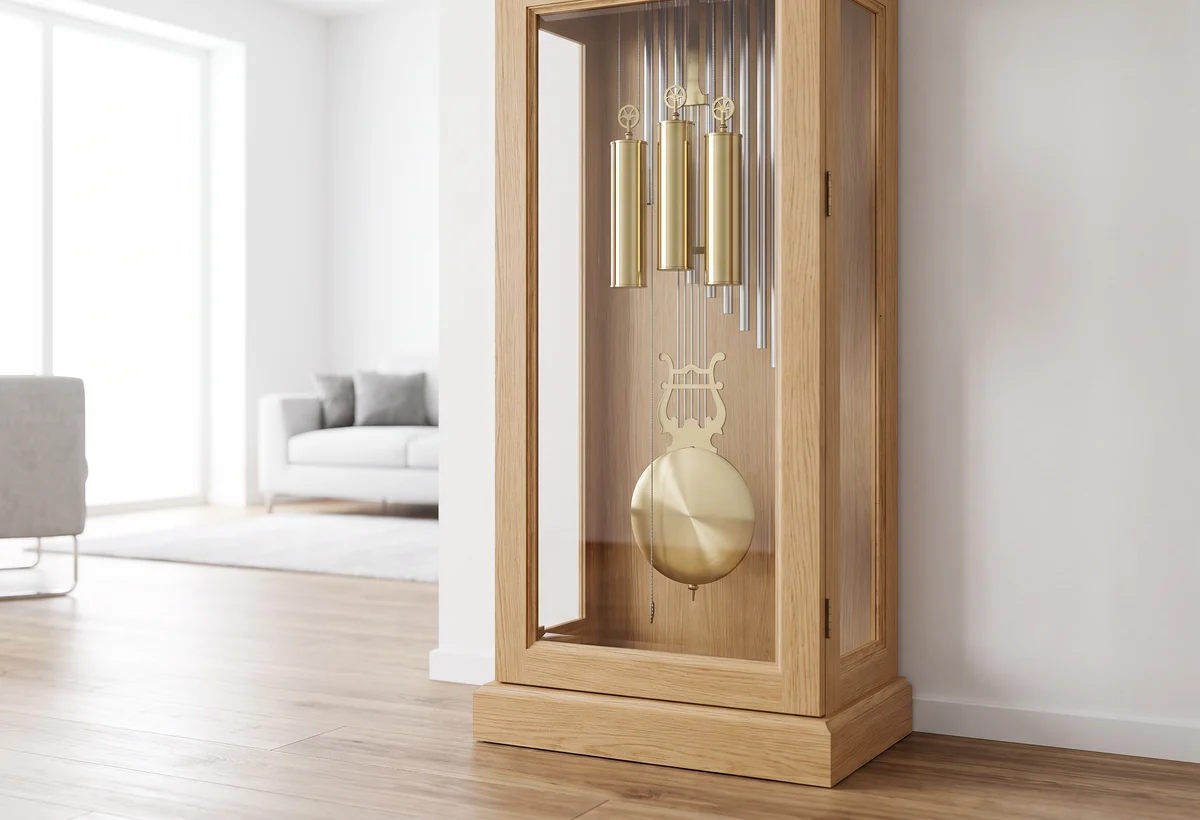
A US clock specialist notes that modern clocks, "like many Ridgeway or Howard Miller models, often do not hold their original value".
He describes a mid-1990s Howard Miller that still did not sell after its asking price was halved. Model, movement and condition decide what a modern clock is worth.
Moving a grandfather clock: the safe basics
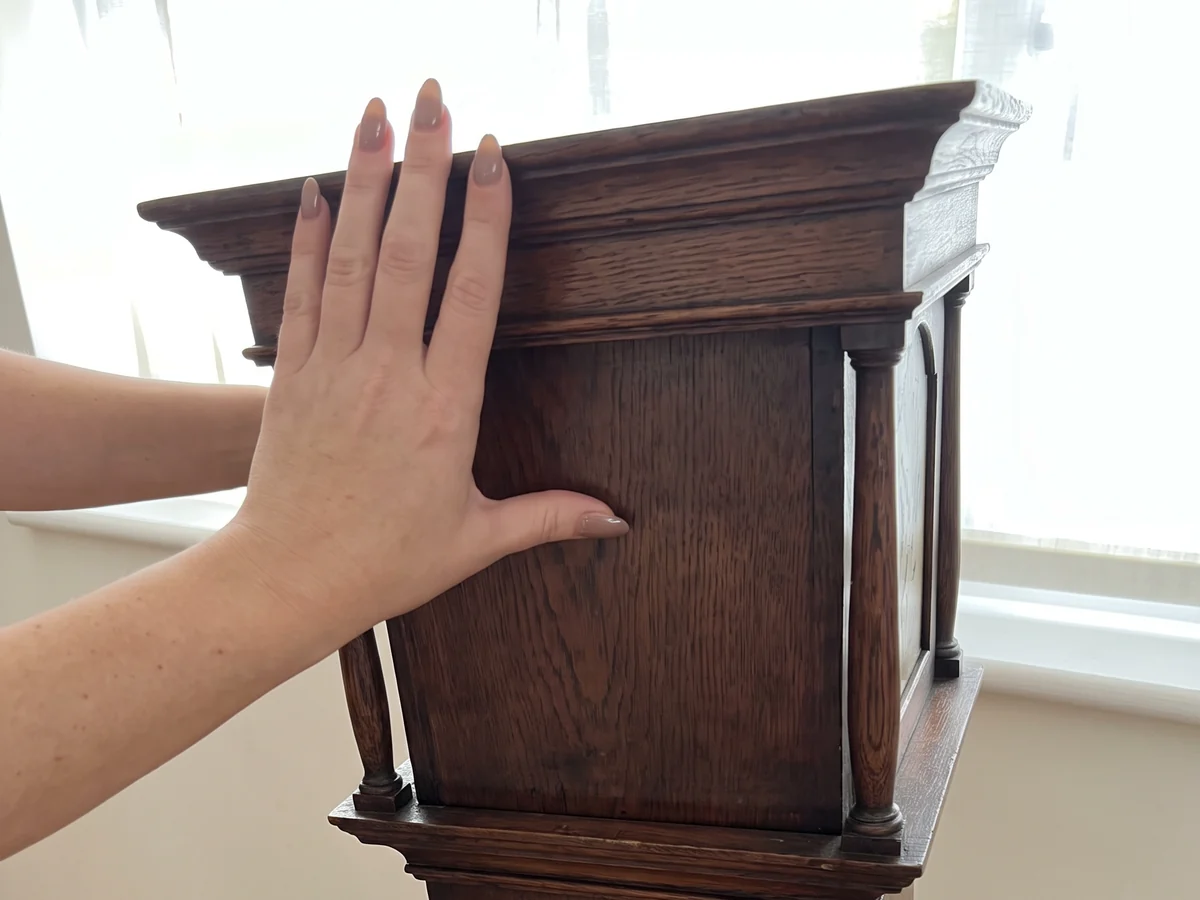
Weights and pendulum out first
- Stop the pendulum, unhook it and lay it somewhere safe.
- Lift off the weights and label each one left, centre or right. Some are already marked underneath.
- Secure the cables or chains so they cannot tangle or slip off.
- Take the hood off before the case is moved, and pad any chime rods.
In the new room, level the case before you hang the pendulum and weights again; floors are rarely true. Avoid standing a longcase on carpet. For a valuable clock, use a specialist clock restorer or remover.
Free grandfather clock valuation from photos
You do not need to move the clock to find out what it is. Photographs are enough to start, and we give free, no-obligation valuations and advice on antique clocks.
- The whole clock
Straight on, in good light, plus one from the side to show the proportions.
- The dial
The whole dial and a close-up of any name, the winding holes and the arch.
- Inside the case
Open the trunk door: the weights, pendulum and any labels.
- The movement
With the hood off, from the side and the back, if you can do it safely.
- Send
Use the form below, call 01376 334482 or WhatsApp us. You can also contact us to book an appointment in Mayfair (47 Maddox Street) or Braintree, Essex.
Clearing a house as well? Our attic finds worth money guide and what to do with inherited jewellery cover the smaller things. Buying? See the antique pocket watches and antique silver in our collection, including an Edwardian silver-gilt carriage clock by Drew and Sons, London, 1913.
Request a free clock valuation
- Grandfather clock and longcase clock mean the same thing; grandmother clocks are smaller.
- Many longcase clocks are modest; early London makers in original cases are in a different league.
- Count the winding holes: none is 30-hour, two is 8-day, three is chiming.
- Date the clock by its dial, and check that the case, hood and plinth belong to it.
- Tempus Fugit is a motto, not a maker; modern Howard Miller and Ridgeway clocks rarely hold their value.
Questions we are asked
How much is a grandfather clock worth?
It depends on the maker, 8-day or 30-hour work, the dial, the case and originality. Many decorative longcase clocks are modest; good 8-day clocks by known makers in original condition are worth more, and early London clocks by makers such as Tompion and Knibb reach six figures. Send photos for a free valuation.
Is a grandfather clock the same as a longcase clock?
Yes. Longcase is the British trade term; grandfather clock comes from Henry Clay Work's 1876 song. In the US they are also called tall-case or floor clocks.
How do I know if my grandfather clock is 8-day or 30-hour?
Count the winding holes in the dial. None means a 30-hour clock wound by pulling a rope or chain; two means an 8-day clock; three means an 8-day chiming clock. Open the trunk door to check, as some dials have dummy holes.
How can I tell how old my grandfather clock is?
Start with the dial. Square brass dials belong to the late 1600s to mid 1700s, one-piece brass dials to about 1760 onwards, and painted dials to about 1772 onwards, with the decoration changing by period.
What is a Tempus Fugit grandfather clock worth?
Tempus fugit is a Latin motto meaning "time flies", not a maker. The value depends on who made the clock and when. Modern clocks that carry the motto often do not hold their original value.
Are Howard Miller and Ridgeway grandfather clocks worth anything?
They are modern clocks, usually worth a fraction of their new price second hand. Model, movement and condition decide the value; send photos and we will tell you what yours is worth.
What is a married longcase clock?
One whose movement and dial were put into a case made for a different clock. Gaps around the dial, plugged holes and a replaced seatboard are common signs, and a marriage lowers the value.
What is a grandmother clock?
A smaller longcase clock, nominally under 6 ft 3 in tall. A granddaughter clock is smaller again, under 5 ft 2 in.
Find out what your grandfather clock is worth
Send photos of the clock, dial and movement for a free valuation and honest advice, or visit us in Mayfair or Braintree by appointment.
- Free valuation from photos
- Honest advice, no obligation
- Appointments in Mayfair and Braintree
New pieces reach our list first: join the Mozeris list.