Atmos Clock Value: How to Date, Identify and Look After an Atmos
What your Atmos is worth, how to date it from the serial number, which calibre you have, and what to do when it stops or has to move.
An Atmos clock's value depends on its model, condition and paperwork:
- What sets the value: an original running movement, box and papers, early serial numbers, and unusual or limited edition cases.
- Date it: the serial number is on top of the movement; 300,000 to 519,999 is the 1970s, 600,000 and up is the redesigned calibre 540 from late 1983.
- How it runs: a sealed gas capsule winds it from changes in room temperature.
- Stopped? Check the lock lever, the level and the room temperature before anything else.
In this article
How an Atmos works
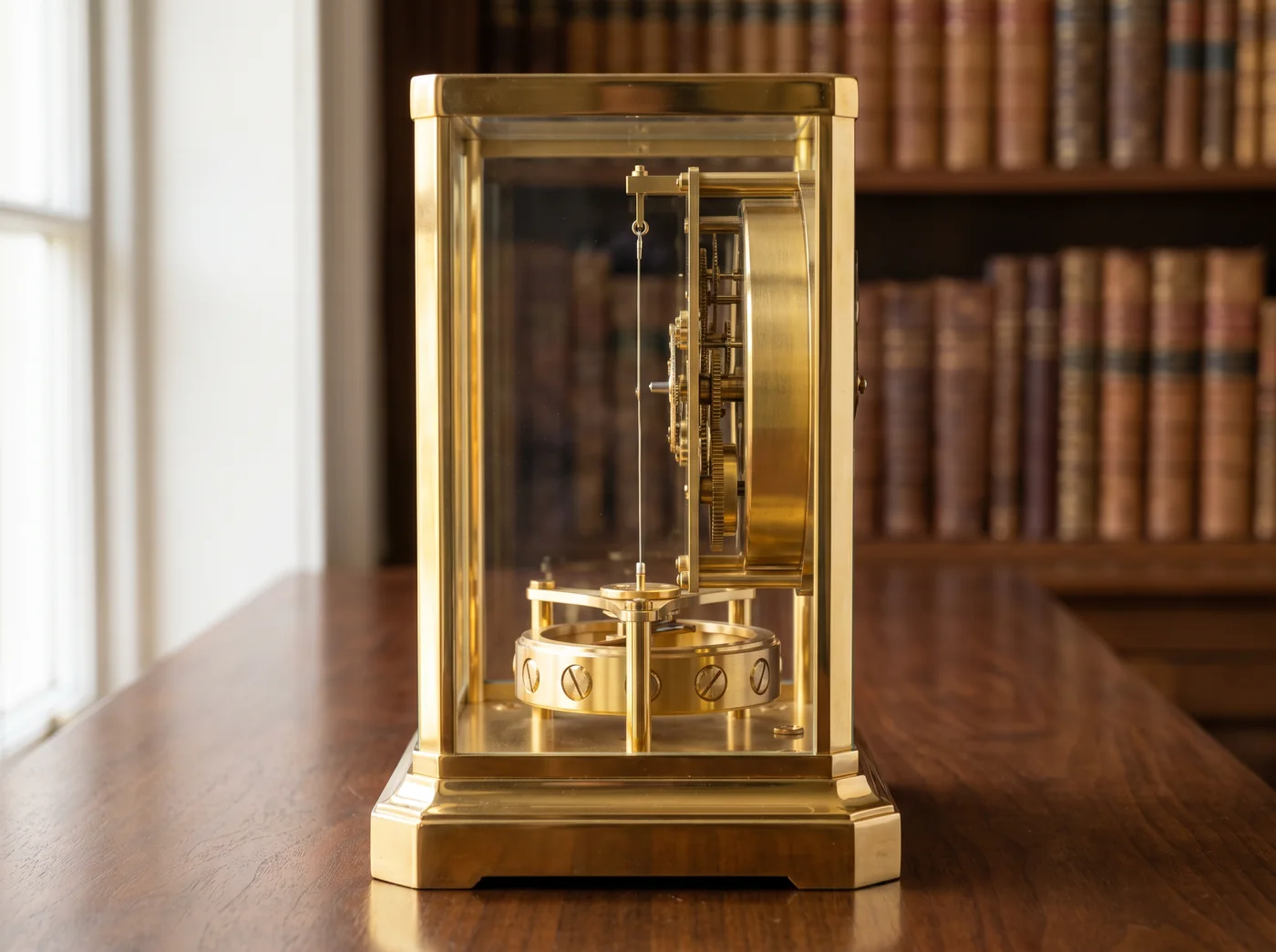
An Atmos is a mantel clock that winds itself from the air around it. There is no battery, no plug and no key. Small daily rises and falls in room temperature keep its mainspring wound.
- The capsule. A sealed capsule at the back holds a gas mixture. Warmth makes it expand and cold makes it contract, so it swells and shrinks like the bellows of an accordion.
- The winding. That movement works a chain that keeps the mainspring wound. Between 15 and 30°C, a change of one degree gives about two days of running.
- The balance. In place of a swinging pendulum, a gilt torsion balance hangs on a fine wire and turns slowly one way, then back, twice a minute. The minute hand moves in steps every 30 seconds.
- The thrift. The maker's own figure: 60 million Atmos clocks together would use no more energy than one 15 watt light bulb.
Who invented it
The Atmos began with Jean-Léon Reutter, an engineer in Neuchâtel. His first clocks were made in France and ran on mercury and ammonia. LeCoultre took over in 1935 and changed to the safer ethyl chloride capsule used ever since.
| When | What happened |
|---|---|
| 1928 | Jean-Léon Reutter, an engineer in Neuchâtel, designs a clock driven by changes in room temperature |
| 1 June 1929 | Compagnie Générale de Radio (CGR) in France sets up a department to make it: the Atmos I, powered by mercury and ammonia |
| 27 July 1935 | CGR hands all production to LeCoultre in the Swiss Jura |
| 15 January 1936 | The Atmos II is announced, with a sealed capsule of ethyl chloride; full production starts in mid 1939 |
| Late 1983 | A redesigned movement, calibre 540, replaces the original design; serial numbers jump to 600,000 |
How to date an Atmos from its serial number
The serial number dates an Atmos to its decade, and often closer. There is no official public lookup, so the tables below come from a specialist repairer's records of clocks he has overhauled since 1982.
Where to find the serial and the calibre
- Serial: stamped on top of the movement, next to the fast and slow lever. On the Atmos II and some early calibre 519 clocks it is under the movement, read through the front glass.
- No clear top? Some cases carry a paper label under the base with the serial written by hand.
- Calibre: stamped under the base on every model from the 522 onwards, about the size of the date on a coin. On the 540 it is also on the front plate behind the dial.
- Atmos II or 519? Neither is stamped. The Atmos II has a turning knob to regulate it; the 519 has a slide lever on top.
Lock the balance before you tilt or turn an Atmos over to read the base. See how to lock it below.
Serial number to year
| Serial number | Made |
|---|---|
| 6,000 to 6,499 | 1939 |
| 6,500 to 24,999 | 1940s |
| 25,000 to 126,999 | 1950s |
| 127,000 to 299,999 | 1960s |
| 300,000 to 519,999 | 1970s |
| 520,000 to 649,999 | 1980s |
| 650,000 to 704,999 | 1990s |
Later clocks carry higher numbers again. Serial blocks were sometimes held back for particular calibres, so expect some overlap at the edges of each decade.
Serial number to calibre
| Serial number | Calibre | What it is |
|---|---|---|
| About 4,000 to 59,999 | Atmos II, 519, 529 | Atmos II and III, 1936 to late 1955 |
| 60,000 to 69,999 | 519, 522, 529, 532 | Atmos IV, the shortest production run |
| 70,000 to 599,999 | 526-5, 528-6, 528-8, 529, 532 | Atmos V to VIII, the classic Reutter design, made to late 1983 |
| 600,000 and up | 540, later 560 and others | The redesigned Atmos from late 1983 |
A quick rule of thumb, and its limit
Dealers use a rough formula for six figure serials: divide by 1,000, multiply by 0.051 and add 1954. It works well for the classic clocks. Serial 437226, an Atmos at Royal Museums Greenwich, gives 1976, the year the museum records.
It drifts after the 1983 redesign. An Atmos du Millénaire, serial 696579, was sold new in December 2000, yet the formula gives 1989. For any 540 or later, use the decade table.
One more clue: the capsule was dated by hand at the factory. A repairer sees that date when the clock is serviced, which can place it to within a month.
Calibres and models you are likely to meet
Most Atmos clocks share one recipe: a gilt brass frame, glass on all sides and the movement on show. The case styles changed far more than the movement inside.
- Atmos II and calibre 519 (to 1955). The early production. Collectors look most for serial numbers under about 110,000.
- Calibres 526 and 528 (to 1983). The Atmos V to VIII, the clock most families inherit. The 528-6 and 528-8 are common in auction rooms.
- Marina. A 528 era case with panels decorated with fish and sea plants.
- Vendôme. First catalogued in 1962, with variants in 1969 and 1972, and a second series on the calibre 540 in the 1990s.
- Designer cases. A gilt and steel case by Luigi Colani on the calibre 528, about 1975, and Marc Newson's clocks in Baccarat crystal.
- Calibre 540 and later (from late 1983). The redesigned movement, made in many case styles, including today's Atmos Classique. Limited editions such as the Atmos du Millénaire, with its 1,000 year calendar, sit at the top of the market.
Looking for LeCoultre wristwatches instead? See our vintage gold Jaeger-LeCoultre watches guide.
Presentation Atmos clocks
Gifts of state and long service
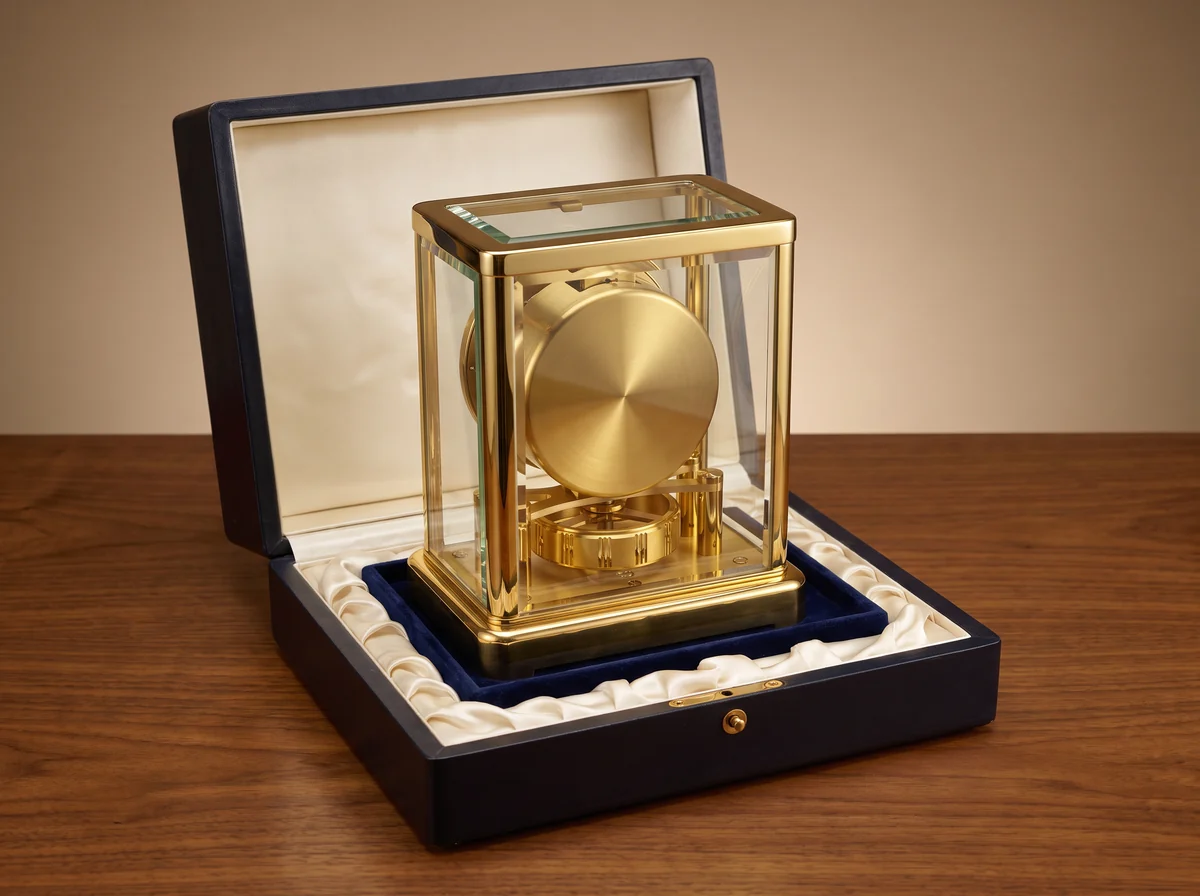
Switzerland has long given the Atmos to its guests of honour. The maker names John F. Kennedy, Winston Churchill, General de Gaulle and Charlie Chaplin among them.
Companies gave them too, mostly as long service awards, which is why so many carry an engraved plaque with a name and a date.
A plaque does not change the clock inside. What adds value is a recipient or a story that can be proved, with the letter, box or papers that came with it. Keep all of them together.
Why an Atmos stops, and what to check
Most stopped Atmos clocks are not broken. Work through these checks in order before you book a repairer.
- Is the lever fully off?
The locking lever must be fully released. A lever left half way holds the balance.
- Is it level?
Centre the bubble in the spirit level with the two front feet; the back foot is fixed. Clocks without a level are set so the point under the balance sits over the mark in the base.
- Does the room change temperature?
It needs a swing of about 2°C (4°F) a day, within roughly 8 to 30°C. A room held at one steady temperature starves it.
- Is it in the sun?
Direct sun upsets the timekeeping and fades the case. Choose a shaded, stable shelf.
- Is the glass door rubbing?
On the calibre 526, a door pushed fully shut can touch the wheel that carries the minute hand. Leave it a fraction open.
- Give it a start
With the clock level, turn the balance gently half a turn by hand, without pressing down, and let go.
Never put an Atmos in the freezer to test the capsule. Moisture condenses on the steel parts and rusts them. A failed capsule causes only about 15 to 20 per cent of stoppages.
If it still will not run, it needs a specialist. The factory's advice, as quoted by one leading repairer, is a complete service about every 20 years.
Setting the time, and when the clocks change
Lock the balance first. Then move only the minute hand, and only forwards; never touch the hour hand. When the clocks go back, that means going forwards the long way round. Our guide to changing a clock when the clocks go back covers other antique clocks.
How to move an Atmos safely
Lock the balance first
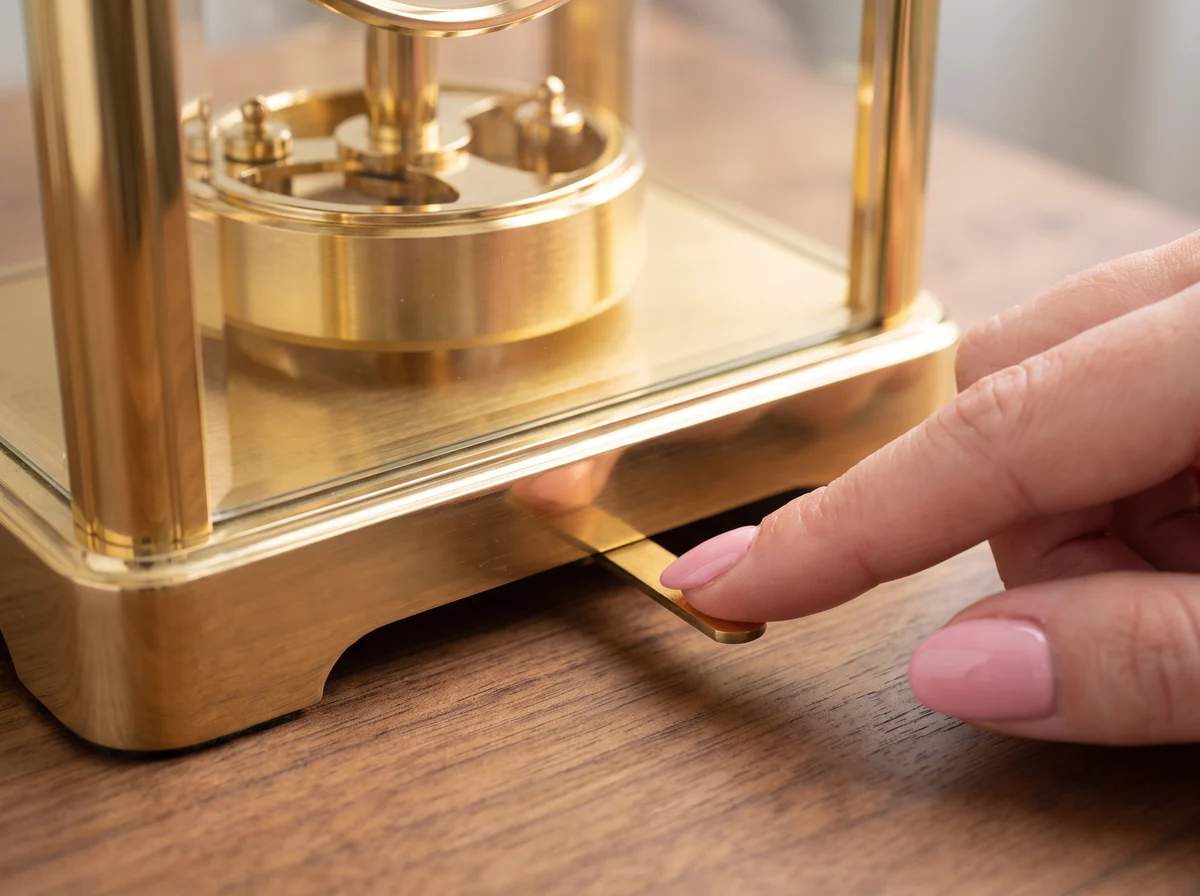
Watch the balance. Wait until it reaches the end of a turn, just before it starts back, then push the locking lever from left to right as far as it will go.
On most older clocks the lever is under the front of the base. On the 540 and some early models it sits just below the six on the dial, behind the glass door.
- Tighten the transport screw
Some 526 and 540 clocks, and the Classique, also have a screw under the base. Turn it up to the balance, then a further quarter turn.
- Carry it upright
Lift by the base, never by the glass. Wear cotton gloves: the gilding is thin and fingerprints mark it.
- Pack it well
Use the original box if you have it. If not, wrap it in bubble wrap, box it, and put that box inside a second one with packing all round.
- Unlock at the new home
Level it first, then release the lever from right to left and the balance will start.
Moving an unlocked Atmos lets the balance swing hard. That can knock it out of poise, and a balance even slightly out of poise stops the clock.
What makes an Atmos clock valuable
The everyday Atmos, a gilt brass calibre 526 or 528 from the 1950s to the 1980s, is the clock most families inherit. Its value turns on the points below: the movement, the paperwork, the serial number and the case.
At the very top, rare and designer pieces make headlines. An Atmos du Millénaire with its 1,000 year calendar, one owner from new with its box and papers, made £11,520 at Bonhams in July 2025. A Marc Newson Atmos 568 in Baccarat crystal made CHF 22,860 at Phillips in 2024, and a unique Newson Atmos 561 made US$425,000 at a Sotheby's charity sale in November 2013.
What adds value
- Its own movement, running. A working original Atmos mechanism.
- Box, papers and guarantee. The original box, guarantee and service papers all count with buyers.
- Early numbers. Collectors prefer serials under about 110,000.
- Unusual cases. A square dial, designer cases and limited editions.
What lowers it
- A replaced movement. A quartz conversion, like the Marina sold at Bonhams in 2024 with quartz parts in place of its movement, leaves a decorative case rather than a collector's clock.
- Not running. An overhaul often costs more than it adds, so buyers deduct it.
- Worn gilding. Polishing and household cleaners rub through the thin gold. Dust it with a soft cloth and plain water only.
- Damage. Cracked or chipped glass panels, dents and missing parts.
Every Atmos is different. Send us a few photos and we will tell you what yours is worth, free and with no obligation. Ask for a free valuation.
Have an Atmos? Get a free valuation
Free valuation, advice and buying
Send us photographs and we will tell you what your Atmos is, when it was made and what it is worth today, free and without obligation.
- Photograph
The front, the back with the capsule drum, the serial on top of the movement, the calibre stamp under the base (lock it first) and any plaque, box or papers.
- Send
Use the form below, call 01376 334482 or WhatsApp us.
- Visit
Bring it to 47 Maddox Street, Mayfair (by appointment) or to Braintree, Essex. Contact us to book.
Buying? See the clocks and objects in our decorative objects and silver collections, such as an Edwardian silver-gilt carriage clock by Drew & Sons, 1913, and our watches, including antique pocket watches.
Other clocks: carriage clock value, grandfather clock value and antique French mantel clocks. Selling a watch too? See sell your pocket watch and sell your vintage watch.
Atmos and Jaeger-LeCoultre are trade marks of their owner. Mozeris Fine Antiques is an independent dealer with no connection to the maker.
Request a free valuation
- An Atmos winds itself from daily changes in room temperature through a sealed gas capsule.
- Date it from the serial on top of the movement; 600,000 and up is the post-1983 calibre 540.
- An original running movement, papers, early numbers and special editions add value.
- Always lock the balance before moving or tilting it. We give free valuations from photos.
Questions we are asked
How much is an Atmos clock worth?
It depends on the model, whether the original movement runs, the serial number, and the box and papers. Early numbers, unusual cases and limited editions are worth more; a replaced movement or worn gilding costs value. Send photos and we will tell you what yours is worth, free.
How do I date my Atmos clock?
Read the serial number on top of the movement beside the fast and slow lever. 127,000 to 299,999 is the 1960s, 300,000 to 519,999 the 1970s, and 600,000 and up is the redesigned calibre 540 from late 1983.
Where is the serial number on an Atmos?
On top of the movement, next to the regulating lever. On the Atmos II and some early 519s it is under the movement, seen through the front. The calibre is stamped under the base.
How does an Atmos clock work without winding?
A sealed capsule of gas expands when the room warms and contracts when it cools, keeping the mainspring wound. A change of one degree gives about two days of running.
Why has my Atmos stopped?
Usually the lever is not fully released, the clock is not level, or the room temperature hardly changes. Check those, then turn the balance gently half a turn by hand.
How do I lock an Atmos clock to move it?
Wait for the balance to reach the end of a turn, then push the locking lever from left to right as far as it goes. It is under the front of the base on most older clocks.
Are Atmos clocks still made?
Yes. The redesigned calibre 540 replaced the original design in late 1983, and later calibres such as the 560 followed.
Is a presentation Atmos worth more?
An engraved plaque alone changes little. A notable recipient that can be proved, with letters, box or papers, can add interest and value.
Find out what your Atmos is worth
Send photos of the clock, the serial and the base for a free valuation and advice, or visit us in Mayfair or Braintree.
- Free valuation and advice from photos
- Appointments in Mayfair and Braintree
- Phone 01376 334482 or WhatsApp
- Honest advice, no obligation
New pieces reach our list first: join the Mozeris list.