Antique French Mantel Clocks: Types, Values and How to Identify Them
How to recognise each type of antique French mantel clock, from ormolu figures to black slate, what the Paris movement tells you, how to tell gilt bronze from spelter, and what makes one valuable.
What is my antique French mantel clock, and what is it worth? In short:
- Most are 19th century clocks with a round Paris movement in a gilt bronze, marble, black slate, enamel or porcelain case.
- The case decides most of the value: fire gilt bronze is worth far more than gilt spelter, a zinc alloy.
- At the top is period ormolu by named Paris makers: a Laurent clock with a seated harpist made £8,320 at Bonhams in 2023.
- A period Empire or 18th century clock is worth many times a later copy in the same style.
In this article
- What is an antique French mantel clock?
- The main types, and how to recognise each
- The Paris movement (pendule de Paris), in plain words
- Fire gilt bronze, electro-gilding or spelter? The key value test
- Condition: what buyers check
- What makes a French mantel clock valuable
- How to identify the maker
- Buying an antique clock from us
- How to get a free valuation of your clock
- Questions
What is an antique French mantel clock?
An antique French mantel clock is a spring-driven clock made to stand on a chimneypiece, usually with a round brass movement behind the dial, known as a Paris movement. The case did most of the selling: gilt bronze, marble, black slate, porcelain or enamel.
Case and movement were usually made by different firms. One clock in the Banco de España collection has a case by the bronze maker G. Schmoll and a movement by Vincenti & Cie, a typical split of the work.
Reign or periodStyle at its height (approximate)
Style is the quickest guide to age, but every style was copied later. A Louis XVI or Empire design made in the 1880s is common, so the case, the gilding and the movement all have to agree.
The main types, and how to recognise each
Seven families cover most antique French mantel clocks. Here is how to tell them apart, and what lifts the value within each.
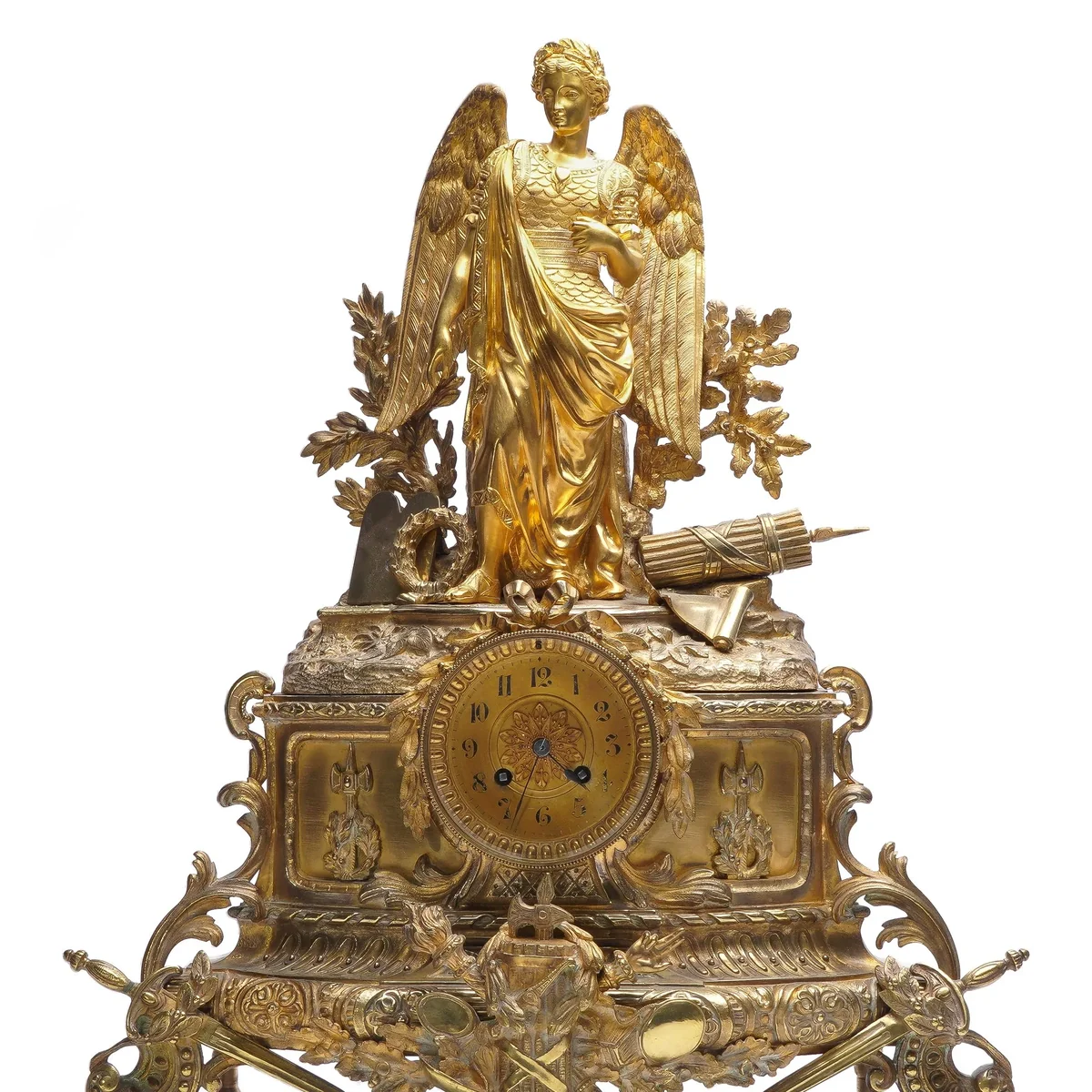
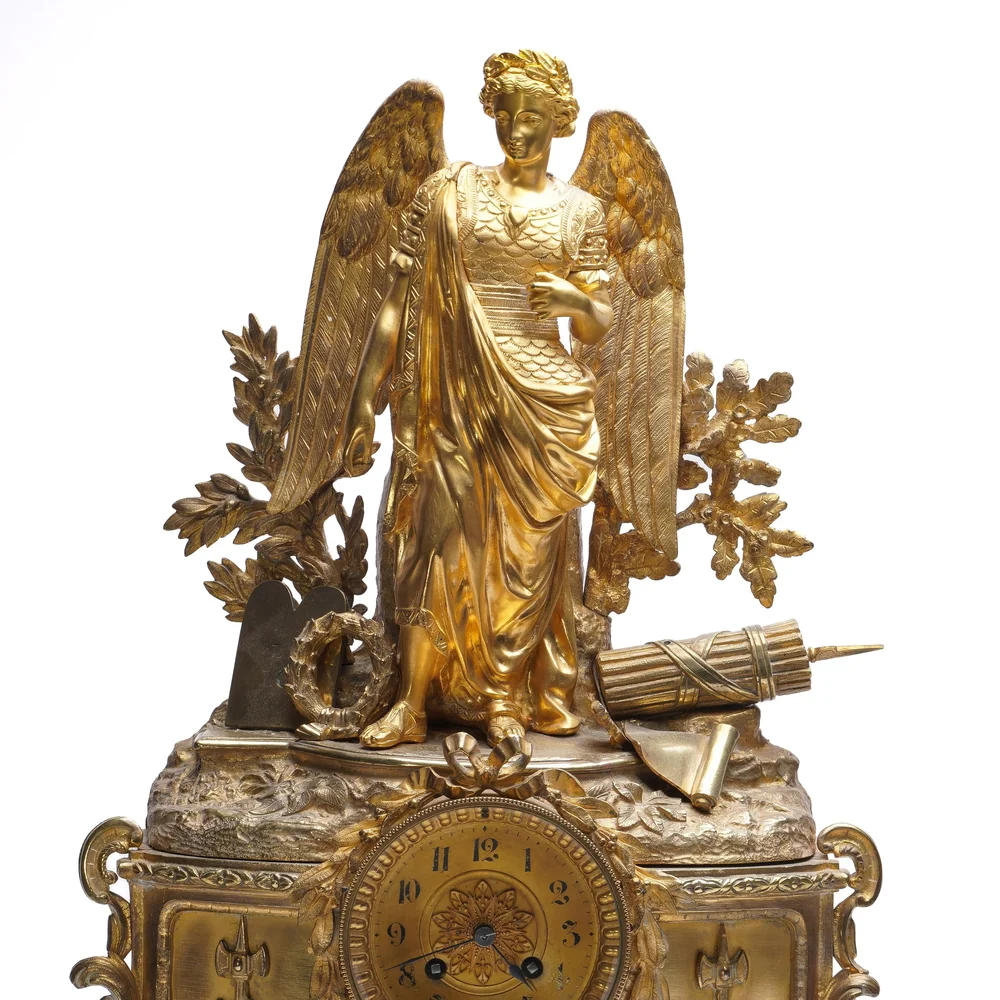
Gilt bronze (ormolu) figural clocks

A cast figure or group sits on top, with the movement in the plinth below. Subjects come from myth, allegory, history and literature. The quality of the casting and the finishing by hand (chasing) is what you are paying for.
Look at faces, hair and feathers. On a good bronze they are crisp and sharp; on a poor one they are soft and blurred, as if melted.
Empire and Restauration, 1804 to 1830
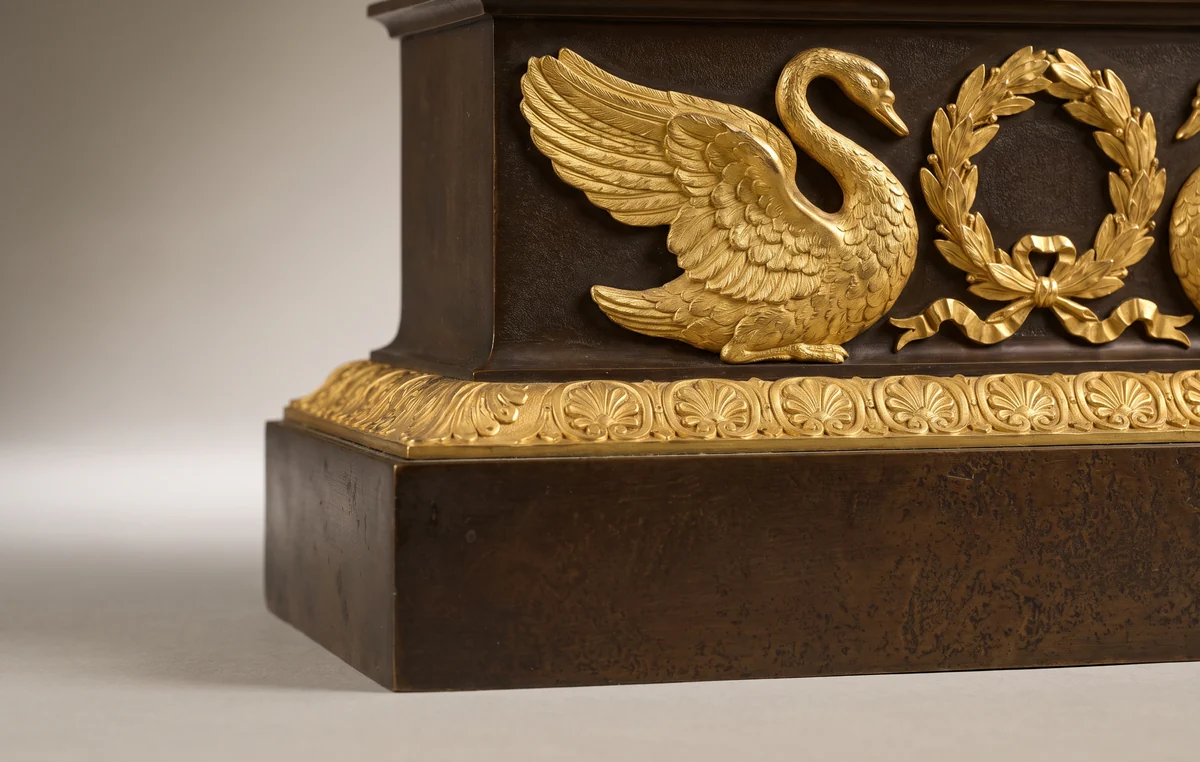
Napoleon's Empire brought severe classical shapes: gilt bronze set against dark patinated bronze, swans, laurel, palmettes and figures from antiquity. The great bronze makers included Pierre-Philippe Thomire, Claude Galle and André-Antoine Ravrio. After 1815 subjects turned more domestic and romantic.
Period clocks often hang the pendulum from a silk thread. An early 19th century ormolu and marble clock by Laurent of Paris, with a seated harpist, made £8,320 at Bonhams in November 2023.
Portico clocks
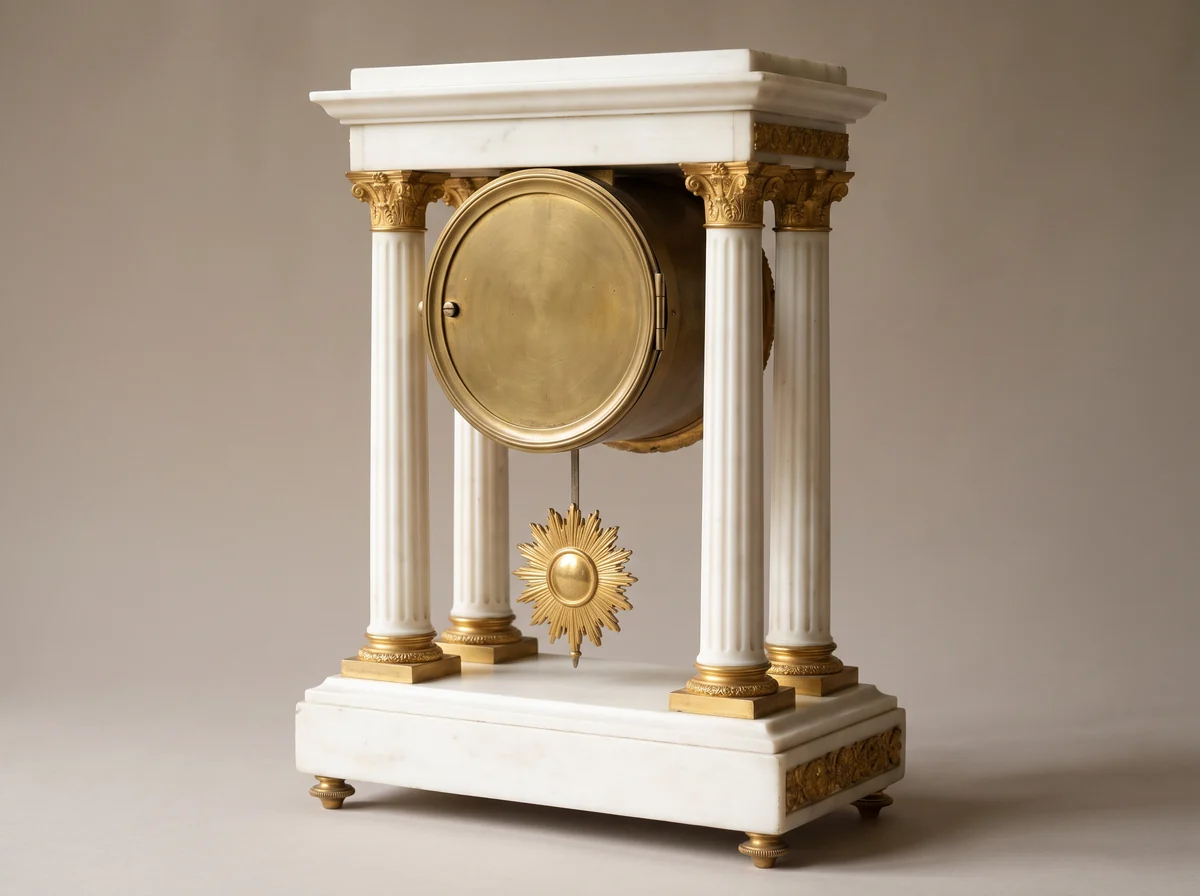
The round drum movement hangs between two or four columns, like a little temple, with the pendulum swinging beneath it. Cases are usually marble with gilt bronze mounts.
An early 19th century portico clock by Drouot of Paris, in white marble with a gilt bronze eagle on top, catalogued by Bonhams in July 2025, still had silk suspension and a count wheel on the back plate: the marks of an early movement.
Louis XV and Louis XVI revivals
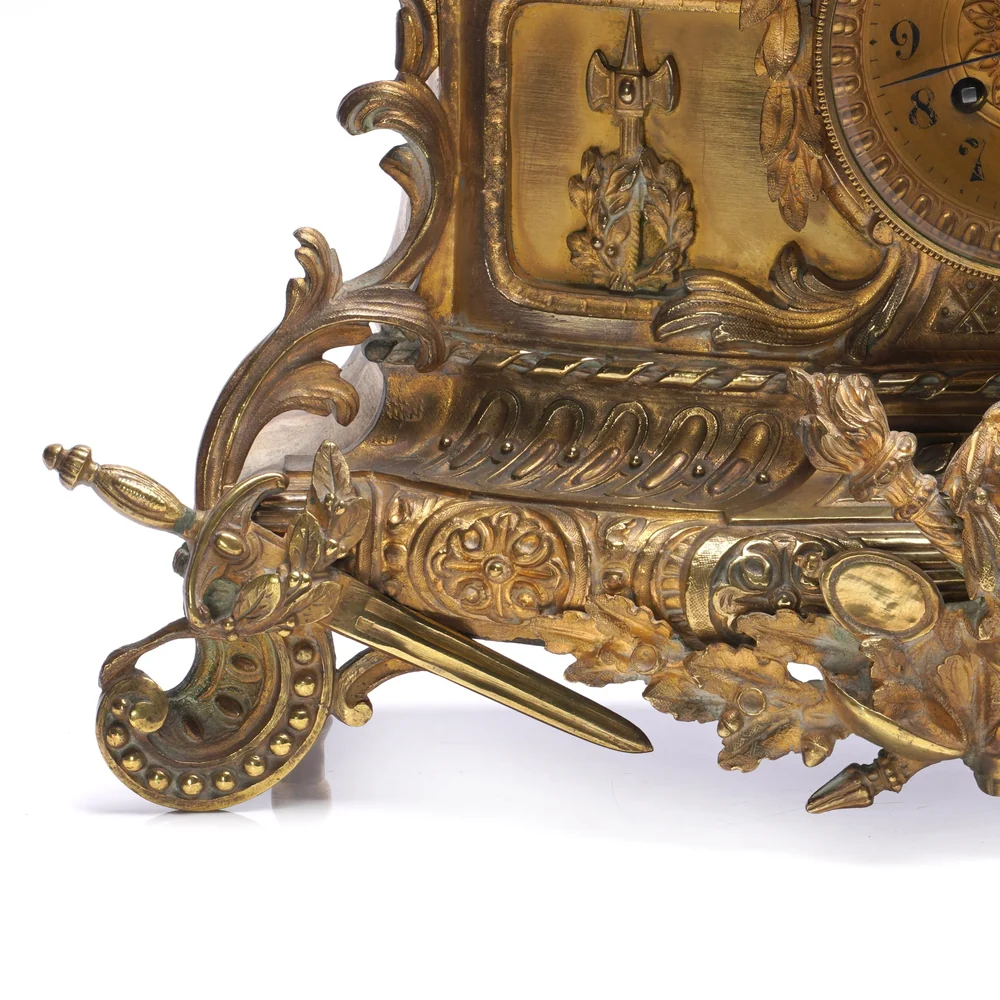
Through the 19th century, makers revived the 18th century styles. Louis XV means rococo: scrolls, shells and lively asymmetry. Louis XVI means neoclassical: urns, swags, rams' heads and straight lines.
Period or revival matters more than anything else here. A true late 18th century ormolu clock is worth many times a small 19th or 20th century clock in the same style.
Black slate and marble clocks
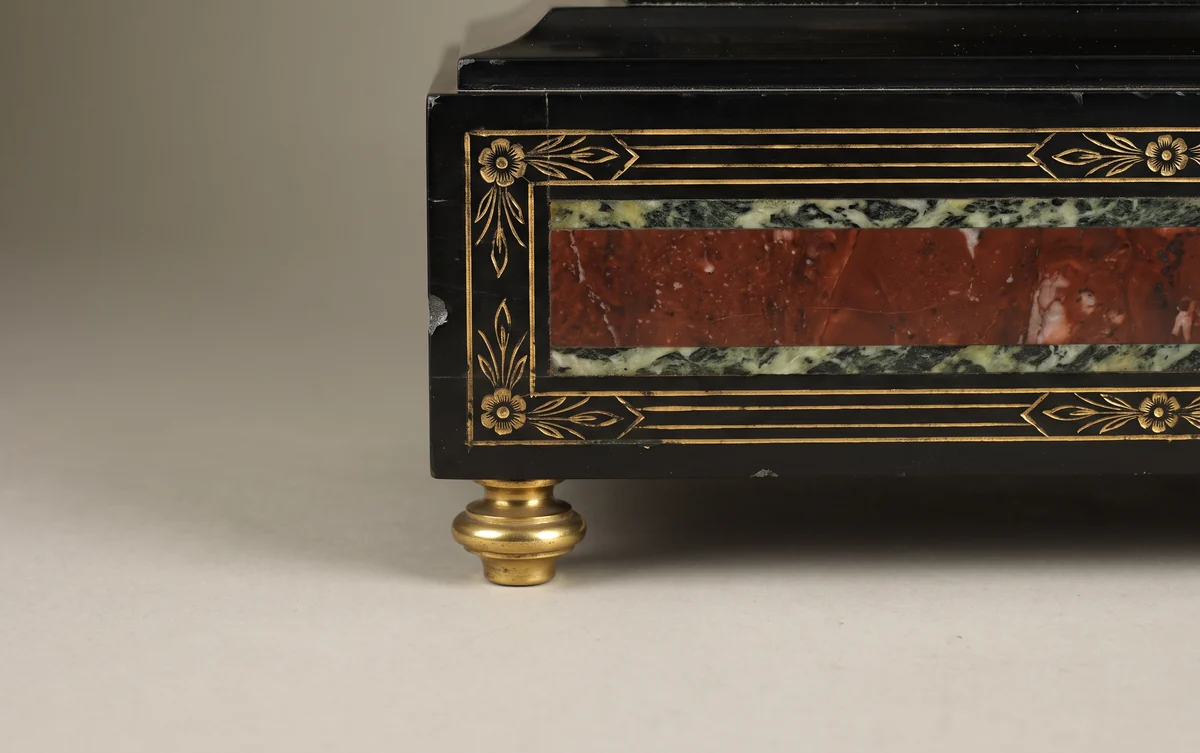
A familiar sight on British mantelpieces: a heavy, architectural case in polished black stone, with inset bands of red or green marble and incised lines filled with gilt. Many are Belgian black limestone, sold as black marble, rather than true slate.
Most date from the later 19th century. Calendar dials with moon phase, a good movement such as a Marti, and crisp inlay lift a slate clock above the ordinary.
Champlevé enamel and porcelain-mounted clocks
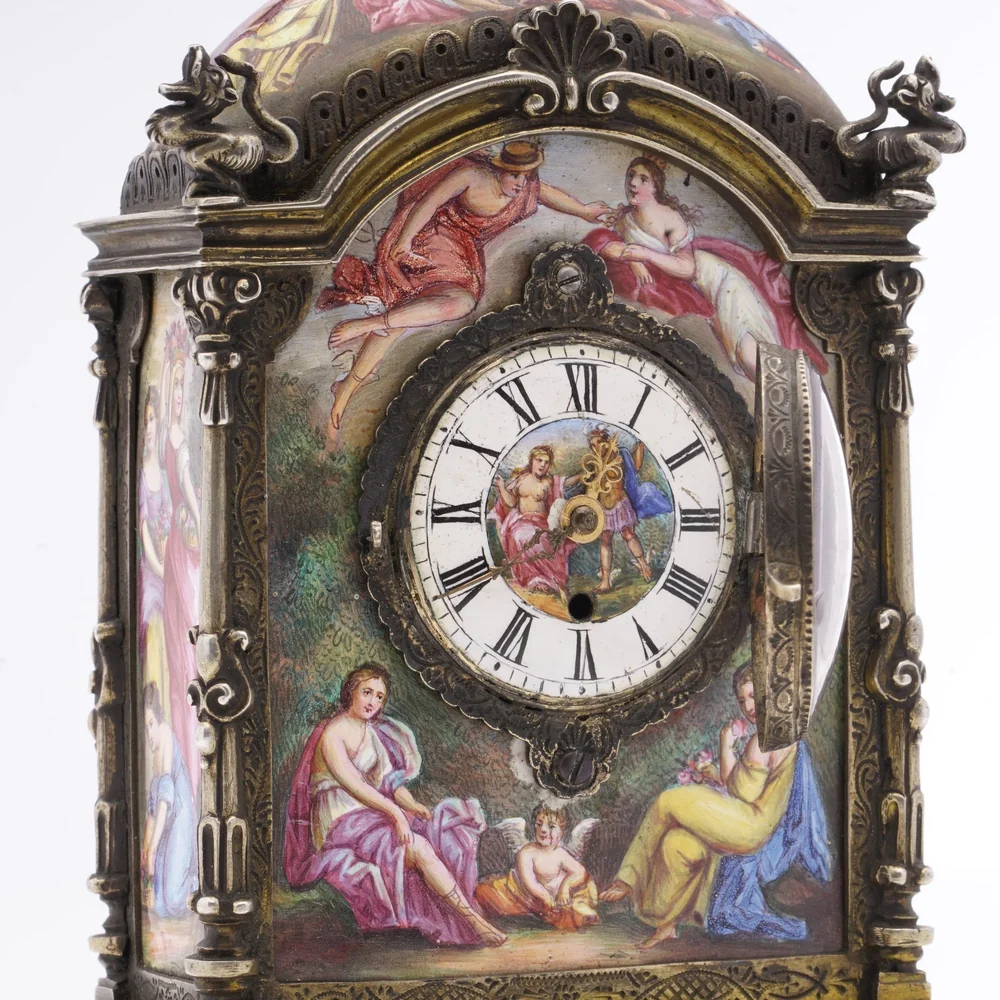
French makers set gilt bronze or gilt brass cases with champlevé enamel (enamel fired into recesses cut into the metal), onyx panels, or painted porcelain plaques in the Sèvres manner.
Do not confuse them with Viennese clocks like the one above, which have pictures painted in enamel on silver gilt. Four glass clocks with champlevé and onyx, by makers such as A.D. Mougin, are typical of the type. More on the techniques in our guide to enamelling.
Clock garnitures: the clock with urns or candelabra
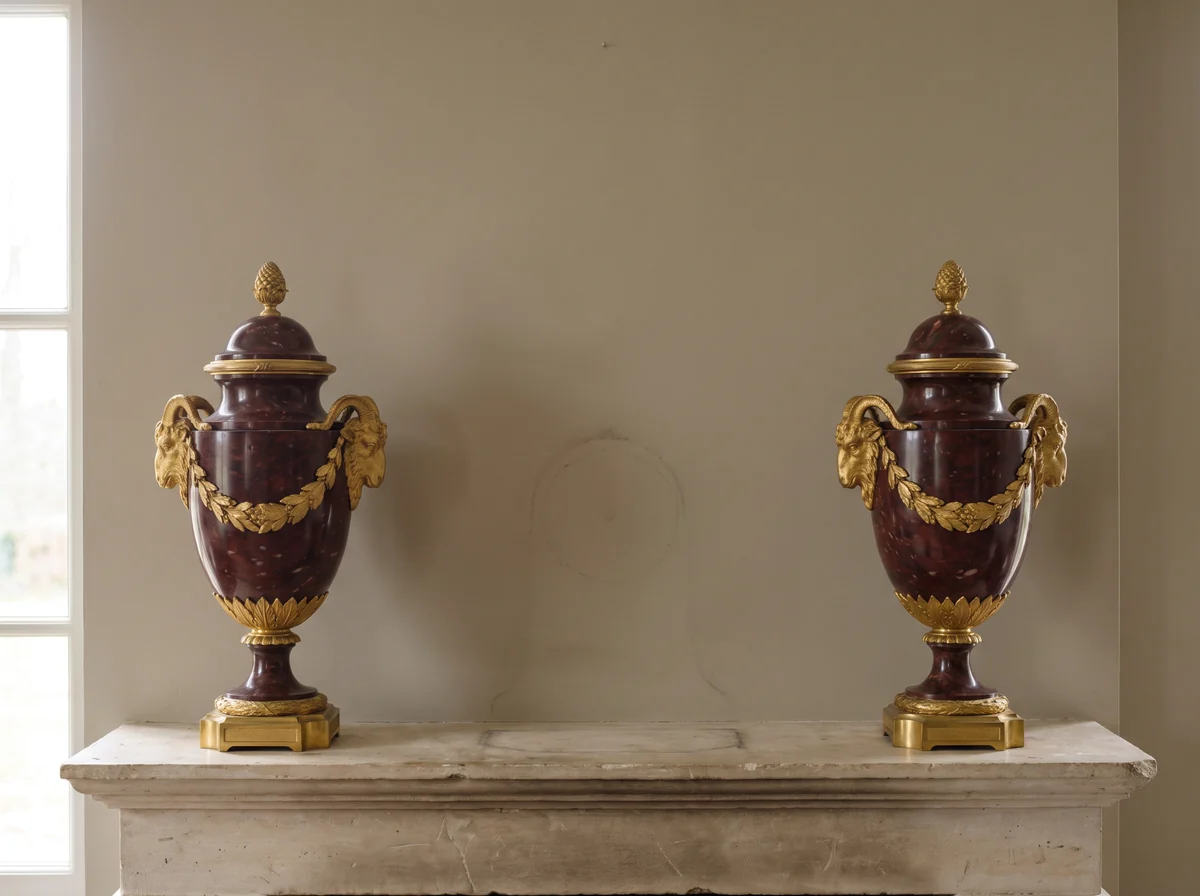
A garniture de cheminée is a clock with a matching pair of urns, vases or candelabra for the sides of the mantelpiece. A complete original set is worth more than its parts.
Read catalogues closely: "associated" or "matched" means the pieces were put together later. A Japy Frères champlevé garniture with its pair of vases made £3,584 at Bonhams online in April 2025.
Art Nouveau and Art Deco, briefly
French makers carried on into the 20th century. Art Nouveau clocks use flowing plant forms and female figures; Art Deco clocks use geometric marble and onyx cases, often with stylised figures cast in spelter, which was a key metal for Art Deco figures. Value follows the same rules: quality of design and casting, condition and originality.
The Paris movement (pendule de Paris), in plain words
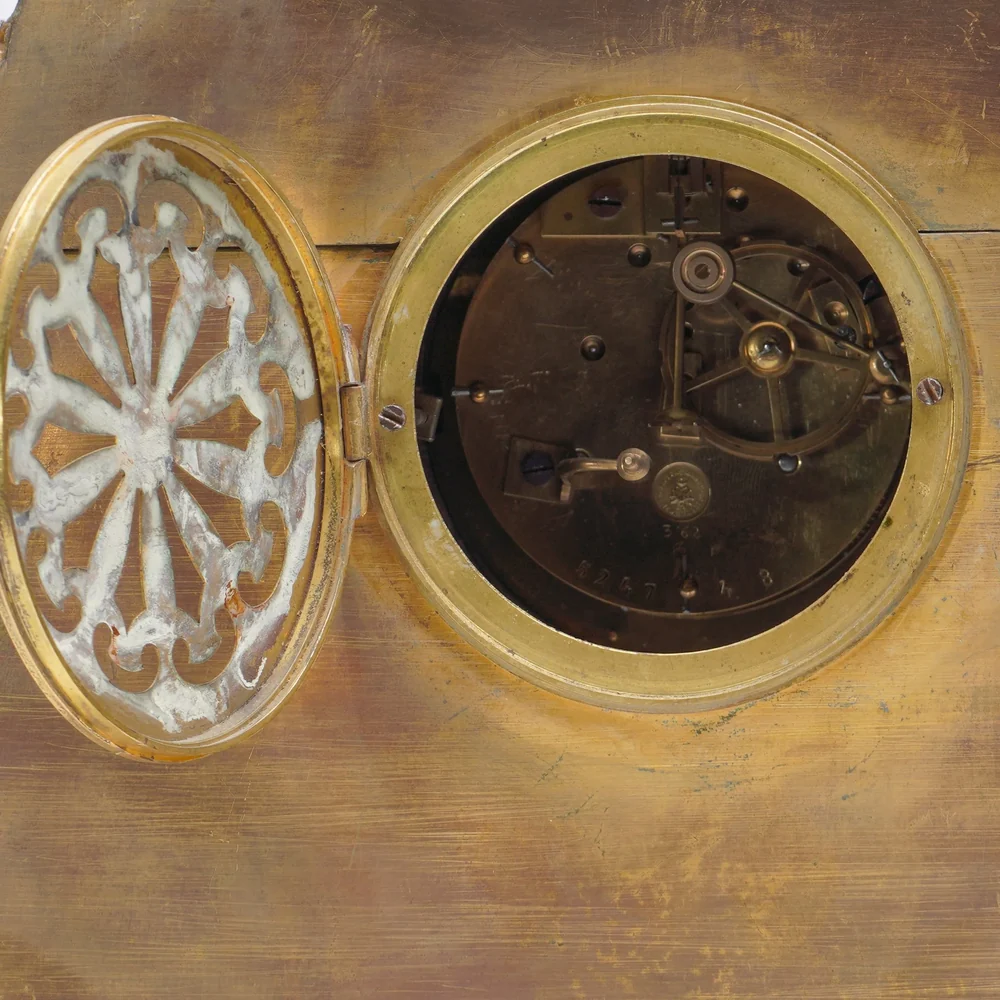
What is behind the dial
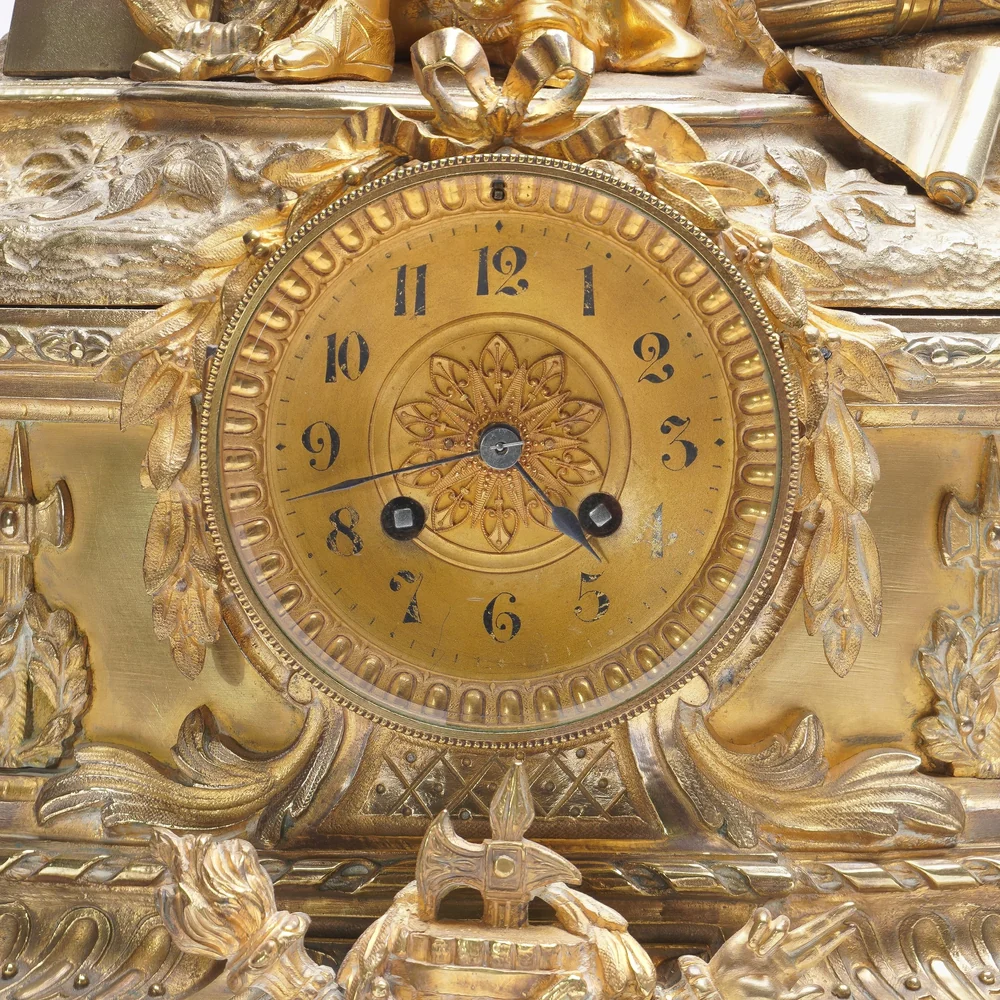
Open the round back door and you will usually find a pendule de Paris: a movement with round brass plates, driven by springs, that runs for about eight days on one winding.
Two winding holes in the dial mean two trains: one for the time and one for the strike. One hole means a timepiece that does not strike.
The strike sounds the hours, and a single blow at the half hour, on a bell. Many do this with a count wheel, a notched wheel on the back plate; others use a rack.
The pendulum and the Brocot suspension
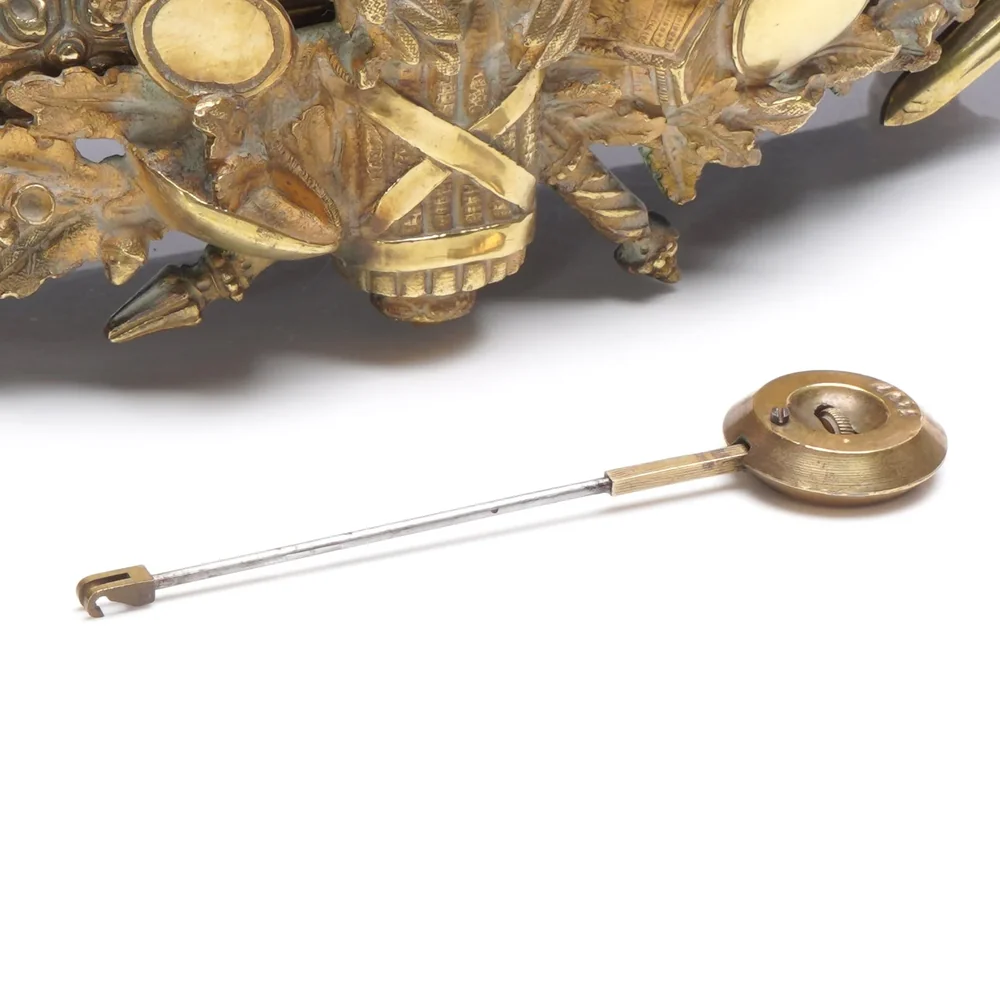
Silk thread suspension, where the pendulum hangs from a loop of silk, is a sign of an early clock.
The Brocot suspension, devised by Achille Brocot, lets you regulate the clock from the front: a key turned in a small square on the dial, usually above the 12, raises or lowers the pendulum.
A visible escapement, the rocking part ticking on the dial, is often the Brocot pin-pallet escapement, refined from his father's design.
Keep the pendulum and key with the clock. Missing ones are a common loss.
Fire gilt bronze, electro-gilding or spelter? The key value test
This is the question that moves the price most. Two clocks can look alike across a room, yet one is fire gilt bronze and the other gilt spelter, worth far less.
Fire gilding and electro-gilding
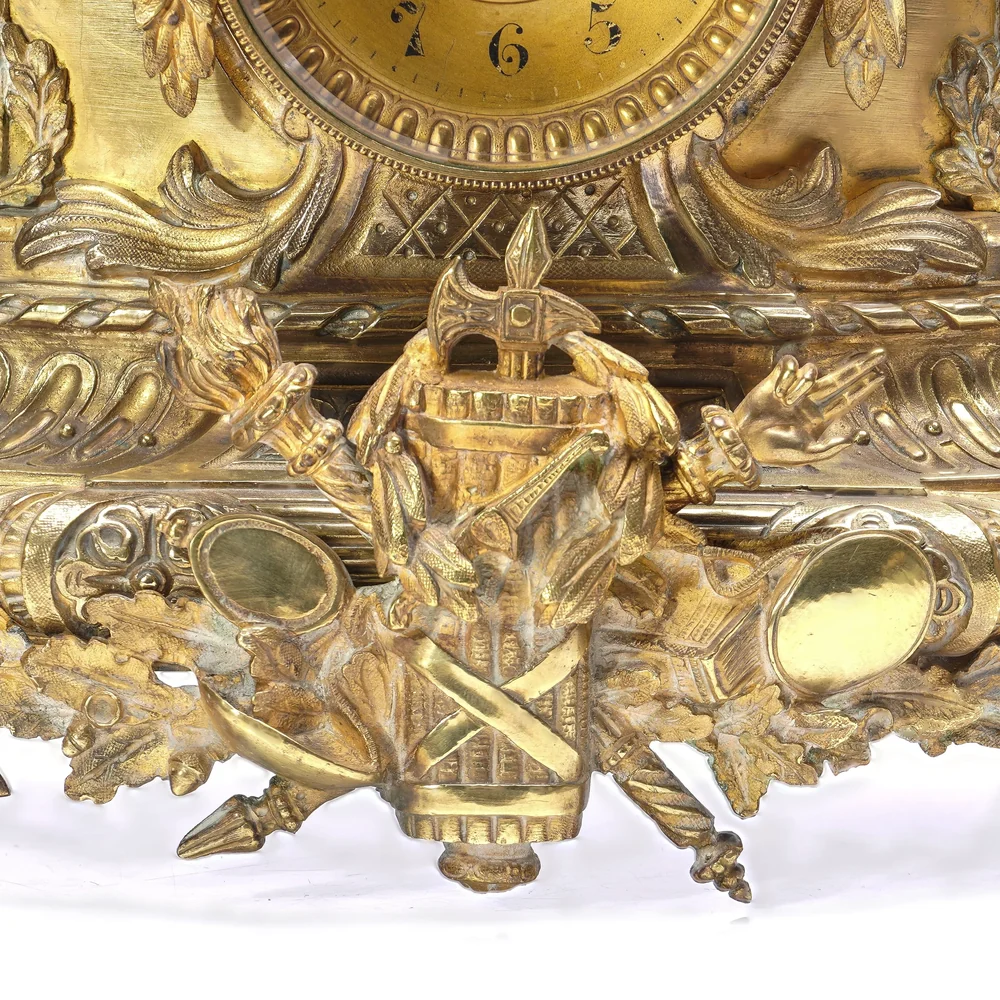
Fire gilding (mercury gilding) is the classic ormolu, from the French or moulu. Gold mixed with mercury was brushed on the bronze, then heated until the mercury burned off, a process that poisoned gilders.
France legislated against it around 1830, but it continued in use to the 1900s. Electro-gilding, gold laid on by electric current, replaced it, and the coat is thinner.
Silver gilt uses the same idea on silver; see our silver gilt guide.
| Fire gilt bronze | Electro-gilt | Spelter | |
|---|---|---|---|
| What it is | Bronze gilded with a gold and mercury paste, heated until the mercury burns off | Gold laid on by electric current, a thinner coat | A zinc based alloy, cast, then gilded or bronzed |
| Colour of the gold | Deep and warm, often matte areas set against burnished highlights | Often brighter and more even | Varies; the finish is only a skin |
| A scratch underneath | Yellow or gold coloured metal | Yellow if the base is bronze or brass | Silver or grey metal |
| Weight and sound | Heavy; rings when tapped | Depends on the base metal | Lighter; a dull note |
| Typical damage | Rubbed high points | Flaking or patchy wear | Cracks, breaks and corrosion |
Turn it over: the spelter test
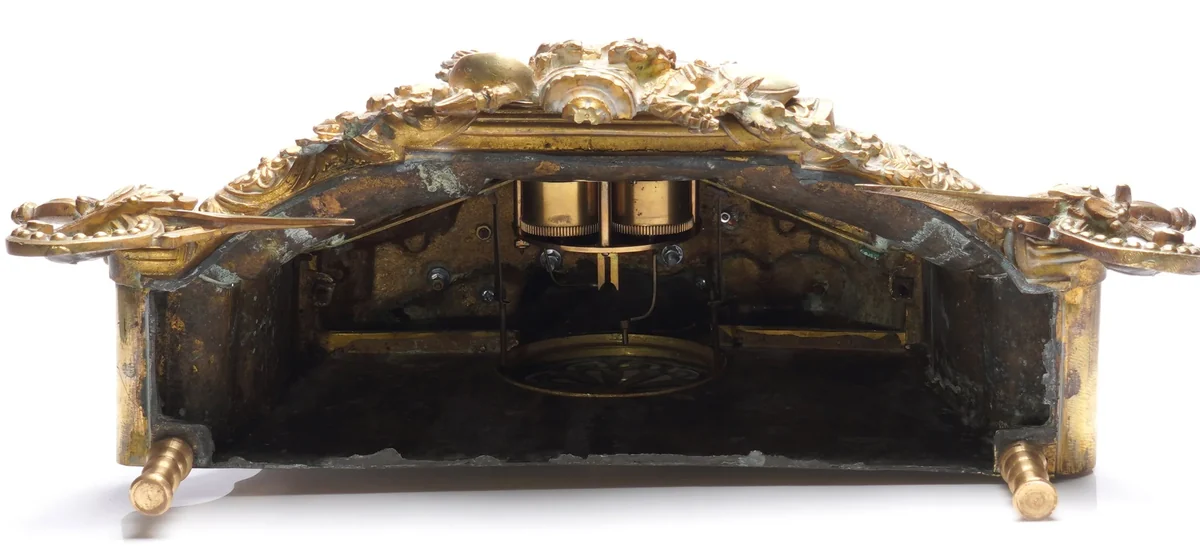
Spelter is a zinc based alloy, cast and then gilded or bronzed to look like bronze. It came into wide use from the 1860s.
Look underneath, at an unseen edge. Bronze and brass show yellow or gold where bare; spelter shows silver or grey.
Lift it. Bronze is heavier and rings when tapped; spelter is lighter, cracks and corrodes more easily. Never file or scrape a clock to test it.
These are signs, not proof. Gilding colour also changes with cleaning and age, so a specialist who sees the clock, or clear photographs, gives the safe answer.
Condition: what buyers check
The common problems
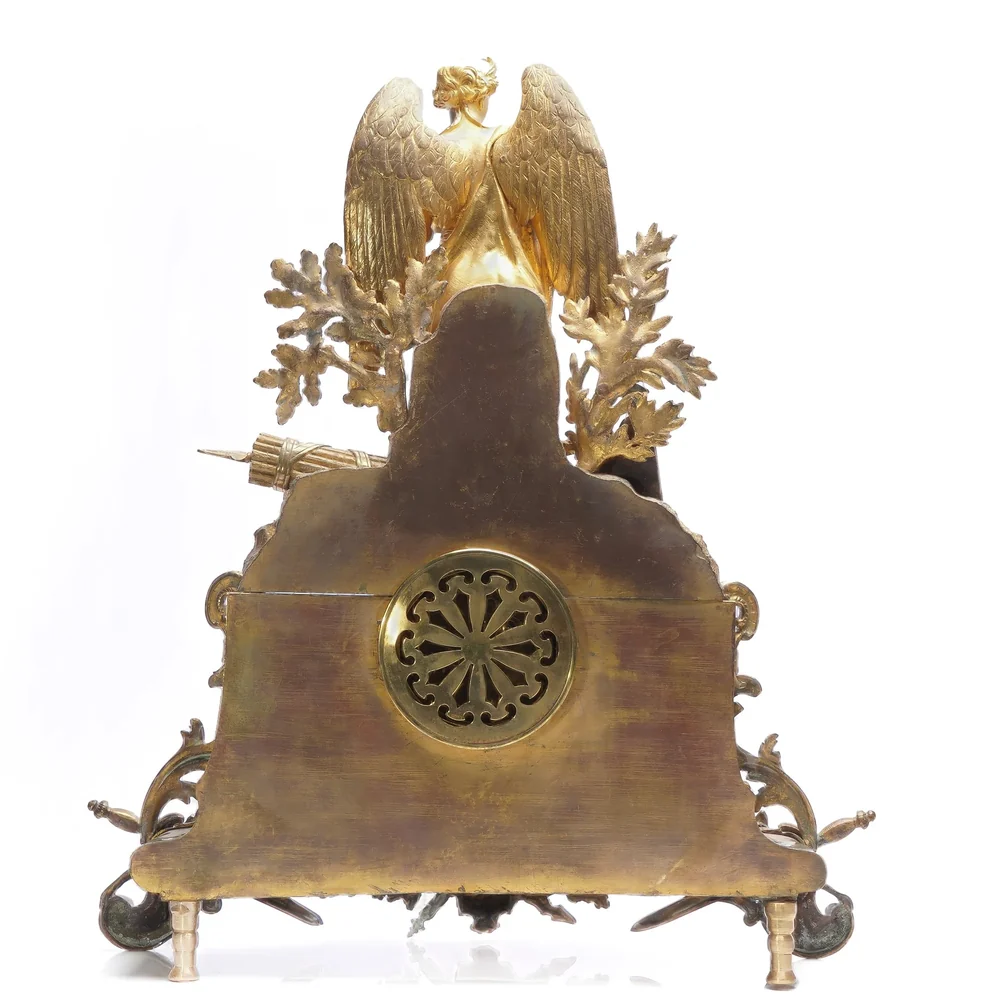
- Gilding rubbed through, or a later re-gilding that is too bright and even.
- Chips to marble and slate edges, and repairs to broken spelter figures.
- A replaced movement, especially a battery conversion. Buyers want the original Paris movement.
- Dial damage: cracked enamel or a rubbed signature.
- Missing parts: pendulum, key, bell, glass, back door or urns.
Do not polish gilding or clean it with metal polish or water; both can take the gold off. Leave it as it is until it has been looked at.
What makes a French mantel clock valuable
Every antique French mantel clock is judged on the same four points, in roughly this order:
Fire gilt bronze first, then marble and good champlevé, then slate and spelter.
A true Empire or 18th century clock is worth many times a later copy.
Sharp, hand finished detail beats soft, blurred casting every time.
Original movement, dial, pendulum and, for a garniture, the matching side pieces.
Every clock is different. Send us a few photos and we will tell you what yours is worth, free and with no obligation. Ask for a free valuation.
Not sure which type you have? Send photos for a free valuation
How to identify the maker
The name on the dial is often the retailer or clockmaker, while the back plate of the movement may carry a stamp of the movement maker, such as Japy Frères, Vincenti or Marti, sometimes with an exhibition medal and year.
Those stamps help date a clock and judge its quality; send us a clear photograph of the back plate and we will read it for you.
Buying an antique clock from us
Fine clocks and decorative objects
Fine French and European clocks join our decorative objects, silver and watches from time to time. We describe each clock's case, movement and condition, and photograph the back and the movement as well as the front.
See the decorative objects, silver and watches in stock, including antique pocket watches. Pieces can be seen in Mayfair or Braintree by appointment; contact us to arrange a visit.
How to get a free valuation of your clock
Photograph these six things
- The whole clock from the front, straight on.
- The dial, close up.
- The back, with the back door open to show the movement.
- Any stamps or numbers on the back plate.
- Underneath, and any chips or repairs.
- The pendulum, key and any matching urns or candelabra.
Add the height and roughly how heavy it feels, and say whether it runs and strikes. Do not clean, polish or wind a clock that has stood still for years before we have seen it.
- Send the photos
Use the form below, WhatsApp 07494 214652 or call 01376 334482.
- We tell you what it is
A specialist identifies the type, period, case material and movement, and gives you a realistic value.
- You decide
There is no charge and no obligation. Clearing a house? Our attic finds guide and inherited silver page help with the rest, and our sell your pocket watch page covers any watches.
Request a free clock valuation
- Identify the type first: figural gilt bronze, Empire, portico, revival, slate and marble, enamel and porcelain, or a garniture.
- Gilt bronze or spelter is the biggest single value question; look underneath for yellow or grey metal.
- Check that the style, gilding and movement agree: later copies of early styles are common.
- Keep the original movement, pendulum and key, and do not polish the gilding.
Questions we are asked
How can I tell if my French clock is ormolu?
True ormolu is fire gilt bronze: heavy, crisply cast, with a deep warm gold, often matte against burnished areas. Where bare metal shows underneath it is yellow. Grey metal under the gilding means spelter, a zinc alloy, which is worth far less.
Are black slate mantel clocks worth anything?
Yes, though usually less than gilt bronze. Condition, a good movement and extra dials such as a calendar or moon phase help. Send photos and we will tell you what yours is worth, free.
How old is my French mantel clock?
Start with the style, then check it agrees with the movement. Silk thread suspension points to an early clock; a Brocot suspension, adjusted through the dial, to a later one. Movement stamps and medal years narrow it further.
What is a Paris movement?
The standard French clock movement of the 19th century: round brass plates, spring driven, running about eight days, usually striking the hours and half hours on a bell.
What is a clock garniture?
A mantel clock with a matching pair of side pieces, usually urns, vases or candelabra. An original complete set is worth more than the clock alone; "associated" in a catalogue means put together later.
Should I put a battery movement in my antique clock?
Not if you care about its value. Buyers of antique clocks want the original movement, so a conversion leaves it as a decorative object. Keep the old movement if one has already been removed.
Is a French clock with a figure of Napoleon from his time?
Not necessarily. Empire subjects were made again for decades, and a later clock in the Empire style is worth a fraction of a period one. The case, gilding and movement must all agree.
Can you value my clock from photographs?
Yes. Send clear photos of the front, the back with the movement showing and anything marked, and we will tell you what it is and what it is worth, free and with no obligation.
Find out what your French clock is worth
Send photos for a free valuation, or visit us in Mayfair or Braintree by appointment.
- Free valuation from photos
- No charge, no obligation
- Appointments in Mayfair and Braintree
New pieces reach our list first: join the Mozeris list.