French Clock Movement Marks: Makers' Stamps, Medals and How to Date Them
Where to find the makers' marks on a French clock, a searchable table of the main movement makers and their medal stamps, and how to turn a medal year into a date.
What do the marks on my French clock movement mean? In short:
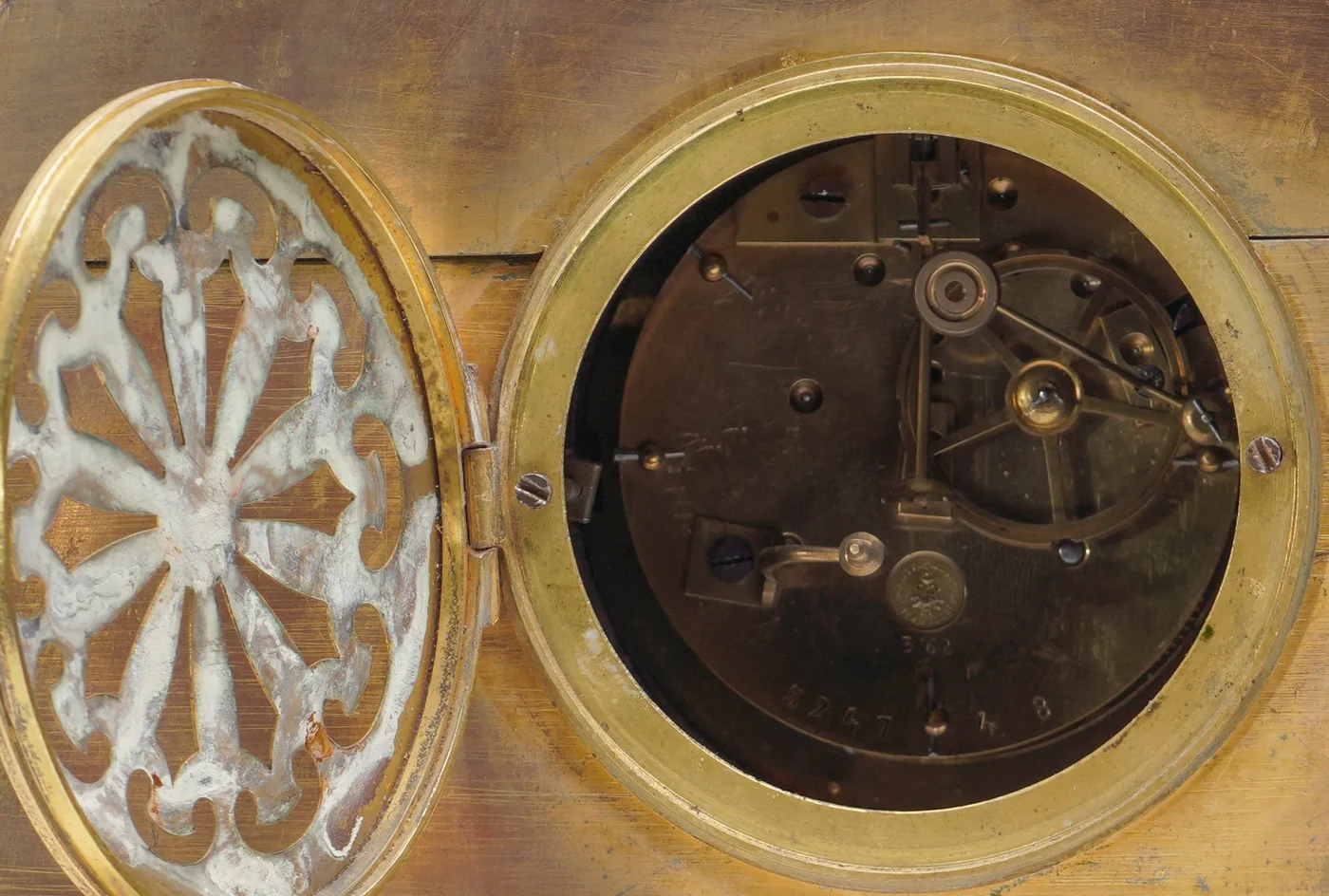
- The maker's stamp is on the back plate of the movement, behind the round back door, often with a number.
- A medal stamp names an exhibition year. Your clock was made in that year or later, often decades later: Japy's 1855 medal stamp was still used in the 1870s.
- The name on the dial is usually the shop or Paris finisher, not the movement maker.
- An English
Made in France
orFrench Made
is an export mark, required in Britain from 1887 and in the US from 1 March 1891.
In this article
- Where to find the marks on a French clock
- French clock makers' marks: the main makers and their stamps
- How a medal year dates your clock: the 'not earlier than' rule
- Serial numbers on French clock movements
- Retailer stamps vs makers' stamps
- 'Made in France', 'French Made' and other export marks
- What a maker's stamp means for value
- Get a free valuation of your French clock
- Questions
Where to find the marks on a French clock
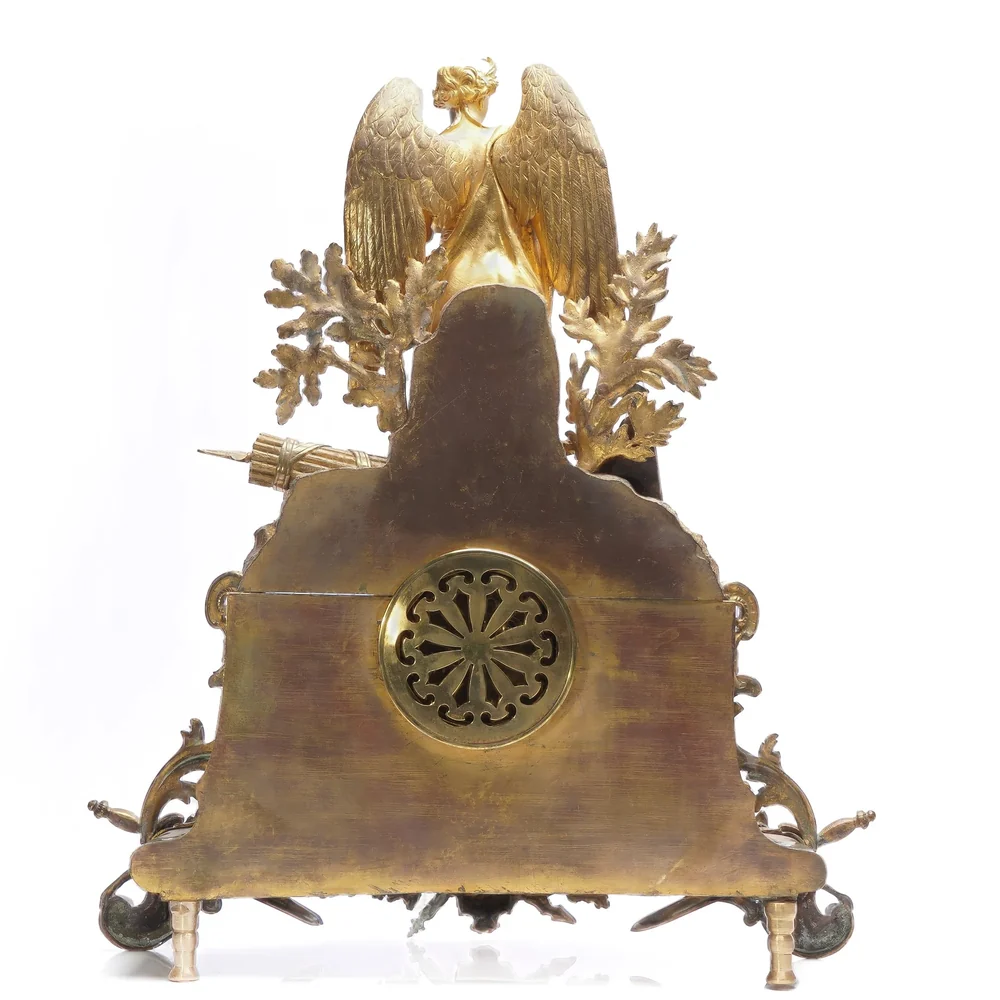
Open the back door, not the front
The marks that matter are on the back plate of the movement, the brass plate you see when you open the round door at the back of the case.
The dial usually carries a different name: the shop or the Paris firm that finished and sold the clock.
The case may be signed by its bronze maker, and an English retailer's case can carry a stamp and hallmarks of its own.
- Maker's or medal stamp. Often a small round or oval mark low on the plate.
- Numbers. The maker's production number, sometimes with other stamped figures.
- Count wheel. On many striking movements, a notched wheel on the back plate.
- Suspension. Where the pendulum hangs; some carry a name of their own.
- Other names. A finisher, a retailer or a patent name can appear anywhere on the plate.
Use a torch held at a low angle and take the photo straight on. Stamps are shallow, and raking light makes the letters stand up. Do not take the movement out of the case to look; everything you need is visible through the door.
French clock makers' marks: the main makers and their stamps
Many French clocks were a team effort. One firm made the movement, often in the Montbéliard area or at Saint-Nicolas-d'Aliermont in Normandy; a Paris house finished it, cased it and sold it. These are the names you will meet most often, with what their stamps say and the medals they claimed.
| Maker | The stamp reads | Medals and years | Earliest date | Source |
|---|---|---|---|---|
| Japy FrèresBeaucourt, County of Montbéliard | JAPY FRÈRES & Cie / GRE MED D'HONNEURwith a cross in the centre, plus production numbers | Grand medal of honour, Paris Exposition Universelle 1855; another in 1867 | Not before 1855 | Banco de España |
| Vincenti & CieMontbéliard, from 1823; in business until 1923 | A round seal, MEDAILLE D'ARGENT 1855 VINCENTI & CIE | Silver medals, Paris 1834 and the Paris Exposition of 1855 | Not before 1855 | Banco de España |
| S. Marti et CieParis | MEDAILLE DE BRONZEwith the firm's name | Bronze medal, international exhibition of industrial products, 1860 | Not before 1860 | National Historical Museum, Athens, The Met |
| Honoré PonsParis; movement factory at Saint-Nicolas-d'Aliermont from 1807 | MEDAILLE D'OR / PONS / 1827 | Gold medal, 1827 | Not before 1827 | Banco de España |
| A.D. MouginFrance | AD Mougin deux medailles made in France | Two medals; no years on the stamp | No year from the medals; see export marks | Harvard Art Museums |
| Raingo FrèresParis | RAINGO FRERES PARISin a circular recess | Bronze medal Paris 1844; prizes London 1862, Paris 1867 and 1878; gold medal Paris 1889 | No year on the stamp | V&A |
| Brocot & DelettrezParis, founded 20 October 1851 | A Brocot & Delettrez, Pariswith a number. BROCOT PROPTEalso appears on the regulating work of other firms' clocks | Not on the stamp | Not before 1851 for the firm's stamp | Wikipedia, Christie's, V&A |
| Henri MarcParis | Hy Marc, Parisand a number on the back plate; Hry Marc a Parison the dial | Not on the stamp | No year on the stamp | Woolley & Wallis |
| DrocourtParis and Saint-Nicolas-d'Aliermont; Pierre from 1853, Alfred from 1872 | D.C. either side of a small carriage clock in an oval, with the serial number | Bronze Paris 1867, silver Paris 1878, gold Paris 1889 | No year on the stamp; firm from 1853 | BADA, Bonhams |
| Duverdrey & BloquelSaint-Nicolas-d'Aliermont | The firm's name on the movement; Bayard Parison dials | Not on the stamp | No year on the stamp | Antikeo |
"Not on the stamp" means the stamp described in our source names no medal. Every row is taken from a museum record, an auction catalogue or a dealer's description, linked in the last column.
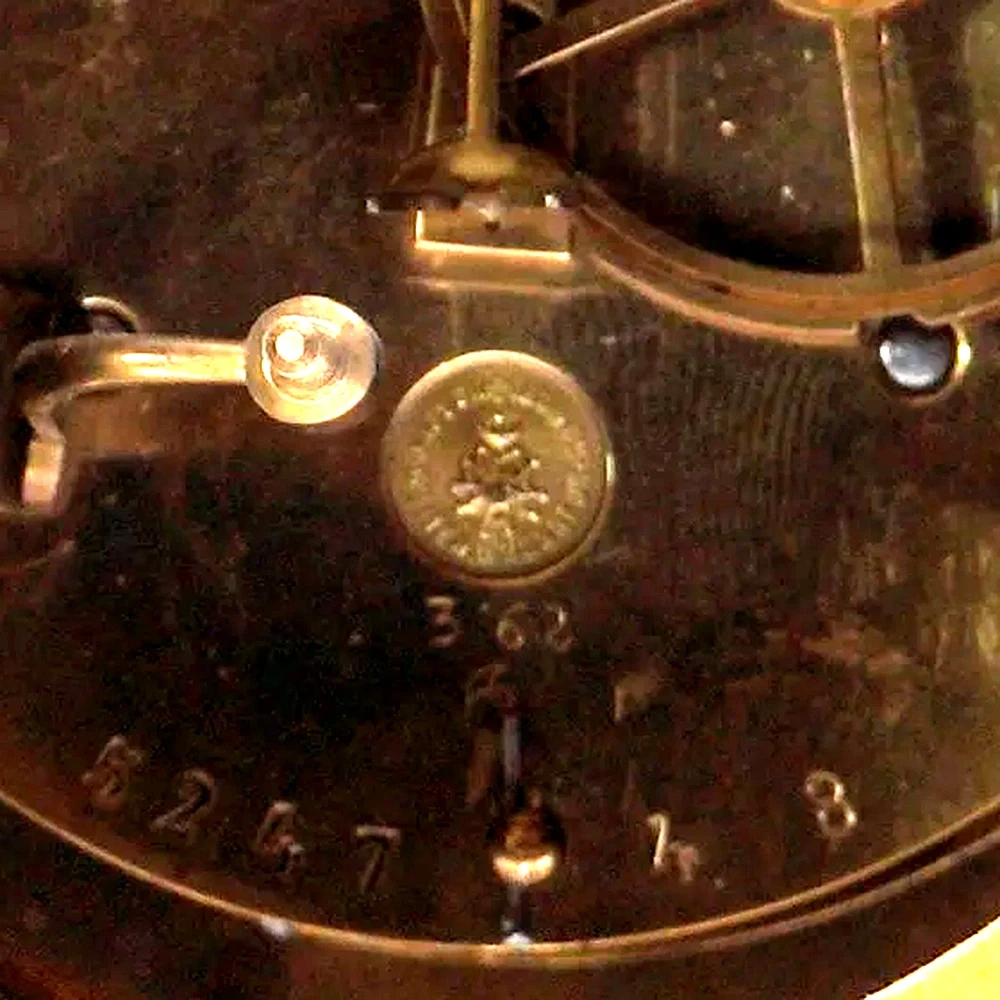
How to read a medal stamp
- The medal: or is gold, argent silver, bronze bronze; médaille d'honneur is a medal of honour, and GRE MED or G DE MED a grand medal.
- The year, when there is one, is the year of the exhibition, not of your clock.
- The name is the movement maker. It is rarely the name on the dial.
Worn stamps like this one are common. A photograph in raking light usually brings the lettering back.
How a medal year dates your clock: the 'not earlier than' rule
A medal stamp gives you the earliest possible date, and nothing more. A firm could only boast of a medal after it had won it, so a Japy Frères movement stamped GRE MED D'HONNEUR
was made after 1855. But makers kept the stamp for decades.
Medal or prize yearBrocot & Delettrez, firm founded 1851 to Brocot's death in 1878
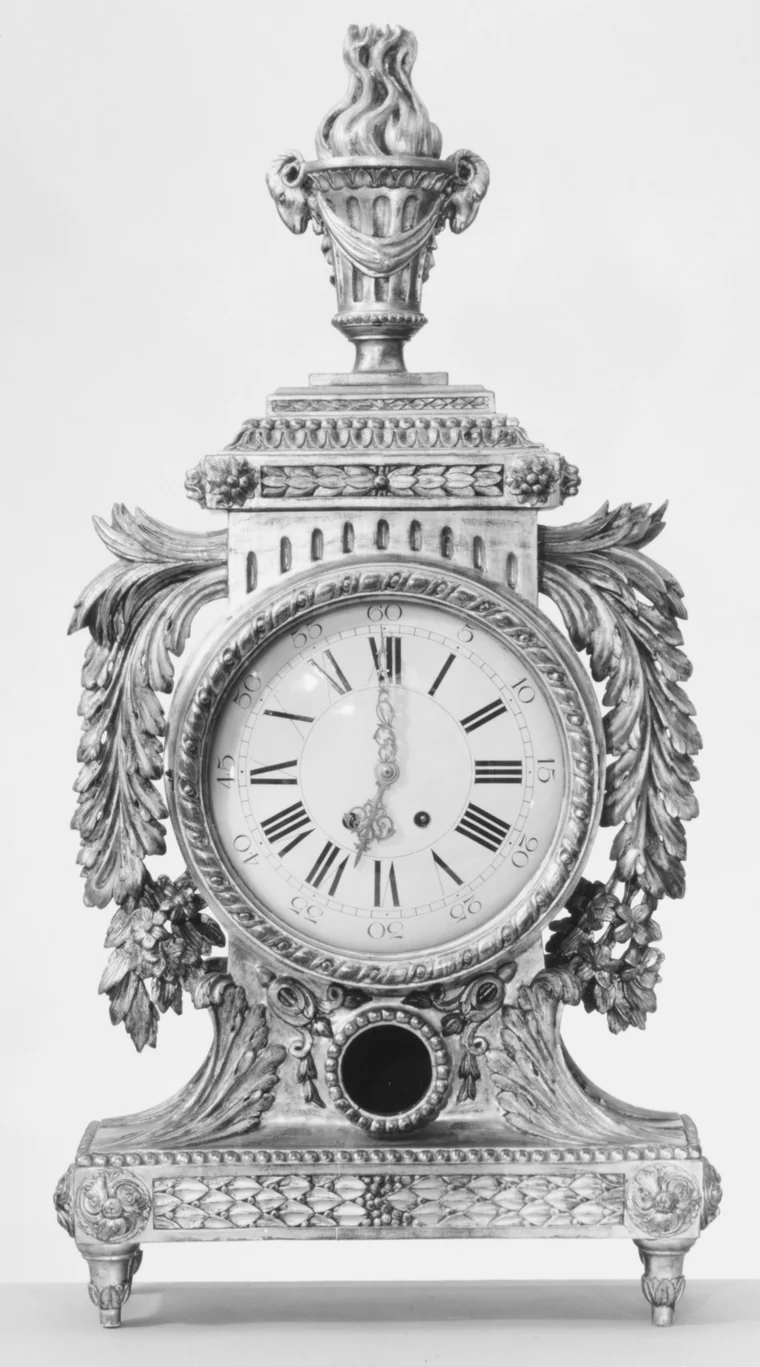
The case and the movement can be a century apart
The Met dates this case to about 1770, but its dial and movement, by the firm of Samuel Marti et Cie of Paris, to about 1860 to 1890.
So date the movement by its stamp, and the case by its style and making. If they disagree, the clock has had a new movement, which buyers want to know about.
Four steps to a date range
- Read the year
Find the medal year, or the founding date of the firm on the stamp. That is your earliest date.
- Do not stop there
Firms used their medal stamps long after the event. The Banco de España dates one Japy clock with the 1855 stamp to about 1875, and the Met dates a Marti movement with an 1860 medal to about 1860 to 1890.
- Look for a latest date
An English
Made in France
mark, a dated retailer, hallmarks on a silver case or the end of the firm (Vincenti closed in 1923) close the range. - Check the case agrees
Style, gilding and construction should fit the same window. Our French mantel clock guide shows the periods and styles.
Send a photo of your movement stamp for a free opinion
Serial numbers on French clock movements
Most French movements carry a stamped number. It was the maker's production number, and on good clocks it was repeated on parts made for that movement.
- Matching numbers are the useful part. A Mougin clock at Harvard has 8715 on the movement and on the pendulum bob; good carriage clock keys were often numbered to the clock.
- No public lookup turns a Japy, Vincenti or Marti number into a year, as you can for a Waltham pocket watch. For French clocks, rely on the stamp, the case and the retailer.
- Several numbers on one plate are normal. A Japy back plate in the Banco de España collection carries three: 1462, 70810 and 107477.
Retailer stamps vs makers' stamps
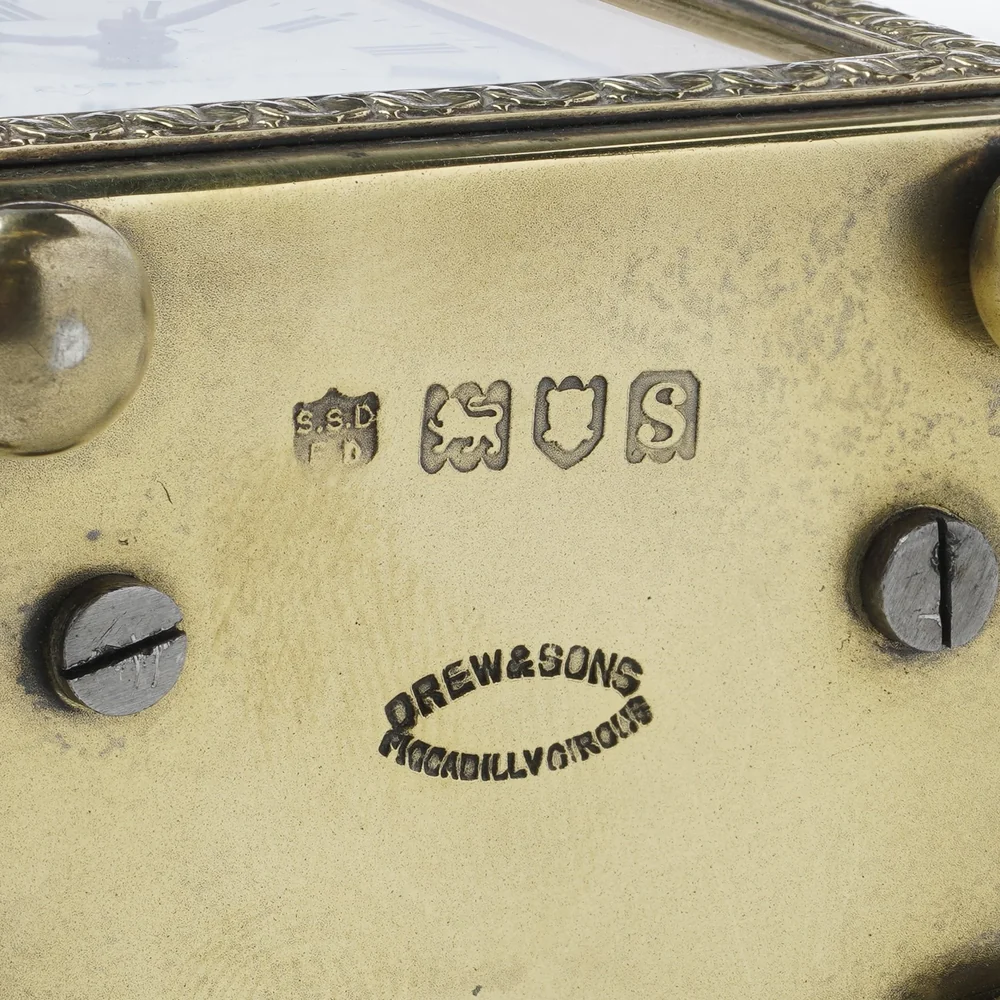
The shop's name is not the maker's
Our 1913 carriage clock shows the pattern. The dial and the silver-gilt case both name Drew & Sons of Piccadilly Circus, the London retailer, while the movement inside is stamped as French made.
The clock is in stock now; our carriage clock value guide covers carriage clock makers and cases.
Paris clocks often carry three or four names. These real examples show who is who:
- A dial signed DELETTREZ A PARIS on a clock whose movement has the Vincenti & Cie silver medal stamp and the retailer's stamp. It sold for £420 at Bonhams Chester in November 2008.
- Three stamps on one back plate: Victor Paillard, the bronze founder; Rodier, the Paris clockmaker who finished the movement; and the Pons gold medal of 1827 for the movement itself.
- A Japy movement in a clock whose maker's name is J. Delaye of Grenoble.
- BROCOT PROPTE on the regulating work of a Raingo Frères clock at the V&A. It names Brocot, not the maker of the clock.
'Made in France', 'French Made' and other export marks
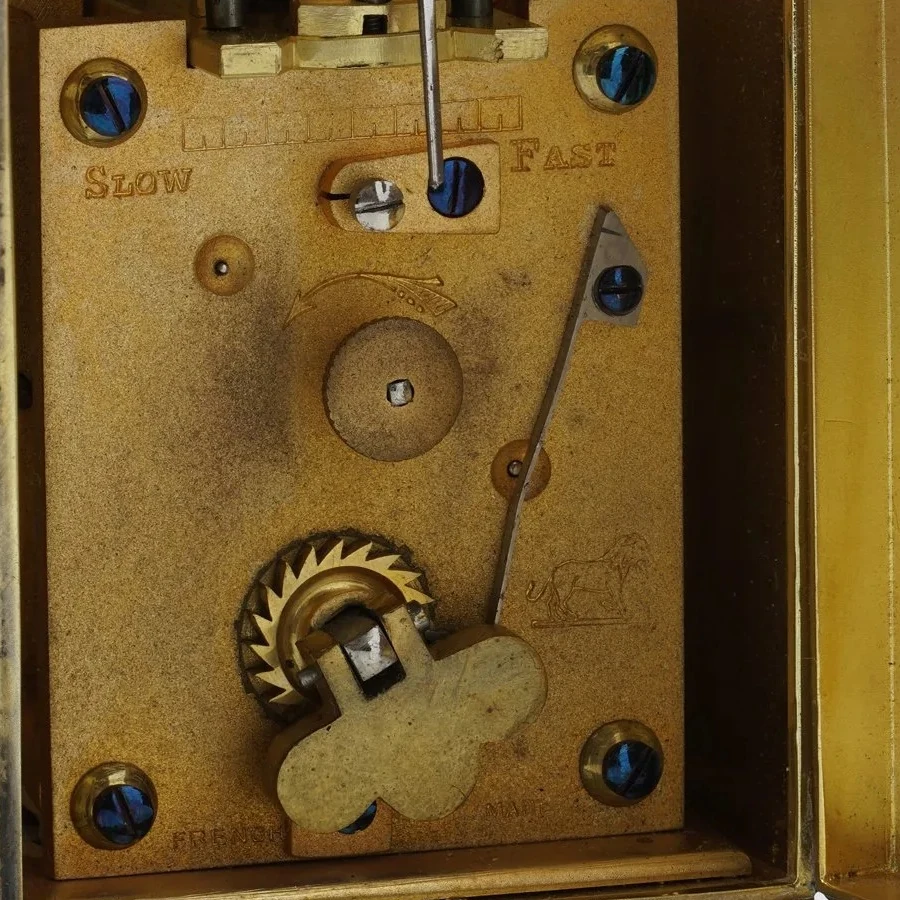
Why the words are in English
A French maker had no reason to write English on a clock sold in France. These marks were made for export, and two laws explain them.
Britain, 1887: the Merchandise Marks Act required the country of origin on imported goods that carried the name or trade mark of a British firm.
United States, 1 March 1891: the Tariff Act of 1890 required imports to be marked in legible English words
with their country of origin.
So an English origin mark points to a clock made for export after those dates. It fits our clock: a London retailer's name on a French movement, with a case hallmarked in 1913.
A French mark is different. Paris
or a French medal stamp says nothing about export, and a clock without any origin mark can still be early or late.
What a maker's stamp means for value
A stamp tells you who made the movement and when it could have been made. On its own it rarely sets the price; the case, the condition and what the clock does matter more.
The NAWCC notes that Japy Frères and Duverdrey & Bloquel signatures add little to a carriage clock.
A Drocourt carriage clock, no. 7374 with the D.C. trademark, made £1,152 at Bonhams in November 2023.
A movement that matches its case, pendulum and key is worth more than a later replacement.
For prices by type, see our antique French mantel clocks guide and the carriage clock value guide; we do not repeat them here.
Get a free valuation of your French clock
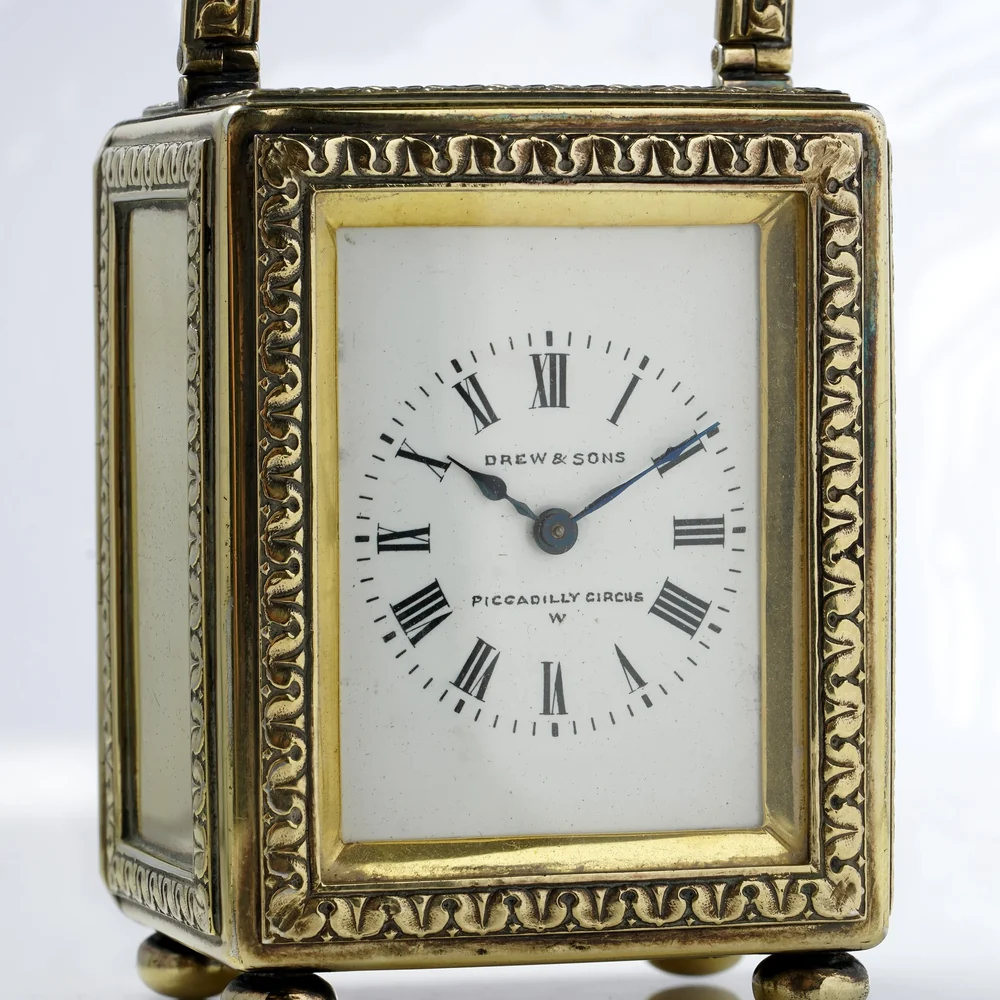
Photograph these five things
- The whole clock from the front, straight on.
- The back plate through the open door, square on, with a torch at a low angle.
- A close-up of each stamp and number.
- The dial, and any name on it.
- The pendulum, key and anything stamped underneath the case.
- Send the photos
Use the form below, WhatsApp 07494 214652 or call 01376 334482.
- We read the marks
A specialist reads the stamps, dates the movement and case, and tells you what the clock is and a realistic value.
- You decide
There is no charge and no obligation. Looking to buy? See our decorative objects, silver and antique pocket watches, or contact us to see a piece in Mayfair or Braintree. For a watch, see sell your pocket watch.
Request a free valuation of your French clock
- Look on the back plate, through the round back door, for the maker's stamp and number.
- A medal year is an earliest date, not the year your clock was made.
- The dial usually names the retailer or finisher; the stamp names the movement maker.
- English export marks point to a clock made for Britain or America after 1887 or 1891.
Questions we are asked
What does 'Médaille d'Honneur' on a French clock movement mean?
On a Japy Frères movement it refers to the grand medal of honour Japy won at the Paris Exposition Universelle of 1855, and again in 1867. The movement was made after 1855, often decades later.
What does the S. Marti 'Médaille de Bronze' stamp mean?
S. Marti et Cie won a bronze medal at an international exhibition of industrial products in 1860, so a movement with this stamp was made in 1860 or later. The Met dates one Marti movement to about 1860 to 1890.
How old is my Vincenti clock with 'Médaille d'Argent 1855'?
It was made in 1855 or later. Vincenti & Cie of Montbéliard won silver medals in 1834 and 1855 and stayed in business until 1923, so the case style and other marks narrow the date.
Is the name on the dial the maker of my clock?
Usually not. The dial normally names the retailer or the Paris firm that finished the clock. The movement maker's stamp is on the back plate.
What does 'Made in France' on a clock mean?
It is an export mark, written in English for the British or American market. The US required such marks on imports from 1 March 1891, and Britain from 1887 on foreign goods carrying a British name.
Can I date a French clock by its serial number?
Not on its own. There is no public table that turns a French movement number into a year. Use the number to check that the movement, pendulum and key belong together.
Does a Japy Frères stamp make my clock valuable?
Not by itself. The NAWCC notes that a Japy Frères signature adds little to a carriage clock. The case material, quality, condition and originality decide most of the value.
Can you read the stamp on my clock from a photo?
Yes. Send a clear photo of the back plate, taken square on with a torch at a low angle, and we will read it and tell you what the clock is, free and with no obligation.
Find out what your French clock is
Send photos of the dial and the back plate for a free valuation, or visit us in Mayfair or Braintree by appointment.
- Free valuation from photos
- No charge, no obligation
- Appointments in Mayfair and Braintree
New pieces reach our list first: join the Mozeris list.