How Old Is My Clock? How to Date an Antique Clock, Clue by Clue
How to tell how old your clock is, and whether it is really antique: seven clues to check, the stamps that follow the law, and the red flags of a reproduction or a marriage.
To find out how old your clock is, check these in order:
- Battery or mains lead? Quartz is mostly 1960s on; mains synchronous clocks date from 1931 in Britain.
- The movement: hand finishing, plates, pillars and fixings. Cross-head screws are 1930s or later.
- Dial and backplate: engraved backplates and brass dials are early; printed dials are 20th century.
- Stamps: "Made in Germany" or "French Made" usually after 1887; "Foreign" after 1926; "West Germany" 1949 to 1990.
- Antique means more than 100 years old: in 2026, made before about 1926.
In this article
Antique, vintage or modern? The 30-second check
For tax purposes HMRC treats an antique as an object more than 100 years old. In 2026 that means a clock made before about 1926. Most people want a closer date than that, and the clock itself usually gives one.
Start by turning it round:
- A battery compartment: a quartz or battery-electric movement, almost always from the 1960s or later. If the case looks much older, the original movement may have been replaced.
- A mains lead and no winding holes: a synchronous electric clock. In Britain these went on sale in 1931.
- Winding holes in the dial, or a key: a mechanical clock. It could be from almost any date, so work through the checklist below.
The dating checklist: seven clues, in order
Work from the inside out. The movement is the hardest part to fake or swap, so start there, then read the dial, the case and any marks. No single clue dates a clock. You are looking for several clues that agree.
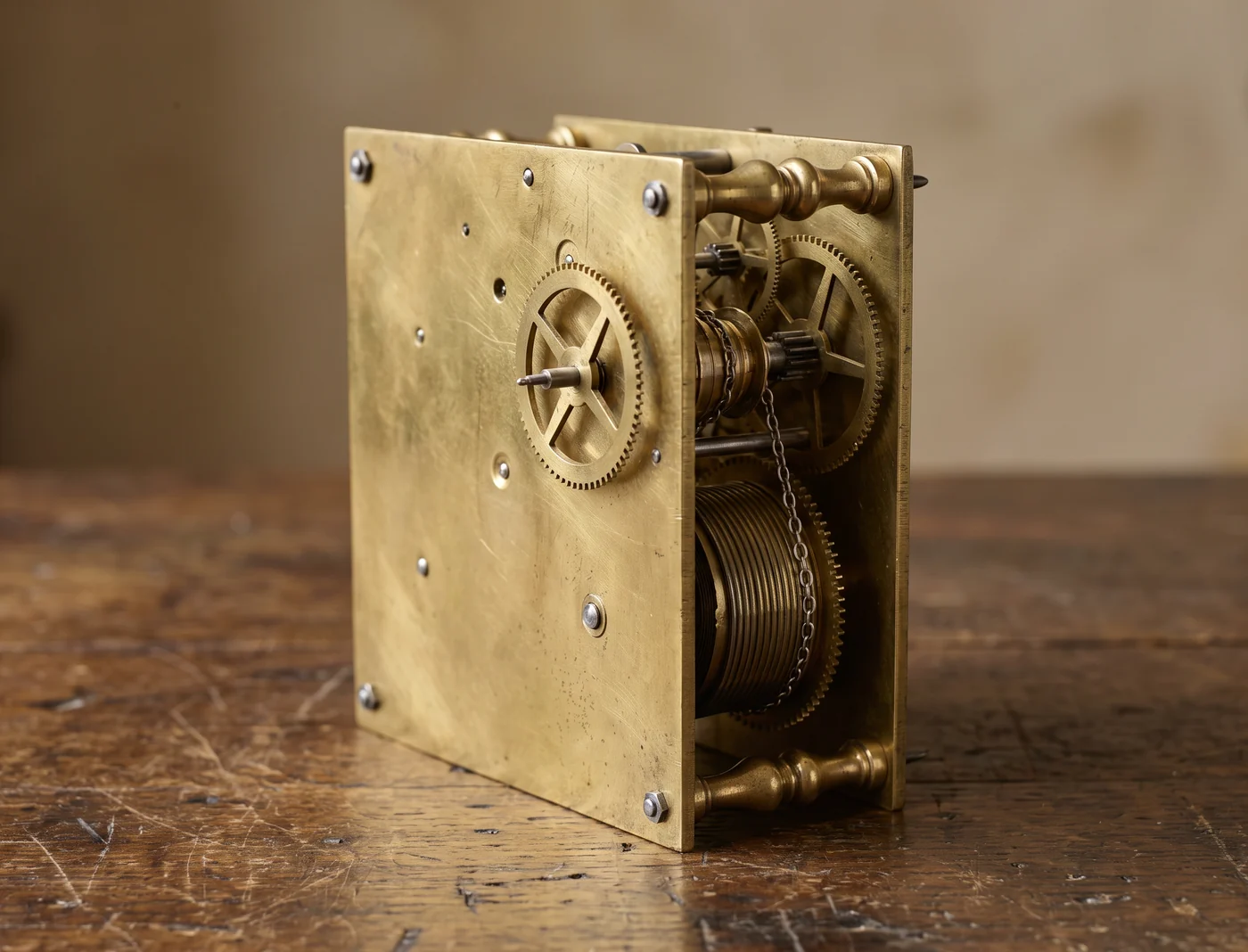
The movement: plates, pillars and wheels
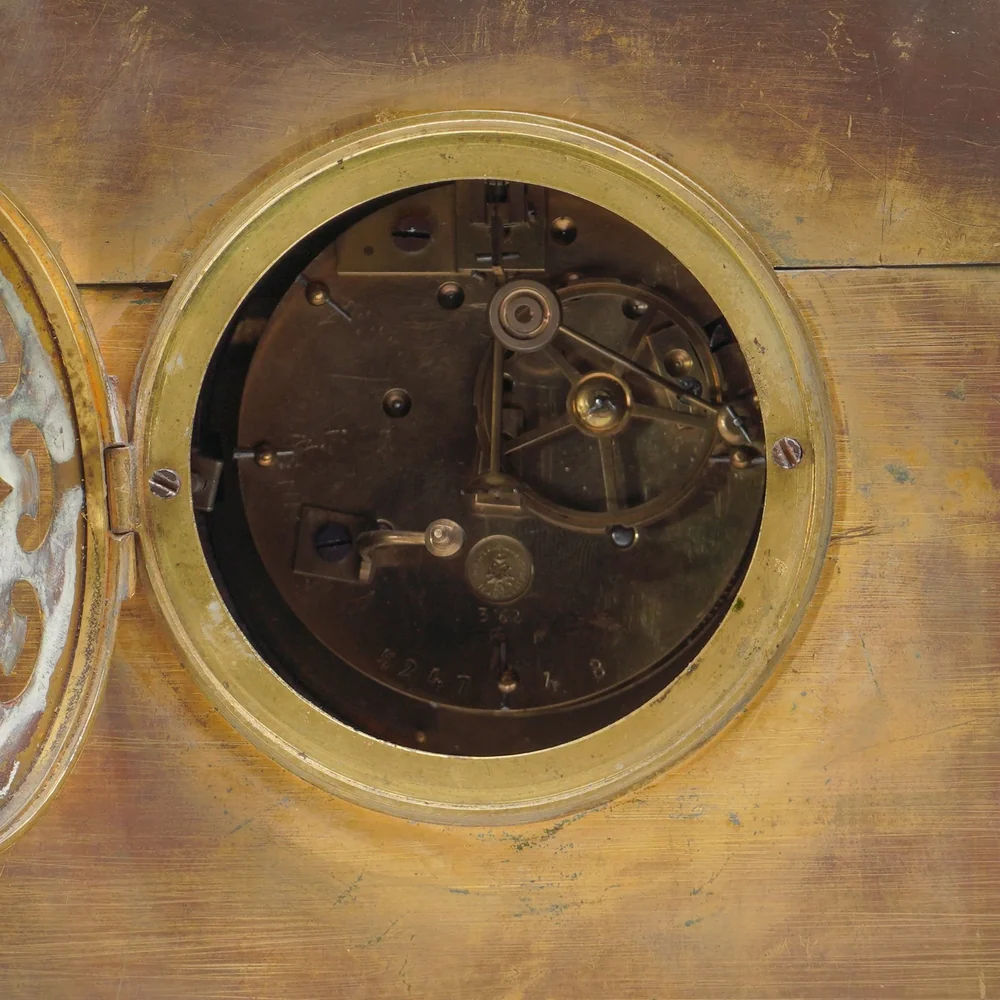
Open the back door. An English clock usually has two thick brass plates held apart by turned pillars. A French mantel clock has a small, round, finely finished movement (see antique French mantel clocks).
"Hand-cut wheels" is a common phrase but not quite right: wheel-cutting engines were in use in England by 1668 to 1672. What marks an early movement is hand finishing: filed spokes, tool marks and slightly uneven shapes.
Thin plates and wheels stamped from sheet brass point to factory production. Chauncey Jerome's stamped-gear American clocks were selling in England from 1842.
Pins, nuts and screws
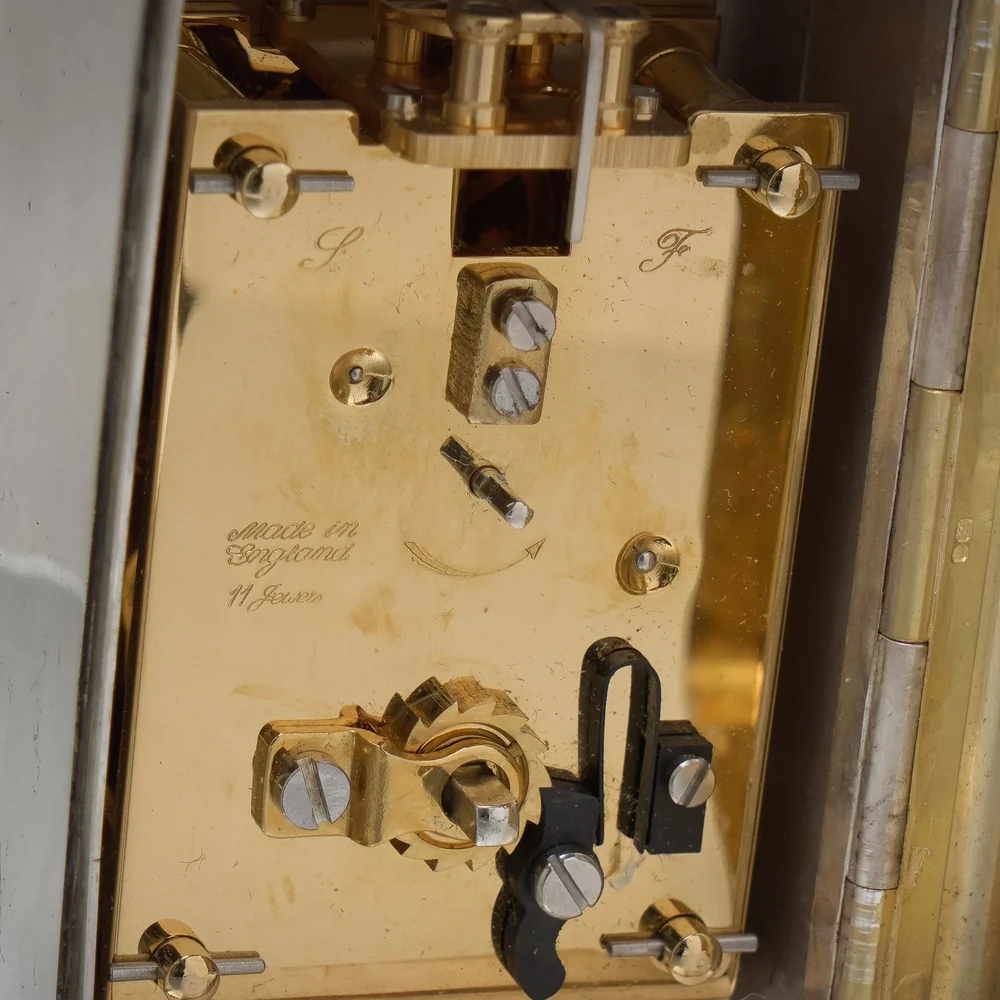
Older movements hold their plates together with taper pins pushed through the pillar ends; later ones use nuts or screws. Collectors on the NAWCC forum put the change on American clocks at about 1875 to 1885. Junghans screwed its movements from about 1875, while other German makers still pinned theirs after 1900.
Pins on their own prove nothing. The English carriage clock above was made in 1988 and its plates are still pinned.
Cross-head screws are a stronger clue. The Phillips screw was patented in the 1930s and Pozidriv in 1962, so a cross-head screw in a clock sold as Victorian is a later repair or a warning sign.
The backplate
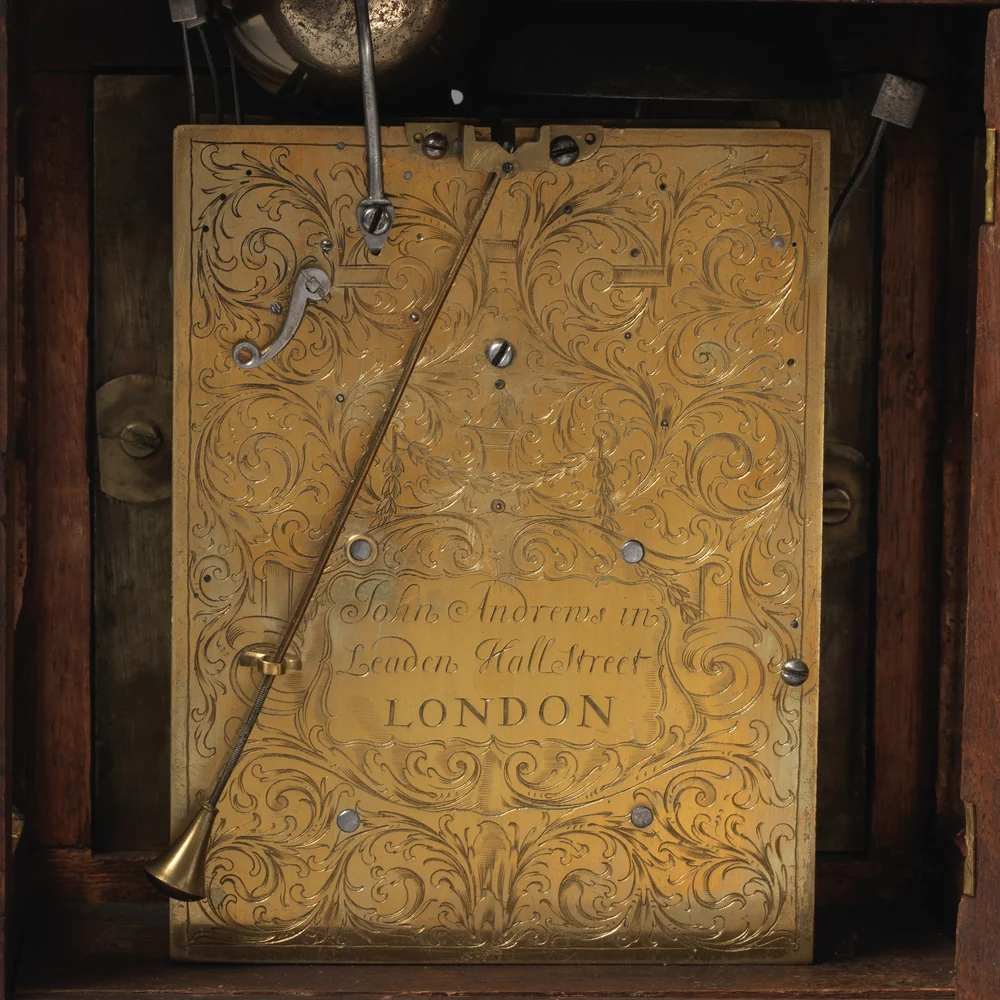
On English bracket clocks the backplate was meant to be seen through a glass door. From the late 1600s it was often engraved all over with scrolls, flowers and birds.
The engraving grew simpler through the 1700s. By about 1800 it was usually a border with the maker's name in the centre, then just the name, and most Victorian backplates are plain.
So a richly engraved backplate suggests the 18th century or earlier, and a plain one the 19th, provided the movement belongs to the case.
The dial and hands
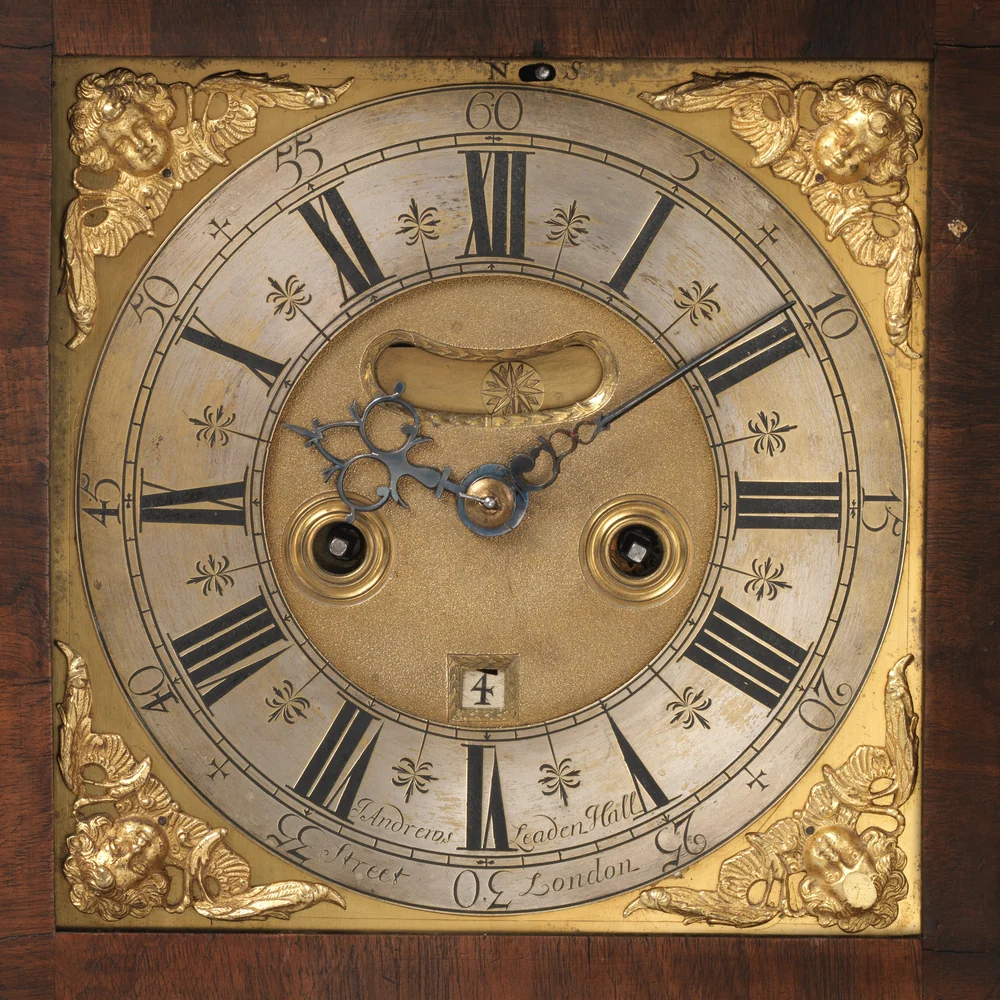
The dial is the quickest visual guide, but dials were repainted, re-silvered and swapped, so check it against the movement.
- Brass with a separate silvered ring and cast corner pieces: English, late 1600s and 1700s.
- Painted white dials on English longcase clocks from about 1770. The decoration dates them more closely: see dating by the dial.
- White enamel: typical of French carriage and mantel clocks.
- Printed paper on a metal backing: cheap factory clocks, such as a Gilbert shelf clock of about 1880 in The Henry Ford's collection.
Hands should match each other and suit the dial. Odd hands usually mean a repair.
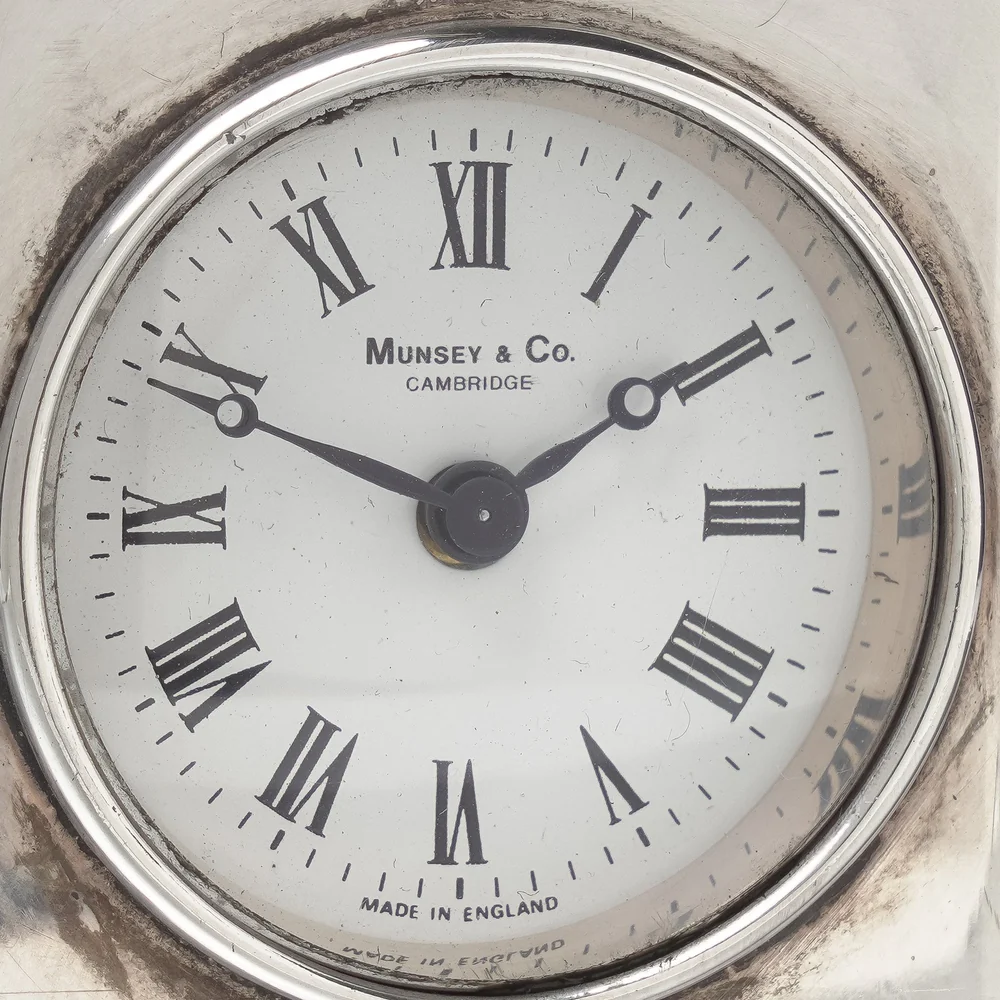
Printed names and country marks
Crisp printed lettering, often with the retailer's name and a country of origin, belongs to the 20th century.
On this 1988 carriage clock the dial names Munsey & Co of Cambridge, the shop that sold it, and reads Made in England.
The case: veneer, nails and boards
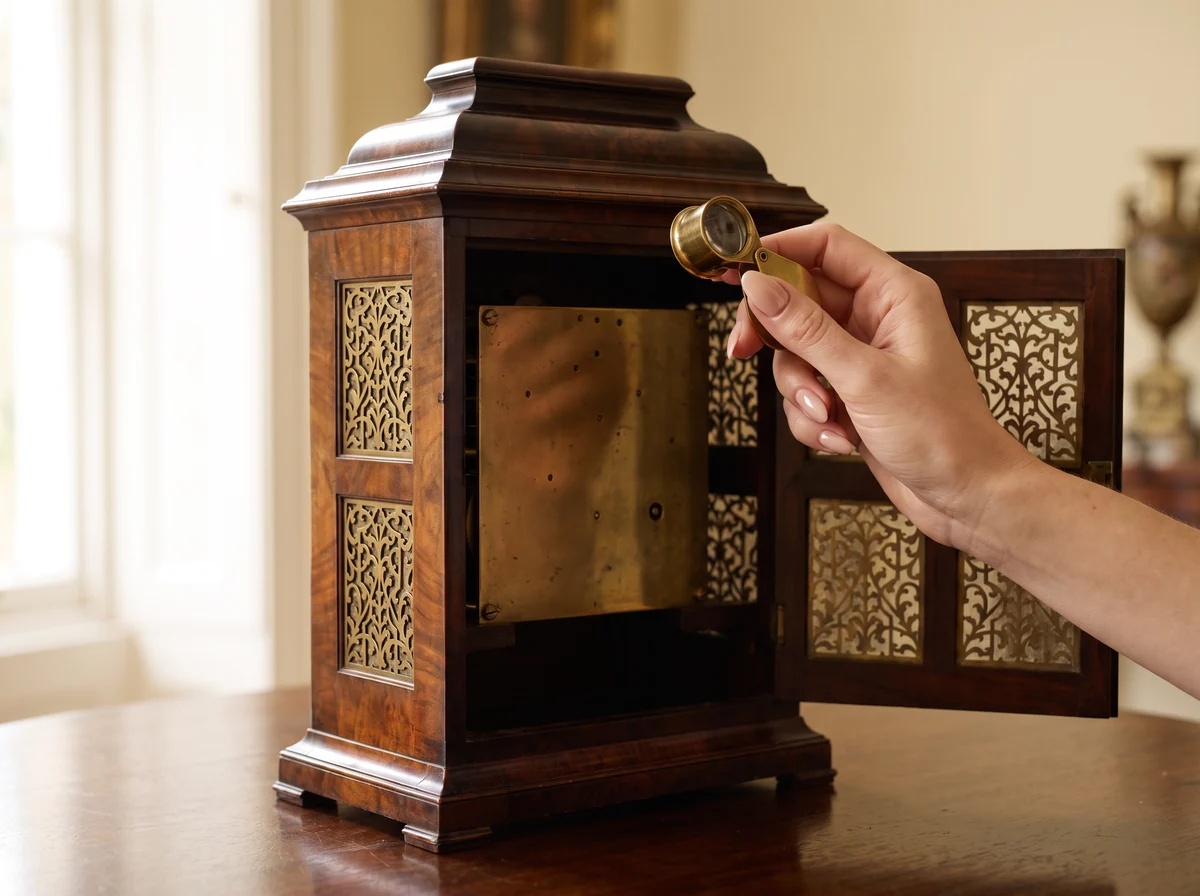
Look at the edges of the veneer and inside the case, where nobody polished.
- Veneer: hand-sawn veneers are often 1 to 2 mm thick. After Brunel patented veneer-cutting saws in 1806, steam sawing produced much thinner, more even sheets.
- Nails: hand-forged at first, then machine-cut nails with a rectangular section (roughly 1800 to 1914), then round wire nails, which took over in the later 19th century.
- Boards: plywood appears in clock cases from about 1905. A plywood back on a clock sold as Georgian is a later replacement at best.
- Wear: old wood darkens where it is exposed. Pale, fresh wood or crisp machine marks inside an "antique" case mean new work.
Labels, stamps and country of origin
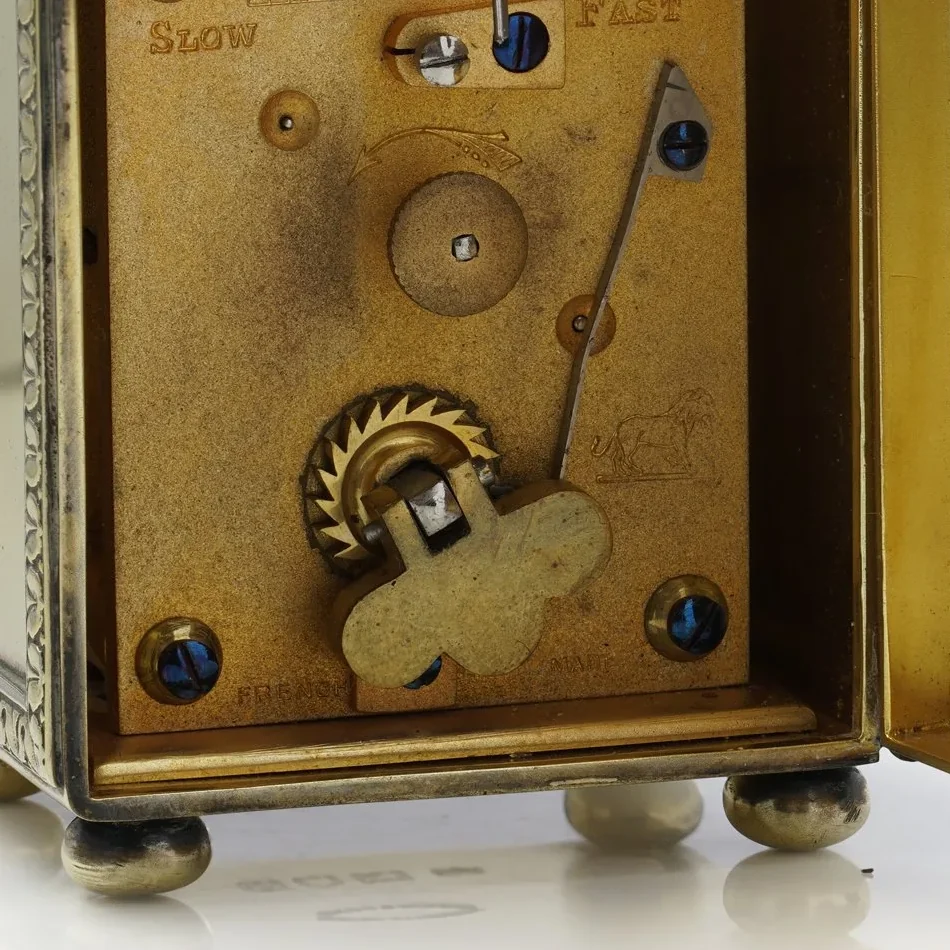
Country marks are some of the most reliable dating clues, because they follow the law.
- 1887: the Merchandise Marks Act required imported goods bearing a British maker's name or trade mark to show where they were made. That is the origin of "Made in Germany". Our 1913 clock shows the pattern: a London retailer on the dial, FRENCH MADE on the movement.
- 1891: clocks exported to the United States had to be marked with their country of origin.
- 1926: a new Merchandise Marks Act allowed the country's name, or the word "Empire" or "Foreign". FOREIGN on the dial or movement is common on German clocks sold in Britain between the wars.
- 1949 to 1990: "West Germany" or "Western Germany" dates a German clock to the years of two German states.
French movements often carry a maker's stamp with an exhibition medal; the medal year gives a "not before" date (French clock movement marks).
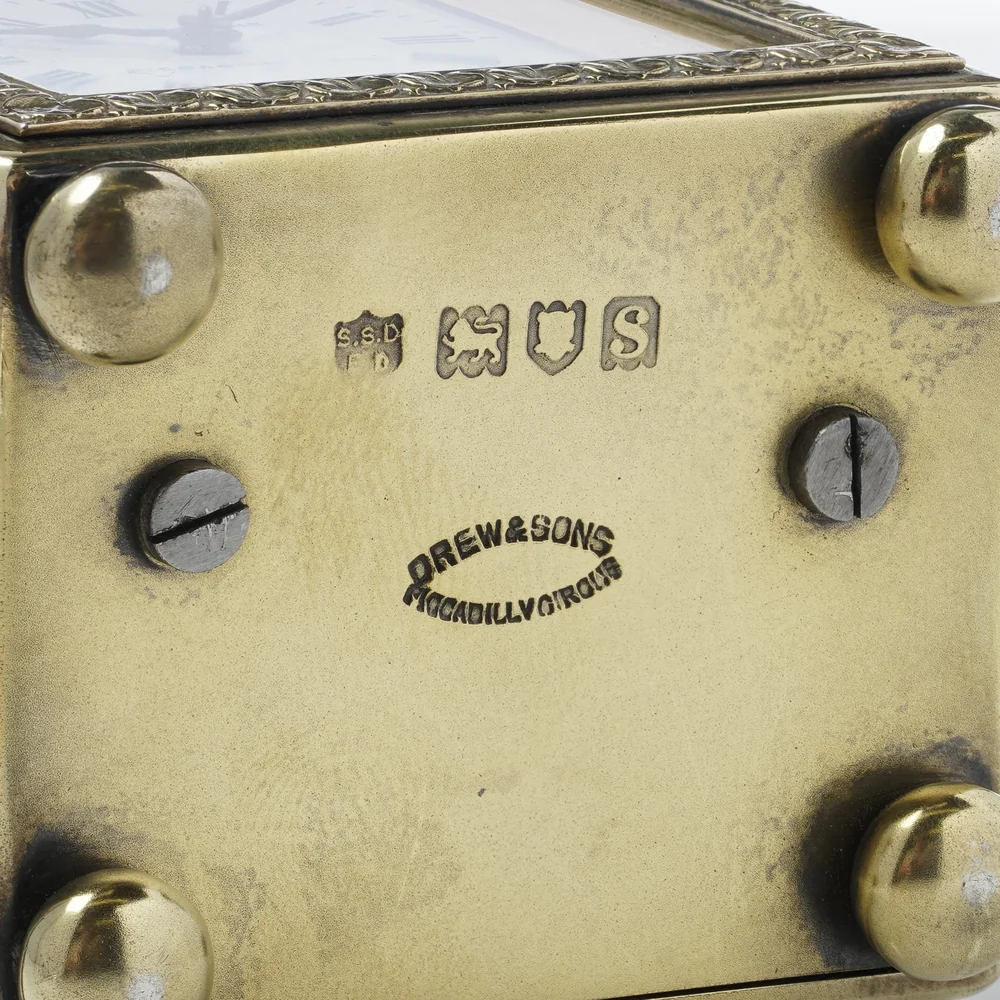
A silver case gives the exact year
If the case is British silver or gold, the hallmark includes a date letter for the year it was assayed. See how to read silver hallmarks.
Serial numbers help only where the maker's records are known. The Atmos is one clock that can be dated from its number: see Atmos clock value and dating.
Electric, synchronous and quartz clocks
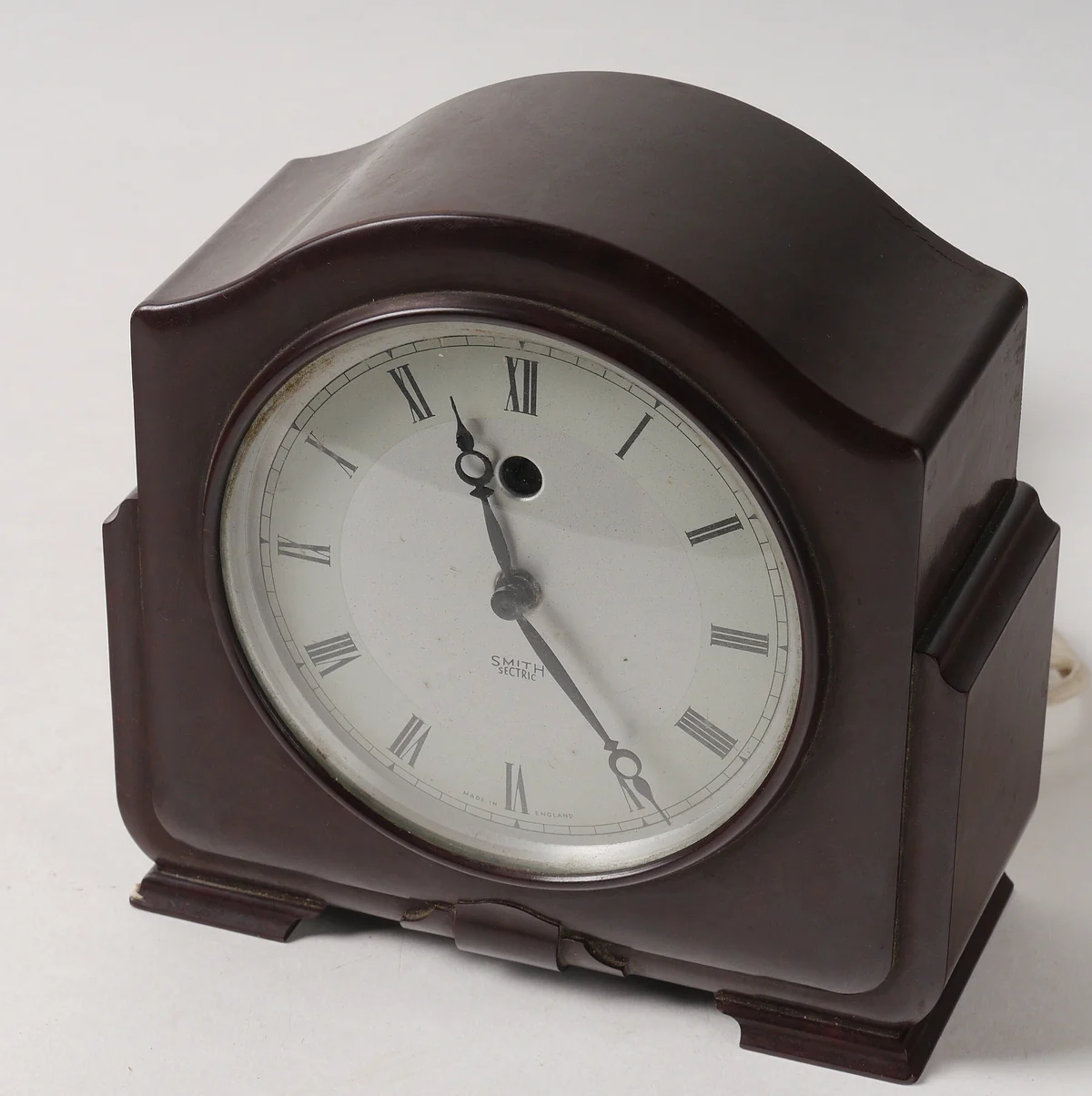

Britain's National Grid made mains clocks practical. The Synclock, the first synchronous clock sold in Britain, arrived in 1931, and Smiths followed at the end of that year. The Sectric name appears from 1937.
- Synchronous: a mains lead and a label such as "200-250V 50~". They keep time from the grid's frequency.
- Floating balance: small mechanical clocks with a balance instead of a pendulum; Smiths began making them in 1956.
- Battery-electric: Smiths announced its transistorised Sectronic in 1962.
- Quartz: on sale from the 1960s and dominant by the 1980s. Smiths stopped making domestic clocks in 1979.
Key dates for dating a clock
Use these as "not before" markers: a clock cannot be older than its newest original feature.
| When | What changed | What you see on the clock |
|---|---|---|
| 1668 to 1672 | A wheel-cutting engine is made in England (now in the Science Museum) | Teeth on English clock wheels were cut by machine from early on; look for hand finishing instead |
| Late 1600s to about 1800 | Engraved backplates on English bracket clocks, simpler as the 1700s go on | Scrolls and foliage, then a border with the maker's name by about 1800 |
| About 1770 | Painted dials arrive on English longcase clocks | White dials with painted corners; see dating by the dial |
| 1806 | Brunel patents veneer-cutting saws; steam sawing follows | Thinner, more even veneers than the 1 to 2 mm hand-sawn ones |
| 1842 | Chauncey Jerome starts selling cheap American brass clocks in England | Stamped wheels, thin plates, paper labels inside the case |
| 1887 | Merchandise Marks Act | "Made in Germany" or "French Made" on imports bearing a British maker's name |
| 1891 | US McKinley Tariff marking rule in force | Country of origin on clocks exported to America |
| About 1905 | Plywood used in clock cases | Plywood backs and bases |
| 1926 | Merchandise Marks Act 1926 | "Foreign", "Empire" or a country name |
| 1931 | Mains synchronous clocks go on sale in Britain | A mains lead, no winding holes |
| 1930s | Cross-head (Phillips) screws come in | Cross-head screws: a 20th century clock or a later repair |
| 1949 to 1990 | Two German states | "Made in West Germany" or "Western Germany" |
| 1956 | Smiths floating balance clocks | A balance in place of a pendulum on small mechanical clocks |
| 1962 | Smiths Sectronic transistor clock | Battery-electric with a moving coil |
| 1970s to 1980s | Quartz takes over | A battery and a sealed plastic movement |
Red flags: reproductions, marriages and conversions
Many clocks are part old, part new. These are the signs that the age on the label and the age of the clock do not agree:
A bright, evenly machined movement with stamped model numbers inside a case styled as Georgian or Victorian.
A battery unit fitted in place of the original movement, often behind an old dial. The case may be old; the clock no longer is.
A movement and dial from one clock in a case made for another: empty or plugged holes, a dial that does not fill its opening, blocks packing the movement out.
Cross-head screws, wire staples or a plywood back on a clock said to be 18th century.
Even spray lacquer, no wear on the handle, door edges or feet, and no darkening of the wood inside.
A freshly painted signature on a worn dial, or a crisp paper label in a faded case.
Longcase clocks have their own marriage signs: see is it a marriage? on our grandfather clock page.
Not sure how old your clock is? Send photos for a free opinion
Does age decide what a clock is worth?
Not on its own. A plain 19th century clock can be worth less than a fine 20th century one. The maker, the quality of the movement, originality and condition matter as much as the date.
For prices, see the guide for your type of clock:
- Antique clock value guide: the overview.
- Carriage clock value, antique French mantel clocks, grandfather clock value and Atmos clock value.
Free clock dating and valuation from photos
Send us photographs and we will tell you, free and with no obligation, roughly when your clock was made, what it is and what it is likely to be worth. These photos answer most questions:
- Front
The whole clock, straight on, then the dial close up.
- Back door open
The backplate or movement, with any stamps, names and numbers in focus.
- Sides and base
Both sides, the underside, and any labels or hallmarks.
- Inside the case
The back board and joints, so we can see the wood and the fixings.
Use the form below, call 01376 334482, WhatsApp us or book an appointment at 47 Maddox Street, Mayfair, or in Braintree, Essex.
Buying? See the Drew & Sons carriage clock of 1913 in our silver, and our pocket watches. Clocks going back this month? Here is how to change an antique clock.
Request a free valuation
- Date a clock from several clues that agree: movement, fixings, backplate, dial, case and stamps.
- Country marks follow the law: "Made in Germany" usually after 1887, "Foreign" after 1926.
- Cross-head screws, plywood and printed dials belong to the 20th century.
- Send photos of the front, back, movement and inside of the case for a free opinion.
Questions we are asked
How can I tell how old my clock is?
Check, in order: the movement (plates, pillars, finish), the fixings, the backplate, the dial and hands, the case construction, and any country, maker or hallmark stamps. Several clues that agree give a date range; one clue alone can mislead.
How do I know if my clock is antique?
HMRC treats an antique as more than 100 years old, so in 2026 a clock made before about 1926. Country marks, hallmarks, case construction and the type of movement usually show which side of that line it falls.
What does "Foreign" on a clock mean?
It comes from the Merchandise Marks Act 1926, which allowed imported goods to be marked "Foreign" or "Empire" instead of a country name. On clocks it usually points to an import sold in Britain between the wars, very often German.
What does "Made in Germany" or "French Made" on a clock tell me?
That the clock was imported, most likely after the Merchandise Marks Act of 1887, which required imported goods bearing a British maker's name or trade mark to show where they were made. "West Germany" dates a clock to 1949 to 1990.
Do taper pins mean a clock is old?
Not on their own. Many older movements are pinned, but some makers kept using pins well into the 20th century: our English carriage clock of 1988 still has them. Cross-head screws are a more useful warning sign.
How old is a clock with a painted dial?
On English longcase clocks painted dials begin around 1770, and the style of the painting narrows the date. Our grandfather clock guide has the full dial timeline.
Is a battery clock ever antique?
Rarely. Battery-electric and quartz clocks for the home date mostly from the 1960s on. If an old-looking case has a battery movement, the original movement has probably been replaced.
Can I date a clock from its serial number?
Only where the maker numbered its clocks and the records survive. The Atmos is a good example. For most antique clocks the construction and the marks date it more reliably.
Find out how old your clock is, and what it is worth
Send photos of the dial, the back and the movement for a free opinion and honest advice, or visit us in Mayfair or Braintree.
- Free valuation from photos
- Honest advice, no obligation
- Appointments in Mayfair and Braintree
New pieces reach our list first: join the Mozeris list.