Carriage Clock Value: What Your Carriage Clock Is Worth, by Maker and Type
What is your carriage clock worth? How to read the case, the movement and the maker's marks, and how to get a free valuation from photos.
Carriage clock value depends on maker, movement, case and condition:
- Everyday 20th century brass clocks are for use and enjoyment rather than collecting.
- Good 19th century French clocks that strike or repeat form the core of the collector market.
- Porcelain panels, the best Paris makers and top English makers sit at the top.
- Value killers: quartz conversion, a replaced platform, cracked panels or dial, strike or repeat not working.
In this article
- What a carriage clock is
- Case styles: six to recognise
- Movements and complications
- How to identify the maker
- Carriage clock makers and what drives their value
- What puts a carriage clock in the top tier
- What lowers the value, and what raises it
- Silver and modern carriage clocks
- Free carriage clock valuation and advice
- Questions
What a carriage clock is
A travelling clock with a platform on top
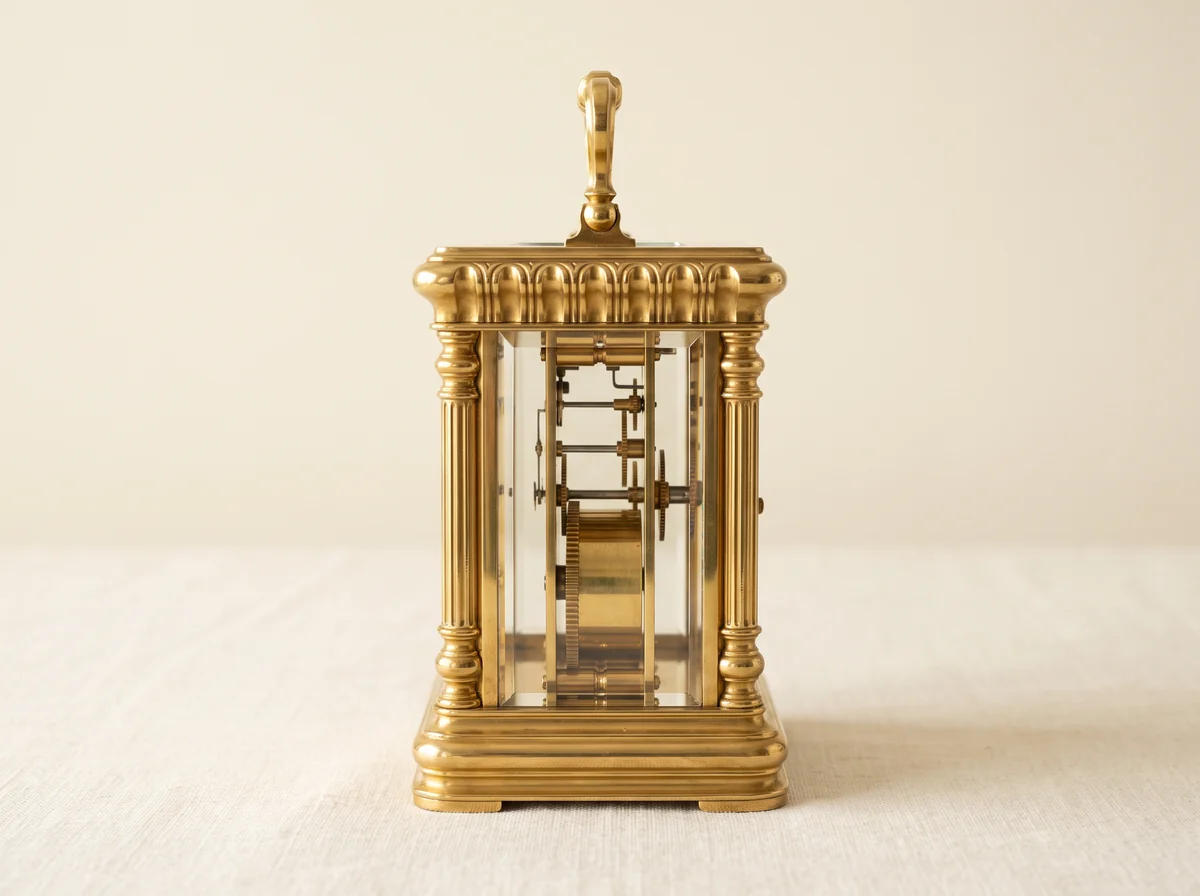
A carriage clock is a small spring-driven clock built to travel. The French call it a pendule de voyage. Most have a brass or gilt case with glass on every side and a handle on top.
There is no pendulum. A balance wheel on a platform laid across the top of the movement keeps time, so the clock still runs when carried. Most French examples run for eight days on one winding.
France first, then England
- Breguet made travelling clocks for Napoleon. One of 1796, described as the second carriage clock ever made, sold at Bonhams for £295,000 in December 2019.
- Paul Garnier of Paris began making them in small batches of about 20 in 1830, rather than one at a time, and popularised the one-piece case.
- Saint-Nicolas-d'Aliermont, near Dieppe, made the rough movements (blancs roulants). Paris firms such as Drocourt finished them in their own workshops.
- English makers, many of them chronometer makers, made their own from about 1820: heavier clocks, often with a fusee. They were dearer than the French, and production had all but ended by 1900.
By 1860 Britain was France's best customer. Almost all carriage clocks seen today were made between 1885 and 1914, which is why so many survive.
Case styles: six to recognise
French makers gave their case shapes names that the whole trade used. The shape helps date a clock, and the best makers kept the most complex cases for their best clocks.
Corniche
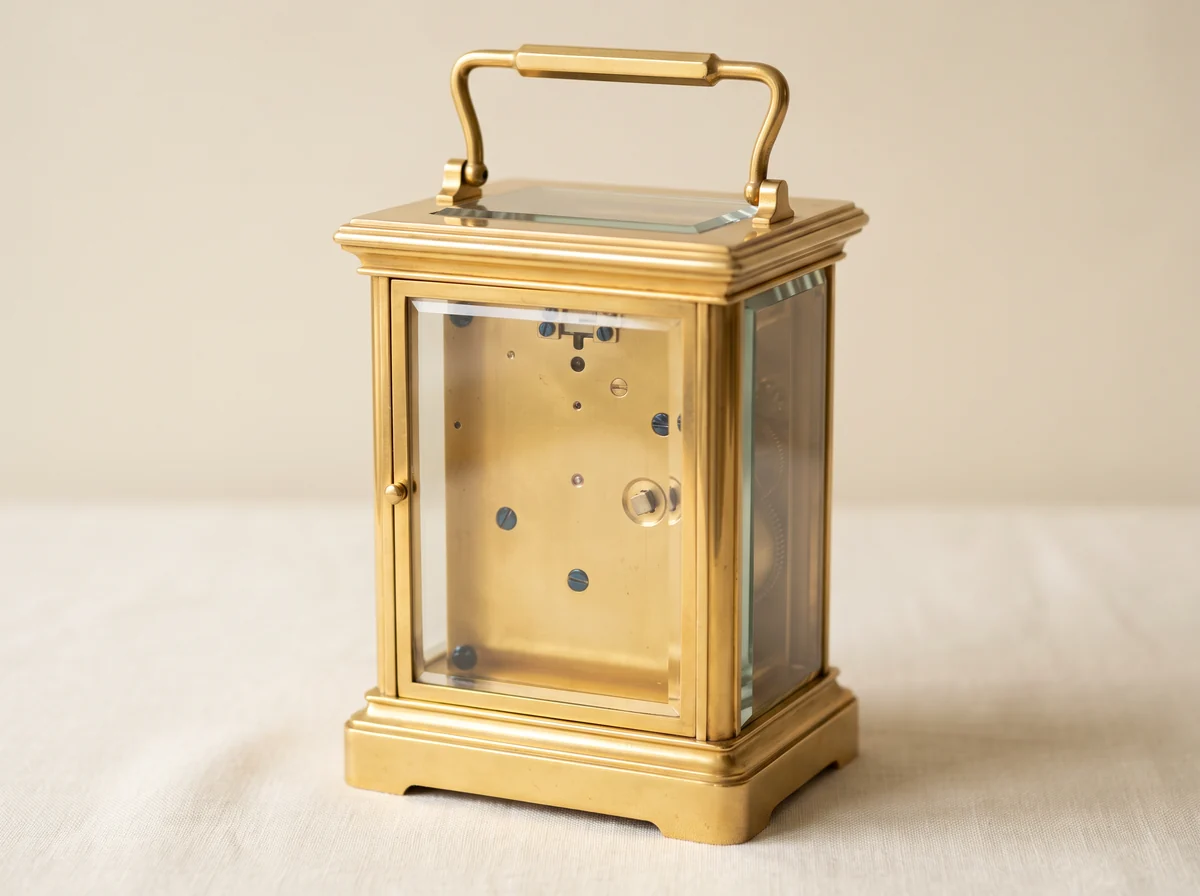
Named for its cornice: flat, stepped mouldings at top and base, plain corner pillars and a gently curved handle. Introduced about 1875 to 1880, it is the shape you will see most often, made by good and ordinary makers alike.
Gorge
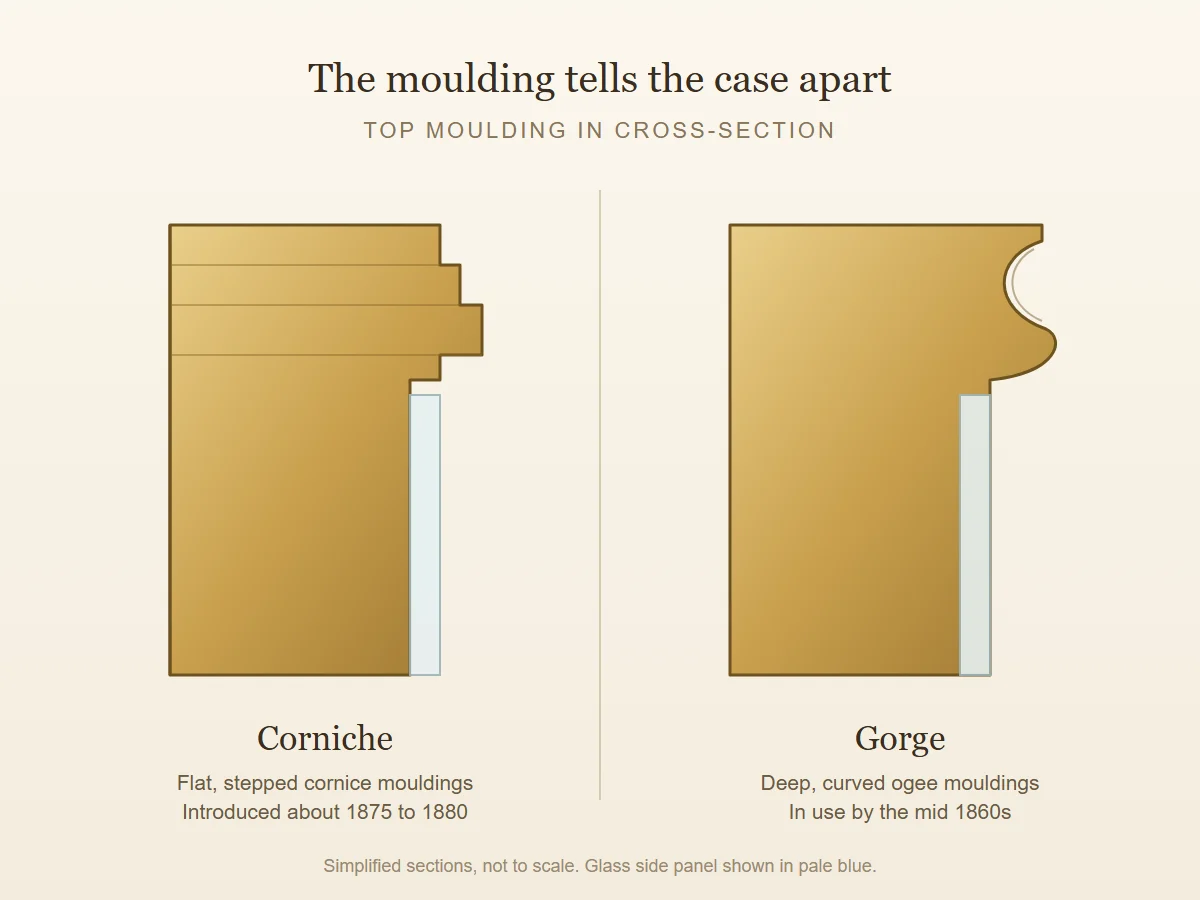
The gorge case takes its name from its deep, curved ogee mouldings. It was in use by the mid 1860s and was the shape French makers preferred for their best clocks, in sizes from miniature to giant. Two porcelain panelled Drocourt clocks sold at Bonhams in 2019 and 2020 were engraved gorge cases.
Anglaise
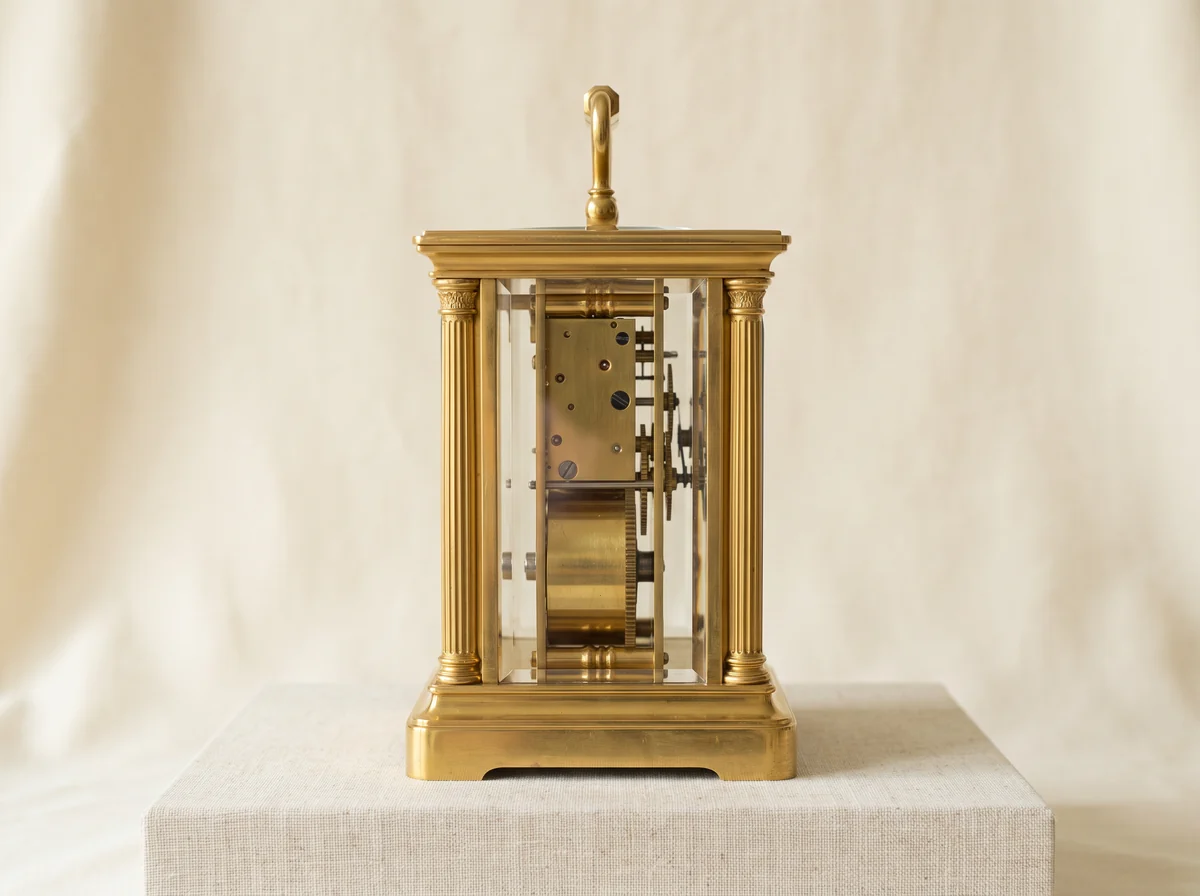
The "English" case sits on a rectangular plinth, sometimes with columns at the corners. It is one of the shapes used after 1880 and into the early 1900s, plain or dressed with porcelain panels.
Obis
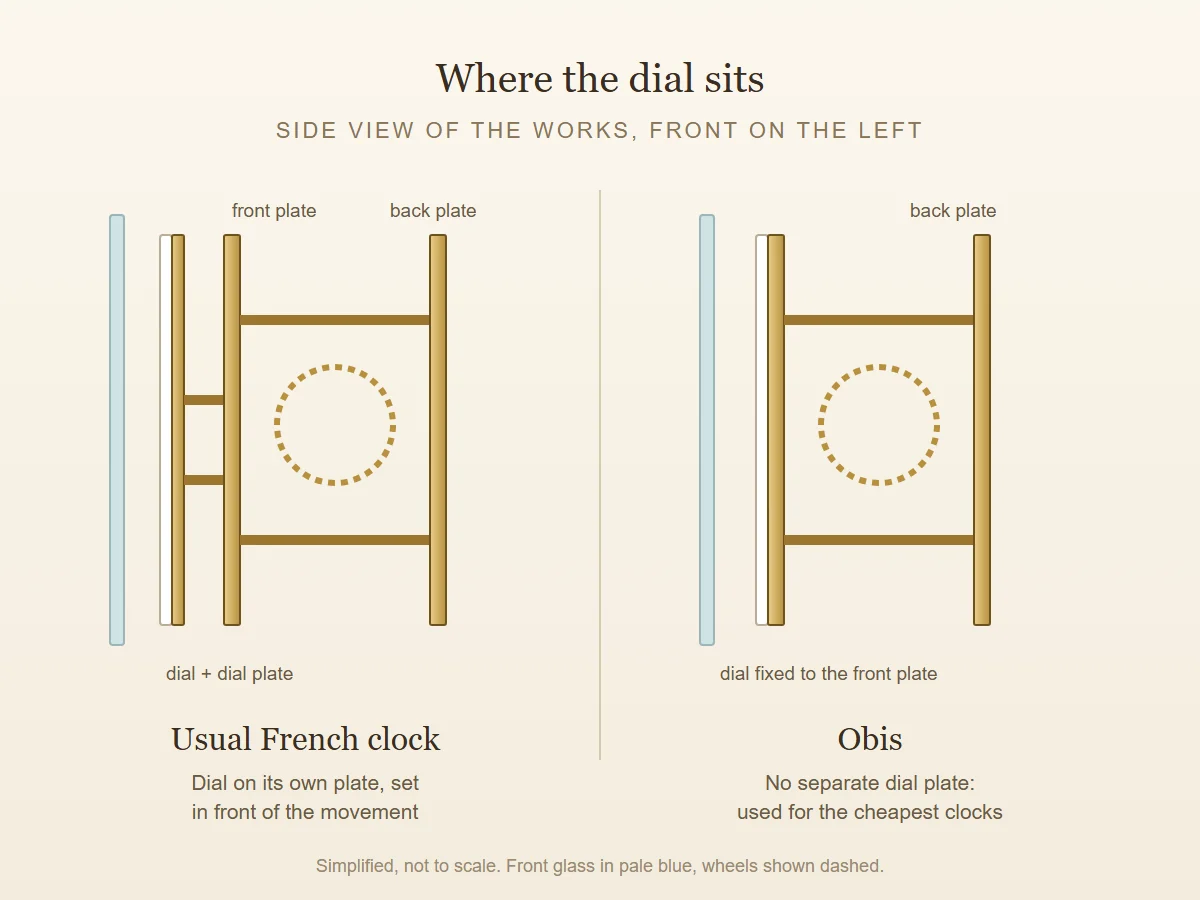
The obis looks like a simpler corniche, and it was almost always used for the least expensive timepieces and alarms. The giveaway is inside: the dial is mounted straight onto the front plate of the movement, with no separate dial plate. Expect modest values.
Engraved cases
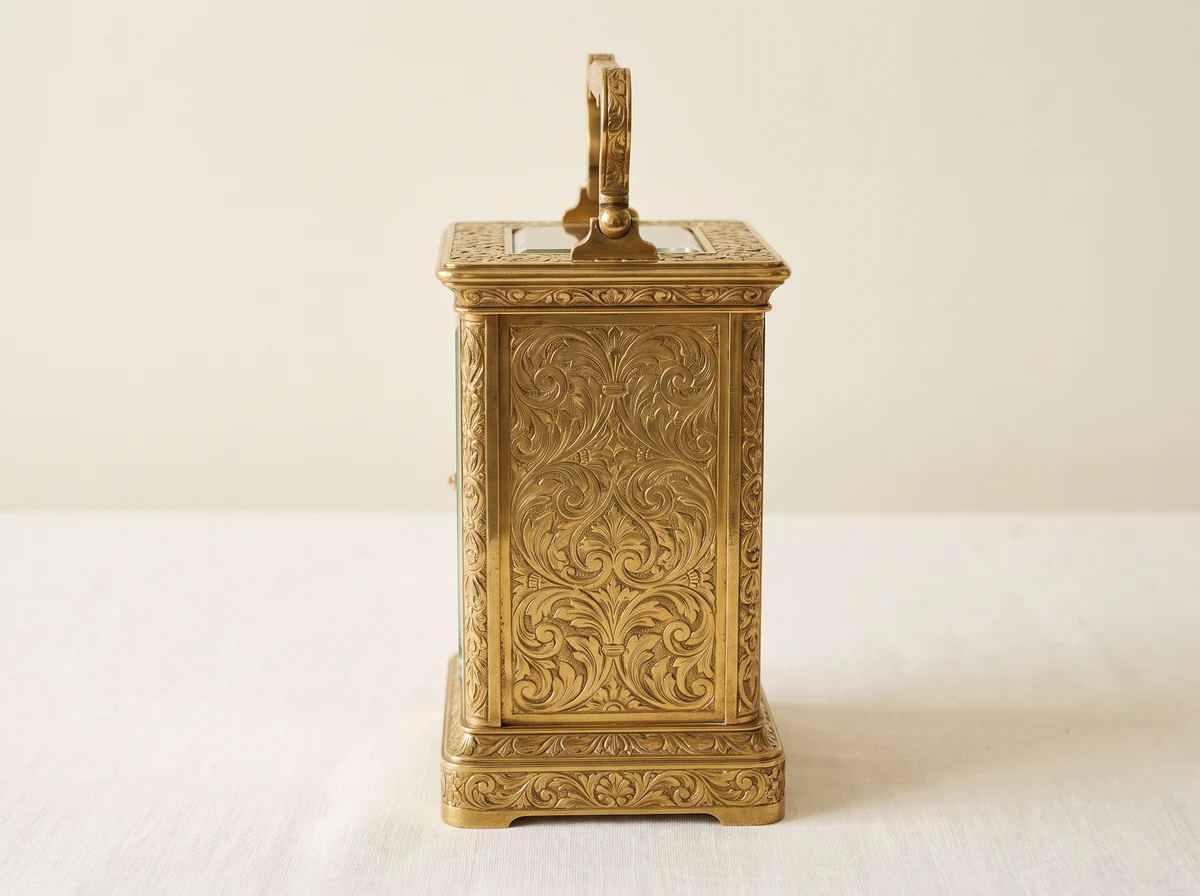
Many high-grade French clocks are engraved all over with foliage and scrolls. Engraving was an option the first buyer paid extra for, so a crisp, unworn engraved case usually signals a better clock. Heavy polishing softens it and costs value.
Porcelain and enamel panels
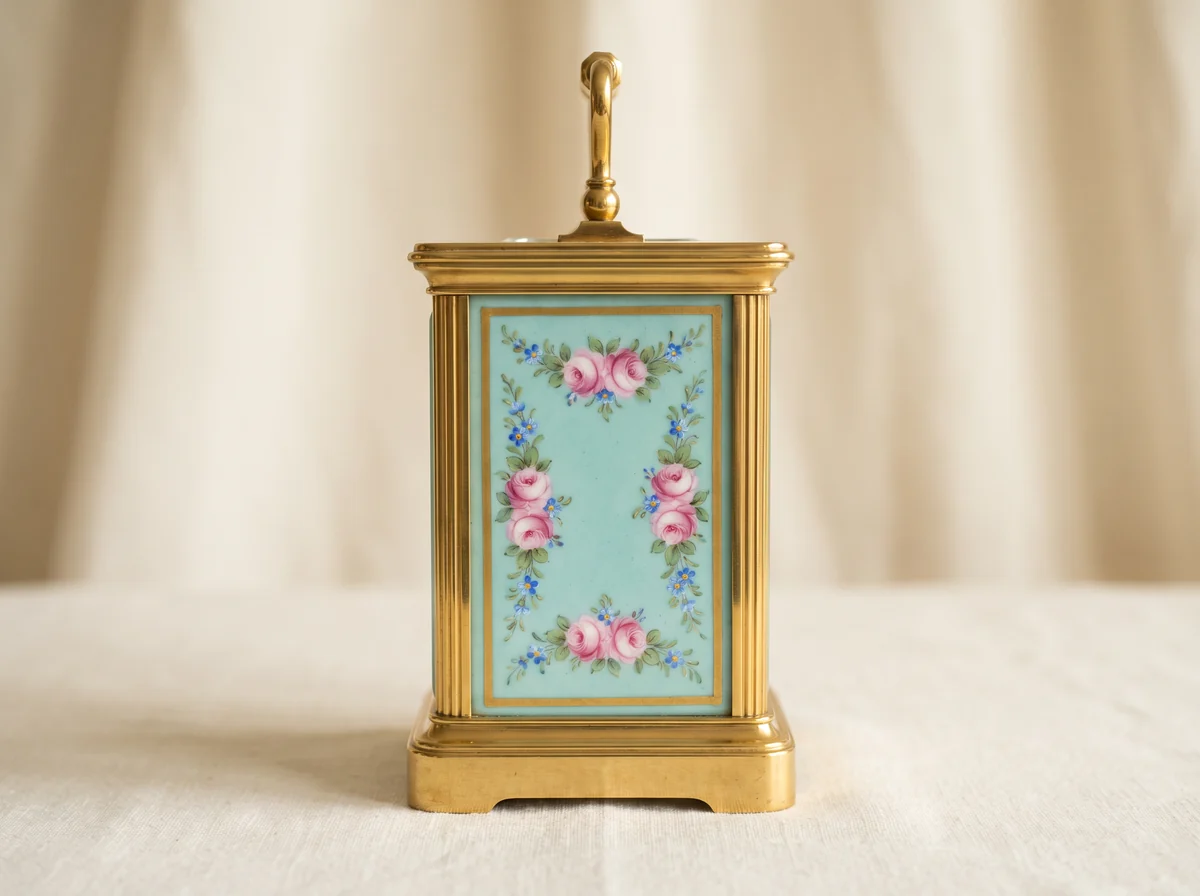
Painted porcelain or enamel panels in place of glass mark the top decorative tier. Panels with figures or landscapes are found on the best Drocourt clocks: an engraved gorge Drocourt with porcelain panels sold for £4,462.50 at Bonhams in December 2020. Check every panel: a crack or a replacement hurts value badly.
Most carriage clocks stand 4.5 to 7.5 inches tall with the handle up. Miniatures, or mignonettes, are under 4.5 inches and giants about 9 inches. Both are rarer and tend to date from after 1875.
Movements and complications
After the case, the movement decides most of the value. French makers offered a ladder of complications, from the plain to the remarkable:
| Movement | What it does | Effect on value |
|---|---|---|
| Timepiece | Tells the time only, no strike | The base level; most late, plain clocks |
| Alarm | A small extra dial sets an alarm | Adds a little; could be added to almost any clock |
| Striking | Strikes the hours, and one blow at the half hour, on a bell or gong | A clear step up from a timepiece |
| Repeat | A button on top repeats the last hour; some repeat quarters or even minutes | Adds value if it works |
| Petite sonnerie | Strikes the quarters on two gongs, the hour only at the hour | Uncommon, wanted |
| Grande sonnerie | Strikes the hour and the quarter at every quarter | The top French striking work |
Grande sonnerie clocks nearly always have a lever under the base to change to petite sonnerie or silence. Test the repeat button and the strike before you judge a clock: work that does not run costs money to put right.
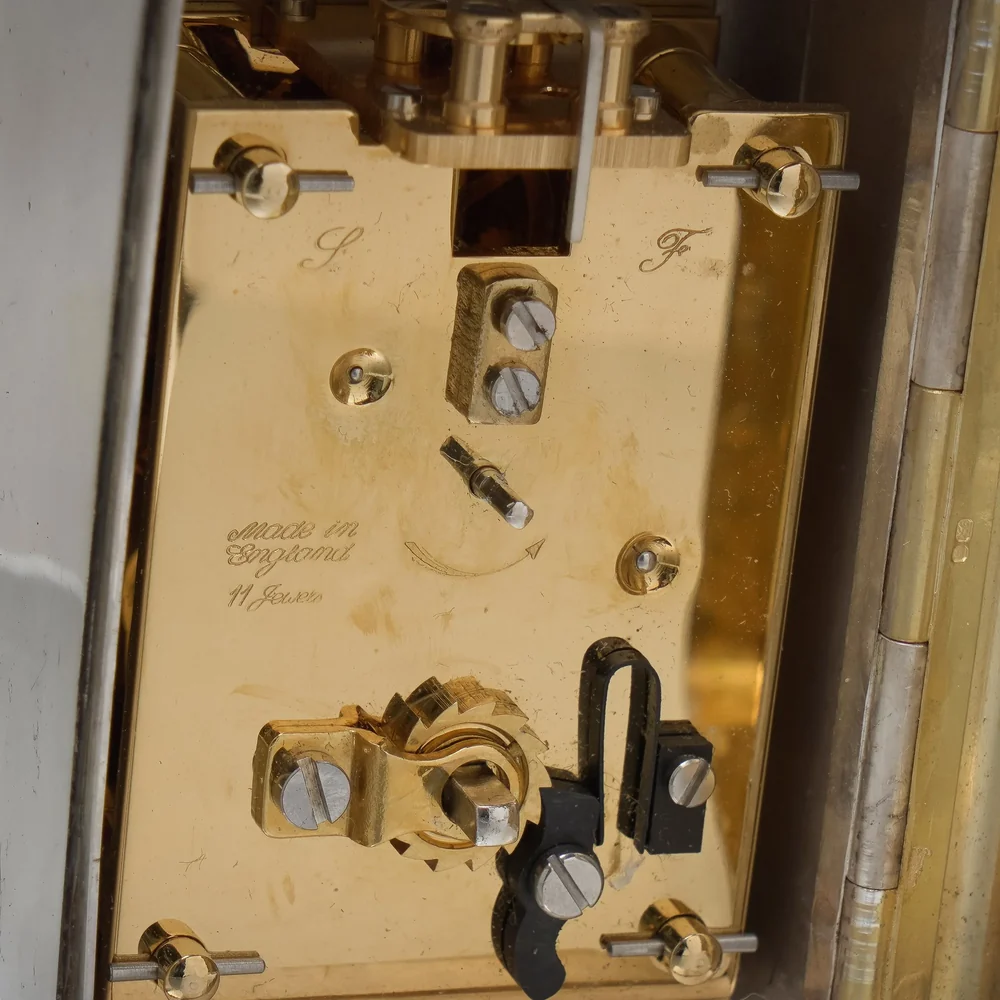
The platform escapement
The platform carries the balance wheel and escapement. Most French makers used a lever escapement; after 1880 cheaper lines used the cylinder, and a few have a spring detent.
Look on the back for a regulator lever marked S and F, or A and R in French, which makes the clock run slower or faster. The L'Epée factory alone made 200,000 platform escapements in 1889 for other makers.
How to identify the maker
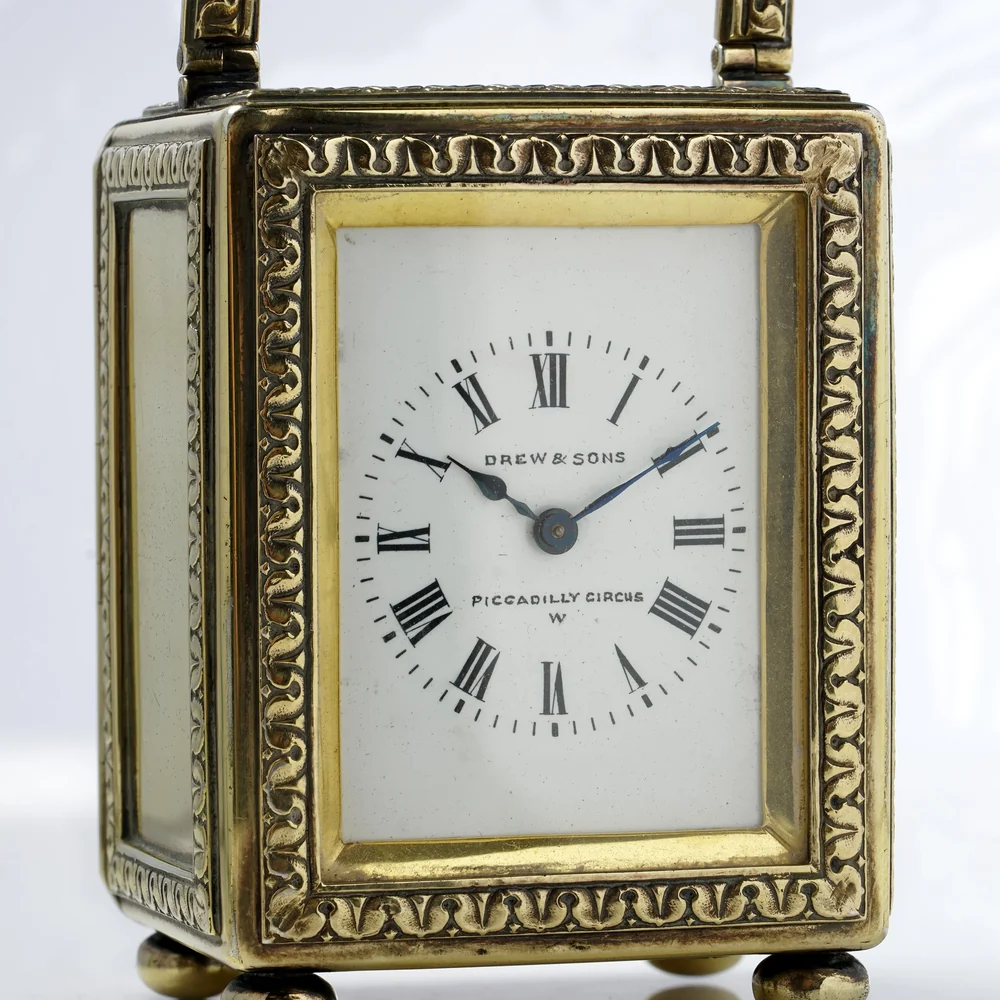
The name on the dial is usually the shop
Except for a handful of makers, the names on French carriage clock dials are retailers, not makers. London firms such as J.W. Benson, Garrard and T. Martin of Regent Street, and Shreve, Crump & Low of Boston, all put their names on clocks made in France.
A retailer's name still helps: it shows where and roughly when the clock was sold.
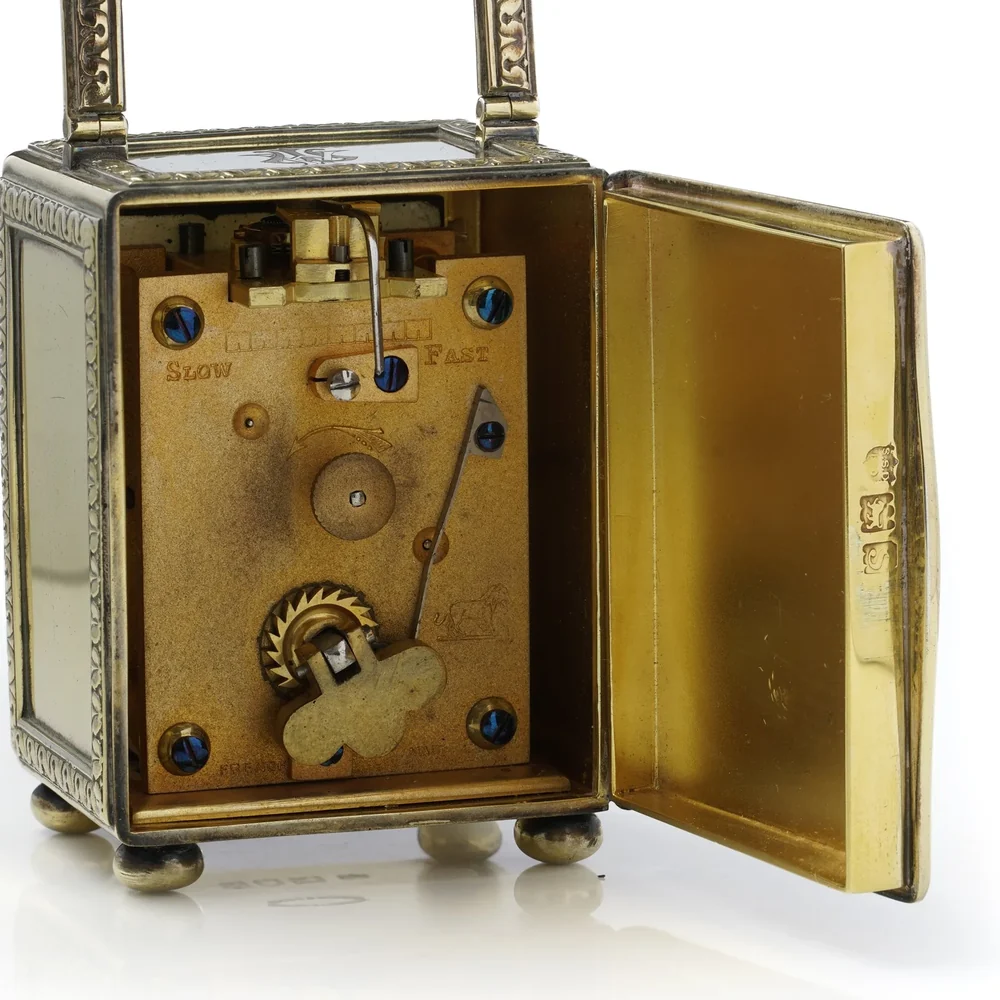
Open the back door
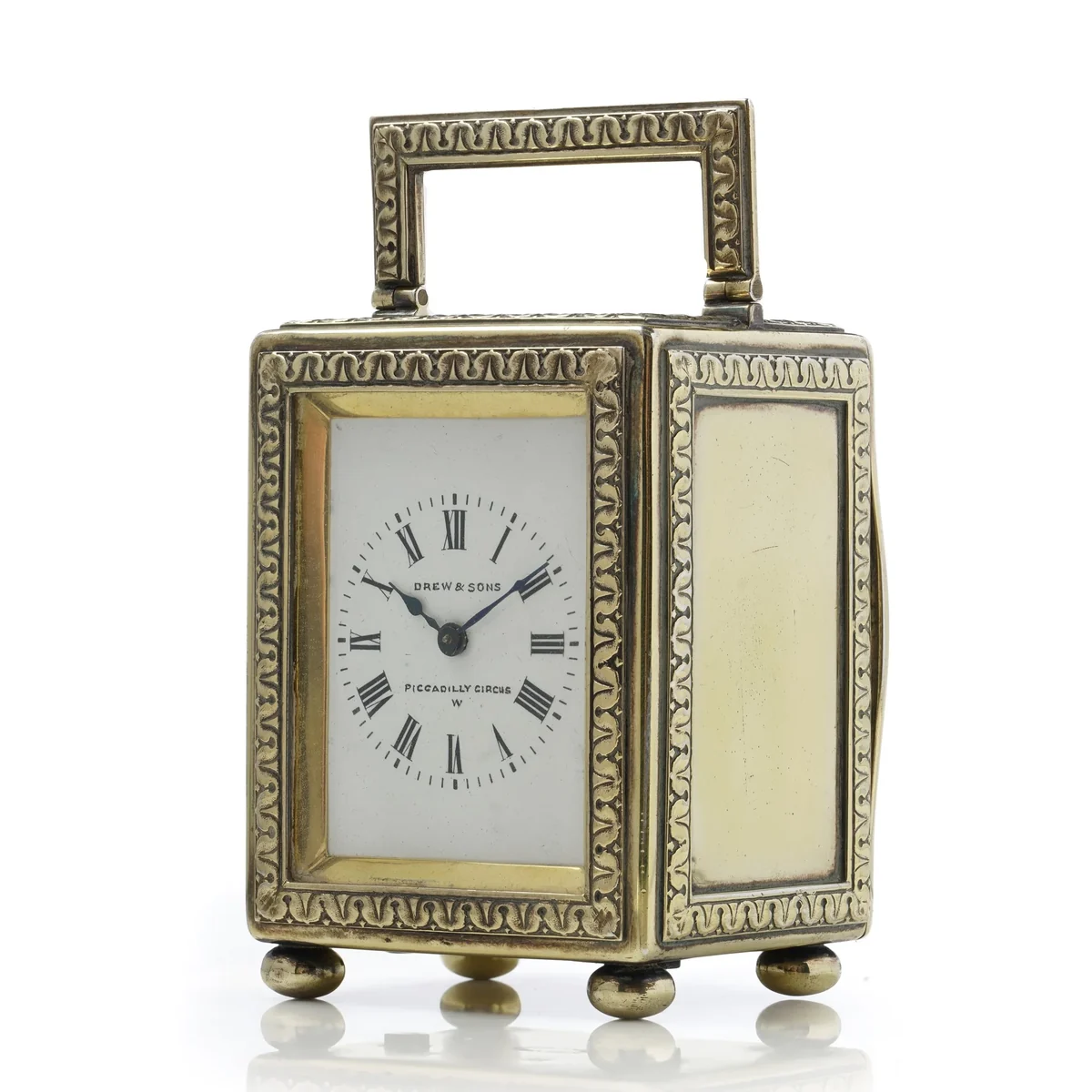
The backplate is where makers stamped trademarks and serial numbers. Our Drew & Sons clock shows the pattern: a lion trademark and the words FRENCH MADE on the movement, a London retailer on the dial, and London hallmarks on the silver case.
- Trademarks: Henri Jacot used a parrot; Margaine stamped AM. An HH mark is common, and it belongs to a New York importer, not a maker.
- Bayard on a dial goes with Duverdrey & Bloquel of Saint-Nicolas-d'Aliermont on the backplate.
- Serial numbers on the backplate. Good makers' keys are often stamped with the same number, and auction houses note it.
- Made in England or Swiss Made with a jewel count is typical of 20th century clocks, like our 1988 example.
- A battery compartment means a quartz movement.
A signed maker raises collector value, with exceptions: the NAWCC notes that Japy Frères and Duverdrey & Bloquel signatures add little.
Carriage clock makers and what drives their value
The questions we are asked most are "is my Bayard, Matthew Norman or Mappin & Webb carriage clock worth anything?" This table shows, maker by maker, what drives the value.
| Name | Who they were | What drives value |
|---|---|---|
| Breguet | Paris; made travelling clocks for Napoleon | Early date, complications, provenance |
| Frodsham, Dent, McCabe | London; English carriage clocks from about 1820 to 1900, often with a fusee | Size, quality, repeat and strike |
| Drocourt | Paris from 1853, workshops in Saint-Nicolas-d'Aliermont; exhibition medals 1867 to 1889 | Porcelain panels, engraved gorge cases, striking |
| Henri Jacot | Paris; parrot trademark; in business from the 1820s to 1920 | Grande sonnerie, original travelling case |
| Margaine | Paris, a contemporary of Drocourt; marked AM | Quarter striking, gorge cases |
| L'Epée | Sainte-Suzanne, from 1839; made platform escapements for other makers | Escapement quality, model |
| Couaillet | Saint-Nicolas-d'Aliermont; thousands of clocks between 1880 and 1920 | Case style, strike and, above all, condition |
| Duverdrey & Bloquel (Bayard) | Saint-Nicolas-d'Aliermont; Bayard on the dial, their name on the backplate | Mechanical and complete; the signature adds little on its own (NAWCC) |
| Matthew Norman | Swiss carriage clocks made in Delémont, Jura, in the 20th century | Repeat, calendar and moon dials |
| Rapport, Taylor & Bligh | 20th century London and English brass carriage clocks | Mechanical, original box |
| Retailers: Garrard, Mappin & Webb, Benson | Shops that sold clocks made by others | The maker inside and the case; fine materials such as lapis panels |
Note the numbers stamped on Matthew Norman backplates, such as "London 1750": Denhams catalogued that clock as 20th century, so the number is not a date.
What puts a carriage clock in the top tier
Carriage clocks run from everyday 20th century timepieces to rare early pieces that make headlines. From the ordinary to the exceptional, the ladder looks like this:
- Everyday: 20th century French and Swiss brass timepieces and alarms, clocks to use and enjoy rather than collect.
- Collector clocks: good 19th century French clocks with striking, repeating or a known maker, and early silver-mounted clocks.
- The decorative top tier: porcelain panels and decorated miniatures by the best Paris makers.
- The summit: large English clocks by top London makers, and the rare early French pieces.
At the summit, a large engraved English carriage clock by Parkinson & Frodsham of London, with a fusee movement and side repeat, sold for £8,320 at Bonhams in July 2023. The market is selective: condition and originality decide which clocks sell.
Every carriage clock is different. Send us a few photos and we will tell you what yours is worth, free and with no obligation. Ask for a free valuation.
What lowers the value, and what raises it
Condition and originality move the price as much as the maker. These are the points we check first:
A later escapement fitted in place of the original. The clock may run well, but collectors pay for the original.
The original movement replaced with a battery unit. It leaves a decorative case, not a collector's clock.
Cracked, restored or replaced porcelain or enamel panels, the costliest fault on a decorated clock.
A cracked or repainted enamel dial; replaced or chipped bevelled glasses.
Striking, repeat or alarm work that does not run.
Worn gilding and softened engraving from years of polishing.
An original leather travelling case and a key stamped with the clock's number add value. Bonhams notes both, as on the Drocourt retailed by J.W. Benson sold with its numbered key in 2025. Keep them with the clock.
Have a carriage clock? Send photos for a free valuation
Silver and modern carriage clocks
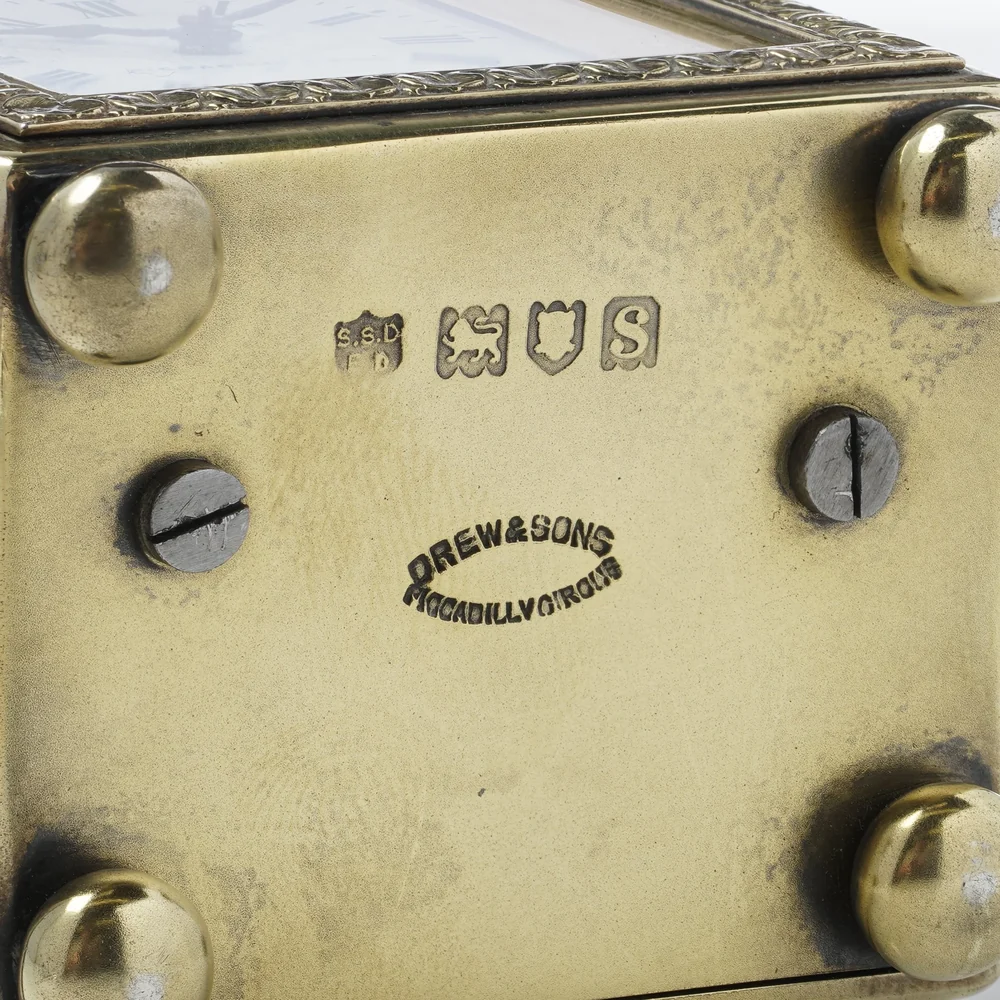
Silver cases: read the hallmarks
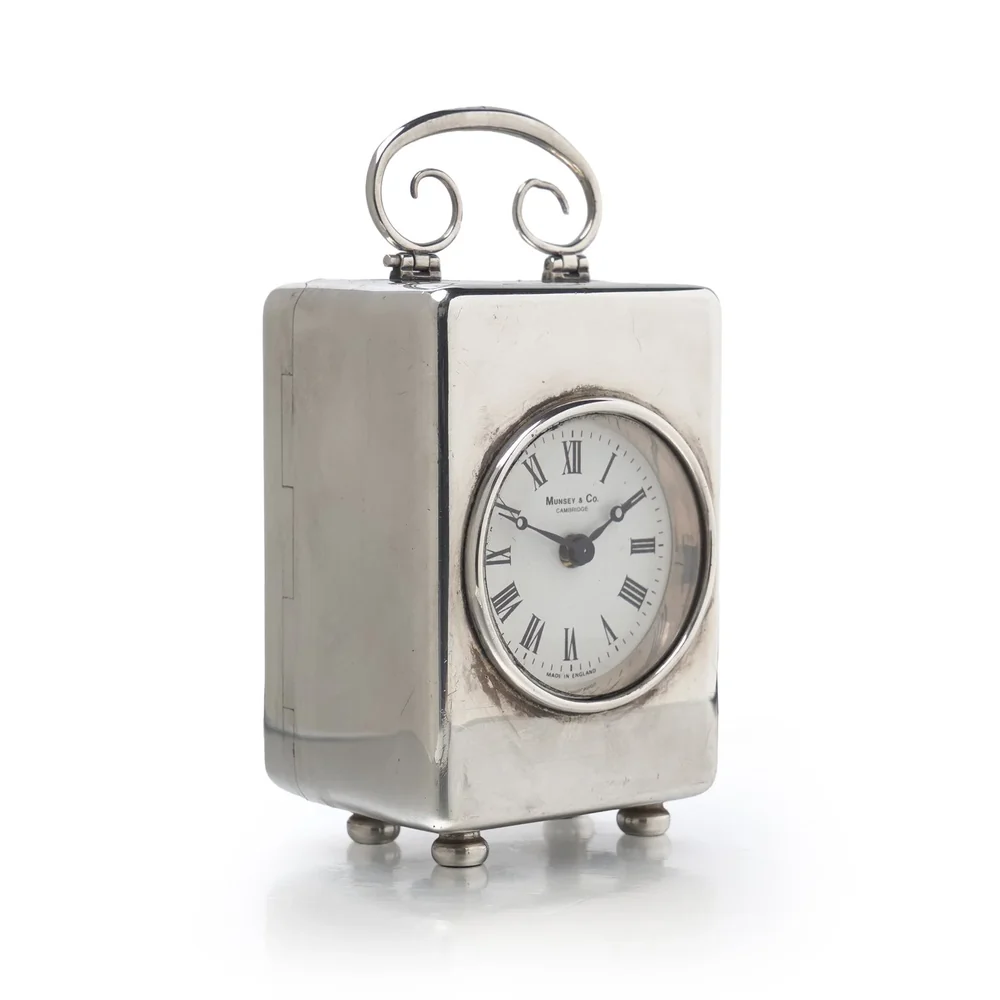
Both silver clocks on this page are miniatures, 7 to 9 cm high. A British silver case carries hallmarks that date it, and the silver adds to the value of the clock.
Our Edwardian silver-gilt carriage clock by Drew & Sons, London 1913 stands 7 cm high on bun feet. See how to read silver hallmarks.
Modern silver and presentation clocks
Carriage clocks have long been the traditional gift for retirement or long service. Many presentation clocks are quartz. Swiss mechanical ones such as Matthew Norman's, with repeat, calendar or moon dials, are the more interesting.
A hallmarked silver case, a known retailer and full working order count in their favour.
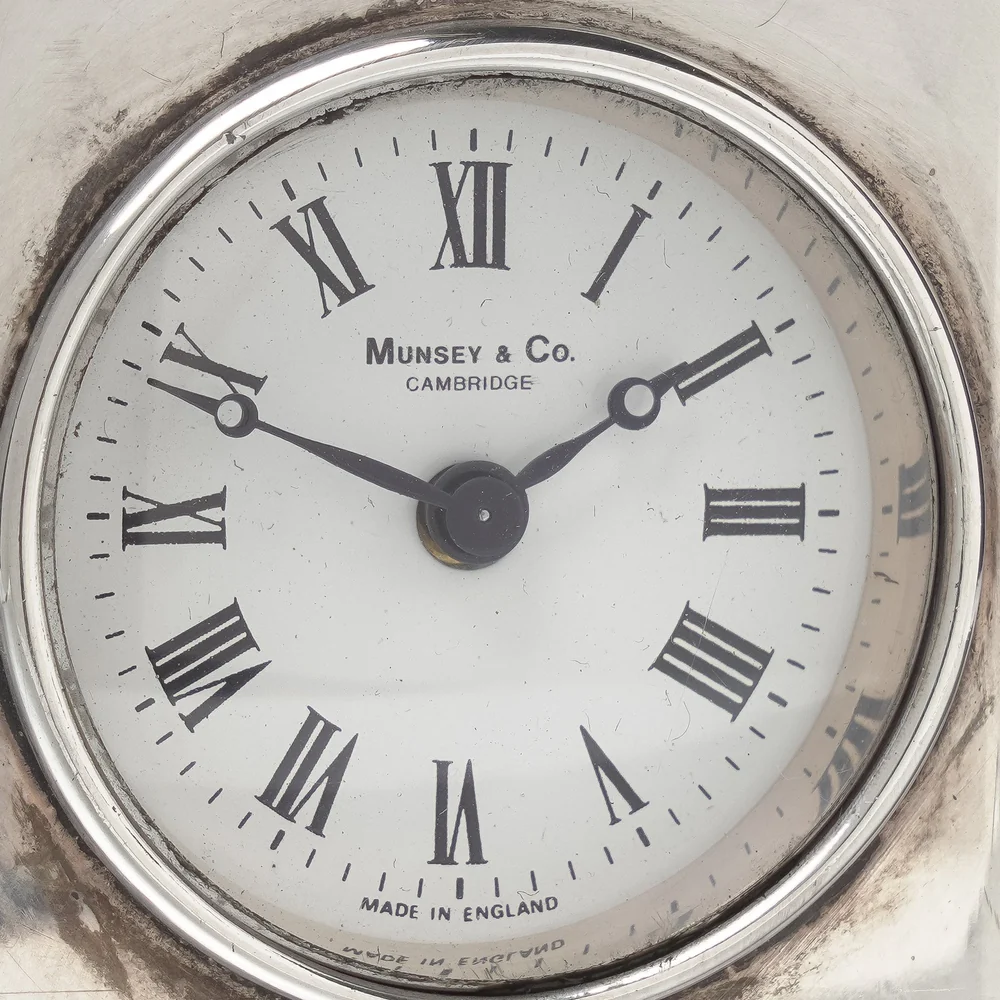
Modern dials name the retailer too
The 1988 clock is signed by Munsey & Co of Cambridge, the shop that sold it, and marked Made in England. Its English movement, with 11 jewels, is the one shown in the movements section above.
For silver more widely, see inherited silver and antique silver desk accessories.
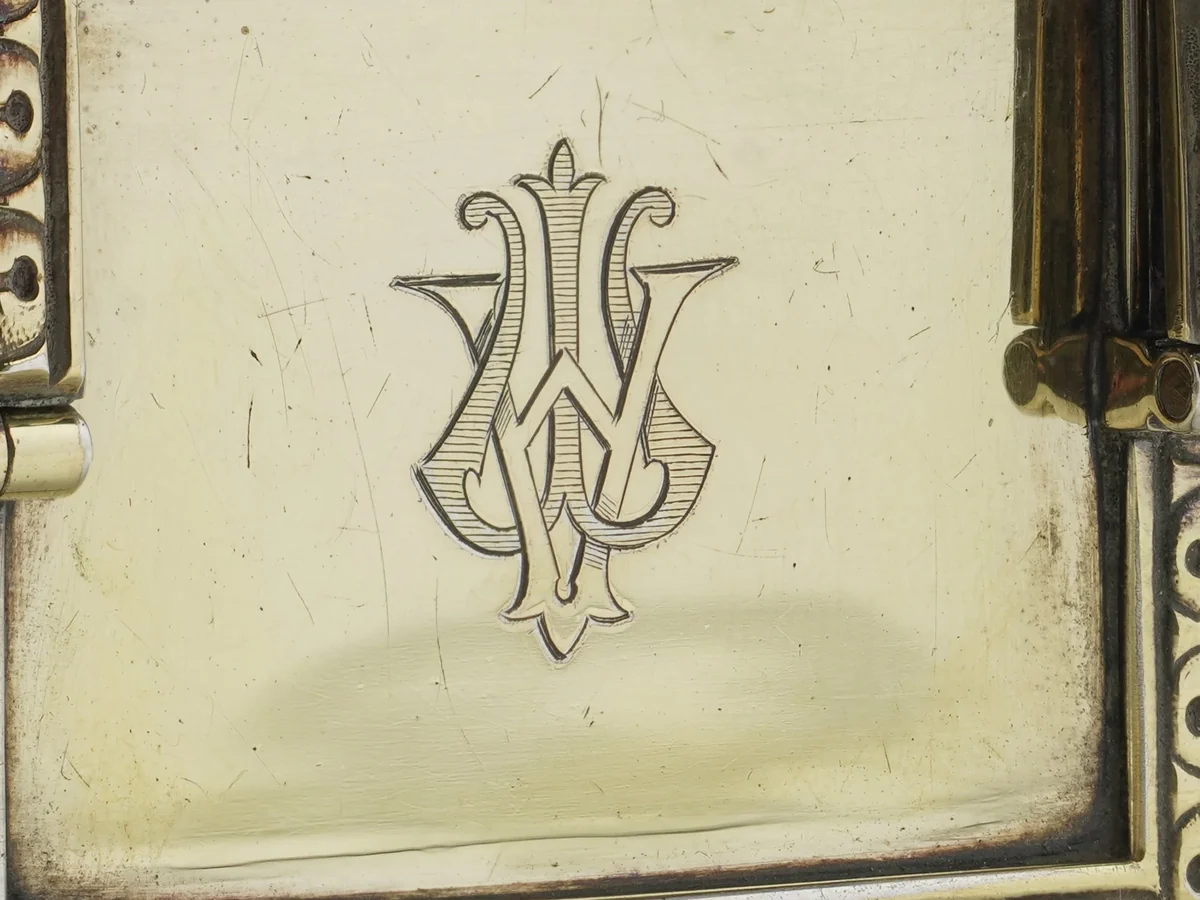
A monogram or presentation inscription records who owned a clock and why it was given. Mention it when you send photos.
Free carriage clock valuation and advice
We value carriage clocks free from photographs, and we will tell you plainly what yours is and what it is worth. Send these:
- Front and sides
The dial straight on, then each side panel.
- Back door open
The backplate, with any stamps, numbers and S/F or A/R marks in focus.
- Top and base
The platform through the top glass, and the underside for hallmarks or a strike lever.
- Extras
The travelling case, the key and any paperwork or inscription.
Use the form below, call 01376 334482, WhatsApp us or book a visit to 47 Maddox Street, Mayfair (by appointment) or Braintree, Essex.
Buying? See the Drew & Sons carriage clock and the rest of our silver, and our watches and pocket watches. For French mantel clocks, see antique French mantel clocks.
Request a free valuation
- Most carriage clocks are French, made between 1885 and 1914; 20th century brass ones are modest.
- Case style, complications and a real maker's mark lift value; the name on the dial is usually the shop.
- Originality decides the price: quartz conversions and replaced platforms cost the most.
- Send photos of the front, back, top and base for a free valuation.
Questions we are asked
How much is a carriage clock worth?
It depends on the maker, the movement, the case and above all originality and condition. Everyday 20th century brass clocks are modest; striking and repeating French clocks, porcelain panels and large English clocks by top London makers sit far higher. Send photos for a free valuation.
Are old carriage clocks worth anything?
Yes, but age alone is not enough. Most were made between 1885 and 1914. The maker, the complications, the case and above all originality and condition decide the price.
How do I find out who made my carriage clock?
Open the back door and look at the backplate for a trademark, serial number or country stamp. The name on the dial is usually the shop that sold it, not the maker.
What is a grande sonnerie carriage clock?
One that strikes the hour and the quarter at every quarter on two gongs. It is the most complex French striking work, and most have a lever underneath to switch to petite sonnerie or silent.
Is a Matthew Norman carriage clock valuable?
They are 20th century Swiss mechanical clocks made in Delémont. Models with repeat, calendar and moon phase work are more interesting than plain alarms; send photos and we will tell you what yours is worth.
Is a Bayard carriage clock valuable?
Bayard clocks were made by Duverdrey & Bloquel in Saint-Nicolas-d'Aliermont. The NAWCC notes the signature adds little collector value on its own, so condition and complications decide the price.
Does a quartz carriage clock have any value?
Little beyond its use and any silver in the case. A battery compartment on the back shows a quartz movement; an antique clock converted to quartz also loses most of its collector value.
Why do people give carriage clocks for retirement?
A carriage clock has long been a traditional gift from employers to retiring or long-serving staff, though the custom is much less common today.
Find out what your carriage clock is worth
Send photos of the dial, back, top and base for a free valuation and honest advice, or visit us in Mayfair or Braintree.
- Free valuation from photos
- Honest advice, no obligation
- Appointments in Mayfair and Braintree
New pieces reach our list first: join the Mozeris list.