Pocket Watch Case Makers' Marks: Whose Initials Are in Your Case
Pocket watch case makers' marks decoded: what the initials inside a British case mean, a searchable finder of the main sponsor's marks, Dennison's Star and Moon cases, the other numbers inside, and Swiss case marks.
Pocket watch case makers' marks, in brief:
- The initials in a small outline inside a British gold or silver case are the sponsor's mark, registered at an assay office.
- The sponsor was often the case maker, but also importers (W&D, CN), retailers (J.W.B) and carriers (GS).
- A.L.D is the Dennison Watch Case Co., Birmingham. Dennison Star, Moon and Sun cases are gold filled, not solid gold.
- The large stamped number is the case number; the movement has its own number.
- Swiss cases use hallmarks such as the Helvetia head (18ct) and squirrel (14ct), usually without maker's initials.
In this article
What the initials inside the case mean
A sponsor's mark, not always a maker's mark
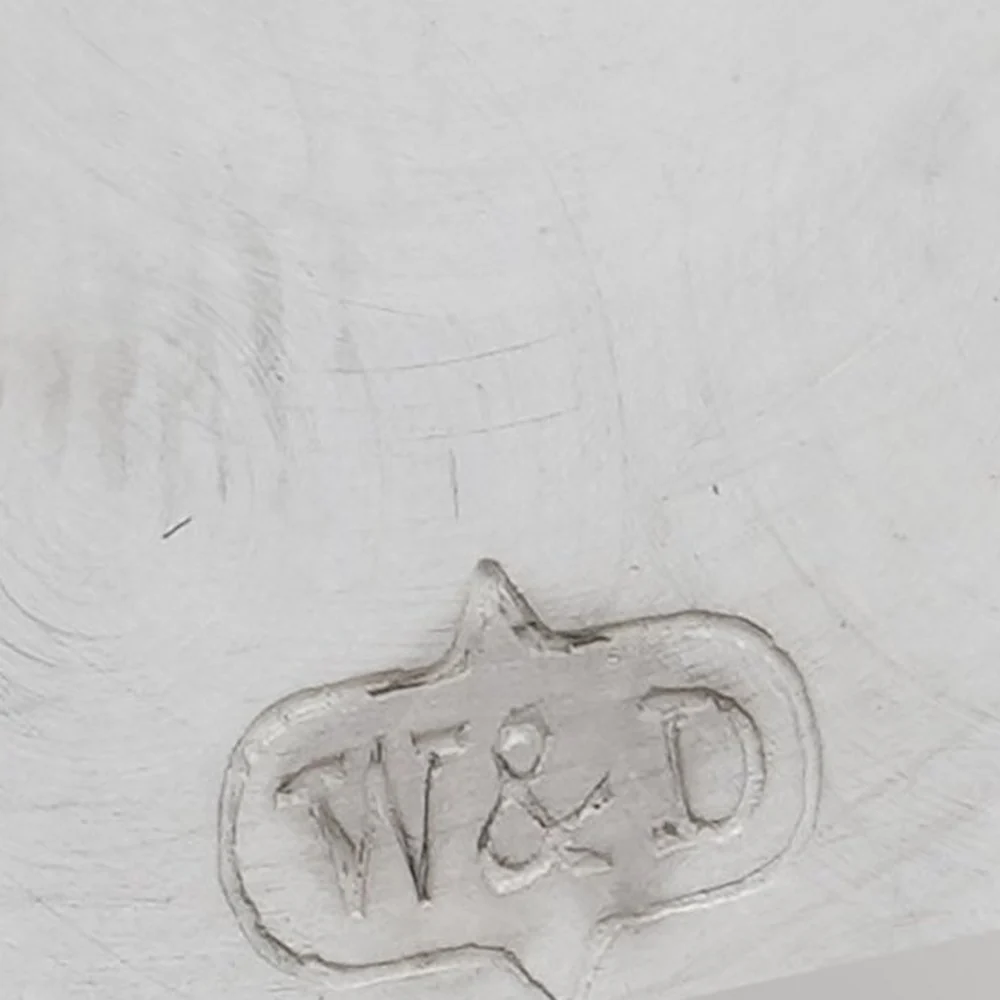
Open the back of a British gold or silver pocket watch and you will usually find two to four initials in a small shaped outline, struck beside the hallmarks. That is the sponsor's mark.
It was registered at an assay office by the person who sent the case to be tested, and who answered for its gold or silver content. Assay offices would not mark a case without one.
The sponsor was often the case maker, but it could be a watch factory, an importer, a retailer or even a carrier.
The trade long called it the maker's mark. The Gold and Silver Wares Act of 1844 called it a private mark, and the Hallmarking Act 1973 calls it the sponsor's mark, because so many sponsors made nothing at all. Case makers also kept their customers' punches and struck those instead of their own, so the initials tell you who took responsibility, not always whose bench the case came from.
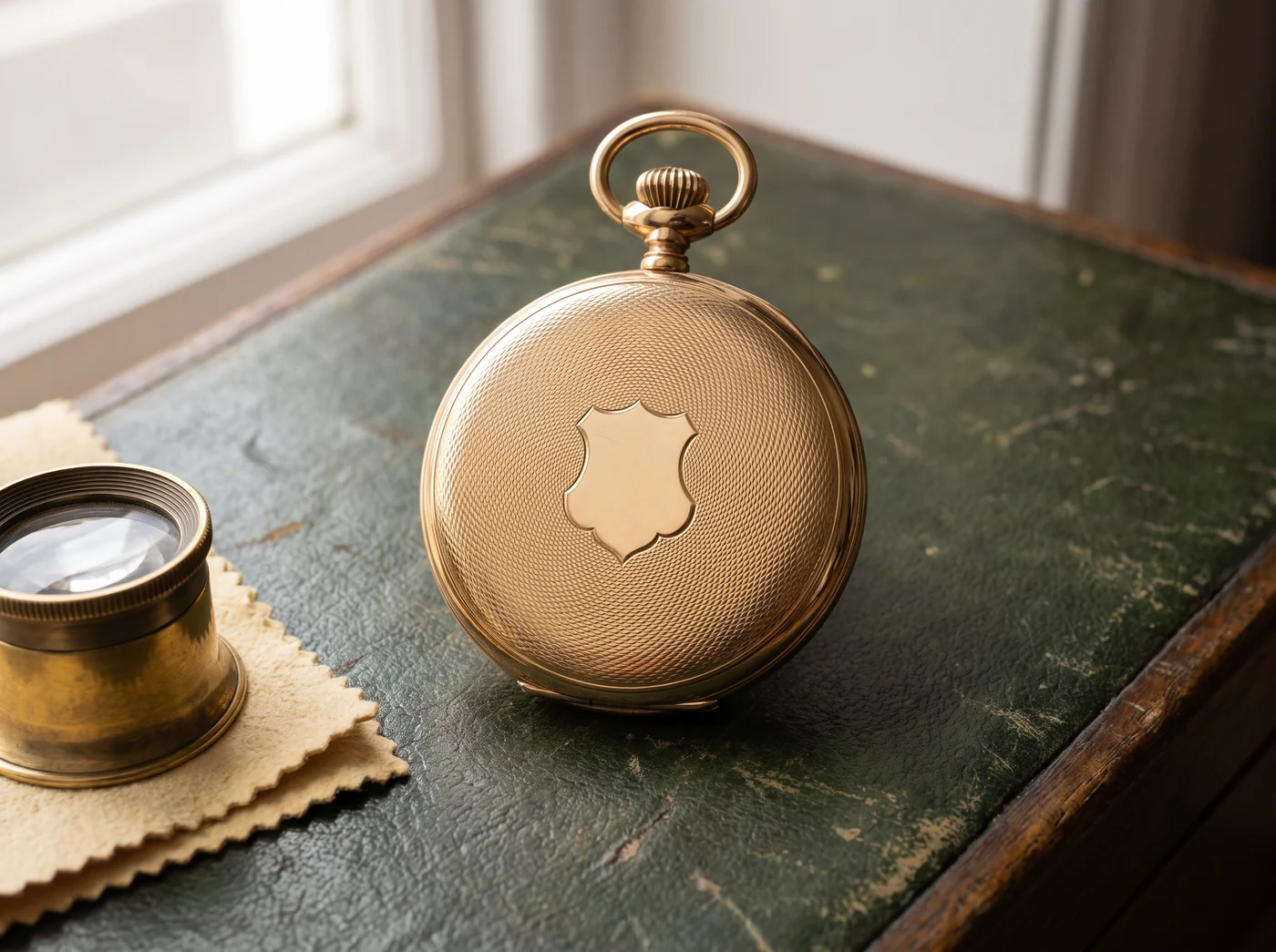
The large shield or cartouche on the outside of a hunter case is something else: a space left blank for the owner's monogram. A monogram there tells you about the first owner, not the maker. The sponsor's mark is always small, punched, and inside.
The other marks in the same row, the town mark, standard mark and date letter, are covered on our pocket watch hallmarks page. This page is about the initials.
Source: David Boettcher, Sponsor's Marks; Dennison.
Case makers' marks finder
Who made English watch cases
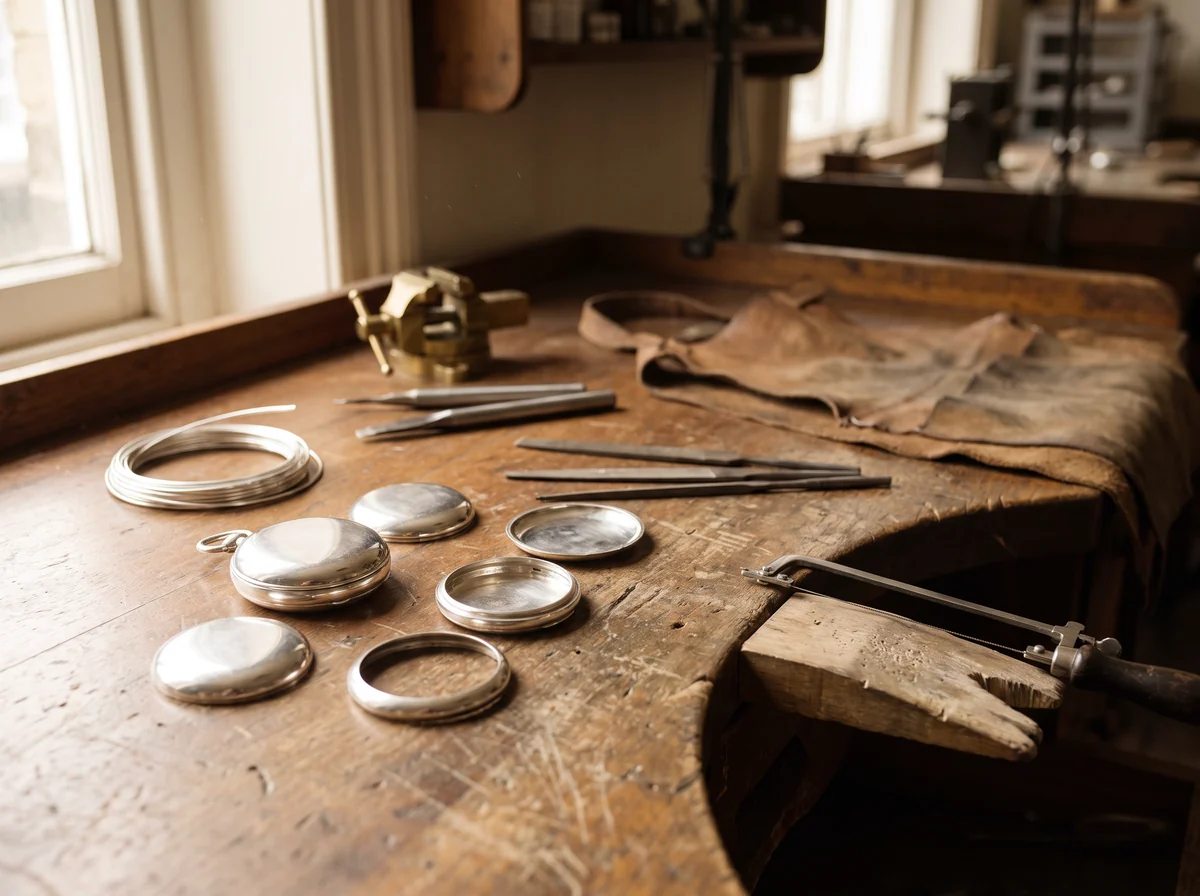
An English watch was the work of several trades. The movement came from one workshop and the case from a separate specialist, often in Clerkenwell, Coventry, Birmingham or Liverpool.
Ralph Samuel of Liverpool told a Select Committee in 1856 that his business made an average of 600 gold and 800 silver cases a month. Liverpool had no assay office, so its cases went to Chester.
From 1 June 1907 every imported gold and silver watch case had to be hallmarked in Britain, so importers registered marks of their own.
Type the initials you can see, with or without the dots, or pick who registered the mark. Click a column heading to sort. Every row is a mark recorded in assay office registers, as published by David Boettcher, who draws on Philip Priestley's Watch Case Makers of England (NAWCC, 1994).
| Registered by | ||||
|---|---|---|---|---|
| A.L.D | Aaron Lufkin Dennison; from 1905 the Dennison Watch Case Co. | Handsworth, Birmingham | Birmingham, 20 Apr 1876; London, 6 May 1876 | Case maker |
| A.W | Alfred Wigley, Dennison, Wigley & Co. | Birmingham | Birmingham, 17 Nov 1874; London, 1875 | Case maker |
| F.F.S | Frederick Francis Seeland, American Watch Co. (Waltham) | London | London, 2 Nov 1875; Chester, 31 Jan 1876 | Importer |
| A·B | Alfred Bedford, American Watch Co. (Waltham) | Holborn, London | London, 30 Aug 1876; also Chester | Importer |
| AB | Arthur Baume, Baume & Co. (London agents for Longines) | London | London, 1876; rectangular mark 1 Mar 1907 | Importer |
| V·R | Vale & Rotherham, forerunners of Rotherham & Sons | Coventry | Birmingham, 6 Feb 1822 | Watch manufacturer |
| R&S | Rotherham & Sons (John Rotherham) | 4 Spon Street, Coventry | Birmingham, 7 Apr 1841; London punches 1907 to 1919 | Watch manufacturer |
| JRsans serif, in a diamond | John Rotherham, Rotherham & Sons | Coventry | London, 7 Mar 1881; Birmingham, 15 Jul 1886 | Watch manufacturer |
| RSin an oval | Ralph Samuel | 54 Wood Street, Liverpool | London, 16 Jan 1843 (Liverpool cases usually went to Chester) | Case maker |
| S&R | Samuel & Rogers (Mary Samuel and Arthur Rogers) | 72 Wood Street, Liverpool | Chester, 18 Feb 1864 | Case maker |
| RO over JE | Oliver & Edwards (Richard Oliver and John Edwards) | Galway Street, Clerkenwell | London, 1846 | Case maker |
| GJ | George Jenkins, formerly of Jenkins & Green | Clerkenwell, London | London, 19 Jan 1857 | Case maker |
| IH | John Hammon | 11 Sekforde Street, Clerkenwell | London, 1860 and 1862 | Case maker |
| W.E | William Ehrhardt | Birmingham | Birmingham, 14 Nov 1867; also London | Watch manufacturer |
| P·B·B | Platnauer Brothers | Birmingham | Birmingham, 20 Nov 1867 | Importer |
| CN | Charles Nicolet, Stauffer & Co. (IWC and other Swiss makers) | Old Jewry, London | London, 1 Mar 1877 | Importer |
| E.W.Co | English Watch Co. Ltd | Birmingham | Birmingham, 16 Mar 1885 | Watch manufacturer |
| H.W | Henry Williamson (H. Williamson Ltd) | Farringdon Road, London; works in Coventry | London, 4 Feb 1887 | Watch manufacturer |
| TPH | Thomas Peter Hewitt, Lancashire Watch Co. | Prescot | Chester, May 1899 | Watch manufacturer |
| J.W.B | J. W. Benson; cases made for them by Benson Brothers of Liverpool | Ludgate Hill, London | London | Retailer |
| W&D | Wilsdorf & Davis, the firm behind Rolex | Hatton Garden, London | London, 25 Jun 1907; Birmingham 1909; Chester 1912; Glasgow | Importer |
| W.H.S | William Henry Sparrow for H. Williamson Ltd | Birmingham | London, 22 Jun 1907 | Importer |
| A·G·R | Arthur George Rendell for Robert Pringle & Sons | Clerkenwell Road, London | Chester, 15 Jun 1907; London, 25 Jun 1907 | Importer |
| GS | Stockwell & Co., carriers | London | Several offices, from 1907 | Assay agent |
| B&S | B. H. Britton & Sons | 35 Hockley Hill, Birmingham | Chester, 1912 | Case maker |
| ZWCO | Zenith Watch Co. (Great Britain) Ltd | High Holborn, London | London, 16 Jul 1914 | Importer |
| D.S.&S | David Shackman & Sons | Golden Square, London | London, 1922 | Case maker |
| A5Malso A2M, J♡W and similar | J. Véron Grauer & Cie, Geneva carriers | Geneva | Dublin, 1928; Edinburgh, 1931; Glasgow | Assay agent |
Look at the shape, not just the letters
The outline, the typeface and the dots matter as much as the initials. John Rotherham's JR, entered in London in 1881, is sans serif with no dot, in a square turned on its point. A J.R in serif letters with a dot, in a diamond wider than it is tall, was entered in London in November 1876 by Joseph Radges, a different man.
Some marks are not makers at all. GS is Stockwell & Co., a carrier that submitted Swiss cases for hallmarking from 1907; George Stockwell never made a watch case. Marks such as A5M or a J and W with a symbol between them, seen with Glasgow, Edinburgh and Dublin import marks, belong to the Geneva carriers J. Véron Grauer & Cie.
Source: Boettcher, Sponsor's Marks; English Watch Companies; J. W. Benson; Philip T. Priestley, Watch Case Makers of England 1720 to 1920.
ALD, Dennison and the Star, Moon and Sun cases
A.L.D stands for Aaron Lufkin Dennison, the American pioneer of machine-made watches. In 1874 he set up a case factory in Handsworth, Birmingham, with Alfred Wigley, a rose engine turner, as Dennison, Wigley & Co. It became the Dennison Watch Case Co. in 1905 and closed in February 1967.
Its first big customer was the American Watch Co. of Waltham. Those early cases for imported Waltham movements carry the Waltham managers' marks, F.F.S or A·B, rather than A.L.D (see Waltham pocket watch value). Cases not made for Waltham are usually stamped "Dennison Watch Case Co.", and gold and silver ones also carry A.L.D, because the assay offices wanted personal initials, not a company name.
Gold filled: a name and a word, but no hallmark
Dennison was also known for gold filled (rolled gold) cases: a layer of gold bonded to a base metal core. These are not solid gold, so they could not be hallmarked and carry no A.L.D. Instead the case is stamped with the Dennison name, often a sun, moon and star trademark, and one word for the grade:
| Word in the case | Gold layer | Wear guaranteed |
|---|---|---|
| Sun | 14ct gold, inside and outside | 25 years |
| Moon | 10ct gold, inside and outside | 20 years |
| Star | 9ct gold outside; inside electroplated | 10 years |
The sun, moon and star symbol on its own was a trademark, not a grade. For how to test a case, see how to tell if a vintage watch is solid gold.
Source: Boettcher, Aaron Dennison and the Dennison Watch Case Company.
The other numbers inside a pocket watch case
A case can hold half a dozen numbers and names. Here is where each one lives:
| Where | What you find | What it tells you |
|---|---|---|
| Outside the back | An engraved monogram or inscription, often in a shield cartouche | Who owned it, sometimes when it was given |
| Inside the back | Sponsor's mark, hallmarks, case number, case maker's name or trademark | Who sent the case for hallmarking, the metal, the year |
| Inner dome (cuvette) | Retailer's name, patent numbers, sometimes the case number again | Who sold it |
| Movement plate | Maker's name and the movement serial number | Who made the watch itself |
| Anywhere inside | Small hand-scratched numbers, letters or dates | Past services by watchmakers |
Case number
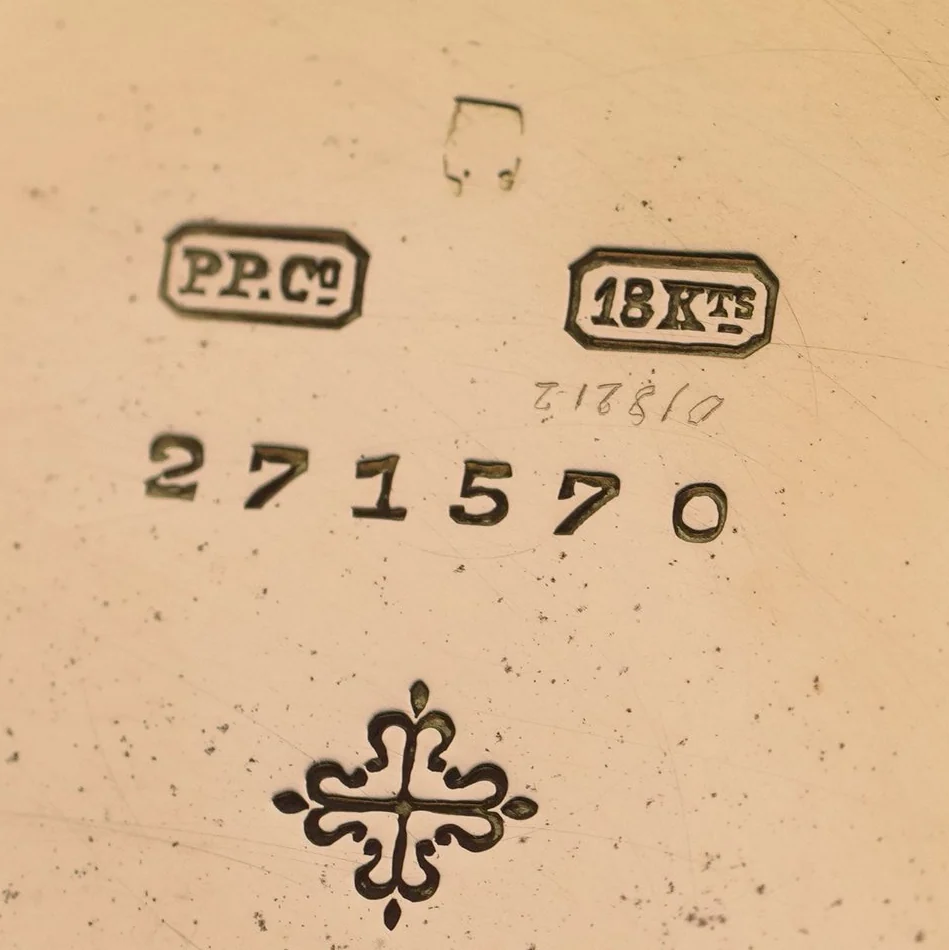
The large stamped number is the case number, struck by the case maker or the watch firm. Many makers ran it as a separate series from their movement numbers.
IWC, for example, used separate series for movements and cases, and cannot issue an archive extract when the case number does not match its records. Some makers stamped the movement number in the case instead, so the two agree.
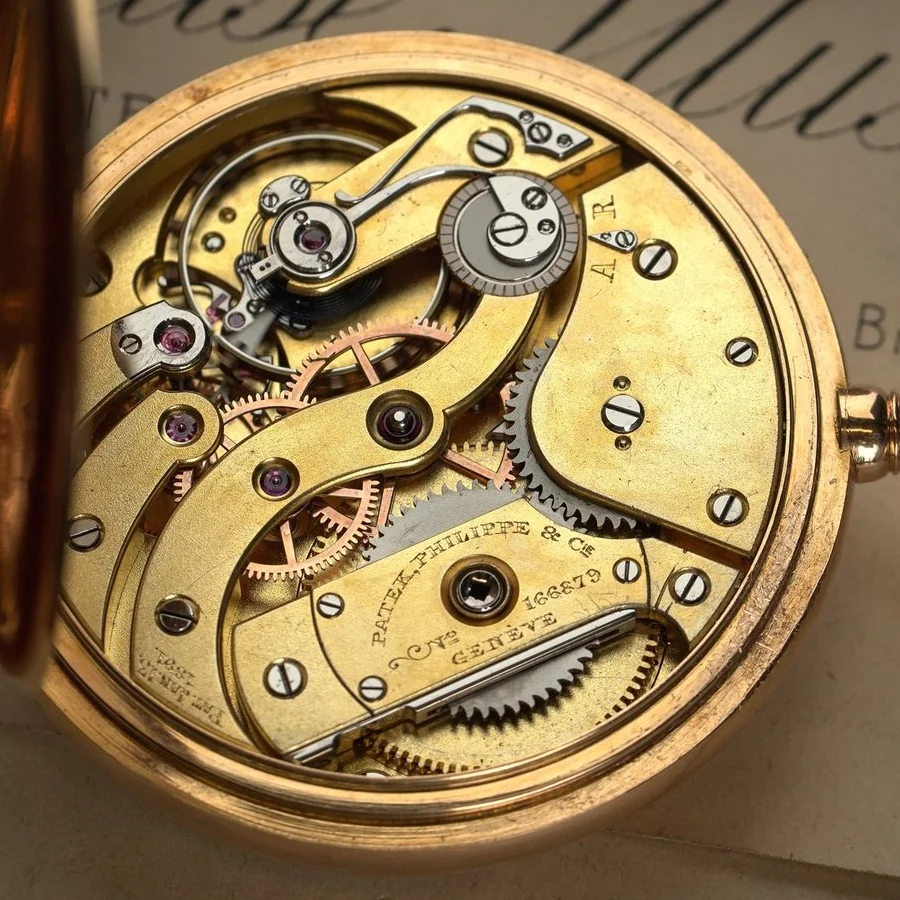
Movement number
The movement number is on the movement itself, usually beside the maker's name. On this Patek Philippe the case reads 271570 and the movement 166879: two numbers, one watch.
Patek Philippe asks for both when you order an Extract from the Archives. If you need help getting at the movement, see how to open a pocket watch.
Scratched numbers and letters
Tiny numbers, letters or dates scratched by hand inside the back are watchmakers' service marks. Many repairers kept a ledger and scratched the job number or their own mark after each service, so the marks mean little without the ledger.
Names that are not the case maker
A retailer's name on the dial or dome tells you who sold the watch. J. W. Benson of Ludgate Hill did not make cases: case makers, including Benson Brothers of Liverpool, made them and struck Benson's own J.W.B mark. Watches signed Thos. Russell & Son, Liverpool, have been seen in cases by the Illinois Watch Case Co. of Elgin. Always look inside for the sponsor's mark.
Source: Boettcher, IWC serial numbers; NAWCC Message Board; Boettcher, J. W. Benson; Russells of Liverpool.
Can't read the marks in your case? Send us a photo for a free opinion
Swiss case marks in brief
Swiss cases work differently. From 1 January 1882, federal law required gold and silver watch cases sold in Switzerland to be tested at a government bureau de contrôle. The maker stamped the fineness; the bureau added a hallmark. Swiss law did not demand a sponsor's mark, so most Swiss cases carry no maker's initials.
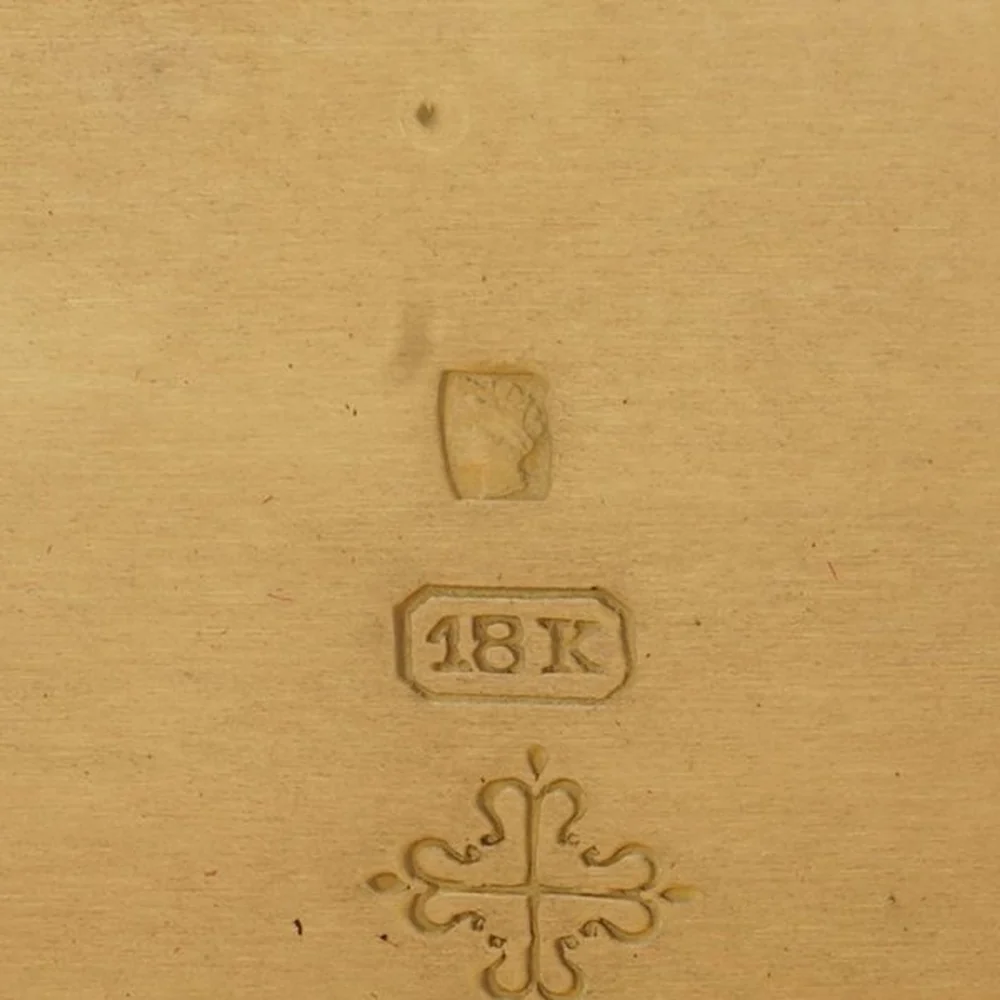
Helvetia head: 18 carat gold
The head of Helvetia, the female figure of Switzerland, is the Swiss hallmark for 18 carat (750) gold. A small letter beside it names the bureau that tested the case.
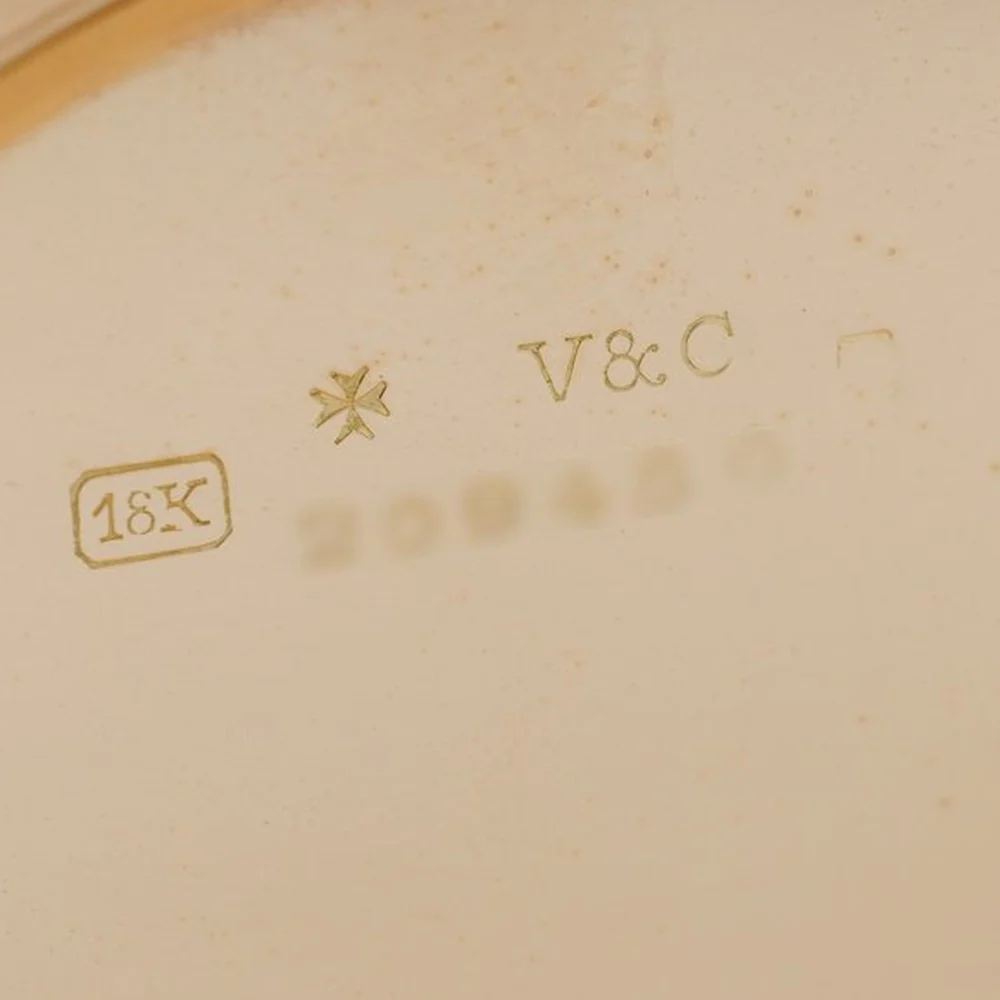
Brand marks sit beside it: Patek Philippe's Calatrava cross, Vacheron & Constantin's Maltese cross. Those are trademarks, not hallmarks.
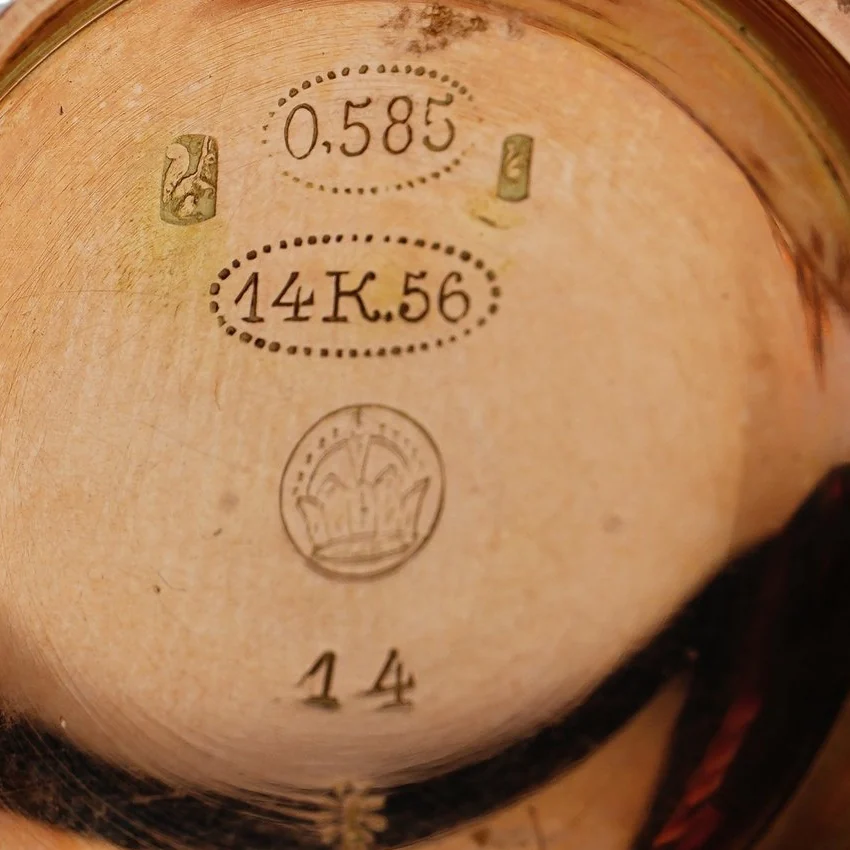
Squirrel: 14 carat gold
A squirrel marks 14 carat gold: 0.583 fine until 1933, then 0.585. The 56 in "14K.56" is a Russian zolotnik number for the same standard, one of the foreign marks Swiss makers were allowed to add for export.
Silver used a grouse for 0.800 and a bear for 0.875.
From 1926, Swiss case makers could strike a poinçon de maître: a small hammer or other symbol with a registration number that identifies the case factory without naming it. The register was centralised in 1934, and the numbers can be looked up.
A Swiss case sold in Britain after 1 June 1907 also carries British import hallmarks and an importer's sponsor's mark, such as W&D or CN from the finder above. The import marks themselves are explained on pocket watch hallmarks, and the bigger picture in English vs Swiss antique gold watches.
Source: Boettcher, Swiss Hallmarks; Swiss Poinçons de Maître.
What the case maker tells you about value
Five things a valuer reads from the marks
- The metal. A hallmarked gold case has a value in its weight alone. A Star, Moon or Sun case does not.
- Originality. A case mark that fits the movement shows they started life together, for example R&S in a Rotherham watch.
- Archive papers. For makers who kept records, matching case and movement numbers make an archive extract possible.
- The right name. GS or A5M is a carrier, not a maker, so it adds no maker's name to the watch.
- The date. The sponsor's mark, read with the date letter, dates the case to a year or two.
In our experience as dealers, the movement and the maker on the dial count for more than the case maker. A watch with a well known case maker and a modest movement is valued as a modest watch in a good case. For prices by metal, movement and maker, see our pocket watch value guide; for scrap figures, the gold price calculator uses the live gold price.
For the brands themselves, see our Patek Philippe guide and vintage gold Rolex models, the second for what Wilsdorf & Davis became.
Selling or buying a pocket watch
We buy and sell antique pocket watches in gold and silver, English and Swiss, and we read these marks every day.
- Photograph the marks
Inside the back (the sponsor's mark and hallmarks), the movement, the dial and the outside of the case. Good light, as close as your phone will focus.
- Send them to us
Use the form below, call 01376 334482 or WhatsApp us. We reply with what the marks say and a free valuation.
- Sell, or keep it
If you sell, we pay by bank transfer once the watch is checked. See sell your pocket watch.
Buying? Browse our pocket watches or the full watch collection, or book a viewing in Mayfair or Braintree through our contact page.
Request a free pocket watch valuation
- The initials inside a British case are a sponsor's mark: who sent it for hallmarking, often but not always the maker.
- Check the shape of the outline and the dots, not just the letters, and read it with the date letter.
- A.L.D is Dennison; Star, Moon and Sun are Dennison gold filled grades, not solid gold.
- Case number and movement number are usually different; both matter for archive papers.
Questions we are asked
What do the initials inside my pocket watch case mean?
On a British gold or silver case they are the sponsor's mark: the initials of the person or firm who sent the case to an assay office for hallmarking. Often that was the case maker, but it could be a watch factory, an importer, a retailer or a carrier.
Is the sponsor's mark the same as the maker's mark?
Not always. The trade called it the maker's mark, but the sponsor only took responsibility for the metal. Importers, retailers such as J. W. Benson and carriers such as Stockwell & Co. all registered marks.
What does ALD mean inside a pocket watch?
A.L.D is the sponsor's mark of Aaron Lufkin Dennison and the Dennison Watch Case Co. of Handsworth, Birmingham, first entered at the Birmingham Assay Office in April 1876.
What do Dennison Star, Moon and Sun mean?
They are grades of Dennison gold filled case: Sun had 14ct gold layers guaranteed for 25 years, Moon 10ct for 20 years, and Star 9ct on the outside for 10 years. None of them is solid gold.
What does GS mean in a watch case?
GS is the mark of Stockwell & Co., carriers who submitted Swiss watch cases for British hallmarking from 1907. They did not make the case.
Why do the case number and the movement number not match?
Many makers numbered cases and movements in separate series, so different numbers are normal. Some makers repeated the movement number in the case. Archive services check both numbers against their records.
What are the tiny scratched numbers inside the case back?
Watchmakers' service marks: a job number, date or personal mark scratched after a repair. They can only be read with the repairer's own ledger.
Do Swiss pocket watches have a case maker's mark?
Usually not by name. Swiss hallmarks such as the Helvetia head (18ct) and squirrel (14ct) show the metal. From 1926 some cases carry a numbered poinçon de maître that identifies the case factory.
Does the case maker affect the value of a pocket watch?
Less than the movement, the maker on the dial and the metal. The marks matter most for confirming the metal, dating the case and showing that case and movement belong together.
Have a pocket watch to value or sell?
Send photos of the marks inside the case, the movement and the dial for a free valuation, or visit us in Mayfair or Braintree.
- We buy directly
- Free valuation from photos
- Appointments in Mayfair and Braintree
- Insured postage or collection
New pieces reach our list first: join the Mozeris list.