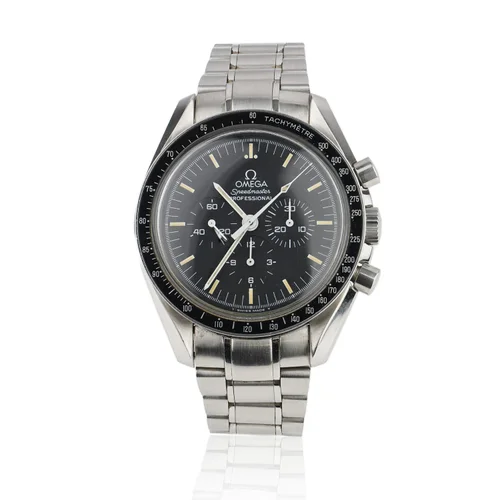
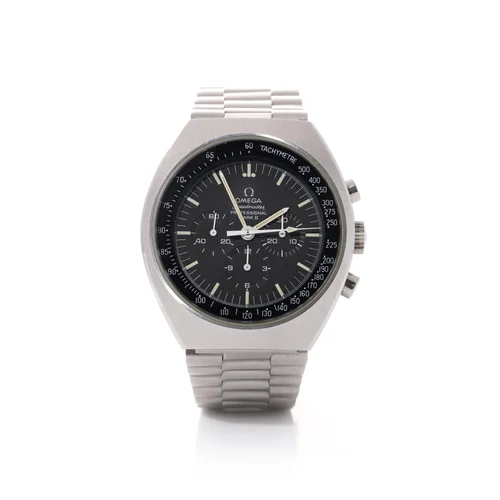
History of the Omega Speedmaster Professional
Omega introduced the Speedmaster in 1957 as a sports and racing chronograph, alongside the Seamaster 300 and Railmaster. The first reference, CK2915, had broad arrow hands, a steel bezel engraved with a tachymeter scale and the column-wheel calibre 321. In 1965 NASA qualified the Speedmaster for manned space flight after a series of tests on chronographs from several makers. That June Ed White wore one during the first American spacewalk on Gemini 4, and on 21 July 1969 Buzz Aldrin wore his reference 105.012 on the lunar surface during Apollo 11. In 1970 the Apollo 13 crew used the Speedmaster to time a critical engine burn, and NASA honoured Omega with the Snoopy Award. From the mid 1960s the dial carried the word Professional, and the asymmetric case with crown guards became standard. In 1968 Omega replaced calibre 321 with the cam-operated calibre 861, later refined as calibre 1861. In 2021 the Moonwatch moved to calibre 3861, a Co-Axial Master Chronometer certified by METAS, while Omega reintroduced the calibre 321 in a 39.7 mm steel case in 2020. The 42 mm case, hesalite crystal and black dial have changed remarkably little in six decades.
Key references
| Ref. CK2915 | 39 mm, stainless steel. Calibre 321. Made from 1957 to 1959. The first Speedmaster, with broad arrow hands and a steel tachymeter bezel. |
|---|---|
| Ref. 105.003 | Steel case without crown guards. Calibre 321. Made in the mid 1960s. The model worn by Ed White on Gemini 4. |
| Ref. 105.012 | Steel asymmetric case with crown guards. Calibre 321. Made in the mid to late 1960s. Carries Professional on the dial; the reference Buzz Aldrin wore on Apollo 11. |
| Ref. 145.022 | 42 mm, stainless steel. Calibre 861. Made from 1968 into the late 1980s across several sub-variants. The first Speedmaster Professional with the calibre 861. |
| Ref. 3570.50 | 42 mm, stainless steel on bracelet. Calibre 1861. Made from the 1990s to 2014. Hesalite crystal with the Omega logo etched at its centre. |
| Ref. 311.30.40.30.01.001 | 39.7 mm, stainless steel. Calibre 321, remade by Omega. Introduced 2020. Based on the 105.003 with a dot-over-90 tachymeter bezel. |
| Ref. 310.30.42.50.01.001 | 42 mm, stainless steel. Calibre 3861 Co-Axial Master Chronometer. Introduced 2021. Hesalite crystal; ref. 310.30.42.50.01.002 is the sapphire-crystal version with display back. |
How to spot a fake
- Request an Omega Extract from the Archives: it confirms the movement serial, production date and the country the watch was delivered to.
- The movement serial number is engraved on the movement; the reference number is stamped inside the caseback. Both should agree with the Extract and with the case style.
- Match the calibre to the reference: 321 in a 105.012, 861 in a 145.022, 1861 in a 3570.50, 3861 in a 310.30.42.50.01.001. A modern movement in a vintage case is a common marriage.
- Check the tachymeter bezel insert. Early inserts show a dot over 90, later ones a dot beside it, and the font and spacing must suit the reference.
- Modern hesalite crystals carry a small Omega logo etched at the centre, visible when you tilt the watch.
- Look at the caseback engraving. From 1969 onwards Professional casebacks are engraved with the flight-qualified by NASA text, and the engraving should be sharp and even.
- Bracelets and clasps carry reference numbers and end link numbers that should match the period of the watch.
- Original box, warranty card and service papers should carry the matching serial number.
How we check a sourced piece
Every Speedmaster we source is opened by a watchmaker, who confirms the calibre against the reference, checks the chronograph start, stop and reset and records amplitude and rate on a timegrapher. We check the case and movement serials, review service history and request an Omega Extract from the Archives where appropriate. You receive detailed photographs and video before you commit to buy. Mozeris Fine Antiques is an independent dealer and is not affiliated with Omega.