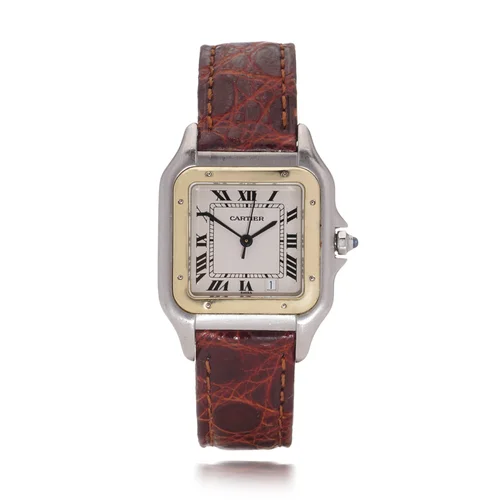
History of the Cartier Panthère jewellery
The panther first appeared at Cartier in 1914, as a pattern of onyx and diamonds imitating panther skin on a lady's wristwatch. Louis Cartier gave the nickname La Panthère to Jeanne Toussaint, who became director of Cartier's fine jewellery in 1933 and made the animal her signature. With the designer Peter Lemarchand she turned the motif into sculpture: in 1948 Cartier made its first three-dimensional panther jewel, a brooch for the Duke of Windsor, and in 1949 a panther clip perched on a 152.35 ct Kashmir sapphire cabochon followed for the Duchess of Windsor. From then on the panther appeared in brooches, bracelets, rings and clips, in gold with black enamel spots, or paved with diamonds and onyx, and later with sapphires and emeralds. In the 1980s the Panthère de Cartier watch, with its supple link bracelet, carried the name to a wider audience. Today the Panthère de Cartier collection includes rings, bracelets, earrings and necklaces built around the panther head and body, many set with emerald eyes and an onyx nose.
Key references
| Panthère de Cartier ring | 18KT gold head with emerald eyes and onyx nose, plain or with lacquer or diamond-set spots. |
|---|---|
| Panthère bracelet | 18KT gold, plain or paved with diamonds and onyx. The panther head or full body forming the bracelet. |
| Vintage panther brooches and clips | 18KT gold or platinum with diamonds, onyx, enamel or coloured stones. The sculptural line that began in 1948. |
| Panthère earrings and pendants | 18KT gold with emeralds and onyx. The panther head as studs, hoops or a pendant. |
| Panthère de Cartier watch | 18KT gold, steel, or steel and gold, with the supple panther link bracelet. |
How to spot a fake
- Look for the Cartier signature, the 750 or Au750 gold mark and a serial number, usually on the inside of a ring or on the clasp or back of a bracelet or brooch. Engraving should be clean and evenly spaced.
- Study the modelling of the head. On a genuine piece the features are crisply chased, the eyes are well matched emeralds and the nose is neatly set onyx.
- Check the spots. Lacquered spots should be even and clean-edged; stone-set spots should be secure and evenly spaced.
- On vintage brooches, French pieces carry French assay marks and a maker's mark; check that these suit the period and the place of manufacture.
- On watches, check that the dial, case reference and bracelet all belong together and that the case number matches the papers.
- Box, certificate and archive documentation add confidence when they match the serial number. The piece itself is always checked first.
How we check a sourced piece
Before we recommend a piece we test the metal, read every hallmark and maker's mark under magnification, and check the serial number and its engraving against the model and period it should belong to. You receive a written condition report with detailed photographs and video, so you see the piece exactly as it is before you commit to anything. For Panthère pieces we also check the setting of the eyes and nose, the condition of any lacquer and the articulation of links. Mozeris Fine Antiques is an independent dealer and is not affiliated with Cartier.