Military jewellery guide
Sweetheart Brooches of Both World Wars: How to Identify a Regimental Sweetheart Brooch
A sweetheart brooch is a small copy of a regimental or service badge, made as a brooch and given by a serviceman to a wife, mother, sister or sweetheart. Most date from the First World War, when one existed for every regiment, and many were made again in the Second. The badge, crown and hallmark tell you which.
The register of regimental badges, how to read the back, and how to tell First World War from Second.
Reviewed by Faustas Svencionis, Mozeris Fine Antiques, since 2015 · Updated October 2026

Key takeaways
- The badge names the unit. Our register lists 79 British and Commonwealth services with their emblems, mottos and look-alikes.
- The back dates it. A Birmingham date letter p to t means 1914 to 1919; P to V means 1939 to 1946.
- Crown and cypher narrow it. GvR is George V, GRVI is George VI, and a St Edward's crown means 1953 or later.
- Keep it as it is. Do not polish it; keep it with medals, papers and photographs.
What is a sweetheart brooch?
A sweetheart brooch is a miniature regimental, naval or air service badge worn as a brooch by the women in a serviceman's family. The name is loose: mothers, wives and sisters wore them as well as sweethearts.
The first known example is a gold, diamond and enamel copy of the 10th Royal Hussars' insignia. The Earl of Airlie commissioned it for his wife Mabell on their wedding day, 19 January 1886. By the middle of 1914 a brooch was made for every regiment of the British Army, the Royal Flying Corps and the Navy.
Some were made by fine jewellers in gold or silver, set with diamonds or other stones. Most were mass-produced in Birmingham and London in brass, enamel or mother of pearl. Many were sold in small shops in army camps, where a soldier could buy one before leaving for the front.
Women wore them for luck, or to show that someone in the family was serving. When a man did not come home, the brooch often went into a drawer. In 1939 Mass Observation found sales of gold and diamond “sweetheart badge brooches” rising again in London shops.
Sweetheart brooches belong to the same family of remembrance jewellery as our mourning jewellery guide. Remembrance Sunday falls on 8 November 2026 and Armistice Day on 11 November, when many families take these brooches out again.
Sources: History Workshop, Radical Objects, 2018; Royal Welsh Museum; IWM; Bucks Military Museum Trust; Tank Museum.
The register: every service and how to recognise its badge
The badge on the front names the unit. The register below lists 79 British and Commonwealth services, what their badge looks like on a brooch, which war it fits and how to tell it from a look-alike.
Find the emblem first, then read the motto and the title scroll. Brooches copy the cap badge, so a brooch with an unusual setting still carries the same emblem. Each row links its source: the National Army Museum and Auckland War Memorial Museum collection records, regimental museums and Wikipedia.


| Service or regiment | Badge on the brooch | Wars | How to tell it apart | Source |
|---|---|---|---|---|
| Army: artillery, engineers and corps | ||||
| Royal Artillery | A muzzle-loading gun under a crown; scrolls UBIQUE above and QUO FAS ET GLORIA DUCUNT below | WW1, WW2 | Only the gun badge has a gun under the crown. A 1942 to 1946 economy badge is a plastic grenade with UBIQUE. | NAM; NAM; Wikipedia |
| Royal Horse Artillery | Royal cypher inside the Garter (HONI SOIT QUI MAL Y PENSE) under a crown; scroll ROYAL HORSE ARTILLERY | WW1, WW2 | No gun. The Royal Engineers also put a cypher in the Garter: the scroll decides. | NAM |
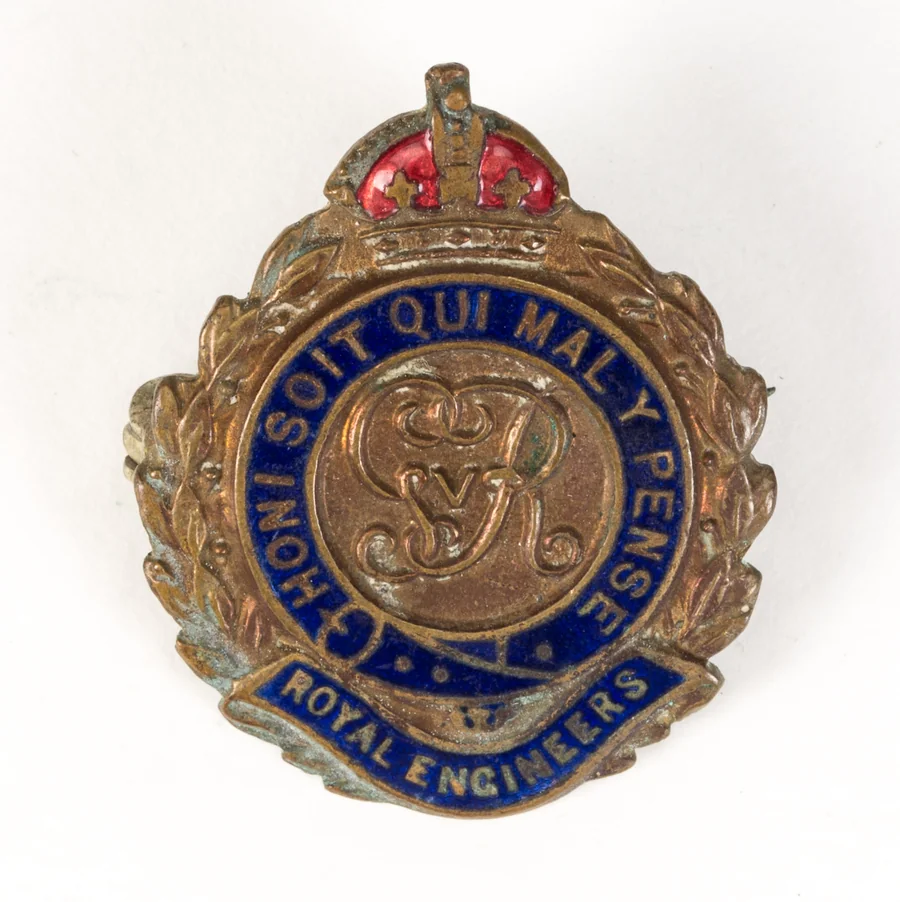
| Royal Engineers | Royal cypher (GvR in the First World War) inside the Garter, crown above, laurel wreath, scroll ROYAL ENGINEERS | WW1, WW2 | Read the scroll and the cypher: GvR is George V, GRVI George VI. | NAM; Auckland Museum; Auckland Museum |
| Army Service Corps / Royal Army Service Corps | Eight-pointed star and laurel wreath; inside the Garter the letters ASC, or on the 1940 pattern the cypher GRVI with the scroll ROYAL ARMY SERVICE CORPS | WW1, WW2 | Letters ASC in the centre: the earlier pattern. GRVI: George VI. | Auckland Museum; NAM |
| Royal Army Medical Corps | Rod and serpent of Asclepius in a laurel wreath under a crown; IN ARDUIS FIDELIS | WW1, WW2 | The Army Veterinary Corps badge has the letters AVC in the wreath, not a rod. | NAM; Auckland Museum; Wikipedia |
| Army Veterinary Corps | Intertwined letters AVC in a laurel wreath under a crown | WW1, WW2 | Later Royal Army Veterinary Corps badges show the centaur Chiron instead. | Auckland Museum; NAM |
| Army Ordnance Corps / Royal Army Ordnance Corps | Shield with three cannon balls above three cannon, title scroll; RAOC motto SUA TELA TONANTI | WW1, WW2 | Three small cannon on a shield, not the single Royal Artillery gun. The corps became Royal in 1918. | Auckland Museum; Wikipedia |
| Tank Corps | A First World War tank facing right in a wreath, crown above, no motto (approved 1917, issued 1918 to 1923) | WW1 | Later badges turn the tank to face left and add FEAR NAUGHT. | NAM |
| Royal Tank Corps / Royal Tank Regiment | First World War tank facing left in a wreath under a crown; scroll FEAR NAUGHT | WW2 | A left-facing tank with FEAR NAUGHT is not a First World War badge. | NAM; Tank Museum; Wikipedia |
| Royal Armoured Corps | Armoured fist with curved arrows under a crown, designed by Abram Games | WW2 | Formed on 4 April 1939, so never a First World War brooch. | NAM; NAM; Auckland Museum |
| Royal Corps of Signals | Figure of Mercury above a scroll CERTA CITO, crown above | WW2 | Formed in 1920, so a Signals brooch is not First World War. | NAM; Wikipedia |
| Army Cyclist Corps | Sixteen-spoke bicycle wheel over crossed rifles, crown, scroll ARMY CYCLIST CORPS | WW1 | The badge is dated 1914 to 1918. | NAM |
| Parachute Regiment | Outspread wings round an open parachute, the royal crest of lion and crown above | WW2 | Formed in 1942. A King's crown dates a badge 1942 to 1952; a St Edward's crown is later. | NAM; Wikipedia; militaria.co.uk |
| Army: cavalry and yeomanry | ||||
| 5th Royal Irish Lancers | Crossed lances behind a circle QUIS SEPARABIT with the numeral 5 | WW1 | Shares QUIS SEPARABIT with the Irish Guards and Irish regiments: look for the lances and the 5. Amalgamated in 1922. | Auckland Museum; Auckland Museum |
| 17th Lancers | Skull and crossed bones above DEATH OR GLORY | WW1 | The skull recalls General Wolfe's death at Quebec in 1759. The regiment ran to 1922. | NAM; Wikipedia |
| 20th Hussars | Monogram XHX on an inverted horseshoe with battle honours; a silver brooch by Marshall Brothers is hallmarked Birmingham 1906 to 1907 | Pre-1914, WW1 | The hallmark puts that brooch before the First World War. Amalgamated in 1922. | NAM |
| 7th Dragoon Guards | Lion standing on a crown over a scroll QUO FATA VOCANT | WW1 | Same motto as the Northumberland Fusiliers: a lion here, St George there. | Auckland Museum; NAM |
| Royal Scots Greys | An eagle, the one captured at Waterloo in 1815; mottos NEMO ME IMPUNE LACESSIT and SECOND TO NONE | WW1, WW2 | An eagle, not the thistle star of the Scots Guards and Royal Scots. | NAM; Wikipedia |
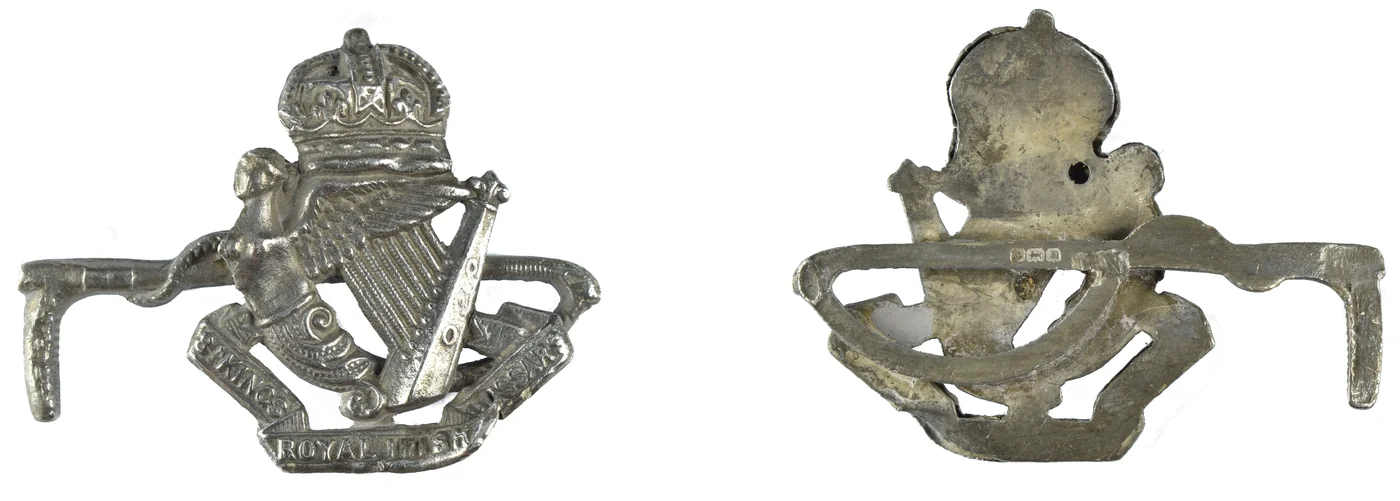
| 8th King's Royal Irish Hussars | Harp under a crown with a title scroll; one silver brooch adds a riding-crop bar and is hallmarked Birmingham 1942 to 1943 | WW2 example | A harp with a Hussars scroll, not an Irish infantry badge. | Portable Antiquities Scheme |
| Army: Foot Guards | ||||
| Grenadier Guards | A flaming grenade, adopted after Waterloo in 1815 | WW1, WW2 | Fusilier regiments also wear grenades, but add a centre device and a title. | NAM |
| Coldstream Guards | Star of the Order of the Garter with a cross inside the Garter HONI SOIT QUI MAL Y PENSE | WW1, WW2 | The Royal Sussex star sits over a plume. | NAM; Wikipedia |
| Scots Guards | Star of the Order of the Thistle, a thistle in a circlet NEMO ME IMPUNE LACESSIT | WW1, WW2 | The Royal Scots add St Andrew's cross to the same star and motto. | NAM |
| Irish Guards | Star of the Order of St Patrick; QUIS SEPARABIT | WW1, WW2 | A star, not the harp of the Irish line regiments. Formed in 1900. | NAM; Wikipedia |
| Welsh Guards | A leek; CYMRU AM BYTH | WW1, WW2 | Formed in February 1915, so no brooch is earlier. | NAM; Wikipedia |
| Army: English infantry | ||||
| Royal Warwickshire Regiment | Antelope, ducally gorged and chained, scroll ROYAL WARWICKSHIRE | WW1, WW2 | The antelope is the post-1898 cap badge. | Auckland Museum; Wikipedia |
| Northumberland Fusiliers | St George killing the dragon; QUO FATA VOCANT | WW1, WW2 | ROYAL in the title dates it after 3 June 1935. | Auckland Museum; Wikipedia |
| Royal Fusiliers | Flaming grenade with a rose inside the Garter HONI SOIT QUI MAL Y PENSE | WW1, WW2 | Grenade with rose and Garter. | Auckland Museum |
| Lancashire Fusiliers | Flaming grenade with a sphinx in a laurel wreath, title band | WW1, WW2 | A sphinx on a grenade. The Glosters' sphinx has no grenade. | NAM |
| The Queen's (Royal West Surrey) | Paschal lamb with halo and flag, scroll THE QUEEN'S | WW1, WW2 | The lamb and flag. | Auckland Museum; Wikipedia |
| The Buffs (Royal East Kent) | Dragon inside a band THE BUFFS VETERI FRONDESCIT HONORE; a 1943 brooch sets the badge on a mother of pearl disc | WW1, WW2 | The Royal Berkshire dragon is a China dragon over a ROYAL BERKSHIRE scroll. | Auckland Museum; NAM; Wikipedia |
| Queen's Own Royal West Kent | White Horse of Kent on a scroll INVICTA, scroll ROYAL WEST KENT | WW1, WW2 | The King's (Liverpool) horse is the White Horse of Hanover, without INVICTA. | NAM; Wikipedia |
| Essex Regiment | Castle and key of Gibraltar in an oak wreath, a sphinx on an EGYPT tablet above; motto MONTIS INSIGNIA CALPE | WW1, WW2 | Castle with a key: Essex. Castle with PRIMUS IN INDIS: Dorset. | NAM; Wikipedia |
| Dorsetshire Regiment | Castle and scroll PRIMUS IN INDIS in a wreath, a sphinx above MARABOUT | WW1, WW2 | See the Essex Regiment. | NAM |
| Devonshire Regiment | Eight-pointed star, crown on the top point, Exeter Castle in a circlet SEMPER FIDELIS | WW1, WW2 | A castle inside a star. Mother of pearl Devonshire brooches were made in England. | NAM; AWM |
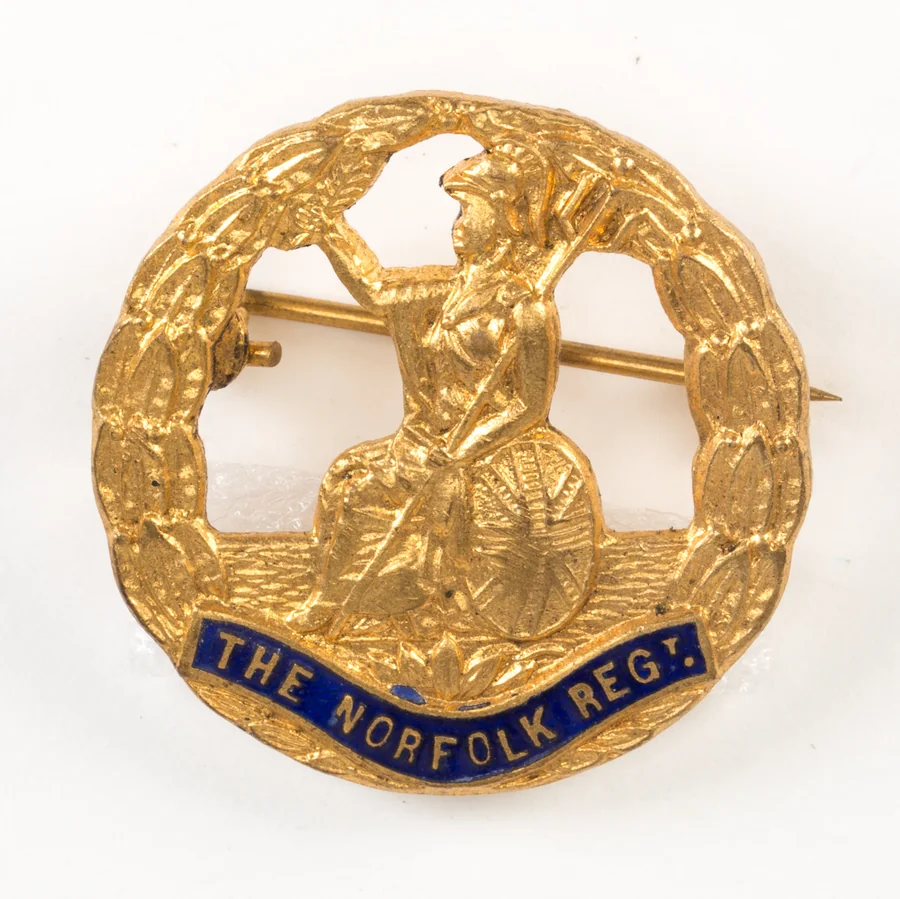
| Norfolk Regiment | Seated Britannia with olive branch and trident in a wreath, scroll THE NORFOLK REGT. | WW1, WW2 | A ROYAL NORFOLK scroll dates it after 3 June 1935. | NAM; Auckland Museum; Auckland Museum |
| Bedfordshire Regiment | Star behind a Maltese cross, the Garter HONI SOIT QUI MAL Y PENSE, a stag in the centre, scroll BEDFORDSHIRE | WW1 | A stag inside a Garter star. | Auckland Museum |
| Leicestershire Regiment | Tiger with the battle honour HINDOOSTAN, scroll LEICESTERSHIRE | WW1, WW2 | Tigers also appear on the Hampshire, York and Lancaster and Royal Munster badges. Royal from 1946. | NAM; NAM |
| Hampshire Regiment | Hampshire rose with a royal tiger above, crown and laurel wreath | WW1, WW2 | Rose and tiger together. Bi-metal cap badges were used until 1916. | NAM; Auckland Museum |
| Gloucestershire Regiment | Sphinx on an EGYPT pedestal between laurel sprigs, scroll GLOUCESTERSHIRE; also worn as a back badge | WW1, WW2 | The only British Army regiment with a back badge. | NAM; Wikipedia |
| Royal Sussex Regiment | Star of the Order of the Garter over the Roussillon plume | WW1, WW2 | The plume separates it from the Coldstream star. | NAM |
| Royal Berkshire Regiment | China dragon over a ROYAL BERKSHIRE scroll | WW1, WW2 | See The Buffs. | NAM |
| Manchester Regiment | Arms of the City of Manchester until 1923, then a fleur-de-lys | WW1, WW2 | City arms point to the First World War, the fleur-de-lys to 1923 or later. | NAM |
| Middlesex Regiment | Coronet and cypher of the Duke of Cambridge on its badges; NAM holds a sweetheart brooch of about 1918 | WW1, WW2 | The Duke of Cambridge's coronet and cypher. | NAM; Wikipedia |
| Durham Light Infantry | Stringed bugle horn under a crown | WW1, WW2 | Light infantry bugles differ by their scrolls and initials. | NAM |
| Oxford and Bucks Light Infantry | Silver bugle horn with cord over a blue enamel scroll OXFORD & BUCKS L I (brooch of about 1941) | WW1, WW2 | The title scroll names it. | NAM |
| King's Royal Rifle Corps | Maltese cross bearing battle honours; motto CELER ET AUDAX; enamel badges on mother of pearl discs are recorded | WW1, WW2 | The Rifle Brigade cross carries WATERLOO under the crown and its own title. | Auckland Museum; Wikipedia; Collections WA |
| Rifle Brigade | Maltese cross in a wreath, a bugle in the centre with RIFLE BRIGADE round it, WATERLOO under the crown | WW1, WW2 | See the King's Royal Rifle Corps. | Auckland Museum |
| Army: Scottish regiments | ||||
| Royal Scots | Star of the Order of the Thistle with St Andrew's cross, a thistle in a circlet NEMO ME IMPUNE LACESSIT | WW1, WW2 | St Andrew's cross separates it from the Scots Guards. | NAM |
| Black Watch | Rayed star, St Andrew in a thistle wreath, NEMO ME IMPUNE LACESSIT, crown above | WW1, WW2 | St Andrew on a star. The Cameron St Andrew has no star. | NAM |
| Gordon Highlanders | Stag's head rising from a ducal coronet in an ivy wreath; BYDAND | WW1, WW2 | Ivy and BYDAND. The Seaforth stag carries CUIDICH 'N RIGH. | NAM |
| Seaforth Highlanders | Stag's head with CUIDICH 'N RIGH | WW1, WW2 | See the Gordon Highlanders. | NAM |
| Queen's Own Cameron Highlanders | St Andrew with his saltire in a thistle wreath, scroll CAMERON | WW1, WW2 | See the Black Watch. | NAM |
| Argyll and Sutherland Highlanders | Boar's head within a double circlet of leaves and thistles; mottos NE OBLIVISCARIS and SANS PEUR | WW1, WW2 | The regimental museum holds a sweetheart brooch shaped as a sporran. | Auckland Museum; NAM; Commons |
| King's Own Scottish Borderers | Edinburgh Castle on St Andrew's cross; NISI DOMINUS FRUSTRA and IN VERITATE RELIGIONIS CONFIDO | WW1, WW2 | A castle on a saltire. | NAM |
| Army: Welsh and Irish regiments | ||||
| South Wales Borderers | Sphinx on an EGYPT plinth inside a wreath with SWB | WW1, WW2 | A sterling silver brooch with a blue enamel bow was given by Pte William Harvy Smith, killed at Gallipoli on 25 April 1915. | NAM; Royal Welsh Museum |
| Welsh Regiment | Prince of Wales's plumes rising from a coronet, ICH DIEN, scroll THE WELSH | WW1, WW2 | The Leinster Regiment used the same plumes: the scroll decides. | NAM; Royal Welsh Museum |
| Royal Irish Rifles | Harp under a crown with QUIS SEPARABIT (1913 to 1921); an angel harp from 1902 to 1913 | WW1 | The motto under the harp. The Connaught Rangers have a title scroll. | NAM; NAM |
| Connaught Rangers | Harp under a crown, scroll CONNAUGHT RANGERS | WW1 | Disbanded in 1922, so no Second World War brooch. | NAM; Wikipedia |
| Royal Irish Regiment | Harp under a crown, scroll THE ROYAL IRISH REGIMENT | WW1 | Disbanded in 1922. | NAM; Auckland Museum |
| Royal Munster Fusiliers | Flaming grenade with a tiger, scroll ROYAL MUNSTER; motto SPECTEMUR AGENDO | WW1 | Disbanded in 1922. The Royal Dublin Fusiliers share the motto. | Auckland Museum; Wikipedia |
| Royal Dublin Fusiliers | Brooches in the form of the cap badge, some with SPECTAMUR AGENDO; silver examples by Frederick Narborough of Birmingham (1914) and Hopkins & Hopkins of Dublin | Boer War, WW1 | One variant leaves Royal out of the title. Disbanded in 1922. | RDF Association; Wikipedia |
| Royal Irish Fusiliers | Flaming grenade bearing the harp, the Prince of Wales's plume, coronet and ICH DIEN, with Princess Victoria's coronet above | WW1, WW2 | Two pieces: a coronet above the grenade. | NAM; NAM |
| Navy and Royal Marines | ||||
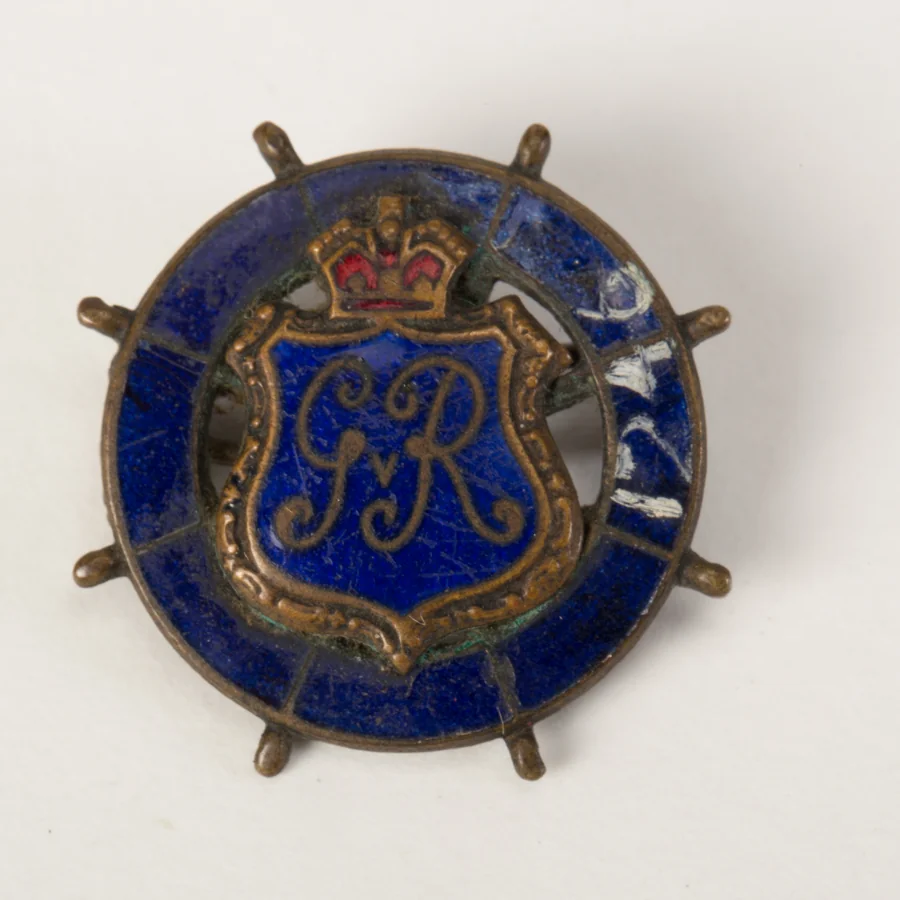
| Royal Navy | Blue enamel shield with the cypher GR on a ship's steering wheel, crown above | WW1 | A ship's wheel rather than an anchor. | Auckland Museum; Auckland Museum |
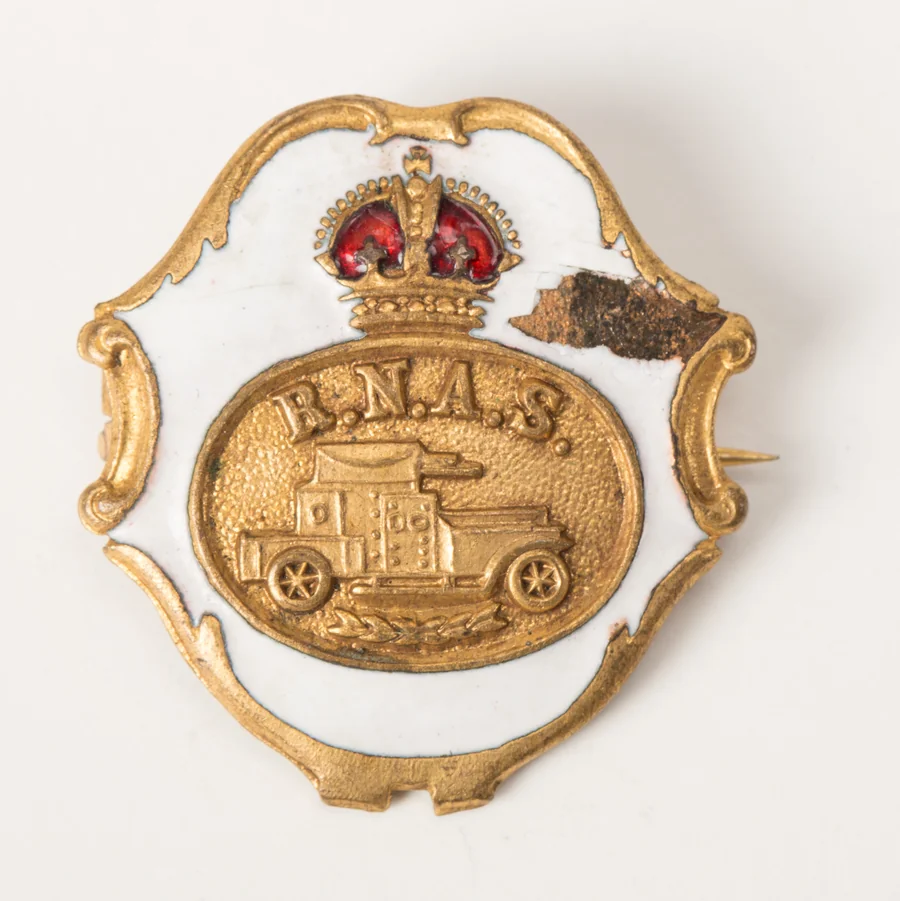
| Royal Naval Air Service, armoured cars | Gilt armoured car on a white enamel plaque, crown above, lettered R.N.A.S. | WW1 | The RNAS merged into the RAF on 1 April 1918. | Auckland Museum; Wikipedia |
| Royal Marines | An emblem that includes the fouled anchor of the Lord High Admiral; motto PER MARE PER TERRAM | WW1, WW2 | The motto names the Marines. | Wikipedia |
| Merchant Navy (Mercantile Marine) | Oval frame inside an oak wreath under a naval coronet | WW1, WW2 | Brooches existed for Merchant Navy units by the First World War. | Auckland Museum; History Workshop |
| Air services | ||||
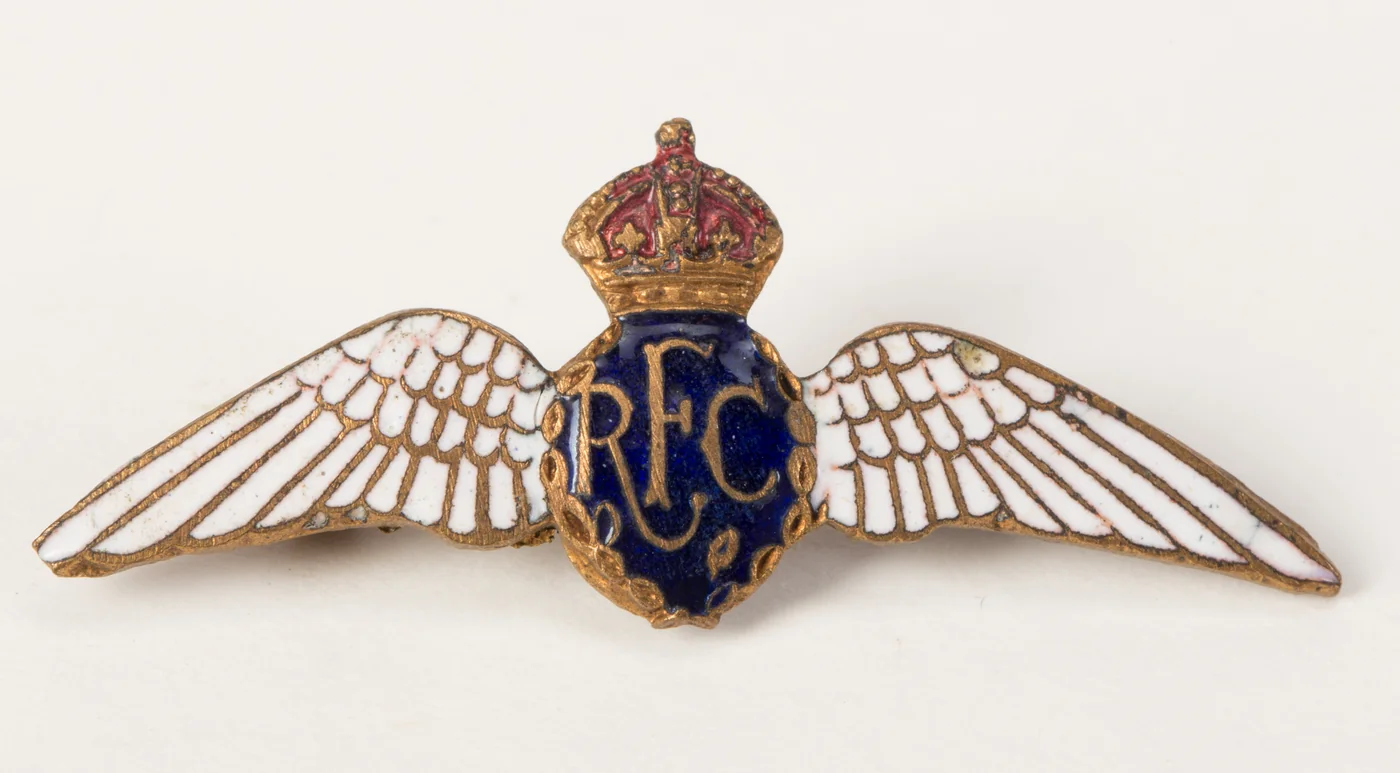
| Royal Flying Corps | Crown above a blue enamel oval lettered RFC, white enamel wings either side; finer versions are set with diamonds and an emerald | WW1 | Formed in 1912 and merged into the RAF on 1 April 1918, so RFC dates it before then. | Auckland Museum; Auckland Museum; SDASM |
| Royal Air Force | Eagle under a crown inside a circle PER ARDUA AD ASTRA (spelt PER ARDVA on one silver and enamel example) | WW1, WW2 | The RAF badge was first used in August 1918. The RFC used the same motto. | Portable Antiquities Scheme; Wikipedia; Wikipedia |
| Women's services and the home front | ||||
| Women's Army Auxiliary Corps / Queen Mary's Army Auxiliary Corps | Monogram AAC in a wreath, scroll QUEEN MARY'S, crown above (1918 to 1920) | WW1 | WAAC was instituted in July 1917; QUEEN MARY'S on the scroll means 1918 or later. | NAM; NAM |
| Auxiliary Territorial Service | Letters ATS in a laurel wreath under a crown | WW2 | Formed on 9 September 1938. | NAM; Wikipedia |
| Queen Alexandra's Imperial Military Nursing Service Reserve | Circular silver badge lettered with the service title, the letter R under a crown; made by J.R. Gaunt, London | WW1 | The full title runs round the band. | Auckland Museum |
| Home Guard | Battalions wore their county regiment's badge: 32,000 men in 19 Gloucestershire battalions wore the Glosters' sphinx | WW2 | A Home Guard brooch reads as a county regiment brooch. The Home Guard ran from May 1940 to December 1944. | Wikipedia; Wikipedia |
| Royal Observer Corps | A beacon lighter with a raised torch in a laurel wreath, crown above, FOREWARNED IS FOREARMED | WW2 | Formed in 1925. The St Edward's crown replaced the earlier crown from 1952. | Wikipedia |
| Commonwealth forces | ||||
| New Zealand Expeditionary Force | Fern-leaf frame under a Tudor crown, NZ in the centre, scroll EXPEDITIONARY FORCE | WW1 | Gold, gilt and silver examples are recorded. | Auckland Museum |
| New Zealand, NZ ONWARD | Fern frame under a crown with NZ and ONWARD on a blue enamel scroll | WW1, WW2 | Auckland holds NZ ONWARD brooches from both wars, so the design alone does not date one. | Auckland Museum; Auckland Museum; Auckland Museum |
| New Zealand Field Artillery | NZFA in a fern wreath under a crown; the back stamped 9CT and ST. SIL. | WW1 | Gold letters on a silver frame. | Auckland Museum |
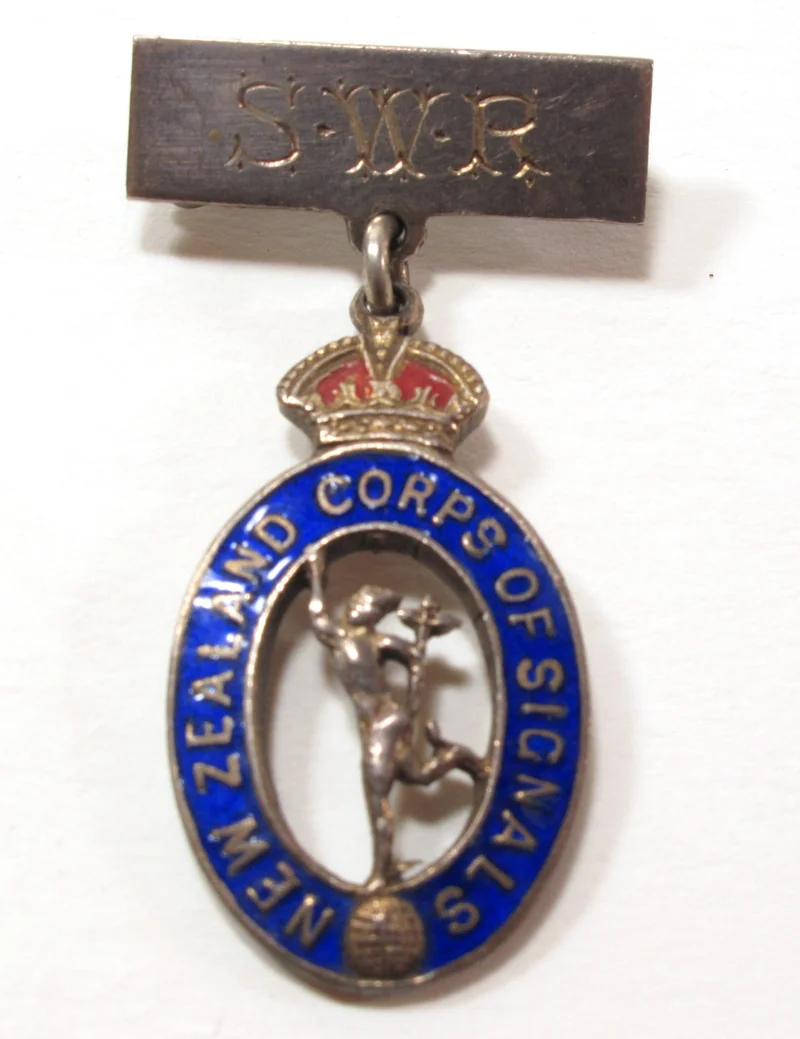
| New Zealand Corps of Signals | Silver and enamel Signals badge hanging from a bar engraved S.W.R, both stamped SILVER | WW2 | A bar and drop, a common later form. | Auckland Museum |
| Canadian Engineers | Beaver in a maple-leaf wreath, crown above, CANADIAN ENGINEERS on blue enamel | WW1 | The beaver and maple leaves. | Auckland Museum |
| Australian Imperial Force | The Rising Sun badge, often on carved mother of pearl | WW1, WW2 | The AIF used the same badge in both wars, so many cannot be dated. | AWM |


Sources: each row links its own source. Compiled by Mozeris Fine Antiques, October 2026. Corrections are welcome through our contact page.
Free valuation
Have a sweetheart brooch? Request a free valuation
If a sweetheart brooch has come down in your family, send us photos of the front and back and we will tell you what it is and what it is worth.
A specialist looks at every request personally and replies by email with an estimate within one working day. There is no obligation to sell.
What to photograph
- The front. The whole brooch, in daylight.
- The back. Pin, catch and any marks.
- Close up. The hallmark, stamp or engraving.
Prefer email? Send photos to info@mozerisfineantiques.com, call 01376 334482 or WhatsApp us.
Read the back: hallmarks, maker's marks and pins
The back of a sweetheart brooch tells you the metal, the maker and, if it is hallmarked, the year. Turn it over and look along the frame and the pin.
- PinA plain pin across the back. The pin, hinge and catch are often replaced in repair.
- HingeA small tube or block soldered to the frame.
- CatchA simple open hook (a C-catch) or a later rotating safety catch.
- HallmarkLion for sterling silver, the town mark (an anchor for Birmingham) and a date letter: q here is 1915 to 1916.
- Maker's markInitials in a shaped punch, such as MB for Marshall Brothers of Birmingham.
- Metal stampSTERLING, ST. SIL., SILVER or 9CT stamped by the maker. A stamp is not an assay office hallmark: it gives no town and no year.
- EngravingInitials, a date or a service number. One New Zealand brooch is engraved 6-3-16 and J.E.M. on the back.
- Safety chainA short chain with a small pin, so the brooch is not lost if the main pin opens.
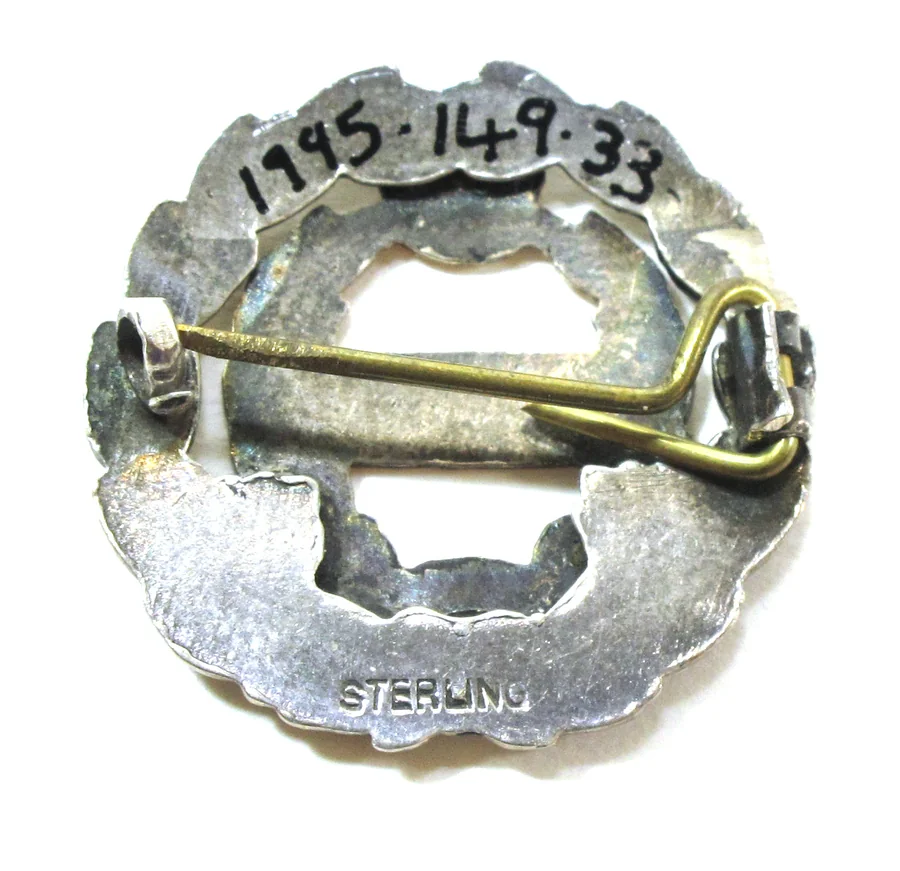
A full British hallmark has the lion for sterling silver, the town mark and a date letter. Birmingham's town mark is an anchor, and its date letter changes each July. The Imperial War Museum finds 1915 the most common year on hallmarked First World War brooches.
| Letter | Assay year | Letter | Assay year |
|---|---|---|---|
| p | 1914 to 1915 | P | 1939 to 1940 |
| q | 1915 to 1916 | Q | 1940 to 1941 |
| r | 1916 to 1917 | R | 1941 to 1942 |
| s | 1917 to 1918 | S | 1942 to 1943 |
| t | 1918 to 1919 | T | 1943 to 1944 |
| U | 1944 to 1945 | ||
| V | 1945 to 1946 |
Our Birmingham Assay Office guide and how to read silver hallmarks explain the marks in full, and hallmarks and maker's marks explains the difference between them.
| Maker | Where | Recorded example |
|---|---|---|
| Marshall Brothers | Birmingham | Imperial Yeomanry brooch, 1900; 20th Hussars brooch, 1906 to 1907 (NAM) |
| Frederick Narborough | Birmingham | Royal Dublin Fusiliers brooches hallmarked 1914 (RDF Association) |
| Edward Tessier | London | Probyn's Horse brooch hallmarked London 1917 (NAM) |
| Goldsmiths and Silversmiths Company | London | Hodson's Horse silver brooch, 1917 (NAM) |
| Hopkins & Hopkins | Dublin | Royal Dublin Fusiliers sterling silver and green enamel (RDF Association) |
| Asprey | London | Marcasite and enamel South Wales Borderers officer's brooch (Royal Welsh Museum) |
| J.R. Gaunt | London | The Buffs lapel badge; QAIMNS Reserve badge (Auckland Museum) |
Sources: Birmingham Assay Office; IWM; Auckland Museum (engraving); Auckland Museum (safety chain); Auckland Museum (9CT and ST. SIL.); Portable Antiquities Scheme.


First or Second World War? Six tells
Production of sweetheart brooches peaked in the First World War and revived in the Second, and many designs did not change. Six tells, used together, usually settle which war a brooch belongs to.
| Tell | First World War | Second World War | Source |
|---|---|---|---|
| Hallmark date letter (Birmingham) | Lower case p, q, r, s, t: 1914 to 1919. 1915 is the most common year on hallmarked brooches. | Capitals P to V: 1939 to 1946. | Birmingham Assay Office; IWM |
| Royal cypher | GvR, George V (1910 to 1936), as on Royal Engineers badges of 1914. | GRVI, George VI (1936 to 1952), as on Royal Horse Artillery and RASC badges of 1936 to 1940. | NAM; NAM; Wikipedia |
| Crown | King's (Tudor) crown, used from Edward VII to George VI. | The same King's crown. A St Edward's crown means 1953 or later, not wartime. | militaria.co.uk |
| Did the unit exist? | Royal Flying Corps to 1 April 1918; Tank Corps with the tank facing right; Irish regiments disbanded in 1922; Army Cyclist Corps. | Royal Corps of Signals (1920), ATS (1938), Royal Armoured Corps (1939), Parachute Regiment (1942). REME formed in 1942, but its horse and lightning badge dates from 1947. | NAM; Wikipedia; Wikipedia |
| Badge redesigns | Manchester Regiment city arms (to 1923); NORFOLK and NORTHUMBERLAND without ROYAL (before June 1935). | Manchester fleur-de-lys; ROYAL NORFOLK and ROYAL NORTHUMBERLAND; RAF eagle (from 1918). | NAM; Auckland Museum |
| Place and material | Carved Bethlehem mother of pearl badge brooches from late 1917, after the town was taken. | Many mother of pearl brooches copy First World War designs, so a unit that served in both wars can be hard to date. | AWM |
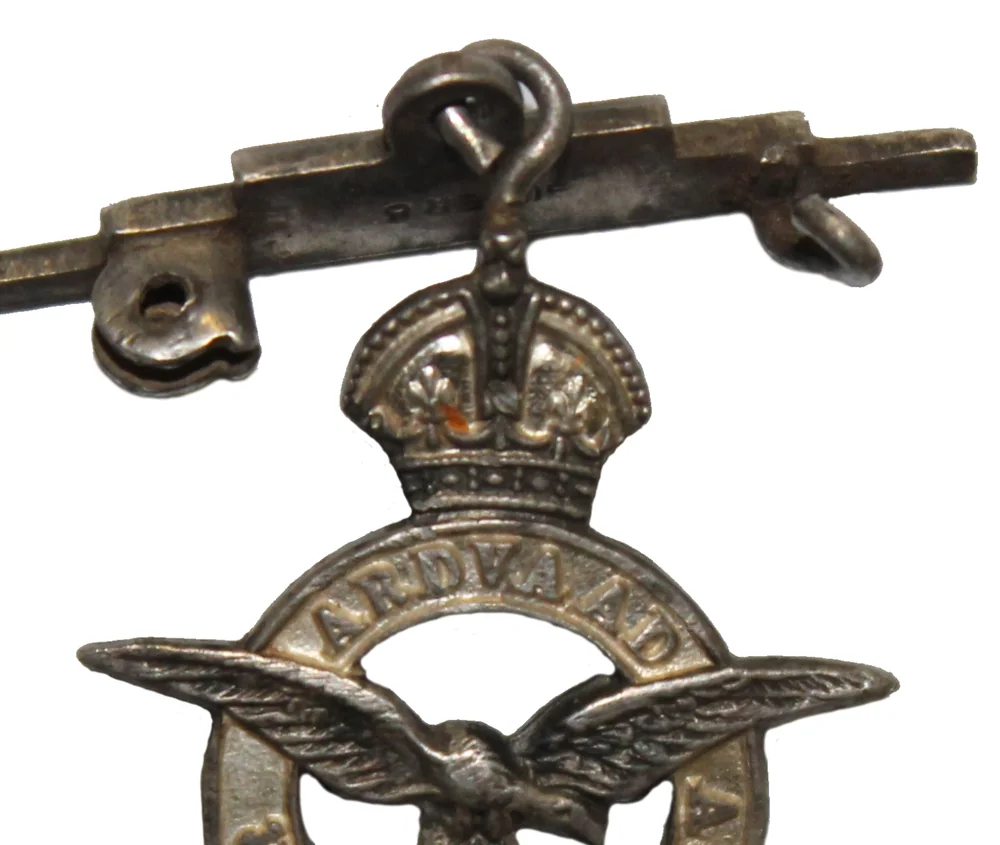
When a regiment served in both wars and kept the same badge, the brooch itself may not say which war. Then the hallmark, the family papers and any engraving decide it.
Look-alike badges: how to tell them apart
Many regiments share a motto or an emblem, so a single feature is not enough. Read the centre of the badge, the motto and the title scroll together.
| Emblem or motto | Worn by | How to tell them apart |
|---|---|---|
| HONI SOIT QUI MAL Y PENSE (the Garter) | Royal Engineers, Royal Horse Artillery, Army Service Corps, Coldstream Guards, Royal Fusiliers, Bedfordshire Regiment, Royal Sussex Regiment | Look inside the Garter (cypher, letters ASC, cross, rose or stag) and read the scroll. |
| NEMO ME IMPUNE LACESSIT | Scots Guards, Royal Scots, Black Watch, Royal Scots Greys | Thistle star alone: Scots Guards. With St Andrew's cross: Royal Scots. St Andrew himself: Black Watch. An eagle: Greys. |
| QUIS SEPARABIT | Irish Guards, Royal Irish Rifles, 5th Royal Irish Lancers | A star: Irish Guards. A harp: Royal Irish Rifles. Lances and a 5: the Lancers. |
| ICH DIEN and the Prince of Wales's plumes | Welsh Regiment, Leinster Regiment, Royal Irish Fusiliers | Scroll THE WELSH or the Leinster title; on a grenade, the Royal Irish Fusiliers. |
| Harp under a crown | Royal Irish Rifles, Connaught Rangers, Royal Irish Regiment, 8th Hussars | Read the scroll under the harp. |
| Sphinx | Gloucestershire, Lincolnshire, South Wales Borderers, Lancashire Fusiliers, Essex, Dorsetshire | Laurel sprigs: Glosters. Plinth alone: Lincolnshire. SWB in a wreath: Borderers. On a grenade: Lancashire. Above a castle: Essex or Dorset. |
| Tiger | Leicestershire, Hampshire, York and Lancaster, Royal Munster Fusiliers | HINDOOSTAN: Leicestershire. With a rose: Hampshire. Under a rose and coronet: York and Lancaster. On a grenade: Munsters. |
| Dragon | The Buffs, Royal Berkshire Regiment | A band THE BUFFS, or a China dragon over ROYAL BERKSHIRE. |
| White horse | Queen's Own Royal West Kent, King's (Liverpool) | INVICTA: Kent. No motto scroll: the Hanoverian horse of the King's. |
| Castle | Devonshire, Essex, Dorsetshire, 6th (Inniskilling) Dragoons, King's Own Scottish Borderers | Exeter Castle in a star; a key; PRIMUS IN INDIS; a flag and INNISKILLING; a saltire behind. |
| Bugle horn | Durham, Somerset and Oxford and Bucks Light Infantry, Rifle Brigade, King's Royal Rifle Corps | Initials PA: Somerset. A title scroll: Oxford and Bucks. On a Maltese cross: the rifle regiments. |
| Flaming grenade | Grenadier Guards and the fusilier regiments; the 1942 to 1946 plastic Royal Artillery badge | Plain grenade: Grenadiers. A device on the ball: fusiliers. UBIQUE on a scroll: Royal Artillery. |
| PER ARDUA AD ASTRA | Royal Flying Corps, Royal Air Force | Letters RFC: before April 1918. An eagle: the RAF. |
Brooch or converted cap badge?
Soldiers often turned collar badges, buttons and cap badges into keepsakes, and army orders were issued to stop it. A cap badge has a slider or lugs on the back. A brooch has a pin and catch. A badge with a slider removed and a pin added is a converted badge, not a purpose-made brooch.
Sources: History Workshop; militaria.co.uk; NAM, Calcutta Light Horse brooch possibly converted from a cap badge.
Materials: silver, gold, mother of pearl, enamel and more
Sweetheart brooches were made at every price, from brass and paste to gold, platinum and diamonds. The material is the first clue to how the brooch was bought.
- Silver. Usually hallmarked, or stamped STERLING, ST. SIL. or SILVER. Often with blue, red or green enamel.
- Gold. 9ct and 15ct are recorded, sometimes with gold letters sweated onto a silver frame.
- Mother of pearl. A pearl disc with a small enamel badge, or a metal frame on a pearl back. Made in Birmingham and elsewhere in England, and carved in Bethlehem from late 1917.
- Enamel. Coloured enamel on brass, silver or gold, for the crown, the scrolls and the ground. Our enamelling techniques guide explains how it is made.
- Brass, gilt and nickel. The cheaper brooches, often bar brooches.
- Tortoiseshell. Recorded in 9ct gold and tortoiseshell on Royal Dublin Fusiliers brooches.
- Diamonds and platinum. At the top of the range, including diamond-set platinum.
- Marcasite and paste. Marcasite on an Asprey officer's brooch; paste on cheaper pieces.
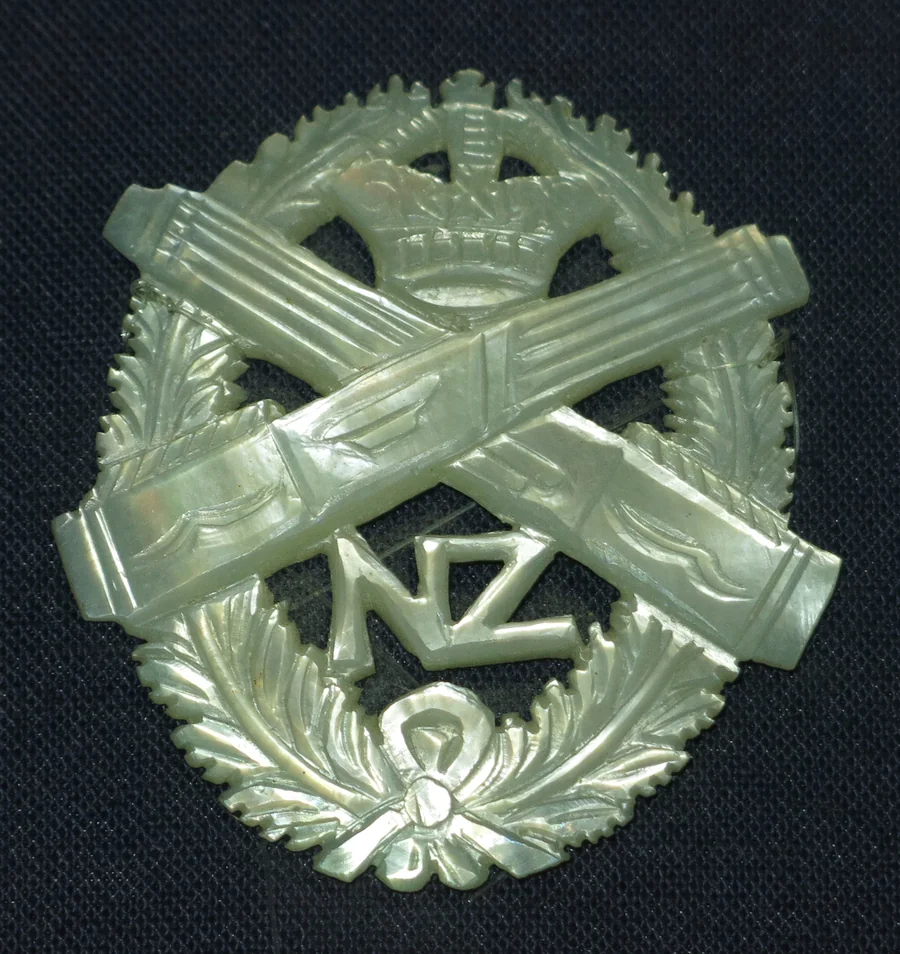

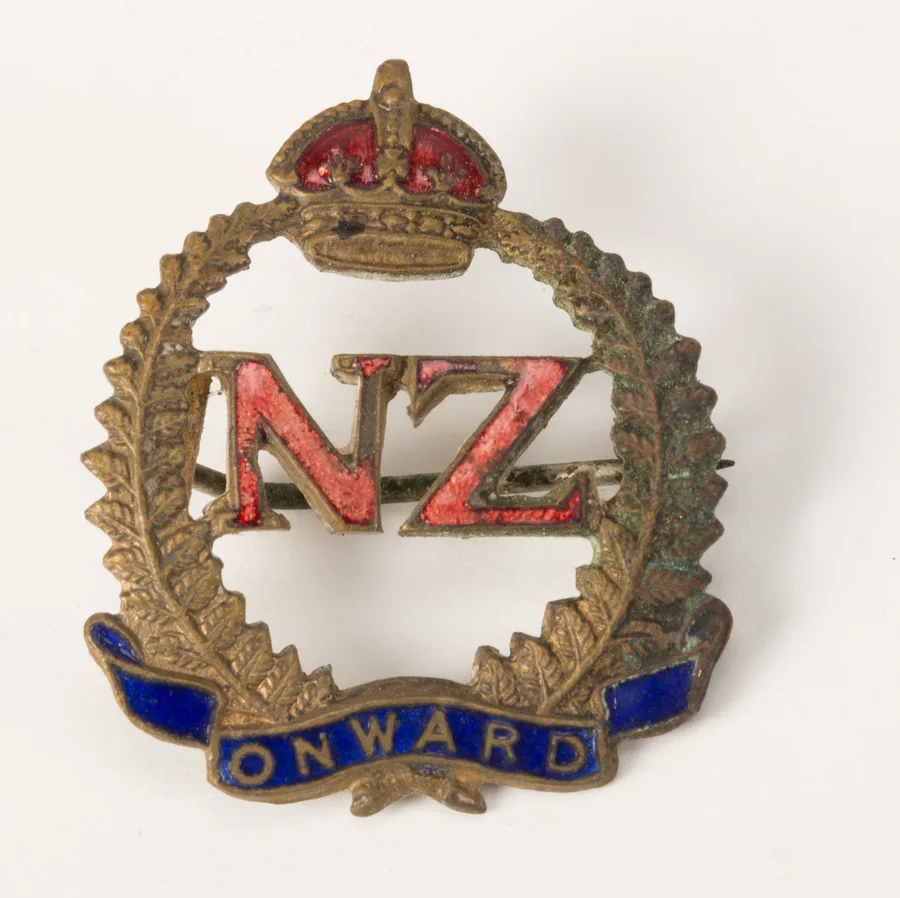
A Second World War gold brooch in Auckland frames a photograph of a soldier behind a clear Perspex back.
Sources: Tank Museum; RDF Association; AWM; Royal Welsh Museum; History Workshop; Auckland Museum; Auckland Museum.


Trench art and place brooches
Not every wartime brooch copies a badge. Some name a place, and some were made near the front.
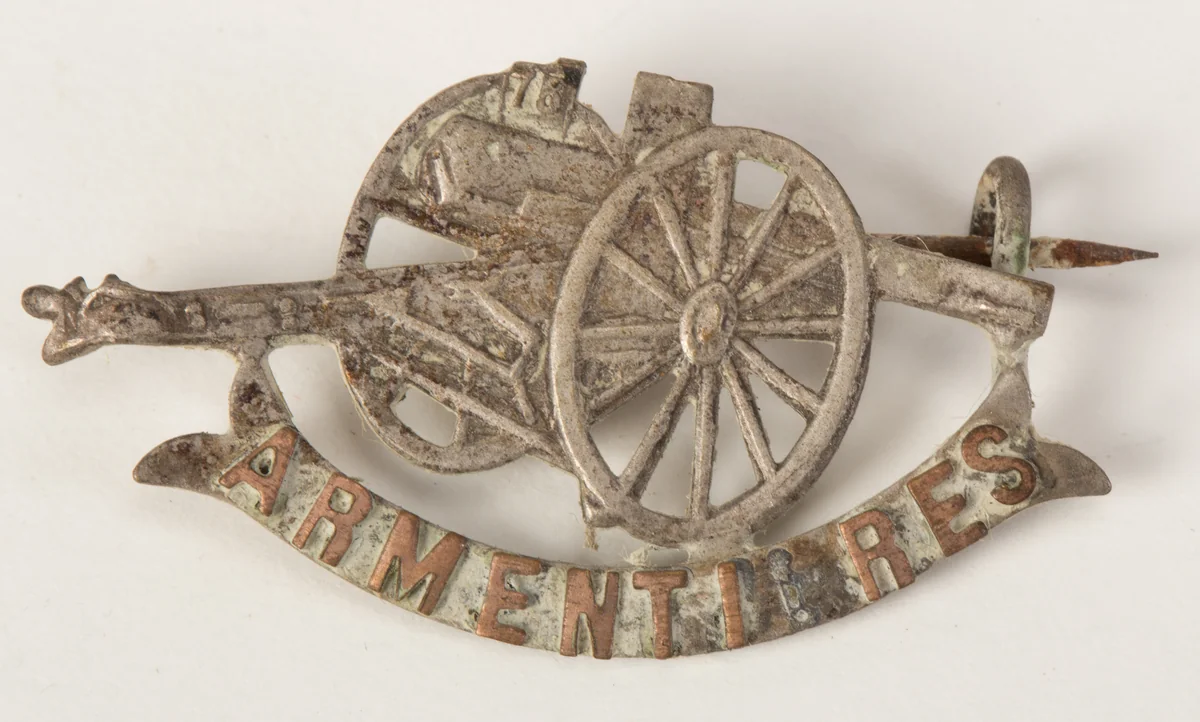

The Armentières brooch above puts a silver gun over a gold scroll with the town's name. Brooches carved in mother of pearl in Bethlehem carry the town's name or a date, such as the New Zealand brooch marked Bethlehem 1918. Shrapnel and bullet jewellery was also made as trench art.
A place name or a date carved into the piece is part of its story. Keep it with any letters that mention it.
Sources: Auckland Museum; Auckland Museum; AWM; History Workshop.
Tracing the soldier behind a brooch
Start with the brooch itself: the badge gives the unit, and the back may give initials, a date or a service number. Then match them to the records.
- Engraving. Auckland holds brooches engraved with a soldier's service number, with brothers' names and with initials and a date.
- Service records. About two thirds of First World War soldiers' service records were destroyed when the War Office store was bombed on 7 to 8 September 1940. The survivors, the “burnt documents”, are in series WO 363, and pension records in WO 364.
- The war dead. The Commonwealth War Graves Commission lists those who died in service.
- Regimental museums. Many hold sweetheart brooches and welcome family histories.
Watches often come home with the brooch: see our Dirty Dozen military watches and military pocket watches guides.
Sources: The National Archives, WO 364; The National Archives research guide; Auckland Museum.

Caring for a family brooch
Leave the brooch as it is. Polishing, dipping and re-enamelling remove the wear that shows its age.
- Do not polish. Silver dip and polish attack enamel and mother of pearl.
- Do not repair it yourself. A loose pin or catch is a job for a jeweller.
- Store it on its own. A soft pouch keeps the pin from scratching other pieces.
- Keep the story with it. Medals, letters, photographs and the box belong together.
- Photograph both sides. In good daylight, before anything else is done.
For wearing one today, see how to wear an antique brooch.
Valuing or selling a sweetheart brooch
What a sweetheart brooch is worth depends on the metal, the maker, the stones, the condition of the enamel, the unit and the story you can prove. Every piece is different, so we value each one individually.
- Metal. Gold and hallmarked silver before brass and nickel.
- Maker. A named jeweller such as Asprey or the Goldsmiths and Silversmiths Company.
- Stones. Diamonds, platinum and gem-set pieces.
- Condition. Complete enamel, the original pin and no repairs.
- The unit. How rare the badge is.
- Provenance. A name, a service record, photographs or medals that go with it.
Send us a few photos and we will tell you what yours is worth, free and with no obligation.
How selling works
- Send photosUse the form on this page, or email them to us.
- A specialist reviews itBadge, marks, metal and condition.
- Free estimate by emailWithin one working day.
- You decidePaid once agreed. No obligation.
Ways to sell
- Mayfair, 47 Maddox Street (by appointment)
- Braintree, Essex (by appointment)
- Royal Mail Special Delivery
- Free FedEx collection
We buy directly, with payment once you accept our offer, and we can also sell for you by consignment or at auction. Five-star rated: read our Google reviews.
We buy brooches every week: see sell your silver jewellery, sell your gold jewellery and sell your antique jewellery. If the brooch came to you with other jewellery, read inherited jewellery: what to do. Browse our brooches and antique and vintage brooches.
Frequently asked questions
What is a sweetheart brooch?
A sweetheart brooch is a miniature copy of a regimental, naval or air service badge made as a brooch. Servicemen gave them to wives, mothers, sisters and sweethearts, mostly during the First World War.
Who wore sweetheart brooches?
Mothers, wives, sisters and sweethearts of men in the services. They wore them for luck, to show support, and after a death in remembrance.
How can I tell if my sweetheart brooch is from WW1 or WW2?
Look at the hallmark first: Birmingham lower case p to t is 1914 to 1919, capitals P to V are 1939 to 1946. Then check the royal cypher, whether the unit existed in that war, and any engraving.
Is my sweetheart brooch silver or gold?
Look on the back for a hallmark or a stamp such as STERLING, SILVER or 9CT. Many were made in brass, gilt or nickel with enamel, and these carry no metal mark.
Can I find out who gave the brooch?
Sometimes. Initials, a date or a service number on the back can be matched to service records, medal records and the Commonwealth War Graves Commission. About two thirds of First World War soldiers' records were destroyed in 1940, so family papers matter.
Should I clean a sweetheart brooch?
No. Polish and silver dip damage enamel and mother of pearl. Leave the patina, and ask a jeweller about a loose pin.
What is my sweetheart brooch worth?
It depends on the metal, the maker, any stones, the condition of the enamel, the unit and the story that goes with it. Send us photos of the front and back for a free, no-obligation valuation.
Do you buy sweetheart brooches?
Yes. We value and buy sweetheart brooches and other military jewellery. Send photos, or visit us in Mayfair by appointment or in Braintree.
Free valuation
Value or sell your sweetheart brooch
Ready to find out more about your brooch? Send us a few photos using the form below.
A specialist looks at every request personally and replies by email with an estimate within one working day. There is no obligation to sell.
Prefer email? Send photos to info@mozerisfineantiques.com, call 01376 334482 or WhatsApp us.