Dirty Dozen Watches and British Military Watch Markings: How to Identify Grandad's Army Watch
The twelve makers, what every mark on the back means, how to spot a redial or a swapped back, and what to do with the watch you found in the drawer.
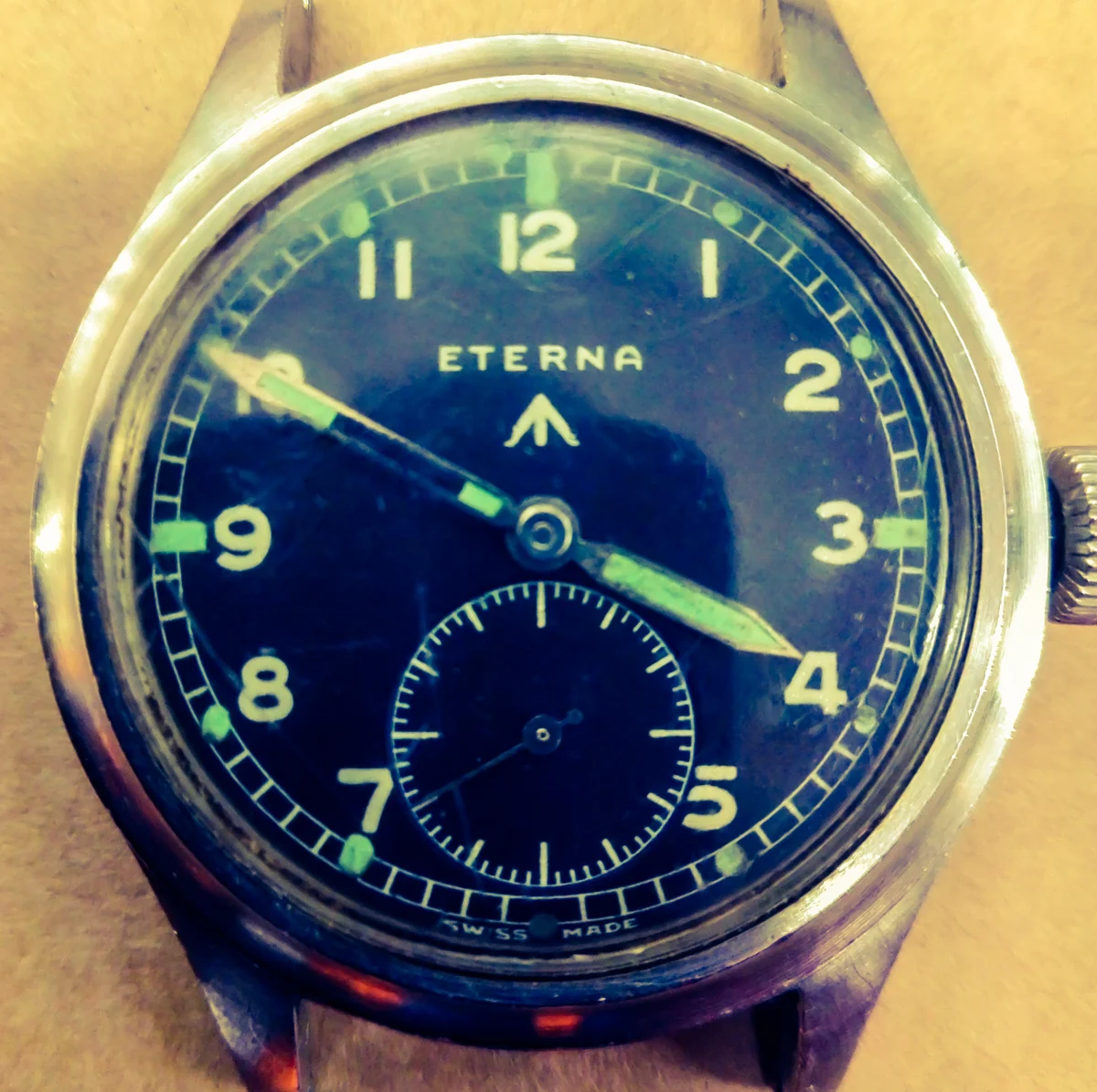
The Dirty Dozen are the twelve Swiss makers that supplied the British Army with W.W.W. wristwatches in 1945. To recognise one:
- Dial: black, white luminous numerals, railway track, small seconds at 6, broad arrow below 12.
- Back: the arrow, “W.W.W.”, a military number such as M18775, usually the maker's own number too.
- Makers: Buren, Cyma, Eterna, Grana, IWC, Jaeger-LeCoultre, Lemania, Longines, Omega, Record, Timor, Vertex.
- Rarest: Grana. Most numerous: Omega and Record.
- Value: originality first: dial, hands, back and an unpolished case.
_edited.jpg)
In this article
- What are the Dirty Dozen?
- The 12 makers at a glance: how to tell each one apart
- How to read a W.W.W. case back
- British military watch markings decoded, 1939 to the 1980s
- Before and after: A.T.P., the RAF's Mark 11 and the W10
- Is it genuine? 10 checks before you do anything
- Vertex: the only British name in the Dozen
- Three Dirty Dozen stories from British salerooms
- Found one in a drawer? What to do next
- Questions
What are the Dirty Dozen?
In 1945 the War Office wanted a tougher watch than the A.T.P. watches bought from 1939. British makers did not have the capacity, so the order went to Switzerland. Thirteen firms were asked and twelve delivered, mostly between May and December 1945. The thirteenth, Enicar, appears in stores lists, but no Enicar W.W.W. is known.
Collectors added the nickname decades later, after the 1967 film The Dirty Dozen. We value and buy military watches, and most that reach us are W.W.W.s that came home in 1946 or later. Pocket watches are on our military pocket watch guide.
The specification, feature by feature
- 1Maker's name. Printed at 12; it must match the movement inside.
- 2Broad arrow. Painted below the name. Its shape varies from maker to maker.
- 3White Arabic numerals. Luminous, on a matt black dial.
- 4Railway minute track. With luminous dots at the hours.
- 5Small seconds at 6. A sub-dial, not a centre seconds hand.
- 6Luminous hands. Style varies: pencil, syringe or cathedral.
- 7Fixed bars. Solid bars between the lugs, not spring bars.
Our diagram of a W.W.W. dial and case, drawn from the 1945 specification. The maker's name is shown as a bar.
- Dial: matt black, luminous Arabic numerals and hands, railway minute track, small seconds.
- Case: waterproof, dustproof and shock resistant, with a screw-down back (IWC alone snaps on) and a shatterproof Perspex crystal.
- Movement: 15 jewels, able to be regulated to chronometer standard.
- Marks: the broad arrow on the dial and back, “W.W.W.” and a military number.
Most references read it as Watch, Wristlet, Waterproof: “wristlet” meant a watch for the wrist, not the pocket. WatchGecko and Wikipedia give the specification as War Office R.S./Prov/4373A, “Watches, Wristlet, Waterproof”. We have not seen the original document. You will also read “Wrist Watch Waterproof” (Fratello) and “Watch, Wrist, Waterproof” (Rogers Jones).
The 12 makers at a glance: how to tell each one apart
Every W.W.W. looks alike at arm's length. The movement, the case and the letter at the start of the military number tell them apart. Production figures are estimates, and sources differ; IWC, Jaeger-LeCoultre and Omega figures come from their own records.
| Maker | Calibre and case | Letter | How to tell it apart | Made (est.) |
|---|---|---|---|---|
| Buren | 462; 36.5 mm chrome-plated | B | “Grand Prix” under the name, the only dial with it | 11,000 |
| Cyma | 234; 38 mm steel, dust cover | P | Large steel case with an inner dust cover | 20,000 |
| Eterna | 520; 36 mm steel, dust cover | P or Q | Shares P with Cyma: the movement settles it | 5,000 |
| Grana | KF320 (Kurth Frères); 35 to 36 mm steel | M | No maker's number outside the back; the rarest | 1,000 to 1,500 (some say up to 5,000) |
| IWC | 83; 35 mm chrome-plated | M | The only snap-on back; soft-iron inner cover | 5,000 to 6,000 |
| Jaeger-LeCoultre | 479; 36.5 mm chrome-plated | F | Thick bezel and cathedral hands | 6,000 to 10,000 |
| Lemania | 27A; 36.5 mm chrome-plated | L or Q | Plain dial; same case as Buren and Record | 8,000 to 10,000 |
| Longines | 12.68Z; 37.5 to 38 mm steel | F | The largest case of the twelve; cathedral hands | 5,000 to 8,000 |
| Omega | 30T2; 35 mm steel | Y | 15 jewel 30T2, movement numbers around 9.8 to 10.3 million | 25,000 |
| Record | 022K; 36.5 mm chrome-plated | L | Same case as Buren and Lemania | 25,000 |
| Timor | 6060 (A. Schild base); 36.5 mm chrome-plated | K | Thick, sculpted case with heavy lugs | 13,000 |
| Vertex | 59; 36 mm chrome-plated | A | Narrow syringe hands; the only British company | 15,000 |
- The letter narrows it, the movement decides. Cyma and Eterna share P, Jaeger-LeCoultre and Longines F, Grana and IWC M.
- Shared cases mean swapped backs. Buren, Lemania and Record used the same case, so backs were mixed up in servicing.
- Hands are a clue. Vertex used narrow syringe hands; Jaeger-LeCoultre and Longines broad cathedral hands. Our guide to watch hands shows each shape.
How to read a W.W.W. case back
Turn the watch over. A genuine W.W.W. back carries up to four lines, and inside the back most makers repeated the military number.
- 1Broad arrow. The Crown's property mark.
- 2W.W.W. The specification the watch was bought to.
- 3Military number. A letter and a number, e.g. M 18775.
- 4Maker's case number. On most makers; none outside on Grana and IWC.
- 5Notches. A screw-down back; IWC alone used a snap-on back.
- 6Fixed bars. Part of the specification; spring bars mean a later change.
Our diagram. The arrow, W.W.W. and military number are laid out as on the Grana sold by Bonhams in June 2023; the grey line shows where most makers engraved their own case number.
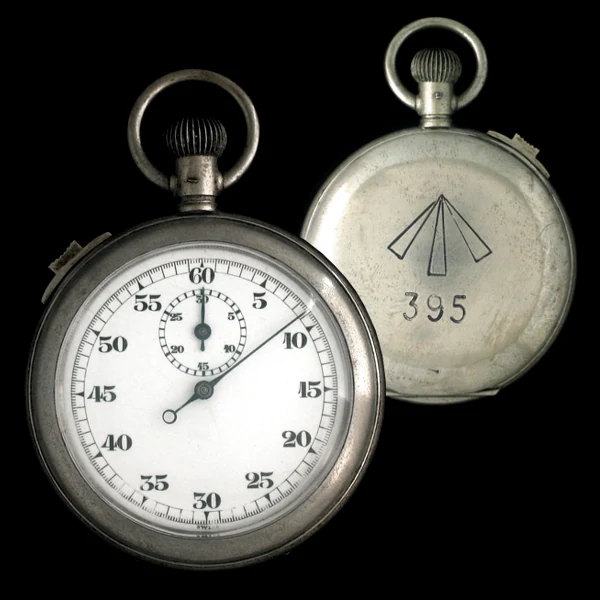

The arrow and the numbers
The broad arrow marks Crown property; a second arrow nose to nose means sold out of service, as our military pocket watch guide explains.
The military number starts with the maker's letter. The maker's own case number is a separate civilian serial. After the war some watches went to the Dutch, Indonesian and Pakistani forces and gained a third number.
British military watch markings decoded, 1939 to the 1980s
The W.W.W. is one chapter. These are the marks found on British service wristwatches from the Second World War to the 1980s, each with its source. Letters and numbers on a back usually read: issue code, NATO number, then issue number and year.
| Mark | What it means | Service and period | Where and example | Source |
|---|---|---|---|---|
| Broad arrow | Crown (government) property | All services, until phased out in the 1980s | Dial, case back, sometimes inside | Wikipedia |
| A.T.P. | Army Trade Pattern: watches bought from the trade from 1939 | Army, Second World War | Dial or back, e.g. “A.T.P - 45864” | Fratello; Auckland Museum |
| W.W.W. | Watch, Wristlet, Waterproof: the 1945 Army specification | Army, from 1945 | Back, with a letter and number, e.g. M18775 | Wikipedia; Bonhams |
| A.M. and 6B/159 | Air Ministry stores reference for RAF pilot's wristwatches | RAF, Second World War | Back, e.g. “6B/159 A 8205” on Sir Hugh Dundas's Longines | IWM EPH 11900 |
| 6B/346 | The Mark 11 navigator's watch, by Jaeger-LeCoultre and IWC | RAF, 1948 to 1981 | Back, with issue number and year, e.g. 2874/48 | Worn & Wound; Bonhams |
| 6B/542 | RAF specification of the early 1950s; Omega made it in 1953 | RAF, 1950s | Back | Worn & Wound |
| 6B or 6BB | 6B: RAF flight equipment; 6BB: RAF issue | RAF, post-war | Back, before the NATO number | Worn & Wound; Anordain |
| H.S. and a number | Admiralty hydrographic department, which supplied navy timekeepers | Royal Navy | H.S.9 on Lemania single-button chronographs; H.S.3 on deck watches | Worn & Wound; Royal Museums Greenwich |
| 0552 | Royal Navy issue code | Royal Navy, 1945 to the 1970s | e.g. 0552/920-3305 on chronographs | Worn & Wound; Anordain |
| W10 | British Army issue code | Army, late 1960s to the 1970s | Smiths, then Hamilton (1973 to 1976) | Anordain; Worn & Wound |
| 6645-99 | NATO Stock Number: 6645 = time measuring instruments, 99 = United Kingdom | All services, post-war | After the issue code, e.g. W10/6645-99-… | EverySpec; Wikipedia |
| Number/68 | Issue number, then the year of issue | Post-war | Last line of the back | Anordain |
| T in a circle | Tritium luminous paint, not radium | Later issues, e.g. Mark 11 | Dial | Worn & Wound |
.jpg)
Before and after: A.T.P., the RAF's Mark 11 and the W10
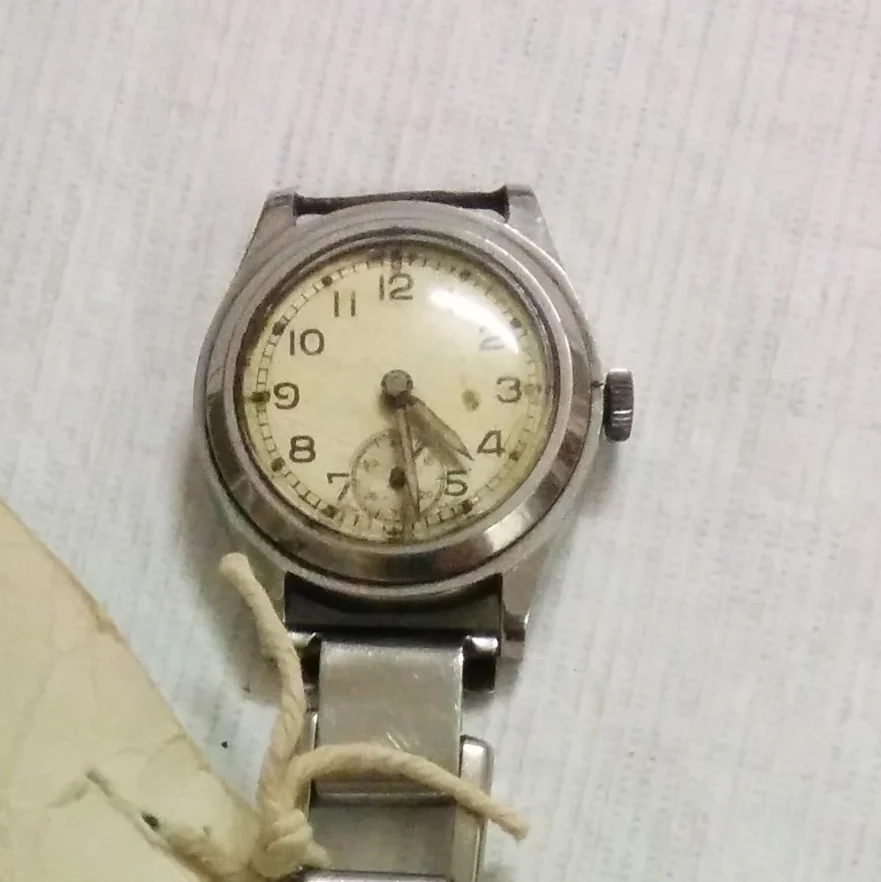
Before: A.T.P., from 1939
Army Trade Pattern watches were bought from the trade from 1939. WatchGecko counts 133,600 from 17 Swiss firms. They are smaller than a W.W.W., 30 to 34 mm, with white or silver dials, and “A.T.P.” on the dial or back.
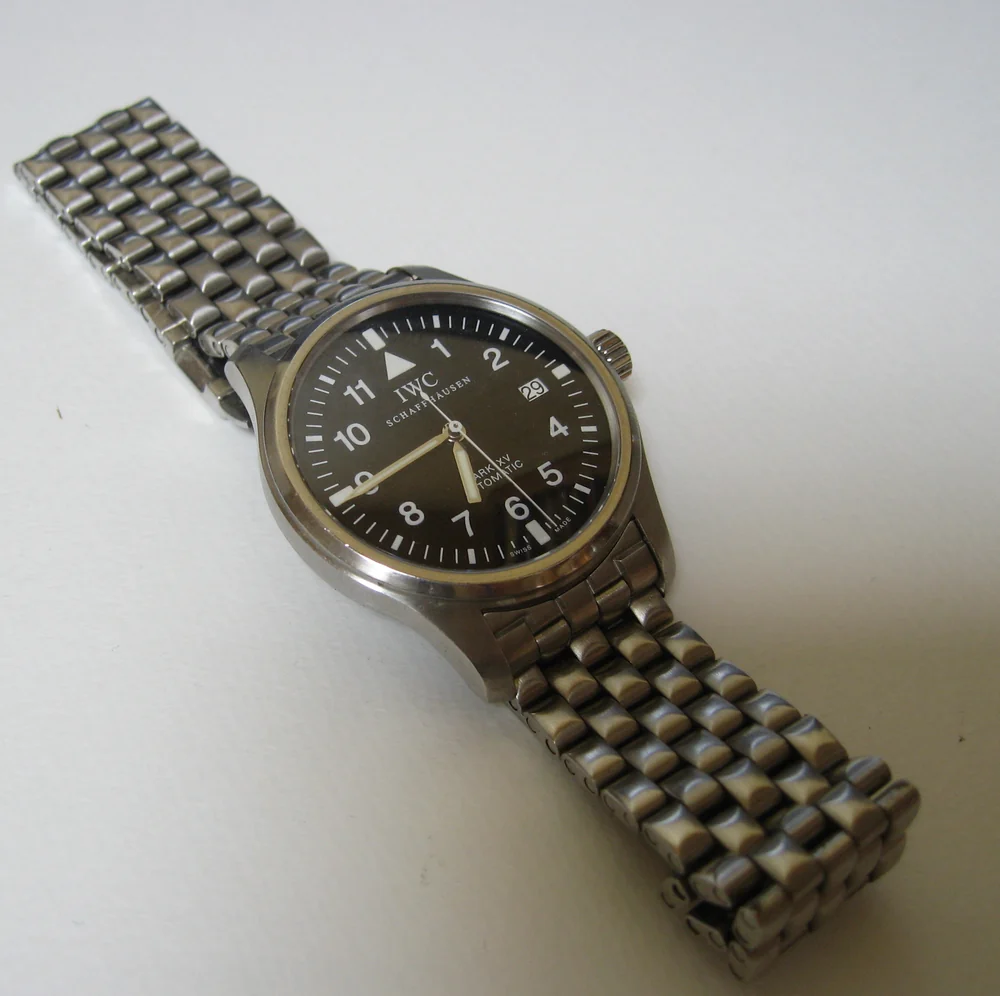

After: the Mark 11, 6B/346
The RAF's navigator's watch, in service from 1948 to 1981. Jaeger-LeCoultre made it with calibre 488/SBr until 1953, IWC with calibre 89. The back reads 6B/346 with an issue number and year.
Then the W10
Smiths made the Army's W10 in the late 1960s, with calibre 60466E: the last serially made wristwatch built entirely in England for the Ministry of Defence. Hamilton followed from 1973 to 1976, then Cabot Watch Company, founded by Hamilton's contracts director Ray Mellor.
Is it genuine? 10 checks before you do anything
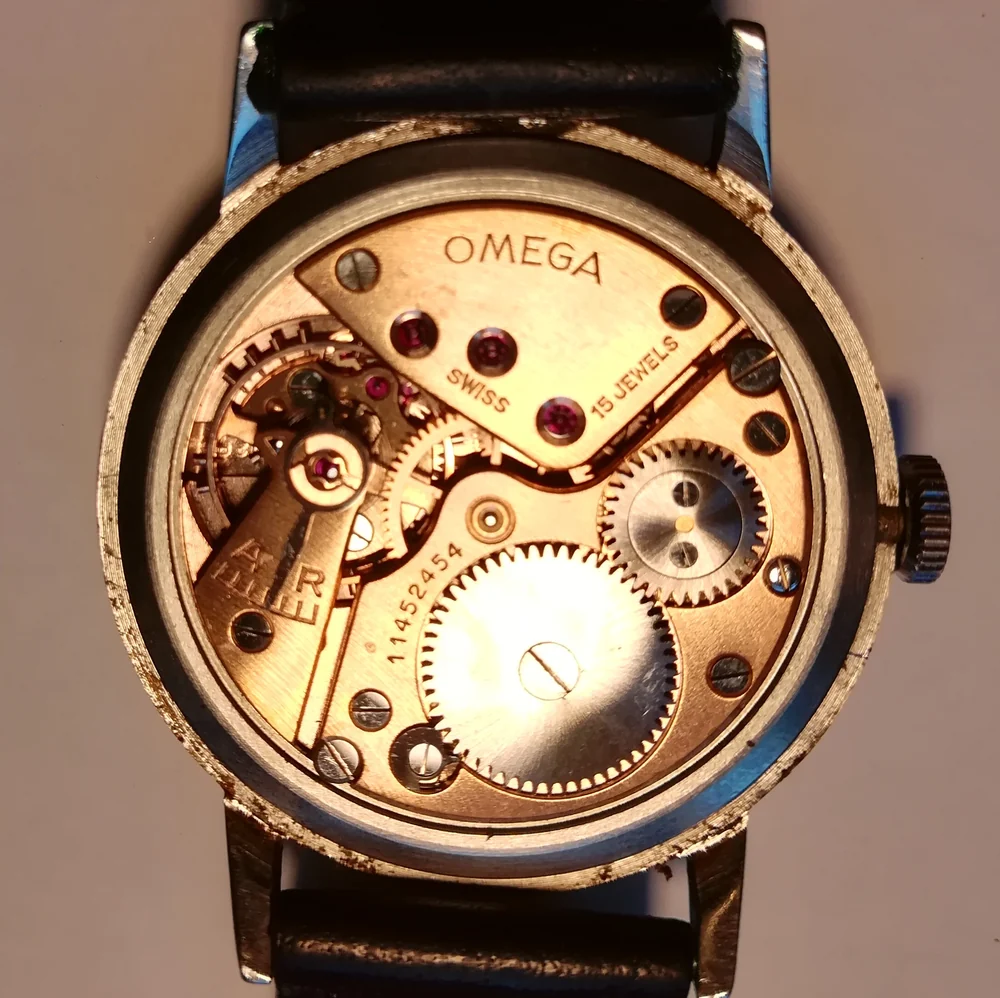
Most W.W.W.s spent decades in service and in drawers, and many were repaired. A service part is not a fake, but every replaced part changes what the watch is. Check from photos first:
,_fine_anni_%2740.jpg)
The movement must match the dial
An Omega dial should sit over an Omega 30T2, a Grana dial over a Kurth Frères KF320. A watchmaker can confirm this in minutes. Do not open the back yourself.
- Dial print
Redials look too crisp, with the wrong typeface or a broad arrow the wrong shape for the maker.
- Luminous paint
Numerals and hands should have aged alike. Many lost their radium after the war, so relumes are common.
- Hands
The style should suit the maker: syringe for Vertex, cathedral for Jaeger-LeCoultre and Longines.
- The letter
Y for Omega, K for Timor, A for Vertex: a letter that does not suit the maker means a swapped back.
- Inside the back
Most makers repeated the numbers inside; they should match the outside.
- Engraving
Worn cases have worn engraving. Sharp, shallow marks on a battered case are a warning.
- Arrow added
An arrow on the dial with no W.W.W. marks on the back points to a civilian watch dressed up.
- Crown
Replacement crowns are common: compare its size and shape with catalogued examples of the maker.
- Fixed bars
The bars should be solid. Drilled lugs or spring bars mean a changed case.
- Franken parts
Dial, case and movement from three watches. Ask for photos of everything.
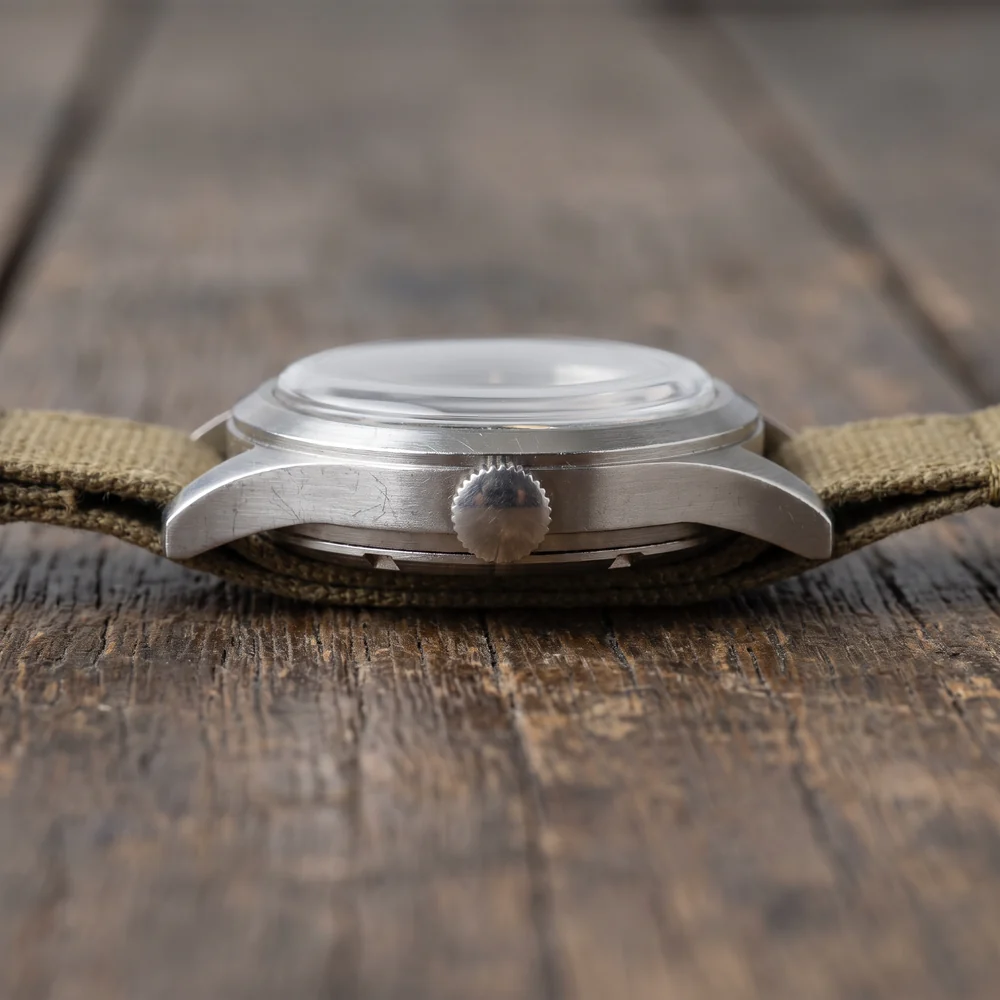
Look at the side as well
The side shows what the dial hides: a knurled crown, the notches of a screw-down back, and lugs with fixed bars. A polished case loses its edges, and its value with them.
Many dials of this period were painted with radium. Do not open, scrape or reluminise the watch yourself. Our military pocket watch guide covers safe storage.
Vertex: the only British name in the Dozen
Claude Lyons started in the watch trade in 1912 and founded Vertex Watches Ltd in London and La Chaux-de-Fonds in 1916, a British company with Swiss production. Its Hatton Garden showrooms were destroyed in the Blitz in 1940. Its W.W.W., with calibre 59, is put at about 15,000 watches.
The firm closed in 1972. In 2016 Lyons' great-grandson, Don Cochrane, reincorporated Vertex and it makes new watches today. Modern Vertex and Timor watches with W.W.W.-style dials are new watches, not wartime ones.
In Charlie Higson's James Bond novel King Zero (Penguin Michael Joseph, 24 September 2026), Bond wears a Vertex calibre 59 W.W.W. inherited from a great-uncle who served with the 6th Airborne Division, which took Pegasus Bridge on D-Day. Most W.W.W.s were delivered from May 1945; some sources date the first to 1944.
Three Dirty Dozen stories from British salerooms
- Birmingham, August 2020. A complete set of all twelve sold at Fellows on 24 August for £27,000 hammer (£34,452 with fees). Fellows said only around 20 full sets are thought to exist.
- Cardiff, July 2021. A Grana found in a Swansea house clearance sold at Rogers Jones on 24 July for £18,000 hammer, a joint auction record at the time.
- London, June 2023. A Grana engraved W.W.W. M18775 sold at Bonhams New Bond Street on 21 June for £23,040 including premium.
What decides value: the maker, an original dial and hands, matching numbers on the back and inside, an unpolished case, and a story you can prove. Every watch is different. Send us a few photos and we will tell you what yours is worth, free and with no obligation. Ask for a free valuation.
Have a W.W.W. or other military watch? Get a free valuation
Found one in a drawer? What to do next
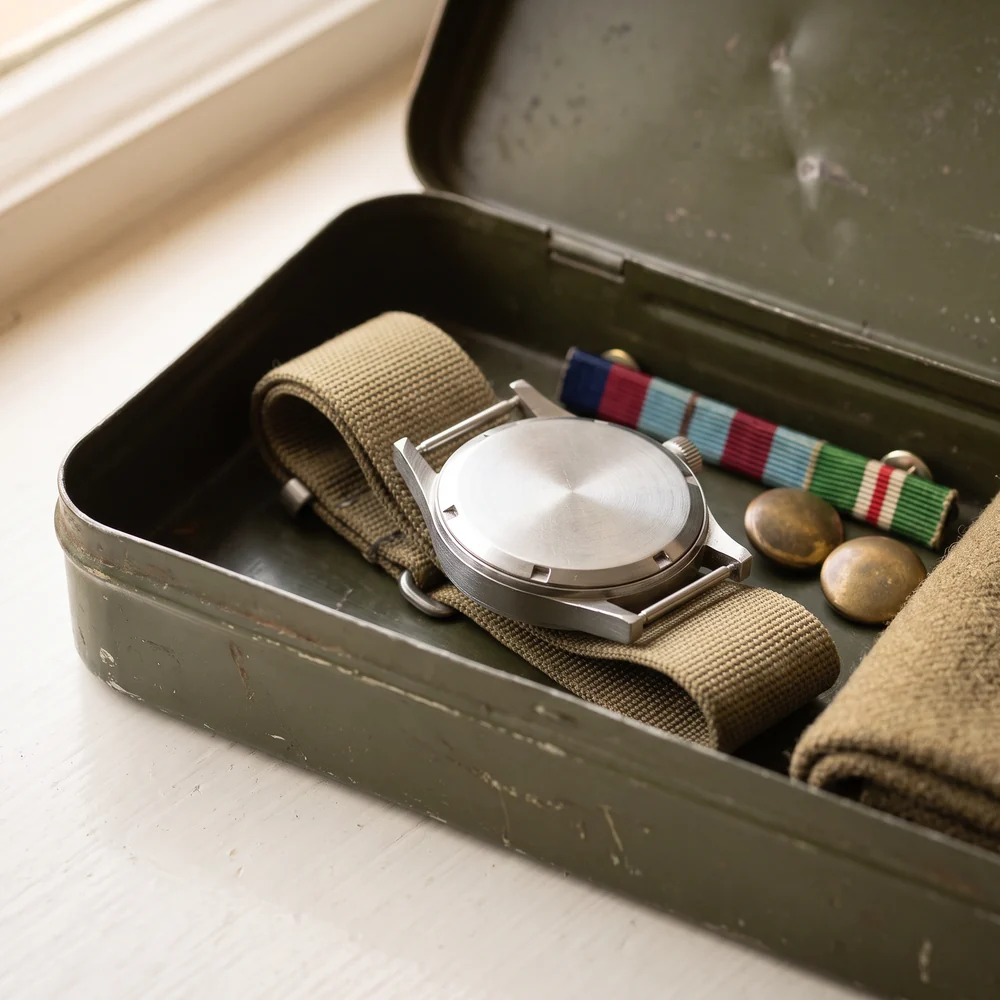
Leave it as it is
These watches turn up in house clearances and inheritance boxes. What you do in the first week matters more than anything else. See also inherited pocket watches and attic finds worth money.
- Do not polish
Polishing softens the case edges and the engraving, and both are part of the value.
- Do not open it
Leave the back and the dial alone, and do not force the crown.
- Keep the story
Medals, service record, pay book, letters and photographs belong with the watch.
- Photograph it
Dial, crown side, and the back in raking light: a torch held low makes engraving readable.
- Get it valued
Use the form below, call 01376 334482 or WhatsApp us. Visit 47 Maddox Street, Mayfair (by appointment) or Braintree, Essex. Contact us.
If you sell, we buy directly and pay by bank transfer: see sell your vintage watch, sell your watch and where to sell a watch. For the makers' civilian watches, read our Omega, IWC, Longines and Jaeger-LeCoultre guides. Buying? Browse our watches.
Request a free valuation
- A W.W.W. has a black dial, white luminous numerals, small seconds and the broad arrow on dial and back.
- The letter at the start of the military number narrows the maker; the movement confirms it.
- Our decoder reads every British service mark from A.T.P. in 1939 to W10 and 6645-99.
- Do not polish or open it; keep medals and papers with it.
- We value and buy military watches, free from photos.
Questions we are asked
Which Dirty Dozen watch is the rarest?
The Grana, made by Kurth Frères. Estimates run from about 1,000 to 1,500, with some sources saying up to 5,000. Eterna and Longines are also scarce.
What does W.W.W. stand for?
Most references read it as Watch, Wristlet, Waterproof, the title of the War Office specification. Other sources print Wrist Watch Waterproof or Watch, Wrist, Waterproof.
Why are they called the Dirty Dozen?
Collectors named them decades later, after the 1967 film The Dirty Dozen, because there are twelve makers.
Were W.W.W. watches worn on D-Day?
Most were delivered between May and December 1945, after D-Day on 6 June 1944. A few sources date the first deliveries to 1944.
Is an Omega W.W.W. the same as an Omega 6B/159?
No. The W.W.W. is the Army watch of 1945 with Omega's calibre 30T2. 6B/159 is an Air Ministry reference used on RAF wristwatches of the Second World War, made by several firms including Omega and Longines.
Are modern Vertex and Timor watches the same as the originals?
No. They are new watches in the W.W.W. style. An original has 1940s marks on the back and a period movement.
What is my Dirty Dozen watch worth?
It depends on the maker, an original dial and hands, matching numbers, the case condition and any provenance. Send us photos of the dial and back for a free, no-obligation valuation.
Do you buy military watches?
Yes. We value and buy military wristwatches and pocket watches. Send photos, or visit us in Mayfair or Braintree.
Value or sell your military watch
Send photos of the dial, case back and any papers for a free valuation, or bring it to Mayfair or Braintree. Call 01376 334482.
- We buy directly
- Free valuation from photos
- Appointments in Mayfair and Braintree
- Insured postage or collection
New pieces reach our list first: join the Mozeris list.