Blue Diamonds: Why They Are Blue, How They Are Graded and What They Are Worth
An 8.03 ct blue diamond was offered at auction in London on 1 October 2026. Here is what makes blue diamonds so rare, how GIA grades them, what the famous ones sold for, and how to tell one from a sapphire or topaz.
Natural blue diamonds owe their colour to boron and make up a tiny share of mined diamonds.
- Most are type IIb: boron absorbs red and yellow light, and the stones conduct electricity.
- GIA grades them from Faint to Fancy Vivid; saturation drives the price more than anything else.
- Fancy Vivid blues have made about $57.5 million at auction; an 8.03 ct Fancy Light was estimated at £1.5m to £2m in London in October 2026.
- In our experience most blue stones in jewellery boxes are sapphire, topaz, spinel, aquamarine or zircon. Only a laboratory can confirm a natural blue diamond.
In this article
Latest, October 2026: the 8.03 ct blue diamond at Elmwood's
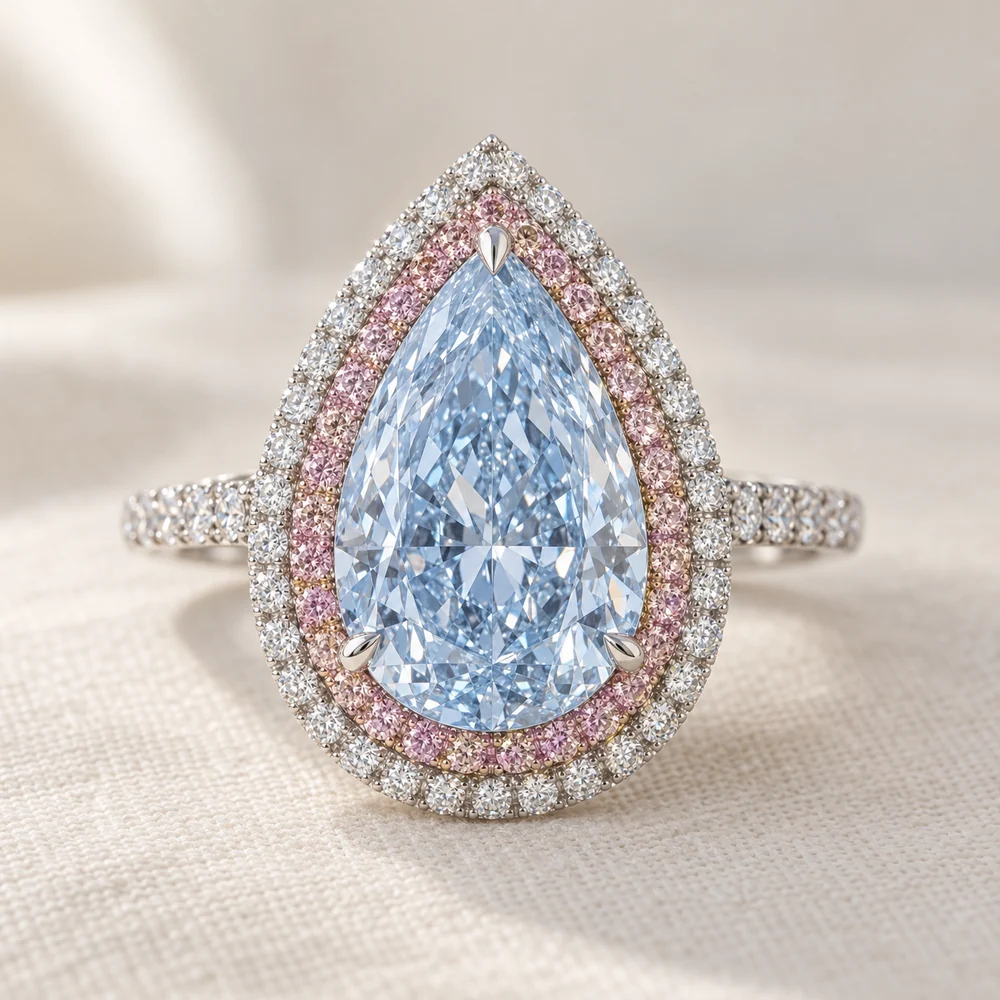
An 8.03 ct Fancy Light Blue pear
On 1 October 2026 the London auction house Elmwood's offered a ring set with an 8.03 ct blue diamond, consigned by a collector in Glasgow.
- GIA: Fancy Light Blue, natural colour, even distribution, VS2, no fluorescence.
- Setting: concentric borders of round pink and white diamonds, diamond shoulders.
- Estimate: £1.5m to £2m, Fine Jewellery sale, London.
Sources: PA, via STV News, 22 September 2026; National Jeweler, 24 September, and JCK, 28 September 2026, both citing the GIA report.
Elmwood's says it is only the third blue diamond over 8 carats ever offered at auction in the UK, after the 70.21 ct Idol's Eye in 1865 and the Wittelsbach Diamond in 2008, and the largest pear-shaped blue diamond ever offered at a British auction. Joe Kendrick, the head of sale, called it an extraordinary rarity in its own right.
When we checked on 2 October 2026, Elmwood's had not published a result and no outlet had reported one. We will add the hammer price here as soon as it is announced.
Why blue diamonds are blue, and why they are so rare
Four facts explain both the colour and the rarity.
Boron turns them blue
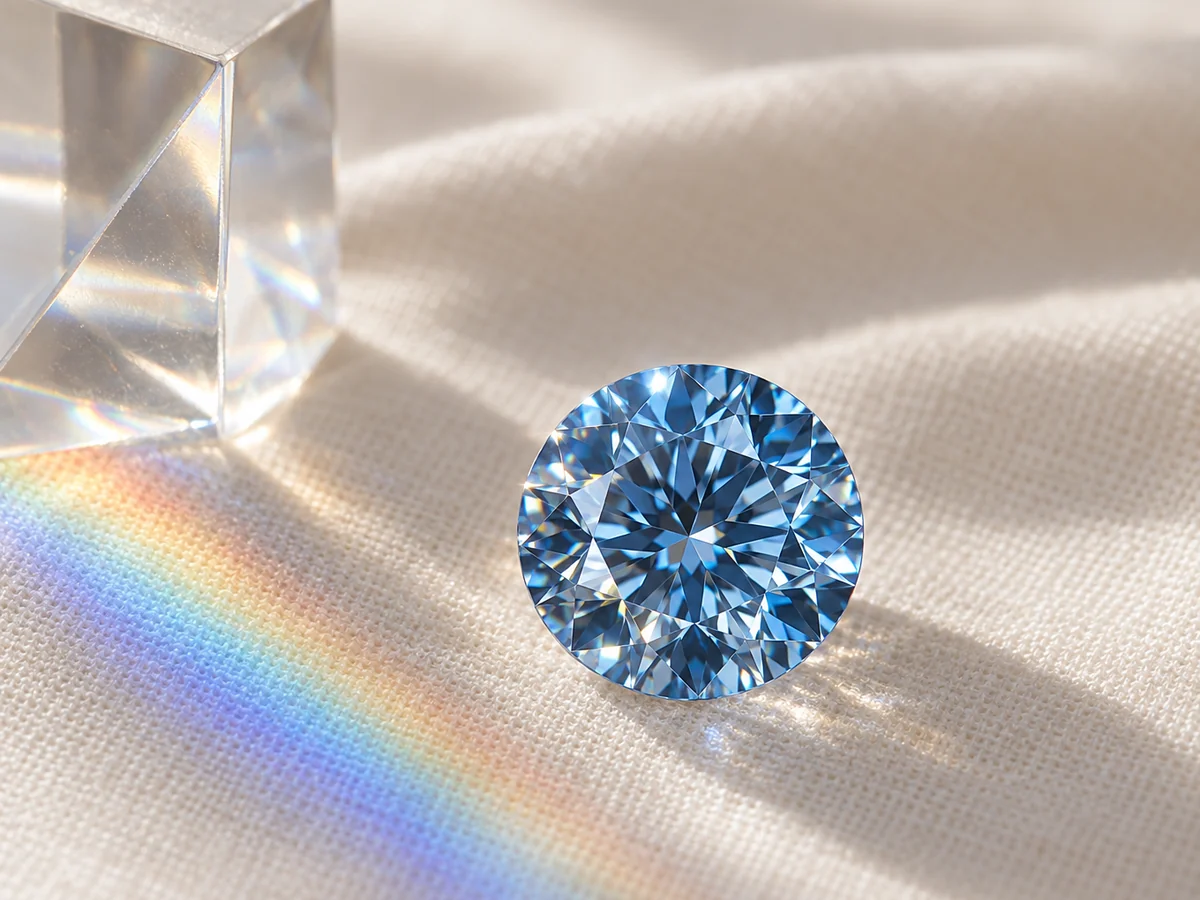
A diamond is carbon. In most blue diamonds a tiny amount of boron has taken the place of some carbon atoms. Boron absorbs light at the red and yellow end of the spectrum, so what reaches your eye is blue. Gemmologists call these stones type IIb.
GIA research finds a minority of blues coloured by hydrogen or natural radiation instead.
They form far deeper than other diamonds
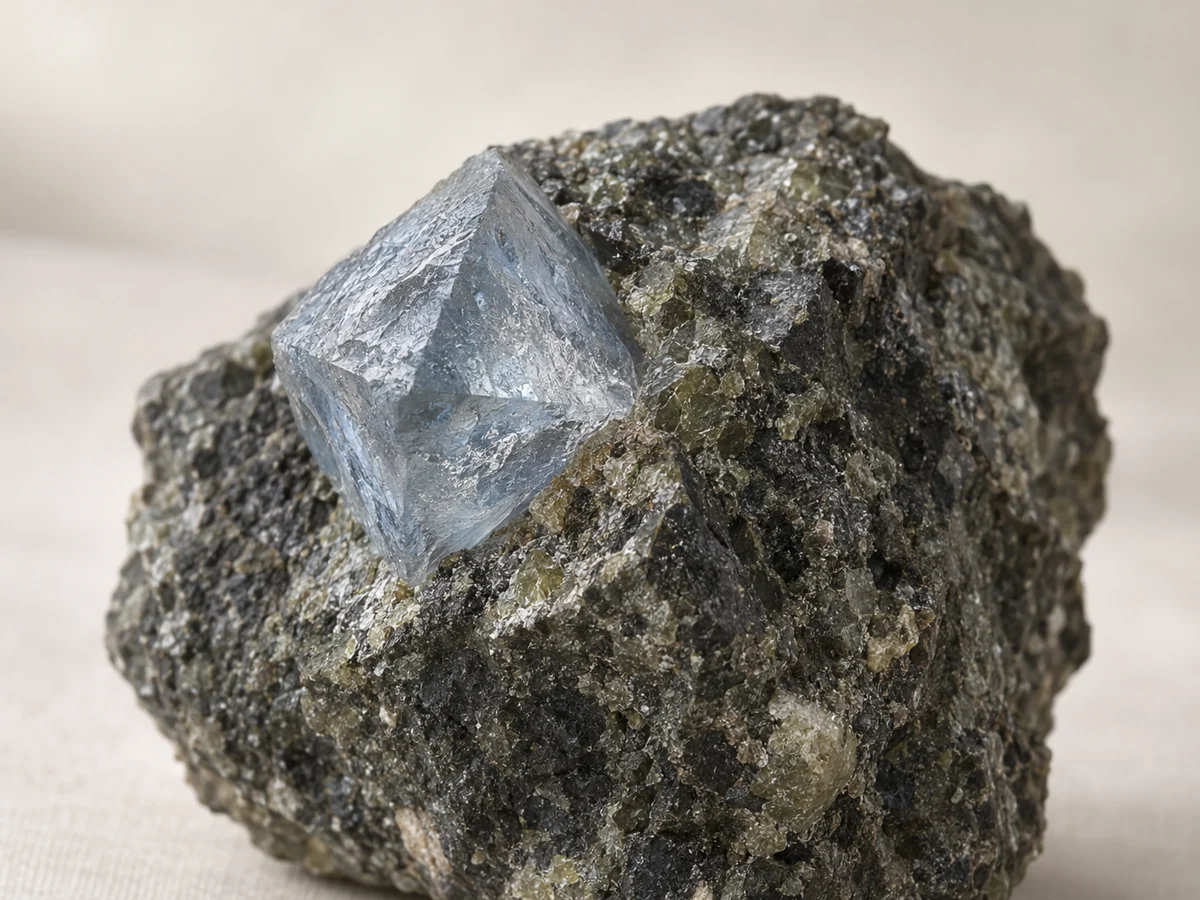
A 2018 study in Nature led by GIA's Evan Smith found that blue diamonds crystallise at least 410 to 660 km down, some in the lower mantle: about four times deeper than most diamonds. The same study traced the boron to ancient ocean floor, carried down into the mantle as tectonic plates sank.
Source: GIA, 2018.
They conduct electricity, and many glow
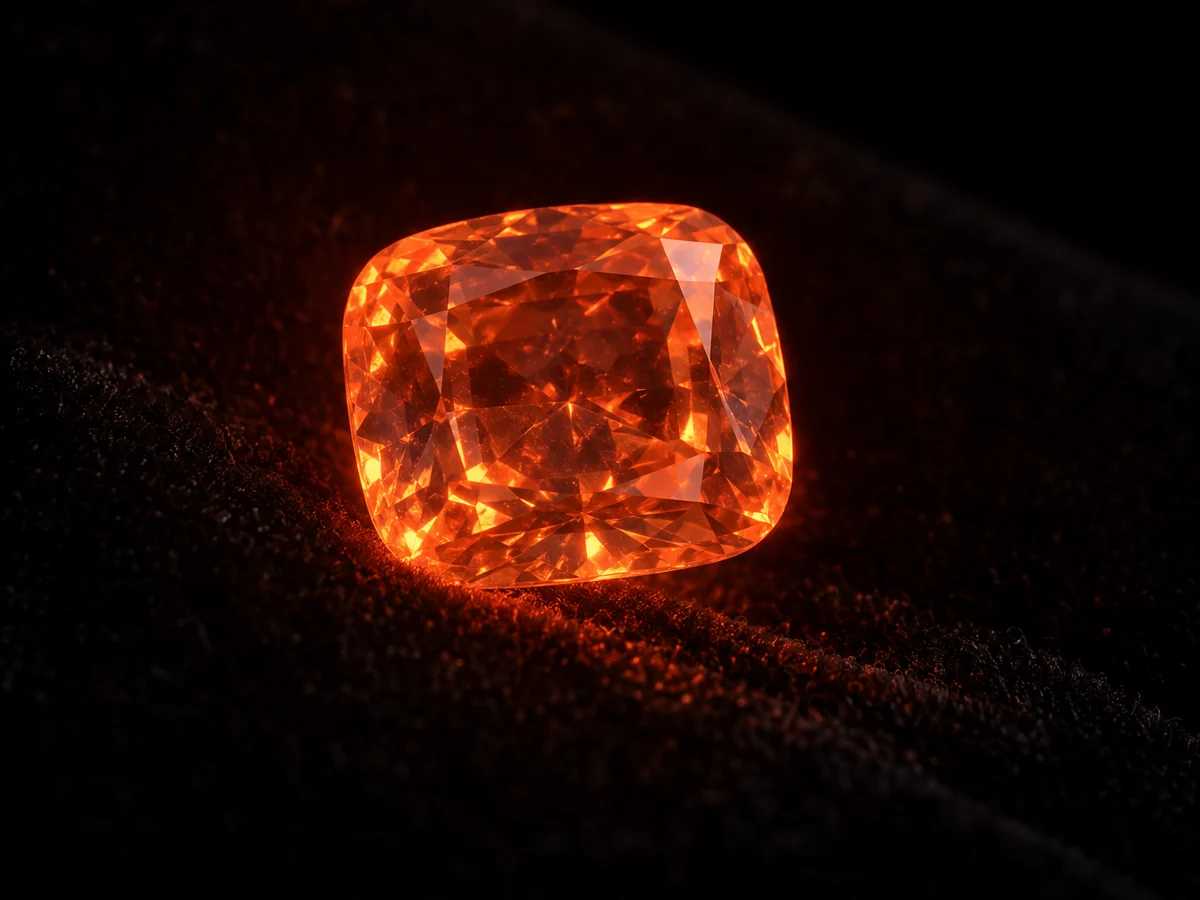
Boron makes type IIb diamonds semiconductors, which most diamonds are not. That matters when you test one (see below). Natural type IIb stones also often phosphoresce once a UV lamp is switched off; the Hope glows red.
About 0.02% of mined diamonds
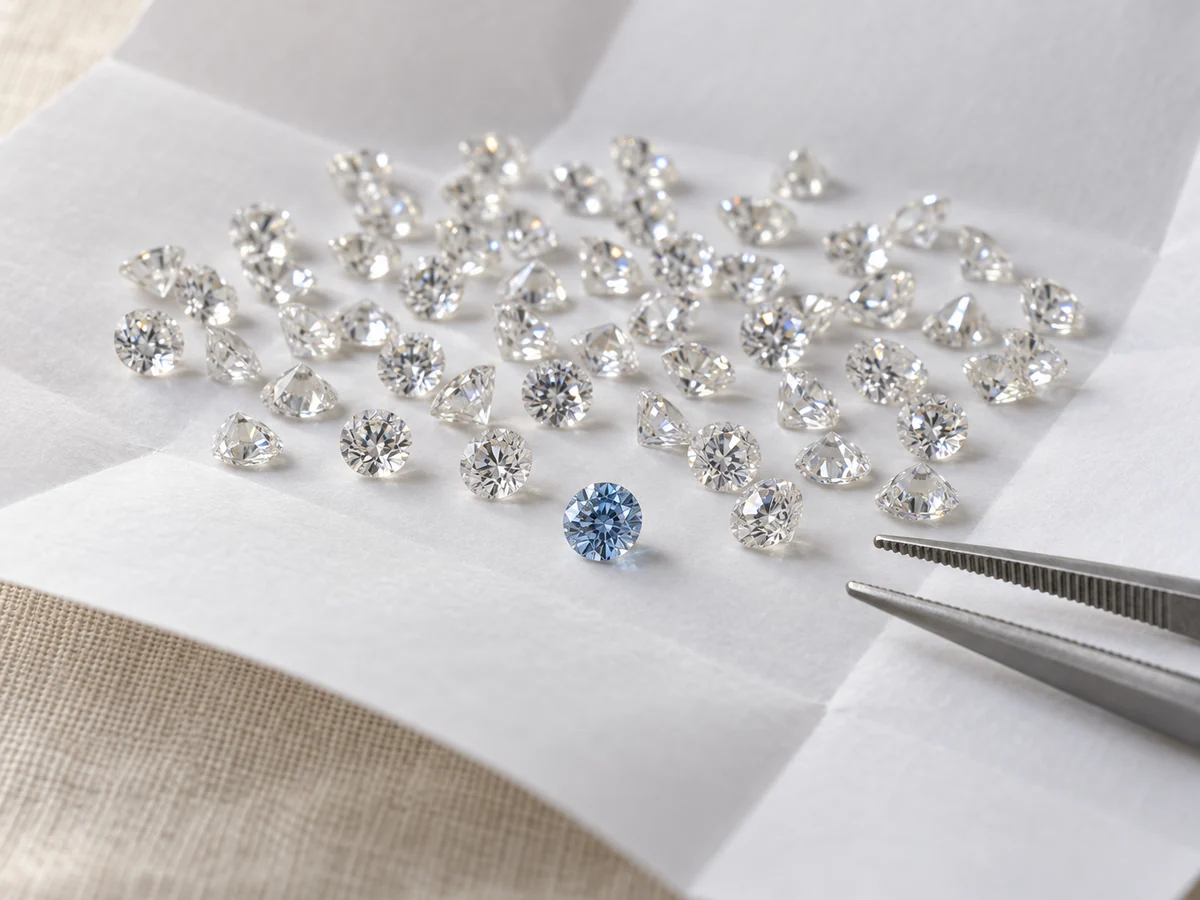
That is Evan Smith's estimate for boron-bearing type IIb diamonds, reported by National Jeweler in August 2018, and not all of those are a strong blue. Historic sources are few: the Hope and the Wittelsbach both came from the Kollur mine in India, the De Beers Cullinan Blue from South Africa. Large stones are rarer still: Elmwood's could find only two earlier blues over 8 ct offered at UK auction, one of them in 1865.
For how diamonds were mined and cut through history, see our history of diamonds and the coloured gemstone auction trends for 2026.
Famous blue diamonds and what they sold for
| Diamond | Weight and grade | Story | Auction result |
|---|---|---|---|
| The Hope | 45.52 ct, Fancy Dark greyish blue | From India's Kollur mine; owned by Louis XIV as the French Blue. Given to the Smithsonian by Harry Winston in 1958. | Not sold at auction: in the Smithsonian, Washington, D.C., since 1958 |
| Wittelsbach-Graff | 35.56 ct when sold; recut to 31.06 ct, Fancy Deep Blue, internally flawless | Bavarian crown jewel. Laurence Graff bought it and had it recut, which many historians criticised. | £16.4m, Christie's London, December 2008 |
| Oppenheimer Blue | 14.62 ct, Fancy Vivid Blue | Owned by Sir Philip Oppenheimer of the diamond family. | CHF 56.8m (about $57.6m), Christie's Geneva, May 2016 |
| De Beers Cullinan Blue | 15.10 ct, Fancy Vivid Blue, step cut | Cut from a rough found in South Africa in 2021. | $57.5m, Sotheby's Hong Kong, April 2022 |
Sources: Wikipedia (Hope; Wittelsbach-Graff), Fortune, May 2016 (Oppenheimer Blue), UPI, 28 April 2022 (De Beers Cullinan Blue). Results include the buyer's premium.
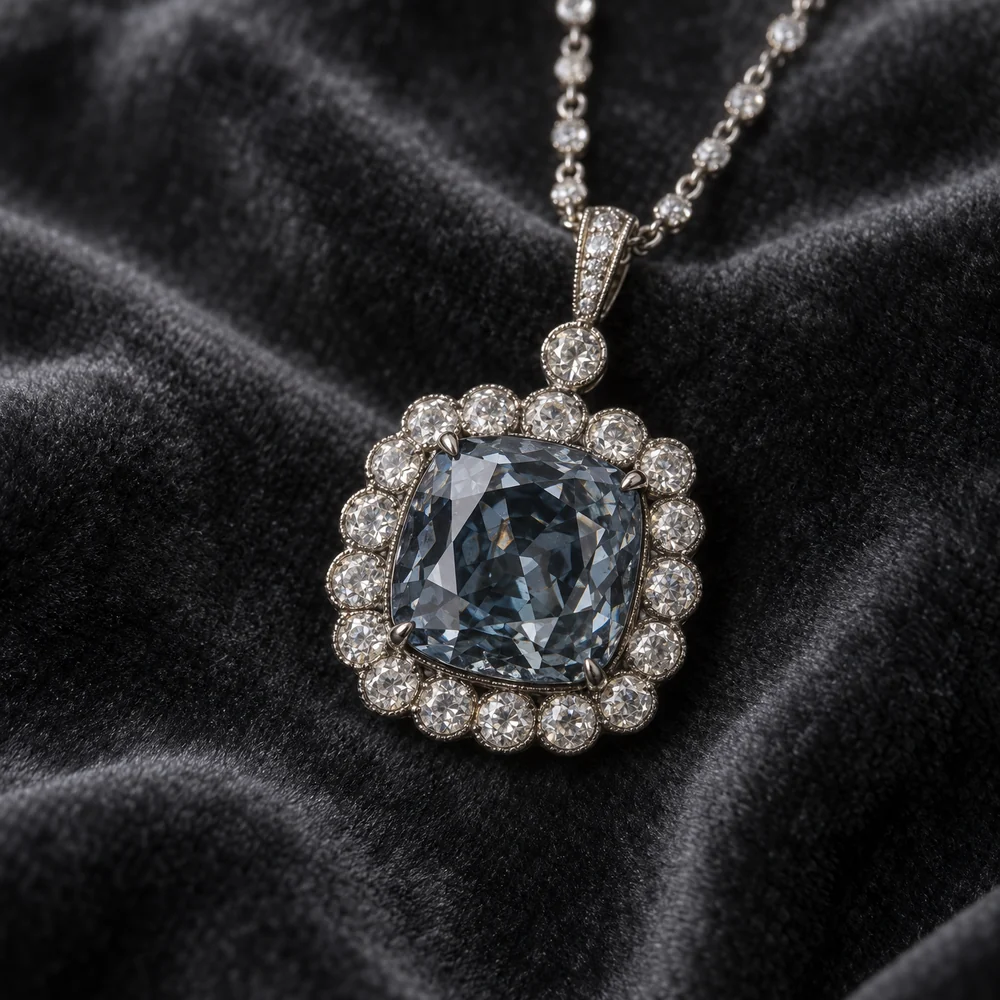
The Hope and its curse
The story goes that the Hope brings misfortune to its owners. It is a legend, much of it from early 20th-century newspapers.
The documented history includes one odd detail: Harry Winston sent it to the Smithsonian by registered post.
GIA colour grades, and what they do to the price
Coloured diamonds are graded on how strong and how dark the colour is, not on the D to Z scale used for white diamonds. From the weakest to the strongest, GIA uses Faint, Very Light, Light, Fancy Light, Fancy, Fancy Intense and Fancy Vivid, plus Fancy Deep and Fancy Dark for darker stones.
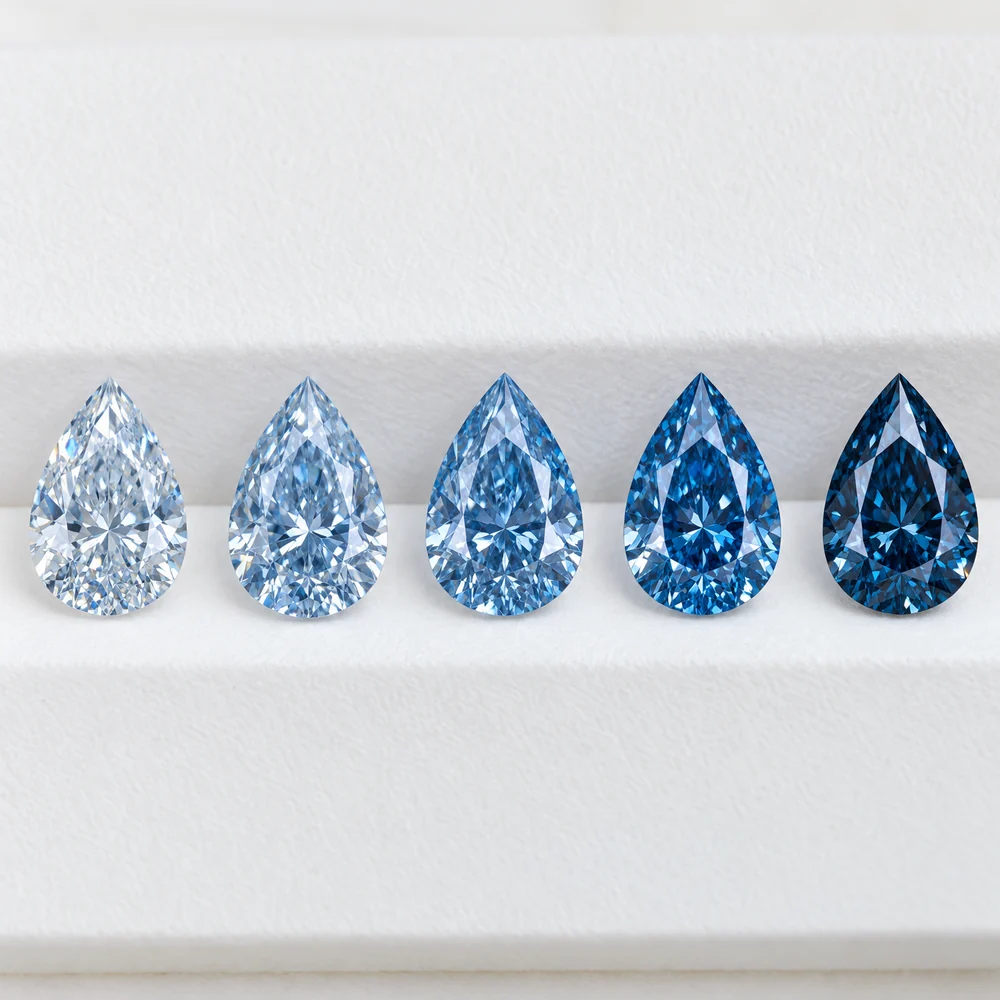
- Fancy Light and Fancy: clearly blue. The Elmwood's stone is Fancy Light.
- Fancy Intense and Fancy Vivid: strong, saturated colour. UPI's report of the 2022 Sotheby's sale said fewer than 1% of blue diamonds that GIA grades reach Fancy Vivid.
- Fancy Deep and Fancy Dark: strong colour with a darker tone. The Hope is Fancy Dark greyish blue.
Grades can carry a modifier such as greyish or greenish blue, and the report states whether the colour is natural.
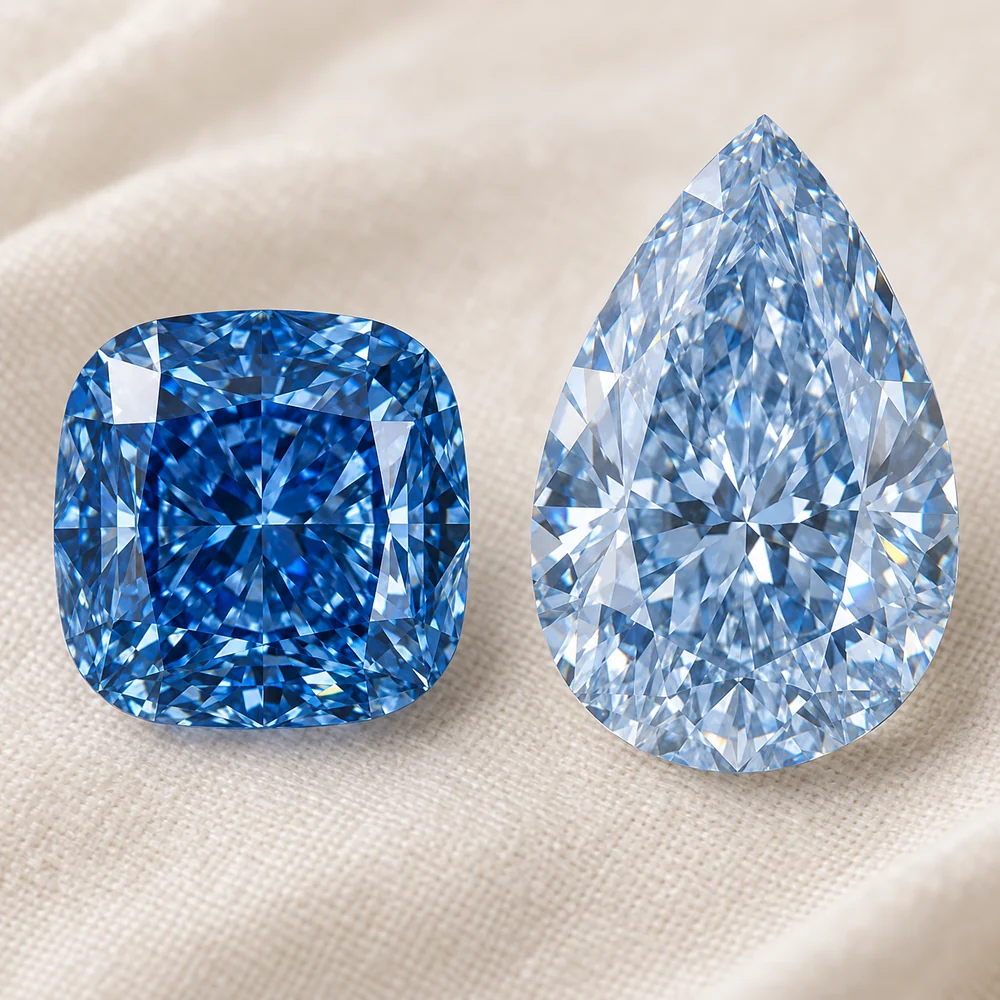
What the grade does to the price
The two Fancy Vivid stones in the table above sold for about $3.8 to $3.9 million per carat.
The Elmwood's Fancy Light estimate works out at roughly £187,000 to £249,000 per carat. Same colour family, very different saturation, and more than ten times the price per carat.
Our arithmetic from the published results and estimate, for comparison only.
Is it a blue diamond? Treated stones, lookalikes and how to check
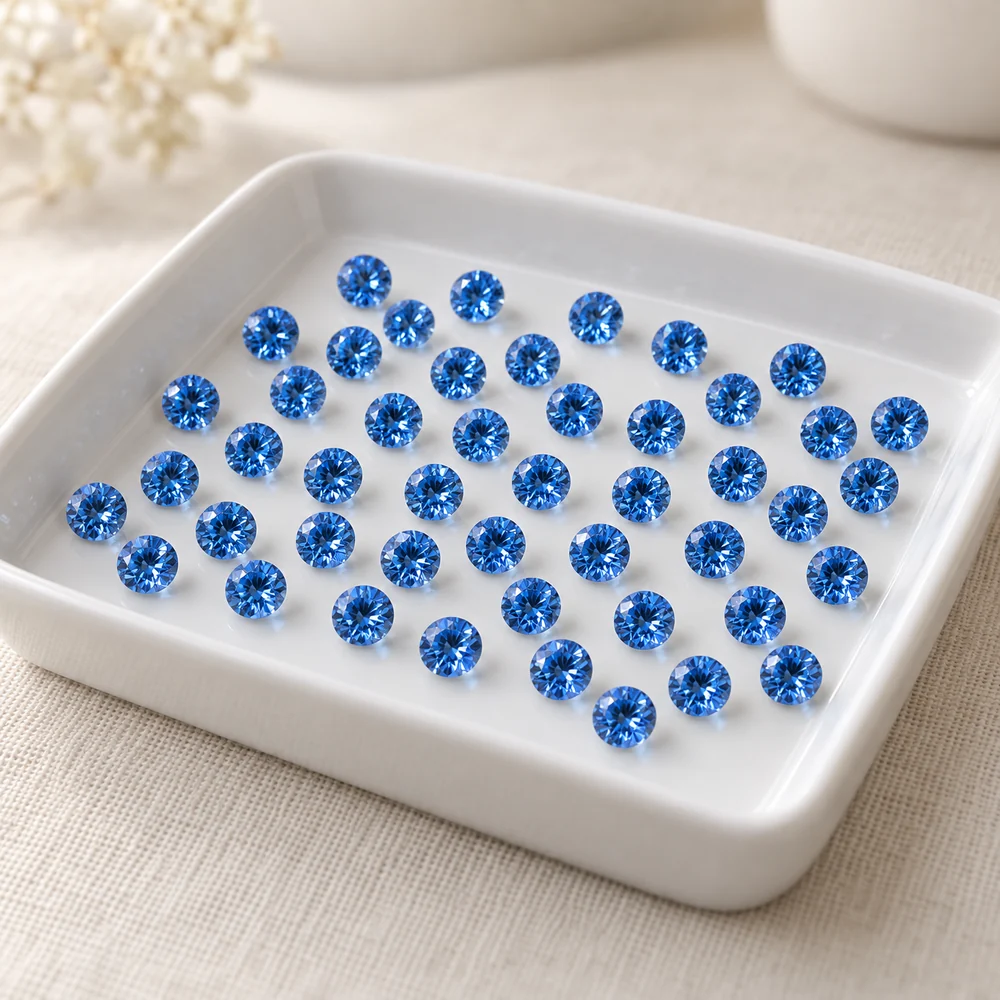
Treated and lab-grown blues
Because natural blues are so scarce, blue diamonds sold at everyday prices are treated or lab-grown.
- Irradiated: a natural white or brownish diamond is exposed to radiation, turning it blue to green. GIA has required an "IRRADIATED" laser inscription since 2001 before it grades one, and the report says "Artificially Irradiated".
- Lab-grown: grown in a press (HPHT) or from gas (CVD), with boron added. Gem labs separate them reliably with imaging and spectroscopy; GIA-graded lab-grown stones are inscribed as such.
Lab-grown blue diamonds contain boron too, so they also conduct electricity. A conductive reading does not prove a blue diamond is natural: only a laboratory can.
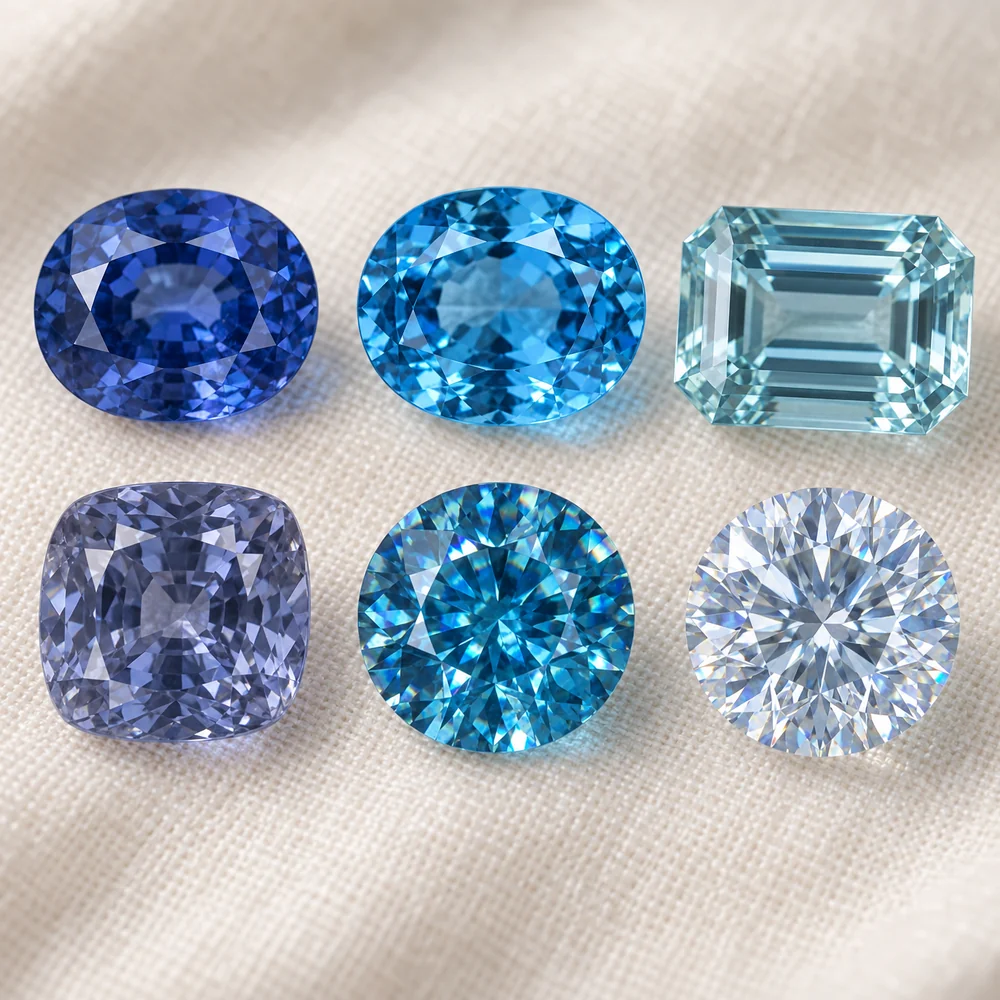
Sapphire, topaz, spinel and other lookalikes
In our experience, most blue stones in family jewellery are sapphires, topazes, aquamarines, spinels or zircons rather than diamonds.
Side by side the colours overlap. A jeweller tells them apart with a few measurements: hardness, how the stone bends light, and what shows under a loupe.
| Stone | Hardness (Mohs) | Refraction | Clues |
|---|---|---|---|
| Blue diamond | 10 | Single, very high (RI 2.42) | Sharp facet edges, strong sparkle, no doubling |
| Blue sapphire | 9 | Double, RI about 1.76 to 1.77 | Silky inclusions, colour zoning, often a deeper blue |
| Blue topaz | 8 | Double, RI about 1.61 to 1.63 | Bright sky or London blue, often large and clean. All blue topaz is assumed irradiated |
| Spinel (natural or synthetic) | 8 | Single, RI about 1.72 | No doubling under a loupe, unlike sapphire |
| Aquamarine | 7.5 to 8 | Double, RI about 1.57 to 1.58 | Pale, slightly greenish blue, glassy look |
| Blue zircon | 6 to 7.5 | Strong double, RI about 1.92 to 1.98 | Doubled facet edges under a loupe, worn or chipped edges. Blue zircon is assumed heated |
See also our sapphire engagement ring guide, the September (sapphire), March (aquamarine) and November (topaz) birthstone pages, and the glossary.
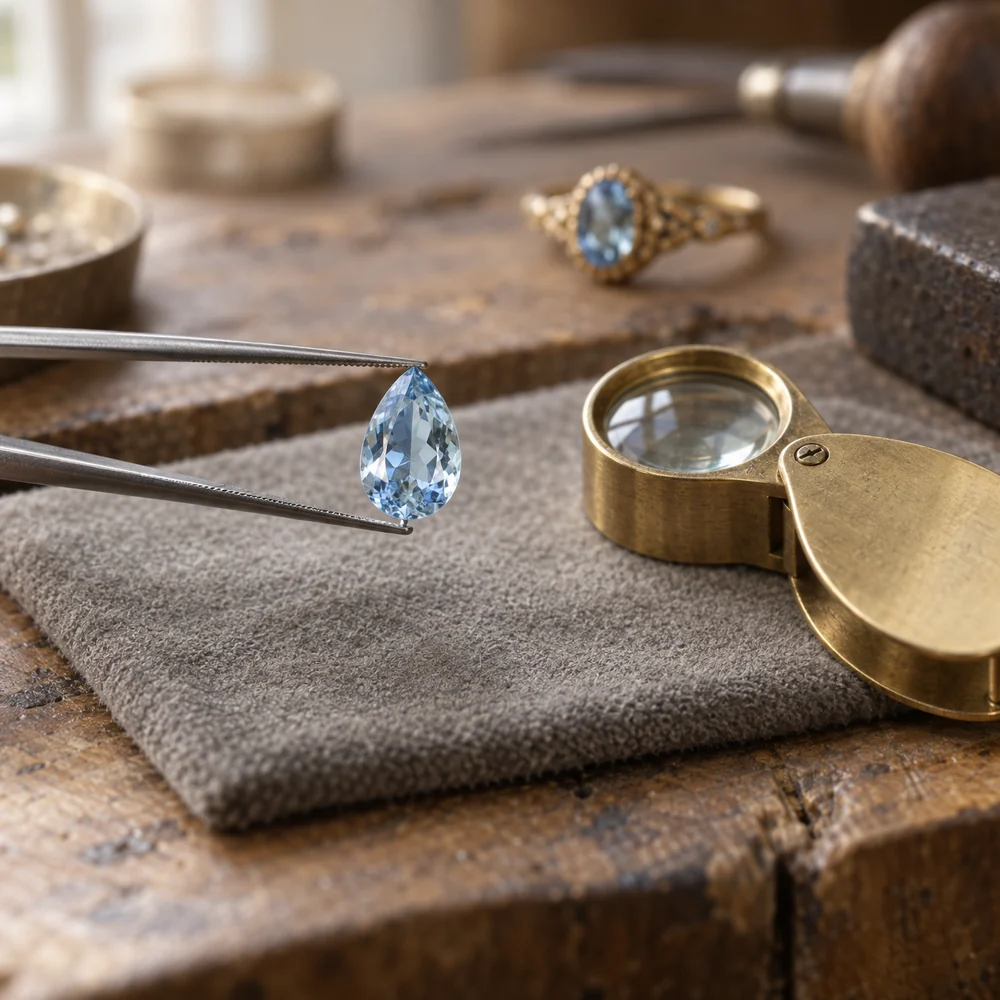
How to check a blue stone you own
You can narrow it down at home with a 10x loupe and a careful look at the mount.
Only a laboratory report settles it. The six checks below tell you whether one is worth paying for.
- Look at the setting
Check the metal marks and the age of the piece. In our experience a large blue stone in a 9ct gold or silver mount is not a natural blue diamond.
- Use a 10x loupe
Look through the stone at the back facets. Doubled edges mean a doubly refractive stone: zircon shows this strongly, sapphire and topaz faintly. Diamond and spinel never do.
- Check the facet edges
Diamond's edges stay sharp. Rounded, scratched or chipped edges point to a softer stone such as zircon or topaz.
- Be careful with testers
A natural blue diamond conducts electricity, so a combined diamond and moissanite tester can read it as moissanite. Do not rely on one.
- Find the paperwork
A GIA report states the grade and whether the colour is natural. If the girdle is inscribed, check the number against the report.
- Get it tested
For a stone of any size, a laboratory report settles it. We can look first and tell you whether a report is worth paying for.
Our guide on how to tell if a diamond is real covers white diamonds, and how we authenticate antique jewellery explains our own checks.
Think you have a blue diamond? Get a free quote
How we can help
We buy and sell jewellery from 47 Maddox Street, Mayfair (by appointment) and Braintree, Essex. Most blue stones we are shown are sapphire, topaz or spinel, which have their own value. If yours could be a diamond, we will tell you how to get it graded.
- Send photos
Face up, from the side and of any marks or reports. Use the form below or our free valuation form.
- Get an answer
Usually within 24 hours, with no obligation.
- Send or bring it
Insured postage, or an appointment. Call 01376 334482 or WhatsApp us.
- Get paid
By bank transfer the same day we receive and check the piece.
Browse sapphire rings, diamond rings, coloured gemstone engagement rings and all rings. Selling? See sell your jewellery and inherited jewellery: what to do.
Send us photos for a quote
- Natural blue diamonds are coloured by boron, form unusually deep and are exceptionally rare.
- The GIA colour grade, from Fancy Light to Fancy Vivid, sets the price more than size alone.
- Most blue stones are something else; have a promising one looked at before you test, sell or reset it.
Questions we are asked
Why are blue diamonds blue?
Most natural blue diamonds contain a trace of boron, which absorbs red and yellow light. Gemmologists call them type IIb. A few are coloured by hydrogen or natural radiation instead.
How rare are blue diamonds?
GIA scientist Evan Smith estimated that about 0.02% of mined diamonds are boron-bearing type IIb stones, and only some of those are a strong blue.
How much is a blue diamond worth?
It depends above all on the colour grade, then weight, clarity and a report confirming natural colour. Fancy Vivid blues have sold for about $3.8 million per carat at auction; treated and lab-grown blues sell for a small fraction of natural ones.
What are the GIA colour grades for blue diamonds?
Faint, Very Light, Light, Fancy Light, Fancy, Fancy Intense and Fancy Vivid, plus Fancy Deep and Fancy Dark for darker stones.
What did the 8.03 ct blue diamond at Elmwood's sell for?
It was offered on 1 October 2026 with an estimate of £1.5 million to £2 million. On 2 October 2026 no result had been published; we will add it to this page when it is.
Is my blue stone a diamond or a sapphire?
Most blue stones in family jewellery are sapphire, topaz, spinel, aquamarine or zircon. A loupe shows doubled facet edges in some of them; a gem laboratory gives a definite answer.
Can a diamond tester identify a blue diamond?
Not reliably. Natural blue diamonds conduct electricity, so a combined tester may read one as moissanite. Lab-grown blues conduct too. A laboratory report is the answer.
Which blue diamonds have sold for the most?
Two of the highest auction results are the Oppenheimer Blue (CHF 56.8 million, Christie's Geneva, 2016) and the De Beers Cullinan Blue ($57.5 million, Sotheby's Hong Kong, 2022).
Selling a blue stone or a diamond ring?
Send photos and any reports. We buy antique, vintage and modern jewellery directly, and the valuation is free.
- We buy directly
- Free valuation from photos
- Appointments in Mayfair and Braintree
- Insured postage or collection
New pieces reach our list first: join the Mozeris list.