Part of: Guide to Georgian jewellery
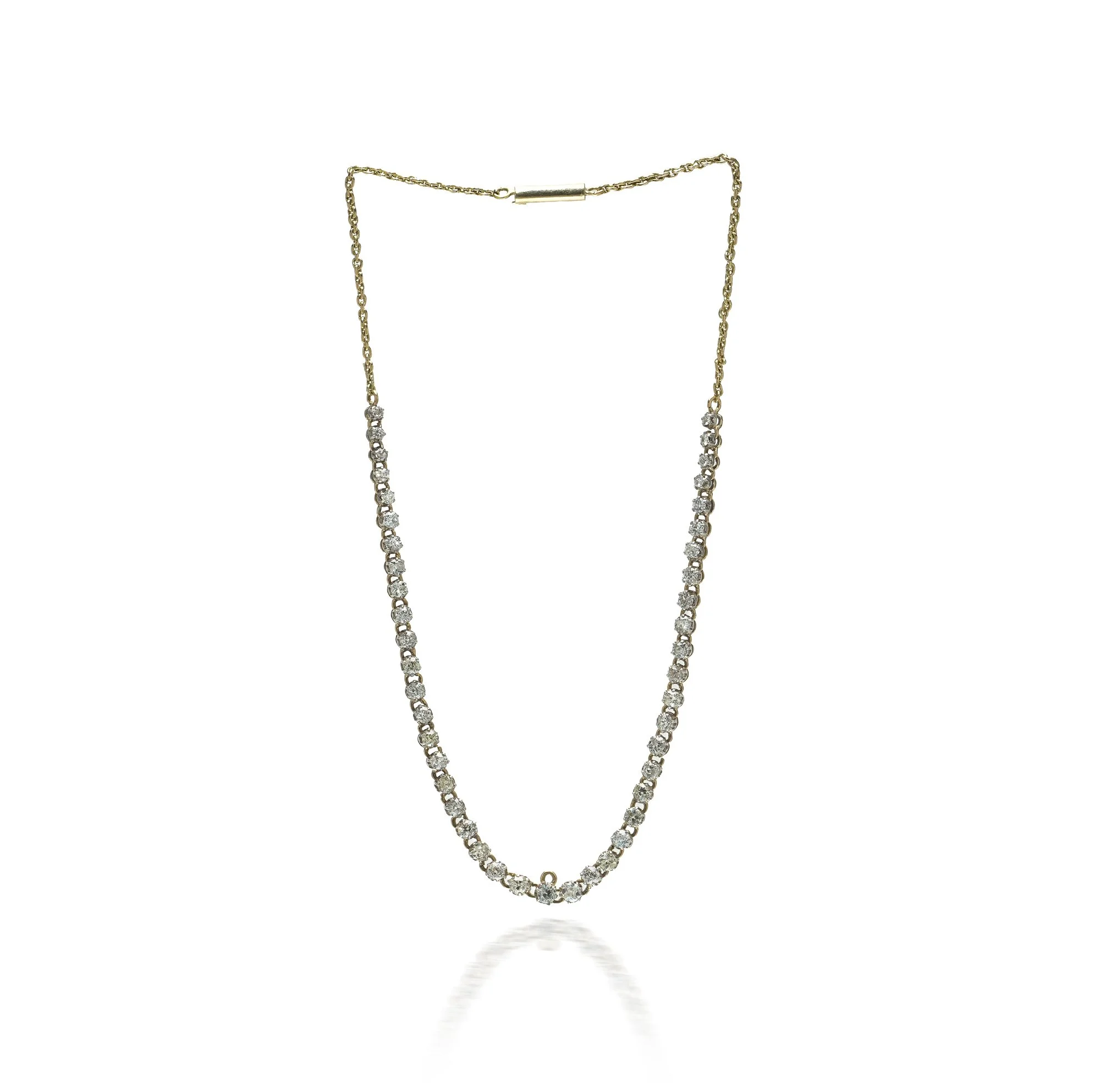
A rivière necklace is a single row of gemstones, each set on its own and joined link to link, so the stones run around the neck like a river; rivière is French for river. The stones are usually all of one kind, either the same size or graduated, getting larger towards the centre front. Rivières appeared in the 1700s and were made through the Georgian, Victorian and Edwardian periods in diamonds, coloured stones and paste. The modern tennis necklace is a close relative.
Shop the pieces: antique and vintage necklaces in our collection.
Have a rivière or antique necklace to sell?
Free, no obligation, returned at our cost if you decline.

- Read our Google reviews (opens Google)
- Free, no obligation
- A reply within one working day
- Paid the same day after inspection
What does rivière mean?
Rivière means river in French. The name describes the way a continuous line of individually set stones flows and catches the light. In English it is often written without the accent, as riviere.

How a rivière necklace is made
- One row. A single line of stones with no pendant or cluster breaking the line.
- Individual settings. Each stone sits in its own collet or claw setting, and the settings are linked so the necklace moves freely.
- Matching stones. The stones are normally all diamonds, or all of one coloured stone such as amethyst, garnet, citrine or topaz.
- Uniform or graduated. Stones may be all one size, or graduated from small at the clasp to larger at the front.
The history of the rivière necklace
- Georgian (1714 to 1837)
- What to expect
- Closed-back collet settings, often foiled; diamonds, coloured stones and paste rivières
- Victorian (1837 to 1901)
- What to expect
- Diamond and coloured-stone rivières in gold and silver; open-backed settings become common later in the period
- Edwardian (1901 to about 1915)
- What to expect
- Fine platinum or platinum-topped settings with diamonds
- 20th century to today
- What to expect
- Modern line and tennis necklaces with small uniform stones
Rivières were worn at court and at evening events, and diamond rivières were often family jewels passed down through generations.
Rivière vs tennis necklace
A rivière and a tennis necklace are both a single line of stones. The rivière is the older form, usually with larger stones in collet settings, often graduated, and often antique. A tennis necklace is a modern design of small, uniform stones in a flexible line.
How to recognise an antique rivière
0 of 5 checked
1Settings
Closed-back foiled collets point to the Georgian period; open-backed collets to later work.
2Cut
Rose, old mine and old European cut diamonds suggest an antique piece.
3Metal
Silver-topped gold is typical of the 1800s; platinum of the Edwardian period and later.
4Clasp
Original box clasps, sometimes set with a stone, and old safety chains.
5Wear
Check for loose stones and worn links before wearing.
Have a rivière or antique necklace to sell? Send clear photographs of the front, the back of the settings and the clasp for a free, honest check.
Free, no obligation, returned at our cost if you decline.
What makes a rivière necklace valuable?
The stones (diamonds or fine coloured stones, their size, colour and clarity), how well they are matched, the cut and period, the metal and settings, the condition, and any original box or provenance. We never publish figures; every piece is different.
Free, no obligation, and returned at our cost if you decline.
Read our Google reviews (opens Google)
- Stones
- Matching
- Cut
- Metal
- Condition
- Provenance
How selling works
- 1
Send photographs
of the necklace laid flat, the back of the settings and the clasp.
- 2
Free value inspection
We reply within one working day with an estimate, subject to inspection. If our offer differs, you can decline and we return it at our cost.
- 3
Paid the same day after inspection
by bank transfer or in cash, in Mayfair, at our Braintree office, by post or by free collection.
Questions people ask
What is a rivière necklace?
A single row of individually set gemstones, uniform or graduated in size, linked so they flow around the neck like a river.
What does rivière mean?
River, in French.
How old are rivière necklaces?
The style appeared in the 1700s and was popular through the Georgian, Victorian and Edwardian periods.
What is the difference between a rivière and a tennis necklace?
Both are a line of stones; the rivière is the older form with larger, often graduated stones in collet settings, while the tennis necklace is a modern line of small uniform stones.
What stones are used in rivière necklaces?
Most often diamonds, and also amethyst, garnet, citrine, topaz and paste.
How do I wear a rivière necklace?
Close to the base of the neck, with an open neckline, on its own so the line of stones shows.
Related guides
Have a rivière necklace to sell?
Send a few photographs and we will tell you what it is and what it is worth, free.
Free, no obligation, returned at our cost if you decline.