The Tiaras at the Oman State Banquet at Windsor Castle
A lover's knot, a Greek key, a Victorian wedding present and a honeysuckle: the stories behind four tiaras worn at Windsor.
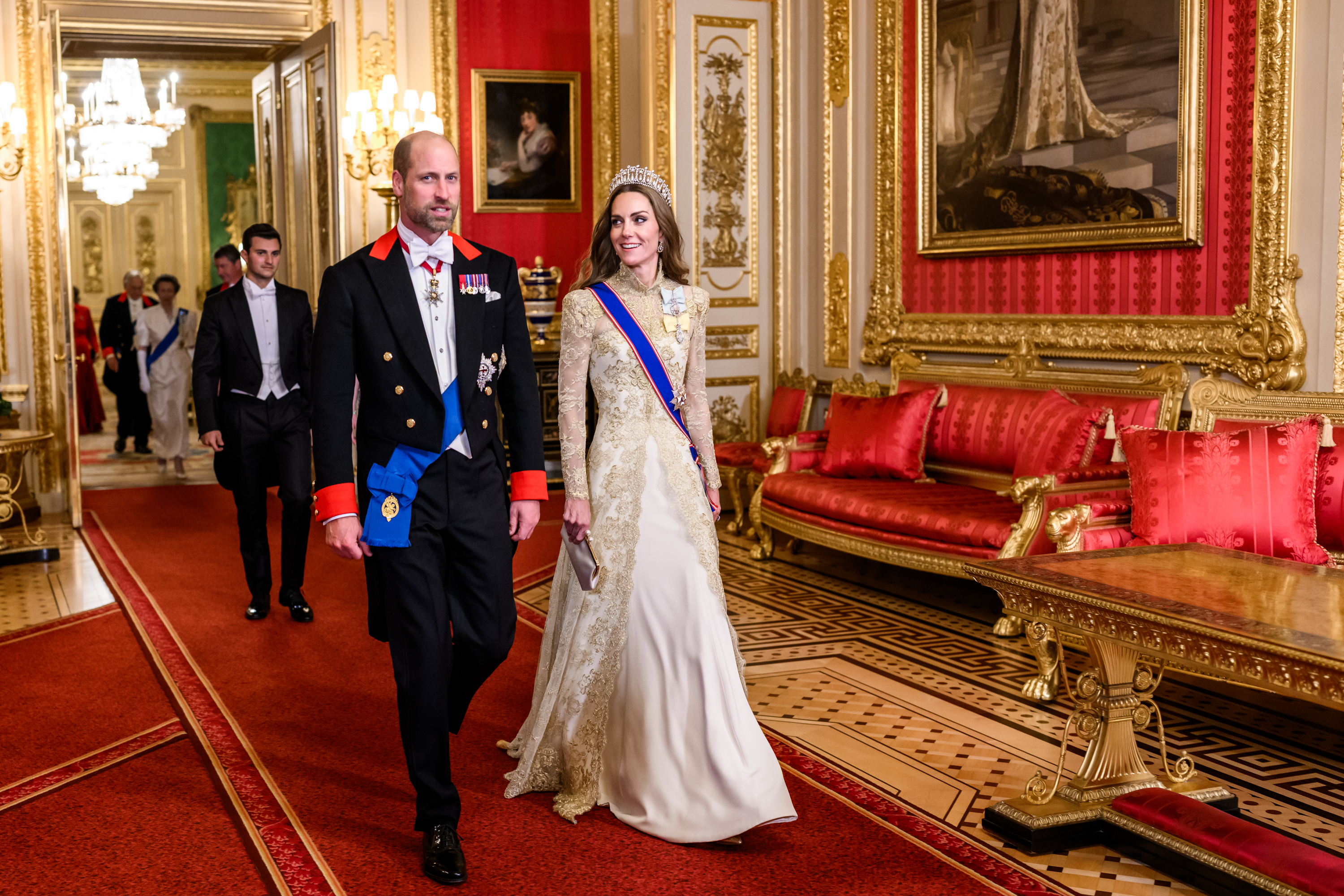
At the state banquet for Sultan Haitham bin Tarik of Oman at Windsor Castle on 20 October 2026, four royal tiaras were worn, according to The Court Jeweller: Queen Camilla in the Girls of Great Britain and Ireland tiara, the Princess of Wales in Queen Mary's Lover's Knot tiara, the Princess Royal in the Meander tiara and the Duchess of Gloucester in the Honeysuckle tiara.
The banquet
On Tuesday 20 October 2026 the King and Queen hosted a state banquet at Windsor Castle for Sultan Haitham bin Tarik of Oman, as reported by HELLO! and The Court Jeweller. Four members of the Royal Family wore tiaras. Here is the background to each.
Queen Mary's Lover's Knot: the Princess of Wales
Garrard made this tiara for Queen Mary in 1913, as a copy of a tiara owned by her grandmother, Princess Augusta, Duchess of Cambridge. It has a row of diamond lover's knots, each with a pearl drop hanging beneath. Diana, Princess of Wales wore it from 1981; it returned to the late Queen after her divorce, and the Princess of Wales first wore it in December 2015, according to The Court Jeweller. It has been her most worn tiara ever since.
The Meander: the Princess Royal
This tiara belonged to Princess Andrew of Greece, Prince Philip's mother, who gave it to Princess Elizabeth as a wedding present in 1947. Its name comes from the meander, the continuous right angled pattern also called the Greek key, combined with a laurel wreath, both classical Greek motifs. HELLO! reports that the late Queen never wore it in public and passed it to Princess Anne, who lent it to her daughter Zara for her wedding in 2011.
Girls of Great Britain and Ireland, and the Honeysuckle
Queen Camilla wore the Girls of Great Britain and Ireland tiara, a wedding present to the future Queen Mary in 1893 and a favourite of Queen Elizabeth II. The Duchess of Gloucester wore Queen Mary's Honeysuckle tiara, set with a pink centre stone and matched with pink jewels.
Bows, knots and Greek keys in antique jewellery
The lover's knot and ribbon bow stand for love and fidelity, and were made in great numbers as brooches, rings and pendants from the eighteenth century onwards. The Greek key belongs to the classical revival, popular in Victorian gold jewellery and again in the twentieth century. With pieces like these, interest depends on the period, the quality and cut of the stones, the workmanship, and whether a piece is original or later altered. We value antique tiaras, bows and brooches free from photographs.
More from Mozeris News
- The Prince of Wales Feathers Brooch: The 1863 Emerald Jewel Worn by Diana, Camilla and Catherine
- Queen Camilla Wears Her Diamond Leek Brooch at the Senedd Opening
- Queen Mary of Denmark Debuts Queen Alexandrine's Sapphire Tiara, Redesigned
- Meghan's Engagement Ring: The Story Behind the Three Stone Design
Looking to buy or sell? Get in touch
We buy and sell antique and vintage jewellery, watches, silver and collectables, with free valuations and free insured collection.
About Mozeris Fine Antiques
Mozeris Fine Antiques is a dealer in fine jewellery, watches and silver, with offices in Mayfair, London, and Braintree, Essex. We buy and sell, and offer free valuations. Visits are by appointment.
- The Court Jeweller, "Four royal tiaras sparkle at Windsor Castle for the Omani state banquet", 20 Oct 2026
- HELLO!, Princess Anne's Meander tiara at the Oman state banquet, 20 Oct 2026
- The Court Jeweller, "Kate wears the Lover's Knot tiara", Dec 2015
- The Royal Watcher, "Royal tiaras at the Oman state banquet at Windsor Castle", 21 Oct 2026
Mozeris Fine Antiques is not connected with the Royal Household or Garrard. No press, agency or AI images are used; the photograph shows a piece from our own stock.