Russian silver hallmarks
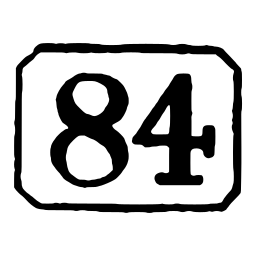
910 marks in our databaseRussian silver states its purity in zolotniks: 84 means 84 parts of silver in 96, close to 875 in 1,000. Before 1896 a piece carries a town mark, the assay master's initials and often the year; from 1896 to 1917 a woman's head in a kokoshnik headdress replaced the town mark.
Russian silver is marked in zolotniks, an old Russian unit: 84 means 875 parts of silver in 1000, 88 means 916 and 91 means 947. Alongside the standard you will usually find a town mark, the assay master's initials and year, and the maker's initials in Cyrillic. From the late 1890s to 1917 the standard sat beside the kokoshnik, a woman's head in a traditional headdress.
How to read Russian marks
- Standards
- Purity is stated in zolotniks out of 96: 84 is about 875 in 1,000, 88 about 916 and 91 about 947.
- Town marks
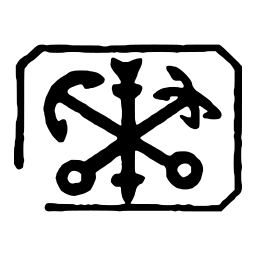
- Each town had its own mark, such as the crossed anchors and sceptre of St Petersburg.
- Assay master
- Before 1896 the assay master's initials and the year were struck with the standard and town mark.
- Kokoshnik
- From 1896 to 1917 a woman's head in a kokoshnik headdress replaced the town mark, with the standard in zolotniks.
- Maker's mark
- The maker's initials, usually in Cyrillic, in a separate punch.
A note from our specialists
The number 84 does not always mean Russian silver. We regularly see 84 on Persian silver, where it follows the Russian zolotnik standard but the piece was made in Iran and carries no Russian town or assay master's mark. On genuine Russian pieces, check that the standard, the town mark, the assay master and the maker all agree in date: mismatched punches are a warning sign.
Faustas Svencionis, Mozeris Fine Antiques
We hold 910 Russian marks for photo matching
Our identifier compares your photo with every Russian mark we hold, then reads the town, the standard, the date and the maker. Free, with the result on screen and by email.
Records you can browse
Questions
What does 84 mean on Russian silver?
84 zolotniks out of 96, which is about 875 parts of silver in 1,000, the most common Russian standard.
When was the kokoshnik mark used?
From 1896 to 1917. It shows a woman's head in a kokoshnik headdress, with the standard in zolotniks.
What does 84 mean on Russian silver?
84 zolotniks, a standard of 875 parts of silver in 1000. It is the most common Russian silver standard.
What is the kokoshnik mark?
The Russian assay mark from the late 1890s to 1917: a woman's head in a kokoshnik headdress, struck beside the standard number.
Thinking of selling?
Send a few photos of the piece and its marks, and a specialist will value it, free and with no obligation.