How to Tell if a Fabergé Egg Is Real
The 50 Imperial eggs and where they are, the scrap dealer who nearly melted one, how to read Fabergé and Russian marks, how modern pieces are marked, and the red flags of a fake.
How do you tell if a Fabergé egg is real?
- Only 50 Imperial eggs were made, and 43 are accounted for, so an egg found today is almost always modern, decorative or fake.
- Genuine Imperial-era Fabergé carries the firm's mark in Cyrillic, often a workmaster's initials, and a Russian assay mark with a standard in zolotniks.
- Modern licensed Fabergé is real and marked in Latin letters, with an edition number such as 3/25 and 750 for 18ct gold.
- Marks that disagree with the metal or the date, printed-looking enamel and stories with no paperwork are the main red flags.
In this article
Is it an Imperial egg? Almost certainly not
Fifty eggs, and we know where most are
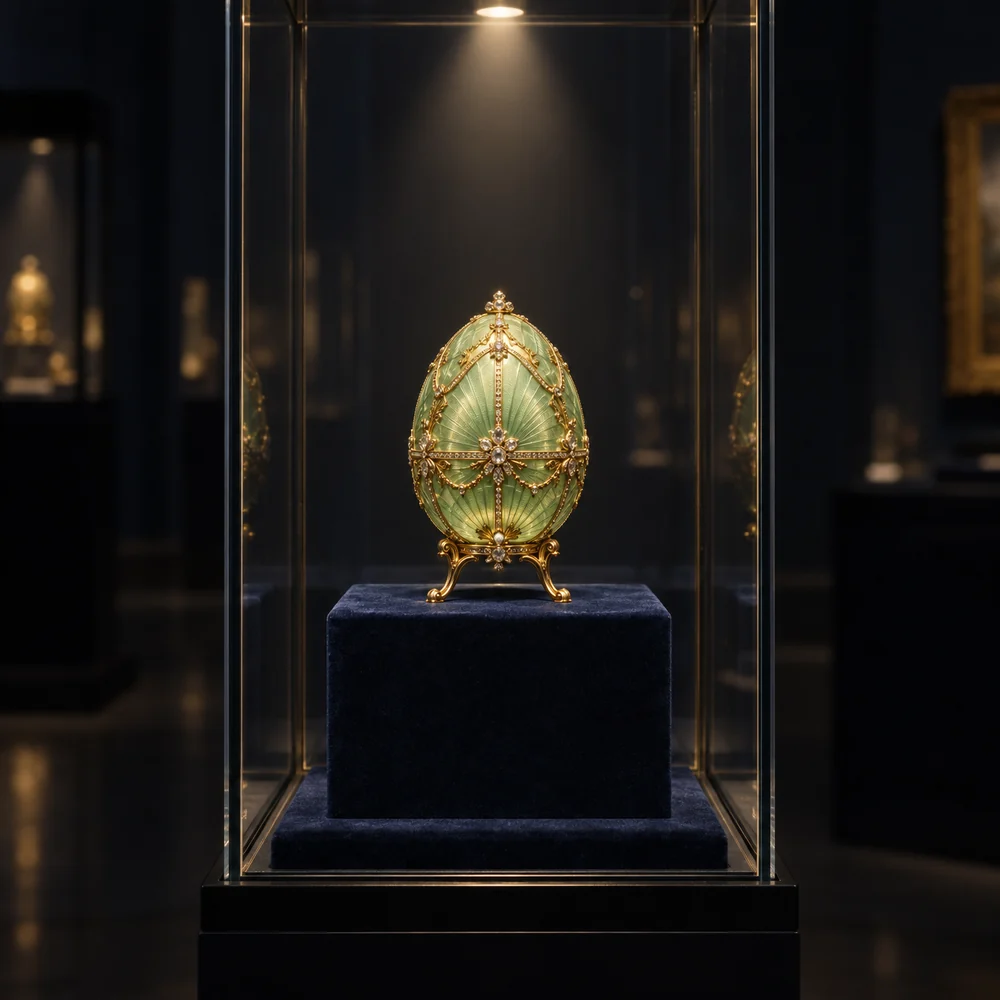
Fabergé made 50 Imperial Easter eggs for the last two Tsars, Alexander III and Nicholas II, between 1885 and 1916. Two more, planned for 1917, were never delivered.
The first, the Hen Egg, cost 4,151 roubles. After the 2014 rediscovery below, 43 were accounted for and seven were still missing.
Source: Wikipedia, Fabergé egg; Apollo Magazine.
10 Imperial eggs
9, bought by Viktor Vekselberg from the Forbes collection
5
3
Nearly all the rest are in other museums and known private collections. Fabergé also made a short series for the industrialist Alexander Kelch, of which seven appear to have been completed.
An egg that turns up in a house clearance, an online auction or a family cabinet is almost always a modern Fabergé piece made under licence, a decorative egg in the Fabergé style, or a fake. None of those is a bad thing to own. The problem only starts when it is sold as Imperial.
The egg that nearly went into the melting pot
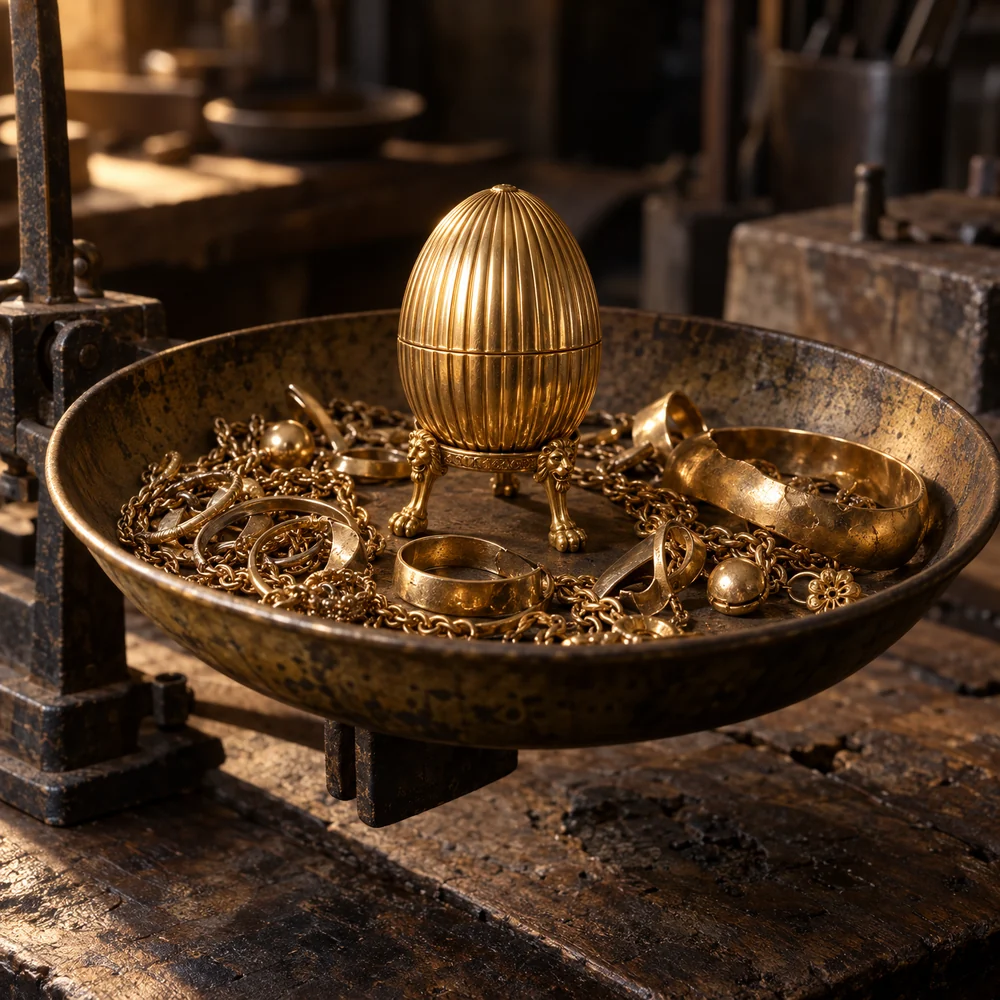
In about 2004 a scrap metal dealer in the American Midwest paid $13,302 for a small gold egg on a stand, with a watch inside, planning to sell it for its gold.
In 2012 he typed "egg" and "Vacheron Constantin", the name on the watch, into Google and found a 2011 Telegraph article about a lost Fabergé egg. The picture matched.
Source: Wikipedia, Third Imperial Egg.
It was the Third Imperial Egg, given by Alexander III to his wife Maria Feodorovna at Easter 1887. It was listed in a Soviet inventory in 1922, then sold at Parke-Bernet in New York in 1964 for $2,450, catalogued only as a gold watch in an egg-shaped case. Kieran McCarthy of Wartski identified it, Wartski bought it for a private collector, and it went on show in London for four days in April 2014.
"A Conan-Doyle story on speed." Kieran McCarthy of Wartski, speaking to Apollo Magazine
Others are still out there. The Nécessaire Egg of 1889 was last recorded at Wartski on 19 June 1952, sold for £1,250 to a buyer the firm's records name only as "A Stranger" (Wikipedia). The missing eggs also include the Hen with Sapphire Pendant of 1886, the Cherub with Chariot of 1888, the Royal Danish of 1903 and the Alexander III Commemorative of 1909.
How to read genuine Fabergé and Russian marks
Russian gold and silver was assayed and marked by the state, so genuine Fabergé carries several small marks. A loupe and a strong light are all you need. Read them in this order:
Find the marks, struck together
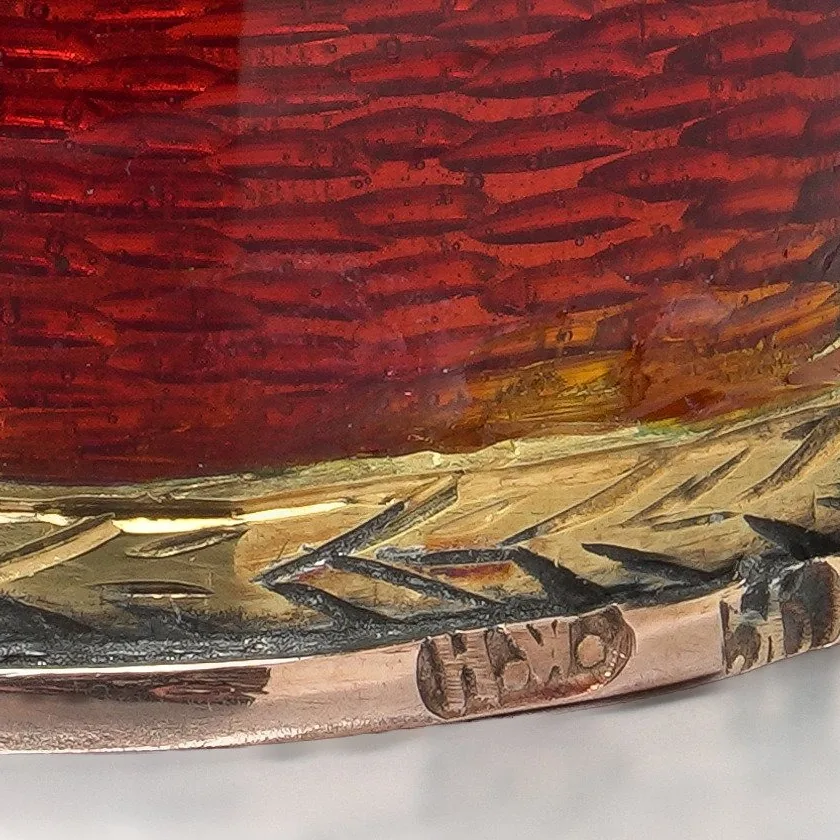
They are usually struck together on a rim, a base or a clasp. What they should say depends on where the piece was made or sold:
| Where it was made or sold | What to expect |
|---|---|
| St Petersburg | The firm's mark in Cyrillic, with the workmaster's initials beside it |
| Moscow | К.ФАБЕРЖЕ in Cyrillic under the double-headed eagle of the Imperial Warrant, without workmaster's initials |
| Small pieces | Often just КФ in Cyrillic |
| Made for export | FABERGÉ or CF in Latin letters |
| Sold in London, 1903 to 1917 | Russian marks plus British import hallmarks. In 1908 British customs stopped a parcel, and in 1910 Fabergé lost a High Court case and had to have London stock hallmarked |
Source: silvercollection.it, Fabergé marks; London branch: History Hit.
Look for the workmaster's initials
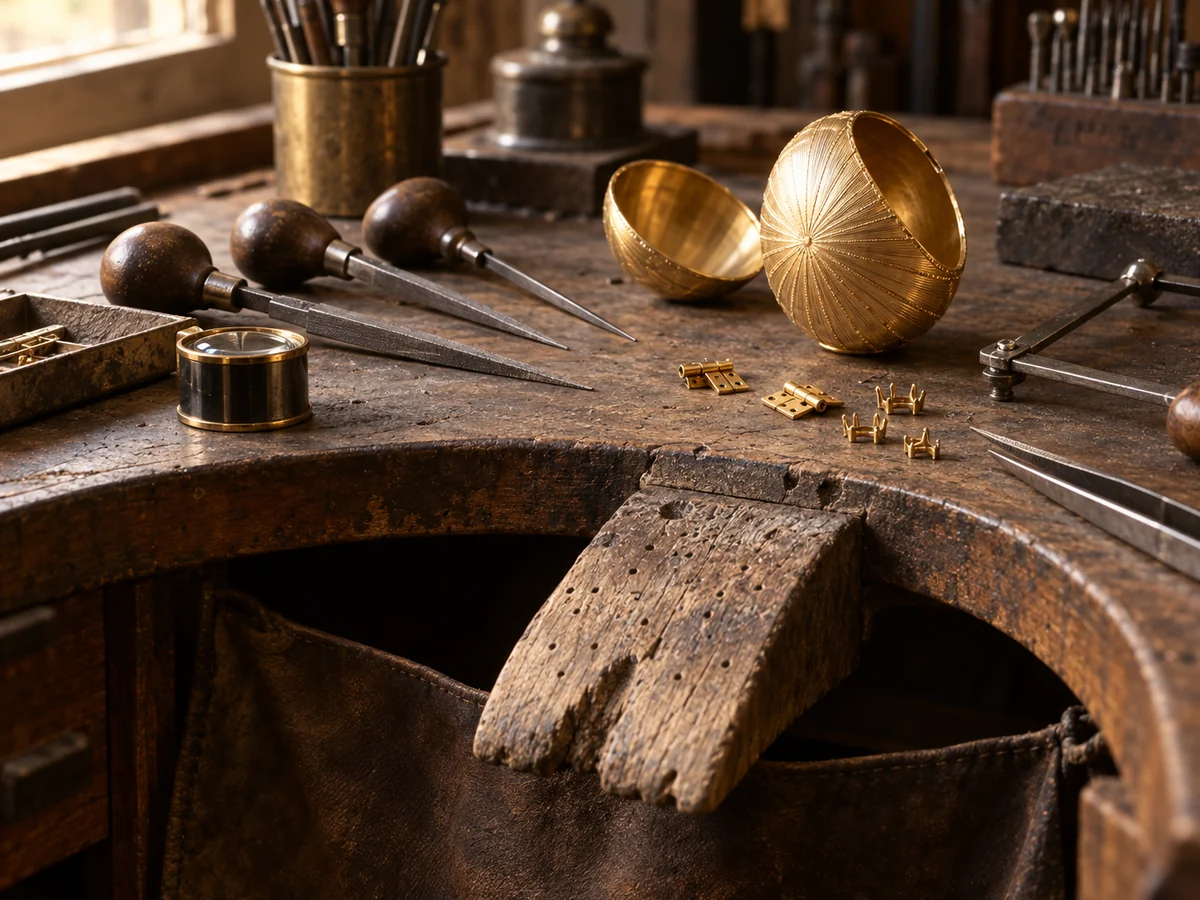
Fabergé did not run one workshop but many, each under a workmaster who struck his own initials beside the firm's mark. The head workmasters made the Imperial eggs.
| Workmaster | Mark | Known for |
|---|---|---|
| Erik Kollin | EK | Head workmaster until 1886 |
| Michael Perchin | MP in Cyrillic | The Imperial eggs from about 1886 until his death in 1903 |
| Henrik Wigström | HW | Head workmaster from 1903: every signed egg after 1903 bears HW |
| August Holmström, then his son Albert | AH | The firm's chief jeweller from 1857 |
| August Hollming | A*H, with a star | A St Petersburg workmaster; the star sets his mark apart |
Source: Wikipedia, Fabergé workmaster.
Read the mark, not the label
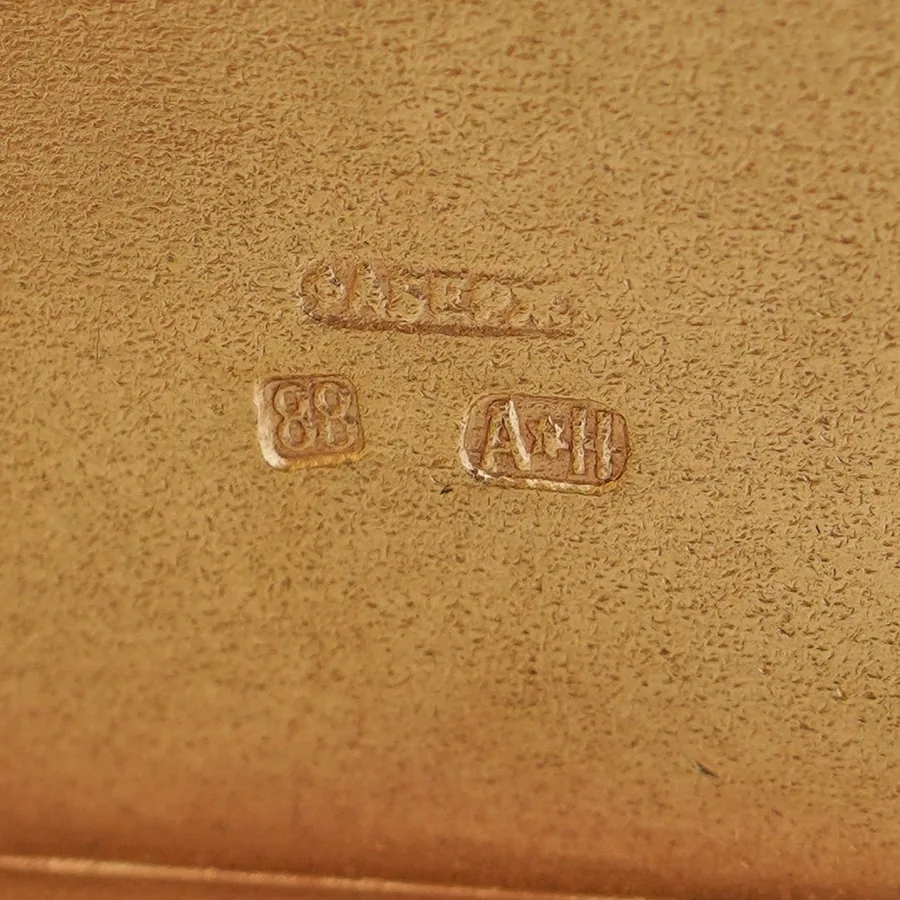
This case carries the firm's mark ФАБЕРЖЕ in Cyrillic, the standard 88 zolotniks (916 silver) and the workmaster's A*H. Look between the A and the H: there is a small star.
August Hollming of St Petersburg struck A*H; August Holmström and his son struck AH, with nothing between the letters. Cases like this are often catalogued under the wrong name, so read the punch itself (Pushkin Antiques).
Date it by the kokoshnik
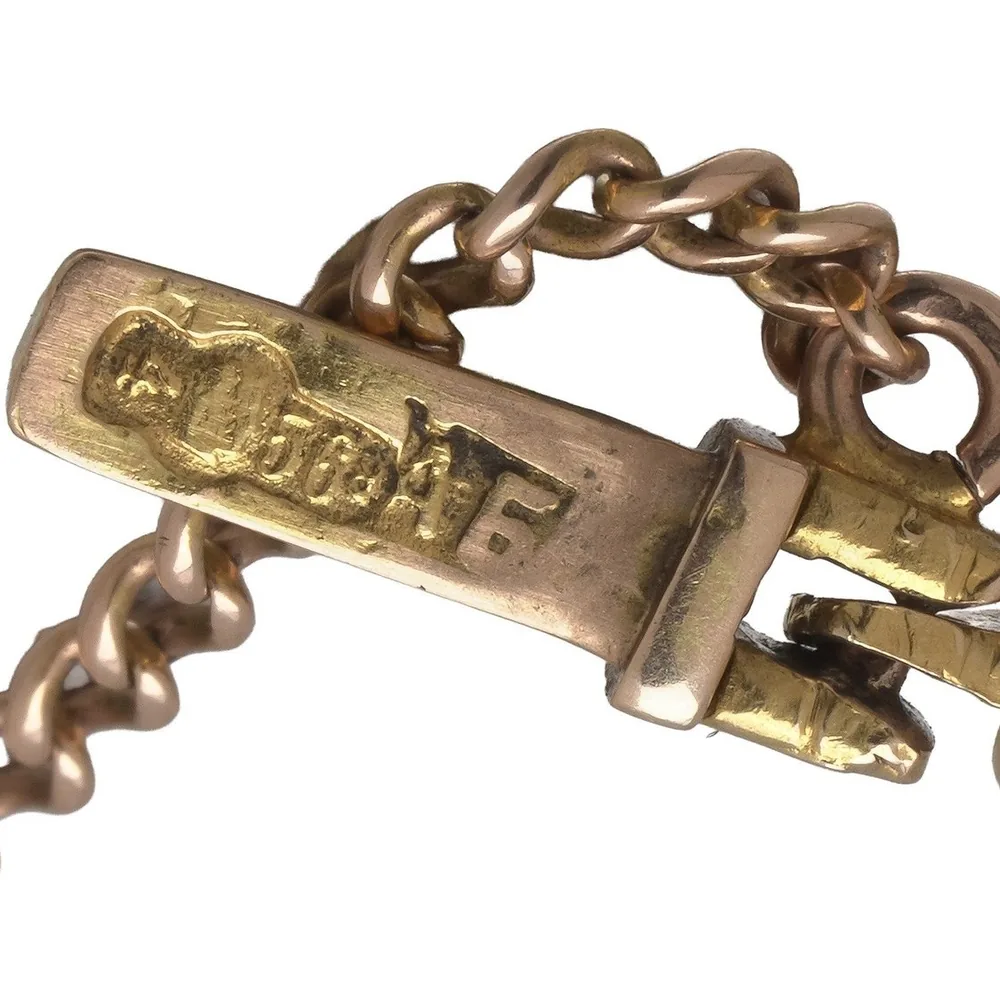
The assay mark dates the metal, and it is the part of a Russian mark forgers most often get wrong. The kokoshnik, a woman's head in a traditional headdress, was decreed in 1896:
- Before 1899: the city's arms, the assay master's initials and the year.
- 1899 to 1908: the kokoshnik facing left, with the assayer's initials.
- 1908 to 1917: facing right, with a Greek letter for the assay office.
The number beside it is the purity in zolotniks, out of 96. On this bracelet in our collection the gold standard 56 sits on gold, as it should; an 84 or 88 on a piece sold as gold is a silver mark, and a warning.
| Standard | Metal | Modern equivalent |
|---|---|---|
| 84 | Silver | 875 |
| 88 | Silver | 916 |
| 91 | Silver | 947 |
| 56 | Gold | 583, or 14ct |
| 72 | Gold | 750, or 18ct |
Send us photos of the marks
Modern Fabergé: genuine, licensed and not Imperial
The Bolsheviks closed the St Petersburg firm in 1918 and Carl Fabergé died in Lausanne in 1920. The name lived on, which is why so many eggs are signed Fabergé today.
| Year | What happened to the name |
|---|---|
| 1937 | Samuel Rubin founded Fabergé Inc. for perfume, without the family's permission; a 1951 settlement let him use the name for perfume |
| 1985 | Theo Fabergé, Carl's grandson, launched the St Petersburg Collection; his daughter Sarah's first designs followed in 1994 |
| 1989 | Unilever bought Fabergé Inc.; Victor Mayer of Pforzheim made Fabergé jewellery and eggs under licence from 1989 to 2009 |
| 2007 and 2013 | Pallinghurst bought the trademarks, then the gem miner Gemfields bought the company |
| 2025 | Gemfields sold Fabergé to SMG Capital for $50 million |
Source: House of Fabergé, Victor Mayer, Theo Fabergé, Engineering News, August 2025.
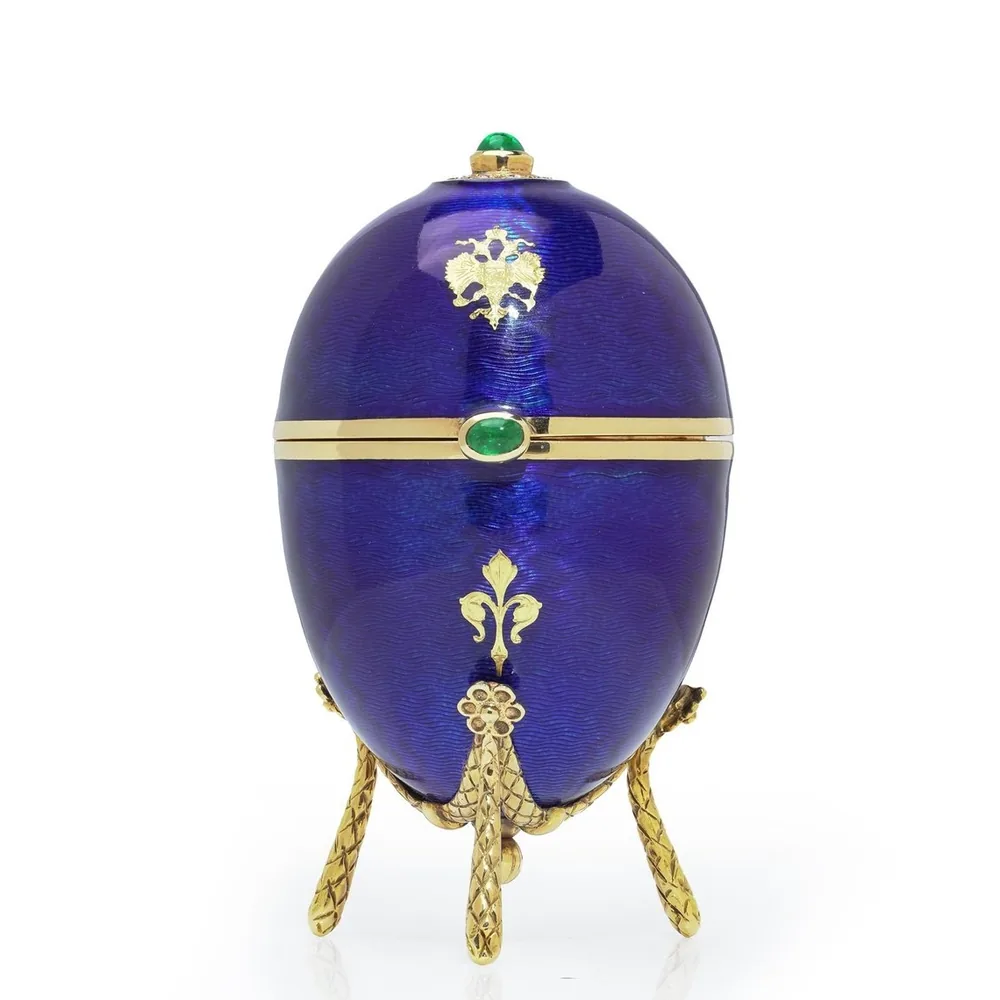
How modern pieces are marked
Like any modern jewellery: FABERGÉ or the designer's initials in Latin letters, an edition number such as 3/25, and a standard mark such as 750 for 18ct gold, often with a national hallmark.
This blue egg in our collection is marked 750, Fabergé and 6/25: genuine Fabergé, but not Imperial.
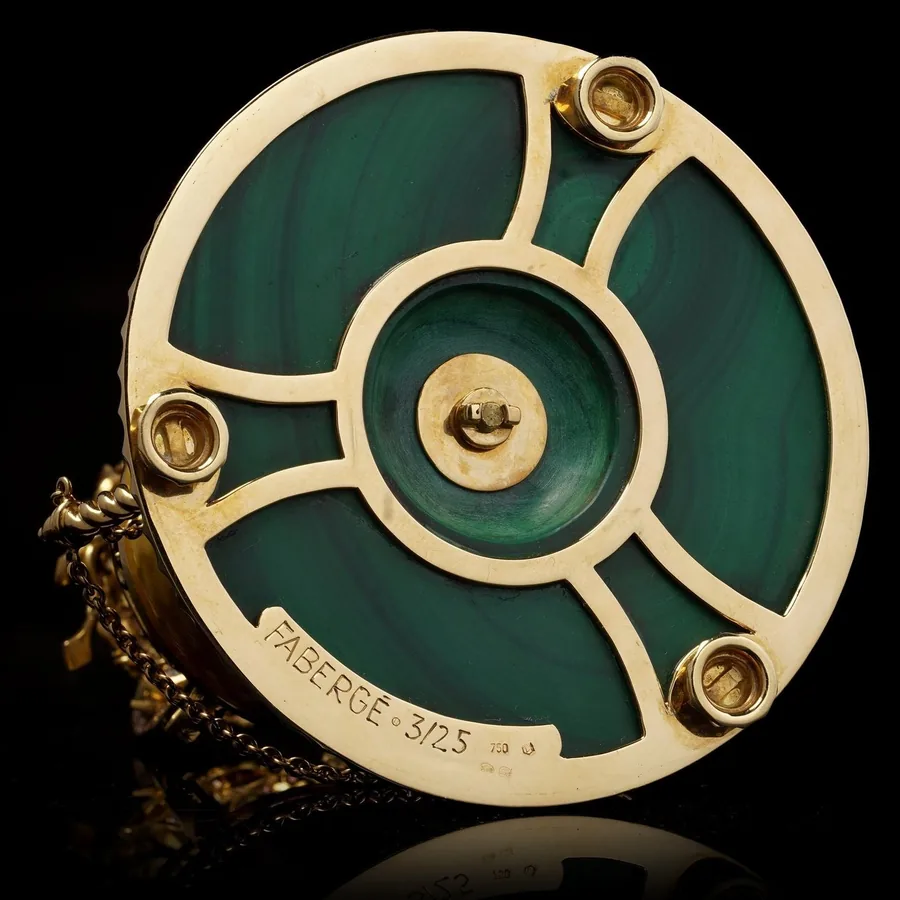
Victor Mayer, number 3 of 25
The elephant egg Victor Mayer made under licence has its malachite base engraved FABERGÉ 3/25 beside the gold marks: a name in Latin letters and an edition number, exactly what a licensed piece should carry.
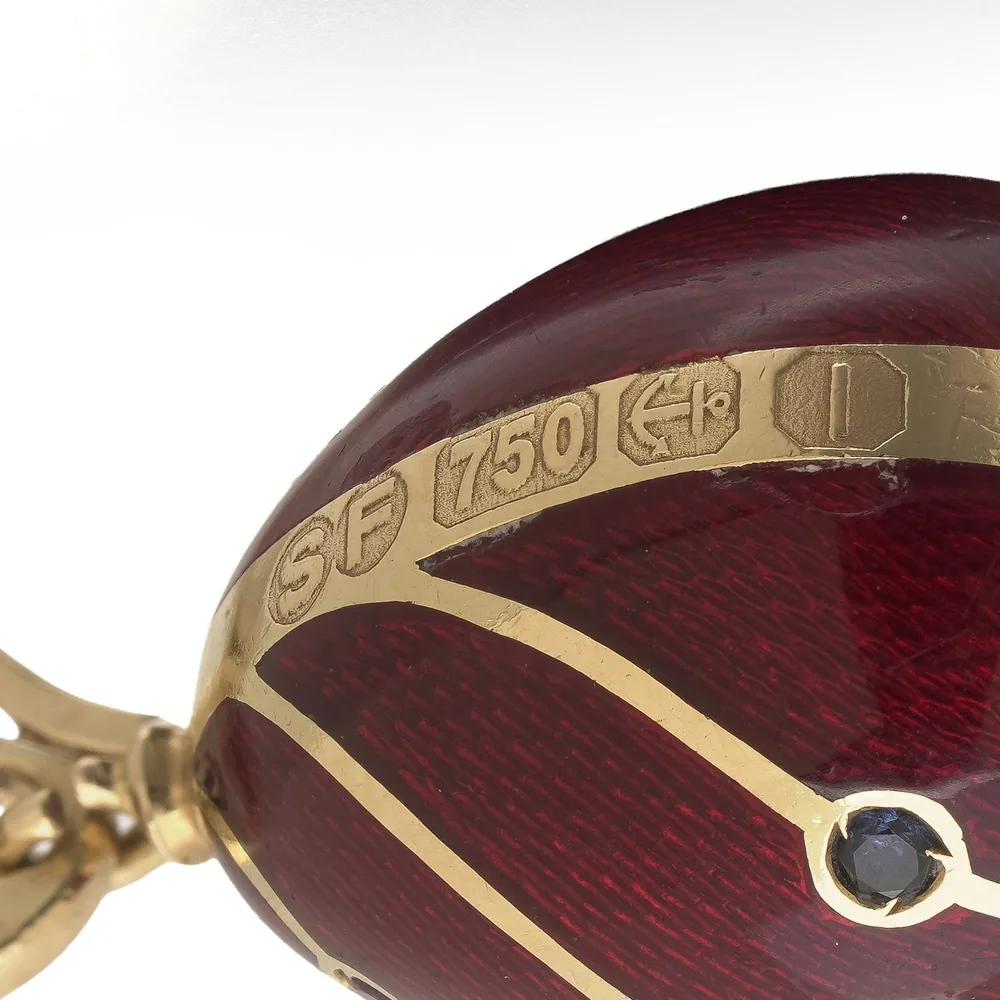
Sarah Fabergé, 2010
Sarah Fabergé's egg pendant in 18ct gold and red enamel, from an edition of 500, carries SF, 750 and the Birmingham anchor: British hallmarks for 2010.
The Sarah Fabergé pendant is in our collection. See also our Fabergé jewellery guide.
Red flags: how fakes give themselves away
Imitations were made in such numbers during the 20th century that the trade has a word for them: "Fauxbergé", Wikipedia notes. These are the signs we look for first.
Enamel that is painted, not engine-turned
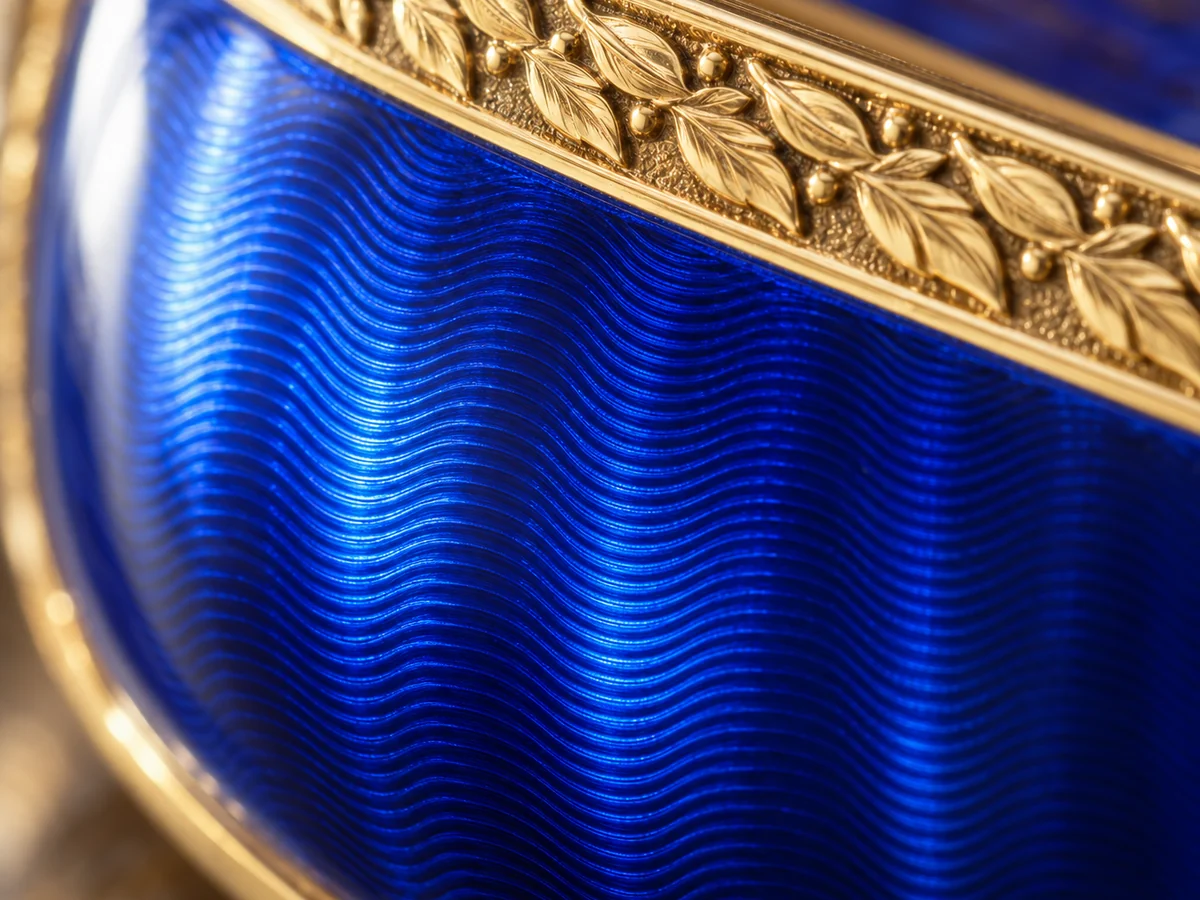
True guilloché is engine-turned metal seen through translucent enamel: the pattern is cut into the gold or silver, so it sits under the colour, crisp and even. Opaque enamel, or a pattern that looks printed on top, is a warning. More on enamelling techniques and niello.
Glued stones, gilt base metal, a light feel
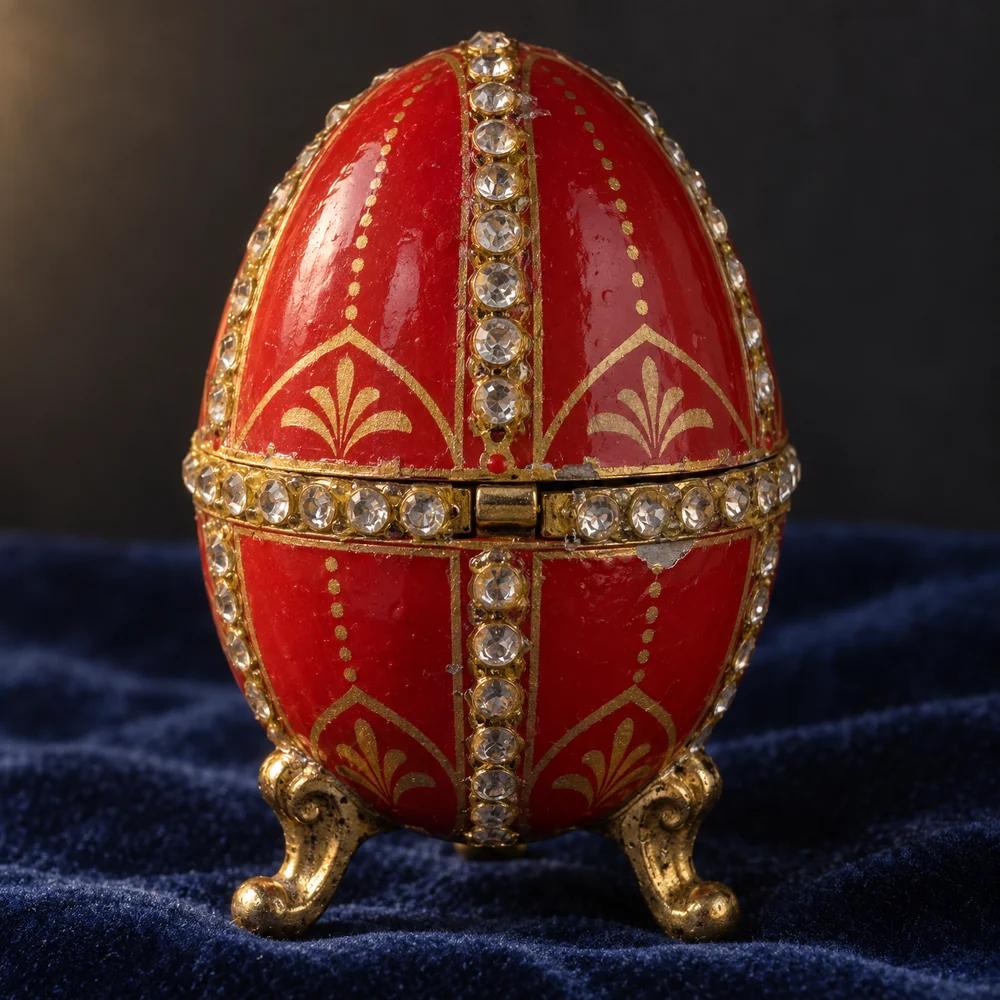
Stones glued into cups, gilding wearing off a grey or brassy metal, rough mould seams. Gold and silver are heavy, so a gilded base-metal copy feels light in the hand.
A story with no paper
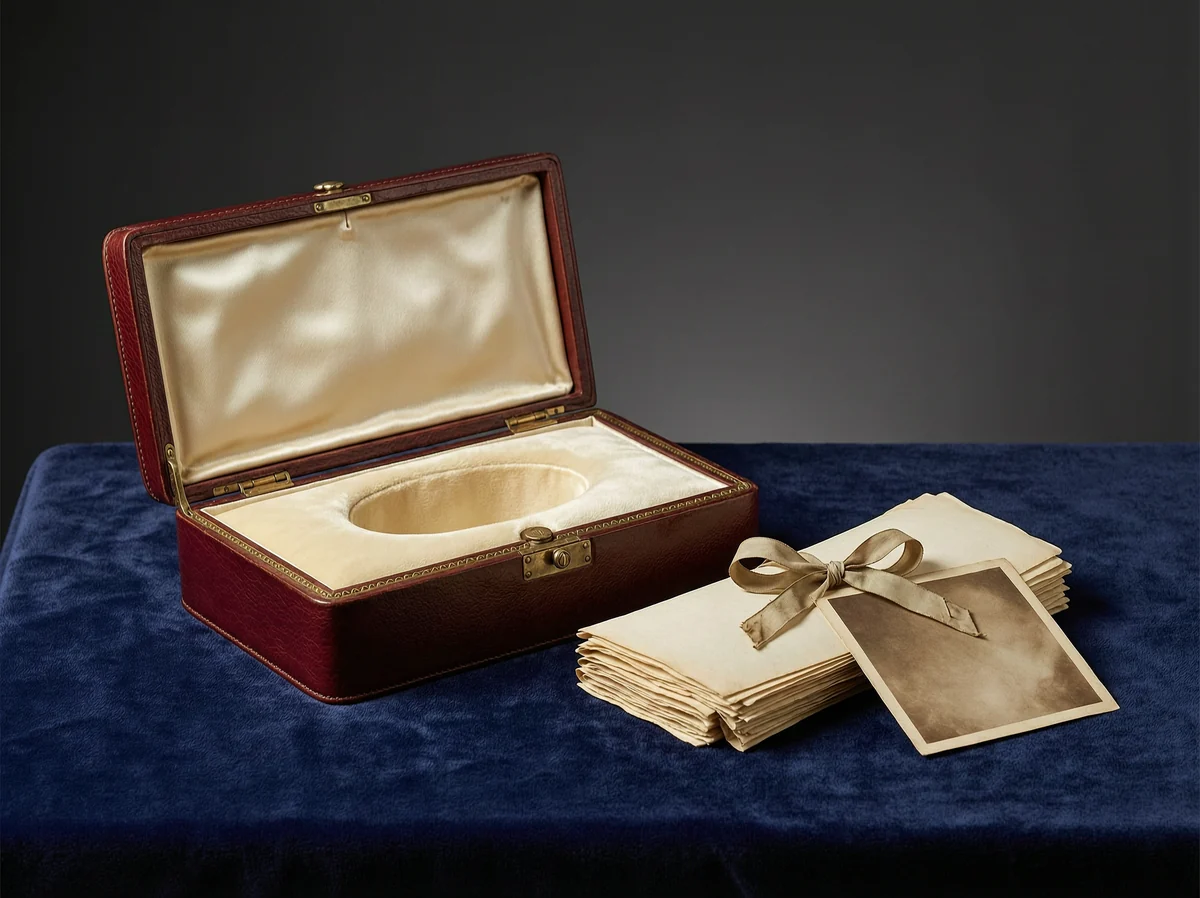
"From a Russian princess" is not provenance. The Third Imperial Egg was proved by its paper trail: an archive photograph, the 1922 inventory and the 1964 sale catalogue. Without documents, even a real piece is hard to prove, so keep invoices, old photographs, insurance lists, auction receipts and the fitted case together.
Marks that disagree
| What you see | Why it matters |
|---|---|
| Marks that are crisp and deep on a worn piece | Genuine punches wear with the surface around them |
| Marks on a cast or rough surface, or struck crooked | Real marks were struck on finished metal |
| A kokoshnik facing the wrong way for the date | Left until 1908, right after |
| A silver standard on gold, or a metric 925 on a piece called Imperial | Imperial Russia used zolotniks: 84, 88, 91 for silver |
| Imperial eagles, crowns and Romanov monograms everywhere | Real pieces wear their marks small and discreet |
Your seven-step checklist
- Look for the marks
Rims, bases, clasps and hinges. No marks at all on gold or silver is a warning.
- Read each one
Firm's mark, workmaster, assay mark and standard. Do they agree with each other?
- Check the metal
A gold standard on gold, a silver standard on silver.
- Look at the enamel
Translucent colour over an even engine-turned pattern, with no bubbles or repainting.
- Weigh and measure
Gold and silver are heavy: a gilded base-metal copy feels light.
- Gather the paper
Invoices, old photographs, insurance lists, auction receipts, the fitted case.
- Ask a specialist
Before you insure it, sell it or turn down an offer.
When to get expert help, and how we can help
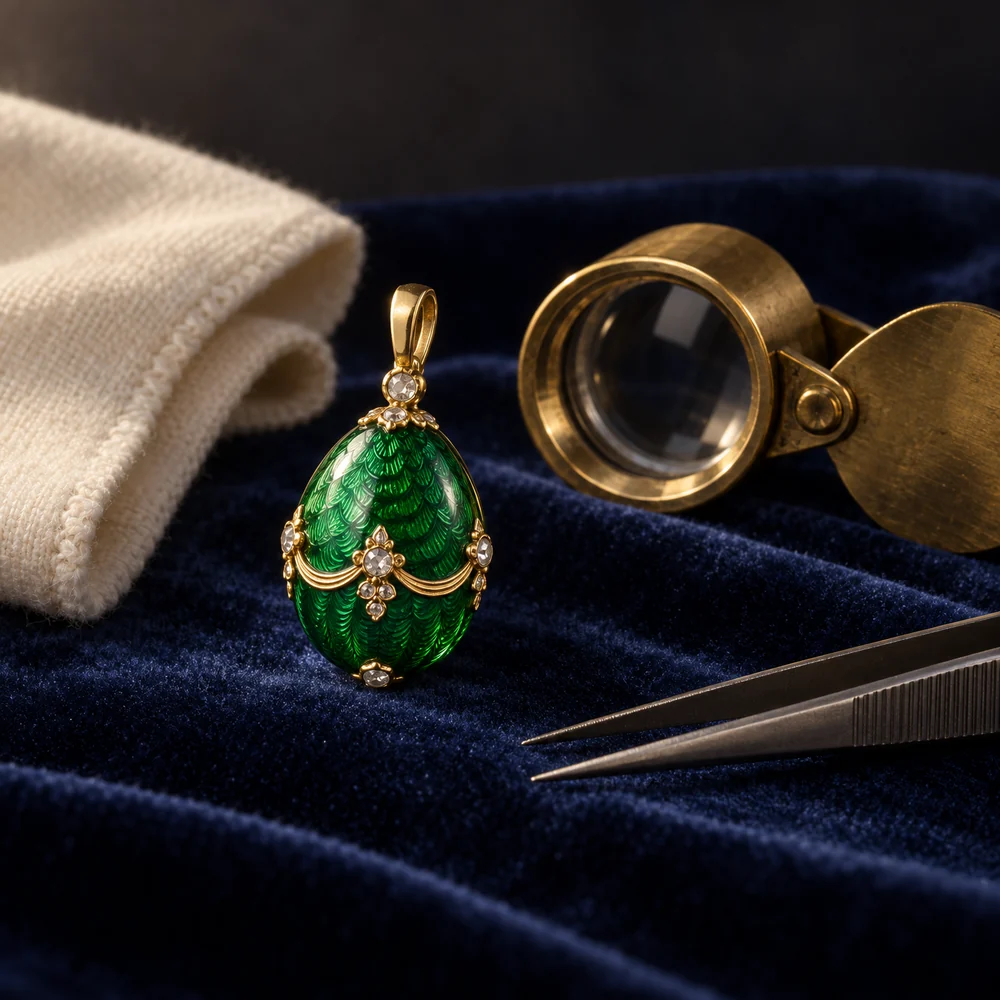
Ask before you sell
Get help as soon as a piece has Russian marks, the Fabergé name, or a family story attached. The specialists include Wartski, who identified the Third Imperial Egg, and the Russian departments of the big auction houses.
We value and buy Russian gold, silver and enamel, and modern Fabergé, directly. Send clear photos of the whole piece and close-ups of every mark, and we will tell you what you have and what it is worth, without obligation.
Do not polish it first: polishing softens marks and enamel. More on hallmarks and makers' marks, reading silver hallmarks and selling to a dealer or at auction.
Request a free valuation
- There are 50 Imperial eggs and 43 are accounted for: yours is very probably modern, decorative or fake.
- Real Imperial-era marks are Cyrillic, small and consistent: firm, workmaster, kokoshnik and zolotnik standard.
- Modern licensed Fabergé is genuine and marked in Latin letters with an edition number.
- Paperwork proves a piece. Do not polish it, and ask a specialist before you sell.
Questions we are asked
How can I tell if my Fabergé egg is real?
Read the marks under a loupe: the firm's name in Cyrillic, a workmaster's initials on St Petersburg pieces, and a Russian assay mark with a standard in zolotniks. Check they agree with each other and with the metal, look at the enamel, and gather any paperwork. Modern licensed eggs are marked in Latin letters with an edition number.
How many real Fabergé Imperial eggs are there?
Fabergé made 50 Imperial Easter eggs for the Tsars between 1885 and 1916. After the Third Imperial Egg was rediscovered in 2014, 43 were accounted for and seven were still missing.
Which Fabergé eggs are missing?
They include the Hen with Sapphire Pendant of 1886, the Cherub with Chariot of 1888, the Nécessaire of 1889, last sold by Wartski in 1952, the Royal Danish of 1903 and the Alexander III Commemorative of 1909.
What does the kokoshnik mark mean?
It is the Russian state assay mark used from 1899 to 1917: a woman's head in a traditional headdress. It faces left until 1908 and right afterwards, beside a number giving the purity in zolotniks, such as 84 or 88 for silver and 56 or 72 for gold.
Are Victor Mayer Fabergé eggs real Fabergé?
They are genuine licensed Fabergé, made in Pforzheim between 1989 and 2009 and marked in Latin letters with edition numbers. They are modern pieces, not Imperial eggs, and are valued as such.
What were the Fabergé workmasters?
The heads of the separate workshops that made Fabergé's work. In St Petersburg each struck his initials beside the firm's mark: MP for Michael Perchin, HW for Henrik Wigström, A*H for August Hollming.
Is an egg marked Fabergé in English letters fake?
Not necessarily. Pieces made for export were marked FABERGÉ in Latin letters, and modern licensed pieces are too. The rest of the marks, the quality and the history decide it.
Where can I get a Fabergé piece authenticated?
A Fabergé specialist such as Wartski, the Russian department of a major auction house, or a dealer who handles Russian works of art. We give free valuations from photos of the piece and its marks.
Want to know what you have?
Send photos of the piece and every mark. We value and buy Russian gold, silver and enamel and modern Fabergé directly, and the valuation is free.
- We buy directly
- Free valuation from photos
- Appointments in Mayfair and Braintree
- Insured postage or collection
New pieces reach our list first: join the Mozeris list.